
13F dates in October 2026: June holdings and the Q3 deadline
Original Q2 filings and current SEC guidance explain holdings dates, filing dates, the Q3 deadline and what an October 13F observation can establish.
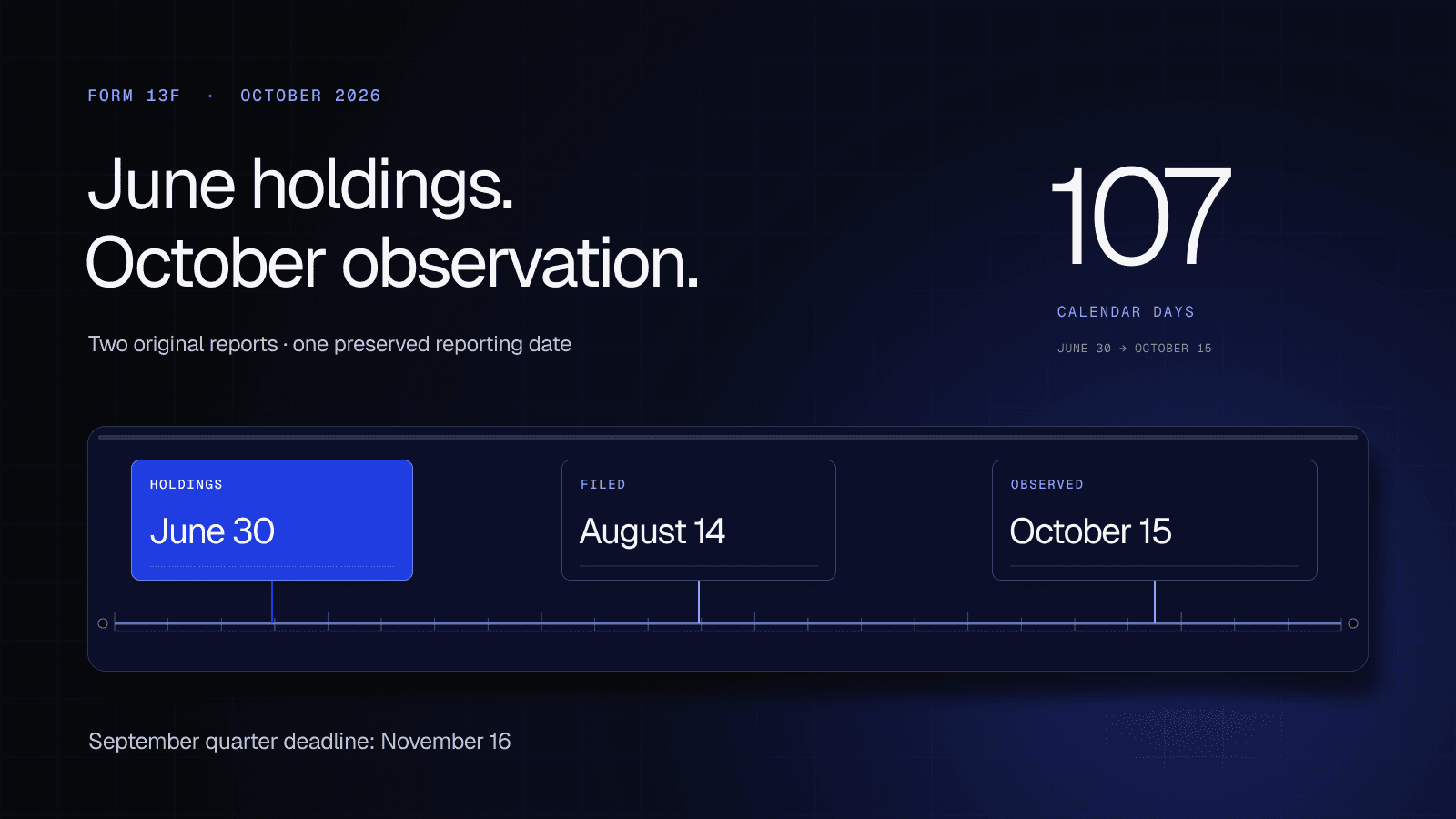
A June 30, 2026 holdings snapshot is 107 days old on October 15, even when its Form 13F was downloaded this morning. Berkshire Hathaway and Bridgewater Associates both filed their reviewed June-quarter reports on August 14. Their filing dates place the disclosures in Q3; their reporting dates place the holdings in Q2.
That difference determines which portfolios can be compared. It also separates a newly observed document from a new investment decision. As of October 15, June 30 is the latest 2026 quarter-end whose normal filing deadline has passed. The SEC's calendar sets November 16 as the deadline for the September quarter.
Two managers, the same reporting period
The original reports give a straightforward matched-period comparison:
- Berkshire Hathaway: accession 0001193125-26-352200, filed August 14, 2026, for the quarter ended June 30. The cover page identifies an original 13F-HR, with the amendment flag set to false.
- Bridgewater Associates: accession 0001350694-26-000003, also filed August 14 for June 30, and also marked as an original report.
These documents can be placed in the same reporting-period analysis. Calling one an August portfolio and the other a June portfolio would create an artificial difference from identical date fields. Calling either a September-quarter portfolio would move its measurement date by three months.
The accession identifies the particular submission being used. Keeping it alongside the manager and quarter makes a later correction distinguishable from a new reporting period. It also lets another analyst locate the same disclosure rather than rely on a changing label such as "latest holdings."
Filing lag and observation age answer different questions
There are 45 calendar days between June 30 and August 14. That measures the interval between the reported quarter-end and the two original filing dates. There are another 62 days between August 14 and October 15. Together, they produce the 107-day age of the holdings observation on October 15.
The first interval explains when the information became public in these reports. The second explains how much additional time had passed before the research date. Neither is a calculation of portfolio turnover or a measure of how far a manager's current holdings have diverged from the disclosure.
This distinction matters when comparing screens assembled on different days. A dataset refreshed in October may contain the same June-quarter observations that were available in August. Refreshing the document or its metadata improves access; it does not refresh the underlying holdings date.
A dated holdings display should make the reporting quarter prominent and retain the filing date and observation date separately. A reader can then see both the period represented and the age of the evidence. "Updated today" is an inadequate substitute for either.
Use the period to choose the comparison
For a cross-manager comparison, start with the quarter each report actually covers. A Q2 observation for one manager and a Q3 observation for another answer different time-specific questions, even if both files were retrieved on the same day. Aligning downloads cannot correct that mismatch.
For a manager's change over time, compare the relevant reporting periods and reconcile their filing histories. The filing date alone cannot identify a new quarterly snapshot: an amendment can refer to an earlier period. A restatement and an addition of omitted holdings also have different effects on the existing report, as the Altss 13F amendment analysis explains through exact Citadel and HBK filings.
The two August 14 reports establish the periods and original-report status of those selected documents. They do not certify a complete manager universe. A research service making a completeness claim would need evidence about the population it covers and the applicable reporting histories, beyond these two examples.
The security perimeter is as important as the date
Form 13F reports securities on the SEC's Official List of Section 13(f) Securities. The SEC FAQ says the list primarily includes US exchange-traded stocks, closed-end fund shares and ETFs, along with certain other instruments. Securities outside that list should not be reported. Short positions are excluded and should not be netted against reported long positions.
A reported position is evidence within a defined disclosure perimeter. It is not a complete balance sheet or a calculation of the manager's net economic exposure. An allocator comparison needs to keep that perimeter visible rather than treat a larger reported 13F value as a larger complete investment portfolio.
Both original example reports have a false public confidential-omission flag. That is a specific cover-page observation. It does not expand the security perimeter or turn the documents into statements of every asset and liability. Where confidential treatment is relevant, the SEC's instructions and the particular public report must be read together.
For private-markets fundraising, the distinction is especially consequential. A disclosed public-security position can support research about that reported holding. It cannot establish cash available for a private-fund commitment or an institution's willingness to back a new manager. Those questions concern a different investment decision and require evidence addressing it.
What to expect before the Q3 deadline
The September-quarter deadline is Monday, November 16, 2026, 32 days after the October 15 observation date used here. That is the scheduled filing deadline, not a claim that no September-quarter report can appear earlier. An early report should be classified by its stated period, just as an August filing must be classified by its June reporting date.
Until the deadline, the appropriate description of a collection is the actual coverage observed. The absence of a document in that collection does not establish that a manager has no reportable holdings, and the presence of some September-quarter filings does not establish that the quarter is complete.
For the Berkshire and Bridgewater originals reviewed here, the usable comparison remains June 30 against June 30. Retain their August 14 submission dates, exact accessions and original-report flags, then treat later filings according to their actual periods and amendment types. That keeps a portfolio comparison aligned with the information the disclosures contain. The Altss OSINT methodology covers the broader handling of dated institutional evidence.
Editorial update, October 15, 2026: Expanded the date arithmetic and comparison guidance while preserving the original reporting period and cited submissions.