
Ceniarth’s impact-first commitments: senior loans and overlapping exposure
Ceniarth’s 2025 cases disclose a priced senior commitment, repeated enterprise exposure, dual tranches and an outside guarantee behind one impact mandate.
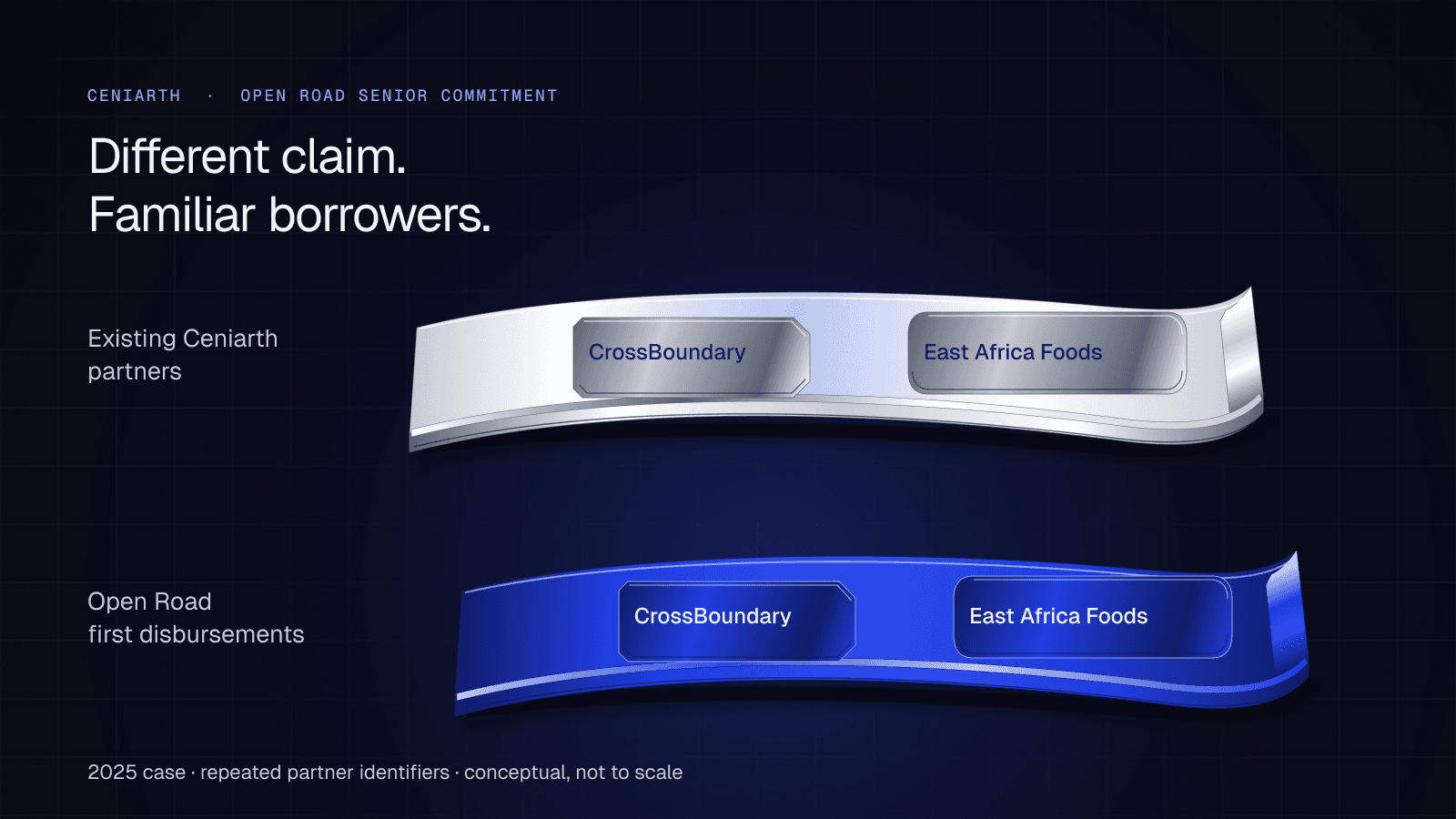
Ceniarth’s $1 million senior commitment to Open Road Impact illustrates a portfolio problem that an impact mandate alone cannot resolve. The commitment was priced at 4%, yet the intermediary’s early lending also reached enterprises Ceniarth already supported. A commitment to a new vehicle can therefore add a different contractual claim while increasing exposure to familiar businesses.
The case appears in Ceniarth’s 2025 annual report, published on June 23, 2026. Its selected transactions show the investor supplying senior and mezzanine capital, combining a fund position with companion-vehicle debt, and extending financing with another institution’s guarantee support. For an allocator, the useful comparison is the claim acquired and the enterprise risk behind it.
Open Road: senior capital can reach existing partners
Ceniarth reports a $1 million senior loan commitment to Open Road’s second vehicle in 2025, priced at 4%. Open Road finances the gap between an organization securing an investment commitment or grant letter and receiving the money. The report’s case study describes typical underlying loans lasting seven to eight months. That is a characteristic of Open Road’s lending, rather than the disclosed maturity of Ceniarth’s own commitment.
The pricing identifies a concrete financing proposition. It does not supply a realized return or the complete terms governing Ceniarth’s repayment. Those belong to the investor’s claim on the vehicle; the vehicle’s borrowers have their own financing needs and repayment schedules.
Ceniarth also reports that roughly 20% of the new vehicle’s first disbursements went to existing Ceniarth partners, including CrossBoundary and East Africa Foods. It explicitly acknowledges added enterprise concentration risk. The percentage describes those initial disbursements, rather than Ceniarth’s portfolio allocation or its total exposure to either company.
That overlap changes the allocation analysis. An intermediary can bring specialist origination and bridge-lending capabilities while financing businesses the investor already knows. Assessing diversification therefore requires the underlying borrower relationships alongside the seniority of the new commitment.
Lendable: one investor, two positions
Ceniarth committed $3 million across the mezzanine and senior tranches of Lendable’s Transportation and Energy Fund. Its disclosed mandate is to finance businesses reducing emissions or helping customers do so across emerging markets, including mobility, agriculture, energy and waste management.
The report describes a capital structure of 60% senior debt, 30% mezzanine and 10% first- and second-loss capital, designed to attract institutional investors. Ceniarth says its mezzanine position helps the fund reach the equity ratios needed to scale. This describes the financing design and Ceniarth’s participation; the case does not establish a fully funded structure or an executed loss-allocation waterfall.
Ceniarth’s impact-levers explanation also recognizes a role for senior capital when a fund has secured junior support but still needs scale. An impact-first investor can participate at more than one level. Its identity alone does not locate a prospective co-investor’s claim in the structure.
Keep the lender, guarantor and investment form separate
Iungo Capital supplies another configuration. Ceniarth says it extended and upsized its commitment after Iungo’s financing discussions with the DFC stalled, with guarantee support from the Livelihood Impact Fund. Ceniarth extended its financing commitment; the named guarantee support came from LIF. The case leaves the guarantee’s amount, coverage and contractual triggers unspecified, so it cannot establish how much loss protection a particular claim receives.
The Apis & Heritage case separates investment forms within another relationship: an LP position in its second fund and a debt commitment to a companion vehicle. The employee-ownership objective does not make those claims interchangeable or establish direct company equity for Ceniarth. Their allocation ratio and investor rights remain outside the disclosed case.
Open Road’s case belongs in a portfolio review at two levels: the senior commitment to the intermediary and its lending to existing Ceniarth partners. Familiarity with those enterprises adds comfort, as Ceniarth explains, while the report also acknowledges concentration risk. The reported 4% pricing and the disclosed overlap describe different parts of the same allocation.