
Climentum and SA-H2: climate capital for companies and projects
Climentum’s company-stage mandate and SA-H2’s development and construction tranches show the investment jobs behind two Q3 2026 climate first-close announcements.
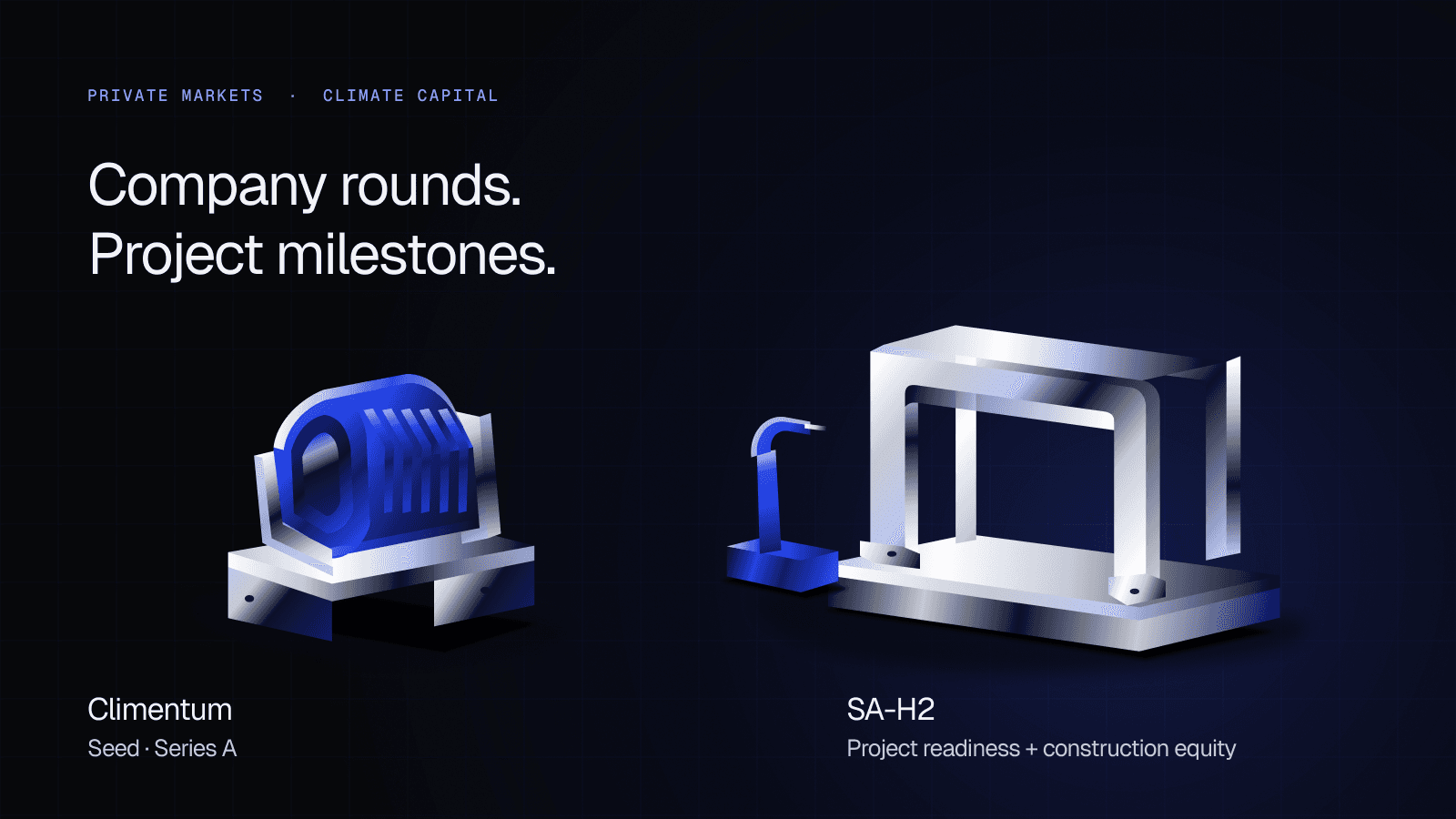
Climentum Capital Fund II reached a €60 million first close to back early-stage climate technology companies. SA-H2 reported a ZAR 3 billion first close for a different proposition: preparing green-hydrogen projects for investment decisions and financing their construction. The July and August 2026 announcements describe capital entering two distinct parts of the energy transition, with different recipients and milestones behind the climate label.
For a technology founder, a project developer or an institutional LP, that distinction changes the investment discussion. A company raising its next equity round needs a different proposition from a hydrogen project seeking development funding. The named backers become more useful when connected to the investment job their capital supports.
Climentum: company equity at Seed and Series A
EIF’s July 3 announcement reports Climentum’s €60 million first close toward a €100 million target. The disclosed cornerstone commitments comprise €40 million from the European Investment Fund, €15 million from Denmark’s Export and Investment Fund, EIFO, and €5 million from the Danish Society of Engineers, IDA. EIF’s participation is supported by the RCR-REPowerEU mandate.
The fund primarily targets Seed and Series A companies developing hardware and deeptech solutions for energy, industry, transport and agriculture. Its stated geographic emphasis includes Denmark, Sweden, Germany, Austria and Switzerland. That is a company-stage and technology mandate, rather than a description of a portfolio of completed infrastructure assets.
A founder approaching this strategy would need to connect the technology to the business being financed: its industrial application, commercial development and proposed company round. For an LP assessing the manager, those company-building choices are central to the investment proposition. An energy or transport theme alone says less than the combination of technology, company stage and geographic focus. The published focus does not supply an exhaustive country-eligibility list or the terms of a particular investment.
SA-H2: project readiness and construction capital
The European Commission’s August 6 announcement describes SA-H2, also known as Climate Investor Three South Africa, as a blended-finance private-equity fund for large-scale energy-transition projects in Southern Africa. Its scope includes green-hydrogen production, derivatives such as green ammonia and green methanol, and industrial decarbonisation.
The Development Tranche provides early-stage risk capital and technical assistance to prepare projects for final investment decision. Separate blended Equity Tranches progress from financial close into construction. Here, “early stage” refers to project readiness. It is a different milestone from a Seed or Series A company round, even when both investments support new industrial capacity.
The backer mapping makes that distinction concrete. Invest International, the European Commission through Global Gateway, and South Africa’s Industrial Development Corporation committed to the Development Tranche. The Equity Tranches attracted the Public Investment Corporation on behalf of the Government Employees Pension Fund, Sanlam Life, Invest International and the European Commission. PIC and GEPF describe an asset-manager/client relationship within that list, rather than two separate commitments to add together.
The release also identifies signed development funding agreements with Green Efuels Producers, a wastewater-to-green-methanol project in Gauteng, and the Hive Hydrogen Coega Green Ammonia Project. These are examples of project preparation already entering the fund’s activity. A development agreement does not establish that a plant has reached financial close, completed construction or started generating operating cash flows.
For a developer researching this capital route, the proposed project’s readiness and the work needed to reach its next investment milestone therefore matter alongside the technology. For an LP, the Development and Equity Tranche descriptions identify different capital roles. The announcement’s public-capital rationale does not establish an investor’s executed loss allocation, return rights or protection; those require the relevant fund terms.
Match the proposition before comparing the closes
SA-H2’s ZAR 3 billion first close sits against a ZAR 12 billion target for mid-2028. Climentum’s €60 million first close sits against its €100 million target. These retain their original currencies and fundraising perimeters. A target is neither a completed raise nor a measure of capital currently available to a new company or project. The publication dates also do not supply exact legal closing dates or cash-disbursement schedules.
Existing infrastructure portfolios can contain both operations and development, while public capital and assistance can perform separate jobs within a fund. The Climentum and SA-H2 announcements give those broader distinctions specific counterparties: an industrial technology company seeking a company round, and a green-hydrogen developer seeking capital for project preparation or construction. That is the comparison to make before treating two climate fundraises as substitutes.