
October 2026 Investment Manager RFPs: Deadlines, Mandates and Changed Instructions
Source-checked October 2026 investment manager RFPs: Chicago Park, Pittsburgh and Rhode Island deadlines, strategy requirements and expired-search exclusions.
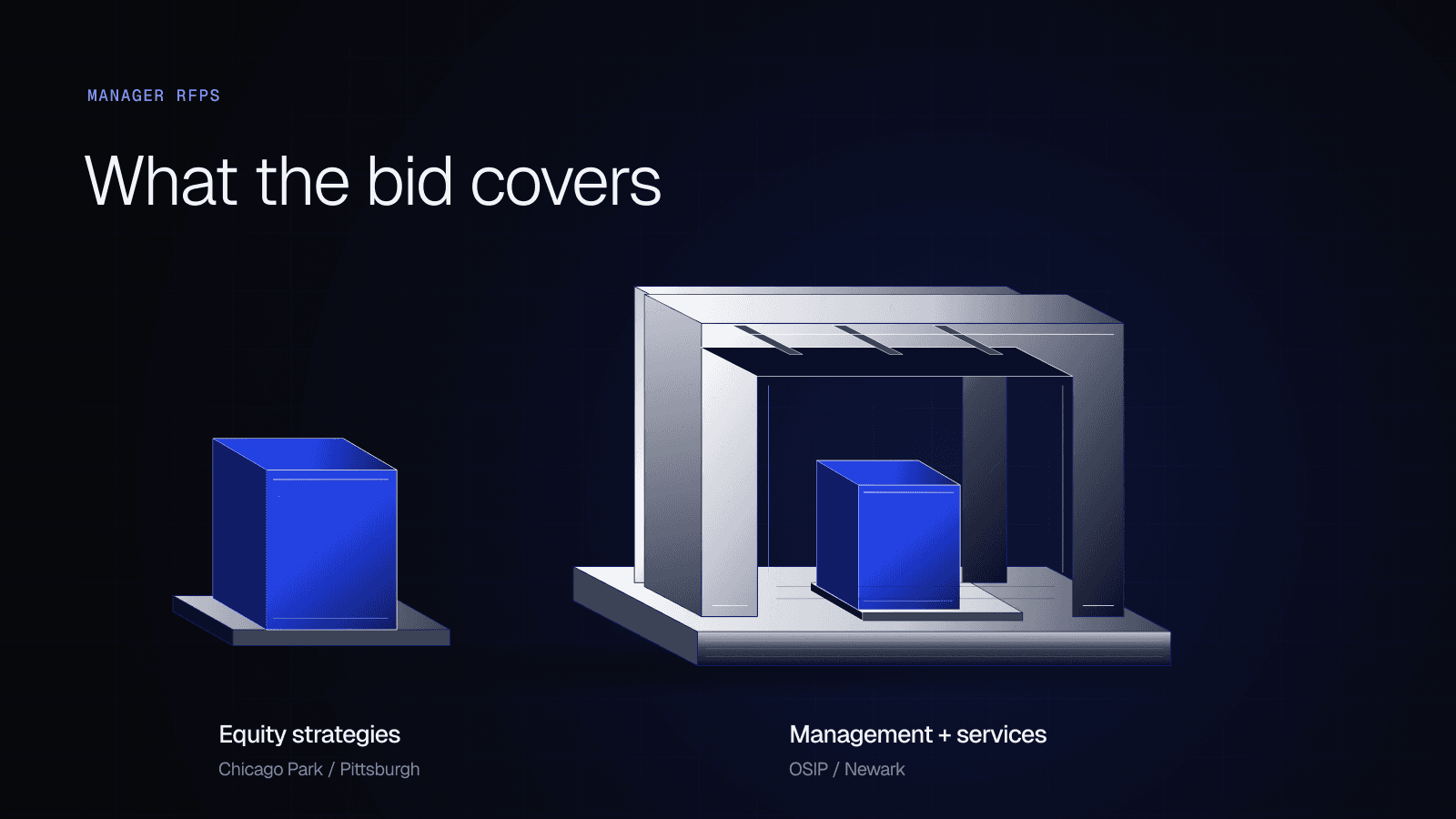
Rhode Island’s Ocean State Investment Pool tender connects portfolio management to the work of running a public-sector cash pool. Its October 16 answers prefer a single all-in fee, allow identified third-party service providers and expect the respondent to market OSIP to eligible public entities. Chicago Park’s passive equity search and Pittsburgh’s active small-cap mandate ask managers to solve different investment problems.
The immediate calendar has also changed. The OSIP question responses extend proposals to October 23, 2026, at 4:00 PM EST. Treasury’s index still displays October 20; the dated response document explicitly labels the later deadline as updated.
For managers allocating proposal resources, these four searches divide into strategy mandates and broader service engagements. The distinction affects the investment product, operating partners and fee proposal a credible response needs.
The current deadlines and delivery routes
- Chicago Park: October 19, 2026, 4 PM CST. Passive domestic and developed international equity; responses through the questionnaire linked by Meketa.
- Pittsburgh: October 20, 2026, 5 PM local Pittsburgh time. Active U.S. small-cap equity; ten written copies and two electronic versions, with the physical response received by the deadline.
- Rhode Island OSIP: October 23, 2026, 4 PM EST. Investment management, recordkeeping, operations and administration; the RFP requests electronic PDF and Word copies, read with the updated question-response deadline.
- Newark, Delaware: November 3, 2026, 2 PM prevailing time. Combined pension and OPEB investment management and custody; email submission in PDF format. Questions are due October 23 at 5 PM.
These are the source-labelled times, without converting CST, EST or local time into a different zone. The named tenders and their instructions were reviewed on October 16.
Chicago Park and Pittsburgh require different equity products
The Park Employees’ and Retirement Board Employees’ Annuity and Benefit Fund of Chicago seeks a Russell 1000 strategy, an MSCI EAFE strategy, or both. Meketa’s notice says the existing domestic index manager manages approximately $80 million, while the board is considering an international index manager for approximately $30 million. Those descriptions distinguish an existing portfolio from an engagement being considered.
The eligible wrapper also changes with the sleeve. Domestic equity may use a separately managed account or a commingled or pooled fund; international equity is limited to commingled or pooled funds. The board additionally seeks passive capability across a broad range of asset classes. A manager with the right benchmark therefore still needs the appropriate vehicle and broader passive offering.
Pittsburgh’s U.S. small-cap RFP identifies Russell 2000 as the benchmark and an initial allocation of up to $20 million, subject to adjustment. Its minimum qualifications list $100 million of firm AUM at hiring and say the product should have at least three years of verifiable, GIPS-compliant history. Section C(6) also caps CMPTF at 25% of capital in the manager’s portfolio and 10% of its total AUM at hiring and any additional funding. The city’s October 6 answers clarify that the 25% test uses strategy assets at funding.
For the full potential $20 million ticket on its own, the two caps imply at least $80 million of strategy assets and $200 million of firm AUM at the applicable measurement point. A smaller allocation changes those figures; other CMPTF capital covered by the tests would also need to be counted. The $200 million calculation is conditional capacity, rather than a replacement for the stated $100 million hiring minimum or evidence of an award.
The October 6 answers sharpen the strategy screen: all small-cap styles and quantitative strategies may be considered, but index strategies are excluded. An ETF may be considered. The fund wants an existing stand-alone U.S. small-cap strategy, rather than a U.S. carve-out from a global product. That leaves meaningful scope for different active styles, with a clear geographic and product boundary. The answers also settle a practical deadline question: hard copies must arrive by October 20. Mailing them that day does not meet the stated receipt requirement.
OSIP’s fee proposal has to cover an operating model
The original OSIP RFP combines investment management and credit research with participant accounts, transaction processing, reporting, audit and custody coordination, technology and participant services. Its minimum qualifications include five years managing institutional assets in the subject product or a similar strategy, at least $5 billion of such institutional AUM and an institutional public client.
The October 16 responses make the service economics more specific. Treasury prefers a single all-in fee and permits respondents to propose fee tiers. Proposed outsourcing must identify the functions and, where applicable, the provider. The current custodian is separately engaged by OSIP, while the service provider is responsible for associated fees and expenses on agreed terms. The current provider pays the annual audit fee out of OSIP fees; respondents are to coordinate with the OSIP-contracted auditor. Marketing, education and distribution costs belong in the proposed fee.
The evaluation reflects that breadth. Investment management and administration/operations each receive 25 points; organization and experience receive 20, participant services/marketing/distribution 15, and fees 15. A response needs to explain who operates the pool and serves its participants, alongside the portfolio process. A low investment-management price alone leaves much of the scored service proposition unanswered.
Newark wants management and custody in one response
Newark’s RFP 26-03 seeks investment management for its Employee Pension Fund and OPEB Trust together with custody. Proposals covering only one service area will not be considered. The city describes the desired respondent as an investment management firm bringing a custody solution.
The scope includes portfolio monitoring and policy advice, plus master custody, safekeeping, clearing, accounting and reporting. Bidders must separately identify component fees and provide a consolidated proposal; pricing must be all-inclusive unless expressly stated otherwise. In the initial 100-point written evaluation, meeting the requirements and the cost of services each carry 30 points, while investment performance, strategy and related considerations carry 25.
The September 30 notice of intent was non-binding: failure to submit it does not preclude a proposal. The combined service requirement remains central to the November response. For an investment team considering a custody partner, responsibility, reporting and price have to form one workable offer.
Across the four searches, the client’s specified job is the starting point. The plan-specific authority and policy context still matters, as do the separate portfolio needs illustrated by New York City’s infrastructure commitments. Here, those distinctions lead to concrete bid choices: a passive wrapper, an established active product, a pool-service operating model, or a combined management-and-custody solution.
Presentation updated October 16, 2026: Removed visible formatting markers from the deadline list; dates and instructions are unchanged.
October 18, 2026 update: the Pittsburgh section adds the RFP’s concentration caps and conditional allocation-capacity calculations, using the October 6 answers. Other mandate sections are unchanged and were not re-reviewed for this update.