
Q3 2026 AI infrastructure financing: commitments, guarantees and capacity
Compare selected Q3 NVIDIA and OpenAI records while separating prospective capital, investment values, conditional guarantees and future operating capacity.
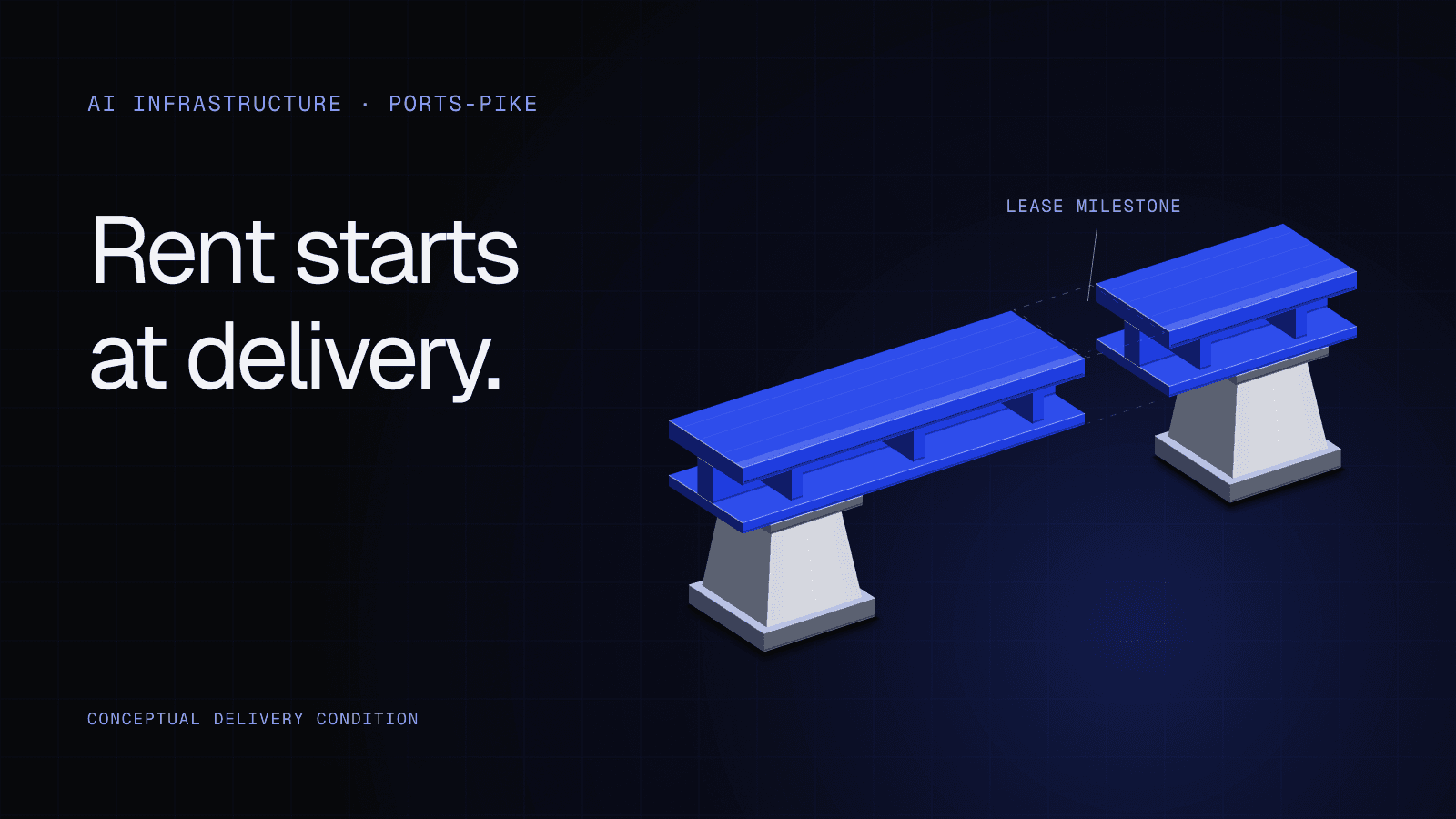
OpenAI’s PORTS-Pike agreement makes completed capacity the trigger for rent. SB Energy is to build, own and operate the Ohio data center, while OpenAI begins paying as capacity becomes available under a 20-year lease. That sequence puts the delivery milestone at the centre of the investment question: a signed capacity agreement can support a financing proposition while the physical infrastructure still has to be completed.
The selected Q3 2026 disclosures describe several ways capital supports that buildout: project-level credit support, prospective financing platforms and investments already held in infrastructure financiers. Their usefulness to an infrastructure LP or credit analyst lies in identifying the obligation and its activation point, rather than treating every large dollar figure as a completed investment.
Delivery determines when the customer starts paying
In its August 17 announcement, OpenAI agreed to secure approximately 8 gigawatts of IT capacity. The first 800 megawatts were expected in 2028; later development required additional generation and transmission infrastructure. Permits, environmental reviews and financing remained prerequisites. OpenAI said it would fund the lease commitments from business revenue, cash flow and investor capital.
The project’s own campus description also places the buildout across private land and remediated Department of Energy land. That is a development programme with multiple dependencies. For an investor comparing proposed financing, the useful questions are which phase an instrument funds, what must be completed before its revenues begin, and which party has obligations during that interval. The public announcements do not supply a complete allocation of construction risks among all financing parties.
Credit support has its own perimeter and trigger
NVIDIA’s report for the quarter ended July 26 describes guarantees signed in August: a $105 billion cap for SB Energy affiliates serving an OpenAI affiliate, associated with approximately 4.25 gigawatts of IT load.
Generally effective at lease commencement, support increases across nine construction phases, the first expected in NVIDIA’s fiscal 2029. It covers defined lease and power payments following specified tenant defaults. Exposure is expected to decline over each phase’s 20-year lease. Termination conditions include a satisfactory OpenAI credit rating or lease expiry. Another approximately 3.8 gigawatts remained subject to NVIDIA’s discretionary support option.
The customer’s capacity agreement and the initially supported perimeter answer different questions. The cap is neither cash advanced nor an expected loss. Delivery analysis and tenant-default protection remain separate parts of underwriting.
A financing platform is a different proposition
NVIDIA’s August 10 partnerships announcement named Apollo, BlackRock, Blackstone, Brookfield, Goldman Sachs and KKR. The proposed independent platforms aimed to mobilize more than $500 billion of third-party capital over time. The parties had signed memorandums of understanding; final agreements remained necessary.
That announcement describes a route for bringing investors and compute customers together, rather than terms for a single subscribed fund. An LP assessing a later offering would still need the actual vehicle, investment mandate, capital structure and contractual rights. The scale of the ambition does not resolve those choices, and the announcement does not assign the entire prospective capital figure to PORTS-Pike.
Existing exposure still needs a defined measurement basis
At July 26, NVIDIA reported $3.3 billion of equity-method investments in infrastructure financiers. The relevant variable-interest-entity investments carried maximum loss exposure of $4.7 billion, including carrying values and future commitments. Those measures describe existing investment exposure on different bases; adding them would double-count rather than reveal another financing pool.
This differs from the ownership and portfolio-building questions in Altss’s infrastructure-equity fund analysis. Here the professional task is to connect a proposed investment to an obligor, a covered payment and a delivery timetable. A platform’s capital ambition, a tenant’s capacity agreement and a guarantor’s contingent obligation can all support the same industry while requiring different investment decisions. These selected July and August records illuminate those decisions; they do not measure total Q3 AI-infrastructure fundraising.