
Q3 2026 buyout fundraising: three final closes, with vehicle boundaries
Three Q3 buyout final-close announcements compared with original sources, separating third-party LP commitments, GP capital and expected co-investment.
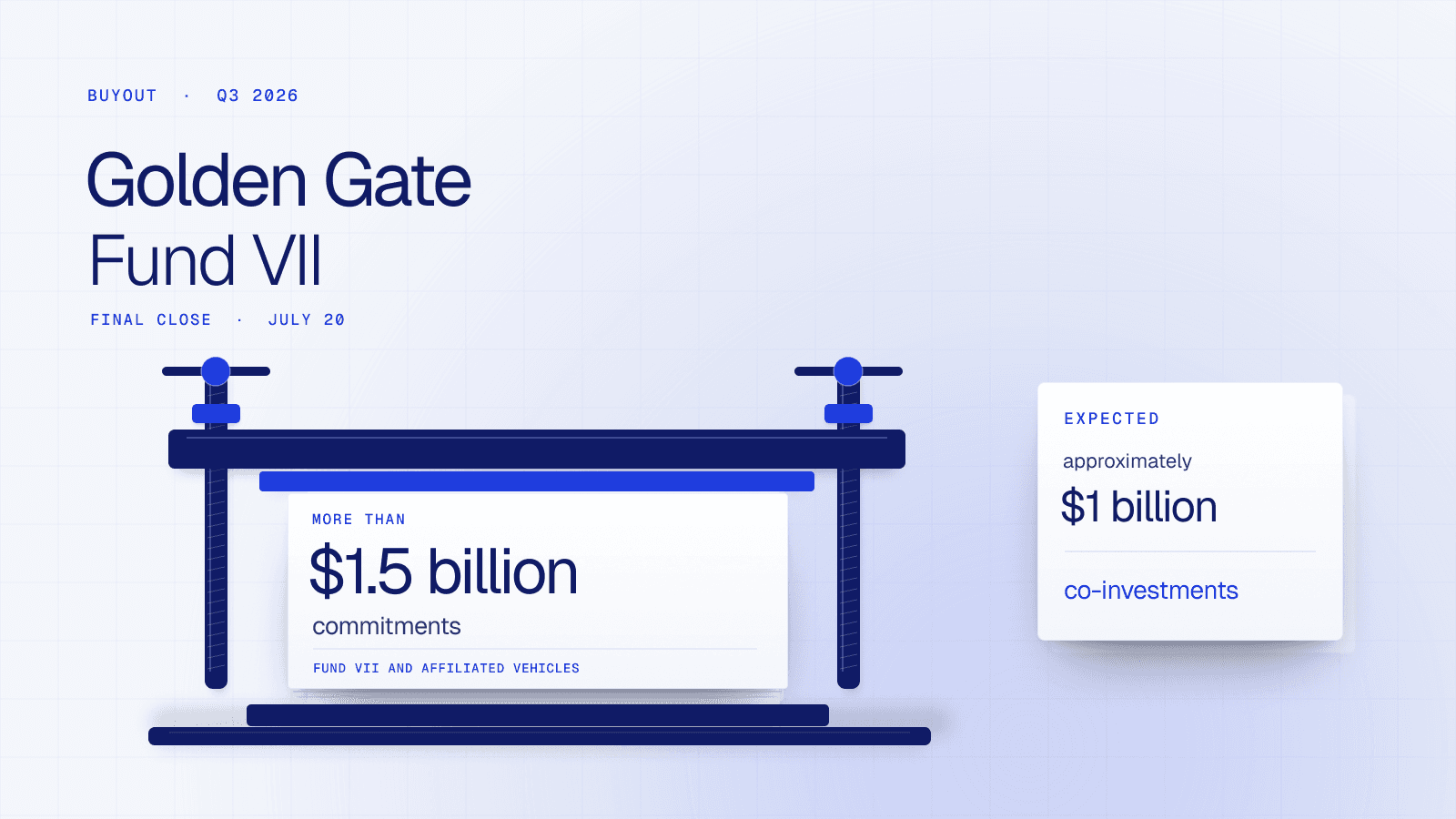
Warren Equity Partners closed approximately $2.8 billion for Fund V in July 2026, roughly $550 million above its initial $2.25 billion target. Citation Capital finished its inaugural fund with $1.2 billion of investable capital. Golden Gate Capital reported more than $1.5 billion of commitments for Fund VII and affiliated vehicles, alongside approximately $1 billion of co-investments it expected to offer.
The three July announcements, within Q3, describe different packages for an institutional LP. Citation arrived at final close with a seeded portfolio. Warren combined a larger-than-target raise with a defined infrastructure-services strategy and a material disclosure about operating costs. Golden Gate paired committed fund capital with prospective co-investment capacity while reporting cash distributions from its previous flagship. Those details make the comparison more useful than ordering managers by headline size.
Warren: a larger raise for a defined operating-company strategy
Warren’s July 13 release covers Warren Equity Partners Fund V, L.P. and Fund V-A, L.P., collectively Fund V. The approximately $2.8 billion close exceeded the initial $2.25 billion target in less than 12 months and reached the hard cap. Based on those disclosed figures, the excess was approximately $550 million, or about 24% of target. More than 60 institutions participated.
For a competing GP, that is a specific fundraising outcome: a named strategy closed above its initial objective within a disclosed period. The comparison does not require a claim about the broader buyout market. For an LP, the larger commitment pool makes the intended deployment mandate especially relevant.
Warren invests in businesses that maintain, operate and upgrade infrastructure and facilities, across areas including power, water, transportation, waste and digital infrastructure. The exposure is to operating companies serving those markets. Its separate ELIDO Fund II strategy targets lower-middle-market companies within the same themes; it is a different fund allocation, rather than another component of the Fund V close.
The manager’s investment criteria, checked October 15, list North American transactions with enterprise values of $20 million to $500 million and no minimum for add-ons. Buyouts, corporate carve-outs and recapitalizations are included. This helps an allocator locate the strategy within an existing private-equity portfolio: the infrastructure end market is one dimension, company size and transaction structure are others.
Fundraising also overlapped with investment activity. The closing release identifies USG Water Solutions as Fund V’s first platform investment, announced on June 1. An allocator considering the fund at final close therefore had a named initial investment to examine, rather than only a prospective sector allocation.
Citation: a debut fund with an existing portfolio
Citation’s July 13 announcement separates a $1.1 billion hard cap in third-party LP commitments from the GP and affiliate commitments that brought Fund I’s investable capital to $1.2 billion. It separately reports $2.1 billion of firm AUM inclusive of co-investment capital. The $1.2 billion figure is the relevant reported Fund I amount; the larger firm figure describes a wider perimeter.
Citation described Fund I as seeded and named four completed investments: Cibo Vita, Aptive Environmental, Gallo Mechanical and World Travel Holdings. Its stated mandate is North American middle-market control buyouts in services, industrials and selected consumer businesses, particularly founder- and family-led companies.
This changes the diligence conversation around an inaugural fund. A first fund can already offer observable investment choices. The LP can examine the named businesses, their place in the strategy and the terms on which exposure enters the fund. That is more concrete than treating the manager’s founding credentials as the entire investment case. It also makes remaining portfolio construction a question about the relationship between an existing seed and future investments.
The distinction between fundraising completion and portfolio ramp also appears in Q3 private-credit closes. Across asset classes, an investor joining at final close needs to understand the portfolio it is entering, not assume that investment activity starts with the announcement.
Citation’s combined GP-and-affiliate contribution is useful context for alignment. Assessing the individual partners’ economic exposure still requires the underlying split and funding terms. The published combined category should stay intact rather than become an assumed personal cash commitment by a particular founder.
Golden Gate: fund commitments alongside prospective co-investments
Golden Gate’s July 20 announcement reports more than $1.5 billion for Golden Gate Capital Fund VII, L.P. and affiliated vehicles. The firm separately expected to offer approximately $1 billion of co-investments to LPs and described $2.5 billion of total investable capital. The co-investment component was prospective, rather than an additional amount reported as subscribed at final close.
For an LP’s capital plan, the distinction affects the decision still to be made. A fund commitment and a potential allocation alongside a particular company investment occupy different places in that plan. Underwriting the proposed program requires the expected pace of offers, allocation process and economics, as well as the fund commitment itself. The release does not specify an individual LP’s entitlement or co-investment fee schedule.
That distinction is visible from the allocator side in September pension commitments, where fund mandates and co-investment structures can carry separate deployment authority. An expected co-investment program should be evaluated as a proposed route for additional capital, with its own decision process.
Golden Gate targets control investments in North American companies with $20 million to $50 million of EBITDA, across industrials, consumer services, and technology and financial services. Its company-size measure is earnings; Warren’s published range is enterprise value. Neither is a stated fund equity-check range, and dividing one manager’s measure by the other would not establish a valuation multiple.
Fund VII had already made platform investments in oneZero Financial Systems and Brava Roof Tile before final close. As with Citation, the LP comparison includes a starting portfolio as well as future deployment. It also includes the potential for additional company-level concentration through co-investments, depending on which opportunities an investor accepts.
Golden Gate’s announcement adds another relevant piece of financial context. It reports approximately $2.2 billion of gross distributions to LPs from its prior Opportunity Fund since the beginning of 2025, alongside six exits. The stated ratio, approximately 24%, uses that fund’s average NAV over the period. It describes a particular prior-fund gross cash-flow measure. Assessing an LP’s capacity to recycle proceeds into a new commitment requires its actual net cash receipts and other obligations; the announcement’s ratio is not a net-return or paid-in-capital measure.
The operating model belongs in the cost comparison
Warren’s release contains a disclosure that a fund-size comparison could easily miss. Its Operations Group can include employees of WEP Operations Group, affiliates or independent contractors. The release says the group is generally paid by WEP-sponsored funds or portfolio companies, and that those payments do not offset Fund V’s management fees or other WEP compensation.
The economic question is how the operating capability is funded alongside the management fee. An LP model containing only that fee has not yet represented the separate payment categories disclosed in the announcement. Payments borne by a fund and those borne by portfolio companies also need to be located correctly in the underwriting model.
The release gives no rate or aggregate charge for those services, so it cannot support a price ranking against Citation or Golden Gate. It does identify a concrete diligence item: the operating-services budget, allocation policy and treatment of offsets. Warren presents its Operations Group as part of its plan for organic growth, operational development and consolidation. The value-creation plan and the cost of delivering it belong in the same investment discussion.