
Q3 2026 private-credit fund closes: four announcements with capital scope intact
Four Q3 private-credit announcements distinguish first and final closes, related vehicles, leverage, anchor commitments and cumulative series figures.
Hayfin and Tikehau reached European direct-lending final closes in July 2026 with substantial portfolios already deployed. Hayfin reported more than half of commitments deployed across over 35 companies; Tikehau reported 44% deployment after an investment period that began in March 2024. The capital raised at those closes supported an existing lending programme, rather than marking the first day of investment activity.
August's US first closes offered a different allocation choice. Homestead's inaugural commingled agricultural credit strategy targets senior-secured lending to borrowers against farmland and other agricultural assets. Nuveen's fourth C-PACE lending vintage seeks to finance improvements to commercial buildings. Those mandates share an asset-backed credit label, but they direct capital toward different borrowers and collateral.
The four announcements below were published during July and August, within calendar Q3 2026. They are selected cases, not a measure of the quarter's total fundraising. Together, they show why an LP's shortlist needs both the closing milestone and the lending mandate: a large final close can contain an existing portfolio, while a first close can extend an established origination platform into another fund.
European final closes already had loans at work
Hayfin's July 2 announcement reported more than €15 billion for Direct Lending Fund V and related investment vehicles. The commingled DLF V had reached final close. The strategy lends primarily to European middle-market and upper-middle-market businesses through performing senior-secured loans, with an emphasis on cash-flow generation or asset coverage.
Its deployment disclosure changes the interpretation of the fundraising headline. More than 50% of commitments had already been deployed across over 35 companies at the close. An LP considering this vintage would therefore be assessing an existing portfolio as well as the manager's ability to originate the remaining investments. Portfolio composition, entry underwriting and the timing of an incoming commitment become more relevant than a headline-sized estimate of new lending capacity.
Tikehau's July 23 release put the sixth vintage of its European Direct Lending strategy at €5.2 billion, excluding leverage. Its investment period had begun in March 2024; by the announcement, the strategy had completed 30 transactions and was 44% deployed. Tikehau described an origination focus on Europe's core middle market alongside private-equity sponsors.
The two managers thus disclosed meaningful portfolio ramp before final close. Their percentages do not establish a common measure of undrawn cash: Hayfin referred to deployed commitments, while Tikehau described the fund as deployed. The direct conclusion is about lifecycle, not a calculated euro balance. A July final-close date alone would conceal the earlier investment activity.
Tikehau also reported net debt to EBITDA of 3.5 times, against an initial leverage limit of 4.0 times at entry. That borrower-level measure answers an underwriting question; it is separate from the excluding-leverage qualification attached to the fundraising amount. An allocator comparing these disclosures can examine both the capital structure of the fund and the financial leverage of its borrowers without collapsing them into one ratio.
Capital channels shape the investor base
Hayfin's more-than-€15-billion figure covered the commingled fund and related vehicles, rather than a disclosed standalone amount for the commingled fund. Within that fundraise, a rated-note feeder contributed approximately $600 million of total investable capital. Hayfin described the structure as providing insurers with access to its European direct-lending strategy.
The feeder is significant as an investor-access route. It brings a different funding structure into the same strategy, rather than identifying another borrower mandate. Its dollar-denominated amount was already included in the fundraise, so adding it to the euro headline would double-count a component while introducing a currency conversion the announcement did not make.
Tikehau disclosed another feature relevant to fundraising teams: a majority of commitments came from outside Europe, including 18% from North America and 28% from Asia and the Middle East. A European lending mandate can therefore draw on a geographically broader LP base. In these two cases, the borrower opportunity set and the source or structure of investor capital are separate dimensions of the fundraising proposition.
The same distinction underlies Altss's comparison of equity commitments and broader investable capital. Fund size becomes useful for manager comparison when the associated financing and vehicle scope remain attached to it.
US first closes served different asset-backed mandates
Homestead Capital announced its first close on August 14. Its inaugural commingled private-credit strategy focuses on originating senior-secured loans to agricultural borrowers across the United States, primarily collateralized by farmland and other agricultural assets.
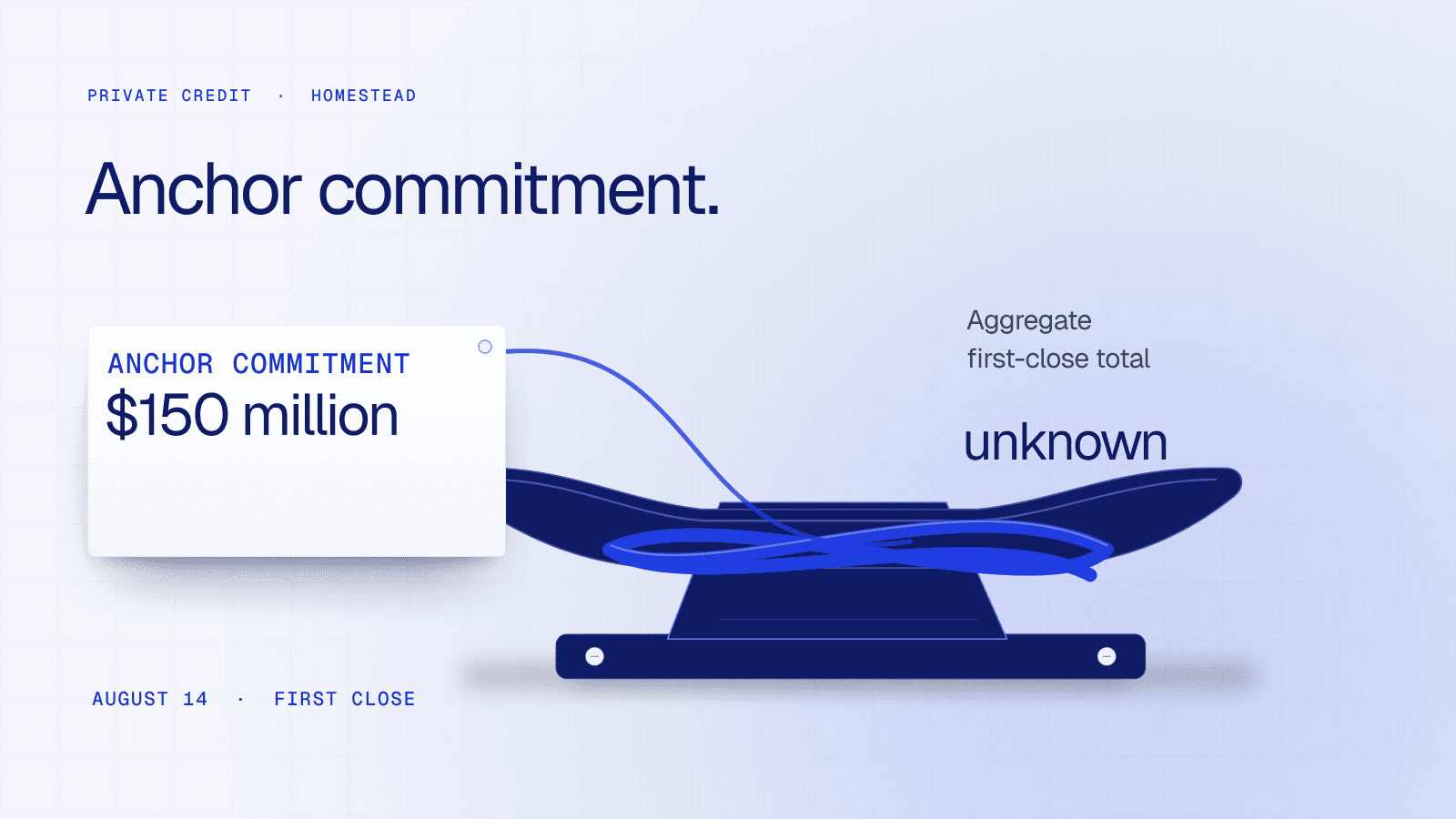
A $150 million commitment from the private-credit team of an unnamed large US state pension system anchored the close. Homestead set a $350 million target and a $500 million hard cap. The single disclosed anchor equalled approximately 43% of the target, calculated as $150 million divided by $350 million. That illustrates the scale of the anchor within the fundraising plan; the release did not disclose an aggregate first-close amount or identify the pension.
The commingled strategy also sat alongside a separate capital channel. Homestead referenced an earlier $300 million forward-flow programme with Barings and MassMutual supporting its agricultural lending platform. For a borrower, both channels related to financing availability. For an LP, the choice of fund subscription and the economics of a separate forward-flow arrangement require different analysis. The programme was not described as another subscription into the commingled fund.
Nuveen's August 25 announcement reported a first close exceeding $1 billion in new commitments for CPACE Lending Fund IV. It separately reported $3 billion of commitments across the series since its 2023 inception. The first-close milestone applied to Fund IV, even though the announcement's headline referred more broadly to closing the fourth vintage.
Nuveen described C-PACE as a state-administered public-private financing programme supplying long-term private capital to building owners and developers. Fund IV targets capital improvements intended to make commercial buildings more energy efficient, water efficient and climate resilient. The borrower use of proceeds differs from Homestead's farmland-backed lending, even though both fit within a broad asset-backed allocation.
That distinction gives an allocator a more useful comparison than a ranking by first-close dollars. Homestead's stated mandate centres on agricultural borrowers and agricultural collateral; Nuveen's centres on commercial-property improvements through C-PACE. European corporate direct lending adds a third borrower context. Portfolio construction starts with those exposures, then examines the specific underwriting, security and cash-flow arrangements within each mandate.