Topic hub
Fund terms and economics
This hub covers the terms of a private fund: what investors pay the manager, how profits are split, how capital moves in and out over the fund's life, and which rights investors hold. Most of these terms are set in the limited partnership agreement and adjusted for individual investors in side letters.
After the fund documents, sections follow the money: fees (management fee, fee offsets), carried interest and the distribution waterfall, fund expenses, alignment terms such as the GP commitment, capital commitments and flows, the fund's term, and governance and LP rights such as the LPAC and the key person clause. Where practice differs, as with European and American waterfalls, each variant has its own entry.
Not in this hub: the legal vehicle that holds the fund, such as a limited partnership or a feeder fund, which is in Fund structures, and the fundraising process, which is in Fundraising. Hedge fund fee terms are in Hedge funds.
Reference index
Fund documents
2 concepts- Limited Partnership Agreement (LPA)
A limited partnership agreement (LPA) is the governing contract of a private fund organised as a limited partnership, setting out its purpose, term, capital commitments, economics, governance and the rights and obligations of the general partner and the limited partners.
- Side Letter
A side letter is a separate agreement between a fund or its general partner and one LP that adds to or varies the limited partnership agreement's terms for that investor, for example on fees, reporting, regulatory accommodations or co-investment rights.
Fees
4 concepts- Management Fee
A management fee is the periodic fee a private fund pays its manager for operating the fund, usually a percentage of LP commitments during the investment period and of invested capital or NAV after it.
- Two and Twenty
Two and twenty is shorthand for a manager fee structure of a 2% annual management fee plus 20% of profits as carried interest or a performance fee, the reference point for private equity, venture and hedge fund fees.
- Management Fee Offset
- Fee Drag
Carried interest and waterfalls
8 concepts- Carried Interest (Carry)
Carried interest (carry) is the share of a private fund's profits allocated to the general partner, commonly 20%, after LPs have received back their contributed capital and any preferred return required by the waterfall.
- Preferred Return (Pref)
A preferred return (pref) is the annual rate of return, commonly 8%, that LPs must receive on their contributed capital through the distribution waterfall before the general partner shares in profits as carried interest.
- Hurdle Rate
A hurdle rate is the minimum rate of return an investment or fund must achieve before a performance-based payment starts; in private funds, the threshold, commonly 8% a year, that LP capital must earn before carried interest is paid.
- GP Catch-Up
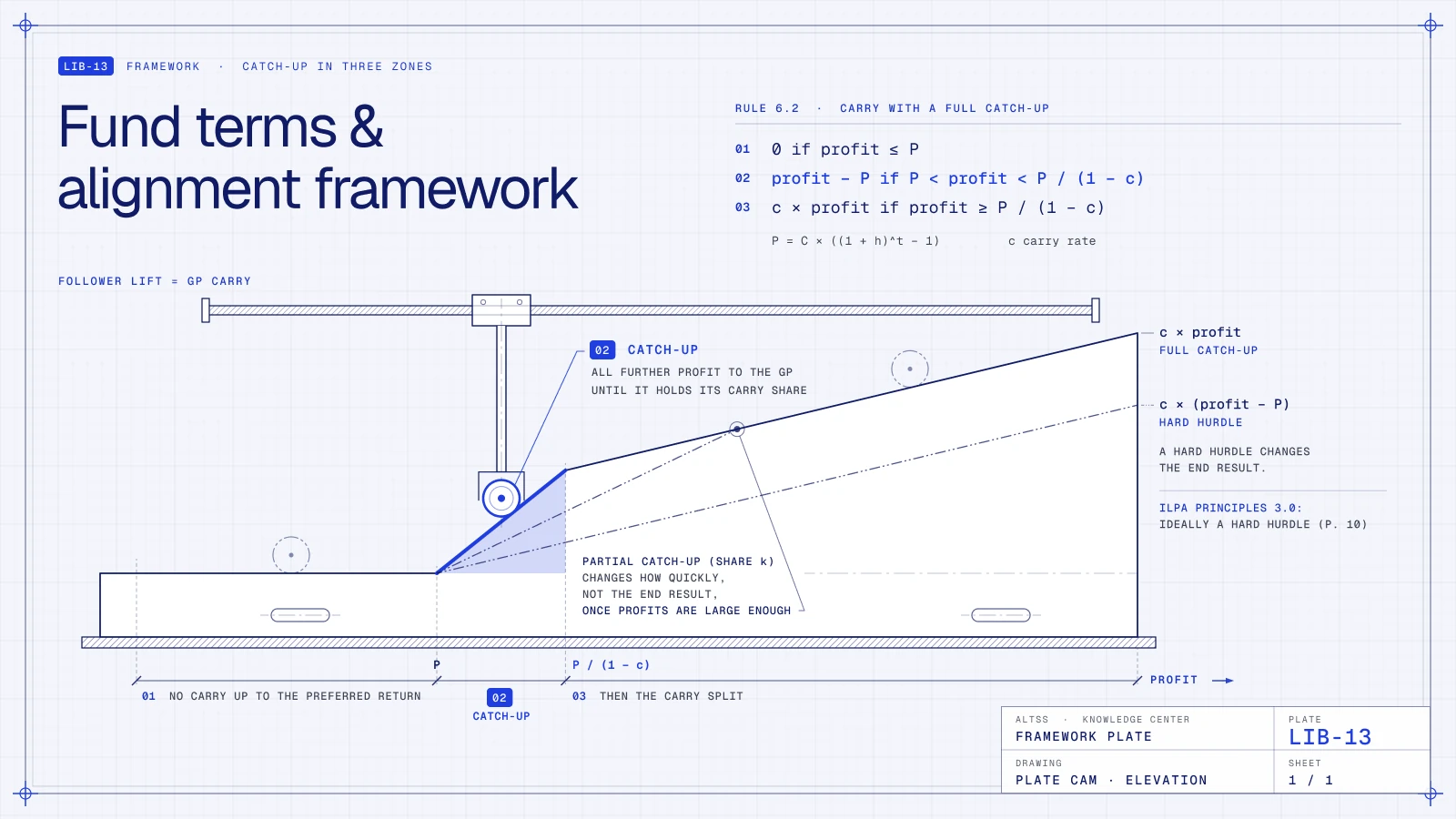
A GP catch-up is the waterfall tier after the preferred return in which the general partner receives all or most distributions until its cumulative share equals its carry percentage of all profits distributed so far.
- Distribution Waterfall
A distribution waterfall is the order, set in a fund's limited partnership agreement, in which investment proceeds are divided between LPs and the general partner: typically return of capital, preferred return, GP catch-up, then a carried-interest split.
- European (Whole-Fund) Waterfall
A European (whole-fund) waterfall is a distribution waterfall that pays carried interest only after LPs have received back all capital contributed to the fund plus the preferred return, measured across the whole fund rather than deal by deal.
- American (Deal-by-Deal) Waterfall
An American (deal-by-deal) waterfall is a distribution waterfall that pays carried interest on each investment as it is realised, once LPs have recovered the capital for that deal and, depending on the fund agreement, related costs and realised losses.
- GP Clawback
A GP clawback is the general partner's obligation to return carried interest it has received in excess of what the fund's cumulative results entitle it to, usually tested at the end of the fund's life and sometimes at interim dates.
Alignment
2 concepts- GP Commitment
The GP commitment is the capital that a fund's general partner and its principals commit to their own fund alongside LPs, putting the managers' own money at risk in the same investments.
- Alignment of Interests
Capital commitments and flows
7 concepts- Capital Commitment
A capital commitment is an investor's contractual obligation, made in a fund's subscription agreement and limited partnership agreement, to contribute up to a stated amount of money when the general partner calls it over the life of the fund.
- Capital Call
A capital call is the general partner's formal demand, issued under the limited partnership agreement, that limited partners pay a specified portion of their unfunded commitments to the fund by a stated date.
- Unfunded Commitment
An unfunded commitment is the portion of an investor's capital commitment to a fund that has not yet been called and that the general partner may still draw under the limited partnership agreement.
- Paid-In Capital
- Distributions
Distributions are payments of cash, or transfers of securities in kind, from a fund to its partners out of investment proceeds or income, allocated between limited partners and the general partner according to the fund's distribution waterfall.
- Recallable Distributions
- Recycling
Fund term and lifecycle
3 concepts- Vintage Year
A fund's vintage year is the year used to group it with comparable funds for benchmarking and portfolio planning, usually the year of its first capital call or of its first legally binding close; conventions differ.
- Fund Term (Fund Life)
The fund term is the contractual life of a closed-end fund, set in its limited partnership agreement, after which the fund must be wound up unless it is extended under the agreement's extension provisions.
- Investment Period
The investment period is the phase of a closed-end fund's life, set in its limited partnership agreement, in which the general partner may call capital for new investments; afterwards calls are limited to follow-ons, committed deals, fees and expenses.
Governance and LP rights
5 concepts- Limited Partner Advisory Committee (LPAC)
A limited partner advisory committee (LPAC) is a small committee of LP representatives, formed under a fund's partnership agreement, that the general partner consults on conflicts of interest and other matters the agreement reserves for its review or consent.
- Key Person Clause
A key person clause is a limited partnership agreement provision that names individuals the fund depends on and, if they leave or stop devoting the required time, triggers protections such as suspending new investment until LPs decide how to proceed.
- No-Fault Divorce
A no-fault divorce clause is a fund agreement provision letting a specified supermajority of LPs remove the general partner, end the investment period or dissolve the fund without proving misconduct, usually on terms compensating the GP for lost future economics.
- Most Favored Nation (MFN) Clause
A most favored nation (MFN) clause is a fund term, usually in a side letter, letting an LP elect more favourable terms granted to other LPs, typically only those of LPs with equal or smaller commitments and subject to carve-outs.
- Conflicts of Interest (Fund)
Methodologies and frameworks
Framework · Version 1.1.0
Fund Terms & Alignment Framework
A method for reviewing private fund terms: management fee base and step-downs, carried interest, preferred return, catch-up, whole-fund and deal-by-deal waterfalls, clawback, fee offsets, GP commitment and LP governance rights, with worked calculations and a mapping to ILPA Principles 3.0 and the Model LPA.