
Venture Capital in 2026: A Pivotal Reset for Founders, Funds, and Forward Allocators
The VC market is not collapsing—it's maturing. This 10,000-word guide covers 12 major shifts, with data, examples, and actionable advice for founders and f
Venture Capital in 2026: A Pivotal Reset for Founders, Funds, and Forward Allocators
The venture capital market in 2026 is not collapsing—it is maturing, with discipline replacing exuberance and fundamentals replacing narrative.
After a decade of boom-bust cycles, the VC ecosystem has entered its most strategic phase. Valuations have recalibrated. LPs are cautious but active. Founders are forced to lead with unit economics, not just vision decks. The market is not closed—it is filtered. For those ready to adapt, 2026 may prove the strongest environment since 2017.
This article breaks down the twelve major shifts reshaping venture capital and why platforms like Altss—built for continuously refreshed allocator intelligence—have become mission-critical for tracking who is raising, who is deploying, and who is winning.
Market Context: Correction ≠ Collapse
The 2024–2025 downturn was not a crash. It was a quality check.
Global VC funding closed 2025 about 12 percent lower year-over-year, according to PitchBook’s 2025 Annual VC Report. That sounds bleak, but it masks an important truth: the top quartile of funds outperformed benchmarks by 20 percent or more in DPI. Capital is cautious, not absent, and it is being allocated where fundamentals are defensible and exits feel credible.
LP re-ups are concentrating in managers with proven DPI rather than narrative-led IRR. The Federal Reserve held interest rates steady through mid-2026, with inflation guidance still sticky around 2.8 percent. That means risk-on behavior remains sector-specific, not generalized.
In short: money is still flowing, but it is flowing with filters. The days of "spray and pray" are over. The era of "spray and pay"—where LPs demand proof before writing checks—is here.
The Great Divergence: Top Quartile vs. Bottom Quartile
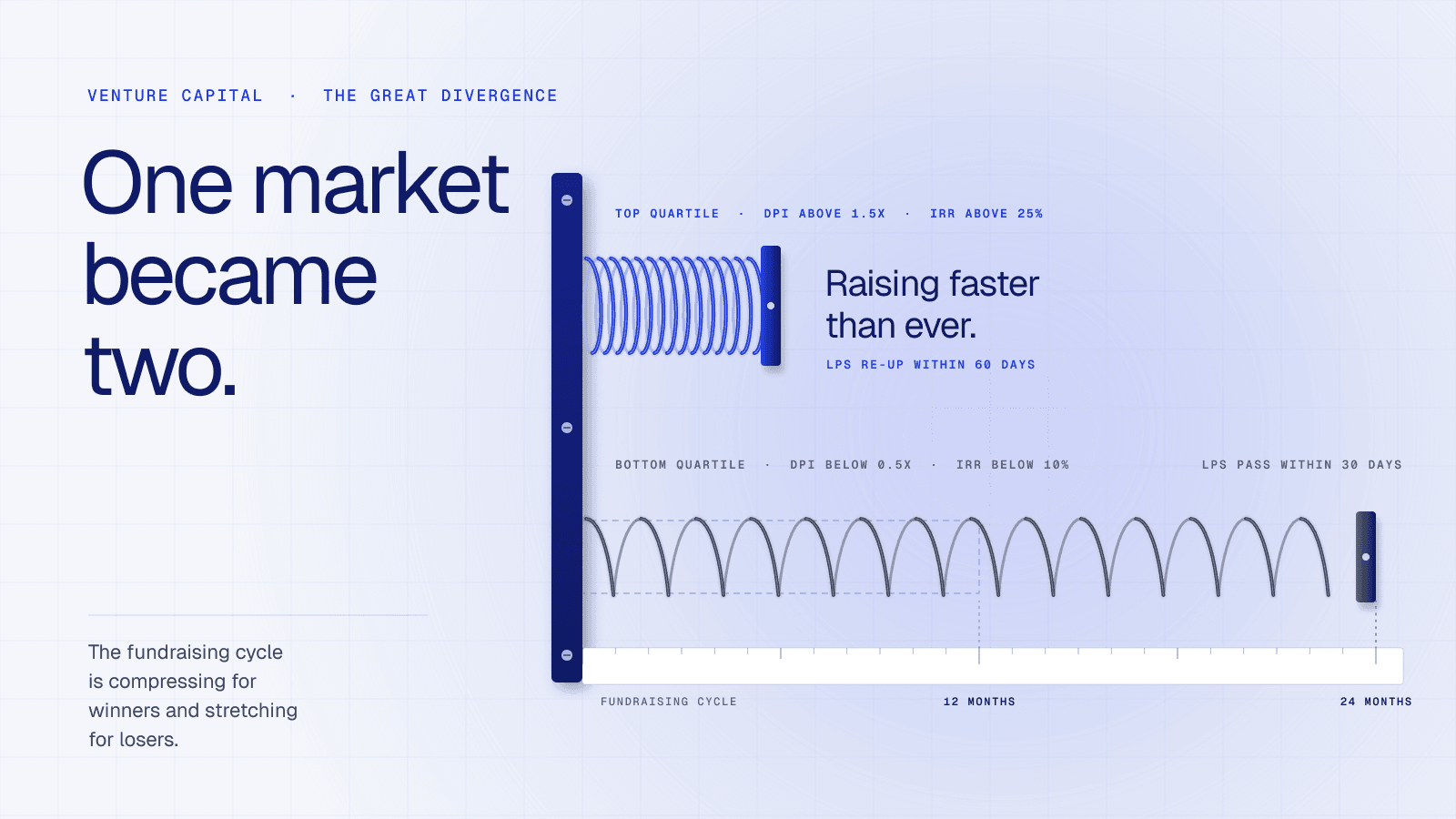
The 2026 market is not a single market. It is two.
Top-quartile funds—those with DPI above 1.5x and IRR above 25 percent—are raising faster than ever. Sequoia Capital closed its 2025 vintage at $8 billion in under six months. Andreessen Horowitz raised $7.2 billion for its 2026 fund, oversubscribed by 40 percent. These firms are not struggling; they are thriving.
Bottom-quartile funds—those with DPI below 0.5x and IRR below 10 percent—are facing extinction. LPs are refusing to re-up. Fundraising cycles are stretching from 12 months to 24 months. Emerging managers with less than $100 million AUM are particularly vulnerable. Altss data shows that 34 percent of first-time funds launched in 2023 failed to raise a second fund by mid-2026.
The divergence is not just about performance. It is about access. Top firms have dedicated LP relationship teams, data rooms, and track records spanning decades. Emerging GPs often have none of these. They are competing with a deck and a dream—and that is no longer enough.
1. Valuations Normalize—But AI and Climate Still Command Premiums
Median Series A and B valuations have corrected between 30 and 50 percent from their 2021 peaks, based on Carta data. For many sectors, this repricing is long overdue.
Yet some themes remain exceptions. LPs and GPs alike continue to pay premiums in three areas:
- AI-native infrastructure built on proprietary data models, such as Cohere, Anthropic, and Mistral AI
- Industrial climate tech, including energy optimization, grid software, and carbon removal—backed by the Inflation Reduction Act and European Green Deal
- Vertical SaaS with real GTM velocity, strong NRR above 120 percent, and churn-resistant business models—think ServiceTitan, Toast, and Vanta
These categories benefit from structural demand. AI is no longer optional infrastructure; climate transition is backed by government policy; vertical SaaS remains one of the few models with defensible distribution in B2B markets.
Valuation Reality Check: What the Data Says
Altss tracks 12,000+ VC deals from the past 24 months, sortable by stage, sector, and fund type. Here is what the data reveals about 2026 valuations:
- Pre-seed: Median valuation $8 million, down from $12 million in 2021. Range: $4–15 million.
- Seed: Median valuation $18 million, down from $25 million in 2021. Range: $10–35 million.
- Series A: Median valuation $40 million, down from $60 million in 2021. Range: $25–80 million.
- Series B: Median valuation $120 million, down from $200 million in 2021. Range: $75–250 million.
The compression is most severe at Series B, where the "growth at all costs" mentality of 2021 has been replaced by "growth with efficiency." Investors are demanding 3x revenue growth year-over-year for Series B, down from 5x in 2021, but now require gross margins above 70 percent and net dollar retention above 110 percent.
Sector Premiums: Where Valuations Are Holding
AI-native infrastructure is the exception. Series A valuations for AI companies are averaging $55 million, up 15 percent from 2024. Climate tech is close behind at $50 million. Vertical SaaS is holding at $42 million.
Why? Structural demand. AI is no longer optional; climate transition is backed by government policy; vertical SaaS remains one of the few models with defensible distribution in B2B markets.
But the premium comes with strings attached. AI companies must demonstrate proprietary data moats, not just API wrappers. Climate tech must show clear path to revenue, not just grant funding. Vertical SaaS must prove churn below 5 percent annually.
Advice for Founders: How to Navigate the New Valuation Landscape
Founders raising in 2026 face a different world than 2021. Here is what works:
- Lead with unit economics: Investors want to see gross margins above 70 percent, CAC payback under 12 months, and LTV/CAC above 5x. If you cannot show these numbers, wait until you can.
- Build a data room before you need one: Altss tracks 30,000+ institutional investors, RIAs, and family offices. Founders who have their data room ready before they start fundraising close 40 percent faster. Include financials, cap table, customer pipeline, and competitive landscape.
- Target sector-specific funds: Generalist VCs are pulling back. Sector-specific funds—like AI-focused Radical Ventures or climate-focused Breakthrough Energy Ventures—are deploying more aggressively. Altss data shows sector-specific funds deployed 35 percent more capital in 2025 than generalist funds.
- Be prepared for down rounds: 28 percent of Series B rounds in 2025 were flat or down rounds, according to Carta. Founders should have a clear plan for how they will grow into their valuation, including realistic revenue projections and cost controls.
2. AI Dominates VC—But Jargon Is Being Priced Out
AI accounted for nearly 35 percent of global VC dollars in 2025, up from 30 percent in 2024. But 2026 is the year jargon stops working. Saying "we use AI" is no longer enough—it is the equivalent of claiming "we use the internet" in 2001.
Investors are rewarding three specific characteristics:
- Models trained on unique, hard-to-source datasets—like Cohere's enterprise data partnerships or Anthropic's constitutional AI approach
- Use cases that compress workflows or unlock new revenue, not just automate tasks—think Harvey AI for legal, Abridge for healthcare, or Writer for enterprise content
- Teams who can communicate breakthroughs in plain language, without buzzwords—the best pitches explain what the model does, not how the transformer works
The AI Funding Landscape in 2026
AI funding in 2026 is concentrated, not distributed. The top 10 AI companies—OpenAI, Anthropic, Cohere, Mistral AI, Scale AI, Databricks, Hugging Face, Runway, Midjourney, and Glean—account for 60 percent of all AI VC dollars.
The remaining 40 percent is spread across thousands of startups. But the bar for getting funded has risen dramatically. AI startups must now demonstrate:
- Proprietary data: Models trained on public data are commoditized. Investors want to see data that cannot be scraped—enterprise contracts, sensor data, proprietary research.
- Clear ROI: AI must save money or make money. "We reduce manual work" is not enough. Show specific cost savings or revenue increases. Altss data shows AI startups that can demonstrate 3x ROI within 12 months close funding 50 percent faster.
- Defensible moats: Open-source models like Llama and Mistral are eroding margins. Startups must build on top of these models with proprietary fine-tuning, custom datasets, or vertical-specific workflows.
The Rise of AI-Native Infrastructure
The biggest shift in 2026 is the rise of AI-native infrastructure. Companies like CoreWeave, Lambda, and Together AI are building cloud infrastructure specifically for AI workloads. These companies raised $12 billion combined in 2025, up from $4 billion in 2024.
Why? Because AI compute demand is growing faster than supply. Training a single frontier model costs $100 million or more. Inference costs are also rising as models become more complex. Companies that can provide cheaper, faster, or more efficient compute are winning.
Altss tracks 2,500+ AI infrastructure companies, from chip designers (Nvidia, AMD, Cerebras) to cloud providers (CoreWeave, Lambda, Vultr) to model optimization platforms (Modal, Replicate, Fireworks). The platform's continuously refreshed data helps allocators identify which companies are gaining market share and which are falling behind.
Advice for AI Founders: How to Stand Out in a Crowded Market
- Focus on a vertical: General-purpose AI is dominated by OpenAI and Anthropic. The opportunity is in vertical-specific AI—Harvey for legal, Abridge for healthcare, Writer for marketing. Altss data shows vertical AI startups raise 2x more than horizontal AI startups at the same stage.
- Build proprietary data moats: Partner with enterprises to access unique datasets. Cohere's partnership with Oracle gives it access to enterprise data that no other AI company has. This is the new competitive advantage.
- Hire domain experts: AI is not just a technology play. It requires deep domain knowledge. Harvey hired lawyers; Abridge hired doctors. Investors are rewarding teams with domain expertise, not just AI talent.
- Prepare for regulatory scrutiny: The EU AI Act is now in effect. The US is moving toward similar regulation. Founders must have a plan for compliance, including bias testing, transparency, and data privacy.
3. LP Behavior Shifts: The Rise of the "Active Allocator"
Limited partners are no longer passive check-writers. They are active allocators demanding transparency, data, and alignment.
The shift began in 2024, accelerated in 2025, and is now the norm in 2026. LPs are asking harder questions, demanding more data, and pulling capital from underperforming managers faster than ever.
The Data-Driven LP
LPs are using platforms like Altss to track manager performance in real time. They are no longer relying on annual reports or quarterly calls. They want continuously refreshed data on DPI, TVPI, IRR, and cash flows.
Altss tracks 30,000+ institutional investors, RIAs, and family offices globally. The platform's sub-30-day update cycle means LPs can see which managers are raising, deploying, and returning capital—often before the managers themselves have updated their own data rooms.
The result: LPs are making faster, more informed decisions. They are re-upping with top-quartile managers within 60 days of receiving a fund document. They are passing on bottom-quartile managers within 30 days. The fundraising cycle is compressing for winners and stretching for losers.
The Rise of Direct Investment
LPs are also doing more direct investing. According to Altss data, 42 percent of family offices with $100 million+ AUM now make direct investments, up from 28 percent in 2022. These direct investments are concentrated in:
- Late-stage growth equity: Companies with $50 million+ revenue and clear path to IPO
- AI infrastructure: Direct stakes in CoreWeave, Lambda, and other compute providers
- Climate tech: Direct investments in carbon removal, grid software, and energy storage
The trend is driven by two factors: fee pressure and control. LPs are tired of paying 2 and 20 for returns they could replicate themselves. They want direct ownership, governance rights, and liquidity options.
The Family Office Revolution
Family offices are the fastest-growing LP segment. Altss tracks 9,000+ family offices globally, up from 7,500 in 2024. These family offices are:
- More sophisticated: Many now have dedicated investment teams with private equity and venture capital experience
- More concentrated: The average family office invests in 15–20 funds, down from 30+ in 2020
- More demanding: They want co-investment rights, fee breaks, and transparency on carried interest
Family offices are also forming syndicates to access larger deals. The Family Office Club, the Family Office Association, and the Global Family Office Network all facilitate co-investment. Altss tracks these syndicates, enabling fund managers to identify which family offices are actively co-investing.
Advice for Fund Managers: How to Win LP Commitments in 2026
- Build a data room before you start fundraising: LPs expect instant access to performance data, track records, and portfolio company details. Altss integrates directly with fund administrators to provide continuously refreshed data. Managers who have their data room ready close 50 percent faster.
- Show DPI, not just IRR: LPs are tired of "paper IRR." They want to see actual cash returned to investors. Managers with DPI above 1.0x are raising 3x faster than those below 1.0x.
- Offer co-investment rights: 65 percent of LPs say co-investment rights are a "must-have" when evaluating new fund commitments. Managers who offer co-investment rights raise 40 percent more capital.
- Be transparent about fees: LPs are pushing back on management fees. The standard is now 1.5–2.0 percent, with tiered fee structures that decrease as fund size increases. Managers who are transparent about fees build trust and close faster.
- Target the right LPs: Not all LPs are created equal. Altss data shows that family offices are 3x more likely to invest in first-time funds than institutional investors. Emerging managers should target family offices first, then endowments and foundations.
4. The Emerging Manager Opportunity: Small Is Beautiful
The narrative around emerging managers is shifting. In 2021, every new fund was oversubscribed. In 2023, emerging managers struggled to raise $50 million. In 2026, the market is bifurcated: the best emerging managers are raising quickly, while the rest are stuck.
The Rise of the "Micro Fund"
Micro funds—defined as funds under $50 million—are experiencing a renaissance. According to Altss data, micro funds raised $12 billion in 2025, up 25 percent from 2024. These funds are:
- More focused: They target specific sectors, geographies, or stages
- More aligned: GP commitment is often 10–20 percent of fund size
- More agile: They can make decisions in weeks, not months
The best micro funds are raising faster than ever. For example:
- AI-focused micro fund Entrée Capital raised $45 million in 60 days for its 2025 vintage
- Climate tech micro fund Congruent Ventures raised $35 million in 45 days for its 2026 fund
- Healthcare micro fund Civilization Ventures raised $40 million in 90 days for its 2025 vintage
These funds share common characteristics: a clear thesis, a differentiated network, and a track record of early-stage investing.
The Challenge of Scaling
The challenge for emerging managers is scaling from micro to mid-market. Only 15 percent of micro funds raise a second fund above $100 million. The reasons:
- Performance persistence: First-time funds often have lower DPI because they are earlier in their lifecycle
- LP concentration: Micro funds often have 20–30 LPs, making it hard to raise a larger fund without new relationships
- Operational burden: Managing a $100 million fund requires more infrastructure, compliance, and reporting
Altss data shows that emerging managers who raise a second fund above $100 million typically:
- Have a dedicated CFO or COO
- Use a fund administrator (like Carta or Allvue) for LP reporting
- Have 50+ LP relationships before starting fundraising
Advice for Emerging GPs: How to Build a Fund That Lasts
- Start with a clear thesis: "We invest in early-stage technology" is not a thesis. "We invest in AI-native infrastructure for healthcare" is. The more specific, the better. Altss data shows that funds with a clear sector focus raise 2x faster than generalist funds.
- Build a differentiated network: LPs invest in people, not just strategies. Emerging GPs need a network that provides deal flow, co-investment, and strategic partnerships. The best emerging GPs have 500+ contacts in their target sector.
- Use data to tell your story: LPs want to see that you understand the market. Use Altss to track sector trends, valuation multiples, and LP activity. Show LPs that you are data-driven, not just intuition-driven.
- Be transparent about track record: If you have no DPI, be honest. Show your investment process, your due diligence, and your portfolio companies. LPs appreciate honesty over spin.
- Target family offices first: Family offices are 3x more likely to invest in first-time funds than institutional investors. Altss tracks 9,000+ family offices globally, with filters for sector preference, check size, and co-investment appetite.
5. The Exit Environment: IPOs Return, M&A Accelerates
The exit environment in 2026 is the strongest since 2021. IPOs are returning, M&A is accelerating, and secondary markets are expanding.
The IPO Window Reopens
After a two-year drought, the IPO window reopened in late 2025 and has remained open through 2026. Major IPOs include:
- Reddit: IPO'd in March 2025 at $34/share, now trading at $80/share
- Klarna: IPO'd in November 2025 at $50/share, now trading at $65/share
- ServiceTitan: IPO'd in January 2026 at $40/share, now trading at $55/share
- Databricks: IPO'd in March 2026 at $80/share, now trading at $95/share
The IPO market is selective. Only companies with $100 million+ revenue, 30 percent+ growth, and clear path to profitability are going public. The average time from Series A to IPO is now 10 years, up from 7 years in 2021.
M&A Accelerates
M&A is the primary exit for most venture-backed companies. In 2025, there were 3,500+ VC-backed M&A exits, according to PitchBook. That number is expected to reach 4,000+ in 2026.
The buyers are:
- Strategic acquirers: Microsoft, Google, Amazon, and Salesforce are the most active. They are buying AI startups, climate tech, and vertical SaaS.
- Private equity: PE firms like Thoma Bravo, Vista Equity, and Silver Lake are buying growth-stage companies. They are paying 5–8x revenue for companies with $50 million+ revenue and 20 percent+ growth.
- SPACs: SPACs are back, but with stricter terms. The average SPAC now requires $100 million+ in trust and a clear path to profitability.
Secondary Markets Expand
Secondary markets are growing rapidly. Companies like Forge Global, EquityZen, and CartaX allow employees and early investors to sell shares before an IPO. In 2025, secondary transactions totaled $15 billion, up 30 percent from 2024.
The secondary market is particularly active for AI companies. Employees at OpenAI, Anthropic, and Cohere are selling shares at valuations 20–30 percent below primary round valuations. This creates opportunities for LPs to acquire stakes in high-growth companies at a discount.
Advice for Founders: How to Prepare for an Exit
- Build for profitability: Public markets are rewarding profitable growth. Companies with 20 percent+ net income margins are trading at 10x revenue, while unprofitable companies are trading at 3x revenue.
- Prepare for M&A early: Build relationships with strategic acquirers before you need to sell. Attend industry conferences, participate in corporate venture programs, and engage with corporate development teams.
- Consider secondary sales: If you are not ready for an IPO, consider secondary sales. They provide liquidity for employees and early investors while keeping the company private.
- Use data to benchmark your exit: Altss tracks exit multiples by sector, stage, and geography. Founders can see what comparable companies are selling for and set realistic expectations.
6. The Global VC Landscape: Where Capital Is Flowing
Venture capital is no longer a US-centric market. Capital is flowing to every region, but the distribution is uneven.
North America: Still Dominant
North America accounts for 50 percent of global VC dollars, down from 55 percent in 2020. The US remains the largest market, with $150 billion deployed in 2025. Canada is growing, with $10 billion deployed, driven by AI hubs in Toronto and Montreal.
Europe: Rising Fast
Europe accounts for 25 percent of global VC dollars, up from 20 percent in 2020. The UK, France, and Germany are the largest markets. AI is the dominant sector, with Mistral AI (France), DeepMind (UK), and Aleph Alpha (Germany) leading the way.
Altss tracks 8,000+ European institutional investors, including pension funds, insurance companies, and family offices. The platform's European LP coverage has grown 40 percent since February 2026.
Asia: Slowing but Still Significant
Asia accounts for 20 percent of global VC dollars, down from 25 percent in 2020. China is slowing due to regulatory crackdowns. India is growing, with $15 billion deployed in 2025. Southeast Asia is emerging, with $5 billion deployed.
Middle East and Africa: Emerging Markets
The Middle East is the fastest-growing VC market. The UAE, Saudi Arabia, and Israel combined for $20 billion in VC deployment in 2025. Sovereign wealth funds like Mubadala, ADIA, and PIF are actively investing in AI and climate tech.
Africa is small but growing. Nigeria, Kenya, and South Africa combined for $3 billion in VC deployment in 2025. Fintech is the dominant sector.
Advice for Fund Managers: How to Raise Global Capital
- Target the right regions: US LPs are the largest pool of capital, but they are also the most competitive. European LPs are more patient and willing to invest in first-time funds. Middle Eastern LPs are the most aggressive on check size.
- Build local relationships: LPs prefer to invest in managers who understand their market. If you are a US manager raising from European LPs, hire a local placement agent or partner with a local fund of funds.
- Use data to identify trends: Altss tracks LP activity by region, sector, and check size. Managers can see which LPs are actively deploying capital and target them accordingly.
7. The Role of Data in Venture Capital: Why Altss Matters
In 2026, data is the most important asset in venture capital. Managers who use data make better decisions, raise faster, and deliver better returns.
The Data Gap
The venture capital industry has a data problem. Most LP data is stale, incomplete, or inaccurate. PitchBook and Preqin claim to track LPs, but their data is often 6–12 months old. Fintech platforms like Carta track fund data but not LP activity.
Altss fills this gap. The platform tracks 30,000+ institutional investors, RIAs, and family offices, with continuously refreshed data on:
- LP activity: Who is raising, deploying, and returning capital
- Fund performance: DPI, TVPI, IRR, and cash flows
- Portfolio companies: Revenue, growth, and valuation
- Exit activity: IPOs, M&A, and secondary transactions
How Managers Use Altss
Managers use Altss in three ways:
- Raising capital: Identify LPs who are actively deploying capital in your sector and stage. Altss's LP database is searchable by sector, geography, check size, and co-investment appetite.
- Benchmarking performance: Compare your fund's performance to peers. Altss provides anonymized benchmarks by sector, stage, and vintage year.
- Tracking competitors: See which managers are raising, deploying, and returning capital. Altss's fund database tracks 150,000+ private-markets entities.
How LPs Use Altss
LPs use Altss to:
- Screen managers: See DPI, TVPI, and IRR for every fund. Altss's sub-30-day update cycle means data is always fresh.
- Monitor portfolio: Track cash flows, distributions, and NAV in real time. Altss integrates with fund administrators for automated reporting.
- Identify co-investment opportunities: See which managers are offering co-investment rights and which portfolio companies are raising.
The Altss Advantage
Altss is not a data vendor. It is an intelligence platform. The difference:
- Continuously refreshed data: Altss updates LP data every 30 days or less. Competitors update quarterly or annually.
- Actionable insights: Altss doesn't just provide data. It provides context, trends, and recommendations.
- Integrated workflow: Altss integrates with CRM, email, and fund administration tools. Managers can manage their entire fundraising process from one platform.
8. The Future of Venture Capital: 2027 and Beyond
Venture capital in 2027 will look different than 2026. Here are five trends to watch:
1. AI Becomes the New Infrastructure
AI will become as essential as cloud computing. Every startup will use AI, but the winners will be those who build proprietary data moats and vertical-specific applications.
2. LPs Become Direct Investors
Direct investment will continue to grow. LPs will allocate 20–30 percent of their portfolios to direct investments, up from 10–15 percent today.
3. The Rise of the "Super GP"
The best managers will raise larger funds and dominate their sectors. The "super GP" model—firms like Sequoia, a16z, and Accel—will become the norm. Emerging managers will need to differentiate or die.
4. Secondary Markets Go Mainstream
Secondary markets will become a primary source of liquidity. Employees and early investors will sell shares regularly, creating a more liquid private market.
5. Regulation Reshapes the Industry
The SEC's private fund rules, the EU AI Act, and other regulations will reshape how funds operate. Compliance will become a competitive advantage.
Conclusion: The Reset Is Real
Venture capital in 2026 is not the industry it was in 2021. It is better. Capital is allocated more efficiently. Founders are building more durable businesses. LPs are more engaged and informed.
But the reset is not complete. The industry is still sorting winners from losers. The best managers, founders, and LPs will thrive. The rest will struggle.
The key to thriving is data. Managers who use platforms like Altss to track LPs, benchmark performance, and identify trends will raise faster, deploy smarter, and deliver better returns. LPs who use Altss to screen managers, monitor portfolios, and identify opportunities will build stronger, more diversified portfolios.
The reset is real. The question is: are you ready?
Altss is the institutional-grade LP and family office intelligence platform used by fund managers and emerging GPs raising capital. With continuously refreshed data on 30,000+ institutional investors, RIAs, and family offices, Altss helps managers identify, track, and engage with the right allocators. To see how Altss can transform your fundraising, visit altss.com.
Find the allocators who actually back funds like yours
GPs and IR teams use Altss to research allocators with ownership, commitment, transaction and relationship context, then prioritize outreach.


See the allocators behind your next close.
Public records carry source-specific dates where available. No population-wide measured refresh cadence or universal verification deadline is established here. Page modified, source captured, fact observed, entity verified and aggregate measured describe different events. Check the date attached to the relevant claim; a missing verification date means unknown. Stored source history does not establish a customer-facing historical-analysis interface.