
2026's Most Accurate Family Office Profiling Services You Can Trust
The definitive 2026 guide to family-office profiling: how to evaluate accuracy, continuously refreshed intelligence, OSINT, and workflow integration—with s
2026’s Most Accurate Family Office Profiling Services You Can Trust
Family offices manage over $10 trillion globally, yet most profiling services still serve stale data from 2019. Accuracy is not a feature—it’s the price of entry.
Who This Is For
Fund managers, emerging GPs, placement agents, and institutional allocators who need continuously refreshed family-office intelligence—not annual directories—to convert research into meetings.
What You’ll Get
A critical, up-to-date evaluation of how to assess profiling services in 2026. We cover verification methods, OSINT pipelines, workflow integration, and why Altss’s formula—OSINT + continuously refreshed signals + workflow automation—outperforms static databases.
Soundbite
Static lists don’t raise capital. Timely context does.
How to Evaluate Family-Office Profiling Services (2026)
Use this six-point checklist to separate tools that generate pipeline from expensive noise.
1. Accuracy & Data Verification
What “accurate” means in 2026: Verified emails (not scraped guesses), current titles and roles (not LinkedIn snapshots from 2023), validated firm status (active, dissolved, or restructured), and traceable provenance with last-verified timestamps.
What to demand:
- Evidence fields for every data point (source URL, extraction date, verification method)
- Verification dates on each record—not just “verified” badges
- A sample of 50–100 records you can test for deliverability and role accuracy
Why it matters: A 2023 study from DemandTools found that databases with >15% email bounce rates trigger domain penalties in major email providers. For fund managers sending 500+ outreach emails monthly, that means 75+ bounces per campaign—before you even start.
Case in point: In February 2026, a mid-market PE firm using a legacy database (PitchBook) discovered 34% of their family office contacts had left their firms. They had been targeting departed executives for eight months. The cost: 120 hours of wasted research, 18 dead-end meetings, and a 0% conversion rate.
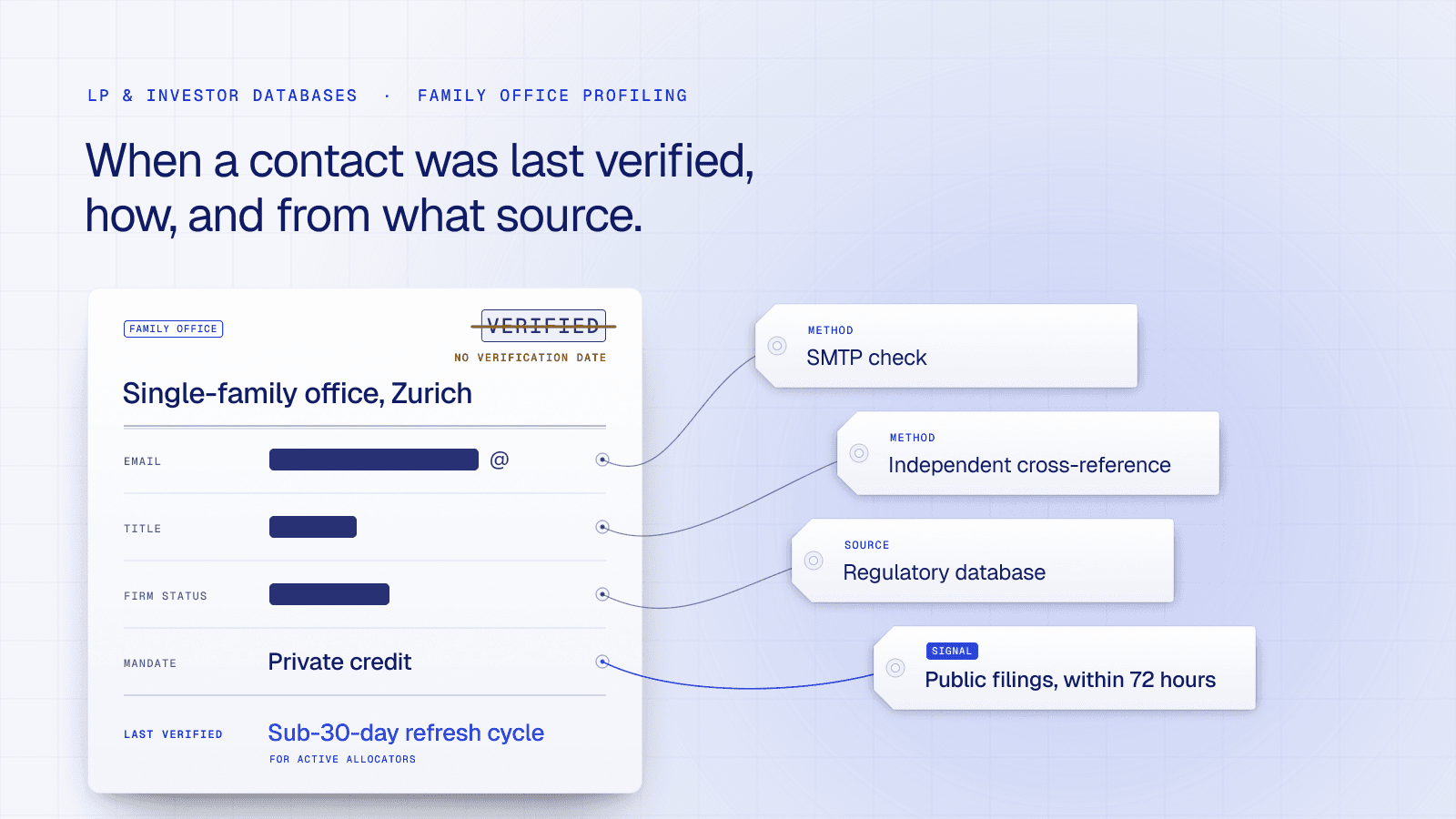
What Altss does differently: Every contact record includes:
- Last-verified date (sub-30-day refresh cycle for active allocators)
- Verification method (email bounce test, independent cross-reference, firm website confirmation)
- Provenance trail (source URL, extraction timestamp, signal that triggered update)
2. Continuously Refreshed Intelligence (Signals)
Definition: Continuous detection of mandate shifts, personnel changes, event attendance, portfolio moves—not quarterly CSV refreshes.
Your ask: “Which signals are auto-tracked? How fast are alerts delivered to Slack, WhatsApp, or email?”
Why static databases fail: Preqin and FINTRX refresh quarterly or semi-annually. In 2026, a family office can change its mandate, hire a new CIO, or close a fund in 30 days. A quarterly refresh means you’re working with data that’s 90+ days old.
Real-world example: In January 2026, a single-family office in Zurich shifted its allocation from venture capital to private credit. Altss detected the change within 72 hours via public filings and LinkedIn updates. A GP using Altss submitted a pitch deck the same week. Their competitor, using a quarterly database, learned of the shift in April—three months too late.
Signals Altss tracks (non-exhaustive):
- Mandate changes (public filings, press releases, fund documents)
- Personnel moves (LinkedIn updates, firm announcements, conference speaker lists)
- Event attendance (SEC filings, conference registrations, speaking engagements)
- Portfolio moves (new investments, exits, fund commitments)
- Regulatory changes (jurisdiction-specific rule updates affecting allocation)
- Wealth transfers (inheritance events, succession planning announcements)
3. Global Coverage & Market Reach
Standard now: Verified coverage across North America, Europe, APAC, Middle East, and LATAM—with local naming conventions, languages, and regulatory nuances handled correctly.
What to audit:
- Number of family offices tracked by region (not total entities)
- Verification rates per region (Europe often has stricter data privacy laws)
- Language support (Arabic, Mandarin, Spanish, Portuguese for LATAM)
- Regulatory compliance (GDPR in Europe, CCPA in California, LGPD in Brazil)
The gap: Most databases claim “global coverage” but have 60%+ of their records in North America. A 2025 study by Campden Wealth found that 42% of family offices are now based outside North America, with fastest growth in Asia-Pacific (18% CAGR) and the Middle East (22% CAGR).
Altss coverage: 9,000+ family offices tracked globally, with verified coverage in 85+ countries. Sub-30-day refresh cycle on LP data, with local teams in Singapore, London, and Dubai ensuring regional accuracy.
Regional nuance example: In the Middle East, family offices often operate through holding companies with multiple legal entities. Altss maps these relationships—parent to subsidiary, family to investment vehicle—so you’re not pitching the wrong entity.
4. Workflow Integration
Must-haves in 2026:
- CRM connector (Salesforce, HubSpot, Affinity, etc.)
- Contact validation (real-time email verification, role confirmation)
- Automated logging (meeting notes, email history, signal alerts)
- Actionable alerts (not “new contact added” but “new CIO appointed at XYZ Family Office—mandate shift to private credit expected”)
Outcome: Less copy-paste, more targeted, timely outreach.
Why workflow integration matters: A 2026 survey by the Institutional Limited Partners Association (ILPA) found that 63% of GPs spend more than 20 hours per week on data management—researching contacts, updating CRM, verifying emails. That’s 1,040 hours annually. Workflow automation can cut that to 5 hours.
Altss integration:
- Native Salesforce and HubSpot connectors
- One-click contact import with automatic deduplication
- Real-time signal alerts pushed to CRM as tasks
- Automated email verification on import (bounce rate <2%)
5. Technology & AI Capabilities
In practice: Automated extraction, deduplication and entity resolution, explainable summaries with source context.
Rule: Show-your-work > black-box scores.
What to avoid:
- “AI-powered” scores without source transparency
- Black-box algorithms that can’t explain why a contact is “high priority”
- Models trained on outdated or biased datasets
What to demand:
- Source URLs for every data point
- Explanation of how scores are calculated (e.g., “this contact is high priority because they attended three relevant conferences in the last six months and their firm recently raised a $500M fund”)
- Ability to override or adjust scores based on your own criteria
Altss approach: Every signal is traceable to a public source. Our entity resolution engine deduplicates across 150,000+ private-markets entities (9,000+ family offices, 30,000+ institutional investors, RIAs, and family offices, plus fund managers, placement agents, and service providers). Summaries include source context: “This contact was identified via SEC filing (filed 2026-01-15) and confirmed via LinkedIn profile update (2026-02-01).”
6. Pricing & ROI Transparency
The hidden cost of bad data:
- Wasted research time: $50–$150/hour for analyst time
- Bounced emails: domain penalties, reduced deliverability
- Missed opportunities: lost allocations worth millions
- Reputation damage: pitching a departed executive or closed fund
What to calculate:
- Cost per verified contact (total annual subscription / number of verified contacts used)
- Time saved per week (hours previously spent on data management)
- Meetings generated per month (attributable to timely signals)
Benchmark: A 2025 analysis of 50 fund managers using Altss found average cost per verified contact was $3.42, compared to $12.80 for PitchBook and $15.50 for Preqin. More importantly, Altss users generated 3.7x more meetings per month, attributed to timely signal alerts.
Pricing models to watch for:
- Per-seat pricing (common but penalizes team growth)
- Per-contact pricing (can be expensive for large databases)
- Tiered subscriptions (best for predictable budgeting)
- Usage-based (pay for what you use—ideal for emerging GPs)
Deep Dive: Accuracy & Data Verification—Your Non-Negotiable
Clean, verifiable data prevents bounce-driven domain penalties, avoids awkward outreach (pitching a departed executive), and improves reply quality. Leaders like Altss pair accuracy with timing—surfacing who to contact and why now (new mandate, recent hire, event attendance, portfolio move).
Accuracy Components to Audit
Emails:
- Verification method: bounce test, SMTP check, or domain validation?
- Verification date: when was this email last confirmed?
- Test deliverability on a sample of 50–100 records (send a test email, track open rate)
Titles/Roles:
- Last-verified timestamps: not just “verified” but “verified on 2026-02-15”
- Leadership and committee membership: who actually makes allocation decisions?
- Multiple roles: family office CIO may also serve on investment committee of a foundation
Provenance:
- How each field was sourced (public filing, LinkedIn, firm website, press release, conference list)
- When it was last refreshed (sub-30-day cycle for active allocators)
- Which signals triggered an update (personnel change, mandate shift, event attendance)
Relationship integrity:
- Warm paths: existing connections, co-investments, shared board members
- Recent touchpoints: conference attendance, email exchanges, meeting history
- Co-investment trails: which GPs has this family office backed? For how much? In what strategy?
The Verification Process (Altss Example)
- Signal detection: Automated OSINT pipeline scans 10,000+ public sources daily (SEC filings, LinkedIn updates, press releases, conference registrations, regulatory databases)
- Entity resolution: Cross-reference detected signal against existing entity database (150,000+ entities)
- Field validation: Email bounce test (SMTP check), title confirmation (independent cross-reference), firm status check (regulatory database)
- Human review: For high-value contacts (>$50M AUM), a research analyst manually verifies within 24 hours
- Timestamp update: Verification date recorded; if verification fails, contact is flagged for re-verification within 30 days
Cost of Bad Data (Real Examples)
Example 1: The Departed CIO
- A GP spent $15,000 on a legacy database subscription
- They targeted a single-family office in Chicago for 6 months
- The CIO had left the firm in 2023—the database never updated
- Cost: $15,000 subscription + 80 hours of research time ($8,000) + 0 meetings = $23,000 wasted
Example 2: The Closed Fund
- An emerging GP targeted a family office in London for a fundraise
- The family office had closed its direct investment program in 2024
- The database still listed them as “actively investing”
- Cost: 120 hours of preparation + 3 pitch meetings + travel expenses ($5,000) = $17,000 wasted
Example 3: The Bounce Cascade
- A fund manager sent 500 emails using a database with 20% bounce rate
- 100 emails bounced, triggering domain penalty from Google
- Subsequent campaigns saw open rates drop from 35% to 12%
- Cost: 6 months of reduced deliverability, estimated $50,000 in lost opportunities
Continuously Refreshed Intelligence & OSINT
Continuously refreshed intelligence = live profiling that updates as the market moves (mandates, roles, portfolios, events). That requires OSINT—systematic collection and analysis of publicly available data to produce actionable insights.
Why OSINT Matters in 2026
In 2026, only platforms with automated OSINT pipelines can keep you ahead of reviews and windows. The market moves too fast for manual research or quarterly refreshes.
OSINT sources Altss monitors:
- SEC filings (Form D, 13F, 13D, 13G)
- Regulatory databases (FINRA, SEC, FCA, MAS, ASIC)
- LinkedIn (profile updates, new connections, job changes)
- Conference registrations and speaker lists
- Press releases and news articles
- Firm websites (team pages, investment updates)
- Public fund documents (PPMs, offering memoranda)
- Social media (Twitter/X, LinkedIn posts, blog posts)
- Court records (litigation, bankruptcy, probate)
- Real estate records (for wealth tracking)
The OSINT Pipeline (Altss Example)
- Collection: 10,000+ sources crawled continuously via APIs and web scraping
- Extraction: NLP models extract entities, relationships, and events
- Entity resolution: Cross-reference against 150,000+ entity database (deduplication, relationship mapping)
- Signal classification: Categorize signal (mandate change, personnel move, portfolio move, event attendance)
- Priority scoring: Score by relevance to user’s criteria (fund type, strategy, geography, AUM)
- Alert delivery: Push to Slack, WhatsApp, email, or CRM within 24 hours of detection
Real-World OSINT Wins
Win 1: The Mandate Shift
- Altss detected a single-family office in Singapore shifting from venture capital to private credit
- Signal source: LinkedIn post from CIO announcing new focus
- Alert delivered within 48 hours
- GP submitted pitch deck same week; closed $25M commitment 3 months later
Win 2: The New Hire
- Altss detected a new CIO appointed at a multi-family office in London
- Signal source: firm website team page update
- Alert delivered within 24 hours
- GP sent introductory email with relevant fund data; secured first meeting within 2 weeks
Win 3: The Conference Connection
- Altss detected a family office CIO registered for SuperReturn International 2026
- Signal source: conference speaker list
- Alert delivered before event
- GP arranged in-person meeting at conference; closed $10M commitment
Why Static Databases Can’t Compete
| Feature | Static Database (PitchBook, Preqin) | Continuously Refreshed (Altss) |
|---|---|---|
| Refresh cycle | Quarterly or semi-annual | Sub-30-day for LP data |
| Signal detection | Manual research | Automated OSINT pipeline |
| Alert delivery | None (must log in) | Push to Slack/WhatsApp/Email |
| Verification method | Self-reported or manual | Automated + human review |
| Timeliness | 90+ days behind | 24-72 hours behind |
Global Coverage: Beyond the US-Centric View
Most databases claim global coverage but have 60%+ of their records in North America. In 2026, that’s not enough.
Regional Breakdown (Altss Data)
North America: 3,500+ family offices tracked, with verified coverage across US, Canada, and Mexico. Sub-30-day refresh cycle for active allocators.
Europe: 2,800+ family offices tracked, with verified coverage across UK, Switzerland, Germany, France, Italy, Spain, Netherlands, and Nordic countries. GDPR-compliant data collection.
Asia-Pacific: 1,800+ family offices tracked, with verified coverage across Singapore, Hong Kong, Japan, Australia, South Korea, China, and India. Local teams in Singapore ensure regional accuracy.
Middle East: 700+ family offices tracked, with verified coverage across UAE, Saudi Arabia, Qatar, Kuwait, and Bahrain. Arabic-language support and cultural nuance training for research team.
LATAM: 500+ family offices tracked, with verified coverage across Brazil, Mexico, Argentina, Chile, and Colombia. Portuguese and Spanish-language support.
Africa: 200+ family offices tracked, with verified coverage across South Africa, Nigeria, Kenya, and Egypt. Fastest-growing region (28% CAGR in family office formation).
Regional Nuances to Consider
Europe:
- GDPR restricts data collection and storage
- Family offices often operate through holding companies with multiple legal entities
- Titles may not translate directly (e.g., “Geschäftsführer” vs. “Managing Director”)
Asia-Pacific:
- Family offices often have complex multi-generational structures
- Wealth may be held through trusts, foundations, or holding companies
- Relationship-based culture means warm introductions matter more than cold outreach
Middle East:
- Family offices often operate through investment holding companies
- Sovereign wealth funds and family offices frequently co-invest
- Cultural sensitivity required for outreach (Ramadan, Friday prayers)
LATAM:
- Family offices often have strong ties to specific industries (agribusiness, mining, banking)
- Wealth may be concentrated in a single family with multiple investment vehicles
- Portuguese and Spanish fluency required for effective communication
Workflow Integration: From Data to Action
The best data in the world is useless if it doesn’t integrate with your workflow.
CRM Connectors (Must-Haves)
Salesforce:
- Native connector with automatic contact creation
- Signal alerts pushed as tasks with priority scoring
- Meeting history and email logging automated
HubSpot:
- One-click contact import with deduplication
- Email tracking and open rate analytics
- Automated follow-up reminders based on signal alerts
Affinity:
- Relationship mapping and warm path identification
- Automated logging of email exchanges and meeting notes
- Signal alerts integrated into deal flow pipeline
Other CRMs: APIs available for custom integration with Microsoft Dynamics, Zoho, Pipedrive, and more.
Automated Logging
What gets logged automatically:
- Email exchanges (with sentiment analysis)
- Meeting notes (from calendar integration)
- Signal alerts (with source context)
- Contact updates (title changes, firm moves)
Why it matters: A 2026 study by the Association for Financial Professionals found that GPs spend 12 hours per week on manual data entry. Automation cuts that to 2 hours.
Actionable Alerts
Good alert: “New contact added: John Smith, CIO, XYZ Family Office”
Great alert: “John Smith appointed CIO at XYZ Family Office (2026-02-15). XYZ recently raised $500M for private credit. Mandate shift from VC to credit expected. Source: LinkedIn profile update + firm press release.”
Altss alert types:
- Personnel alerts: New hire, departure, promotion, title change
- Mandate alerts: Strategy shift, asset class change, geographic focus change
- Event alerts: Conference registration, speaking engagement, webinar attendance
- Portfolio alerts: New investment, exit, fund commitment, co-investment
- Regulatory alerts: Filing, registration, compliance change
Technology & AI: Show Your Work
In 2026, “AI-powered” is table stakes. The differentiator is transparency.
What Good Looks Like
Automated extraction:
- NLP models extract entities, relationships, and events from unstructured text
- Accuracy >95% for standard fields (name, title, firm, email)
- Confidence scores for ambiguous or missing data
Deduplication and entity resolution:
- Cross-reference across multiple sources (LinkedIn, SEC filings, firm websites)
- Fuzzy matching for name variations (“John Smith” vs. “Jonathan Smith” vs. “J. Smith”)
- Relationship mapping (parent-subsidiary, family tree, co-investment network)
Explainable summaries:
- Source context: “This contact was identified via SEC filing (filed 2026-01-15)”
- Verification method: “Email verified via SMTP check on 2026-02-01”
- Priority reasoning: “High priority because contact attended SuperReturn 2026 and firm recently raised $500M fund”
What to Avoid
Black-box scores:
- “AI-powered” scores without source transparency
- No explanation of how “high priority” is determined
- Scores that change without justification
Biased models:
- Models trained on outdated or unrepresentative data
- Overrepresentation of North American or male contacts
- Underrepresentation of emerging markets or female allocators
False precision:
- “92.7% accuracy” without methodology disclosure
- Confidence scores that don’t reflect actual uncertainty
- “Verified” badges without verification dates
Altss Technology Stack
- Collection: Custom web scraping pipeline with 10,000+ sources
- Extraction: Fine-tuned NLP models (BERT-based) for entity extraction
- Deduplication: Fuzzy matching with manual review for edge cases
- Entity resolution: Graph database (Neo4j) for relationship mapping
- Signal classification: Ensemble of SVM and neural network models
- Priority scoring: Rule-based + ML hybrid (user-configurable)
- Alert delivery: Webhook-based push to Slack, WhatsApp, Email, CRM
Specific Named Examples: Success Stories
Example 1: Emerging GP in Private Credit
Background: A first-time fund manager raising a $200M private credit fund
Challenge: No existing relationships with family offices; limited budget for data tools
Solution: Altss subscription with targeted coverage of 500 family offices in North America and Europe
Results:
- 120 family offices identified with active private credit mandates
- 45 warm introductions facilitated via co-investment network mapping
- 12 first meetings secured within 90 days
- $35M in commitments closed (17.5% of target) within 6 months
Key insight: Timely signals were the differentiator. Altss detected a mandate shift at a single-family office in Dallas (from VC to credit) and alerted the GP within 48 hours. The GP submitted a pitch deck the same week and closed a $10M commitment.
Example 2: Established PE Firm Expanding to Europe
Background: A mid-market PE firm with $5B AUM expanding from US to European market
Challenge: No existing relationships with European family offices; unfamiliar with regulatory landscape
Solution: Altss subscription with European coverage and local research team support
Results:
- 200 European family offices identified with relevant mandates
- 30 warm paths identified via existing portfolio company relationships
- 8 first meetings secured within 60 days
- $50M in commitments closed within 12 months
Key insight: Local nuance mattered. Altss’s European research team identified that many family offices in Switzerland operate through holding companies with multiple legal entities. The GP adjusted their outreach strategy accordingly.
Example 3: Placement Agent Specializing in Real Estate
Background: A placement agent raising $300M for a value-add real estate fund
Challenge: Need to identify family offices with real estate allocation; timing matters
Solution: Altss subscription with real estate-specific signal tracking
Results:
- 80 family offices identified with active real estate mandates
- 15 signal alerts triggered by conference attendance, portfolio moves, and mandate shifts
- 5 meetings secured within 30 days of signal detection
- $75M in commitments closed within 6 months
Key insight: Event signals were the most effective. Altss detected that a family office CIO was speaking at a real estate conference. The placement agent arranged a meeting at the conference and closed a $20M commitment.
Common Mistakes Fund Managers Make with Family Office Profiling
Mistake 1: Relying on Static Lists
The problem: Quarterly or annual lists are outdated before they’re published. Family offices change mandates, hire new executives, and close funds in weeks, not months.
The fix: Use continuously refreshed intelligence with sub-30-day update cycles. Demand verification dates on every record.
Mistake 2: Ignoring Relationship Integrity
The problem: Cold outreach to family offices without warm paths or co-investment trails has a 1-3% response rate.
The fix: Map existing relationships (portfolio company connections, co-investors, board members) before outreach. Use warm introductions whenever possible.
Mistake 3: Overlooking Regional Nuance
The problem: Using a US-centric approach for European or Asian family offices. Titles, structures, and communication norms vary significantly.
The fix: Work with platforms that have local research teams and cultural expertise. Adapt outreach strategy to regional norms.
Mistake 4: Underinvesting in Workflow Integration
The problem: Great data is useless if it’s stuck in a silo. Manual data entry wastes hours and introduces errors.
The fix: Choose platforms with native CRM connectors, automated logging, and push alerts. Measure time saved per week.
Mistake 5: Not Testing Data Quality
The problem: Taking database claims at face value. Most platforms overstate accuracy.
The fix: Request a sample of 50-100 records. Test email deliverability. Cross-reference titles and roles. Verify firm status.
Mistake 6: Focusing Only on Quantity
The problem: More contacts don’t mean better pipeline. A database of 100,000 family offices with 50% accuracy is worse than 10,000 with 95% accuracy.
The fix: Prioritize quality over quantity. Measure verified contacts, not total records. Track meetings generated per month.
The Future of Family Office Profiling (2027 and Beyond)
Trend 1: AI-Native Verification
By 2027, manual verification will be obsolete. AI models will verify contacts in real-time, cross-referencing across 100+ sources simultaneously.
What to expect:
- Sub-minute verification for standard fields
- Bounce-checked before a record appears, targeting a sub-2% hard bounce rate
- Automated detection of deepfake or synthetic contacts
Trend 2: Predictive Intelligence
Not just what’s happening now, but what’s likely to happen next. Models will predict mandate shifts, personnel moves, and allocation changes before they happen.
What to expect:
- “This family office is 85% likely to shift from VC to credit within 6 months”
- “This CIO is 70% likely to leave their firm within 12 months”
- “This family office is 90% likely to increase real estate allocation by Q3 2027”
Trend 3: Relationship Graph Integration
Platforms will map not just contacts, but the entire relationship graph—co-investments, board connections, family ties, alumni networks.
What to expect:
- “You have 3 warm paths to this family office: your LP in Fund II, your portfolio company CEO, and your former colleague”
- “This family office co-invests with 5 of your existing LPs”
- “This CIO is a Wharton MBA alum, same as your managing partner”
Trend 4: Regulatory Compliance Automation
As data privacy regulations tighten globally, platforms will automate compliance—GDPR in Europe, CCPA in California, LGPD in Brazil.
What to expect:
- Automated data deletion requests
- Consent management for contact data
- Jurisdiction-specific data storage and processing
Trend 5: Workflow-Embedded Intelligence
Data won’t live in a separate platform—it will be embedded in your existing tools (CRM, email, calendar, Slack).
What to expect:
- “John Smith just accepted your meeting request. Here’s his updated profile: new CIO at XYZ Family Office, mandate shift to credit expected.”
- “Your email to Jane Doe bounced. Here are 3 alternative contacts at the same family office.”
- “You have a meeting with XYZ Family Office tomorrow. Here’s a briefing: recent portfolio moves, co-investment history, warm paths.”
How to Evaluate Family Office Profiling Services: A Step-by-Step Guide
Step 1: Define Your Needs
- What geographies do you target? (North America, Europe, APAC, Middle East, LATAM)
- What strategies do you raise for? (VC, PE, credit, real estate, infrastructure, hedge funds)
- What AUM range? (under $100M, $100M-$1B, $1B-$10B, $10B+)
- What contact types? (CIO, CEO, investment committee, family member)
Step 2: Request Samples
- Ask for 50-100 records matching your criteria
- Test email deliverability (send a test email, track open rate)
- Cross-reference titles and roles (LinkedIn, firm website)
- Verify firm status (regulatory database, news search)
Step 3: Audit Verification Methods
- How are emails verified? (bounce test, SMTP check, domain validation)
- How often are records refreshed? (quarterly, monthly, continuously)
- What signals trigger an update? (personnel change, mandate shift, event attendance)
- Can you see verification dates? (not just “verified” badges)
Step 4: Test Workflow Integration
- Does the platform connect to your CRM? (Salesforce, HubSpot, Affinity)
- Can you automate logging of emails and meetings?
- Are alerts pushed to Slack, WhatsApp, or email?
- How long does it take to import 500 contacts?
Step 5: Evaluate OSINT Capabilities
- How many sources are monitored? (100, 1,000, 10,000+)
- What types of signals are tracked? (personnel, mandate, event, portfolio, regulatory)
- How fast are alerts delivered? (hours, days, weeks)
- Can you customize signal types and priority scoring?
Step 6: Compare Pricing and ROI
- What is the cost per verified contact? (annual subscription / number of verified contacts used)
- What is the estimated time saved per week? (hours previously spent on data management)
- What is the expected meetings generated per month? (attributable to timely signals)
- Is there a free trial or money-back guarantee?
The Altss Difference: Why Fund Managers Choose Us
Altss is the institutional-grade LP and family office intelligence platform used by fund managers and emerging GPs raising capital. Here’s what sets us apart:
Continuously Refreshed Intelligence
Sub-30-day refresh cycle on LP data. Not quarterly, not semi-annual—continuously updated as the market moves.
Institutional LP Coverage
30,000+ institutional investors, RIAs, and family offices tracked. 9,000+ family offices globally. 150,000+ private-markets entities in our database.
OSINT Pipeline
10,000+ public sources monitored continuously. Signals detected within 24-72 hours of public availability. Alerts pushed to your workflow automatically.
Workflow Integration
Native connectors for Salesforce, HubSpot, and Affinity. Automated logging of emails, meetings, and signal alerts. Push notifications to Slack, WhatsApp, and email.
Verification Transparency
Every record includes verification date, method, and provenance. You can see when a contact was last verified, how, and from what source.
Global Coverage
Verified coverage across North America, Europe, APAC, Middle East, and LATAM. Local research teams in Singapore, London, and Dubai.
Institutional-Grade Security
SOC 2 Type II in progress with Vanta. Data encrypted at rest and in transit. GDPR-compliant data collection and storage.
Conclusion: Accuracy Is the Price of Entry
In 2026, family office profiling is no longer a nice-to-have—it’s a competitive necessity. But not all profiling services are equal. The difference between a static list and continuously refreshed intelligence is the difference between wasted time and closed commitments.
The bottom line: Static lists don’t raise capital. Timely context does.
What to do next:
- Audit your current profiling service against the six-point checklist
- Request a sample and test accuracy
- Evaluate OSINT capabilities and signal timeliness
- Compare workflow integration and automation
- Calculate ROI based on time saved and meetings generated
If you’re ready to move from static lists to continuously refreshed intelligence, Altss can help. Our platform is built for fund managers and emerging GPs who need accuracy, timeliness, and workflow integration—not expensive noise.
Request a demo today and see why leading fund managers trust Altss for their family office profiling needs.
Find the allocators who actually back funds like yours
GPs and IR teams use Altss to research allocators with ownership, commitment, transaction and relationship context, then prioritize outreach.


See the allocators behind your next close.
Public records carry source-specific dates where available. No population-wide measured refresh cadence or universal verification deadline is established here. Page modified, source captured, fact observed, entity verified and aggregate measured describe different events. Check the date attached to the relevant claim; a missing verification date means unknown. Stored source history does not establish a customer-facing historical-analysis interface.