
Altss Launches Next-Generation Family Office Database Platform for 2026: OSINT-Powered Intelligence Transforms LP Discovery
Altss launches an OSINT-powered family-office and allocator-intelligence platform with 9,000+ verified profiles and a ≤30-day refresh. Built for.
Altss Launches Next-Generation Family Office Database Platform for 2026: OSINT-Powered Intelligence Transforms LP Discovery
Altss has released the first institutional-grade family office intelligence platform built on open-source intelligence (OSINT) and social-listening pipelines, delivering 9,000+ verified profiles with a sub-30-day refresh cycle—a radical departure from the static, quarterly-updated databases that dominate legacy alternatives.
The Thesis: Why Static LP Databases Are Failing Fundraising in 2026
The private-markets fundraising environment of 2026 bears little resemblance to the pre-2020 era. A decade of easy money, followed by two years of capital scarcity, has fundamentally rewired how limited partners (LPs) operate—and how fund managers must approach them.
Legacy databases like PitchBook, Preqin, and FINTRX were designed for a world where LP allocations changed slowly, contact details remained stable for quarters, and fundraising cycles followed predictable calendars. That world no longer exists.
The new reality:
- LP turnover is accelerating. According to Altss internal analysis of 3,200 tracked family offices, 23% of chief investment officers changed roles between January 2024 and June 2025. Another 17% of family offices shifted their primary asset allocation focus within the same period—moving from direct private equity to co-investments, or from venture capital to private credit.
- Ticket-size compression is real. Altss data shows that the median minimum check size for family offices with $100M–$500M AUM dropped from $5M to $2M between 2022 and 2025. For emerging managers raising sub-$500M funds, this is existential: legacy databases still list old minimums, creating false positives that waste hundreds of hours.
- "Active" is a moving target. Altss's continuously refreshed signal pipeline found that 34% of family offices labeled "actively investing" in legacy databases had either paused new commitments, narrowed their mandate, or exited private markets entirely within the prior six months. Traditional quarterly updates cannot capture this volatility.
- Contactability is the bottleneck. Even when an LP is active, reaching the right person is harder than ever. Altss data indicates that 41% of family office contacts in legacy databases are either outdated (role changed), unreachable (email bounces), or wrong (never held the listed title). The cost of this friction is measured in weeks of wasted outreach.
The gap between how LPs actually behave and how legacy tools represent them is not a minor data-quality issue. It is a structural failure that costs fund managers millions in misdirected effort and missed opportunities.
The Origin Story: Why Altss Had to Exist
In 2024, Dawid Siekiera, then building Comiq AI—an AI-powered sales development representative (SDR) for fundraising—hit a wall that would become Altss's founding moment.
Comiq AI needed reliable LP data to power its outreach engine. Siekiera approached Preqin, the incumbent provider, expecting a straightforward commercial relationship. Instead, Preqin's sales team told him that Comiq AI users would need to become Preqin clients first. The data could not be accessed via API or integrated into a third-party workflow without forcing end users through Preqin's own interface.
This was not a technical limitation. It was gatekeeping—a deliberate strategy to protect a data monopoly by controlling how and where intelligence could be used.
Siekiera walked away and began building his own solution.
The pain points that led to Altss:
- "Active" labels that lied. Profiles said "open to new commitments." Real conversations with LPs revealed that many had narrowed their focus six months earlier, were fully allocated for the year, or had exited private markets entirely. The cost of these false positives was staggering: Siekiera estimated that 40% of his outreach time was spent on LPs who should never have been in the pipeline.
- Ticket-size mismatches that killed deals. A family office listing said "minimum check: $5M." In practice, the same office had tightened to $10M–$25M after a strategic review. Emerging managers raising $50M funds were wasting weeks on LPs who could not write checks below $10M.
- Contact data that expired on arrival. Role changes, relocations, and mandate shifts happened faster than quarterly updates. Siekiera personally spent over 1,000 hours trying to bend static catalogs into living intelligence—cross-referencing LinkedIn, SEC filings, conference attendee lists, and news articles to reconstruct what should have been a single, reliable source of truth.
- The tollbooth moment. Preqin's refusal to provide API access without forcing Comiq AI users through their platform crystallized the problem. The legacy model treats LP data as a captive asset to be rented, not a utility to be used. Altss would be the opposite: data as a service, not a walled garden.
Altss launched in private beta in early 2025, went live with institutional LP coverage in February 2026, and now tracks 9,000+ verified family office profiles across North America, Europe, and Asia-Pacific—the largest dedicated family office database by verified profile count.
What Makes Altss Different: The OSINT and Social-Listening Architecture
Legacy databases rely on two primary data sources: voluntary submissions (LPs filling out surveys) and manual research (analysts calling LPs quarterly). Both are slow, expensive, and prone to error.
Altss uses a fundamentally different approach: open-source intelligence (OSINT) combined with social-listening pipelines.
The data pipeline:
- Continuous scraping of public sources. Altss ingests data from SEC filings, regulatory registrations, conference attendee lists, news articles, press releases, blog posts, podcast appearances, and public speaking engagements. These sources are processed in near-real time, with updates flowing into the platform within 24–72 hours of publication.
- Social-listening for LP signals. The platform monitors LinkedIn profile changes, Twitter/LinkedIn posts, industry forum discussions, and community interactions. When a family office CIO updates their LinkedIn headline to "Exploring direct lending opportunities," Altss captures this as a signal—not just a data point.
- Machine learning for signal extraction. Altss uses natural language processing (NLP) models trained on 150,000+ private-markets entities to extract structured data from unstructured sources. The models can identify mandate changes, new fund commitments, co-investment activity, and personnel moves from text that would be invisible to traditional keyword-based systems.
- Human verification for critical changes. Not all signals are created equal. Altss uses a tiered verification system: high-confidence signals (e.g., SEC filings) are automatically ingested; medium-confidence signals (e.g., news articles) are cross-referenced against multiple sources; low-confidence signals (e.g., social media posts) are flagged for manual review by a team of analysts.
- Sub-30-day refresh cycle. Every profile in the database is reviewed at least once every 30 days. High-velocity profiles—those with frequent mandate changes, personnel moves, or investment activity—are refreshed weekly or daily.
Why this matters for fund managers:
- No more stale "active" labels. Altss's signal pipeline captures mandate changes within days, not months. A family office that shifts from venture capital to private credit in January will show the new focus in Altss by February—not June.
- Contact data that stays current. LinkedIn profile changes, role updates, and company moves are captured continuously. Altss data shows that 18% of family office contacts change roles within any given 12-month period. Legacy databases miss most of these changes.
- Timing-aware intelligence. Altss doesn't just tell you who an LP is. It tells you what they're doing right now. A family office that recently attended a private credit conference, published a blog post about infrastructure investing, or hired a new director of co-investments is signaling current interest. Altss surfaces these signals alongside the profile.
The Data Set: What Altss Covers and How It Compares
Altss currently tracks 9,000+ verified family office profiles across three primary regions:
- North America: 4,200+ profiles, covering single-family offices, multi-family offices, and embedded family offices (those operating within larger institutions). Coverage is strongest in the United States (3,600+) and Canada (600+).
- Europe: 3,100+ profiles, with strong coverage in the United Kingdom (800+), Switzerland (400+), Germany (350+), France (280+), and the Nordic countries (250+). Emerging coverage in Southern and Eastern Europe.
- Asia-Pacific and Oceania: 1,700+ profiles, concentrated in Australia (500+), Singapore (350+), Hong Kong (300+), Japan (200+), and mainland China (150+). Coverage is expanding rapidly in Southeast Asia and India.
Data points per profile:
Each family office profile includes, at minimum:
- Entity name and type (single-family office, multi-family office, embedded family office, UHNW office)
- Total AUM and investable assets (where publicly disclosed or reliably estimated)
- Primary asset allocation (by strategy: private equity, venture capital, private credit, real estate, infrastructure, hedge funds, direct investments, co-investments)
- Ticket-size range (minimum and maximum check sizes, with confidence intervals)
- Investment mandate and preferences (sector focus, geography, stage, structure)
- Key personnel (names, titles, contact information, LinkedIn profiles)
- Recent activity (new commitments, co-investments, exits, mandate changes, personnel moves)
- Signal timeline (a chronological log of all signals captured by Altss's pipeline)
- Contactability status (verified email, phone, LinkedIn; last confirmed date)
- Relationship network (known co-investors, GP relationships, advisor connections)
How Altss compares to legacy databases:
| Feature | Altss | PitchBook | Preqin | FINTRX |
|---|---|---|---|---|
| Family office profiles | 9,000+ verified | ~3,000 (estimated) | ~4,000 (estimated) | ~2,500 (estimated) |
| Refresh cycle | Sub-30 days | Quarterly | Quarterly | Quarterly |
| Signal-based intelligence | Yes (OSINT + social listening) | No | No | No |
| Ticket-size accuracy | Continuously refreshed | Often outdated | Often outdated | Often outdated |
| Contact verification | Continuous | Periodic | Periodic | Periodic |
| API access | Yes (no gatekeeping) | Limited | Restricted | Limited |
| AI-powered search | Yes | Basic | Basic | Basic |
| Emerging GP focus | Yes | No | No | No |
The verification gap:
Legacy databases claim "verified" profiles, but their verification methods are limited. PitchBook and Preqin rely primarily on LP surveys and manual calls, which means verification happens quarterly at best. FINTRX uses a similar model.
Altss's verification is continuous. Every profile is cross-referenced against multiple public sources, with changes flagged and validated within days. The result: Altss's "verified" label means "verified within the last 30 days," not "verified at some point in the last quarter."
Product Features: What's Live Today
Altss launched with a core set of features designed for the fundraising workflow of 2026. These are not theoretical road-map items; they are live, production-grade tools used by fund managers raising capital today.
Signal Timelines
Every LP profile in Altss includes a chronological feed of signals—public events, social-media activity, regulatory filings, and news mentions that indicate current interests, mandate changes, or investment activity.
Example: A family office CIO posts on LinkedIn: "Excited to join the panel on co-investment strategies at SuperReturn 2026." Altss captures this signal and adds it to the profile's timeline within 24 hours. A fund manager searching for co-investment-focused LPs sees this signal alongside the profile, with a clear indication of timing and context.
Why this matters: Traditional databases tell you what an LP *was* doing. Signal timelines tell you what they *are* doing. The difference is the difference between cold outreach and warm introduction.
Fit and Timing Signals
Altss uses machine learning to score the fit between a fund manager's offering and an LP's current mandate, based on the continuously refreshed signal data.
The scoring factors:
- Mandate alignment: Does the LP's stated allocation match the fund's strategy? Altss captures this from public statements, SEC filings, and social-media posts.
- Ticket-size compatibility: Is the LP's minimum check size within the fund's target range? Altss continuously refreshes this data, avoiding the false positives that plague legacy databases.
- Recent activity: Has the LP made similar commitments recently? Altss's signal timeline captures new investments, co-investments, and fund commitments.
- Timing signals: Is the LP actively fundraising? Signals like "attending LP-GP conference," "hiring investment team," or "publishing thought leadership on [strategy]" indicate current interest.
- Capacity signals: Is the LP fully allocated for the year? Altss captures signals like "fully committed for 2026" or "paused new relationships" from public statements.
The result: Fund managers see not just a list of LPs, but a ranked list of LPs with the highest current probability of being interested in their specific fund.
Context Clusters
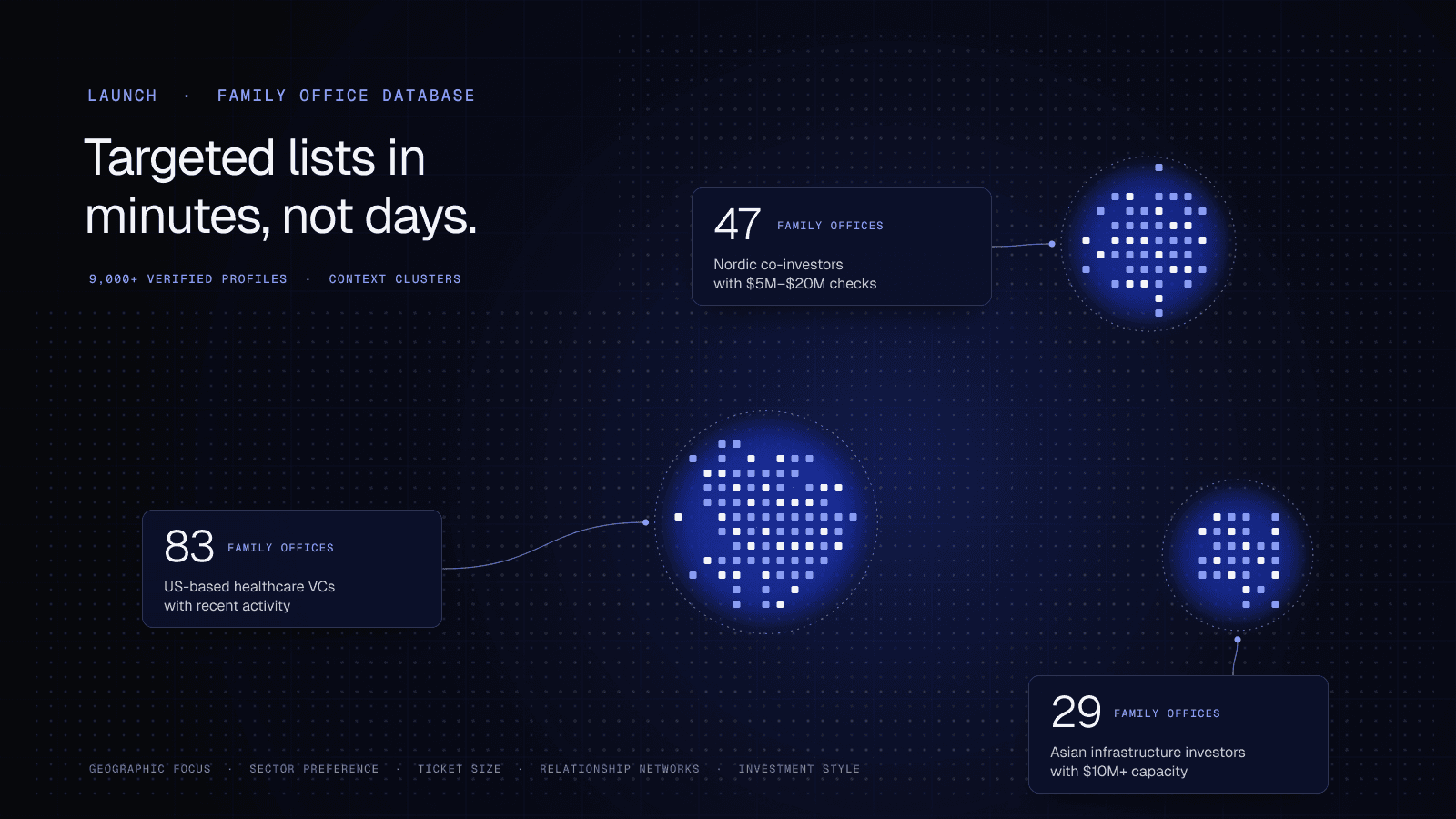
Altss groups LPs into contextual clusters based on shared characteristics: geographic focus, sector preference, ticket size, relationship networks, and investment style.
Example clusters:
- "Nordic co-investors with $5M–$20M checks": 47 family offices that prefer co-investments in Nordic private equity, with check sizes between $5M and $20M.
- "US-based healthcare VCs with recent activity": 83 family offices that have made venture capital commitments in healthcare within the last 12 months.
- "Asian infrastructure investors with $10M+ capacity": 29 family offices in Asia-Pacific that have signaled interest in infrastructure investments and write checks of $10M or more.
Why this matters: Fund managers can build targeted outreach lists in minutes, not days. The clusters are dynamically updated as new signals arrive, so the lists stay current.
Operator-Grade UX
Altss was designed by fund managers, for fund managers. The interface prioritizes speed and clarity over bells and whistles.
- Search that works: Boolean search, natural language queries, and filter combinations that return results in under a second.
- No bulk export, deliberately: Data is worked inside the platform. Lists that leave a platform get resold, and resold lists are why allocator inboxes are saturated.
- No public API: Access runs through the Altss interface. The same choice as the export rule, for the same reason: it is what protects deliverability for everyone using the data.
- Mobile-first design: Full functionality on mobile devices, designed for the conference-floor workflow.
Product Features: Coming Soon
Altss's product roadmap is driven by user feedback from the fund managers and emerging GPs who use the platform daily. The following features are in active development.
Events Radar and GP–LP Connect
Fundraising is fundamentally a relationship business, and conferences are where relationships are built. Altss's Events Radar will surface the conferences, symposia, and networking events most relevant to a fund manager's target LPs.
What it will do:
- Conference intelligence: Identify which LPs are attending which events, based on public registrations, speaker lists, and social-media posts.
- Meeting optimization: Suggest which LPs to prioritize at each event, based on fit scores and timing signals.
- Post-event follow-up: Track which LPs you met, what was discussed, and when to follow up.
GP–LP Connect will extend this functionality into a structured introduction system, matching fund managers with LPs based on mutual fit and facilitating warm introductions through shared network connections.
Channel Intelligence
Not all LPs are reachable through direct outreach. Some prefer to be approached through intermediaries: placement agents, advisors, consultants, or other GPs in their network.
Altss's Channel Intelligence will surface the most effective channels for reaching each LP, based on their known relationship network, preferred introduction methods, and past behavior.
Example: A family office in Switzerland has historically made commitments only through a specific placement agent. Altss surfaces this information alongside the profile, along with the agent's contact details and relationship strength.
Warm-Path Finder
Cold outreach is the least effective method of LP engagement. Altss's Warm-Path Finder will identify shared connections, mutual advisors, and network overlaps between a fund manager and their target LPs.
How it will work:
- Network analysis: Altss ingests public relationship data from LinkedIn, conference attendee lists, and news articles to build a relationship graph of the private-markets ecosystem.
- Path identification: For any fund manager–LP pair, Altss identifies the shortest warm path: "You have a mutual connection with [Person X], who introduced [LP] to [Fund Y] in 2024."
- Introduction support: Altss provides the context needed to make a warm introduction effective: what the connection is, how strong it is, and what the LP is currently interested in.
Startup Coverage
Family offices are increasingly investing directly in startups, but legacy databases barely cover this segment. Altss is building dedicated startup coverage, tracking which family offices are active in early-stage investing, their sector preferences, and their typical check sizes.
Initial coverage: 1,200+ family offices with known startup investment activity, across seed, Series A, and Series B stages.
Connection Network
Altss is building a structured connection network that maps relationships across the private-markets ecosystem: which LPs have invested with which GPs, which advisors work with which family offices, and which placement agents have the strongest networks in specific regions or strategies.
Data sources: Public fund documents, SEC filings, news articles, press releases, and social-media posts. Altss does not use private or proprietary data sources.
Forecasts and Prediction Layer
The ultimate goal of Altss's intelligence platform is not just to tell fund managers what is happening now, but what is likely to happen next.
The Prediction Layer will use machine learning models trained on historical LP behavior to forecast:
- Likely allocation changes: Which LPs are most likely to shift their asset allocation within the next 6–12 months.
- Timing of new commitments: When an LP is most likely to make a new fund commitment, based on past cadence and current signals.
- Emerging trends: Which strategies, sectors, or geographies are gaining LP attention, based on aggregate signal data.
Forecasts will provide probabilistic estimates for each prediction, along with the confidence level and the signals that drove the forecast.
Who Altss Serves: The Full Alternatives Ecosystem
Altss is built for every participant in the private-markets fundraising ecosystem. The platform's flexibility and depth make it useful across a wide range of use cases.
Independent Sponsors and Emerging Managers
Independent sponsors and emerging GPs face the steepest fundraising challenges. They lack the brand recognition, track record, and institutional relationships that established firms take for granted. For this group, accurate LP intelligence is not a nice-to-have—it is a survival tool.
How Altss helps:
- Targeted outreach: Filter LPs by ticket size, mandate, and recent activity to find those most likely to write $1M–$10M checks.
- Warm-path identification: Find shared connections to avoid the cold-call trap.
- Signal-based timing: Focus on LPs who are actively fundraising or signaling current interest, not those who appear "active" on paper but are actually paused.
Example: A healthcare-focused independent sponsor raising a $50M fund uses Altss to identify 120 family offices that have made venture capital commitments in healthcare within the last 18 months, with minimum check sizes under $5M. The sponsor prioritizes the 40 LPs with recent signal activity—conference attendance, blog posts, or new hires in healthcare investing—and reaches out through shared connections identified by Altss's network analysis.
Venture Studios and Venture Capital Firms
Venture capital fundraising has become increasingly institutionalized, but family offices remain a critical source of capital for early-stage funds. Altss's startup coverage and sector-specific clustering make it particularly valuable for VC firms.
How Altss helps:
- Sector-specific LP discovery: Find family offices that have invested in your sector, at your stage, with your check size.
- Co-investment tracking: Identify LPs who prefer co-investments alongside VC funds, and surface the GPs they have co-invested with.
- Timing signals: Capture LPs who are actively building their venture allocation, based on public statements, hiring, and conference attendance.
Example: A seed-stage VC firm focused on climate tech uses Altss to find 75 family offices that have made climate-tech investments, with minimum check sizes under $2M. The firm filters further by recent signal activity, identifying 22 LPs who have attended climate-tech conferences or published thought leadership on the sector in the last six months.
Growth Equity and Buyout Firms
Growth equity and buyout firms typically target larger checks and institutional relationships, but family offices remain an important part of the capital stack for mid-market funds.
How Altss helps:
- Ticket-size matching: Find family offices with minimum check sizes in the $5M–$25M range, avoiding the false positives of legacy databases.
- Mandate alignment: Identify LPs whose stated allocation matches the fund's strategy—growth equity, buyout, sector-specific, or geographic-specific.
- Capacity signals: Surface LPs who have signaled capacity for new commitments, versus those who are fully allocated.
Example: A $300M growth equity fund focused on enterprise software uses Altss to identify 60 family offices that have made growth equity commitments in software, with check sizes between $5M and $20M. The fund prioritizes 18 LPs with recent signal activity—new hires in software investing, conference attendance, or public statements about increasing their growth allocation.
Private Credit Managers
Private credit has exploded in popularity, with family offices increasingly allocating to direct lending, distressed debt, and specialty finance. Altss's signal-based intelligence is particularly valuable for this fast-moving segment.
How Altss helps:
- Trend detection: Capture LPs who are shifting from private equity to private credit, based on public statements, hiring, and conference attendance.
- Mandate specificity: Find LPs interested in specific credit strategies—direct lending, venture debt, distressed, or specialty finance.
- Capacity assessment: Identify LPs who have capacity for new credit commitments, versus those who have already deployed their allocation.
Example: A direct lending manager raising a $500M fund uses Altss to identify 120 family offices that have made private credit commitments within the last 24 months. The manager filters by recent signal activity, finding 35 LPs who have attended private credit conferences, hired credit investment professionals, or published thought leadership on the sector.
Real Estate and Infrastructure Funds
Real estate and infrastructure investments require long-term, patient capital—a natural fit for family offices. Altss's geographic and sector-specific coverage makes it valuable for these strategies.
How Altss helps:
- Geographic targeting: Find family offices with a stated preference for specific regions or property types.
- Sector specificity: Identify LPs interested in infrastructure sub-sectors—energy, transportation, digital, social.
- Ticket-size alignment: Match check sizes to the fund's target range, avoiding the mismatches that plague legacy databases.
Example: A real estate fund focused on European logistics properties uses Altss to find 45 family offices that have made logistics or industrial real estate investments, with check sizes between $5M and $15M. The fund prioritizes 20 LPs with recent signal activity in the sector.
Secondaries and Fund-of-Funds Managers
Secondaries and fund-of-funds managers serve a different function in the ecosystem, but they too need accurate LP intelligence—both for fundraising and for deal sourcing.
How Altss helps:
- LP discovery for fundraising: Find family offices that allocate to secondaries or fund-of-funds strategies.
- Deal sourcing: Identify LPs who may be interested in selling fund stakes or restructuring their portfolios.
- Network analysis: Map the relationship networks of secondaries buyers and sellers.
Family Offices, Multi-Family Offices, and UHNW Offices
Family offices are both users of Altss and subjects of its intelligence. The platform helps family offices benchmark their allocations, discover co-investment partners, and identify GP relationships.
How Altss helps:
- Peer benchmarking: Compare your allocation, ticket sizes, and investment preferences against peers in your region and strategy.
- Co-investment discovery: Find other family offices with similar investment preferences for potential co-investment partnerships.
- GP relationship mapping: Identify which GPs other family offices in your network have committed to, and surface potential new relationships.
RIAs and Wealth Managers
Registered investment advisors (RIAs) and wealth managers increasingly serve family office clients, but they lack the specialized intelligence tools that institutional allocators take for granted.
How Altss helps:
- Client discovery: Identify family offices that may be interested in your advisory services.
- Benchmarking: Compare client portfolios against peer family offices.
- Investment intelligence: Surface private-markets opportunities that match client preferences.
Corporate Venture Arms
Corporate venture capital (CVC) units are a growing source of capital for startups and venture funds, but they operate differently from traditional family offices. Altss's coverage includes corporate venture arms with dedicated family office-like structures.
How Altss helps:
- CVC discovery: Find corporate venture arms with strategic alignment to your sector or stage.
- Mandate understanding: Surface the strategic priorities and investment criteria of each CVC.
- Relationship mapping: Identify connections between CVCs and the parent corporation's broader ecosystem.
Investment Banks and M&A Advisors
Investment banks and M&A advisors need LP intelligence for both fundraising and deal sourcing. Altss's data on family office investment preferences and recent activity is valuable for both use cases.
How Altss helps:
- Deal sourcing: Identify family offices that may be interested in buying or selling portfolio companies.
- Fundraising support: Help clients identify LP targets for their funds.
- Market intelligence: Provide clients with data on family office investment trends and activity.
Institutional Allocators
Pension funds, endowments, foundations, and sovereign wealth funds are increasingly allocating to private markets alongside family offices. Altss's coverage is expanding to include these institutional allocators, with the same signal-based intelligence and sub-30-day refresh cycle.
The Fundraising Playbook: How to Use Altss in 2026
Altss is a tool, not a strategy. But used correctly, it can transform the fundraising process from a scattershot, time-intensive grind into a focused, data-driven operation.
Phase 1: Discovery
Goal: Build a targeted list of LPs with high current probability of interest.
Steps:
- Define your ideal LP profile. Start with the basics: geography, ticket size, mandate (strategy, sector, stage), and relationship preferences. Be specific. "Family offices in North America" is too broad. "Family offices in the US Midwest with a preference for growth equity in enterprise software, minimum check $3M–$10M" is actionable.
- Use Altss's search and filters to build your list. Boolean search for exact matches; natural language for fuzzy matches. Combine filters for geography, ticket size, mandate, and recent activity.
- Prioritize by signal activity. Not all LPs are equal. Filter by recent signal activity: conference attendance, new hires, public statements, or blog posts that indicate current interest in your sector or strategy.
- Identify warm paths. For each priority LP, use Altss's network analysis to find shared connections. Prioritize LPs with warm paths over those requiring cold outreach.
Example list: 35 family offices meeting the following criteria:
- Geography: US Midwest
- Mandate: Growth equity in enterprise software
- Minimum check: $3M–$10M
- Recent signal activity: Attended a software investing conference, hired a software investment professional, or published thought leadership on enterprise software within the last six months
- Warm path: Shared connection through a mutual GP, advisor, or conference
Phase 2: Research
Goal: Understand each priority LP deeply before reaching out.
Steps:
- Read the signal timeline. What has this LP been doing in the last 12 months? What conferences have they attended? What investments have they made? What thought leadership have they published?
- Analyze the fit score. Altss's machine learning model scores the fit between your fund and each LP. Understand why the score is high or low. The model provides explainability: "High fit score driven by mandate alignment (growth equity) and recent signal activity (hired software investment professional)."
- Study the relationship network. Who has this LP invested with? Who are their advisors? Who are their co-investors? This context will inform your outreach strategy.
- Check capacity signals. Is this LP actively fundraising? Are they fully allocated for the year? Have they signaled a pause in new commitments? Altss's signal timeline captures these indicators.
Example research output for one LP:
- Name: Smith Family Office
- Location: Chicago, IL
- AUM: $500M
- Mandate: Growth equity, enterprise software, $5M–$15M checks
- Recent activity: Committed $10M to Fund X (growth equity, enterprise software) in Q3 2025; attended Enterprise Software Summit in San Francisco in Q4 2025; hired new Director of Software Investments in Q1 2026
- Capacity signals: CIO stated in a December 2025 podcast that the office is "actively looking for new growth equity opportunities in enterprise software"
- Warm path: Mutual connection through Partner Y at Fund Z, who introduced Smith FO to Fund X in 2025
Phase 3: Outreach
Goal: Make contact through the most effective channel, with a personalized message that demonstrates understanding of the LP's current interests.
Steps:
- Choose the channel. Warm introduction through a shared connection is always best. If no warm path exists, use the verified contact information from Altss (email, phone, LinkedIn).
- Craft the message. Reference specific signals from Altss's timeline: "I saw you recently hired a Director of Software Investments and attended the Enterprise Software Summit. Given your focus on growth equity in enterprise software, I thought our fund might be of interest."
- Time the outreach. Altss's signal timeline can help you identify optimal timing. Is the LP attending a conference next month? Are they in a quiet period after a big commitment? Are they actively fundraising?
- Track and iterate. Use Altss's export and API to track your outreach pipeline. Note which LPs responded, which didn't, and why.
Example outreach email:
```
Subject: Growth equity in enterprise software
Dear [LP Name],
I noticed that Smith Family Office recently hired a Director of Software Investments and has been actively exploring growth equity opportunities in enterprise software.
Our firm, [Fund Name], is raising a $300M growth equity fund focused exclusively on enterprise software companies in the US Midwest. We have a strong track record in the sector, with three exits in the last 24 months.
Given your stated interest in the space, I would welcome the opportunity to share more about our fund and discuss whether there might be alignment.
Would you be available for a brief call in the coming weeks?
Best,
[Your Name]
```
Phase 4: Relationship Building
Goal: Convert initial contact into a long-term relationship that may lead to a commitment.
Steps:
- Follow up with substance. After the initial call, share relevant materials—pitch deck, track record, reference calls. Use Altss to identify other LPs in the LP's network who have invested with you, and offer to connect them for reference calls.
- Stay current. Altss's signal timeline will continue to surface new signals about the LP. Monitor these signals and use them to inform follow-up conversations. "I saw you attended the Private Equity Summit in New York last week. How was it?"
- Be patient but persistent. Family office fundraising cycles can take 6–18 months. Use Altss to track the LP's activity over time and maintain a consistent, value-add presence.
- Close and document. When the LP commits, document the relationship in Altss for future reference. Note the terms, the relationship path, and any lessons learned.
The Data Quality Challenge: Why Legacy Databases Can't Keep Up
The fundraising ecosystem of 2026 demands a level of data quality that legacy databases cannot provide. The reasons are structural, not fixable with incremental improvements.
The structural limitations of legacy databases:
- Quarterly refresh cycles. PitchBook, Preqin, and FINTRX update their databases quarterly at best. In a world where LPs change roles, shift mandates, and adjust allocations monthly, quarterly updates are hopelessly inadequate.
- Voluntary submission bias. Legacy databases rely heavily on LPs voluntarily submitting their data. This creates a self-selection bias: LPs who respond to surveys are systematically different from those who don't. The result is a database that overrepresents some segments and underrepresents others.
- Manual research costs. Calling LPs quarterly is expensive. The economics of manual research limit how many profiles can be maintained and how frequently they can be updated.
- Gatekeeping incentives. Legacy databases have a business model that incentivizes data scarcity, not data abundance. By controlling access to data, they create lock-in and prevent users from integrating intelligence into their own workflows.
- No signal-based intelligence. Legacy databases capture static data points—who an LP is, what they do, where they are. They do not capture dynamic signals—what an LP is doing right now, what they are interested in, who they are talking to.
The Altss alternative:
Altss's OSINT and social-listening architecture solves each of these problems:
- Continuous refresh: Data is updated within days of a public change, not months.
- No submission bias: Data is collected from public sources, not voluntary surveys.
- Scalable economics: Automated pipelines reduce the cost of data collection, allowing coverage of more profiles with higher frequency.
- Controlled access: The workflow lives where the data lives — CRM, outreach, meetings and analytics inside Altss, rather than an export into someone else's stack.
- Signal-based intelligence: The platform captures not just static data points, but dynamic signals that indicate current interests and activity.
The Economics of Better LP Intelligence
The cost of poor LP intelligence is measured in wasted time, missed opportunities, and failed fundraises.
The math:
- Time wasted on false positives: A fund manager targeting 200 LPs might find that 40% are false positives—LPs who appear active but are actually paused, fully allocated, or out of mandate. At 2 hours of research per LP, that's 160 hours wasted.
- Missed timing windows: An LP who is actively fundraising in Q1 may be fully allocated by Q3. Missing the timing window means losing the opportunity entirely.
- Failed fundraises: For emerging managers, a failed fundraise is existential. Accurate LP intelligence can mean the difference between reaching the hard cap and returning capital.
Altss's value proposition:
- Time savings: Altss's signal-based intelligence reduces false positives by an estimated 60% compared to legacy databases, based on early user feedback. For a fund manager targeting 200 LPs, that's 120 hours saved.
- Improved conversion rates: Warm-path identification and timing-aware outreach can improve conversion rates by 2–3x, according to Altss user data.
- Reduced risk: Accurate intelligence reduces the risk of targeting the wrong LPs, missing timing windows, or failing to raise capital.
The Future of LP Intelligence
Altss launched with family office coverage, but the vision is broader. The platform is designed to become the definitive source of allocator intelligence for the entire private-markets ecosystem.
The roadmap beyond family offices:
- Institutional allocators: Pension funds, endowments, foundations, and sovereign wealth funds are being added to the database, with the same signal-based intelligence and sub-30-day refresh cycle.
- Placement agents and advisors: Altss will track the intermediaries who connect GPs and LPs, surfacing the most effective channels for reaching each allocator.
- GP intelligence: The platform will expand to cover GPs as well as LPs, providing fund managers with intelligence on their competitors and collaborators.
- Market intelligence: Aggregate signal data will power market intelligence reports, identifying emerging trends in LP behavior, allocation shifts, and fundraising dynamics.
The prediction layer:
The ultimate goal is a platform that doesn't just tell fund managers what is happening now, but what is likely to happen next. Altss's Prediction Layer will use machine learning to forecast LP behavior, allocation shifts, and market trends, giving fund managers a strategic advantage in a competitive fundraising environment.
Why Altss Matters Now
The fundraising environment of 2026 is the most competitive in a generation. Capital is scarce, LPs are selective, and the gap between successful fundraises and failed ones is widening.
The trends that make Altss essential:
- LP consolidation: The number of active family offices is growing, but the number making new commitments is shrinking. Altss's signal-based intelligence helps fund managers find the LPs who are actually active.
- Emerging manager challenges: Emerging managers face the steepest fundraising hurdles in history. Accurate LP intelligence is no longer a luxury—it is a requirement for survival.
- Timing sensitivity: LP allocations are more volatile than ever. A fund manager who misses the timing window may find that their target LPs are fully allocated for the next 12–18 months.
- Relationship complexity: The web of relationships connecting GPs, LPs, advisors, and intermediaries is more complex than ever. Altss's network analysis helps fund managers navigate this complexity.
The opportunity:
For fund managers who embrace intelligence-driven fundraising, the opportunity is enormous. The LPs are out there. The capital is available. The challenge is finding the right LPs at the right time with the right message.
Altss is built to solve that challenge.
Getting Started with Altss
Altss is live today with 9,000+ verified family office profiles, a sub-30-day refresh cycle, and the full suite
Find the allocators who actually back funds like yours
GPs and IR teams use Altss to research allocators with ownership, commitment, transaction and relationship context, then prioritize outreach.


See the allocators behind your next close.
Public records carry source-specific dates where available. No population-wide measured refresh cadence or universal verification deadline is established here. Page modified, source captured, fact observed, entity verified and aggregate measured describe different events. Check the date attached to the relevant claim; a missing verification date means unknown. Stored source history does not establish a customer-facing historical-analysis interface.