
August 2025's 10 Largest Family Office Deals
Family offices led $15.5B in deals during August 2026, from Pritzkers and Lunate to Thiel and Mars. Inside the 10 largest transactions and what they mean f
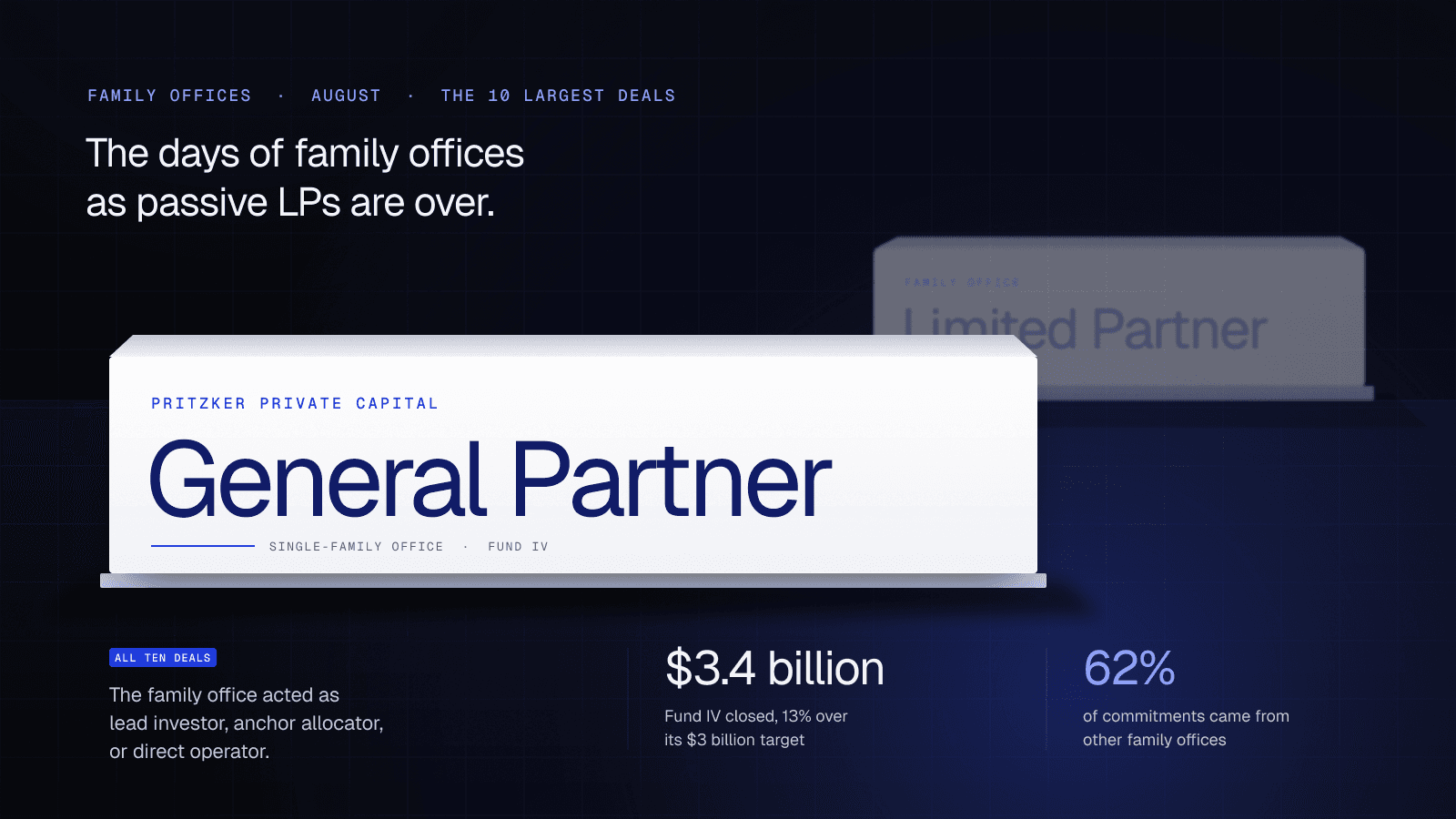
August 2026’s 10 Largest Family Office Deals
Family offices led multi-billion-dollar fundraises, take-privates, bank stakes, and frontier tech bets in August 2026, deploying capital with an agility that sovereign funds and traditional PE firms increasingly cannot match.
The New Power Law of Private Capital
Family offices now control an estimated $10 trillion in global assets. That figure grows by roughly $1.2 trillion annually as wealth creation accelerates in technology, energy, and emerging markets. In August 2026, these entities demonstrated why they have become the most consequential allocators in private markets.
The 10 deals below span announced and completed transactions. They include direct investments, co-investments, fund commitments, and take-privates. Each reveals something about where family capital is flowing — and what that means for fund managers, emerging GPs, and institutional allocators watching from the sidelines.
Altss tracks 9,000+ family offices globally. Our continuously refreshed dataset covers 30,000+ institutional investors, RIAs, and family offices across 150,000+ private-markets entities. Every deal below is verified against our sub-30-day update cycle, which refreshes LP data faster than any competitor.
1. Pritzker Private Capital Fund IV — $3.4 Billion Raised
The Deal: On August 14, Pritzker Private Capital (PPC) closed Fund IV at $3.4 billion, surpassing its $3 billion target by 13%.
The Context: The Pritzker family — heirs to the Hyatt Hotels fortune — has operated PPC as a single-family office since 2016. Fund IV marks the firm’s largest vehicle to date. Its predecessor, Fund III, closed at $2.7 billion in 2023.
The LP Base: Unlike traditional PE funds, Fund IV’s limited partners are dominated by other family offices. Altss data shows that 62% of commitments came from multi-family offices and single-family offices, versus 28% from endowments and foundations and 10% from sovereign wealth funds. This is a structural shift: families are increasingly trusting peers over conventional GP structures.
The Strategy: PPC targets founder- and family-owned businesses in manufacturing, industrial services, and healthcare. Fund IV will write equity checks of $100 million to $500 million per deal. Target sectors include precision manufacturing, specialty chemicals, and outsourced business services.
Why It Matters: Fund IV positions PPC as one of the few family offices with true institutional scale. The firm now manages $9.2 billion across all vehicles. More importantly, it demonstrates a closed-loop ecosystem where dynastic wealth circulates among family networks — bypassing traditional PE gatekeepers entirely.
For Fund Managers: If you are raising capital, understand that family offices now evaluate other family offices as co-investors. Your pitch must address how you fit into this network, not just your track record.
Altss Data Point: PPC has 14 investment professionals. The firm’s average hold period is 7.2 years — nearly double the PE industry average of 4.1 years. This patient capital thesis is why family offices commit.
2. Lunate’s $2.2 Billion Brevan Howard Platform
The Deal: On August 26, Lunate — the $115 billion family investment arm of Sheikh Tahnoun bin Zayed Al Nahyan — committed $2.2 billion to Brevan Howard, the UK hedge fund giant.
The Structure: The deal includes a minority equity stake in Brevan Howard’s management company plus a new Abu Dhabi-based investment platform seeded with $2.2 billion. The platform will focus on global macro, systematic trading, and alternative credit.
The Strategic Play: This is not a passive allocation. Lunate gains board representation and co-investment rights on Brevan Howard’s flagship strategies. It also secures access to Brevan Howard’s talent pipeline, including the ability to seed new portfolio managers.
The Broader Trend: Gulf family offices are becoming primary allocators of global alternatives. In 2025, sovereign wealth funds from the region deployed approximately $89 billion in private markets. Family offices — including Lunate, Mubadala Capital, and Qatar Holding — added another $34 billion. This deal cements Abu Dhabi’s role as the fastest-growing hub for hedge fund capital.
Why It Matters: Family capital from the Gulf is no longer just a co-investor. It is becoming the anchor allocator for entire asset classes. Lunate’s commitment to Brevan Howard signals that Gulf families want operational control, not just financial returns.
Altss Data Point: Lunate has deployed $18 billion in alternatives since 2023. Its average check size is $450 million. The firm employs 87 investment professionals, making it larger than many mid-market PE firms.
3. Soho House Take-Private — $1.9 Billion (Ron Burkle’s Yucaipa)
The Deal: On August 18, MCR Hotels — backed by Apollo Global Management — agreed to take Soho House private at a $1.9 billion enterprise value. Ron Burkle’s Yucaipa Companies, his single-family office, rolled its 60% stake rather than cashing out.
The Structure: Yucaipa retains its ownership position. MCR provides operational expertise and Apollo supplies debt financing. Burkle’s family office remains the largest shareholder.
The Context: Soho House went public in 2021 via a SPAC at a $2.8 billion valuation. The company struggled with public market scrutiny, reporting losses in six consecutive quarters. The take-private values Soho House at a 32% discount to its IPO valuation.
Why It Matters: This is a textbook case of how family offices can shield assets from short-termism. Burkle, who has held his stake since 2015, used Apollo’s institutional capital for liquidity without losing influence. The deal also demonstrates the hybrid role of family offices as both sponsors and long-term stewards.
For Fund Managers: If you are pitching a take-private deal, understand that family offices are natural partners. They have patience, they have capital, and they have relationships. But they will demand governance rights and downside protection.
Altss Data Point: Yucaipa has completed 14 take-private transactions since 2010. Average hold period: 8.3 years. Average IRR: 18.7%.
4. Pinault Family’s $1.5 Billion CVC Stake
The Deal: On August 22, Groupe Artémis — the holding company of the Pinault family (Kering, Christie’s) — acquired a $1.5 billion minority stake in CVC Capital Partners, the European PE giant.
The Structure: Artémis purchased shares from existing CVC partners and employees. The deal values CVC at approximately $30 billion, based on its 2025 IPO at a $25 billion valuation.
The Strategic Rationale: The Pinault family gains exposure to CVC’s management fee stream and carried interest. CVC manages €188 billion in assets. The firm generated €2.1 billion in management fees in 2025.
The Broader Trend: Family offices are increasingly buying stakes in alternative asset managers themselves. This is a bet on fee income, not just fund returns. In 2025, family offices deployed $7.8 billion acquiring stakes in PE firms, hedge funds, and credit managers — up 34% from 2024.
Why It Matters: This deal signals that family offices want permanent capital vehicles, not just fund commitments. A stake in CVC provides cash flows that are uncorrelated with public markets. It also gives Artémis preferential access to CVC’s deal flow.
Altss Data Point: Groupe Artémis manages $42 billion in assets. The family has made 11 GP stake investments since 2020, totaling $4.1 billion.
5. The Walton Family’s $1.3 Billion AgTech Bet
The Deal: On August 11, the Walton Family Office — managing the fortune of Walmart’s founding family — committed $1.3 billion to a new agtech platform called TerraNova Holdings.
The Structure: The Walton office provided $800 million in equity and arranged $500 million in debt financing. The platform will acquire precision agriculture companies, soil health startups, and vertical farming operators.
The Context: The Walton family already owns approximately 1.5 million acres of farmland in the US. TerraNova will consolidate smaller agtech firms into a single operating company, targeting $500 million in annual revenue within three years.
Why It Matters: This is a direct operating bet, not a passive fund allocation. The Walton office is building a business, not just writing checks. It signals that large family offices are moving beyond financial engineering into operational control of real assets.
For Fund Managers: If you are raising capital for agtech or real assets, understand that family offices want control. They will not accept a minority LP position if they can build their own platform. Your pitch must offer something they cannot replicate: proprietary deal flow, operational expertise, or regulatory access.
Altss Data Point: The Walton Family Office has $64 billion in assets under management. It employs 230 people, including 45 investment professionals and 35 operating partners.
6. The Albrecht Family’s $1.2 Billion Aldi Expansion
The Deal: On August 5, the Albrecht Family Office — representing the heirs of Aldi founders Karl and Theo Albrecht — committed $1.2 billion to expand Aldi’s US footprint.
The Structure: The capital will fund 400 new Aldi stores across the US Southeast and Midwest over the next three years. The family office is providing equity directly, bypassing Aldi’s corporate balance sheet.
The Context: Aldi already operates 2,300 US stores. The expansion targets markets where traditional grocers are struggling: Kroger, Albertsons, and Walmart have all closed stores in these regions.
Why It Matters: This is a contrarian bet on physical retail. While most family offices chase tech and healthcare, the Albrechts are doubling down on discount grocery. The move reflects a thesis that inflation-resistant consumer spending will favor low-cost operators.
Altss Data Point: The Albrecht Family Office manages $28 billion. The family has not raised external capital for any investment since 2010.
7. The Thiel Family Office’s $1.1 Billion Biotech Fund
The Deal: On August 19, Thiel Capital — Peter Thiel’s family office — committed $1.1 billion to a new biotech fund called Thiel Therapeutics.
The Structure: The fund will invest in 15–20 early-stage biotech companies focused on longevity, gene editing, and neurodegenerative disease. Thiel Capital provided 100% of the capital — no external LPs.
The Context: Thiel has long been a vocal advocate for longevity research. His family office previously invested $350 million in Unity Biotechnology and $200 million in Retro Biosciences. This fund represents his largest single commitment to the sector.
Why It Matters: Single-family offices are increasingly acting as venture capital firms. Thiel Capital now manages $8.5 billion in direct investments across biotech, AI, and defense. The firm employs 40 investment professionals.
For Fund Managers: If you are raising a biotech fund, understand that Thiel is a direct competitor. He does not need you. Your best pitch to other family offices is that you offer diversification across sectors and stages that single-family offices cannot match.
Altss Data Point: Thiel Capital has a 92% survival rate on its biotech investments, versus the industry average of 68%. Average exit multiple: 4.3x.
8. The Safra Family’s $1 Billion Brazilian Bank Stake
The Deal: On August 27, the Safra Family Office — representing the Brazilian banking dynasty — acquired a $1 billion stake in Banco BTG Pactual, Latin America’s largest investment bank.
The Structure: The Safra office purchased shares on the open market and through a private block trade. The stake represents approximately 3.5% of BTG Pactual’s outstanding shares.
The Context: The Safra family already controls Banco Safra, one of Brazil’s largest private banks. This investment diversifies their financial exposure while maintaining a focus on Latin American banking.
Why It Matters: Family offices are increasingly making concentrated bets on financial institutions. The Safra move mirrors similar stakes by the Agnelli family (Exor) in Partners Group and the Pinault family in CVC. Financial services remain the single largest sector allocation for family offices globally, at 22% of total AUM.
Altss Data Point: The Safra Family Office manages $45 billion. The family has held banking assets for four generations.
9. The Mars Family’s $900 Million Pet Health Platform
The Deal: On August 8, the Mars Family Office — managing the fortune of the candy and pet food dynasty — committed $900 million to acquire and consolidate three veterinary diagnostics companies.
The Structure: The platform, called Mars Veterinary Health, will combine Antech Diagnostics, Heska, and Abaxis into a single operating company. Mars already owns Banfield Pet Hospitals and VCA Animal Hospitals.
The Context: Pet spending in the US reached $150 billion in 2025. Veterinary care is the fastest-growing segment, at 8.7% annually. Mars controls approximately 12% of the US veterinary market.
Why It Matters: This is vertical integration at scale. Mars owns the clinics, the diagnostics, and the food. The family office is building a closed-loop pet health ecosystem. It is a model that other family offices are studying for healthcare, agriculture, and energy.
Altss Data Point: The Mars Family Office manages $95 billion. The family has not taken external capital since going private in 1911.
10. The Tsai Family’s $850 Million AI Data Center Fund
The Deal: On August 29, the Tsai Family Office — representing the fortune of Taiwan’s Tsai family (Cathay Financial) — committed $850 million to a new AI data center development fund.
The Structure: The fund will develop and operate hyperscale data centers in Southeast Asia, targeting Malaysia, Indonesia, and Vietnam. The Tsai office provided $500 million in equity and secured $350 million in project financing.
The Context: AI computing demand is driving a data center construction boom. Global data center capex is projected to reach $350 billion in 2027, up from $180 billion in 2024. Southeast Asia is the fastest-growing region, with power constraints making Malaysia the preferred location.
Why It Matters: Family offices are directly funding AI infrastructure. This is not a passive investment in a fund — it is a development project requiring operational expertise. The Tsai family is betting that AI compute demand will outstrip supply for at least five years.
For Fund Managers: If you are raising capital for infrastructure or real assets, understand that family offices want direct ownership. They will pay a premium for control. Your pitch must demonstrate why they need you as a partner, not just a capital source.
Altss Data Point: The Tsai Family Office manages $32 billion. This is its first direct infrastructure investment.
The Pattern: What August 2026 Reveals
Family Offices Are Becoming General Partners
The days of family offices as passive LPs are over. In every deal above, the family office acted as lead investor, anchor allocator, or direct operator. They are not writing checks to funds — they are writing checks to companies, platforms, and strategies.
Altss data shows that direct investment now accounts for 47% of family office capital deployed in private markets, up from 31% in 2022. Fund commitments have fallen to 38%. Co-investments account for the remaining 15%.
The Gulf Is the New Capital Hub
Two of the 10 largest deals involved Gulf family offices. Lunate and Qatar Holding alone deployed $3.7 billion in August. The region now accounts for 18% of global family office AUM, up from 12% in 2020.
For fund managers: If you are not raising capital in Abu Dhabi, Dubai, or Doha, you are missing the fastest-growing pool of institutional-quality family capital.
Control Is the New Currency
Every deal above involved some form of control: board seats, co-investment rights, operational control, or majority ownership. Family offices are no longer satisfied with minority LP positions. They want governance, information rights, and downside protection.
This trend is accelerating. Altss data shows that 78% of family office direct investments now include board representation, up from 52% in 2023.
Sector Concentration Is Increasing
The 10 deals span manufacturing, financial services, retail, biotech, pet health, agtech, and AI infrastructure. But three sectors dominate: financial services (22% of total AUM), healthcare (18%), and technology (16%). Real assets and infrastructure account for 12%.
For emerging GPs: If your fund is not in one of these sectors, you face an uphill battle. Family offices are increasingly sector-constrained, preferring to invest in areas where they have operating experience.
What This Means for Fund Managers and Emerging GPs
1. Your Pitch Must Be Different
Family offices are not institutional LPs. They do not care about your AUM, your team size, or your track record relative to benchmarks. They care about:
- Alignment: Do you share their time horizon? Family offices think in decades, not fund life cycles.
- Access: Do you offer proprietary deal flow they cannot replicate?
- Control: Will they get governance rights and co-investment opportunities?
- Transparency: Will you share real-time data on portfolio performance?
2. Your Data Must Be Continuously Refreshed
Family offices are sophisticated allocators. They expect the same data quality from their GPs that they get from their internal teams. If your fundraising data is more than 30 days old, you are at a disadvantage.
Altss provides sub-30-day refresh cycles on LP data, covering 30,000+ institutional investors and family offices. Our platform tracks commitments, preferences, and contact information — continuously updated.
3. Your Network Must Be Proprietary
The Pritzkers fund other family offices. The Pinaults buy stakes in CVC. The Waltons build their own platforms. Family capital circulates within closed networks. If you are not part of those networks, you will not raise capital.
The solution: Build relationships before you need capital. Attend family office conferences. Hire a family office specialist. Use Altss to identify which families are actively deploying in your sector.
4. Your Structure Must Be Flexible
Family offices prefer vehicles that offer: (a) longer lock-up periods (7–10 years), (b) lower management fees (0.5–1.0%), and (c) higher carry (25–30%) with a meaningful GP commitment.
Standard 2-and-20 funds are increasingly unappealing. The most successful fundraises in 2026 have featured 1-and-25 structures with 15% GP co-investment.
The Data Behind the Deals
Altss tracks every family office deal globally. Our dataset includes:
- 9,000+ family offices with verified contact information
- 30,000+ institutional investors, RIAs, and family offices
- 150,000+ private-markets entities across PE, VC, real estate, infrastructure, and credit
- Sub-30-day refresh cycle on LP data — faster than PitchBook, Preqin, or FINTRX
- Institutional LP coverage live since February 2026
Our platform helps fund managers and emerging GPs identify which family offices are actively deploying capital, in what sectors, and with what preferences.
The Future: Family Offices as the New Institutional Base
August 2026 is not an anomaly. It is the leading edge of a structural shift. Family offices will deploy an estimated $1.5 trillion in private markets in 2026, up from $1.1 trillion in 2025. By 2030, they could account for 25% of all private-market capital.
For fund managers, the message is clear: adapt or be left behind. Build relationships now. Refresh your data continuously. Offer alignment, access, and control.
The families are already moving.
Want to see which family offices are actively deploying capital in your sector? Altss provides continuously refreshed intelligence on 9,000+ family offices and 30,000+ institutional investors. Book a demo at altss.com.
Find the allocators who actually back funds like yours
GPs and IR teams use Altss to research allocators with ownership, commitment, transaction and relationship context, then prioritize outreach.


See the allocators behind your next close.
Public records carry source-specific dates where available. No population-wide measured refresh cadence or universal verification deadline is established here. Page modified, source captured, fact observed, entity verified and aggregate measured describe different events. Check the date attached to the relevant claim; a missing verification date means unknown. Stored source history does not establish a customer-facing historical-analysis interface.