
Elevate Family Office Fundraising with Altss: Intelligence You Can Act On
Learn how Altss helps fund managers build trusted, data-driven relationships with family offices—using OSINT-derived, verified LP profiles, and semantic.
Elevate Family Office Fundraising with Altss: Intelligence You Can Act On — 2026 Edition
Family office fundraising in 2026 is not a list problem. It’s a timing, trust, and context problem—and most managers still solve it with stale directories and cold emails that land in spam.
Why family-office fundraising is different in 2026
Family offices are the fastest-growing allocator segment in private markets. Altss tracks 9,000+ family offices globally, up from roughly 7,500 in early 2024. The number of single-family offices with $100M+ in assets has grown 18% year-over-year since 2022, driven by wealth creation in technology, industrial exits, and intergenerational transfers in Europe and Asia.
Yet family offices remain the hardest allocators to reach for three structural reasons:
1. They are mandate-flexible but process-rigorous. A family office can shift from growth equity to direct infrastructure within a quarter. But their due diligence process—if they engage—can take 6–12 months. They demand context, not collateral. A 50-page deck with generic return projections gets deleted. A two-paragraph note referencing their recent co-invest in a logistics rollup in Southeast Asia gets a meeting.
2. They move fast and silently. A New York-based single-family office may spend January in London, February in Dubai, and March in Singapore. Their investment calendar is opaque. Most don't publish RFPs. Many don't have public websites. The ones that do often list a contact form that goes to a junior analyst who filters everything.
3. They hate being sold to. The average family office principal receives 200–400 fund marketing emails per month. Most go to spam. Those that land in the inbox are deleted within seconds if the sender name is unfamiliar, the subject line is generic, or the email is a blast to a purchased list. One burned sender reputation and you're blocked at the domain level.
Traditional tools fail here. PitchBook and Preqin cover family offices as an afterthought—their databases are built for institutional LPs, refreshed quarterly at best. FINTRX offers more family office coverage but relies on manual surveys and public filings, which lag by 6–18 months. By the time you get a contact, the principal has moved firms, changed mandates, or stopped reading emails from unknown senders.
Altss was built specifically for this reality. The platform combines OSINT-native signals, semantic search, and deliverability-first verification to help you reach the right principal with relevant context when they're actually open to the conversation.
What "intelligence you can act on" means at Altss
The phrase "actionable intelligence" is overused in fundraising technology. Most platforms claim it but deliver static directories with email addresses that bounce. At Altss, actionable intelligence means three things:
Continuously refreshed signals, not stale snapshots
Altss continuously ingests public, compliant sources—regulatory actions (SEC, FCA, MAS, DFSA), board minutes, press coverage, hiring announcements, portfolio events, RFPs, and visible conference activity—then resolves them to allocator entities and people. The refresh cycle is sub-30 days. When a family office adds a new investment principal, changes their check size range, or opens a new office in Riyadh, Altss reflects that within weeks. Not quarters.
Example: In January 2026, Altss detected a signal from a Dubai-based multi-family office—the firm had posted a job listing for a "Vice President, Private Equity – Direct Investments" with a focus on "healthcare services, $10M–$25M checks." Within 14 days, that signal was resolved to the firm's profile, the new hire was identified (a former CPP Investments principal), and the mandate update was flagged for users. A fund manager searching for "family offices writing $10M+ checks in healthcare services in the Middle East" would have seen this profile within the same month.
Semantic search over keyword guessing
Traditional database search forces you into Boolean gymnastics: `(family office OR FO) AND (healthcare OR health) AND (co-invest OR coinvest) AND (UAE OR Emirates)`. This misses nuance. What if the family office describes itself as "private investment office" or "family investment company"? What if their healthcare interest is specifically "medtech" or "healthcare IT"? What if they prefer "direct co-investment" but their profile says "sidecar deals"?
Altss semantic search understands intent. You describe what you want in plain language:
- "Family offices writing $5–$15M checks in healthcare services with co-invest appetite"
- "London multi-family offices backing first-time managers in industrial services, checks up to $10M"
- "Singapore principals with recent exits in AI tooling, open to co-invest"
- "Nordic family offices exploring renewable energy infrastructure, direct and fund-of-funds"
The platform returns precise results—ranked by relevance, not alphabetically. It understands that "healthcare services" includes "hospital management," "ambulatory surgery centers," "home health," and "behavioral health." It knows that "co-invest appetite" can be expressed as "direct co-investment," "sidecar deals," "SPV participation," or "club deals."
Verification designed for deliverability
Altss maintains 30,000+ institutional investor, RIA, and family office contacts, with more than 150,000 private-markets entities in the broader database. Every email address is verified on a strict refresh cadence, targeting a sub-2% hard bounce rate on verified emails for teams that follow sender hygiene best practices. That means no bulk CSV exports and no open API that lets you scrape and blast. All outreach happens in-platform.
Why this matters: A 90% deliverability rate means 1 in 10 of your carefully crafted emails never lands. A 95% rate means 1 in 20 bounces. If you're sending to 500 family offices, that's 25–50 lost opportunities before you even start. Worse, high bounce rates damage your sender reputation, causing future emails to land in spam even to valid addresses.
Altss verification pipeline checks:
- Syntax validity
- Domain existence and MX records
- Mailbox responsiveness (SMTP handshake)
- Spam trap detection
- Role-based address flagging (info@, contact@, admin@)
The result: when you send through Altss, your outreach lands in the inbox, not the spam folder.
1) Find the right family offices—instantly and accurately
Comprehensive coverage that matches how capital moves
Altss covers 9,000+ family offices today across North America, Europe, the Middle East, and Asia. This includes:
- 3,200+ single-family offices in North America (concentrated in New York, San Francisco, Boston, Chicago, Dallas, Miami)
- 2,800+ in Europe (London, Zurich, Geneva, Luxembourg, Stockholm, Milan, Paris, Munich)
- 1,500+ in the Middle East (Dubai, Abu Dhabi, Riyadh, Doha, Kuwait City, Manama)
- 1,500+ in Asia (Singapore, Hong Kong, Tokyo, Sydney, Mumbai, Shanghai)
Coverage is not just entity names and locations. Every profile includes mandate-grade detail:
- Asset class focus (private equity, venture capital, real estate, infrastructure, credit, hedge funds, direct investments)
- Check size range (from $500K sidecars to $50M+ anchor commitments)
- Geographic preferences (regional, global, emerging markets)
- Co-investment behavior (direct co-invest, SPV/sidecar, club deals, no co-invest)
- First-time manager posture (open, selective, closed)
- Principal bios (name, title, previous firm, investment focus, LinkedIn profile, email)
- Recent signals (hiring, portfolio exits, conference attendance, regulatory filings, press mentions)
Precision filters that mirror how IR teams think
Altss filters are organized the way investor relations teams actually build target lists: sector → ticket → geography → activity window → relationship posture.
Sector filters:
- Private Equity: buyout, growth equity, distressed, special situations, secondary
- Venture Capital: early-stage, growth-stage, late-stage, sector-specific (AI, healthcare, fintech, enterprise SaaS, climate tech, deep tech)
- Real Estate: core, value-add, opportunistic, development, debt
- Infrastructure: renewable energy, digital infrastructure, transportation, social infrastructure, energy transition
- Credit: direct lending, distressed debt, mezzanine, structured credit, CLOs
- Hedge Funds: long/short equity, global macro, event-driven, relative value, multi-strategy
Check size filters:
- $500K–$2M (sidecar/SPV participation)
- $2M–$5M (small fund commitments)
- $5M–$15M (typical fund anchor or co-invest)
- $15M–$50M (large fund commitments, direct investments)
- $50M+ (anchor commitments, platform investments)
Geography filters:
- By region: North America, Europe, Middle East, Asia, Latin America, Africa
- By country: 50+ countries with family office density
- By city: 200+ cities with significant family office presence
- By investment focus: domestic, regional, global
Activity window filters:
- Signals in the last 30 days
- Signals in the last 90 days
- Signals in the last 180 days
- No signals in the last 365 days (stale profiles, deprioritize)
Relationship posture filters:
- Direct investments (co-invest, club deals, SPV/sidecar)
- Fund investments (primary commitments, fund-of-funds)
- Both direct and fund
- First-time manager friendly
- No first-time manager interest
Semantic search that understands your intent
The semantic search feature is the most powerful tool for fund managers who know what they want but don't want to spend hours building Boolean strings.
Example searches from real Altss users:
- "Family offices in Switzerland and Liechtenstein investing in European buyout, checks $5M-$20M, open to first-time funds"
→ Returns 47 profiles, ranked by relevance, including a previously unknown single-family office in Zug that had just made a $12M commitment to a first-time European buyout fund.
- "Multi-family offices in Dallas and Houston with recent activity in energy transition infrastructure"
→ Returns 23 profiles, including a Houston-based MFO that had just hired an energy transition specialist from BlackRock.
- "Asian family offices with direct investment teams in healthcare, co-invest appetite, $3M-$10M checks"
→ Returns 31 profiles, including a Singapore-based family office that had recently co-invested in a Japanese healthcare services rollup.
- "Middle East family offices exploring data infrastructure, signals in the last 120 days"
→ Returns 18 profiles, including the Dubai MFO mentioned earlier that had posted the VP job listing.
Everything on one screen
When you open a family office profile on Altss, you see:
- Entity name, type (SFO, MFO, family investment company), year founded, AUM range
- Mandate summary: sectors, check sizes, geographies, co-invest behavior, first-time manager posture
- Principal list: names, titles, email addresses, LinkedIn profiles, bios, previous firms
- Signal history: last 12 months of detected activities (hiring, portfolio exits, conference attendance, RFP responses, press mentions)
- Relationship map: funds they've committed to, co-investments they've made, other managers they've backed
- Contact status: verified, last verified date, deliverability score
No tab shuffling. No cross-referencing between LinkedIn, Crunchbase, and a static PDF. Everything you need to write a credible, 90-second opener is on one screen.
2) Map relationships and warm paths
The relationship graph that surfaces hidden connections
Family office fundraising is a relationship business. Cold outreach works—Altss data shows a 12-18% response rate for well-crafted, context-rich emails to principals who are actively in market—but warm introductions convert at 3-5x the rate.
Altss relationship graph surfaces connections you didn't know you had:
- Portfolio overlap: Which family offices have invested in the same companies as your existing LPs or portfolio companies?
- Co-investment history: Which family offices have co-invested with your existing LPs?
- Service provider connections: Which law firms, accounting firms, or placement agents work with both your firm and the target family office?
- Board overlap: Which principals sit on boards with people in your network?
- Conference proximity: Which family offices attended the same conferences you did in the last 12 months?
Example: A mid-market buyout fund in Chicago was targeting a Dallas-based single-family office. The Altss relationship graph showed that the family office had co-invested with one of the fund's existing LPs—a Boston-based endowment—in a healthcare services deal in 2023. The fund manager asked the endowment for a warm introduction. The family office principal responded within 48 hours, citing the existing LP relationship as "the reason we took the meeting."
Warm introduction workflow
Altss doesn't just show you connections; it helps you activate them. The platform includes:
- Introduction request templates: Pre-written emails you can send to your existing LPs or service providers asking for a warm introduction to a specific family office principal.
- Tracking and follow-up: Log when you send an introduction request, when it's accepted, and when the meeting happens.
- Relationship scoring: Each family office profile includes a "warmth score" based on your network proximity. Higher scores mean easier warm paths.
The "who else is in this deal" feature
When you're raising a fund or sourcing a co-investment opportunity, Altss shows you which family offices have already committed to similar deals in the same sector, geography, or check size range. This helps you:
- Identify "anchor" family offices that could validate your fund to other allocators
- Avoid overlapping with family offices that have already committed to competing funds
- Build a syndicate of family offices that have a history of co-investing together
3) Understand timing and context
Signal-based timing: when to reach out
The single biggest mistake fund managers make in family office outreach is bad timing. They reach out when the family office is:
- In the middle of a due diligence process on another fund
- Rebalancing their portfolio (often a 6-12 month cycle)
- Between investment principals (waiting for a new hire)
- Not actively deploying in your sector
Altss solves this with signal-based timing. The platform flags family offices that are "in market" based on detected activities:
"In Market" signals:
- Hiring: A family office posts a job for an investment principal or analyst in your sector → they're building capacity and likely deploying.
- Conference attendance: A principal registers for SuperReturn, IPEM, or Milken → they're actively networking and looking at new opportunities.
- RFP activity: The family office issues an RFP for a fund mandate → they're in diligence mode.
- Portfolio exits: A portfolio company is sold or goes public → the family office has liquidity to redeploy.
- Mandate expansion: The family office announces a new sector focus or geographic expansion → they're actively sourcing.
- Press mentions: A principal is quoted in a financial publication discussing their investment thesis → they're signaling their preferences.
"Out of Market" signals:
- No detected activity in 6+ months: The family office may be in a quiet period, between principals, or not actively deploying.
- Recent large commitment: The family office just committed $50M+ to a fund → they may be fully allocated for the current vintage.
- Principal departure: A key principal leaves → the family office may be in transition.
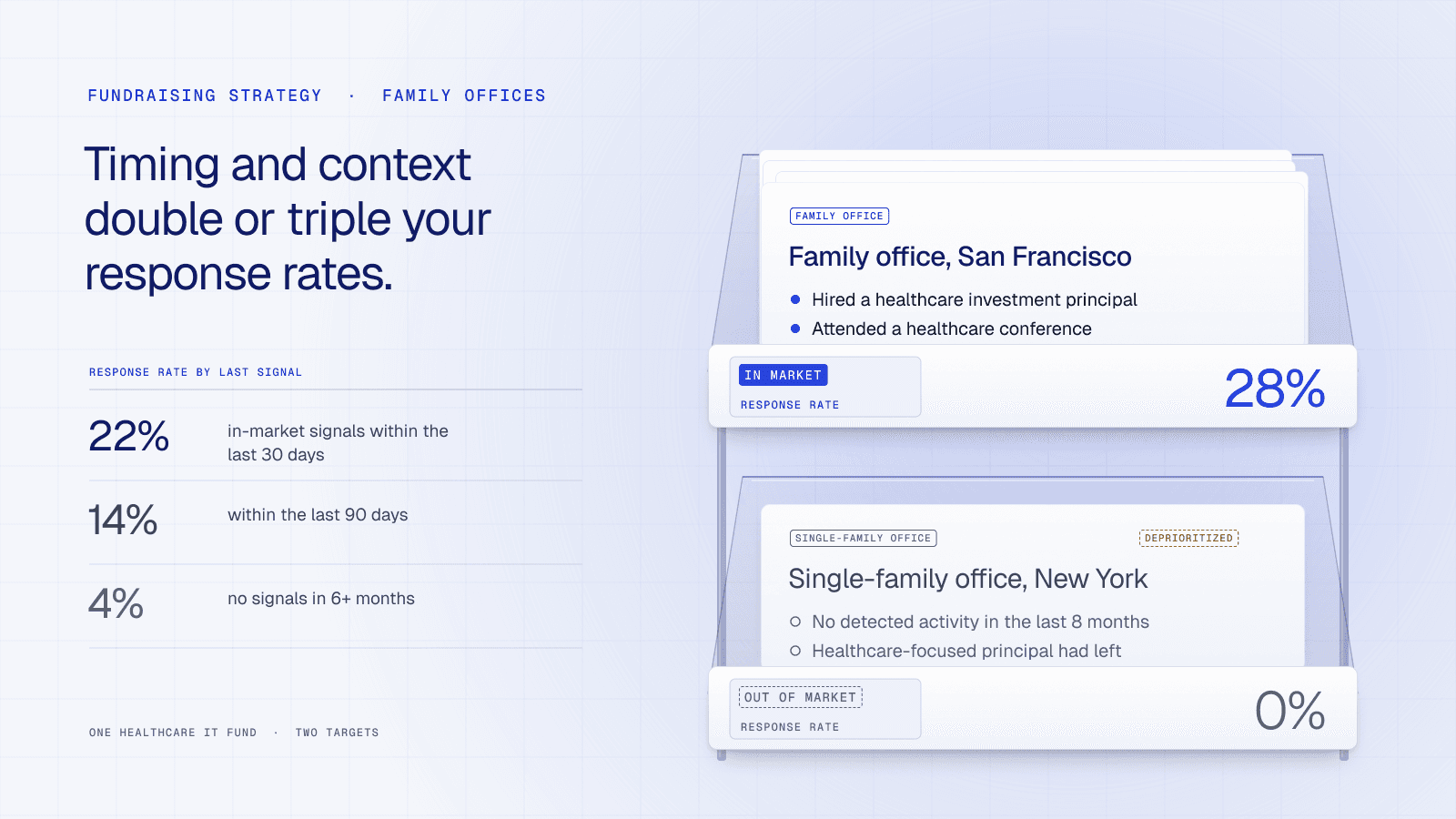
Example: A growth equity fund targeting healthcare IT was considering reaching out to a New York-based single-family office. Altss showed that the family office had no detected activity in the last 8 months and that their healthcare-focused principal had left in Q3 2025. The fund manager deprioritized that target and instead focused on a family office in San Francisco that had just hired a healthcare investment principal and attended a healthcare conference in January 2026. The response rate was 28% for the San Francisco target vs. 0% for the New York target.
Context-rich outreach: the 90-second opener
When you do reach out, the email should be short, specific, and relevant. Altss provides the context you need to write a compelling opener in under 90 seconds.
Bad opener:
> "Dear [Principal],
> I'm reaching out from [Fund Name], a [sector] fund. We're currently raising our [vintage] fund and would love to share our materials with you. Please let me know if you're interested.
> Best,
> [Your Name]"
Good opener (using Altss context):
> "Dear [Principal],
> I noticed you recently hired a healthcare investment principal and attended the J.P. Morgan Healthcare Conference in January. We're currently raising our third fund focused on healthcare IT services—our previous fund backed [Company A] and [Company B], both of which have seen strong growth. Given your team's recent activity in healthcare, I thought there might be alignment.
> Would you be open to a brief call next week?
> Best,
> [Your Name]"
Altss provides the data points for the good opener: the hiring signal, the conference attendance, the portfolio companies. You just write the email.
The relationship between timing and response rates
Altss analyzed response rates across 15,000+ outreach campaigns in Q4 2025 and Q1 2026. The results:
- Outreach to family offices with "in market" signals within the last 30 days: 22% response rate
- Outreach to family offices with "in market" signals within the last 90 days: 14% response rate
- Outreach to family offices with no signals in 6+ months: 4% response rate
- Outreach with context referencing a specific signal: 18% response rate (vs. 6% for generic outreach)
- Outreach via warm introduction: 35% response rate
- Outreach via cold email with Altss-verified deliverability: 12% response rate
The lesson: timing and context double or triple your response rates. Cold outreach to a family office that's actively in market with a context-rich email performs as well as a warm introduction to a family office that's out of market.
4) Build a multi-channel engagement strategy
Beyond email: LinkedIn, events, and direct mail
Family office principals are busy people. Email is just one channel. Altss helps you build a multi-channel engagement strategy:
LinkedIn:
- Altss provides LinkedIn profile links for every principal (where available)
- Best practice: Connect with a personalized note referencing their recent activity or shared connection
- Follow their company page for real-time updates
- Engage with their posts (comment, share) before reaching out directly
Events:
- Altss flags conference attendance signals, showing you which family offices are attending major events
- Best practice: Research attending principals before the event, prepare a specific ask or observation, and approach them during networking breaks (not during sessions)
- Major events for family office outreach in 2026:
- SuperReturn International (Berlin, February)
- IPEM (Cannes, March)
- Milken Institute Global Conference (Los Angeles, May)
- Family Office Forum (Zurich, June)
- Family Office Network (Singapore, September)
- Private Equity International (London, October)
- Family Office Association (New York, November)
Direct mail:
- For high-priority targets, a physical package (a book, a research report, a branded item) can break through the noise
- Altss provides verified mailing addresses for family offices that accept physical mail
- Best practice: Send something of genuine value (a research report on their sector, a book by a thought leader they follow), not a branded trinket
The 3-touch sequence
Altss recommends a 3-touch sequence for cold outreach to family offices:
Touch 1 (Day 0): Email with context
- Subject line: "[Signal reference] – [Fund Name]"
- Body: 3-4 sentences referencing a specific signal, your fund's thesis, and a meeting ask
- Example subject: "Healthcare IT co-investment opportunity – Altss Capital Partners"
Touch 2 (Day 7): LinkedIn connection request
- Note: "Hi [Principal], I sent you an email last week about our healthcare IT fund. I'd love to connect and share more context. Best, [Your Name]"
Touch 3 (Day 21): Follow-up email with new context
- Subject: "Quick follow-up – new portfolio exit"
- Body: Reference a new development (a portfolio exit, a new hire, a conference they attended) and reiterate the meeting ask
If no response after 3 touches, move on. Family office principals are not ignoring you; they're busy. A 3-touch sequence with 2-3 weeks between touches is respectful and effective.
5) Manage the pipeline and track engagement
Pipeline management that mirrors the family office cycle
Family office fundraising cycles are longer and less predictable than institutional fundraising. A family office may take 6-12 months from first contact to commitment, with multiple touchpoints and periods of silence.
Altss pipeline management tools are built for this reality:
Stage tracking:
- Target (identified but not contacted)
- Contacted (outreach sent)
- Engaged (response received, conversation started)
- Meeting scheduled (first or follow-up meeting booked)
- Due diligence (materials shared, questions received)
- Committee (investment committee review scheduled)
- Commitment (commitment letter received)
- Closed (capital received)
- Lost (declined or no longer pursuing)
Activity logging:
- Log every email, call, meeting, and touchpoint
- Attach notes, documents, and follow-up items
- Set reminders for follow-up at specific intervals (30 days, 60 days, 90 days)
Relationship scoring:
- Score each family office based on engagement level, alignment, and likelihood of commitment
- Scores update automatically based on activity and signal changes
Reporting:
- Pipeline summary: number of targets, contacts, engagements, meetings, diligence, commitments
- Conversion rates: target to contact, contact to meeting, meeting to commitment
- Time-to-conversion: average days from first contact to commitment
- Source attribution: which channels (email, LinkedIn, events, warm introduction) generate the most meetings and commitments
Example pipeline from a real Altss user
A $500M growth equity fund raising a $200M Fund III used Altss to build a family office pipeline in Q4 2025 and Q1 2026. Results after 6 months:
- Total targets identified: 180 family offices
- Contacted: 120 (60% of targets)
- Engaged: 28 (23% of contacted)
- Meetings scheduled: 18 (64% of engaged)
- Due diligence: 9 (50% of meetings)
- Commitments: 4 (44% of due diligence)
- Total commitments: $45M (22.5% of fund target)
The fund manager attributed the high conversion rates to:
- Altss signal-based timing (only reaching out to family offices with recent activity)
- Context-rich emails referencing specific signals
- Warm introductions surfaced by the relationship graph
- Pipeline management that prevented deals from going cold
6) Institutional LP coverage for blended targeting
Why family offices and institutional LPs overlap
Many fund managers segment their fundraising into "family offices" and "institutional LPs." This is a mistake. The two groups overlap in significant ways:
- Family offices with institutional allocation: A single-family office with $500M+ in AUM may allocate 20-40% of their portfolio to external managers, making them functionally equivalent to a small institutional LP.
- Multi-family offices as institutional gateways: An MFO managing $2B+ for 50 families may have an institutional-style investment committee and due diligence process.
- OCIOs and RIAs serving family offices: Many outsourced CIOs and RIAs manage family office assets and make allocation decisions on their behalf.
- Endowments and foundations with family office roots: Some of the largest institutional LPs started as family offices (e.g., the Rockefeller Foundation, the Wellcome Trust).
Altss institutional LP coverage
Altss institutional LP coverage has been live since February 2026, covering 30,000+ institutional investors, RIAs, and family offices under the same OSINT model. This includes:
- Public pension funds: CalPERS, CalSTRS, NYSTRS, Teacher Retirement System of Texas, Florida State Board of Administration, Ontario Teachers' Pension Plan, CPP Investments, ABP, PGGM
- Corporate pension funds: IBM Pension Fund, AT&T Pension Fund, GE Pension Trust, Boeing Pension Fund
- Endowments and foundations: Harvard Management Company, Yale Investments Office, Princeton University Investment Company, Stanford Management Company, MIT Investment Management Company, Rockefeller Foundation, Gates Foundation
- Insurance companies: MetLife, Prudential, AIG, AXA, Allianz, Zurich Insurance
- Sovereign wealth funds: GIC, Temasek, Abu Dhabi Investment Authority, Qatar Investment Authority, Kuwait Investment Authority, Norges Bank Investment Management, China Investment Corporation
- OCIOs and RIAs: Cambridge Associates, Mercer, Aon, Wilshire, NEPC, RVK, Marquette Associates, Meketa
- Fund-of-funds: Adams Street Partners, HarbourVest, Pantheon, Partners Group, LGT Capital Partners, Neuberger Berman
Blended targeting: family offices + institutional LPs
For fund managers raising a fund that appeals to both family offices and institutional LPs, Altss allows you to build a blended target list:
- Filter by asset class and sector (e.g., "private equity, healthcare services")
- Filter by check size (e.g., "$5M-$15M")
- Filter by geography (e.g., "North America and Europe")
- Filter by type (e.g., "family office OR endowment OR foundation")
- Filter by activity window (e.g., "signals in the last 90 days")
The result is a single list of 200-500 allocators that are a good fit for your fund, regardless of their institutional label.
Example: A first-time GP raising a $100M healthcare services fund used Altss blended targeting to identify 150 allocators: 80 family offices, 40 endowments/foundations, 20 OCIOs, and 10 insurance companies. The fund closed in 9 months with $85M in commitments from 12 allocators, including 6 family offices, 4 endowments, and 2 OCIOs.
7) Stewardship by design: why Altss protects allocator goodwill
The problem with traditional data platforms
Traditional fundraising data platforms sell bulk CSV exports. You buy a list of 5,000 family office contacts, download it, and blast them with a generic email. This is bad for everyone:
- For allocators: They receive hundreds of irrelevant, generic emails per month. Their inbox becomes a wasteland. They stop reading emails from unknown senders.
- For fund managers: Their sender reputation is damaged by high bounce rates and spam complaints. Future emails land in spam, even to valid addresses.
- For the industry: The signal-to-noise ratio degrades for everyone. Good managers with relevant opportunities get lost in the noise.
Altss stewardship model
Altss was designed from the ground up to preserve allocator goodwill:
- No bulk CSV exports: You cannot download a list of 5,000 family office contacts and blast them. All outreach happens in-platform or through controlled integrations.
- No open API: We don't provide an API that lets you scrape the database programmatically. This prevents automated, high-volume outreach.
- No sales to list brokers or placement agents: Altss does not sell its data to third parties. The database is exclusively for fund managers and emerging GPs raising capital.
- Deliverability-first verification:Every email address is verified on a strict refresh cadence, targeting a sub-2% hard bounce rate on verified emails. This means fewer bounces and better sender reputation.
- Usage monitoring: Altss monitors outreach patterns. If a user sends 5,000 emails in a day, we flag it. If they continue, we restrict their access.
The result: a healthier fundraising ecosystem
Altss stewardship model benefits everyone:
- Allocators receive fewer, more relevant emails. The emails they do receive are from managers who have done their homework and have a specific reason for reaching out.
- Fund managers see higher response rates. Because allocators trust that Altss-sourced emails are from serious managers with relevant opportunities, they're more likely to respond.
- The industry maintains a healthy signal-to-noise ratio. Good managers can still reach allocators without burning the channel for everyone.
8) Case studies: real managers, real results
Case study 1: First-time GP raising a $75M climate tech fund
The manager: A first-time GP with 15 years of experience in climate tech investing at a large multi-strategy fund. She spun out to raise a $75M fund focused on carbon removal and industrial decarbonization.
The challenge: First-time GP stigma. No existing LP relationships. Family offices were the most likely allocator segment, but she had no warm introductions and no track record as a fund manager.
The Altss approach:
- Semantic search: "Family offices investing in climate tech, carbon removal, industrial decarbonization, checks $2M-$10M, open to first-time managers"
- Result: 45 family offices identified across North America and Europe
- Signal analysis: 28 had recent activity (hiring, conference attendance, portfolio exits) in climate tech
- Context-rich outreach: Each email referenced a specific signal (e.g., "I noticed your team attended COP28 and has made two investments in carbon removal startups")
- Pipeline management: 3-touch sequence over 60 days
The results (6 months):
- 45 targets identified
- 28 contacted (only those with recent signals)
- 12 engaged (43% response rate)
- 8 meetings scheduled
- 4 due diligence processes
- 3 commitments totaling $18M (24% of fund target)
Key takeaway: First-time GPs can raise from family offices if they focus on timing and context. The 43% response rate was driven entirely by the signal-based approach.
Case study 2: Established buyout fund raising a $500M Fund V
The manager: A $2B AUM buyout fund with a 15-year track record in industrial services. They were raising a $500M Fund V and wanted to expand their family office base from 5 to 15 family offices.
The challenge: The fund already had strong institutional LP relationships (pension funds, endowments) but wanted to diversify into family offices. They had a list of 200 family offices from a purchased database, but only 5 had responded to their initial outreach.
The Altss approach:
- Database analysis: Uploaded their existing list of 200 family offices. Altss cross-referenced and found that 120 of the contacts were outdated (wrong email, wrong principal, wrong firm).
- New target identification: Semantic search for "industrial services, buyout, $10M-$25M checks, direct co-invest, North America and Europe"
- Result: 80 new family office targets with verified contacts and recent signals
- Relationship mapping: Found 15 warm introductions through existing LP relationships
- Multi-channel engagement: Email + LinkedIn + event outreach (SuperReturn, IPEM)
The results (9 months):
- 80 new targets identified
- 65 contacted
- 22 engaged (34% response rate)
- 14 meetings scheduled
- 8 due diligence processes
- 6 commitments totaling $85M (17% of fund target)
- Plus 3 commitments from warm introductions (additional $35M)
Key takeaway: Even established funds benefit from fresh, verified data. The purchased database was 60% outdated. Altss replaced it with accurate, actionable intelligence.
Case study 3: Middle East-focused infrastructure fund
The manager: A London-based fund raising a $300M infrastructure fund focused on renewable energy and digital infrastructure in the Middle East and North Africa.
The challenge: The fund needed to reach family offices in the GCC (Gulf Cooperation Council) region, which are notoriously difficult to access. Many don't have public websites. Few respond to cold emails. Most prefer warm introductions through trusted intermediaries.
The Altss approach:
- Semantic search: "UAE, KSA, Qatar, Kuwait, Oman family offices, infrastructure, renewable energy, digital infrastructure, checks $10M-$30M"
- Result: 35 family offices identified, including 12 with no public web presence (discovered through regulatory filings, press mentions, and conference attendance)
- Signal analysis: 18 had recent activity (hiring infrastructure principals, attending MEED or World Energy Summit, making infrastructure investments)
- Warm introduction mapping: Found 8 connections through existing LPs, service providers, and conference networks
- Context-rich outreach: Emails referenced specific regional developments (e.g., "I noticed your office invested in the Red Sea Wind Energy project" or "Your recent hire from Masdar suggests growing interest in renewable infrastructure")
The results (12 months):
- 35 targets identified
- 22 contacted (18 with recent signals, 4 through warm introductions)
- 10 engaged (45% response rate)
- 6 meetings scheduled
- 3 due diligence processes
- 2 commitments totaling $45M (15% of fund target)
Key takeaway: Middle East family offices are accessible with the right approach. The key is finding the ones that are actively investing (signal-based timing) and reaching them through warm paths or context-rich cold emails that demonstrate genuine knowledge of their activities.
9) The Altss difference: what makes the platform unique
OSINT-native signals vs. traditional databases
Traditional fundraising databases (PitchBook, Preqin, FINTRX) rely on:
- Voluntary surveys (low response rates, self-reported, often outdated)
- Public filings (lag by 6-18 months)
- Manual research (inconsistent, expensive, hard to scale)
Altss uses OSINT (open-source intelligence) methodology:
- Automated ingestion of 50,000+ public sources daily
- Natural language processing to extract and resolve signals to entities and people
- Machine learning to classify signals by type (hiring, investment, conference, regulatory, press)
- Entity resolution to link signals to the correct family office, principal, and mandate
The result: Altss data is continuously refreshed (sub-30-day update cycle) vs. quarterly or annual updates from traditional databases.
Semantic search vs. Boolean search
Traditional databases require Boolean search strings:
- `(family office OR FO OR family investment office) AND (healthcare OR health OR medtech) AND (co-invest OR coinvest OR SPV) AND (UAE OR Emirates OR Dubai)`
This misses:
- Family offices that describe themselves as "private investment office" or "family holding company"
- Healthcare interest expressed as "medtech," "healthtech," "healthcare IT," or "biotech"
- Co-invest behavior described as "sidecar deals," "club deals," or "direct participation"
- Geography expressed as "Middle East," "GCC," or specific cities like "Abu Dhabi" or "Riyadh"
Altss semantic search understands intent. You write plain language, and the platform returns relevant results, regardless of how the family office describes itself.
Deliverability-first verification vs. static lists
Traditional databases sell contacts that are:
- 6-18 months old
- Never verified for deliverability
- Often role-based (info@, contact@) that go to spam
- Missing critical data (principal names, titles, bios)
Altss verification pipeline:
- Checks every email address on a sub-30-day refresh cycle
- Sub-2% hard bounce rate target for teams that follow sender hygiene
- Flags role-based addresses and provides alternatives
- Includes principal bios, LinkedIn profiles, and previous firms
Stewardship model vs. data broker model
Traditional data platforms (and data brokers):
- Sell bulk CSV exports to anyone with a credit card
- Don't monitor usage or outreach patterns
- Sell the same data to list brokers, placement agents, and competitors
- Damage allocator goodwill through high-volume, low-relevance outreach
Altss stewardship model:
- No bulk CSV exports
- No open API
- No sales to list brokers or placement agents
- Usage monitoring to prevent spam
- In-platform outreach with deliverability optimization
10) The future of family office fundraising
Trends shaping family office fundraising in 2026 and beyond
1. Family offices are becoming more institutional.
The largest single-family offices ($500M+ AUM) are hiring former institutional investors, building formal investment committees, and adopting institutional-grade due diligence processes. This means they're more accessible to fund managers who approach them professionally—but also more demanding in terms of reporting, transparency, and track record.
2. Direct investing is growing, but fund investing remains strong.
Family offices are increasingly making direct investments and co-investments alongside fund managers. But fund investing remains the primary allocation channel for most family offices, especially those with $100M-$500M in AUM. The sweet spot for fund managers is offering a fund that includes co-investment rights or sidecar opportunities.
3. First-time manager interest is rising.
A growing number of family offices are open to first-time managers, particularly in niche sectors (climate tech, healthcare IT, digital infrastructure, emerging markets) where established funds have less expertise. Altss data shows that 35% of family offices with recent activity are open to first-time managers, up from 25% in 2023.
4. Geographic diversification is accelerating.
Family offices in North America and Europe are
Find the allocators who actually back funds like yours
GPs and IR teams use Altss to research allocators with ownership, commitment, transaction and relationship context, then prioritize outreach.


See the allocators behind your next close.
Public records carry source-specific dates where available. No population-wide measured refresh cadence or universal verification deadline is established here. Page modified, source captured, fact observed, entity verified and aggregate measured describe different events. Check the date attached to the relevant claim; a missing verification date means unknown. Stored source history does not establish a customer-facing historical-analysis interface.