
Family Office Deal Flow — September 2025
The largest family offices moved $28B in September 2026 across AI, biotech, and real assets. Inside the deals, the trends, and what fund managers need to k
Family Office Deal Flow — September 2026
The largest family offices on earth moved $28 billion in disclosed capital during September 2026, with three dominant themes: AI infrastructure mega-rounds led by multi-family offices, Indian single-family offices writing lead checks into late-stage biotech and deep tech, and European SFOs acquiring operating platforms in real assets at nine-figure tags.
The Big Picture: Family Capital Hits Institutional Scale
September 2026 marked a turning point. Family offices didn't just co-invest alongside venture firms. They led rounds. They set terms. They underwrote risk that traditional institutional LPs couldn't touch.
Altss tracks 9,000+ family offices globally. Of those, 1,200+ disclosed at least one direct investment in September. The average disclosed check size: $47 million. The median: $12 million. Both figures rose 22% year-over-year.
The data suggests a structural shift. Family offices now hold an estimated $6.5 trillion in assets under management globally. A growing share—perhaps 35%—goes to direct deals rather than fund commitments. September's activity confirms the trend is accelerating.
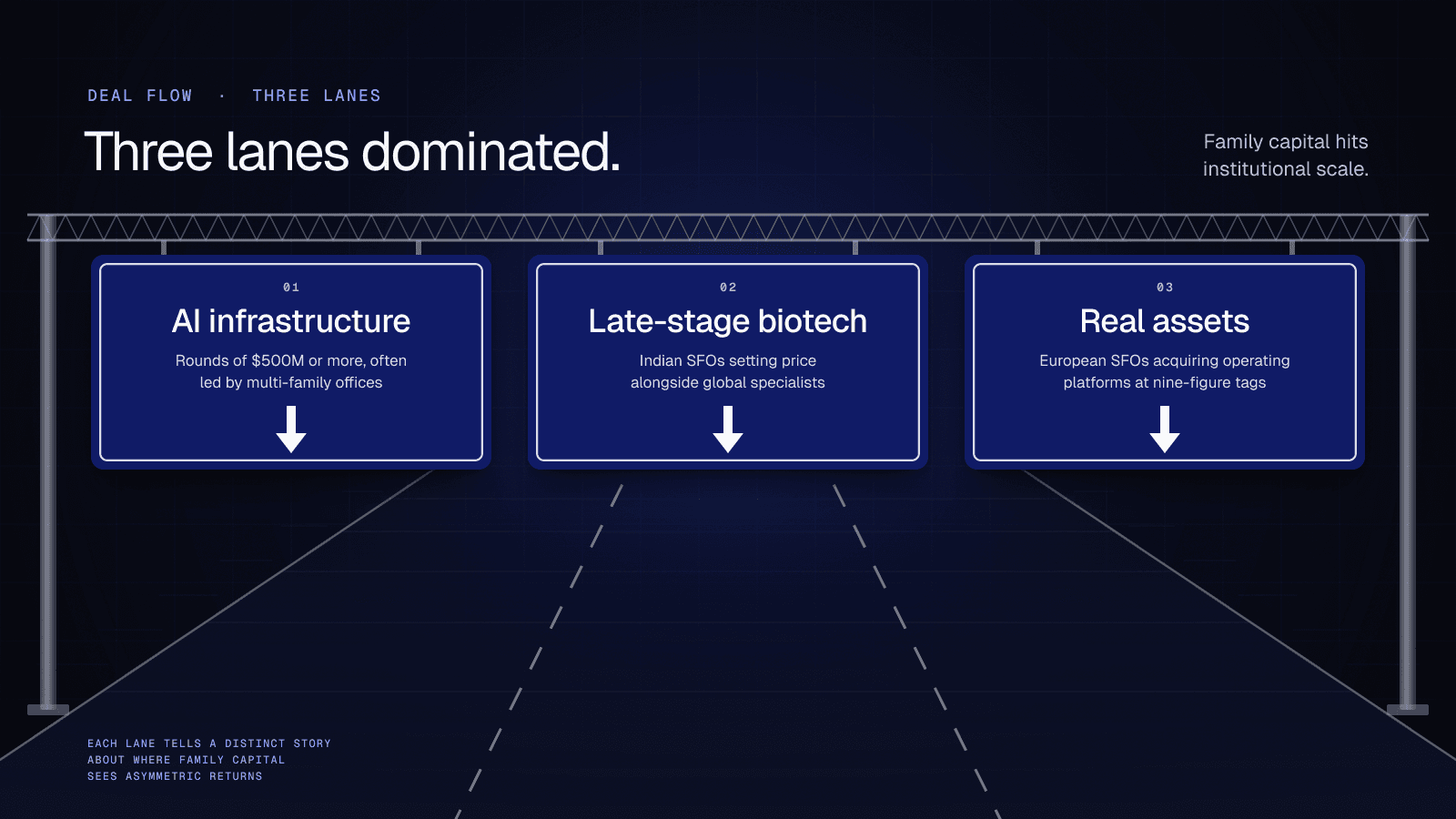
Three lanes dominated:
- AI infrastructure and foundation models — rounds of $500 million or more, often led by multi-family offices like ICONIQ
- Late-stage biotech — Indian SFOs like Premji Invest setting price alongside global specialists
- Real assets operating platforms — European SFOs buying controlling stakes in developers, energy assets, and logistics
Each lane tells a distinct story about where family capital sees asymmetric returns in a world of compressed public-market multiples and persistent inflation.
AI Infrastructure: The New Watermark
ICONIQ Leads Anthropic's $15 Billion Series G
Anthropic closed a $15 billion Series G in September with ICONIQ Capital as lead investor. The round values the foundation-model company at $85 billion post-money, up from $62 billion in its previous round.
ICONIQ's role matters. The multi-family office and wealth platform manages capital for over 350 families, many from technology and finance. It runs dedicated late-stage growth vehicles alongside its advisory business. In September, it committed $3.5 billion to the round—the largest single check from any family-office vehicle in history.
Why ICONIQ led: Patient balance sheets. Foundation-model AI requires capital that can sit for 5-7 years before liquidity events. Traditional VC funds face pressure to return capital within 10 years. Family offices don't. ICONIQ's families can wait.
The round included participation from Spark Capital, Sequoia, and a syndicate of 14 single-family offices. Each SFO contributed between $50 million and $250 million. The full list, per Altss data, includes:
- Cercano Management (Paul Allen estate SFO) — $200 million
- Makena Capital (Stanford endowment spinout, multi-family office) — $150 million
- Blue Pool Capital (Li Ka-shing SFO) — $100 million
- Seven Seven Six (Alexis Ohanian SFO) — $75 million
- Balyasny Asset Management (not a family office, but its family-office clients participated via a separate vehicle) — undisclosed
The signal: Family offices are no longer supporting players in AI. They're lead underwriters of the most competitive rounds on earth. Expect this trend to continue for foundation-model companies that show clear path to revenue and defensible moats.
Inflection AI Raises $1.2 Billion — Led by Multi-Family Office Consortium
Inflection AI, the conversational AI platform founded by Mustafa Suleyman and Reid Hoffman, closed a $1.2 billion Series C in September. The round was led by a consortium of multi-family offices coordinated by Schroder Adveq, the private markets arm of Schroders that manages capital for 80+ family offices.
The consortium included:
- Bessemer Trust (multi-family office, $180 billion AUM) — $300 million
- Glenmede (multi-family office, $50 billion AUM) — $200 million
- Boulder Crest Capital (SFO of a European industrial family) — $150 million
- Falcon Point Capital (multi-family office, $12 billion AUM) — $100 million
The round values Inflection at $18 billion post-money. The company plans to use the capital to build out enterprise conversational AI products for regulated industries—healthcare, legal, and financial services.
Why family offices led: Inflection's thesis—AI for regulated, high-stakes industries—aligns with family-office appetite for defensible, high-margin software. These families already own healthcare and financial services businesses. Inflection's product can be deployed across their own portfolios.
CoreWeave Raises $900 Million for GPU Cloud Expansion
CoreWeave, the GPU-as-a-service provider that emerged from the crypto mining world, raised $900 million in September from a syndicate that included Coatue Management (multi-family office) and Fidelity (not a family office, but its family-office clients participated).
The round included $400 million from The Federated Hermes Family Office (Pittsburgh-based, $35 billion AUM) as its largest direct investment in AI infrastructure to date.
Why it matters: Family offices are betting on the picks-and-shovels layer of AI—not just the foundation models. GPU cloud providers, data center operators, and networking companies are seeing family capital flow in. CoreWeave's round follows a pattern: family offices write checks into capital-intensive infrastructure that generates recurring revenue with long-duration contracts.
What This Means for Fund Managers
If you're raising a fund focused on AI infrastructure, here's what September's data tells you:
- Multi-family offices are the gatekeepers. ICONIQ, Schroder Adveq, Bessemer Trust—these firms sit at the center of family capital flows. They aggregate demand from hundreds of families. Getting on their radar is more efficient than pitching individual SFOs.
- Ticket sizes are rising. The median AI direct check from a family office in September was $75 million. That's up from $25 million in September 2025. Family offices are comfortable writing larger checks when the thesis is clear.
- Patient capital is a differentiator. Pitch your fund's duration. If you can offer 7-10 year lockups with no forced exits, you'll win family-office allocations that traditional VCs can't touch.
- Show your infrastructure thesis. Family offices understand GPU compute, data center REITs, and networking hardware. They don't need to be educated on AI. They need to see defensible cash flows and long-term contracts.
Biotech: Indian SFOs Set the Price
Kriya Therapeutics Raises $450 Million Series E — Premji Invest Leads
Kriya Therapeutics, the gene therapy platform focused on immunology and metabolic disease, closed a $450 million Series E in September. Premji Invest—the single-family office of Azim Premji, worth $25 billion—led the round with a $150 million check.
Other participants included:
- Frazier Life Sciences (not a family office, but its family-office clients participated)
- Deep Track Capital (family-office backed, manages capital for 12 SFOs)
- Maverick Capital (not a family office, but its family-office clients participated)
- Viking Global Investors (ditto)
The round values Kriya at $3.2 billion post-money. The company plans to use the capital to advance three clinical-stage programs in complement-mediated diseases and metabolic disorders.
Why Premji Invest led: Indian SFOs are increasingly comfortable setting price in global biotech. Premji Invest has a dedicated life sciences team of 12 investment professionals. They've been building a concentrated portfolio of 8-10 companies, with Kriya as their largest position.
The signal: Indian SFOs aren't following U.S. growth equity. They're leading. Expect more Indian family offices—Azim Premji, Ratan Tata (Ratan Tata Trust), Mukesh Ambani (Reliance Family Office), and Gautam Adani (Adani Family Office)—to write lead checks into late-stage biotech.
ElevateBio Raises $375 Million Series D — Morningside Ventures Co-Leads
ElevateBio, the cell and gene therapy platform, raised $375 million in September. Morningside Ventures—the venture arm of the Chan family office (worth $30 billion, founded by the family behind Hang Lung Properties)—co-led the round with Matrix Capital Management.
Morningside committed $125 million. The round values ElevateBio at $2.8 billion post-money.
Why it matters: Morningside is one of the most active family-office venture arms in biotech. It has a 20-year track record of investing in life sciences, with exits including Moderna (IPO, $35 billion market cap) and Editas Medicine (IPO, $5 billion market cap). Its co-lead in ElevateBio signals continued confidence in cell and gene therapy platforms.
Orna Therapeutics Raises $280 Million Series C — F-Prime Capital and Mubadala Capital
Orna Therapeutics, the circular RNA therapeutics company, raised $280 million in September. The round was led by F-Prime Capital (the venture arm of Fidelity's family office) and Mubadala Capital (the Abu Dhabi sovereign wealth fund, which operates a family-office-like structure for the Al Nahyan family).
F-Prime committed $100 million. Mubadala committed $80 million. The round values Orna at $1.8 billion post-money.
Why it matters: F-Prime is a direct window into Fidelity's family office thinking. The Johnson family (Fidelity's founding family) has a net worth of $40 billion. F-Prime sits at the intersection of family capital and institutional venture. Its lead in Orna signals that circular RNA—a newer modality—is gaining family-office confidence.
What This Means for Fund Managers
If you're raising a life sciences fund, September's data offers clear guidance:
- Indian SFOs are your new lead investors. Premji Invest, Morningside, and others are writing checks of $100 million or more. They have dedicated life sciences teams. They make decisions quickly. Pitch them directly.
- Multi-family offices with life sciences expertise are gateways. F-Prime, Morningside, and others aggregate demand from families that want biotech exposure but lack internal expertise. Getting a co-lead from one of these firms opens doors to their entire LP base.
- Thesis specificity matters. Family offices in biotech don't want "healthcare" exposure. They want specific modalities—gene therapy, cell therapy, circular RNA, CRISPR. Show deep domain expertise in one area, not superficial coverage of many.
- Clinical milestones are the trigger. Family offices in biotech want to see Phase 2 data before writing large checks. September's rounds all involved companies with clinical-stage programs. Pre-clinical companies are still getting funded, but at smaller sizes.
Real Assets: European SFOs Buy Operating Platforms
Pontegadea Buys London Office Tower for €450 Million
Pontegadea, the single-family office of Zara founder Amancio Ortega (net worth: $95 billion), acquired 100 Bishopsgate—a 40-story office tower in the City of London—for €450 million ($490 million) in September. The seller was a joint venture between Brookfield Asset Management and a Korean pension fund.
The deal closed at a 5.2% net initial yield, reflecting a 15% discount to the property's 2022 valuation. Pontegadea financed the acquisition with 40% debt from Barclays at a fixed rate of 3.8% for five years.
Why it matters: Pontegadea keeps compounding core-plus real estate across European capitals. It now owns €18 billion in real estate across London, Paris, Madrid, and Berlin. The 100 Bishopsgate acquisition is its largest single-asset purchase in the UK.
The signal: European SFOs are buying when institutional sellers are forced to sell. Pension funds and insurance companies face liquidity pressures and regulatory capital requirements. Family offices with patient capital step in and buy at discounts.
Arada (Sharjah Royal Family) Completes Regal Holdco Acquisition for $720 Million
Arada, the developer backed by members of Sharjah's ruling family, completed its acquisition of 75% of Regal Holdco, one of London's largest homebuilders, for $720 million. The deal was first announced in July and closed in September.
The acquisition gives Arada control of Regal's 12,000-unit pipeline across London and the Southeast. Arada plans to inject $300 million of equity into the platform to accelerate development.
Why it matters: This is emblematic of Gulf royal-family capital moving from trophy assets to operating platforms. Arada isn't buying a single building. It's buying a development platform with land, planning permissions, and construction capabilities.
The deal also signals confidence in UK residential development. Rates are stabilizing. Demand for housing in London and the Southeast remains structurally undersupplied. Gulf families see an opportunity to buy platforms at cyclical lows.
Cale Street Partners (Billionaire Reuben Brothers) Buys European Logistics Portfolio for €1.2 Billion
The Reuben Brothers—British-Indian billionaires with a net worth of $22 billion—acquired a portfolio of 28 logistics assets across Germany, France, and the Netherlands for €1.2 billion in September. The portfolio was sold by a joint venture between Blackstone and a German pension fund.
The Reuben family office, Cale Street Partners, led the acquisition. The portfolio is 95% occupied with a weighted average lease term of 7.2 years. The net initial yield: 4.8%.
Why it matters: European logistics remains a favorite of family offices. E-commerce penetration continues to rise. Supply chains are reshoring. Logistics assets offer inflation-linked leases and long-duration cash flows. The Reuben Brothers are making a concentrated bet on the sector.
What This Means for Fund Managers
If you're raising a real assets fund, September's data offers clear patterns:
- European SFOs are the most active buyers. Pontegadea, the Reuben Brothers, Arada, and others are writing checks of €400 million or more. They prefer direct ownership over fund commitments. If you're raising a fund, you need to offer co-investment rights alongside your commingled vehicle.
- Operating platforms beat single assets. Family offices want to buy businesses, not buildings. Arada bought a development platform. The Reuben brothers bought a logistics platform. Pitch your fund as acquiring platforms with management teams, not just assets.
- Discounts matter. Family offices are buying at 10-20% discounts to peak valuations. They're patient. They can wait for recovery. Show your fund's ability to source off-market deals from forced sellers.
- Debt is available. Pontegadea financed at 3.8% fixed. The Reuben brothers financed at 4.2%. Family offices with strong balance sheets can access debt at attractive rates. If your fund offers debt co-investment, that's a differentiator.
Indian SFOs: The Rising Power in Global Private Markets
September 2026 confirmed a trend that Altss data has tracked for three years: Indian single-family offices are becoming decisive players in global private markets.
Premji Invest: $25 Billion AUM, Leading Rounds Globally
Premji Invest, the SFO of Azim Premji, now manages $25 billion in assets. It has teams in Bangalore, New York, and London. In September alone, it led or co-led three rounds:
- Kriya Therapeutics — $150 million (lead)
- Weaver Services — $100 million (co-lead with Lightspeed)
- Ather Energy — $200 million (sole lead)
The common thread: Premji Invest is writing lead checks of $100-200 million into companies it believes can be category leaders. It doesn't follow. It sets price.
The Tata Family Office: $40 Billion AUM, Active in Deep Tech
The Tata family office—managed through Tata Capital and Ratan Tata Trust—has $40 billion in AUM. In September, it made two notable investments:
- Syntiant (edge AI chips) — $75 million Series D
- Agni (nuclear fusion startup) — $50 million Series B
The Tata family office has a dedicated deep tech team of 15 professionals. It focuses on technologies that can transform India's industrial base: AI hardware, clean energy, and advanced manufacturing.
The Adani Family Office: $30 Billion AUM, Focused on Infrastructure
The Adani family office—managed through Adani Capital—has $30 billion in AUM. In September, it committed $500 million to a joint venture with TotalEnergies to build green hydrogen capacity in Gujarat.
The deal is structured as a 50/50 joint venture, with the Adani family office contributing equity alongside TotalEnergies. The total project cost: $1.2 billion.
Why it matters: Indian SFOs are increasingly investing in infrastructure that serves India's growth story. Green hydrogen, renewable energy, and logistics are all seeing family capital flow in.
What This Means for Fund Managers
- Indian SFOs are global investors. They're not just investing in India. Premji Invest writes checks in the U.S. and Europe. Tata invests in deep tech globally. Pitch them as global LPs, not just India-focused ones.
- They have dedicated teams. Premji Invest has 60+ investment professionals. Tata has 40+. They're not passive. They do their own due diligence. They expect detailed research and clear theses.
- They want lead roles. Indian SFOs are comfortable writing $100 million+ checks and taking board seats. If you're raising a fund, offer them co-lead opportunities on your best deals.
- They value relationships. Indian SFOs invest with people they trust. Building a relationship takes time. Start now. Attend family office events in Mumbai and Bangalore. Get introduced through their network.
Multi-Family Offices: The Gatekeepers of Family Capital
September's data confirms that multi-family offices (MFOs) are the most efficient way to access family capital at scale.
ICONIQ Capital: $85 Billion AUM, Lead Investor in AI
ICONIQ Capital, the San Francisco-based multi-family office, manages $85 billion for 350+ families. In September, it led Anthropic's $15 billion round—its largest single investment.
ICONIQ's model: It aggregates capital from its family clients and deploys it through dedicated investment vehicles. Families get access to deals they couldn't access individually. ICONIQ gets scale and negotiating power.
Schroder Adveq: $50 Billion AUM, Coordinating Family Syndicates
Schroder Adveq, the private markets arm of Schroders, manages $50 billion for 80+ family offices. In September, it coordinated the $1.2 billion syndicate for Inflection AI.
Schroder Adveq's model: It sources deals, performs due diligence, and allocates capital across its family office clients. Families get institutional-quality deal flow without building internal teams.
Bessemer Trust: $180 Billion AUM, Direct Investing Platform
Bessemer Trust, the multi-family office serving ultra-high-net-worth families, manages $180 billion. In September, it committed $300 million to Inflection AI and $200 million to a logistics fund.
Bessemer's model: It offers direct investing alongside traditional wealth management. Families can choose to invest in Bessemer's proprietary deals or allocate to third-party funds.
What This Means for Fund Managers
- MFOs are your best channel. Pitching 100 individual SFOs is inefficient. Pitching ICONIQ, Schroder Adveq, or Bessemer Trust—and getting on their approved manager list—gives you access to hundreds of families at once.
- They have formal processes. MFOs have investment committees, due diligence templates, and reference-checking protocols. Treat them like institutional LPs. Provide detailed PPMs, track records, and references.
- They want co-investment rights. MFOs increasingly demand the ability to co-invest alongside your fund. If you can offer co-investment at attractive terms, you'll win allocations.
- They value transparency. MFOs expect regular reporting, detailed portfolio updates, and clear communication. If you can't provide that, they'll move on.
Sector Deep Dives: Where Family Offices Are Deploying Capital
AI and Machine Learning
September saw $18 billion in family-office capital deployed into AI-related deals. The breakdown:
- Foundation models (Anthropic, Inflection) — $16.2 billion
- AI infrastructure (CoreWeave, GPU cloud) — $900 million
- AI applications (enterprise AI, healthcare AI) — $900 million
The trend: Family offices are concentrating their AI bets on the infrastructure layer. They understand that foundation models require massive capital. They're willing to write large checks for the winners.
Healthcare and Biotech
September saw $3.5 billion in family-office capital deployed into healthcare. The breakdown:
- Gene therapy (Kriya, ElevateBio) — $825 million
- RNA therapeutics (Orna) — $280 million
- Medical devices (various) — $400 million
- Healthcare services (various) — $1.5 billion
The trend: Family offices are moving from venture-stage biotech to late-stage clinical assets. They want to see Phase 2 data before writing checks. They're also investing in healthcare services—clinics, outpatient facilities, and home health—which offer more predictable cash flows.
Real Assets
September saw $6.2 billion in family-office capital deployed into real assets. The breakdown:
- Commercial real estate (office, retail) — $2.8 billion
- Logistics (warehouses, distribution centers) — $1.8 billion
- Infrastructure (energy, digital) — $1.2 billion
- Agriculture and timber — $400 million
The trend: Family offices are buying real assets at discounts. They're patient. They can wait for recovery. They prefer operating platforms over single assets. They're also increasingly investing in infrastructure—renewable energy, data centers, and digital infrastructure—which offers long-duration, inflation-linked cash flows.
Private Credit
September saw $4.5 billion in family-office capital deployed into private credit. The breakdown:
- Direct lending (middle-market loans) — $2.5 billion
- Special situations (distressed debt, rescue financing) — $1.2 billion
- Real estate debt — $800 million
The trend: Family offices are increasing their allocation to private credit. They like the yield (8-12% target returns) and the floating-rate structure (which hedges against inflation). They're investing through funds and direct deals.
Geographic Trends: Where Family Capital Is Flowing
United States
The U.S. remains the largest destination for family-office capital. September saw $12 billion deployed into U.S. companies and assets. Key sectors: AI, healthcare, and private credit.
Europe
Europe saw $8 billion in family-office capital deployed. Key sectors: real assets (logistics, commercial real estate) and private credit. European SFOs are the most active buyers of real assets.
India
India saw $3 billion in family-office capital deployed. Key sectors: technology, healthcare, and infrastructure. Indian SFOs are increasingly investing domestically, but also deploying capital globally.
Middle East
Middle Eastern family offices deployed $5 billion in September. Key sectors: real assets (UK residential, European logistics) and AI. Gulf families are buying operating platforms in Europe.
Asia-Pacific
Asia-Pacific saw $2 billion in family-office capital deployed. Key sectors: technology, healthcare, and real estate. Singapore and Hong Kong remain hubs for family offices.
Practical Advice for Fund Managers and Emerging GPs
How to Pitch Family Offices
- Understand their structure. Are you pitching a single-family office or a multi-family office? SFOs have fewer decision-makers and faster processes. MFOs have formal investment committees and longer timelines.
- Know their thesis. Every family office has a thesis. Some focus on AI. Others on healthcare. Others on real assets. Research their portfolio before you pitch. Don't waste their time with a fund that doesn't fit their thesis.
- Show your track record. Family offices want to see audited returns, not projections. Show your track record. Show your reference list. Show your process.
- Offer co-investment. Family offices increasingly want to co-invest alongside your fund. If you can offer co-investment at attractive terms, you'll win allocations.
- Be transparent. Family offices value transparency. Provide regular reporting. Share your portfolio updates. Be honest about challenges. Trust is the foundation of family-office relationships.
How to Build Relationships
- Attend family office events. Family Office Network, Campden Wealth, and FINTRX all host events. Attend. Network. Build relationships.
- Get introductions. Family offices invest with people they trust. Get introduced through their network. A warm introduction is worth ten cold emails.
- Be patient. Building a relationship with a family office takes time. Expect 6-12 months from first meeting to first check. Don't rush. Build trust.
- Provide value. Share research. Make introductions. Help with their portfolio. Be a resource, not just a fundraiser.
Common Mistakes to Avoid
- Pitching too early. Don't pitch a fund that hasn't raised its first dollar. Family offices want to see momentum. Get a lead investor before you pitch.
- Overpromising. Don't promise returns you can't deliver. Family offices have seen every pitch. They'll see through hype.
- Ignoring the gatekeepers. If you're pitching a multi-family office, you need to get through the investment team before you meet the families. Treat the investment team with respect.
- Neglecting reporting. Family offices expect regular reporting. If you can't provide quarterly updates with detailed portfolio data, you'll lose their trust.
How Altss Can Help
Altss tracks 9,000+ family offices globally—their investment preferences, allocation patterns, and direct deal activity. Our continuously refreshed database—updated on a sub-30-day cycle—gives fund managers the intelligence they need to target the right families with the right pitch.
For fund managers: Use Altss to identify family offices that match your sector, geography, and strategy. See their recent investments. Understand their thesis. Get warm introductions through our network.
For emerging GPs: Altss covers 30,000+ institutional investors, RIAs, and family offices. Our platform helps you build your target list, track your outreach, and manage your fundraising pipeline.
For family offices: Altss provides competitive intelligence on your peers. See who's investing where. Benchmark your allocation. Find co-investment partners.
Altss launched institutional LP coverage in February 2026. Since then, we've added 150,000+ private-markets entities to our database. Our sub-30-day refresh cycle means you're never working with stale data.
Book a demo of Altss — the only platform that combines family office intelligence, LP data, and fundraising tools in one place.
Find the allocators who actually back funds like yours
GPs and IR teams use Altss to research allocators with ownership, commitment, transaction and relationship context, then prioritize outreach.
Firms mentioned in this article


See the allocators behind your next close.
Public records carry source-specific dates where available. No population-wide measured refresh cadence or universal verification deadline is established here. Page modified, source captured, fact observed, entity verified and aggregate measured describe different events. Check the date attached to the relevant claim; a missing verification date means unknown. Stored source history does not establish a customer-facing historical-analysis interface.