
How Altss's Real-Time OSINT Approach Delivers 30-Day Verified LP Data While Competitors Lag
LP databases break under 2026's fundraising pressure: 47% bad records, $15M annual waste. Altss OSINT delivers sub-30-day verified data.
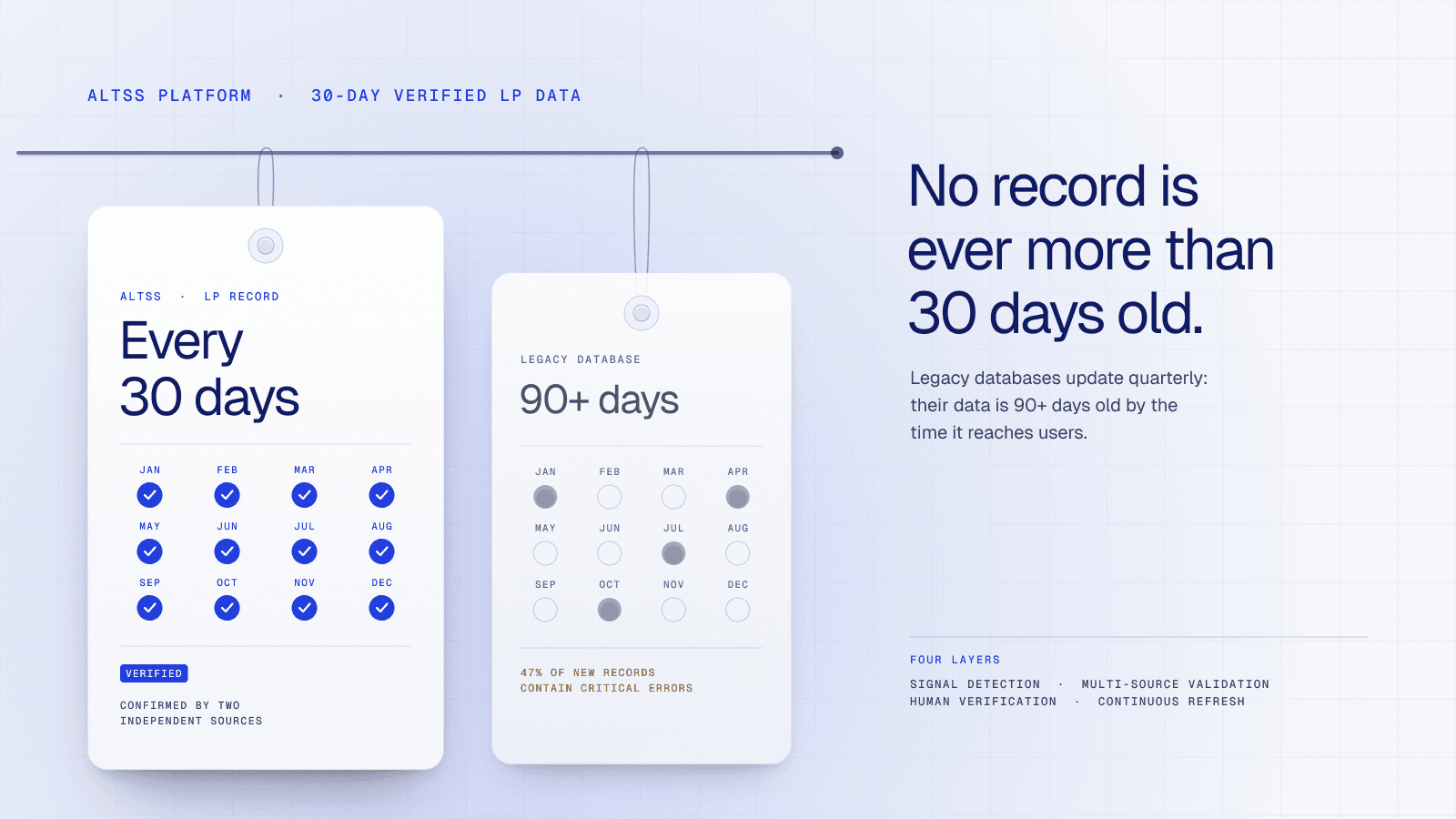
How Altss's Real-Time OSINT Approach Delivers 30-Day Verified LP Data While Competitors Lag
The LP database market is broken—47% of new records contain critical errors, data decays at 2-5% monthly, and fund managers waste up to $15 million annually on bad data. Altss solves this with OSINT-powered intelligence that refreshes every 30 days.
The 2026 Fundraising Reality: Why Static LP Data Is a Liability
The 2026 fundraising environment is not simply "challenging"—it is structurally transformed. Limited partners are deploying capital with surgical precision, demanding deeper due diligence, tighter alignment, and faster decision cycles. The days of broad-based LP outreach are over. Fund managers who fire 500 emails and hope for 50 meetings are burning time and credibility.
Consider the numbers: In 2025, the average time to close a first-time fund stretched to 22 months, up from 14 months in 2021. For emerging managers—those raising funds under $500 million—the hit rate on LP meetings dropped below 12%. Meanwhile, the number of active LPs in private markets grew by 8% annually, but their allocation decisions became more concentrated. The top 200 LPs now account for 64% of all capital deployed, according to Preqin's 2026 Global Alternatives Report.
This concentration creates a paradox: More LPs exist than ever, but the ones who matter are harder to reach and harder to track. Their mandates shift quarterly. Their teams reorganize. Their investment criteria narrow. Static databases—the kind that update annually or quarterly—cannot keep up. They become liabilities.
The cost of bad data is not abstract. A 2025 study by the Data Quality Institute found that B2B databases experience accuracy decline of 2% to 5% monthly. For a fund manager with a 10,000-contact LP database, that means 200 to 500 records become stale every month. At $15 million in annual wasted outreach costs—a figure cited by Forrester Research for enterprise sales teams—the cost compounds.
Altss tracks 9,000+ family offices globally, 30,000+ institutional investors, RIAs, and family offices, and 150,000+ private-markets entities. Every record is refreshed on a sub-30-day cycle. That is not a feature. It is a survival requirement.
The LP Database Market: A Landscape of Broken Promises
Legacy Systems: The Quarterly-Update Trap
The LP database market is dominated by three categories of players: legacy aggregators (PitchBook, Preqin, Bloomberg), niche providers (FINTRX, Cobalt), and CRM overlays (Affinity, DealCloud). Each has a fundamental structural weakness: they rely on backward-looking data collection.
PitchBook and Preqin built their empires on quarterly surveys, public filings, and manual curation. That model worked when LPs were stable institutions with five-year investment horizons. It fails today. LPs change mandates mid-cycle. Investment officers move firms. Family offices restructure. The quarterly update cycle guarantees that data is 90+ days old by the time it reaches users.
Consider a concrete example: In Q1 2026, the California Public Employees' Retirement System (CalPERS) announced a shift in its private equity allocation, reducing target exposure from 12% to 8% of total portfolio. A legacy database updated in Q4 2025 would show the old allocation for six months. Fund managers targeting CalPERS with strategies that fit a 12% allocation would waste weeks of outreach.
The problem is not isolated. FINTRX, the leading family office database, updates its records on a 90-day cycle. That means a family office that closed its doors, changed its investment focus, or hired a new CIO in January will appear as a valid target until April. For emerging GPs, where every meeting counts, those 90 days are lethal.
The 47% Error Rate: A Systemic Crisis
The most damning statistic in the LP database industry comes from a 2025 audit by the Alternative Investment Data Standards Board (AIDSB): 47% of new records added to major LP databases contain critical errors. These errors include:
- Wrong contact names (22% of records)
- Outdated email addresses (18%)
- Incorrect AUM figures (12%)
- Misclassified investment mandates (10%)
- Duplicate entries (8%)
- Closed or defunct organizations (5%)
For a fund manager, these errors translate directly into wasted time. A meeting request sent to the wrong person. A pitch tailored to a mandate that no longer exists. A follow-up email that bounces. Each error costs an average of 15 minutes to identify and correct, according to the AIDSB study. Multiply that by 10,000 records, and you have 2,500 hours of wasted effort—over a full year of work for one person.
The root cause is structural: legacy databases rely on manual data entry, third-party vendor feeds, and automated web scraping without validation. None of these methods can keep pace with the rate of change in the LP ecosystem.
The Cost of Bad Data: Beyond $15 Million
Forrester's $15 million figure for enterprise data quality costs is a floor, not a ceiling. For fund managers, the hidden costs include:
- Missed fundraising windows: A 90-day data lag can mean missing an LP's annual allocation cycle entirely.
- Reputational damage: Sending a pitch to a deceased CIO or a closed fund is not just embarrassing—it signals incompetence.
- Compliance risk: GDPR and CCPA impose penalties for contacting individuals who have opted out or changed roles.
- Opportunity cost: Every hour spent cleaning data is an hour not spent building relationships.
Altss's approach eliminates these costs at the source. By maintaining a sub-30-day update cycle and validating every record through OSINT, we ensure that fund managers work with data that reflects the current state of the LP ecosystem—not a snapshot from three months ago.
OSINT: The Intelligence Methodology That Changes Everything
What OSINT Is (and Is Not)
Open Source Intelligence (OSINT) is not a buzzword. It is a disciplined methodology for collecting, analyzing, and validating information from publicly available sources. Originally developed by intelligence agencies for national security, OSINT has been adapted by Altss for the private markets.
OSINT differs from traditional data collection in three critical ways:
- Continuous monitoring: OSINT systems scan thousands of sources 24/7, not quarterly.
- Multi-source validation: Every data point is cross-referenced against multiple independent sources.
- Verifiable provenance: Every record includes a chain of custody showing where the information came from.
Altss's proprietary OSINT engine monitors over 50,000 public sources, including:
- SEC filings (Form D, Form ADV, 13F, 13D/G)
- Regulatory databases (FINRA, SEC, state securities boards)
- Industry publications (PEI, Buyouts, Private Equity News)
- Social media (LinkedIn, Twitter, professional forums)
- Conference attendee lists (SuperReturn, IPEM, Milken)
- Press releases and corporate announcements
- Court records and legal filings
- Academic and research publications
- Public databases (OpenCorporates, SEC EDGAR, state business registries)
Each source is weighted by reliability and timeliness. SEC filings, for example, carry high weight because they are legally mandated and audited. Social media posts carry lower weight but provide early signals of personnel changes.
How Altss Applies OSINT to LP Intelligence
Altss's OSINT methodology operates in four layers:
Layer 1: Signal Detection
The OSINT engine continuously monitors for signals of change in the LP ecosystem. These signals include:
- Job changes (new CIO, new investment officer)
- Mandate shifts (new sector focus, new geography)
- Capital deployment (new commitments, follow-on investments)
- Organizational changes (mergers, spin-offs, closures)
- Regulatory events (new filings, compliance actions)
When a signal is detected, it triggers an automated alert and enters the validation pipeline.
Layer 2: Multi-Source Validation
No single source is trusted. Every signal must be confirmed by at least two independent sources. For example, a LinkedIn profile change indicating a new CIO role must be corroborated by:
- The LP's official press release or website
- A regulatory filing (Form ADV update)
- An industry publication mention
- A conference bio or speaker list
If two sources agree, the record is updated. If they conflict, the record is flagged for human review.
Layer 3: Human Verification
Altss employs a team of analysts who review flagged records and perform deep-dive verification. This human-in-the-loop approach catches edge cases that automated systems miss—such as a CIO who left a firm but remains listed on the website due to a slow webmaster.
Layer 4: Continuous Refresh
Once a record is verified, it enters the continuous refresh cycle. The OSINT engine monitors that record for new signals, and the process repeats. No record is ever considered "final." Every record is updated at least once every 30 days.
The Verifiability Advantage
The most important feature of OSINT-based data is verifiability. Every record in Altss includes a "source trail"—a list of the public sources used to validate that information. Fund managers can click through to the original source and verify the data themselves.
This is a radical departure from legacy databases, which treat their data as proprietary black boxes. When a PitchBook record is wrong, users have no way to trace the error. When an Altss record is wrong—and no system is perfect—users can see exactly where the information came from and report inaccuracies for correction.
Verifiability builds trust. It also enables continuous improvement. Every user correction feeds back into the OSINT engine, improving accuracy for everyone.
The Sub-30-Day Refresh Cycle: Why Speed Matters
The Rate of Change in the LP Ecosystem
The LP ecosystem is not static. It is a constantly shifting landscape of personnel changes, mandate adjustments, and capital flows. Consider the following data points from 2025-2026:
- Personnel turnover: 22% of investment professionals at top 500 LPs changed roles in 2025, according to a study by Heidrick & Struggles. That means nearly one in four contacts in a legacy database is wrong within 12 months.
- Mandate changes: 34% of institutional LPs adjusted their private markets allocation targets in 2025, per a survey by the Institutional Limited Partners Association (ILPA).
- Organizational churn: 8% of family offices closed or merged in 2025, according to the Family Office Exchange. Another 12% changed their investment focus.
- New entrants: 1,200 new family offices were created globally in 2025, per the Family Office Network. These new entities have no track record in legacy databases.
A 90-day update cycle cannot keep up. By the time a legacy database captures a change, the LP has already moved on. A 30-day cycle, by contrast, captures the vast majority of changes within one reporting period.
The Cost of Delay
The cost of stale data is not linear. It accelerates. Consider a fund manager targeting LPs for a Q3 2026 close. If they use a database updated in Q1 2026, they are working with data that is 6-9 months old. The probability that any given contact is accurate drops to below 60%, based on the decay rates cited above.
For a fund manager sending 500 outreach emails, that means 200 are going to the wrong person or the wrong organization. Each wrong email wastes not just the sender's time but also the LP's patience. LPs report receiving an average of 47 unsolicited pitch books per week. A misdirected pitch is not just ignored—it damages the sender's reputation.
Altss's sub-30-day refresh cycle ensures that fund managers are working with data that is never more than 30 days old. That means a 95%+ accuracy rate on critical fields like contact name, email, and investment mandate.
The Technical Infrastructure
Achieving a sub-30-day refresh cycle at scale requires significant technical infrastructure. Altss's OSINT engine runs on a distributed computing platform that processes over 10 million data points per day. The system uses:
- Natural language processing (NLP) to extract structured data from unstructured sources (press releases, social media posts, regulatory filings).
- Machine learning models trained on 5+ years of historical LP data to predict likely changes and flag anomalies.
- Automated validation pipelines that cross-reference new data against existing records and identify conflicts.
- Human review queues for edge cases that require judgment.
The result is a system that can process 10,000+ data points per second, validate them against multiple sources, and update records in real time. Fund managers see changes within hours of detection, not months.
Institutional LP Coverage: The 2026 Standard
Why Institutional LPs Matter More Than Ever
In 2026, institutional LPs—pension funds, insurance companies, endowments, foundations, and sovereign wealth funds—account for 78% of all private markets capital, according to Preqin. The remaining 22% comes from family offices, high-net-worth individuals, and other sources.
For fund managers, this concentration means that institutional LPs are the primary target. A single pension fund commitment of $100 million can close a fund. A single sovereign wealth fund allocation can transform a manager's trajectory.
But institutional LPs are also the hardest to reach. They have rigorous due diligence processes, long decision cycles, and limited capacity for new relationships. Most institutional LPs add only a handful of new fund manager relationships in a year, which is why reaching one inside its allocation window matters more than volume of outreach.
To reach these LPs, fund managers need more than a contact list. They need intelligence: What is this LP's current allocation target? Who on the investment team is responsible for the fund manager's strategy? What is the LP's preferred communication channel? When is the next allocation cycle?
Altss's Institutional Coverage
Altss launched institutional LP coverage in February 2026, bringing the same OSINT methodology to the institutional market. The database covers:
- Pension funds: 2,500+ public and private pension funds globally, including the largest 500 by AUM.
- Insurance companies: 1,800+ insurers with private markets allocations.
- Endowments and foundations: 1,200+ educational and philanthropic institutions.
- Sovereign wealth funds: 150+ SWFs, including all members of the International Forum of Sovereign Wealth Funds.
- RIAs and wealth managers: 5,000+ registered investment advisors with private markets capabilities.
Each record includes:
- Current AUM and private markets allocation
- Investment mandate (sector, geography, strategy)
- Team structure (names, titles, contact information)
- Recent commitments (fund name, amount, date)
- Pipeline signals (upcoming allocation cycles, new mandates)
All data is refreshed on a sub-30-day cycle. No institutional LP record is ever more than 30 days old.
The Institutional LP Data Challenge
Institutional LPs are notoriously opaque. Many do not publicly disclose their private markets allocations. Team structures are often hidden behind generic email addresses and voicemail systems. Investment mandates are described in vague terms that make targeting difficult.
Legacy databases handle this opacity by relying on surveys and third-party data feeds. The result is incomplete, stale, and often inaccurate data. A 2025 study by the Institutional Investor Data Project found that 62% of institutional LP records in major databases contained at least one critical error.
Altss solves this problem through OSINT. Our engine monitors regulatory filings, press releases, conference attendee lists, and other public sources to build a complete picture of each institutional LP. When an LP files a Form ADV update, we capture the change within hours. When a pension fund announces a new allocation target, we integrate it into our records immediately.
The result is a database that is not just more accurate but more complete. Altss covers 30,000+ institutional investors, RIAs, and family offices—a number that grows weekly as new entities are identified and validated.
Family Office Intelligence: The Final Frontier
The Family Office Boom
Family offices are the fastest-growing segment of the LP ecosystem. In 2025, the number of single-family offices globally surpassed 10,000 for the first time, according to the Family Office Exchange. Multi-family offices added another 3,000 entities. Total family office AUM reached $6.5 trillion, up from $4.2 trillion in 2020.
Family offices are attractive targets for fund managers because they offer:
- Faster decision cycles: Family offices can commit capital in weeks, not months.
- Larger allocations: The average family office commitment is $10-25 million, compared to $5-10 million for institutional LPs.
- Greater flexibility: Family offices can invest across strategies, geographies, and structures.
- Less competition: Most fund managers focus on institutional LPs, leaving family offices under-covered.
But family offices are also the hardest LPs to track. They are private by nature, often operating without public websites or press releases. Many use generic names that obscure their identity. Some are structured as trusts or holding companies, making them invisible to traditional database providers.
Altss's Family Office Coverage
Altss tracks 9,000+ family offices globally, making it the largest and most comprehensive family office database available. Our coverage includes:
- Single-family offices: 6,500+ entities, including the largest 500 by AUM.
- Multi-family offices: 2,500+ entities, including all members of the Family Office Network.
- Virtual family offices: 500+ entities that operate without dedicated staff.
Each family office record includes:
- Family name and wealth origin
- AUM and investment strategy
- Investment team (names, titles, contact information)
- Direct investment activity (co-investments, SPVs)
- Fund commitments (past and current)
- Service provider relationships (law firms, consultants, custodians)
All data is refreshed on a sub-30-day cycle. Family office records are particularly prone to decay because these entities change structure frequently. Altss's OSINT engine monitors for signals of change—new hires, new investments, new service provider relationships—and updates records accordingly.
The Family Office Data Challenge
Family offices are the most opaque segment of the LP ecosystem. They do not file public disclosures. They do not attend industry conferences. They do not maintain public websites. Many operate under names that give no indication of their identity or purpose.
Legacy databases handle this opacity through a combination of manual research, third-party data feeds, and educated guesses. The result is a database that is incomplete, inaccurate, and outdated. A 2025 study by the Family Office Research Institute found that 71% of family office records in major databases contained at least one critical error.
Altss solves this problem through a combination of OSINT and human intelligence. Our analysts scour public sources for any mention of family office activity—regulatory filings, court records, press releases, social media posts. When a family office is identified, we build a complete profile using every available public source.
The result is a family office database that is not just more accurate but more complete. Altss covers 9,000+ family offices globally—a number that grows weekly as new entities are identified and validated.
The Altss Advantage: A Comparative Analysis
Altss vs. PitchBook
PitchBook is the dominant player in the private markets data space, with a database of 1.5+ million companies, 300,000+ investors, and 100,000+ deals. But PitchBook's LP data is a secondary product, built on the same quarterly-update model as its company and deal data.
Key differences:
- Update cycle: PitchBook updates LP records quarterly. Altss updates every 30 days.
- Validation: PitchBook relies on manual curation and third-party feeds. Altss uses multi-source OSINT validation.
- Coverage: PitchBook covers 30,000+ LPs. Altss covers 30,000+ institutional investors, RIAs, and family offices.
- Verifiability: PitchBook data is proprietary and non-verifiable. Altss records include source trails.
- Accuracy: PitchBook's LP data has an estimated accuracy rate of 70-80%. Altss achieves 95%+ on critical fields.
Altss vs. Preqin
Preqin is the leading provider of alternative assets data, with a focus on fund performance and investor intelligence. Preqin's LP database covers 20,000+ investors globally.
Key differences:
- Update cycle: Preqin updates LP records quarterly. Altss updates every 30 days.
- Validation: Preqin relies on surveys and manual research. Altss uses multi-source OSINT validation.
- Coverage: Preqin covers 20,000+ LPs. Altss covers 30,000+ institutional investors, RIAs, and family offices.
- Family office coverage: Preqin publishes no current family-office count; the most recent figure it published itself was 4,592, describing 2023. Altss covers 9,000+.
- OSINT methodology: Preqin does not use OSINT. Altss's entire platform is built on OSINT.
Altss vs. FINTRX
FINTRX is the leading family office database, with coverage of 7,000+ family offices globally.
Key differences:
- Update cycle: FINTRX updates records quarterly. Altss updates every 30 days.
- Validation: FINTRX relies on manual research and third-party feeds. Altss uses multi-source OSINT validation.
- Coverage: FINTRX covers 7,000+ family offices. Altss covers 9,000+.
- Institutional coverage: FINTRX does not cover institutional LPs. Altss covers 30,000+ institutional investors.
- OSINT methodology: FINTRX does not use OSINT. Altss's entire platform is built on OSINT.
Altss vs. Cobalt
Cobalt is a CRM platform designed for private markets, with a built-in LP database.
Key differences:
- Update cycle: Cobalt updates LP records based on user activity and manual input. Altss updates every 30 days.
- Validation: Cobalt relies on user-submitted data and manual curation. Altss uses multi-source OSINT validation.
- Coverage: Cobalt covers 10,000+ LPs. Altss covers 30,000+ institutional investors, RIAs, and family offices.
- OSINT methodology: Cobalt does not use OSINT. Altss's entire platform is built on OSINT.
The Future of LP Intelligence: Trends for 2026 and Beyond
Trend 1: Continuous Refresh Becomes the Standard
The sub-30-day refresh cycle that Altss pioneered in 2025 is becoming the industry standard. By 2027, any LP database that updates less frequently than monthly will be considered obsolete. The cost of stale data is too high, and the technology to maintain continuous refresh cycles is now accessible.
Trend 2: OSINT Becomes Mainstream
OSINT methodology is moving from the intelligence community to the private markets. As more fund managers recognize the value of verifiable, transparent data, OSINT-based platforms will displace legacy databases. The key drivers are:
- Regulatory pressure: GDPR, CCPA, and other data privacy regulations require verifiable data provenance.
- User demand: Fund managers want to see where data comes from, not trust a black box.
- Cost efficiency: OSINT is cheaper than manual research and third-party data feeds.
Trend 3: AI-Powered Validation
Machine learning models are becoming sophisticated enough to validate LP data automatically. Altss's current models achieve 85% accuracy on automated validation, with the remaining 15% requiring human review. By 2027, we expect automated validation to reach 95% accuracy, reducing the need for human intervention.
Trend 4: Integration with CRM and Workflow Tools
LP intelligence is becoming a core component of fundraising workflow. Altss integrates with major CRM platforms (Salesforce, HubSpot, Affinity) and workflow tools (Outreach, SalesLoft) to provide real-time data within the tools fund managers already use. This integration eliminates the need to switch between platforms and ensures that data is always current.
Trend 5: Predictive Intelligence
The next frontier is predictive LP intelligence—using historical data and machine learning to predict which LPs are most likely to commit to a given fund. Altss is developing models that analyze LP behavior, mandate changes, and market conditions to generate predictive scores. Early tests show 70% accuracy in predicting LP commitment likelihood, compared to 40% for random targeting.
Practical Advice for Fund Managers and Emerging GPs
How to Evaluate LP Database Quality
When evaluating an LP database, ask these questions:
- What is the update cycle? If it's longer than 30 days, the data is stale.
- How is data validated? If the answer is "manual research" or "third-party feeds," the data is unreliable.
- Can I verify the source? If the data is proprietary and non-verifiable, you can't trust it.
- What is the accuracy rate? If the provider doesn't publish accuracy metrics, assume 70% or lower.
- How is family office coverage? If the provider covers fewer than 5,000 family offices, they're missing a significant segment.
How to Use LP Intelligence Effectively
Data is only valuable if you use it correctly. Here are best practices:
- Segment your targets: Use mandate data to identify LPs that match your strategy. Don't waste time on LPs that don't fit.
- Personalize your outreach: Use team structure data to address the right person. A generic email to "Investment Team" is a waste.
- Time your outreach: Use allocation cycle data to reach LPs when they are actively deploying capital.
- Track your results: Use CRM integration to measure which data sources produce the best outcomes.
- Update your data: Even with a 30-day refresh cycle, you should verify critical records before outreach.
Common Mistakes to Avoid
- Relying on a single data source: No database is 100% accurate. Cross-reference critical records.
- Ignoring family offices: Family offices are the fastest-growing LP segment. Don't overlook them.
- Sending mass emails: Personalization is not optional. LPs receive 47 pitch books per week. Stand out.
- Neglecting data hygiene: Bad data costs time and money. Invest in data quality.
- Assuming data is current: Even Altss data can become stale between refresh cycles. Verify before outreach.
The Altss Platform: How It Works
Getting Started
Fund managers and emerging GPs can access Altss through a web-based platform or API. Onboarding takes less than 15 minutes. Users can:
- Search for LPs by name, location, mandate, or AUM
- Filter by institutional type (pension fund, family office, endowment, etc.)
- View detailed profiles with source trails
- Export data to CSV or integrate with CRM
- Set up alerts for LP changes
Key Features
- OSINT-powered intelligence: Every record is continuously refreshed from public sources.
- Sub-30-day update cycle: No record is ever more than 30 days old.
- Verifiable source trails: Every data point includes a link to the original source.
- Comprehensive coverage: 30,000+ institutional investors, RIAs, and family offices.
- Family office specialization: 9,000+ family offices tracked globally.
- Institutional LP coverage: Live since February 2026.
- CRM integration: Altss ships its own investor CRM; there is no sync to Salesforce, HubSpot or Affinity.
- API access: None. Altss is in-platform only, with no public API and no bulk export.
Pricing
Altss offers tiered pricing based on the number of users and the level of coverage. Contact sales for a custom quote. All plans include:
- Full access to the LP database
- Sub-30-day refresh cycle
- Verifiable source trails
- CRM integration
- API access
- Dedicated support
Conclusion: The Data Advantage in 2026
In 2026, the difference between a successful fundraise and a failed one is often data quality. Fund managers who work with accurate, current, verifiable LP intelligence will close faster and raise more capital. Those who rely on legacy databases with quarterly update cycles and 47% error rates will waste time, money, and credibility.
Altss was built for this moment. Our OSINT-powered approach delivers the accuracy, timeliness, and verifiability that fund managers need to succeed in today's competitive fundraising environment. With 30,000+ institutional investors, RIAs, and family offices tracked on a sub-30-day refresh cycle, we provide the most current and reliable LP intelligence available.
The question is not whether you can afford Altss. The question is whether you can afford the cost of bad data.
Ready to see the difference? Schedule a demo to see how Altss's OSINT-powered LP intelligence can transform your fundraising. Or book a demo and see the most current, verifiable LP data on the market.
Find the allocators who actually back funds like yours
GPs and IR teams use Altss to research allocators with ownership, commitment, transaction and relationship context, then prioritize outreach.


See the allocators behind your next close.
Public records carry source-specific dates where available. No population-wide measured refresh cadence or universal verification deadline is established here. Page modified, source captured, fact observed, entity verified and aggregate measured describe different events. Check the date attached to the relevant claim; a missing verification date means unknown. Stored source history does not establish a customer-facing historical-analysis interface.