
How to Raise from Family Offices in 2026
The definitive guide to raising capital from family offices in 2026. Intelligence-driven strategies, sector trends, and actionable frameworks for fund mana
How to Raise from Family Offices in 2026
Family offices now control over $3.6 trillion in discretionary capital—and they are the fastest-growing allocator class for emerging GPs—but traditional fundraising playbooks fail because these investors move on conviction, not committee cycles.
The New Landscape: Family Offices as Dominant Allocators
Family offices have crossed a critical threshold. In 2026, they represent the single largest pool of unconstrained private capital globally. Campden Wealth's 2025 Global Family Office Report placed total assets under management at $3.6 trillion, up from $2.8 trillion in 2022. UBS's 2025 Global Family Office Report confirmed that 78% of family offices now allocate to private equity, with an average allocation of 22% of total portfolios.
The shift is structural. Institutional LPs—pension funds, endowments, insurance companies—face regulatory constraints, consultant gatekeeping, and investment committee cycles that stretch six to eighteen months. Family offices operate differently:
- No consultant intermediary. They evaluate directly or through a small internal team.
- Weeks, not quarters. A typical family office investment committee meets monthly. Many single-family offices decide within two weeks of first contact.
- Conviction-driven. They back people and sectors they understand. Pitch theater—polished decks, generic data rooms—repels them.
- Relationship-first. Trust replaces diligence checklists. A warm introduction from a trusted advisor or co-investor is worth more than any data room.
These characteristics make family offices ideal for emerging GPs raising first or second funds. But they also create a matching problem: how do you find the family office that cares about your sector, has capital to deploy, and will respond to your outreach?
The answer is no longer Rolodex-based. It requires systematic intelligence.
The $3.6 Trillion Question: Where Is the Capital Going?
Family offices are not monolithic. Their allocation patterns diverge sharply by geography, generation, and wealth source.
By geography (2025–2026 data from UBS and Campden Wealth):
- North America: 44% of total family office AUM. Average PE allocation: 26%. Strongest interest in venture capital, growth equity, and direct co-investments.
- Europe: 32% of AUM. Average PE allocation: 19%. Preference for buyout, real estate, and infrastructure. More conservative than North American counterparts.
- Asia-Pacific: 16% of AUM. Average PE allocation: 24%. High appetite for tech, healthcare, and cross-border deals. Fastest-growing region.
- Middle East & Africa: 8% of AUM. Average PE allocation: 28%. Focus on energy transition, infrastructure, and direct investments.
By wealth source:
- Financial services founders (hedge funds, private equity, trading): Most sophisticated. Expect institutional-quality reporting. Often co-invest alongside their fund commitments.
- Industrial and manufacturing families: Slower decision-making. Prefer buyout and real assets. Value operational expertise.
- Technology entrepreneurs: Fastest-moving. Comfortable with venture risk. Often have internal venture arms. Seek thematic alignment (AI, climate, biotech).
- Real estate dynasties: Conservative. Prefer real assets and private credit. Emerging interest in proptech and climate adaptation.
By generation:
- G1 (founder): Risk-averse. Focus on capital preservation. Prefer buyout and real estate. Long decision cycles.
- G2 (children): More risk-tolerant. Open to venture and growth equity. Increasingly interested in impact and thematic investing.
- G3+ (grandchildren and beyond): Most aggressive. Often run their own venture funds or family office subsidiaries. Deeply interested in emerging technology, climate, and longevity.
The implication for fund managers: you must tailor your approach by family office type. A generic pitch deck sent to 500 family offices generates zero returns. A targeted, intelligence-driven approach to 50 well-matched family offices can close a fund.
Why Traditional Fundraising Playbooks Fail with Family Offices
Most fund managers approach family offices the same way they approach institutional LPs. This is a mistake. The assumptions that work for pension funds—long lead times, consultant gatekeeping, standardized RFPs—actively harm family office relationships.
The Three Fatal Errors
Error 1: Treating family offices as a homogenous category.
A single-family office managing $50 million for a retired manufacturing family operates completely differently from a multi-family office managing $5 billion for 50 technology entrepreneur families. The first may never invest in venture capital. The second may have a dedicated venture team that reviews 200 funds per year.
The Altss platform tracks 9,000+ family offices globally, each with distinct mandate, sector preference, and decision-maker profiles. Without this intelligence, fund managers waste time on mismatched targets.
Error 2: Leading with a data room instead of a relationship.
Institutional LPs expect a formal due diligence process: PPM, audited financials, legal review, reference calls. Family offices expect a conversation. They want to understand:
- Why you started this fund
- What edge you have that others don't
- Who else is backing you
- How you think about risk
The data room comes later. If you lead with documents, you signal that you don't understand how they operate.
Error 3: Ignoring the gatekeepers.
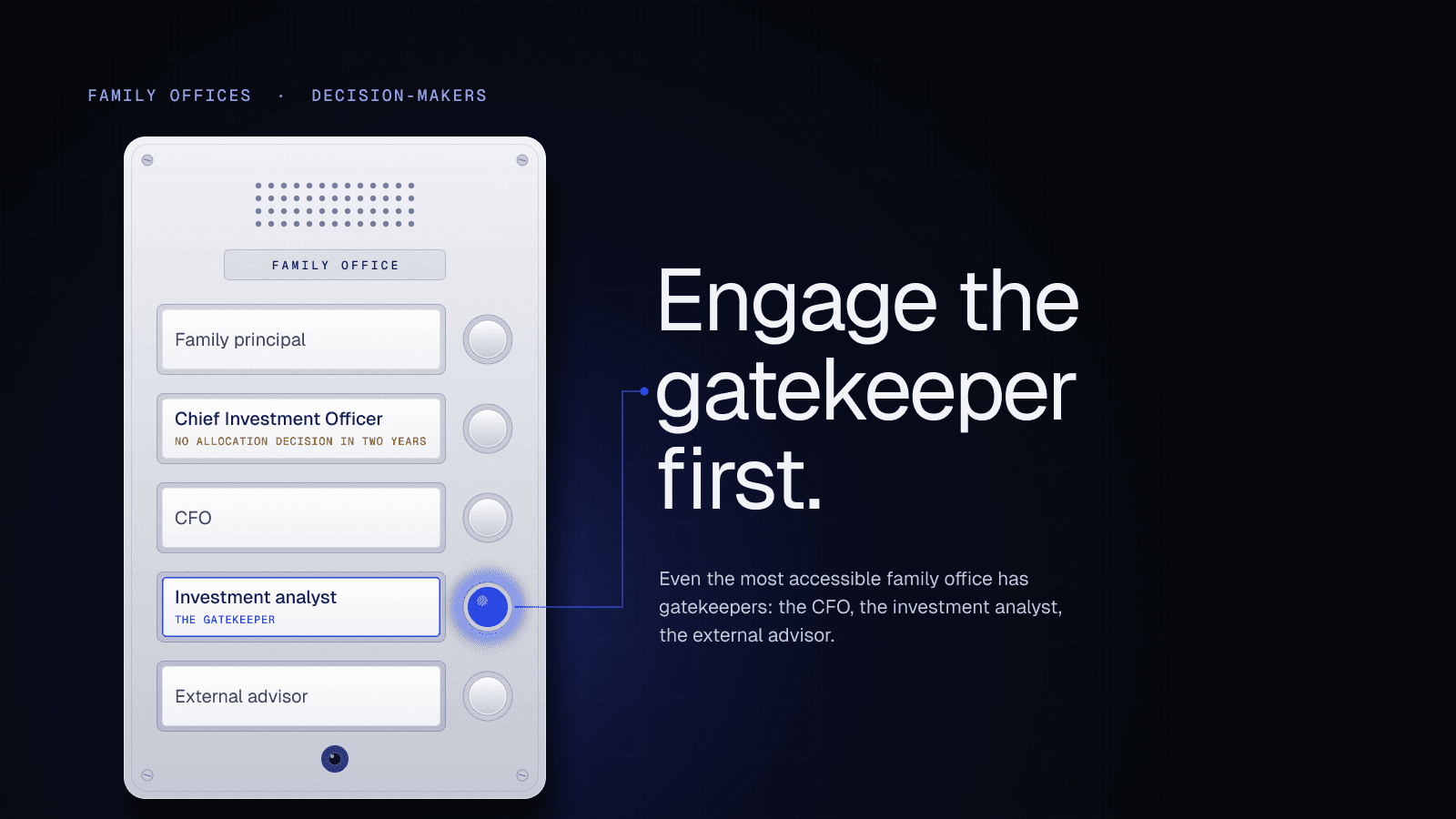
Even the most accessible family office has gatekeepers: the CFO, the investment analyst, the external advisor. Many fund managers blast emails to the "Chief Investment Officer" listed on a database—only to discover that person hasn't made an allocation decision in two years.
Altss maps decision-maker hierarchies, including who has authority for venture investments, who manages direct deals, and who handles co-investments. This is not publicly available information. It requires OSINT (open-source intelligence) collection and continuous refresh.
The Cost of Cold Outreach
Consider the math. A fund manager sends 500 cold emails to family office contacts scraped from LinkedIn and traditional databases. Typical open rate for cold LP outreach: 15–20%. Reply rate: 2–5%. Positive response rate (meeting scheduled): under 1%.
That means 500 emails yield 2–5 meetings. Of those, perhaps one converts to a check—if the manager is lucky.
Now consider intelligence-driven outreach. Using Altss, a manager identifies 50 family offices with:
- Active mandates in their sector
- Recent co-investment activity
- Decision-makers who have met with similar fund managers in the past six months
- Warm paths through portfolio companies, board members, or past deals
Reply rate on warm, intelligence-driven outreach: 30–50%. Meeting conversion: 15–25%. Check conversion from meeting: 10–20%.
The difference is not incremental. It is 10–50x.
What Family Offices Look for in 2026
Family offices have become more sophisticated allocators. The days of "we only invest in what we know" are fading. In 2026, family offices evaluate fund managers across five dimensions:
1. Differentiated Sourcing Edge
Family offices want to know: why do you see deals that others miss? This is the single most important question for emerging GPs.
Examples of credible sourcing edges:
- Industry-specific networks. A GP who spent 15 years in logistics can source supply chain tech deals that generalist VCs never see.
- Geographic concentration. A GP based in Austin who covers Texas-based startups has an edge over Silicon Valley funds.
- Technical expertise. A GP with a PhD in computational biology can evaluate biotech deals that others cannot.
- Operator experience. A GP who built and exited a company in the same sector understands founder pain points.
Family offices are skeptical of "proprietary deal flow" claims. They want specifics: how many deals did you source last year? What was your conversion rate? How many did you pass on, and why?
2. Demonstrated DPI or Compelling Pre-Exit Narrative
Family offices care about realized returns. They want to see:
- Distributions to paid-in capital (DPI). For existing funds, DPI above 0.5x is strong. Above 1.0x is exceptional.
- Realized multiples. Exits that returned 3x+ on invested capital.
- Partial liquidity events. Dividend recaps, secondary sales, or structured exits that returned capital to LPs.
For first-time funds without DPI, GPs must build a compelling pre-exit narrative:
- Track record of exits from prior roles. "At Firm X, I led the investment in Company Y, which exited at 5x in 24 months."
- Anchor LPs who validate the thesis. A commitment from a respected family office or institution provides social proof.
- Co-investment opportunities. Offering family offices the ability to co-invest alongside the fund—and see the deal pipeline firsthand—reduces perceived risk.
3. Capital Efficiency
Family offices dislike funds that burn capital on management fees. They evaluate:
- Fund size relative to opportunity. A $50 million fund targeting a $200 million market is efficient. A $200 million fund targeting a $50 million market is not.
- Fee structure. 2% management fee on a $50 million fund generates $1 million per year. Family offices want to see that money going to sourcing, diligence, and portfolio support—not salaries and offices.
- GP commitment. How much of their own capital is in the fund? 5% is standard. 10%+ signals strong alignment.
4. Access and Transparency
Family offices, especially single-family offices, want direct access to underlying assets. They value:
- Co-investment rights. The ability to invest directly in portfolio companies alongside the fund.
- Information rights. Regular updates on portfolio performance, not just quarterly reports.
- Board observation rights. A seat at the table for key decisions.
This is where Altss data becomes critical. Family offices that offer co-investment rights are clearly marked in the platform, along with their typical check size and co-investment frequency.
5. Sector Resonance with Family Values
The most overlooked dimension. Family offices increasingly invest with purpose:
- Next-generation interests. G3 family members often push capital toward climate tech, AI, and longevity.
- Family legacy. A family that built a manufacturing business may want to invest in industrial automation.
- Philanthropic goals. Impact investing is growing. 68% of family offices now allocate to impact strategies (UBS 2025).
Fund managers who can articulate how their thesis aligns with a family office's values—not just its return targets—win disproportionate attention.
The Altss Advantage: Intelligence-Driven Fundraising
Altss is the only platform built specifically for family office fundraising. It combines OSINT (open-source intelligence) collection with continuously refreshed LP data to solve the matching problem.
What Altss Covers
- 9,000+ family offices globally, including single-family offices, multi-family offices, and family office investment vehicles.
- 30,000+ institutional investors, RIAs, and family offices in a unified database.
- 150,000+ private-markets entities mapped with relationship data.
- Sub-30-day refresh cycle on LP data. When a family office changes mandate, hires a new CIO, or closes a fund to new commitments, Altss reflects it within weeks—not quarters.
Key Features for Fund Managers
Family Office Signal Discovery
Altss tracks who is raising capital, co-investing, or reallocating into specific sectors. A fund manager targeting climate tech can see every family office that has made a climate tech allocation in the past 12 months, along with the check size and decision-maker.
Continuously Refreshed Mandate Updates
Traditional databases show static profiles. Altss shows live signals: "This family office is actively evaluating first-time funds." "This family office closed its venture allocation six months ago." "This family office has a new CIO who previously invested in your sector."
Verified Decision-Maker Data
Email and phone-level coverage on 6,000+ family offices. Altss maps the full decision-making hierarchy: who sources deals, who evaluates, who approves. This is not scraped LinkedIn data—it is collected through OSINT methods and verified against public records, regulatory filings, and press coverage.
GTM Scoring and Match Signals
Altss scores LPs based on GP fit, sector overlap, and recent activity. A fund manager raising a healthcare fund sees family offices with healthcare mandates ranked by likelihood to invest.
Connection Networking
Altss shows warm paths: shared portfolio companies, board members, past deal partners. A fund manager targeting a specific family office can see: "Your LP in Fund I sits on the board of a company this family office owns." That is a warm introduction waiting to happen.
Institutional LP Coverage: Live Since February 2026
Altss expanded to cover institutional LPs in February 2026. This means fund managers can now use a single platform to research family offices, endowments, pension funds, and foundations—with the same depth of data and refresh frequency.
Building Your Family Office Target List: A Step-by-Step Framework
Most fund managers build target lists by downloading a database and filtering by geography or sector. This produces a list of names, not a strategy.
Here is the framework used by top-performing emerging GPs on Altss:
Step 1: Define Your Fit Profile
Before you search, know what you are looking for. Answer these questions:
- Sector: What specific sectors does your fund target? (Example: "Enterprise SaaS for healthcare")
- Stage: What stage do you invest at? (Seed, Series A, growth)
- Geography: Where do you invest? (US only, global, specific regions)
- Check size: What is your minimum and maximum LP commitment?
- Fund structure: Are you open to co-investment? Sidecar vehicles? Separate accounts?
- GP commitment: How much of your own capital is in the fund?
Step 2: Filter by Mandate Activity
Use Altss to find family offices with:
- Active mandates in your sector (invested in at least one comparable fund in the past 24 months)
- Recent capital deployment (made at least one new fund commitment in the past 12 months)
- Open to emerging managers (explicitly stated or evidenced by past investments in first-time funds)
Step 3: Verify Decision-Maker Data
For each target, confirm:
- Who makes the decision? Is it the CIO, the family principal, an investment committee?
- What is their background? Have they invested in your sector before?
- What is their preferred communication channel? Email, warm intro, conference meeting?
Step 4: Map Warm Paths
Before reaching out, find connections:
- Portfolio company overlap. Does the family office invest in a company where one of your LPs is on the board?
- Past deal partners. Did the family office co-invest with a firm where you previously worked?
- Advisor relationships. Does your lawyer, accountant, or banker advise this family office?
Step 5: Sequence Outreach
Do not send a mass email. Use a personalized sequence:
- Warm introduction through a mutual connection (highest conversion)
- Personalized email referencing a specific deal or article (medium conversion)
- LinkedIn message with a brief value proposition (lowest conversion, but better than cold email)
Step 6: Track and Iterate
Use Altss to track:
- Open rates and reply rates by family office type
- Meeting conversion by sector and geography
- Check conversion by relationship type (warm intro vs. cold outreach)
This data allows you to refine your target list continuously.
Case Study: How an Emerging GP Raised a $75M Fund from Family Offices in 8 Months
*Names and details anonymized per GP request.*
The GP: A first-time fund manager with 12 years of operating experience in supply chain technology. Previously a VP at a public logistics company and founder of a failed startup.
The thesis: Invest in supply chain software and automation companies at Series A. Target check size: $3–8 million. Fund target: $75 million.
The challenge: No institutional track record. No existing LP relationships. Competing against established venture firms with decades of history.
The approach:
- Built a target list of 120 family offices using Altss. Filtered by: supply chain or logistics mandate, active venture allocation, open to first-time funds.
- Mapped warm paths. Found that a former colleague from the logistics company now worked at a multi-family office that invested in supply chain. Used that intro to get the first meeting.
- Led with operating experience. The GP's deck focused on specific supply chain pain points they had experienced firsthand. No generic "disrupting logistics" language.
- Offered co-investment rights. Family offices that committed $5M+ received the right to co-invest in any portfolio company at the same terms as the fund.
- Used Altss signal tracking. When a target family office announced a new logistics-focused allocation, the GP reached out within 48 hours with a tailored message referencing the announcement.
The result: Closed $75 million in 8 months. 18 family offices committed, with an average check of $4.2 million. Two family offices provided co-investment capital that doubled the fund's effective deployment capacity.
Key lesson: The GP did not try to be everything to everyone. They built a tight list, used intelligence to find warm paths, and led with specific expertise that resonated with logistics-focused families.
The Role of Direct Investing and Co-Investment
Family offices are increasingly bypassing funds altogether. Direct investing—where the family office invests directly in private companies—grew 34% between 2022 and 2025 (Campden Wealth). Co-investments alongside fund managers grew 28%.
This creates both a threat and an opportunity for fund managers.
The Threat: Disintermediation
Family offices that build internal direct investment teams may reduce their fund allocations. A family office that previously committed $10 million to a venture fund may now allocate $5 million to the fund and $5 million to direct deals sourced by their internal team.
The Opportunity: Co-Investment Partnerships
Fund managers who offer co-investment rights become more attractive, not less. Family offices want access to deal flow. A fund manager with strong sourcing can become the family office's primary deal source, earning management fees on the fund and carried interest on co-investments.
Best practices for co-investment programs:
- Offer pro-rata rights. Family offices that commit a minimum check (e.g., $5M) can co-invest in any portfolio company up to their pro-rata share.
- Provide transparency. Share the deal pipeline quarterly. Let family offices opt in before the fund commits.
- Align fees. Co-investments should carry lower fees than fund commitments. 0.5% management fee and 10% carry is standard.
- Limit co-investment to LPs. Do not offer co-investment to non-LPs. It dilutes the fund's advantage.
Altss tracks which family offices have active co-investment programs, their typical check sizes, and their preferred sectors. This data is continuously refreshed—if a family office launches a new co-investment vehicle, Altss picks it up.
Sectors Winning Family Office Capital in 2026
Not all sectors are equal. Family office allocation patterns shift year to year. Based on Altss data and industry reports, these are the sectors attracting the most family office capital in 2026:
1. Artificial Intelligence and Machine Learning
- Share of family office venture allocations: 22% (up from 15% in 2023)
- Typical check size: $2–10 million
- Key sub-sectors: Enterprise AI applications, vertical AI (healthcare, legal, finance), AI infrastructure
Family offices are drawn to AI for two reasons: return potential and personal interest. Many second- and third-generation family members have technology backgrounds. They understand AI and want to back it.
2. Climate Technology and Energy Transition
- Share of family office venture allocations: 18% (up from 12% in 2023)
- Typical check size: $3–15 million
- Key sub-sectors: Carbon capture, grid-scale storage, sustainable materials, agtech
Climate is the rare sector that combines return potential with values alignment. Family offices with industrial backgrounds see climate as a natural extension of their expertise.
3. Healthcare and Longevity
- Share of family office venture allocations: 16% (stable)
- Typical check size: $3–12 million
- Key sub-sectors: Biotech, digital health, longevity therapeutics, medtech
Healthcare is a perennial favorite. Family offices with healthcare wealth (pharma, medical devices, hospital systems) have deep domain expertise. They can diligence deals that generalist VCs cannot.
4. Defense and National Security
- Share of family office venture allocations: 8% (up from 4% in 2023)
- Typical check size: $5–20 million
- Key sub-sectors: Autonomous systems, cybersecurity, space technology
Defense tech has become mainstream. Family offices with government contracting backgrounds or patriotic motivations are allocating aggressively.
5. Real Estate and Infrastructure
- Share of family office allocations: 12% (declining from 18% in 2020)
- Typical check size: $10–50 million
- Key sub-sectors: Data centers, logistics real estate, affordable housing
Real estate remains a core allocation for conservative family offices, but the mix is shifting from traditional office and retail to alternative asset classes.
The Geography of Family Office Capital
Family offices are not evenly distributed. Fund managers should prioritize regions with high family office density and active allocation.
Top 10 Family Office Markets (by number of offices, Altss data 2026)
- United States: 3,200+ family offices. Concentration in New York, San Francisco, Miami, Dallas, Chicago.
- United Kingdom: 800+ family offices. London dominates. Growing presence in Manchester and Edinburgh.
- Switzerland: 500+ family offices. Zurich and Geneva. Attracts global wealth due to banking secrecy and stability.
- Germany: 400+ family offices. Frankfurt, Munich, Hamburg. Industrial wealth.
- Singapore: 350+ family offices. Fastest-growing market. Government incentives for family office establishment.
- Hong Kong: 300+ family offices. Chinese mainland wealth. Regulatory uncertainty pushing some to Singapore.
- Canada: 250+ family offices. Toronto, Vancouver. Natural resources and technology wealth.
- UAE (Dubai and Abu Dhabi): 200+ family offices. Attracting global wealth. No income tax.
- Australia: 180+ family offices. Sydney, Melbourne. Mining and property wealth.
- India: 150+ family offices. Mumbai, Delhi, Bangalore. Fastest-growing emerging market.
Emerging Markets to Watch
- Brazil: 100+ family offices. São Paulo. Commodity and banking wealth.
- Saudi Arabia: 80+ family offices. Riyadh, Jeddah. Oil wealth diversifying into technology.
- Israel: 70+ family offices. Tel Aviv. Technology wealth. High venture allocation.
- South Korea: 60+ family offices. Seoul. Chaebol wealth spinning off family offices.
Common Mistakes Fund Managers Make (and How to Avoid Them)
Mistake 1: Over-relying on Databases
Databases are starting points, not solutions. A family office that appears in a database may have changed its mandate, hired a new CIO, or closed to new commitments six months ago.
Solution: Use Altss, which refreshes data on a sub-30-day cycle. Never send outreach based on data older than 90 days.
Mistake 2: Sending Generic Pitches
"I have reviewed your family office and believe our fund would be a strong fit" is the most common opening line—and the most ignored.
Solution: Reference something specific: a recent investment, a public statement, a sector interest. "I saw that your office invested in Company X last year. Our fund focuses on the same sector, and I believe our sourcing edge in this area would complement your portfolio."
Mistake 3: Ignoring the Gatekeeper
Many fund managers focus exclusively on the CIO or family principal. The gatekeeper—the analyst, associate, or external advisor—controls access.
Solution: Map the full decision-making hierarchy using Altss. Engage the gatekeeper first. Ask for their perspective. Build a relationship. They will advocate for you to the decision-maker.
Mistake 4: Leading with Track Record
Family offices care about track record, but they care more about fit. A stellar track record in a sector they don't care about is irrelevant.
Solution: Lead with alignment. "Our fund targets supply chain software. Your office has invested in three supply chain companies in the past two years. I believe we are a natural fit."
Mistake 5: Asking for Too Much Too Fast
Family offices want to build relationships before writing checks. Asking for a $5 million commitment after one meeting is premature.
Solution: Start small. Ask for a meeting to share your thesis. Offer to send a one-page summary. Propose a co-investment on a specific deal. Build trust before asking for capital.
The Future of Family Office Fundraising
The family office landscape is evolving rapidly. Fund managers who adapt will have an enduring advantage.
Trend 1: Professionalization
Family offices are hiring institutional talent. Former endowment CIOs, private equity partners, and investment bankers are moving into family office roles. This means family offices are becoming more sophisticated—but also more demanding.
Implication: Fund managers must meet institutional standards for reporting, transparency, and governance, even when raising from single-family offices.
Trend 2: Consolidation
Multi-family offices are growing. The largest MFOs now manage $10 billion+ across hundreds of families. They offer economies of scale but also impose more process.
Implication: Fund managers should target both single-family offices (for speed and flexibility) and multi-family offices (for scale and repeatability).
Trend 3: Technology Adoption
Family offices are adopting technology for portfolio management, reporting, and deal sourcing. Altss is the leading platform for family office intelligence, but other tools (deal management, CRM, reporting) are also gaining traction.
Implication: Fund managers who use technology to provide better service—faster reporting, more transparency, easier co-investment—will win.
Trend 4: Cross-Border Investing
Family offices are increasingly investing outside their home markets. 56% of family offices now allocate to cross-border investments (Campden Wealth 2025).
Implication: Fund managers with global sourcing networks or cross-border expertise have an advantage.
Trend 5: Impact and ESG Integration
Impact investing is no longer niche. 68% of family offices allocate to impact strategies. ESG integration is standard.
Implication: Fund managers must articulate their impact thesis, even if they are not explicitly impact-focused. How does your fund create positive outcomes beyond financial returns?
How Altss Stays Ahead
Altss is not a static database. It is a continuously refreshed intelligence platform built for the speed of family office fundraising.
OSINT-Native Data Collection
Altss uses open-source intelligence (OSINT) methods to collect data from:
- Regulatory filings (SEC, FCA, MAS, etc.)
- Press releases and news coverage
- Conference participation and speaking engagements
- Social media (LinkedIn, Twitter, industry forums)
- Public records (court filings, property records, corporate registrations)
This data is cross-referenced and verified before it enters the platform. The result: higher accuracy than traditional databases, which rely on self-reported data or manual surveys.
Sub-30-Day Refresh Cycle
Most LP databases refresh quarterly or annually. Altss refreshes on a sub-30-day cycle. When a family office:
- Hires a new CIO
- Changes its investment mandate
- Opens or closes a fund to new commitments
- Announces a new co-investment vehicle
Altss reflects the change within weeks.
Institutional LP Coverage: Live Since February 2026
Altss now covers institutional LPs alongside family offices. Fund managers can research endowments, pension funds, foundations, and sovereign wealth funds with the same depth of data.
What Altss Does Not Do
Altss does not claim to have 1.5 million verified LPs. That number is not verified and does not reflect the quality of Altss data. Altss focuses on depth over breadth: 9,000+ family offices with verified decision-maker data, not millions of unverified contacts.
Altss does not claim SOC 2 compliance. SOC 2 Type II certification is in progress with Vanta, but Altss does not market compliance as a feature.
Altss does not target placement agents or executive search firms. The platform is built for fund managers and emerging GPs raising capital.
Practical Advice for Fund Managers Starting Today
Immediate Actions
- Define your fit profile. Write down your sector, stage, geography, check size, and fund structure. Be specific.
- Build a target list of 50 family offices. Use Altss to filter by mandate activity, sector alignment, and geographic fit.
- Map warm paths. For each target, find at least one connection: a portfolio company, a board member, a past deal partner.
- Craft personalized outreach. For each target, write a two-paragraph email referencing something specific about their portfolio or recent activity.
- Sequence your outreach. Start with warm intros. Follow with personalized emails. Use LinkedIn as a backup.
Medium-Term Actions
- Track your metrics. Use Altss to monitor open rates, reply rates, meeting conversion, and check conversion. Iterate based on data.
- Build relationships before asking for capital. Offer to share deal flow. Invite family offices to co-invest on a specific deal. Build trust.
- Develop a co-investment program. Offer pro-rata rights to LPs who commit a minimum check. This differentiates your fund.
- Attend family office conferences. The Family Office Network, Campden Wealth, and UBS host annual events. Attend with a specific target list.
- Use Altss signal tracking. Set up alerts for family offices that change mandates, hire new CIOs, or announce new allocations.
Conclusion: The Family Office Opportunity Is Now
Family offices are the most flexible, fastest-growing source of private capital in 2026. They are not constrained by consultant gatekeeping or slow investment committee cycles. They make conviction-based bets in weeks, not quarters.
But they are also harder to reach than ever. The number of family offices has grown, but so has the noise. Fund managers who rely on outdated databases, generic outreach, and cold emails will fail.
The winners are those who use intelligence: verified decision-maker data, continuously refreshed mandate updates, warm path mapping, and signal-based targeting. Altss provides this intelligence for 9,000+ family offices globally, with a sub-30-day refresh cycle and institutional LP coverage since February 2026.
The question is not whether family offices will allocate to your fund. The question is whether you will find the right ones before your competitors do.
Altss is the only platform built for family office fundraising. Track 9,000+ family offices with verified decision-maker data, continuously refreshed mandates, and warm path mapping. See who is deploying, why they are allocating, and how to reach them before they are oversubscribed.
Find the allocators who actually back funds like yours
GPs and IR teams use Altss to research allocators with ownership, commitment, transaction and relationship context, then prioritize outreach.


See the allocators behind your next close.
Public records carry source-specific dates where available. No population-wide measured refresh cadence or universal verification deadline is established here. Page modified, source captured, fact observed, entity verified and aggregate measured describe different events. Check the date attached to the relevant claim; a missing verification date means unknown. Stored source history does not establish a customer-facing historical-analysis interface.