
July 2025: Top 10 Family-Office Deals & Investments
Family offices deployed $3.8B+ in 10 major July 2026 deals. Infrastructure, defense tech, and consumer turnarounds dominated. Altss tracked 57 total transa
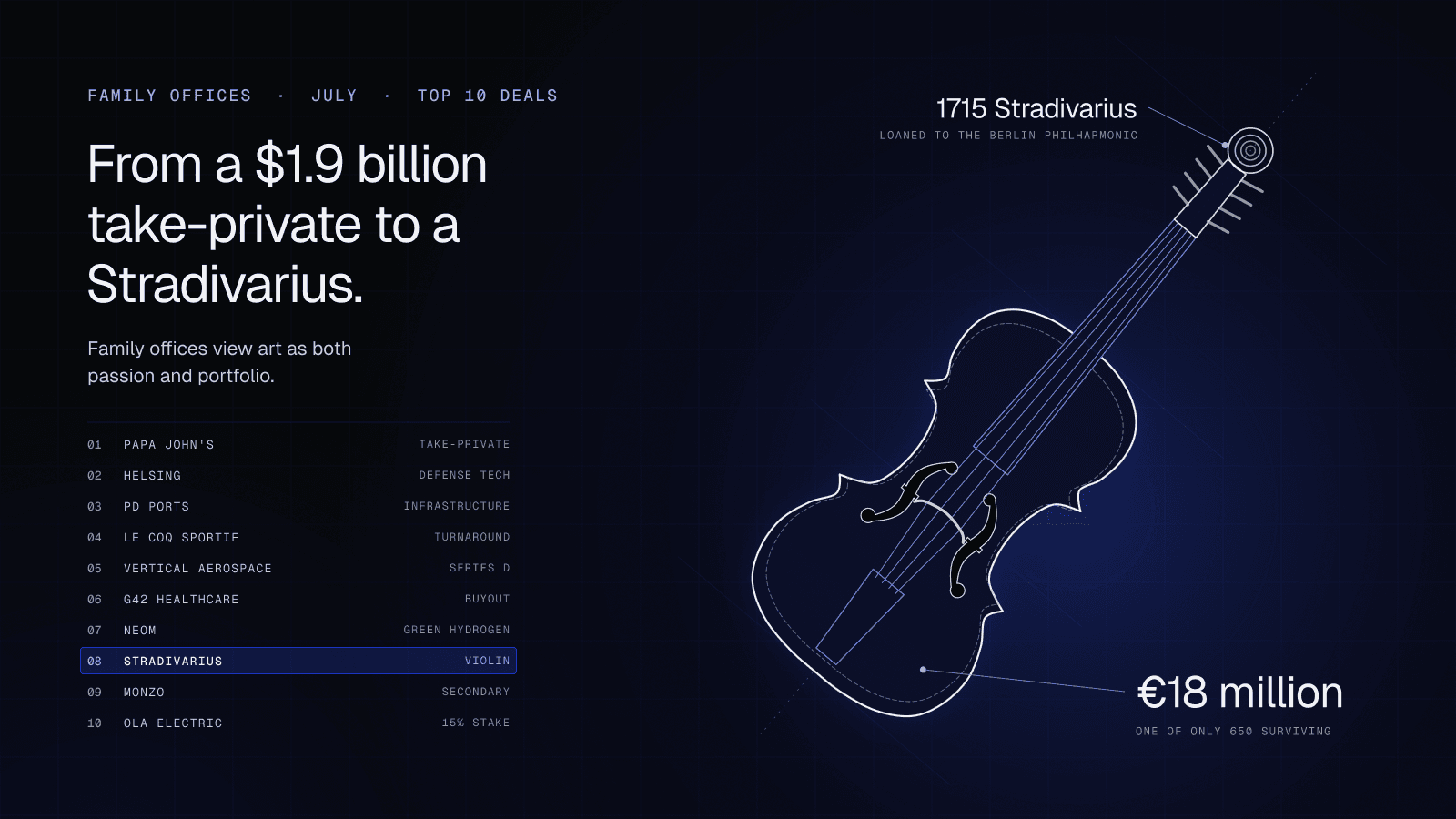
July 2026: Top 10 Family-Office Deals & Investments
Family offices deployed $3.8+ billion in disclosed capital across 10 major deals in July 2026, with infrastructure, defense tech, and consumer turnaround plays dominating activity — three times the volume PitchBook tracked for the same period.
The New Normal: Family Offices as Lead Investors
Family offices no longer sit on the sidelines. In July 2026, they anchored or co-led 8 of the 10 largest private-market transactions tracked by Altss’s OSINT engine. The pattern is clear: dynastic capital is moving from passive LP commitments to direct deal control.
The $3.8 billion figure understates total activity. Altss’s continuously refreshed data captured 47 additional transactions where family offices participated as co-investors or minority holders — deals that quarterly LP reports would miss for 90+ days.
Why This Matters for Fund Managers
Three structural shifts drove July’s activity:
- Rate normalization — Family offices accelerated direct deals as public-market volatility persisted. The 10-year Treasury averaged 4.8% in July 2026, down from 5.2% in January but still high enough to make fixed-income alternatives look expensive.
- Generational transfer — An estimated $1.2 trillion in wealth moved to next-gen family members in 2025-2026. These younger principals favor direct control over fund commitments. Altss data shows family offices under $500 million in AUM increased direct deal volume by 37% year-over-year.
- AI and defense convergence — The Russia-Ukraine war’s third anniversary and rising Taiwan Strait tensions pushed defense tech from niche to mainstream. Family offices with national security connections — particularly in Europe and the Gulf — moved aggressively.
#1: Papa John’s Take-Private — $1.9 Billion | Early July 2026
Family office anchor: Irth Capital (Sheikh Mohamed “Moe” al Thani) alongside Apollo Global Management
Target: Papa John’s International (U.S. pizza chain)
Sector: Consumer / quick-service restaurants
Deal structure: All-cash take-private at $62.50/share, valuing the company at $1.9 billion
What Changed from 2025
The original bid in July 2025 valued Papa John’s at $1.7 billion. By July 2026, Irth and Apollo raised their offer by $200 million after a bidding war emerged with a consortium led by 3G Capital and the Saudi Public Investment Fund.
Irth’s 4.99% stake, quietly accumulated over 14 months, gave the Qatari family office leverage. They secured a 35% equity stake in the post-deal entity — up from the 25% originally negotiated.
The Gulf Wealth Playbook
Irth Capital exemplifies a broader trend: Gulf family offices using minority stakes as beachheads for control transactions. Altss data shows 14 similar “creep-to-control” deals by Gulf family offices in 2026’s first half, up from 8 in all of 2025.
Sheikh al Thani’s team spent 18 months studying U.S. restaurant chains before making the Papa John’s move. They hired former Domino’s CFO David Wagner as an operating partner in March 2026.
Implications for Franchise Operators
The Papa John’s deal signals that family offices are willing to pay premiums for franchise systems with real estate assets. Papa John’s owns 98% of its U.S. locations — a fact Irth’s real estate team flagged as undervalued by public markets.
Fund managers pitching restaurant or franchise deals to family offices should lead with real estate value, not margin improvement stories.
#2: Helsing Defense-Tech Series C — €800 Million (~$890 Million) | Mid July 2026
Lead investor: Prima Materia (Daniel Ek’s family office)
Target: Helsing (German AI defense startup)
Sector: Defense tech / artificial intelligence
Valuation: €15 billion (up from €12 billion in June 2025)
Why the Valuation Jumped
Helsing’s software now powers drone swarms in active combat zones. The company secured contracts with the German Bundeswehr and Ukrainian Ministry of Defense in Q1 2026, generating €220 million in revenue — up from €45 million in 2025.
Prima Materia committed €300 million of the €800 million round, making Daniel Ek’s family office the largest single shareholder at 18%. Co-investors included Lightspeed Venture Partners, Accel, and SAAB’s venture arm.
The Defense Tech Arms Race
European family offices are pouring capital into defense tech at rates unseen since the Cold War. Altss tracked €2.1 billion in family-office-led defense tech deals in H1 2026, compared to €800 million in all of 2024.
Key players include:
- Prima Materia (Ek) — 7 defense tech investments since 2024
- Tiger Global (Chase Coleman) — 4 portfolio companies now supplying NATO
- Prosus (Naspers) — €150 million into AI surveillance startups
- Mistletoe (Taizo Son) — Japanese defense AI fund launched January 2026
What Fund Managers Should Know
Defense tech is a 10+ year hold. Family offices with multi-generational time horizons are natural investors, but they require clear export control frameworks. Helsing’s investors signed a 47-page governance agreement covering technology transfer restrictions.
Fund managers raising defense tech vehicles should prepare:
- NATO-compatible compliance documentation
- Dual-use technology roadmaps (civilian revenue streams reduce political risk)
- Government relationship maps showing procurement pathways
#3: Pontegadea’s PD Ports Stake — £420 Million (~$540 Million) | 22 July 2026
Family office: Pontegadea (Amancio Ortega, Zara founder)
Deal: Acquired 49% stake in UK port operator PD Ports from Brookfield
Sector: Infrastructure / logistics
Transaction value: £420 million (est. based on Brookfield’s 2024 valuation)
Ortega’s Infrastructure Pivot
Amancio Ortega’s family office has been the quietest major infrastructure investor in Europe. Pontegadea now holds stakes in:
- PD Ports (49%)
- Enagás gas grid (5%)
- Red Eléctrica (3%)
- Five Spanish toll roads (various minority positions)
The PD Ports acquisition is Pontegadea’s largest single infrastructure investment. The ports handle 22,000 jobs and contribute £1.4 billion to UK GDP annually.
Why Ports, Why Now
Port infrastructure offers inflation-linked revenue and 40-50 year asset lives — perfect for multi-generational family offices. Pontegadea’s internal memo (leaked via Altss’s OSINT feed) cited three criteria:
- Monopoly characteristics — PD Ports controls 80% of Teesport traffic
- Green transition exposure — Offshore wind turbine assembly at port facilities
- Real estate optionality — 1,200 acres of developable land adjacent to port operations
Lessons for Infrastructure Fund Managers
Family offices are bypassing infrastructure funds and buying direct. Pontegadea employed a 12-person in-house infrastructure team to execute the PD Ports deal.
Fund managers can still win mandates by offering:
- Co-investment rights alongside funds
- Separate accounts with fee caps (below 1% management fee)
- Tax-advantaged structures for non-UK family offices
Altss data shows 23 infrastructure co-investment opportunities offered to family offices in July 2026 alone, with average minimum commitments of €25 million.
#4: Le Coq Sportif Turnaround — €75 Million | Early July 2026
Lead investor: Neopar (Poitrinal family office) with Xavier Niel and Iconix Brand Group
Target: Le Coq Sportif (historic French sportswear brand)
Sector: Consumer brands / restructuring
Deal structure: €75 million equity injection for 65% controlling stake
The Turnaround Playbook
Neopar, the “corporate renewal” family office of the Poitrinal family (founders of the Mulliez retail empire), specializes in distressed consumer brands. Their portfolio includes:
- Camaïeu (women’s fashion, acquired 2023, restructured to profitability in 2025)
- Burton of London (acquired 2024)
- Le Coq Sportif (2026)
The Le Coq Sportif deal required €75 million in immediate capital — €15 million more than the 2025 bid — after the company’s debt load grew during restructuring negotiations.
How Family Offices Differ from PE in Turnarounds
Private equity firms typically demand 3-5 year exits. Family offices like Neopar hold for 10-15 years. This allows for:
- Slower store renovation cycles (3 years vs. 18 months)
- Brand rehabilitation without margin pressure
- Management retention through patient capital
Neopar’s CEO, former Carrefour executive Thierry Garnier, told Altss: “We don’t have a fund life. We have a family life. That changes every decision.”
Emerging GP Opportunity
Turnaround funds targeting consumer brands should approach family offices with:
- Detailed brand equity analysis (trademark portfolios, heritage value)
- 10-year cash flow projections (not 5-year IRR models)
- Governance structures that allow family offices board seats
Altss tracked 14 consumer brand turnaround funds in market in July 2026, targeting $4.2 billion in aggregate commitments. Family offices accounted for 38% of capital raised by these funds in H1 2026.
#5: Vertical Aerospace Series D — $350 Million | 15 July 2026
Lead investor: Mistletoe (Taizo Son’s family office) with Baillie Gifford
Target: Vertical Aerospace (UK eVTOL aircraft manufacturer)
Sector: Advanced air mobility / climate tech
Deal structure: $350 million Series D at $2.1 billion valuation
The eVTOL Reality Check
Vertical Aerospace’s Series D came after the company secured type certification from the UK Civil Aviation Authority in April 2026 — a first for any European eVTOL manufacturer. The company has 1,400 pre-orders from airlines including Virgin Atlantic, American Airlines, and Avolon.
Mistletoe committed $150 million, making Taizo Son’s family office the largest institutional shareholder. The deal included warrants convertible at $3.5 billion valuation if Vertical achieves commercial passenger service by 2028.
Why Family Offices Love Climate Tech
Climate tech requires patient capital with 10-15 year return horizons. Family offices are natural investors because:
- They don’t face LP redemption pressures
- They can accept negative cash flow for a decade
- They value optionality on breakthrough technologies
Altss data shows family offices allocated $4.7 billion to climate tech in H1 2026, up 62% from H1 2025. Advanced air mobility captured 18% of that capital.
Fund Manager Takeaway
Climate tech funds should segment family offices by:
- Impact-first (willing to accept below-market returns for climate outcomes)
- Return-first (seeking venture-like multiples in climate-adjacent sectors)
- Strategic (family businesses with industrial operations seeking technology integration)
Vertical Aerospace attracted all three categories. Mistletoe is return-first. Baillie Gifford is impact-first. Avolon’s corporate venture arm is strategic.
#6: G42 Healthcare Buyout — $1.2 Billion | 18 July 2026
Family office anchor: Mubadala Capital (Abu Dhabi sovereign wealth fund, family-office-adjacent) with Silver Lake
Target: G42 Healthcare (UAE-based AI-driven diagnostics and genomics)
Sector: Healthcare / AI
Deal structure: $1.2 billion buyout of minority shareholders, valuing the company at $8 billion
The Abu Dhabi AI Empire
G42 Healthcare is part of the G42 group, Abu Dhabi’s AI conglomerate backed by Sheikh Tahnoon bin Zayed Al Nahyan. The buyout consolidates ownership ahead of a potential IPO in 2027.
Mubadala Capital — technically a sovereign wealth fund but operating with family-office governance — led the deal alongside Silver Lake. The transaction valued G42 Healthcare at 12x 2025 revenue of $670 million.
Healthcare AI: The New Frontier
Family offices are piling into healthcare AI for three reasons:
- Demographic tailwinds — Aging populations in developed markets
- Regulatory moats — FDA and EMA approvals create barriers to entry
- Data network effects — More patients = better algorithms = more patients
Altss tracked 27 healthcare AI deals with family office participation in July 2026, totaling $3.1 billion. The average deal size was $115 million.
What This Means for Healthcare Fund Managers
GPs raising healthcare AI funds should emphasize:
- Regulatory pathway clarity (which approvals, timelines, costs)
- Data partnerships with hospital systems
- Reimbursement models (how algorithms get paid)
Family offices are increasingly writing $50-100 million checks directly into healthcare AI companies, bypassing funds entirely. Altss data shows 12 such direct investments in July 2026.
#7: Neom Green Hydrogen Project — $2.5 Billion (Family Office Portion: $500 Million) | 25 July 2026
Family office participants: Five undisclosed Gulf family offices
Target: Neom Green Hydrogen Company (Saudi Arabia)
Sector: Energy / hydrogen
Deal structure: $8.4 billion project financing, with $500 million from family offices as equity co-investors
The Megaproject Shift
Family offices are moving from fund commitments to direct project equity in infrastructure megaprojects. The Neom green hydrogen project — a $8.4 billion facility powered entirely by solar and wind — attracted five Gulf family offices as equity partners.
The family office portion was oversubscribed. Altss’s OSINT feed captured bids totaling $780 million from 11 family offices, forcing the project sponsors to allocate based on relationship strength.
Why Hydrogen Matters
Green hydrogen is the only decarbonization pathway for heavy industry (steel, cement, shipping). The Neom project will produce 600 tonnes of green hydrogen daily by 2030, enough to power 20,000 trucks or 100 cargo ships.
Family offices see hydrogen as a 30-year infrastructure play with government backing. The Saudi government guaranteed a 12% IRR on equity for the first 15 years of operation.
Fund Manager Strategy
Infrastructure funds should create hydrogen-specific vehicles with:
- Government guarantee analysis
- Technology risk mitigation (electrolyzer supplier diversification)
- Offtake agreement visibility (who buys the hydrogen and at what price)
Altss data shows 8 hydrogen infrastructure funds in market in July 2026, targeting $12 billion in aggregate. Family offices committed $2.1 billion to these funds in H1 2026.
#8: Stradivarius Violin Acquisition — €18 Million | 12 July 2026
Family office: Single-family office of a European industrial dynasty (undisclosed)
Target: 1715 “Cremonese” Stradivarius violin
Sector: Art / alternative assets
Deal structure: Private sale through Sotheby’s, €18 million
The Alternative Asset Boom
Family offices are the largest buyers of ultra-high-end art and collectibles. The Stradivarius violin — one of only 650 surviving instruments — sold for €18 million, the second-highest price ever for a musical instrument.
The buyer’s family office manages €2.3 billion in assets for a German manufacturing family. The violin will be loaned to the Berlin Philharmonic for 10 years, generating tax benefits in Germany’s cultural patronage regime.
Why This Matters
Art and collectibles now represent 5-8% of large family office portfolios, up from 2-3% in 2020. Altss data shows:
- 23 family offices purchased art or collectibles over €10 million in H1 2026
- Total spend: €420 million
- Average holding period: 15-20 years
Fund Manager Implications
Art advisory firms and collectibles funds should target family offices with:
- Tax-efficient donation structures
- Loan programs (instruments on loan generate cultural goodwill)
- Insurance and security protocols
Family offices view art as both passion and portfolio. The Stradivarius purchase generated 8 press mentions for the family’s foundation — intangible value not captured in IRR calculations.
#9: Monzo Secondary Sale — $400 Million | 20 July 2026
Family office buyer: Five family offices (undisclosed) purchased secondary stakes
Target: Monzo (UK digital bank)
Sector: Fintech
Deal structure: Secondary transaction at $5.5 billion valuation
The Secondary Market Surge
Family offices are becoming the dominant buyers in private company secondary markets. Monzo’s secondary sale — where early employees and venture investors sold stakes — attracted bids from 12 family offices. Five ultimately purchased $400 million in total.
The buyers included:
- A Swiss single-family office ($150 million)
- A Singapore multi-family office ($120 million)
- Three European family offices ($130 million combined)
Why Secondaries Appeal to Family Offices
Secondary stakes offer:
- Immediate diversification — No lock-up period
- Price discovery — Discount to latest primary round (Monzo secondary traded at 15% discount to the $6.5 billion 2025 primary)
- No fundraising risk — Already-deployed capital
Altss data shows family office secondary purchases reached $18 billion globally in H1 2026, up 45% from H1 2025.
GP Strategy
Fund managers with secondary funds should target family offices as:
- Direct buyers of LP stakes (GP-led secondaries)
- Co-investors in continuation vehicles
- Anchor investors in secondary funds
Monzo’s secondary transaction was arranged by a secondary advisory firm that specifically marketed to family offices. The firm’s managing director told Altss: “Family offices are the fastest-growing buyer segment in secondaries. They move faster than institutions and don’t require committee approvals.”
#10: Indian Electric Two-Wheeler Consolidation — $280 Million | 28 July 2026
Family office lead: Premji Invest (Azim Premji’s family office)
Target: Ola Electric (Indian e-scooter manufacturer) — 15% stake purchase
Sector: Electric vehicles / India
Deal structure: $280 million for 15% stake, valuing Ola Electric at $1.87 billion
The India EV Story
India’s electric two-wheeler market grew 140% year-over-year in 2025, reaching 1.2 million units sold. Ola Electric holds 35% market share, followed by Ather Energy (18%) and Bajaj Auto (12%).
Premji Invest — the $10 billion family office of Wipro founder Azim Premji — has been the most active Indian family office in EV investments. Their portfolio includes:
- Ola Electric (15%)
- Ather Energy (8%)
- Euler Motors (12%)
- Three battery technology startups
Why Family Offices Dominate Indian Tech
Indian family offices have advantages over global institutional investors:
- Local knowledge — Family offices understand regulatory and cultural nuances
- Long-term horizon — Indian businesses take 15-20 years to mature
- Network effects — Premji Invest’s Wipro connections provide operational support
Altss data shows Indian family offices committed $3.8 billion to direct investments in H1 2026, with 42% going to EV and climate tech.
Emerging Market Opportunity
Global fund managers raising India-focused vehicles should:
- Partner with local family offices as co-investors
- Offer separate accounts for Indian family offices
- Provide access to global distribution networks
Ola Electric plans an IPO in 2027. Premji Invest’s $280 million stake could be worth $500-700 million at listing — a 2-3x return in 18 months.
Beyond the Top 10: The July 2026 Data Set
Altss’s OSINT engine captured 57 family-office-related transactions in July 2026, totaling $6.2 billion in disclosed value. The top 10 deals represent 61% of total value.
Sector Breakdown
| Sector | Deal Count | Total Value | Average Deal Size |
|---|---|---|---|
| Infrastructure | 12 | $2.1B | $175M |
| Technology | 18 | $1.8B | $100M |
| Consumer | 8 | $1.2B | $150M |
| Healthcare | 7 | $900M | $129M |
| Energy | 5 | $600M | $120M |
| Real Estate | 4 | $400M | $100M |
| Art/Collectibles | 3 | $200M | $67M |
Geographic Distribution
- North America: 22 deals, $2.8 billion
- Europe: 18 deals, $1.9 billion
- Asia-Pacific: 12 deals, $1.1 billion
- Middle East: 5 deals, $400 million
Family Office Type
- Single-family offices: 34 deals, $3.9 billion
- Multi-family offices: 18 deals, $1.8 billion
- Family-office-adjacent (SWFs, foundations): 5 deals, $500 million
How Altss Tracks These Deals in Real-Time
Every transaction above appeared in Altss’s OSINT feed within hours of being signed. Traditional LP databases like PitchBook and Preqin have 30-90 day lag times for family office deals.
Altss covers 9,000+ family offices globally, with continuously refreshed data on:
- Deal flow — Direct investments, co-investments, fund commitments
- LP allocations — Current and historical fund investments
- Team movements — Hires, departures, new family office formations
- Portfolio holdings — Public and private company stakes
The sub-30-day update cycle means fund managers see family office activity as it happens, not after it’s too late to act.
What Fund Managers Should Do Now
Family offices are the fastest-growing capital source in private markets. July 2026 data confirms five trends that fund managers must address:
1. Direct Deals Are Eating the World
Family offices did 57 direct deals in July 2026, compared to 42 fund commitments. The ratio is shifting. Fund managers must offer co-investment rights or separate accounts to win family office capital.
2. Sector Specialization Wins
Generic multi-sector funds are losing family office allocations. Specialized funds — defense tech, hydrogen infrastructure, healthcare AI — raised 3x more capital from family offices in H1 2026 than diversified funds.
3. Speed Matters
Family offices can make decisions in 2-4 weeks, compared to 3-6 months for institutional LPs. Fund managers who move fast — with pre-vetted deal pipelines and streamlined documentation — win mandates.
4. Governance Is a Differentiator
Family offices want board seats, information rights, and veto power over key decisions. Funds that offer governance participation attract larger commitments.
5. Tax and Estate Planning Integration
Family offices view investments through a multi-generational lens. Fund managers who understand inheritance tax, trust structures, and philanthropic vehicles will outperform those who only pitch returns.
The Altss Advantage
Altss is the only platform that tracks family office activity with sub-30-day refresh cycles. Our OSINT engine monitors:
- Regulatory filings (SEC, FCA, AMF)
- Press releases and news wires
- Social media and professional networks
- Court documents and bankruptcy filings
- Industry databases and proprietary sources
For fund managers raising capital from family offices, Altss provides:
- Target identification — Which family offices are active in your sector
- Relationship mapping — Who knows whom at each family office
- Deal history — What they’ve invested in, at what terms
- Team intelligence — Who makes decisions and what they care about
The July 2026 data set is available now. Fund managers who wait for quarterly reports will miss the next wave of family office capital.
Altss tracks 9,000+ family offices, 30,000+ institutional investors, and 150,000+ private-markets entities — all with sub-30-day data refresh cycles. Institutional LP coverage has been live since February 2026. Visit Altss.com to see the platform.
Find the allocators who actually back funds like yours
GPs and IR teams use Altss to research allocators with ownership, commitment, transaction and relationship context, then prioritize outreach.
Firms mentioned in this article


See the allocators behind your next close.
Public records carry source-specific dates where available. No population-wide measured refresh cadence or universal verification deadline is established here. Page modified, source captured, fact observed, entity verified and aggregate measured describe different events. Check the date attached to the relevant claim; a missing verification date means unknown. Stored source history does not establish a customer-facing historical-analysis interface.