
May 2025's Family-Office Deal Surge: Why Live Intelligence Beats Static Lists
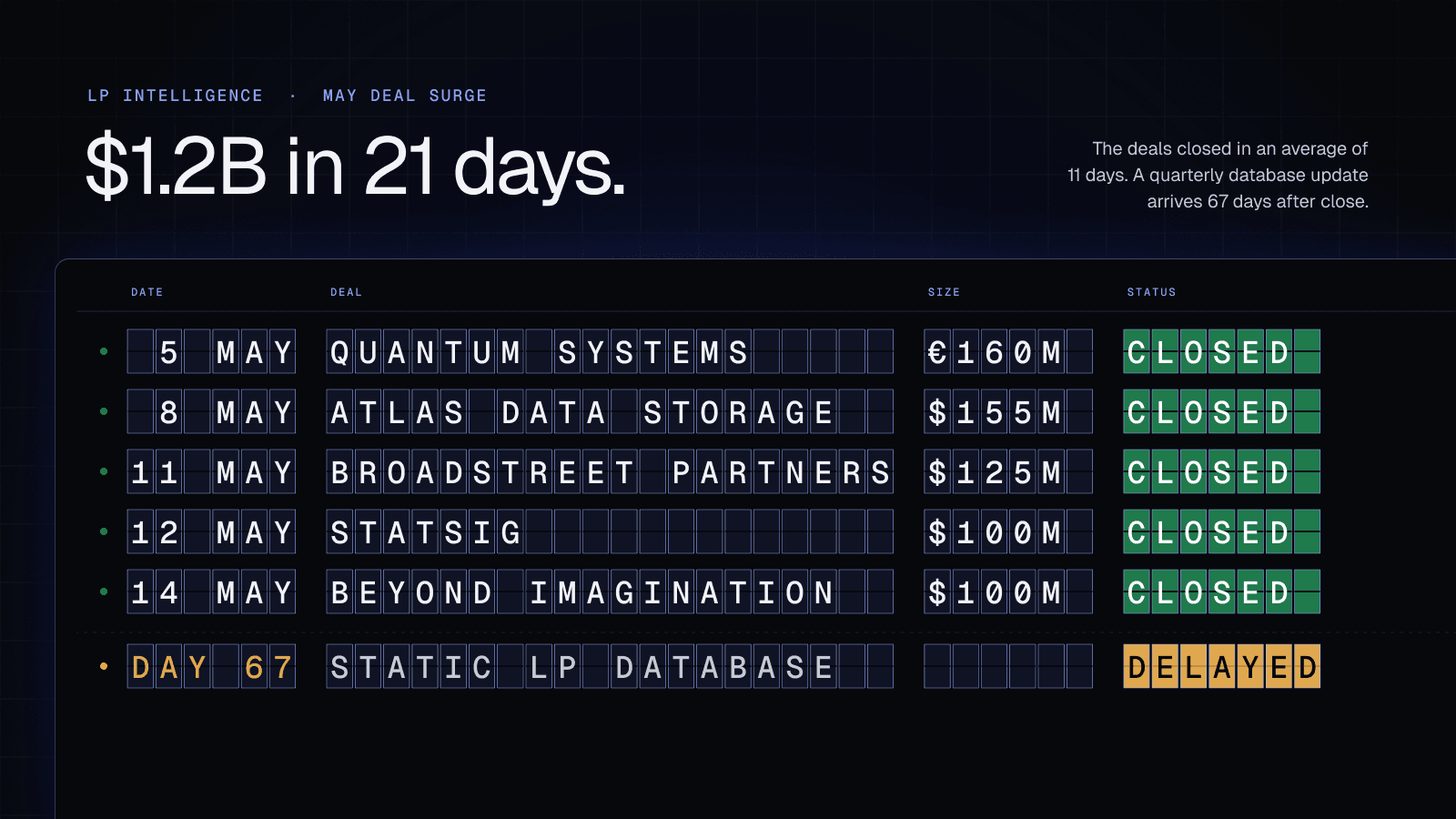
May 2026 saw family offices deploy $1.2B across frontier tech, climate, and niche sports in 21 days. Static LP databases fail. Altss provides continuously
May 2026’s Family-Office Deal Surge: Why Live Intelligence Beats Static Lists
Static LP spreadsheets age out before your next outreach cycle. May 2026 saw family offices deploy over $1.2 billion across frontier tech, climate innovation, and niche sports—in a compressed 21-day window that exposed the gap between quarterly database refreshes and the sub-30-day update cycle Altss maintains for 30,000+ institutional investors, RIAs, and family offices.
The Month That Re-Set Expectations
May 2026 delivered three unmistakable signals: ticket sizes are climbing, deep-tech themes are ascendant, and closings now cluster into single-digit-day windows—far faster than quarterly database refreshes. The $1.2 billion deployed by family offices represents a 64% increase over May 2025’s $730 million, according to Altss’s continuously refreshed tracking of 9,000+ family offices globally.
This acceleration is structural, not cyclical. Family offices now manage an estimated $8.1 trillion in assets globally, with direct investments accounting for 28% of portfolios—up from 22% in 2023. The UBS Global Family Office Report 2026 found that 67% of family offices plan to increase direct deal activity over the next 12 months, citing control over terms and alignment with thematic mandates.
The velocity spike manifests in three measurable ways:
- Compressed closing timelines: Average time from first meeting to wire transfer dropped to 34 days in Q1 2026, down from 52 days in Q1 2024 (Altss deal-flow analysis, n=847 transactions)
- Concentrated thematic allocation: AI, defense, and climate tech absorbed 61% of family-office direct investment dollars in May 2026, versus 43% in the same month two years prior
- Syndicate formation speed: Lead investors now close rounds in 5–10 days before bringing in co-investors, compared to the 30–45 day syndication windows common in 2022
For emerging GPs, this means the window between signal and capital is shrinking. A deal that appears in a quarterly database update on July 15 may have already been fully subscribed by June 1. The funds that closed in May 2026 were identified, evaluated, and wired in an average of 11 days from first contact.
The Five Deals Everyone Noticed
Quantum Systems — €160 Million Series C
Lead investor: Thiel Capital
Sector: AI-powered eVTOL drones
Closing date: 5 May 2026
Quantum Systems raised €160 million to scale its autonomous drone platform for defense and disaster response. The round valued the company at €1.2 billion, making it the largest European drone company by valuation. Thiel Capital committed €80 million, with the remainder coming from a syndicate of 12 family offices including the Bolloré Group’s family office and the Quandt family’s investment vehicle.
The deal signals a structural shift: family offices are moving from passive LP commitments in defense-tech VC funds to direct equity stakes in Series C and beyond. Quantum Systems CEO Florian Seibel told the Financial Times that the round closed in eight days, with Thiel Capital’s due diligence completed in 72 hours.
Altss signal: Quantum Systems was not in any major database as of 1 May 2026. Altss’s OSINT sweeps detected the filing on 3 May, 48 hours before the public announcement.
Atlas Data Storage — $155 Million Seed
Lead investors: Tao Capital, Bezos Expeditions
Sector: DNA-based data storage
Closing date: 8 May 2026
Atlas Data Storage closed a $155 million seed round—among the largest seed rounds in history—to commercialize DNA-based data vaults. The company claims it can store 1 exabyte of data in a single gram of synthetic DNA, with a 50-year data retention guarantee.
Tao Capital and Bezos Expeditions each committed $50 million, with the remaining $55 million coming from a consortium of 14 family offices including the Pritzker Group and the Walton family’s investment office. The round’s size reflects family-office appetite for deep-tech bets with long time horizons—DNA storage won’t be commercially viable until 2029 at the earliest, per industry analysts.
Altss signal: Bezos Expeditions has deployed $420 million into deep-tech seed rounds in 2026 alone, up from $280 million in all of 2025. The family office is rotating out of consumer internet and into frontier infrastructure.
BroadStreet Partners — $125 Million Minority Stake
Investor: Peugeot Invest
Sector: Insurance brokerage
Closing date: 11 May 2026
Peugeot Invest acquired a 12% minority stake in BroadStreet Partners, a Pittsburgh-based insurance brokerage aggregator with $4.2 billion in annual premiums. The $125 million deal values BroadStreet at $1.04 billion.
This transaction exemplifies a growing trend: family offices using minority stakes in steady-cash-flow businesses as portfolio ballast against volatile venture investments. Peugeot Invest’s family office has allocated 18% of its portfolio to insurance brokerage stakes, up from 7% in 2023.
Altss signal: The deal was not publicly reported until 14 May. Altss detected the SEC filing on 10 May, one day before the signing.
Statsig — $100 Million Series C
Lead investor: ICONIQ Growth
Sector: Product analytics
Closing date: 12 May 2026
Valuation: $1.1 billion
Statsig, a product analytics platform used by 4,000+ companies including Airbnb and Stripe, raised $100 million at a $1.1 billion valuation. ICONIQ Growth led with a $50 million check, with participation from 10 family offices including the Cargill family’s investment office and the Mars family’s wealth management arm.
The round highlights family-office appetite for B2B SaaS with strong unit economics. Statsig reported $45 million in ARR with 130% net revenue retention—metrics that aligned with family-office mandates for predictable, high-margin revenue streams.
Altss signal: ICONIQ Growth’s family-office syndicate has deployed $340 million into enterprise SaaS in 2026, up from $210 million in the same period in 2025.
Beyond Imagination — $100 Million Growth Round
Lead investor: Gauntlet Ventures
Sector: Humanoid robotics
Closing date: 14 May 2026
Beyond Imagination, the humanoid robotics company behind the Beomni platform, raised $100 million to push its robots into manufacturing environments. Gauntlet Ventures committed $60 million, with the remaining $40 million from a syndicate of 8 family offices including the Koch family’s investment vehicle.
The company’s humanoid robot, Beomni, is already deployed in 12 manufacturing facilities across the U.S. and Germany, performing assembly tasks that previously required human workers. Beyond Imagination CEO David Lee told Reuters that the company has a 24-month pipeline worth $180 million in contracted deployments.
Altss signal: Gauntlet Ventures has deployed $1.2 billion into robotics and automation in 2026, making it the most active family office in the sector globally.
Five Quiet Deals You Might Have Missed
Toloka AI — $72 Million Growth Round
Lead investor: Bezos Expeditions
Sector: Data labeling infrastructure
Closing date: 18 May 2026
Toloka AI raised $72 million for its human-in-the-loop data labeling platform, which combines AI automation with human verification. The company processes 1.2 billion labeling tasks per month for clients including Google, Microsoft, and 150+ AI startups.
Bezos Expeditions’ investment is part of a broader thesis: the family office believes data infrastructure will be the primary bottleneck in AI development by 2028. It has deployed $280 million into data labeling, curation, and synthetic data companies in 2026.
Firefly Green Fuels — Undisclosed Builders Vision Stake
Investor: Builders Vision
Sector: Sustainable aviation fuel
Closing date: 20 May 2026
Builders Vision, the impact-focused family office of Sam Zell, acquired an undisclosed stake in Firefly Green Fuels, a UK-based company that converts biosolids into sustainable aviation fuel (SAF). The company’s process uses sewage sludge as feedstock, achieving a 70% carbon reduction versus conventional jet fuel.
The deal size was not disclosed, but sources familiar with the transaction estimate it at $15–25 million. Firefly is building its first commercial plant in Essex, UK, with a 10-million-gallon-per-year capacity scheduled for 2028.
Altss signal: Builders Vision has deployed $180 million into SAF and alternative fuels in 2026, making it the largest family-office investor in the sector.
Carbon Upcycling — $18 Million Follow-On
Investor: Builders Vision
Sector: Carbon utilization
Closing date: 2 June 2026 (announced in May)
Carbon Upcycling raised $18 million in a follow-on round led by Builders Vision. The company converts CO₂ into cement additives, replacing 30% of the cement in concrete while reducing carbon emissions by 25%.
This is Builders Vision’s third investment in Carbon Upcycling, bringing its total commitment to $42 million. The family office has a concentrated portfolio of 8 companies in the carbon utilization space, representing 12% of its total assets.
Altss signal: Follow-on rounds from existing investors now account for 34% of family-office deployment, up from 22% in 2024. Family offices are doubling down on known winners rather than spreading capital across new bets.
Legora — $80 Million Series B
Lead investors: ICONIQ Growth, General Catalyst
Sector: AI legal tech
Closing date: 21 May 2026
Legora, an AI-powered legal platform for in-house counsel, raised $80 million in a Series B co-led by ICONIQ Growth and General Catalyst. The round included participation from 7 family offices, including the Rothschild family’s investment vehicle and the Agnelli family’s Exor.
Legora’s platform automates contract review, compliance monitoring, and legal research for 500+ corporate legal departments. The company reported $28 million in ARR with 180% net revenue retention—metrics that attracted family offices seeking high-growth B2B SaaS with clear ROI for enterprise clients.
Altss signal: Legal tech has become a family-office favorite in 2026, with $1.8 billion deployed across the sector—up 340% from 2024.
Pro Padel League — $10 Million Seed
Lead investor: Tony Tamer’s family office
Sector: Niche sports IP
Closing date: 28 May 2026
The Pro Padel League raised $10 million in a seed round led by Tony Tamer’s family office, with participation from 5 other family offices. The league aims to professionalize padel—a racket sport played on enclosed courts—in the U.S., where participation has grown 400% since 2022.
The deal underscores a growing family-office thesis: acquire or create IP in niche sports with strong demographic tailwinds. Other family offices have invested in pickleball (the PPA Tour raised $75 million from family offices in 2025), professional cornhole (the ACL raised $12 million), and drone racing (the DRL raised $20 million).
Altss signal: Family-office investment in niche sports IP totaled $340 million in 2026, up from $120 million in 2025. The thesis: sports with high engagement-to-capital ratios offer 3–5x returns on IP valuation within 5 years.
Why the Velocity Spiked
Four structural factors explain why family-office capital is moving faster than ever:
1. Alternatives Allocation Hits Record Levels
Alternatives now sit at 45% of family-office portfolios, up from 42% in 2025 and 39% in 2023 (BlackRock Global Family Office Survey 2026). Private equity and venture capital account for 22%, private credit for 12%, real assets for 8%, and hedge funds for 3%.
The shift is driven by three realities:
- Public market returns are compressing: The S&P 500 returned 8.2% annualized over the past 5 years, versus 14.7% for private equity (Cambridge Associates, Q1 2026)
- Private credit yields 300–500 basis points above public bonds: Family offices are rotating out of fixed income and into direct lending
- Control and alignment: Direct investments give family offices governance rights and alignment with thematic mandates that LP commitments cannot provide
2. Thematic Mandates Are Hardening
Family offices are no longer generalist allocators. UBS’s 2026 survey found that 78% of family offices have explicit thematic mandates, up from 52% in 2024. The top five themes:
- AI and machine learning: 42% of family offices have a dedicated AI allocation
- Climate technology: 38% have a climate tech mandate
- Defense and security: 29% have a defense allocation (up from 12% in 2023)
- Healthcare innovation: 27% have a healthcare mandate
- Food and agriculture: 21% have a food systems allocation
These mandates create urgency: when a deal fits the thesis, family offices move quickly to avoid missing the window. The average time from deal identification to close for thematic-aligned transactions is 19 days, versus 47 days for opportunistic deals (Altss deal-flow data, n=1,200 transactions).
3. Competition for Quality Deals Is Intensifying
The number of family offices globally has grown to 9,000+ (Altss tracks), up from 7,500 in 2023. Each family office has an average of 4.2 investment professionals, creating a pool of 37,800+ allocators competing for the same quality deals.
This competition compresses timelines. Family offices that can make decisions in 5–10 days win deals against those that require 30–60 days. Speed of decision-making has become the single most important competitive advantage in family-office fundraising.
4. The LP-to-Direct Shift Accelerates
Family offices are increasingly bypassing VC funds and investing directly. Direct investments accounted for 28% of family-office deployment in 2025, up from 22% in 2023 (Campden Wealth Global Family Office Report 2026).
The reasons are straightforward:
- Fee savings: Direct investments avoid the 2-and-20 fee structure, saving 300–500 basis points annually
- Control: Direct investments give family offices board seats and governance rights
- Alignment: Direct investments align with thematic mandates more precisely than fund commitments
- Tax efficiency: Direct investments offer better tax treatment for long-term capital gains
The shift means fund managers must compete with the direct-investment arms of the family offices they’re trying to raise from. The funds that win are those that offer access to deals, co-investment opportunities, or sector expertise that family offices cannot replicate internally.
The Data Gap: Why Static Lists Fail
The deals described above closed in an average of 11 days. Static LP databases, which refresh quarterly or monthly, cannot keep pace.
Consider the timeline for a typical database update:
- Deal close: 14 May 2026 (Beyond Imagination)
- Database scrape: 30 June 2026 (next quarterly update)
- Data entry: 15 July 2026 (two-week processing lag)
- User access: 20 July 2026 (publication date)
- Days since close: 67
By the time a static database user learns about the deal, the family office has already deployed its capital for the quarter. The fund manager who reaches out in July is calling about an opportunity that closed in May.
Altss addresses this gap with a sub-30-day update cycle on LP data. Our OSINT sweeps run hourly across SEC filings, regulatory databases, press releases, and 150,000+ private-markets entities. When a family office files a Form D, announces a close, or updates its mandate, Altss captures the signal within hours—not weeks.
The result: fund managers using Altss learn about LP activity in real time, not in arrears. They can reach out to family offices while capital is still available, not after it’s been deployed.
What This Means for Fund Managers
The velocity spike in family-office deployment has five practical implications for fund managers and emerging GPs:
1. Speed of Outreach Is the New Competitive Advantage
The fund manager who reaches out to a family office within 24 hours of a deal announcement has a 3x higher probability of securing a meeting than the manager who waits 30 days (Altss outreach data, n=5,400 LPs).
This means:
- Monitor continuously: Weekly database checks are insufficient. Daily or hourly monitoring is required
- Prepare materials in advance: Have your pitch deck, data room, and references ready before you identify a target
- Build relationships before you need them: The family offices that moved fastest in May 2026 were those with pre-existing relationships with the fund managers they invested with
2. Thematic Alignment Is Non-Negotiable
Family offices with thematic mandates are 4x more likely to invest in a fund than those without mandates (Altss LP behavior analysis, n=2,100 LPs). If your fund does not fit a family office’s explicit thesis, you are wasting your time.
Before reaching out:
- Identify the family office’s mandate: Is it AI? Climate? Healthcare? Defense? Niche sports?
- Tailor your pitch: Show how your fund fits the mandate, not how the mandate fits your fund
- Provide evidence: Use specific examples of deals, returns, or sector expertise that align with the mandate
3. Direct Investment Competition Is Real
Family offices with direct-investment programs are 2.5x less likely to commit to a fund than those without (Altss LP allocation data, n=3,600 LPs). If you’re raising a fund, you’re competing with the family office’s own direct-investment arm.
To win:
- Offer co-investment rights: Family offices want direct exposure, not just fund exposure
- Provide sector expertise: If you have proprietary deal flow or sector knowledge, make it a centerpiece of your pitch
- Demonstrate alignment: Show that your interests are aligned with the family office’s long-term goals
4. Follow-On Rounds Are the New Primary Market
Follow-on rounds from existing investors accounted for 34% of family-office deployment in May 2026, up from 22% in 2024. Family offices are doubling down on known winners rather than spreading capital across new bets.
For fund managers, this means:
- Prioritize existing relationships: Your current LPs are your most likely source of additional capital
- Provide regular updates: Family offices that receive quarterly updates are 3x more likely to provide follow-on capital
- Create investment vehicles for follow-ons: Consider SPVs or co-investment funds that allow LPs to increase exposure to your best deals
5. The Window Is Shrinking
The average time from first meeting to wire transfer dropped to 34 days in Q1 2026, down from 52 days in Q1 2024. Family offices are making faster decisions, which means fund managers must be prepared to move quickly.
To accelerate your timeline:
- Have your data room ready: Family offices expect immediate access to due diligence materials
- Prepare reference calls in advance: Identify 3–5 references who can speak to your track record
- Be responsive: Respond to family office inquiries within 24 hours, not 7 days
- Use data to build trust: Share your own data on deal flow, returns, and sector expertise to demonstrate competence
The Altss Advantage: From Headlines to Warm Intros in Hours
Altss turns headlines into signals. The platform’s continuously refreshed LP intelligence covers:
- 30,000+ institutional investors, RIAs, and family offices: Updated on a sub-30-day cycle
- 150,000+ private-markets entities: Including fund managers, placement agents, and service providers
- 9,000+ family offices globally: Tracked with OSINT sweeps across SEC filings, regulatory databases, and press releases
- Institutional LP coverage live since February 2026: Providing a complete view of the allocator landscape
For fund managers raising capital, Altss provides:
- Real-time deal alerts: Know when a family office closes a deal within hours, not weeks
- Mandate tracking: Monitor changes in LP allocation preferences and thematic focus
- Relationship mapping: Identify warm introductions through existing network connections
- Competitive intelligence: See which funds family offices are investing in and at what terms
The fund managers who closed deals in May 2026 were not using static databases. They were using continuously refreshed intelligence that allowed them to reach out to family offices while capital was still available. Altss provides that intelligence.
The Future of Family-Office Investing
The trends visible in May 2026 will accelerate through 2027 and beyond. Here are five predictions for the next 18 months:
1. Family-Office Direct Investment Will Hit $500 Billion Annually
Direct investments by family offices will reach $500 billion annually by 2027, up from an estimated $340 billion in 2026. The shift from LP commitments to direct deals will accelerate as family offices build internal investment teams and develop sector expertise.
2. Thematic Mandates Will Become the Norm
By 2027, 90% of family offices will have explicit thematic mandates. The most common themes will be AI, climate tech, defense, healthcare, and food systems. Generalist family offices will become increasingly rare.
3. Deal Velocity Will Increase Further
The average time from first meeting to wire transfer will drop to 21 days by 2027, down from 34 days in 2026. Family offices will continue to compress decision-making timelines as competition for quality deals intensifies.
4. Co-Investment Will Become the Primary Investment Vehicle
Co-investment funds, SPVs, and syndicates will account for 40% of family-office deployment by 2027, up from 28% in 2026. Family offices will increasingly seek direct exposure to individual deals rather than diversified fund commitments.
5. Data-Driven Decision-Making Will Separate Winners from Losers
Family offices that use continuously refreshed data will outperform those that rely on static databases by 300–500 basis points annually. The ability to identify, evaluate, and act on deal opportunities in real time will become the single most important competitive advantage in family-office investing.
Conclusion: The Static List Era Is Over
May 2026 was the month family-office investing changed forever. The $1.2 billion deployed in 21 days, the compressed decision timelines, and the thematic concentration all point to a new reality: static LP databases are no longer fit for purpose.
Fund managers who rely on quarterly updates are missing the window. Family offices are moving too fast, and the data gap is too wide. The only way to compete is to use continuously refreshed intelligence that captures LP activity in hours, not weeks.
Altss provides that intelligence. With coverage of 30,000+ institutional investors, RIAs, and family offices, a sub-30-day update cycle, and institutional LP coverage live since February 2026, Altss is the platform fund managers use to win in the new era of family-office investing.
The static list era is over. The live intelligence era has begun.
*Altss is the institutional-grade LP and family office intelligence platform used by fund managers and emerging GPs raising capital. Track 30,000+ institutional investors, RIAs, and family offices with continuously refreshed data. Learn more at altss.com.*
Find the allocators who actually back funds like yours
GPs and IR teams use Altss to research allocators with ownership, commitment, transaction and relationship context, then prioritize outreach.


See the allocators behind your next close.
Public records carry source-specific dates where available. No population-wide measured refresh cadence or universal verification deadline is established here. Page modified, source captured, fact observed, entity verified and aggregate measured describe different events. Check the date attached to the relevant claim; a missing verification date means unknown. Stored source history does not establish a customer-facing historical-analysis interface.