
Must-Attend GP/LP Events in 2025: A Strategic Guide for IR Professionals
A comprehensive guide to the 2026 GP/LP conference calendar, with data-driven strategies for fund managers and emerging GPs. Includes AI, ESG, and allocato
The 2026 GP/LP Event Landscape: Trends Shaping IR Strategy
Fundraising in 2026 is no longer about attending conferences—it is about engineering a continuous IR machine where every handshake, dinner, and panel becomes a data point in a live allocator-intelligence system.
The Professionalization of GP–LP Engagement
The era of the "spray-and-pray" conference circuit is over. LPs in 2026 demand precision. They want managers who arrive with a thesis, a track record, and a clear understanding of the allocator's portfolio gaps. This shift is not anecdotal. A 2025 survey by the Institutional Limited Partners Association (ILPA) found that 72% of LPs now require pre-meeting materials at least two weeks before any in-person interaction. The same survey showed that 68% of LPs have formalized "manager monitoring" programs that track GP engagement frequency, quality, and responsiveness.
The stakes are high. A single missed follow-up—or a generic email blast after a conference—can drop a GP from an allocator's radar for 12 to 18 months. Meanwhile, GPs who treat IR as a continuous, data-driven process are seeing 30% to 50% higher conversion rates from first meeting to capital commitment, according to data from Altss's platform, which tracks 30,000+ institutional investors, RIAs, and family offices.
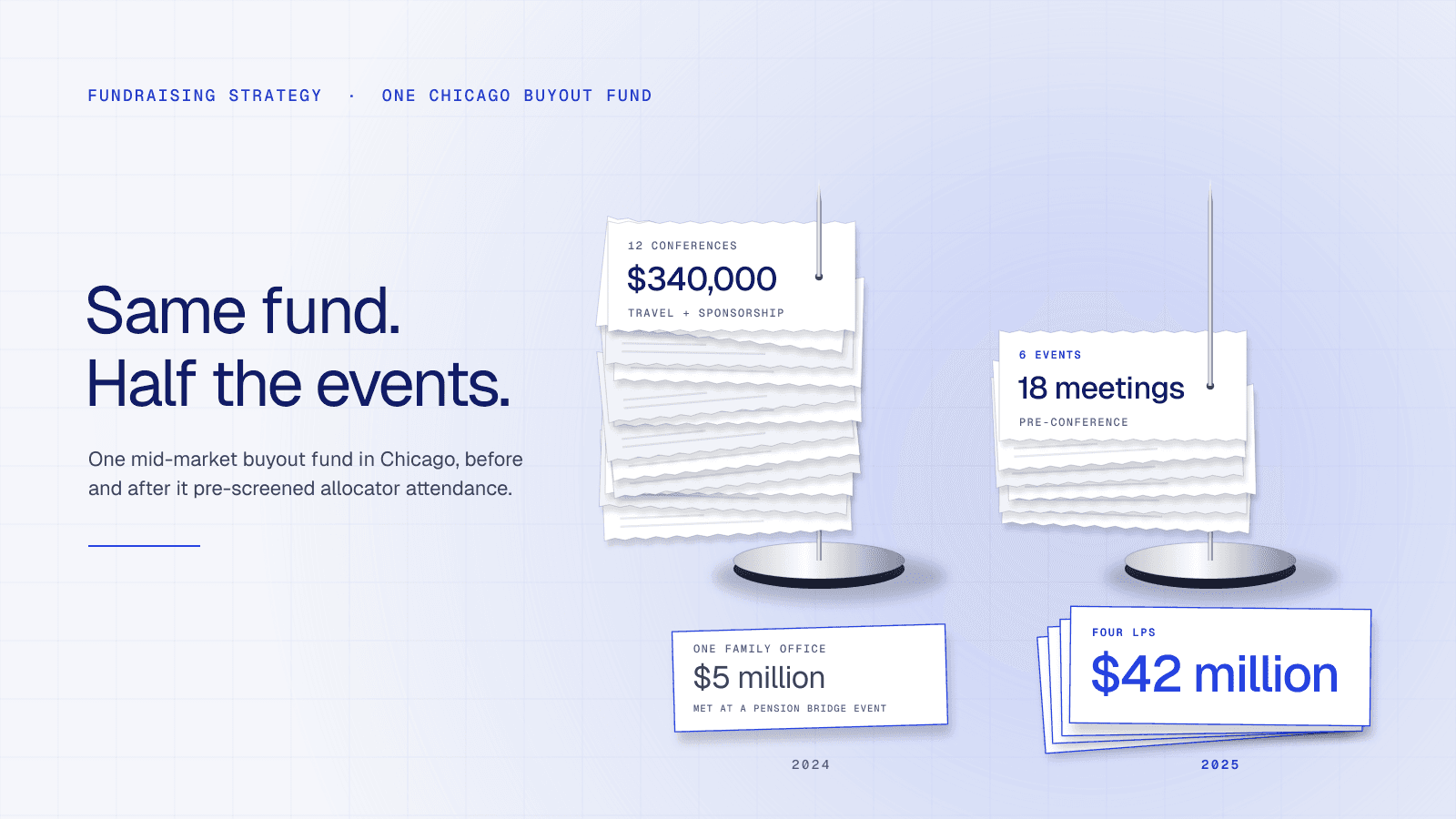
Consider the case of a mid-market buyout fund based in Chicago. In 2024, it attended 12 conferences, spent $340,000 on travel and sponsorship, and closed exactly one $5 million commitment from a single family office it met at a Pension Bridge event. In 2025, it used Altss to pre-screen allocator attendance, prioritize 6 events, and schedule 18 pre-conference meetings. It closed $42 million from four LPs—three of which were identified through the platform's continuously refreshed LP data. The fund's IR lead now spends 40% less time on travel and 60% more time on relationship deepening.
AI and Data: The New IR Infrastructure
Artificial intelligence is not a buzzword in GP–LP relations—it is an operational necessity. The 2025 Mercer study cited in the original post remains relevant: 91% of investment managers are using or planning to use AI in research and strategy. But the 2026 update is more specific. A follow-up survey by Mercer and the CFA Institute, published in January 2026, found that 47% of managers have now deployed AI tools specifically for LP targeting and relationship management. That is up from 12% in 2024.
The most common use cases:
- Allocator mapping: AI models analyze public filings, conference attendance history, and social media activity to identify which LPs are actively rebalancing or adding new manager relationships.
- Sentiment analysis: Natural language processing (NLP) scans earnings calls, LP conference transcripts, and news articles to gauge allocator appetite for specific strategies—say, infrastructure in Europe or venture debt in Southeast Asia.
- Meeting optimization: Machine learning algorithms rank potential meetings by probability of conversion, factoring in fund size, vintage, sector focus, and geographic alignment.
- Post-event intelligence: AI tools scrape follow-up actions, flag missed touchpoints, and suggest optimal timing for next outreach.
One specific example: StepStone Group, the $650 billion allocator and advisory firm, disclosed in its 2025 annual report that it uses an internal AI system codenamed "Aurora" to screen GP submissions. The system evaluates 200+ data points per manager, including team tenure, co-investment history, and alignment with StepStone's portfolio construction models. GPs who fail to meet a minimum threshold are automatically declined for introductory meetings—saving StepStone's investment team an estimated 1,200 hours per year.
For emerging GPs, this means the bar for getting in front of StepStone is higher than ever. But it also means that GPs who can present their data in a machine-readable format—standardized track records, clear fee structures, detailed ESG metrics—have a distinct advantage. Altss's platform now integrates with major allocator systems, allowing GPs to push their data directly into LP workflows.
ESG and Sustainability: From Mandate to Materiality
ESG is no longer a checkbox exercise. In 2026, it is a material factor in capital allocation decisions—but the conversation has matured. The EY Global Institutional Investor Survey, released in November 2025, found that 78% of institutional investors now consider climate risk as a "critical or important" factor in portfolio construction, up from 62% in 2022. The Stanford–MSCI Climate Risk Index, updated quarterly, shows that portfolios with high carbon exposure underperformed low-carbon portfolios by an average of 1.4% per year over the past three years.
But the real shift is in how LPs evaluate ESG. They are moving beyond simple exclusions or ESG ratings. Instead, they demand:
- Impact attribution: Show me the carbon reduction per dollar invested.
- Transition alignment: How does this fund support the net-zero transition, not just avoid fossil fuels?
- Governance alpha: How does board diversity or executive compensation alignment drive returns?
The European Union's Sustainable Finance Disclosure Regulation (SFDR) continues to shape the landscape. As of January 2026, Article 9 funds (those with sustainable investment as an objective) must report on 14 mandatory indicators, including carbon footprint, water usage, and biodiversity impact. GPs raising capital in Europe must have these metrics ready before the first meeting.
Consider the case of a $2 billion European mid-market buyout fund that raised its latest vehicle in 2025. It spent 18 months building a proprietary ESG data platform that tracks portfolio company emissions, supply chain risks, and community impact. The fund's IR team used this data to pre-populate SFDR templates and provide LPs with quarterly impact reports. Result: the fund closed in 10 months, 40% faster than its previous vintage, with 60% of commitments coming from LPs that had never invested with the firm before.
In North America, the trend is different but equally demanding. While the SEC's climate disclosure rules remain in legal limbo (as of February 2026, the rules are stayed pending court challenges), large public pension funds—CalPERS, New York State Common, Teacher Retirement System of Texas—are imposing their own climate reporting requirements. CalPERS, for example, now requires all private equity managers to complete an annual Climate Risk and Opportunity Questionnaire, covering everything from portfolio company emissions to transition planning.
For emerging GPs, the advice is clear: build your ESG infrastructure now, even if your first fund is small. Use frameworks like the SASB (Sustainability Accounting Standards Board) or TCFD (Task Force on Climate-related Financial Disclosures) as a starting point. And if you lack the resources to build an internal platform, consider third-party tools like Novata or Greenomy, which offer standardized reporting templates.
The 2026 Conference Calendar: A Curated, Data-Driven Guide
The following sections provide a detailed, month-by-month breakdown of the highest-signal IR opportunities in 2026. Each entry includes the event's focus, target audience, and strategic value for GPs. All dates are sourced from official organizer websites as of February 2026.
Q1 2026: Foundation Building (North America & Europe)
iConnections Global Alts (January 26–29, Miami Beach, FL)
This is the largest capital-introduction event of the year, now co-presented with the Managed Funds Association (MFA). The 2025 edition drew 3,500+ attendees, including 1,200+ allocators. The venue footprint has expanded to include the Miami Beach Convention Center, with overflow sessions at the Fontainebleau and Faena hotels.
What makes it different: iConnections uses a proprietary matchmaking algorithm that schedules 15-minute "speed-dating" meetings between GPs and pre-qualified LPs. In 2025, the platform facilitated 8,000+ such meetings. For GPs, this is a volume play—but only if you come prepared. The algorithm favors managers with complete profiles, verified track records, and clear strategy descriptions.
Strategic advice: Do not treat iConnections as a one-off. Use the event to schedule pre-meetings in Miami the week before (many LPs arrive early for warm-weather networking). Post-event, use Altss's platform to track which LPs you met, what they asked about, and whether they followed up. The platform's sub-30-day refresh cycle ensures you are working with current contact information and mandate changes.
IPEM Cannes | Wealth (January 27–29, Cannes, France)
IPEM remains EMEA's premier private-markets gathering, held at the Palais des Festivals. The 2026 edition features an expanded wealth track, reflecting the growing importance of private wealth channels in European fundraising. According to IPEM's organizer, the wealth track attracted 300+ family offices and wealth managers in 2025, up from 180 in 2024.
Key trend: European family offices are increasingly co-investing alongside institutional LPs. A 2025 study by Campden Wealth and UBS found that 42% of European family offices with over €500 million in assets now participate in co-investment vehicles, up from 28% in 2022. For GPs, this means IPEM is not just about institutional capital—it is a gateway to high-net-worth allocators who can write $5 million to $20 million checks.
Strategic advice: Target the wealth track sessions, particularly those focused on direct investing and co-investment structures. Bring a clear co-investment framework, including fee terms, governance rights, and exit timelines. And consider hosting a side dinner at a Cannes restaurant—the city's dining scene is a networking asset in itself.
Women's Venture Capital Summit (February 3–5, Half Moon Bay, CA)
This invite-only gathering at the Ritz-Carlton Half Moon Bay is one of the most exclusive events on the calendar. Attendance is capped at 400, with a strict 1:1 GP-to-LP ratio. The summit focuses on women-led VC funds and emerging managers.
Why it matters: Women-led VC funds have outperformed their male-led peers in recent years. A 2025 study by PitchBook found that women-led VC funds generated a median IRR of 18.3% over the past decade, compared to 14.7% for all VC funds. Yet they receive only 2% of total VC capital. This summit is a rare opportunity for women GPs to pitch to allocators who are actively seeking to close this gap.
Strategic advice: The summit's format includes "office hours" with LPs—15-minute one-on-one sessions. Apply early (slots fill within 48 hours of registration opening). Prepare a condensed pitch deck that focuses on three things: deal sourcing advantage, portfolio company performance, and team diversity metrics.
Next Wave Summit (February 10–11, New York, NY)
Organized by Inversion Summits, this event is specifically designed for performance-vetted, emerging-fund-focused LPs and GPs. The 2025 edition featured 80+ allocators, including 30+ first-time fund investors.
What sets it apart: All attending GPs must pass a performance screen—typically top-quartile returns for their vintage and strategy. This creates a high-signal environment where LPs know they are meeting quality managers.
Strategic advice: If you are invited, treat it as a credential. Mention your Next Wave participation in your marketing materials. And use the event to test your pitch in front of sophisticated allocators who have seen hundreds of emerging fund decks.
Private Capital Summit Europe (February 12, London)
Private Equity Wire's allocator-focused forum returns to London in 2026. The 2025 edition drew 200+ LPs, including 50+ from UK pension funds and insurance companies.
Key trend: UK pension funds are increasing their private markets allocations following the government's 2024 "Mansion House Reforms," which encouraged DC pension schemes to invest up to 5% of assets in unlisted equities. The reforms have unlocked an estimated £50 billion in potential private markets capital over the next five years.
Strategic advice: If you are targeting UK pension capital, attend this event. Bring a clear explanation of how your fund aligns with the Mansion House objectives—long-term value creation, UK economic growth, and net-zero transition. And be prepared to discuss fee structures: UK LPs are price-sensitive and increasingly demanding lower carried interest for larger commitments.
Yale SOM PE/VC Symposium (February 20, New York, NY)
This academic-industry bridge event is hosted by the Yale School of Management. While it is not a traditional fundraising conference, it attracts 300+ alumni and investors from Yale's $42 billion endowment, as well as other Ivy League endowments.
Why it matters: Yale's endowment is a bellwether for institutional investing. Its private equity portfolio has generated a 12.3% annualized return over the past 20 years, according to Yale's 2025 investment report. GPs who present at the symposium often get follow-up meetings with Yale's investment team.
Strategic advice: The symposium favors research-driven presentations. Do not pitch your fund directly. Instead, present a white paper on a topic relevant to your strategy—say, "The Future of Healthcare PE in a Post-Pandemic World" or "Infrastructure Investing in the Energy Transition." Use the Q&A to demonstrate your intellectual depth.
Upfront Summit (February 25–26, Los Angeles, CA)
West Coast's invite-only tech and VC event, hosted by Upfront Ventures, returns to Los Angeles. The 2025 edition featured 1,200+ attendees, including 400+ LPs and 200+ founders.
Key trend: LA is emerging as a serious tech hub, driven by the growth of the aerospace, gaming, and content creation sectors. The city now hosts 15% of all US VC deals, up from 8% in 2020.
Strategic advice: If you are a VC fund with a focus on LA or Southern California, this is a must-attend event. Schedule pre-meetings with LA-based family offices, many of which are concentrated in Beverly Hills and Santa Monica. And consider co-hosting a dinner with a local LP to build relationships.
Women's Private Equity Summit (March 2–5, Phoenix, AZ)
With Intelligence's flagship women-in-PE summit returns to the Arizona Biltmore. The 2025 edition drew 500+ attendees, including 200+ LPs.
Why it matters: Women hold only 15% of senior PE roles globally, according to a 2025 study by McKinsey. This summit provides a platform for women GPs to network, pitch, and learn from peers.
Strategic advice: The summit includes a "pitch competition" for emerging funds. Apply early and practice your pitch in front of a mock LP panel. And use the event to build relationships with other women GPs—many of whom will become co-investors or reference sources.
PEI NEXUS (March 10–12, Orlando, FL)
PEI's allocator-dense private equity forum returns to Orlando. The 2025 edition featured 1,000+ attendees, including 400+ LPs.
Key trend: PEI NEXUS has become a key venue for discussing secondaries and continuation vehicles. In 2025, secondary market volume hit $150 billion globally, up from $90 billion in 2023. LPs are increasingly using secondaries to rebalance portfolios and exit older vintages.
Strategic advice: If you are raising a continuation vehicle or considering a GP-led secondary, attend this event. Bring a clear rationale for the transaction—why it benefits LPs, how the valuation was determined, and what the go-forward strategy looks like.
SuperReturn North America (March 17–19, Miami, FL)
The North American franchise of SuperReturn moved to Miami in 2025 and has become a major event for global LPs. The 2026 edition is expected to draw 2,000+ attendees.
Why it matters: SuperReturn attracts a diverse LP base, including sovereign wealth funds from the Middle East and Asia, pension funds from Canada and Australia, and family offices from Europe and the US.
Strategic advice: SuperReturn is a "big tent" event—you will meet many LPs, but the signal-to-noise ratio can be low. Prioritize the "allocator-only" sessions and the evening networking events. And use Altss's platform to pre-identify which LPs are attending and what their current mandates are.
Markets Group ALTSLA (March 17–19, Los Angeles, CA)
This West Coast alts gathering has grown significantly since its launch in 2023. The 2025 edition featured 600+ attendees, including 200+ LPs.
Key trend: ALTSLA has become a key venue for discussing alternatives in the context of high-net-worth and family office investing. The event includes a dedicated "family office track" that covers direct investing, co-investment, and impact investing.
Strategic advice: If you are targeting family office capital, attend this event. Bring a clear co-investment framework and be prepared to discuss how your fund aligns with family office objectives—wealth preservation, intergenerational transfer, and philanthropic impact.
Pension Bridge — The Annual (March 24–26, Half Moon Bay, CA)
This allocator-heavy event is one of the most exclusive on the calendar. Attendance is capped at 500, with a strict 60:40 LP-to-GP ratio.
Why it matters: Pension Bridge attracts senior investment officers from the largest US public pension funds—CalPERS, CalSTRS, New York State Common, Texas Teachers, Florida State Board. These are the allocators who write $50 million to $200 million checks.
Strategic advice: Pension Bridge is not a volume play. You will have time for only 8–10 meetings over three days. Use Altss to pre-identify which pension funds are attending and what their current private equity allocations look like. Then schedule pre-meetings in San Francisco the week before.
Q2 2026: Global Expansion (US, EU, Middle East)
Milken Institute Global Conference (May 4–7, Los Angeles, CA)
This multi-asset, policy-and-capital forum is one of the most prestigious events on the calendar. The 2025 edition drew 4,000+ attendees, including hedge fund managers, sovereign wealth fund executives, and global policymakers.
Why it matters: Milken is not a traditional fundraising event. It is a relationship-building event. The real value comes from the side meetings and dinners, where you can engage with LPs in a relaxed, intellectual setting.
Strategic advice: Do not go to Milken expecting to pitch your fund. Go to build your network. Attend panel sessions on topics relevant to your strategy—say, "The Future of Healthcare" or "Infrastructure in the Age of AI." Use the event to schedule one-on-one coffee meetings with LPs you have identified through Altss.
Invest Europe Investor Forum (May 5–7, Brussels, Belgium)
This is the premier event for European institutional LPs. The 2025 edition featured 800+ attendees, including 300+ LPs from European pension funds, insurance companies, and sovereign wealth funds.
Key trend: European LPs are increasingly focused on "impact" and "sustainability" as core investment criteria. A 2025 survey by Invest Europe found that 65% of European LPs now require GPs to report on SFDR Article 8 or 9 metrics, up from 45% in 2023.
Strategic advice: If you are raising capital in Europe, attend this event. Bring a clear SFDR compliance strategy and be prepared to discuss how your fund contributes to the European Green Deal objectives. And consider hosting a side event focused on a specific theme—say, "Infrastructure Investing in Central and Eastern Europe."
SuperReturn International (June 2–5, Berlin, Germany)
SuperReturn International is the flagship event for global private markets. The 2026 edition is expected to draw 3,000+ attendees from 60+ countries.
Why it matters: SuperReturn International is the single best event for meeting LPs from emerging markets—Latin America, Africa, Southeast Asia, and the Middle East. These LPs are increasingly allocating to private markets as they seek diversification and higher returns.
Strategic advice: SuperReturn International is a marathon, not a sprint. Plan to arrive two days early for pre-conference meetings. Use Altss to identify which LPs from your target regions are attending and schedule meetings in advance. And be prepared for a grueling schedule: 15–20 meetings per day is common.
South Summit (June 9–11, Madrid, Spain)
South Summit has become a key venue for connecting European and Latin American investors. The 2025 edition featured 1,500+ attendees, including 200+ LPs from Spain, Portugal, and Latin America.
Key trend: Latin American family offices are increasingly investing in European private markets, particularly in technology and infrastructure. A 2025 study by Campden Wealth found that 35% of Latin American family offices now have allocations to European private equity, up from 20% in 2022.
Strategic advice: If you are targeting Latin American capital, attend South Summit. Bring a Spanish-language version of your pitch deck and be prepared to discuss how your fund addresses inflation hedging and currency risk.
PEI Women in PE Forum (June 10, New York, NY)
This one-day event is focused on advancing women in private equity. The 2025 edition featured 300+ attendees, including 100+ women GPs and 50+ women LPs.
Why it matters: The event includes a "speed networking" session where GPs can meet LPs in 10-minute increments. It is a high-signal environment where LPs are actively looking for women-led funds.
Strategic advice: Come prepared with a clear ask—are you raising a fund, seeking co-investment, or looking for a reference? And follow up within 24 hours with a personalized email referencing your conversation.
Pension Bridge — The European (June 16–18, London, UK)
This is the European counterpart to Pension Bridge's US event. The 2025 edition featured 400+ attendees, including 200+ European pension fund and insurance company executives.
Key trend: European pension funds are increasing their private equity allocations, driven by low yields on fixed income and the need for return enhancement. A 2025 study by the European Pension Fund Association found that the average European pension fund allocates 12% to private equity, up from 8% in 2020.
Strategic advice: If you are targeting European pension capital, attend this event. Bring a clear explanation of how your fund aligns with the pension fund's liability-driven investing framework. And be prepared to discuss fee structures: European pension funds are price-sensitive and increasingly demanding lower management fees for larger commitments.
Q3 2026: Mid-Year Intensification (US, Asia, Europe)
SALT New York (September 15–17, New York, NY)
SALT has become one of the most influential alternative investment conferences in the world. The 2025 edition featured 2,000+ attendees, including 500+ LPs.
Why it matters: SALT attracts a diverse LP base, including sovereign wealth funds, pension funds, and family offices. The event is known for its high-production-value panels and its exclusive "SALT Talks" series.
Strategic advice: SALT is a "see and be seen" event. Do not expect to have deep conversations on the main floor. Instead, focus on the side events—the cocktail receptions, the dinners, and the after-parties. Use Altss to identify which LPs are attending and schedule one-on-one meetings in the hotel lobby or at a nearby restaurant.
SuperReturn Asia (September 21–24, Singapore)
SuperReturn Asia is the premier event for private markets in Asia. The 2026 edition is expected to draw 1,500+ attendees from 30+ countries.
Key trend: Asian private markets are growing rapidly, driven by the rise of Chinese and Indian family offices, the expansion of Southeast Asian pension funds, and the increasing appetite for infrastructure and technology investments. A 2025 study by Bain & Company found that Asia-Pacific private equity assets under management reached $2.5 trillion in 2025, up from $1.8 trillion in 2023.
Strategic advice: If you are raising capital in Asia, attend SuperReturn Asia. Bring a clear understanding of the local regulatory environment—particularly around foreign investment restrictions and tax treaties. And be prepared to discuss how your fund addresses the unique risks of Asian markets, including currency volatility and geopolitical uncertainty.
Pension Bridge — The West (September 28–30, San Francisco, CA)
This is the West Coast edition of Pension Bridge, focused on US public pension funds and their investment strategies. The 2025 edition featured 400+ attendees, including 150+ LPs.
Key trend: US public pension funds are increasingly using "co-investment" and "separate account" structures to reduce fees and gain more control over their private equity portfolios. A 2025 study by the Center for Retirement Research at Boston College found that 40% of large US public pension funds now have co-investment programs, up from 25% in 2020.
Strategic advice: If you are targeting US public pension capital, attend this event. Bring a clear co-investment framework and be prepared to discuss how your fund can offer co-investment opportunities to LPs.
Q4 2026: Year-End Closing (US, Europe, Middle East)
SuperReturn Middle East (October 19–21, Dubai, UAE)
SuperReturn Middle East is the premier event for private markets in the Gulf region. The 2026 edition is expected to draw 1,000+ attendees, including 300+ LPs from sovereign wealth funds, family offices, and pension funds.
Key trend: Middle Eastern sovereign wealth funds are among the most active investors in private markets globally. The combined assets of the top 10 Gulf SWFs exceeded $4 trillion in 2025, according to the Sovereign Wealth Fund Institute. These funds are increasingly focused on technology, healthcare, and infrastructure investments in Europe and North America.
Strategic advice: If you are targeting Middle Eastern capital, attend SuperReturn Middle East. Bring a clear understanding of the region's cultural norms—particularly around relationship-building and trust. And be prepared to discuss how your fund aligns with the SWF's strategic objectives, such as economic diversification or technology transfer.
PEI Operating Partners Forum (October 27–28, New York, NY)
This event is focused on the role of operating partners in private equity. The 2025 edition featured 500+ attendees, including 200+ operating partners and 100+ LPs.
Why it matters: LPs are increasingly focused on value creation and operational improvement. A 2025 study by Bain & Company found that operating partners are now present in 70% of large PE firms, up from 40% in 2020. LPs want to know how your operating team is structured, what their track record is, and how they drive returns.
Strategic advice: If you have a strong operating team, attend this event. Bring case studies of portfolio company transformations and be prepared to discuss how your operating team creates value.
iConnections Global Alts Europe (November 10–12, London, UK)
The European edition of iConnections has grown rapidly since its launch in 2024. The 2025 edition featured 1,200+ attendees, including 400+ LPs.
Key trend: European LPs are increasingly using iConnections' matchmaking algorithm to identify new manager relationships. The platform's 2025 data showed that 35% of meetings resulted in a follow-up request, up from 25% in 2024.
Strategic advice: Treat iConnections Europe as a complement to IPEM Cannes. Use the platform to schedule meetings with LPs you missed at IPEM and to follow up with those you met.
Pension Bridge — The Annual (December 1–3, Half Moon Bay, CA)
The year-end edition of Pension Bridge is a wrap-up event for US public pension funds. The 2025 edition featured 500+ attendees, including 200+ LPs.
Strategic advice: Use this event to close commitments for the year. Many LPs have budget cycles that end in December, and they are looking to deploy remaining capital. Bring a clear "ask" and be prepared to negotiate terms on the spot.
Beyond the Calendar: The Altss Advantage
The conference calendar above is curated from public sources, but the real value comes from what happens before and after the events. Altss tracks 30,000+ institutional investors, RIAs, and family offices globally, with a sub-30-day refresh cycle on LP data. This means you can:
- Pre-screen allocator attendance: See which LPs are registered for each event, what their current mandates are, and whether they are actively adding new manager relationships.
- Schedule pre-meetings: Use Altss's platform to identify LPs who will be in the same city before the event and schedule one-on-one meetings.
- Track follow-up: After the event, Altss's platform tracks which LPs you met, what they asked about, and whether they followed up. The platform integrates with your CRM to ensure no lead falls through the cracks.
- Monitor mandate changes: LPs change their allocation targets frequently. Altss's continuously refreshed data alerts you when an LP's mandate shifts—say, from venture capital to infrastructure or from North America to Europe.
The Future of GP–LP Events
The conference landscape will continue to evolve. Here are three trends to watch:
- Virtual and hybrid events will persist: While in-person events are back, virtual components are here to stay. Many conferences now offer "digital attendance" options, allowing LPs to watch panels and schedule virtual meetings. GPs should have a virtual pitch deck ready and be comfortable presenting over Zoom.
- Data-driven matchmaking will become standard: The iConnections model—algorithmic matchmaking based on LP and GP profiles—will spread to other events. GPs who invest in their data profiles will have a significant advantage.
- Niche events will proliferate: As the conference market matures, we will see more events focused on specific strategies (e.g., infrastructure, impact, venture debt), geographies (e.g., Africa, Latin America), or demographics (e.g., women, emerging managers). GPs should identify the niche events that align with their strategy and focus on those.
Conclusion: The IR Machine
Fundraising in 2026 is not about attending every conference. It is about engineering a continuous IR machine where every interaction becomes a data point. The GPs who succeed will be those who:
- Use data to identify the right allocators.
- Prepare meticulously for each meeting.
- Follow up systematically.
- Track every interaction in a CRM integrated with live LP intelligence.
The Altss platform is designed to support this machine. With 30,000+ institutional investors, RIAs, and family offices tracked globally, and a sub-30-day refresh cycle, Altss provides the intelligence you need to turn handshakes into commitments.
Start building your IR machine today. The 2026 conference calendar is your blueprint.
*This article was updated in February 2026. All conference dates are sourced from official organizer websites and are subject to change. Confirm details with the organizer before booking travel.*
Find the allocators who actually back funds like yours
GPs and IR teams use Altss to research allocators with ownership, commitment, transaction and relationship context, then prioritize outreach.


See the allocators behind your next close.
Public records carry source-specific dates where available. No population-wide measured refresh cadence or universal verification deadline is established here. Page modified, source captured, fact observed, entity verified and aggregate measured describe different events. Check the date attached to the relevant claim; a missing verification date means unknown. Stored source history does not establish a customer-facing historical-analysis interface.