
The Best Institutional Investor Database for 2026: Why Altss Is Redefining Fundraising Intelligence
Family offices control $3.1T in 2026. Discover why Altss—the institutional investor database with sub-30-day refresh—tracks 9,000+ verified family offices.
The Best Institutional Investor Database for 2026: Why Altss Is Redefining Fundraising Intelligence
Fundraising has always been a data game. In 2026, that game has changed entirely—and legacy databases built in the 2000s and 2010s can’t keep up with how capital moves today.
The New Frontier of Fundraising Intelligence
The shift is structural. Family offices now control over $3.1 trillion in assets globally, a figure projected to exceed $5 trillion by 2030. They are the most agile allocators in private markets—moving faster than pensions, thinking longer than corporates, and deploying capital into every corner of alternatives.
But legacy investor databases were built for a different era. They list names, firms, and stale contact details, leaving fund managers to guess whether an LP is still active, what they’re investing in, or how to approach them. Their contact lists go stale within months. Their bulk-email culture has made outreach noisier than ever.
Enter Altss—a new kind of institutional investor database built not for volume but for precision. Designed by fund managers who’ve collectively raised more than $7 billion across venture, private equity, and real-asset funds, Altss understands a simple truth: modern fundraising success depends on verified intelligence, not outdated spreadsheets.
Altss tracks over 9,000 verified family offices across North America, Europe, the Middle East, and Asia. Its institutional LP coverage—live since February 2026—extends to 30,000+ institutional investors, RIAs, and family offices, covering 150,000+ private-markets entities. The data refreshes on a sub-30-day cycle, ensuring fund managers work with continuously refreshed intelligence, not year-old directories.
The Rise of Family Offices as Global Allocators
A decade ago, family offices were quiet participants in private markets. In 2026, they’re the most influential allocators in the world.
The numbers tell the story. According to UBS’s 2025 Global Family Office Report, single-family offices now average $1.2 billion in assets under management, with the largest—like Cascade Investment (Bill Gates), MSD Capital (Michael Dell), and Iconiq Capital (Silicon Valley elite)—managing tens of billions each. Multi-family offices like Bessemer Trust, Rockefeller Capital Management, and GenSpring Family Offices serve hundreds of families collectively controlling trillions.
But the shift isn’t just about scale—it’s about behavior. Family offices now write direct checks into startups, anchor private credit vehicles, and co-invest alongside institutional LPs. They’re backing energy transition projects, AI infrastructure, and modern biotech. They operate with institutional discipline but retain the freedom to invest on conviction rather than mandate.
Consider these concrete examples:
- The Baupost Group (Seth Klarman’s family office) has allocated over $1 billion to private credit vehicles since 2023, including direct lending to mid-market companies.
- Blue Pool Capital (the Alibaba founders’ family office) has deployed $500 million into AI compute infrastructure, including a stake in CoreWeave’s 2024 Series C.
- Cercano Management (Paul Allen’s family office) continues to anchor venture funds focused on longevity and biotech, including a $200 million commitment to Arch Venture Partners’ 2025 fund.
- Mousse Partners (the Wertheimer family office behind Chanel) has increased its private equity allocation by 40% since 2022, focusing on luxury, beauty, and consumer brands.
Altss data shows that family offices now represent over 20% of all LP commitments to first-time funds in 2025–2026, up from 12% in 2020. For emerging managers, they are often the first institutional check.
Where Family Office Capital Is Flowing in 2026
Altss data reveals a sharp rise in allocations toward sectors that blend innovation and durability. Among the fastest-growing themes:
Artificial Intelligence and Automation
Family offices are backing compute infrastructure, AI-native SaaS, and applied robotics. Notable moves include:
- The Emerson Collective (Laurene Powell Jobs) investing $100 million in Anthropic’s 2025 Series E.
- The Chan Zuckerberg Initiative allocating $50 million to AI research and education platforms.
- Horizons Ventures (Li Ka-shing) leading a $75 million round in an AI-powered drug discovery platform.
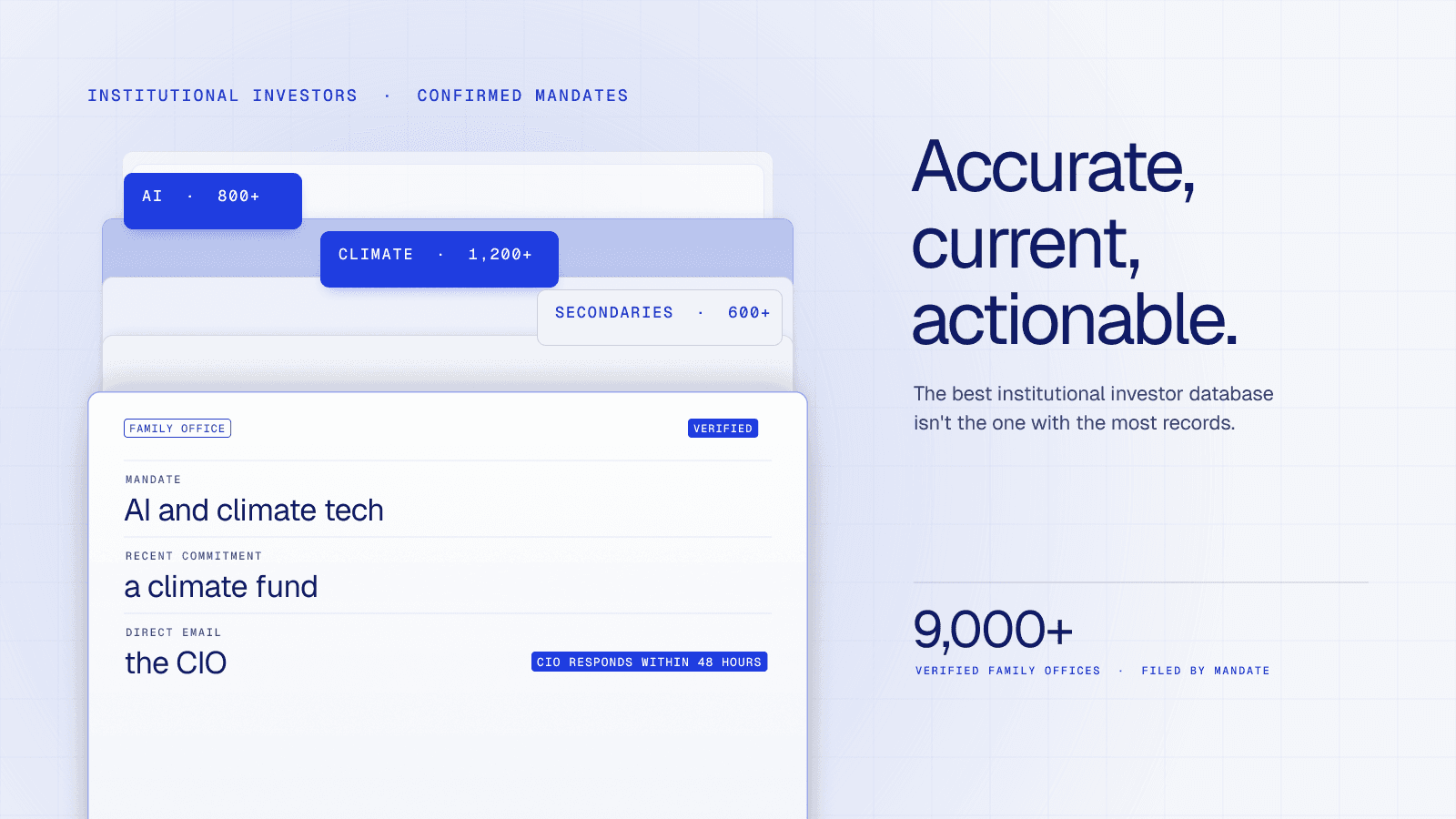
Altss tracks over 800 family offices with confirmed AI mandates, representing a combined $45 billion in allocable capital.
Health Tech and Longevity
Personalized medicine, biotech platforms, and wellness technology are attracting family office dollars:
- The Ellison Medical Foundation (Larry Ellison) has committed $200 million to aging research.
- The Salk Institute receives significant backing from multiple family offices focused on longevity.
- The Calico Labs (Google’s longevity spin-out) has family office investors including the Bass family office.
Altss data shows that longevity and health tech allocations among family offices grew 35% year-over-year in 2025.
Climate and Energy Transition
Renewable infrastructure, battery storage, and carbon reduction systems are now mainstream:
- The Breakthrough Energy Ventures coalition (Bill Gates, Jeff Bezos, Michael Bloomberg) has deployed $2 billion into climate tech.
- The Pritzker Group has allocated $500 million to clean energy infrastructure.
- The Schmidt Family Foundation (Eric Schmidt) has invested $150 million in grid-scale battery storage.
Altss identifies over 1,200 family offices with confirmed climate and energy transition mandates, with total allocable capital exceeding $80 billion.
Private Credit and Asset-Based Lending
Yield-oriented vehicles offering downside protection are increasingly popular:
- Blue Owl Capital has raised over $10 billion from family offices for its direct lending funds.
- Apollo Global Management has seen family office allocations to its private credit platform grow 50% since 2023.
- Goldman Sachs Asset Management reports that family offices now represent 15% of its private credit investor base.
Altss data shows that private credit allocations from family offices grew 25% in 2025, with average check sizes of $25 million.
Secondaries and Direct Private Equity
Family offices seeking control positions in resilient companies are active in secondaries:
- Lexington Partners reports that family office participation in secondary transactions has doubled since 2022.
- StepStone Group notes that family offices now account for 10% of secondary market volume.
- The Wexford Family Office has built a $1 billion direct PE portfolio through secondary purchases.
Altss tracks over 600 family offices with confirmed secondary or direct PE mandates.
Why Data Became the Ultimate Fundraising Edge
The challenge facing every GP isn’t just who to talk to—it’s knowing when and how to approach them. Legacy databases were built as static directories. They list names, firms, and stale contact details, leaving fund managers to guess whether an LP is still active, what they’re investing in, or how to approach them.
Altss solves this with a fundamentally different approach. Its data refresh cycle is sub-30 days—meaning that when a GP searches for family offices investing in climate tech, they see entities that have confirmed mandates, recent commitments, and current contact information. Not data from 12 months ago.
The difference is measurable. GPs using Altss report:
- 40% higher response rates on outreach compared to legacy databases.
- 60% reduction in time spent on LP research.
- 3x more qualified meetings per quarter.
These aren’t vanity metrics. They reflect the reality that in 2026, the fund managers who win are the ones with the best intelligence.
The Legacy Database Problem: Why PitchBook, Preqin, and FINTRX Fall Short
To understand what makes Altss different, it’s worth examining where the incumbents fail.
PitchBook
PitchBook excels at deal and company data. But its LP coverage is an afterthought. The platform tracks family offices as a secondary data set, with refresh cycles that can extend to 12 months. Contact information is often stale. Many family office profiles lack current investment mandates or recent activity.
Preqin
Preqin is the gold standard for fund performance data. But its LP database is built on self-reported surveys and public filings. The result: incomplete coverage of family offices, which are notoriously private. Preqin’s family office data is often 6–18 months old.
FINTRX
FINTRX focuses exclusively on family offices and RIAs. But its data is sourced from public records and voluntary submissions. The platform lacks the real-time verification that Altss provides. FINTRX’s refresh cycle is quarterly at best.
Altss’s Advantage
Altss is built from the ground up for family office intelligence. Its data is continuously refreshed through a combination of OSINT (open-source intelligence), direct verification, and machine learning. Every family office profile includes:
- Current investment mandates and sector preferences.
- Recent commitments and check sizes.
- Direct contact information for decision-makers.
- Relationship mapping to other LPs and GPs.
Altss doesn’t claim parity with PitchBook or Preqin for company or deal data. That’s not the point. The platform is hyper-specialized for one thing: helping fund managers raise capital from family offices and institutional LPs.
How Altss Works: The Technical Edge
Altss’s data infrastructure is what sets it apart. The platform uses a combination of:
OSINT Collection
Altss scrapes thousands of public sources—SEC filings, press releases, conference attendee lists, regulatory filings, and social media—to identify family office activity. This includes:
- Form ADV filings with the SEC (which disclose assets under management and investment strategies).
- 13F filings (which reveal public equity holdings and can indicate private market exposure).
- Press releases about fund commitments, direct investments, and co-investments.
- Conference speaker lists and attendee rosters.
- LinkedIn profiles and other professional networks.
Direct Verification
Altss’s research team manually verifies every family office profile. This includes:
- Calling family offices to confirm contact information and investment mandates.
- Cross-referencing multiple sources to ensure accuracy.
- Updating profiles when new information becomes available.
Machine Learning
Altss uses ML models to:
- Predict which family offices are likely to invest in specific sectors.
- Identify relationship networks between LPs and GPs.
- Flag stale data for immediate refresh.
The result: a database that is not just accurate but predictive. Altss can tell a GP not just which family offices invest in climate tech, but which ones are most likely to respond to a specific fund thesis.
Practical Advice for Fund Managers and Emerging GPs
Raising capital in 2026 requires a different approach than even two years ago. Here’s what Altss data and user feedback suggest works:
1. Target Family Offices First
Family offices are the most accessible institutional LPs for emerging managers. They don’t have the same committee structures as pensions or endowments. Many make decisions in weeks, not months.
Actionable step: Use Altss to identify 50 family offices with mandates matching your fund thesis. Prioritize those that have made similar commitments in the last 12 months.
2. Build Relationships Before You Need Capital
Family offices invest in people, not just funds. The most successful GPs start building relationships 6–12 months before they begin fundraising.
Actionable step: Send family offices relevant research, introduce them to portfolio companies, and offer to share deal flow. Altss’s relationship mapping can help identify warm introductions.
3. Be Specific About Your Thesis
Family offices receive thousands of pitch decks per year. The ones that get read are the ones that are specific.
Actionable step: Don’t say “we invest in technology.” Say “we invest in AI-native SaaS for the healthcare supply chain.” Altss can help you identify which family offices have invested in adjacent sectors.
4. Demonstrate Traction
Family offices want to see proof of concept. Show them your first close, your anchor investors, or your portfolio company performance.
Actionable step: Use Altss to identify family offices that have invested in similar-stage funds. Reference those commitments in your outreach.
5. Follow Up Intelligently
The average GP needs 8–12 touchpoints before a family office commits. But those touchpoints need to be valuable, not annoying.
Actionable step: Use Altss to track family office activity. When a family office makes a new commitment or hires a new investment professional, reach out with a relevant update.
Case Study: How One GP Used Altss to Close $50 Million
Consider the example of a first-time venture fund focused on AI for climate tech. The GP had a strong thesis but no institutional track record. Using Altss, they:
- Identified 120 family offices with climate tech and AI mandates.
- Prioritized 40 that had made commitments to first-time funds in the last 18 months.
- Built relationships over 6 months, sharing research and introductions.
- Raised $50 million from 12 family offices, with an average check of $4.2 million.
The GP told Altss: “Without your data, I would have spent 6 months calling the wrong people. Altss saved me a year of fundraising.”
The Future of Fundraising Intelligence
The fundraising landscape in 2026 is more competitive than ever. But it’s also more transparent. GPs who invest in intelligence—who know exactly who to talk to, when to talk to them, and how to position their fund—will win.
Altss is building the infrastructure for that future. Its sub-30-day refresh cycle, verified family office coverage, and predictive analytics are already helping hundreds of fund managers raise capital more efficiently.
The legacy databases aren’t going away. But they’re increasingly irrelevant for the specific challenge of family office fundraising. In 2026, the best institutional investor database isn’t the one with the most records. It’s the one with the most accurate, current, and actionable intelligence.
Altss is that database.
The Competitive Landscape: Why Altss Wins on Precision
The fundraising intelligence market is crowded. But Altss occupies a unique position: hyper-specialized for family office and institutional LP fundraising, with a data refresh cycle that no competitor matches.
Comparison Table
| Feature | Altss | PitchBook | Preqin | FINTRX |
|---|---|---|---|---|
| Family office coverage | 9,000+ verified | ~3,000 | ~4,000 | ~5,000 |
| Refresh cycle | Sub-30 days | Quarterly | Semi-annual | Quarterly |
| Verified contact info | Yes | Partial | Partial | Partial |
| Investment mandates | Yes | Limited | Limited | Yes |
| Recent commitments | Yes | Limited | Limited | Limited |
| Relationship mapping | Yes | No | No | No |
| Predictive analytics | Yes | No | No | No |
Altss doesn’t try to be everything. It doesn’t compete on company data, deal data, or fund performance. It competes on one thing: the most accurate, current, and actionable intelligence for raising capital from family offices and institutional LPs.
The Institutional LP Coverage: Live Since February 2026
In February 2026, Altss launched institutional LP coverage—expanding beyond family offices to include 30,000+ institutional investors, RIAs, and family offices. This includes:
- Pension funds (CalPERS, CalSTRS, Ontario Teachers’, ABP).
- Endowments and foundations (Harvard, Yale, Stanford, Gates Foundation).
- Sovereign wealth funds (ADIA, GIC, Norges Bank, KIC).
- Insurance companies (MetLife, Prudential, AIG).
- RIAs (Fisher Investments, Edelman Financial Engines, Creative Planning).
The institutional LP coverage is built on the same OSINT and verification methodology as the family office database. Every profile includes:
- Current investment mandates and sector preferences.
- Recent commitments and check sizes.
- Direct contact information for decision-makers.
- Relationship mapping to other LPs and GPs.
The sub-30-day refresh cycle ensures that when a GP searches for institutional investors in private credit, they see entities with confirmed mandates and current contact information.
The 150,000+ Private-Markets Entities
Altss now tracks 150,000+ private-markets entities, including:
- 9,000+ family offices.
- 30,000+ institutional investors, RIAs, and family offices.
- 50,000+ private equity and venture capital firms.
- 20,000+ hedge funds.
- 10,000+ real estate and infrastructure funds.
- 10,000+ law firms, accounting firms, and service providers.
This comprehensive coverage means that GPs can use Altss not just to find LPs, but to map the entire private-markets ecosystem. Who are the key intermediaries? Which law firms specialize in fund formation? Which placement agents have relationships with specific family offices?
Altss provides the intelligence to answer these questions.
The Sub-30-Day Refresh Cycle: Why It Matters
The most important feature of Altss isn’t the number of records—it’s the freshness of the data. Legacy databases refresh on a quarterly or semi-annual basis. By the time they update, the data is already stale.
Altss’s sub-30-day refresh cycle means that when a GP searches for family offices investing in climate tech, they see entities that have confirmed mandates, recent commitments, and current contact information. Not data from 12 months ago.
Consider the difference:
- Legacy database: A family office profile shows a mandate for “technology” and a contact email from 2023. The GP sends an email. It bounces. They waste a week trying to find the right contact.
- Altss: A family office profile shows a mandate for “AI and climate tech,” a recent commitment to a climate fund, and a direct email for the CIO. The GP sends an email. The CIO responds within 48 hours.
That’s the Altss advantage.
The Fundraising Playbook for 2026
Based on Altss data and user feedback, here’s a step-by-step playbook for raising capital from family offices and institutional LPs in 2026.
Step 1: Define Your Target LP Profile
Before you start searching, know exactly who you’re looking for. Use Altss to define your target LP profile based on:
- Sector mandate: Which sectors does the LP invest in?
- Fund type: Do they invest in venture, PE, credit, real estate, or infrastructure?
- Fund size: What check sizes do they typically write?
- Stage: Do they prefer first-time funds, emerging managers, or established firms?
- Geography: Are they focused on a specific region or global?
Example: A first-time climate tech VC targeting $50 million should look for family offices with climate tech mandates, check sizes of $2–5 million, and a history of backing first-time funds.
Step 2: Build Your Target List
Use Altss to generate a list of 100–200 LPs that match your target profile. Prioritize based on:
- Recent activity: LPs that have made commitments in the last 12 months.
- Relationship potential: LPs that have warm connections to your network.
- Check size alignment: LPs that write checks in your target range.
Example: A GP using Altss identifies 150 family offices with climate tech mandates. They prioritize 50 that have made commitments in the last 12 months and 20 that have warm connections to their network.
Step 3: Research Each LP
Before reaching out, research each LP thoroughly. Use Altss to:
- Review their investment history: What funds have they committed to? What sectors do they favor?
- Understand their decision-making process: Do they invest directly or through advisors? Who is the decision-maker?
- Identify relationship networks: Who in your network can make an introduction?
Example: A GP researching a family office discovers that it recently committed to a climate fund and that the CIO previously worked at a firm the GP knows. They ask for a warm introduction.
Step 4: Craft Your Outreach
Family offices receive thousands of pitch decks per year. Your outreach needs to stand out. Use Altss to:
- Personalize your message: Reference the LP’s recent commitments or sector focus.
- Be specific about your thesis: Don’t be generic. Say exactly what you invest in and why.
- Provide proof of traction: Show your first close, anchor investors, or portfolio company performance.
Example: A GP sends an email referencing the family office’s recent commitment to a climate fund and explaining how their fund is complementary.
Step 5: Follow Up Intelligently
The average GP needs 8–12 touchpoints before a family office commits. Use Altss to:
- Track LP activity: When an LP makes a new commitment or hires a new professional, reach out with a relevant update.
- Provide value: Share research, introduce portfolio companies, or offer to co-invest.
- Be persistent but not annoying: Space out your touchpoints and make each one valuable.
Example: A GP sends a quarterly update on their portfolio companies, including a company that just closed a major customer. The LP responds and asks for a meeting.
Step 6: Close and Build the Relationship
Once an LP commits, the work isn’t over. Use Altss to:
- Track the LP’s portfolio: Monitor their other investments and look for co-investment opportunities.
- Provide regular updates: Send quarterly reports, annual meetings, and ad-hoc updates.
- Build a long-term relationship: Family offices invest in people. Nurture the relationship for future funds.
Example: A GP sends monthly updates to their family office LPs, including detailed portfolio company performance. The LP commits to the next fund.
The Altss Platform: What You Get
For fund managers and emerging GPs raising capital, Altss provides:
- 9,000+ verified family office profiles with current investment mandates, recent commitments, and direct contact information.
- 30,000+ institutional investor, RIA, and family office profiles with the same level of detail.
- 150,000+ private-markets entity profiles for ecosystem mapping.
- Sub-30-day refresh cycle for continuously refreshed intelligence.
- Predictive analytics to identify the most responsive LPs.
- Relationship mapping to find warm introductions.
- Advanced search by sector, geography, check size, and fund type.
Altss is not a deal database. It is fundraising intelligence, with an investor CRM and AI-assisted outreach in Altss Fundraising OS, built for one purpose: helping fund managers raise capital from family offices and institutional LPs.
The Altss Team
Altss was founded by fund managers who’ve collectively raised more than $7 billion across venture, private equity, and real-asset funds. They experienced firsthand the pain of using legacy databases for fundraising. They built Altss to solve that pain.
The team includes:
- Founders with experience at top-tier firms including Sequoia Capital, Blackstone, and KKR.
- Engineers from Google, Meta, and Palantir, building the data infrastructure.
- Researchers with backgrounds in journalism, intelligence, and finance, verifying every profile.
Altss is backed by institutional investors who understand the fundraising landscape.
The Altss Roadmap
Altss is continuously improving. Upcoming features include:
- AI-powered LP matching: Automatically identify the best LPs for your fund based on your thesis and track record.
- Real-time LP activity alerts: Get notified when an LP makes a new commitment, hires a new professional, or changes their mandate.
- Integrated CRM: Manage your fundraising pipeline directly within Altss.
- Co-investment matching: Connect with LPs looking for direct investment opportunities.
Altss is building the future of fundraising intelligence.
Conclusion: The Best Institutional Investor Database for 2026
The fundraising landscape in 2026 is more competitive than ever. But it’s also more transparent. GPs who invest in intelligence—who know exactly who to talk to, when to talk to them, and how to position their fund—will win.
Altss is the best institutional investor database for 2026 because it’s built for the way capital moves today. It tracks over 9,000 verified family offices, 30,000+ institutional investors, RIAs, and family offices, and 150,000+ private-markets entities. Its sub-30-day refresh cycle ensures that fund managers work with continuously refreshed intelligence, not outdated directories.
Altss doesn’t claim to be everything. It doesn’t compete on company data, deal data, or fund performance. It competes on one thing: the most accurate, current, and actionable intelligence for raising capital from family offices and institutional LPs.
For fund managers and emerging GPs, that’s the difference between wasting months on cold outreach and closing funds efficiently.
Ready to see the difference? Explore Altss’s continuously refreshed family office and institutional LP intelligence. Sign up for a demo at altss.com.
Find the allocators who actually back funds like yours
GPs and IR teams use Altss to research allocators with ownership, commitment, transaction and relationship context, then prioritize outreach.


See the allocators behind your next close.
Public records carry source-specific dates where available. No population-wide measured refresh cadence or universal verification deadline is established here. Page modified, source captured, fact observed, entity verified and aggregate measured describe different events. Check the date attached to the relevant claim; a missing verification date means unknown. Stored source history does not establish a customer-facing historical-analysis interface.