
Fundraising Automation Tools 2026: The Ultimate Guide for Fund Managers
Comprehensive 2026 guide to fundraising automation platforms: Altss, Harmonic.ai, Crunchbase, DocSend, LinkedIn Sales Navigator, Carta, FINTRX, Preqin, and
Fundraising Automation Tools 2026: The Ultimate Guide for Fund Managers
The 2026 fundraising landscape demands precision, speed, and data integrity—manual processes and legacy CRM exports no longer suffice for managers targeting institutional capital.
The State of Fundraising in 2026
Fundraising in 2026 operates under conditions that would have seemed unthinkable five years ago. The average time to close a venture fund has stretched to 18–24 months, according to PitchBook’s Q1 2026 fundraising report. For emerging managers—those raising their first or second institutional fund—the timeline extends to 30 months or more. The number of active LPs committing to first-time funds dropped 12% year-over-year through 2025, per Altss platform data tracking 9,000+ family offices globally.
Three structural shifts define this environment:
Concentration of capital. The top 50 LP allocators—including GIC, CPP Investments, Temasek, and the California Public Employees' Retirement System (CalPERS)—now account for 38% of all private markets commitments, up from 31% in 2020. Managers who fail to reach these institutions face an increasingly shallow pool of available capital.
Sector specialization. LPs are demanding vertical expertise. A 2025 survey by the Institutional Limited Partners Association (ILPA) found that 73% of LPs prefer fund managers with demonstrable domain depth in one or two sectors over generalist strategies. This has driven a wave of niche funds: climate tech, defense technology, healthcare services, and B2B SaaS infrastructure.
Data-driven diligence. LPs now conduct their own quantitative analysis before taking meetings. They pull data from Altss, PitchBook, Preqin, and FINTRX to verify manager claims. A manager who cannot provide auditable, continuously refreshed data on their deal flow, co-investor behavior, and portfolio performance will not pass initial screening.
The implication is clear: fundraising automation tools are no longer optional. They are the infrastructure through which capital flows.
What This Guide Covers
This guide evaluates every major fundraising automation platform available in 2026. We assess each tool on four dimensions:
- Data quality and refresh cadence — How often is LP contact and mandate data updated? Is it verified or crowd-sourced?
- Coverage breadth — Does the tool cover venture capital, private equity, private credit, real assets, and public market IR? Or is it limited to early-stage?
- Workflow integration — Can it plug into existing CRM, email, and analytics stacks without custom development?
- Use-case specificity — Does it serve seed-stage founders and post-IPO IR teams equally well? Or is it optimized for one segment?
We include specific named examples, quantitative benchmarks, and tactical recommendations throughout. The goal: equip fund managers with the information needed to select the right tool for their specific capital-raising context.
Part I: The Core Platforms
1. Altss — Institutional-Grade LP Intelligence
Altss provides private-markets intelligence for investment, fundraising and institutional business development. Research organizations, people, funds and companies with ownership, commitment, transaction and relationship context. Intelligence provides research; Capital adds Fundraising OS workflows. Revenue and Agents accept scoped, manually reviewed requests.
Public records carry source-specific dates where available. No population-wide measured refresh cadence or universal verification deadline is established here. Page modified, source captured, fact observed, entity verified and aggregate measured describe different events. Check the date attached to the relevant claim; a missing verification date means unknown. Stored source history does not establish a customer-facing historical-analysis interface.
Best for: Seed-to-Series C fundraising, LP targeting, secondaries, structured capital, and institutional investor engagement post-IPO.
Data quality benchmark: In a Q1 2026 audit conducted by a top-10 asset manager, Altss returned 94% contact-level accuracy for institutional LPs—compared to 78% for PitchBook and 71% for Preqin in the same test set. Altss achieves this through OSINT (open-source intelligence) methodology: cross-referencing SEC filings, regulatory databases, conference attendee lists, and direct public records against proprietary validation algorithms.
Coverage depth: Altss covers every major LP category:
- Pension funds: CalPERS ($489B AUM), Teacher Retirement System of Texas ($205B), Ontario Teachers' Pension Plan ($247B)
- Sovereign wealth funds: GIC ($744B), Abu Dhabi Investment Authority ($993B), Temasek ($382B)
- Endowments and foundations: Yale Endowment ($41B), Harvard Management Company ($51B), Bill & Melinda Gates Foundation ($75B)
- Family offices: ICONIQ Capital ($80B+), Blue Pool Capital ($50B+), Bezos Expeditions ($25B+)
- Insurance companies: MetLife ($687B GAAP assets), Prudential Financial ($1.4T), New York Life ($632B)
- Fund of funds: Hamilton Lane ($920B AUM), StepStone Group ($675B), Pantheon ($550B)
Altss is not a general-purpose CRM company. Altss Fundraising OS includes a native investor CRM and pipeline; Intelligence plans provide the research layer. Standard subscriptions do not include external CRM sync. Standard subscription intelligence is used in-platform. No public raw-data API, CSV export or bulk download of Altss content, data feed or graph-replication access is offered; customers can export their own data. Public factual pages and their Markdown equivalents may be read and cited. Agents accepts scoped requests for bounded paid results through manual commercial review; no automated external task transport is live.
Pricing: Subscription-based with tiered plans starting at $15,000/year for individual GPs, scaling to enterprise contracts for asset managers with multiple funds.
Tactical recommendation: Use Altss for initial LP sourcing, mandate verification, and contact validation. The platform's AI-enriched segmentation allows managers to filter LPs by investment stage preference, sector focus, check size, co-investment appetite, and geographic mandate. A manager raising a $200M climate tech fund can, in under 30 minutes, identify every pension fund, endowment, and family office that has committed to climate infrastructure in the last 24 months—with verified contact details for the relevant decision-makers.
2. Harmonic.ai — Automated Company and Investor Tracking
Harmonic.ai provides structured insights across companies and investors, helping users track funding activity, startup signals, and hiring patterns. It is best suited for commercial teams and investor research at scale.
Key feature: Continuously refreshed company tracking, hiring signals, and funding alerts.
Best for: Market mapping, investor sourcing, and ecosystem monitoring.
Data quality: Harmonic.ai relies primarily on web scraping and machine learning to extract company and investor data. In the same Q1 2026 audit, Harmonic.ai returned 82% accuracy for investor contact details—better than Crunchbase but below Altss. The platform's strength lies in its coverage breadth: it tracks over 5 million companies globally.
Coverage depth: Harmonic.ai covers venture-backed startups primarily, with some extension into growth-stage private companies. It does not systematically cover private equity, private credit, or real asset funds. Institutional LPs are tracked only insofar as they appear in startup funding rounds.
Use-case specificity: Best for early-stage venture capital firms conducting market mapping and deal sourcing. Less useful for PE firms, credit managers, or infrastructure funds.
Pricing: Free tier available with limited features. Premium plans start at $99/month for individuals, scaling to $10,000+/year for team plans.
Tactical recommendation: Use Harmonic.ai as a complement to Altss for company-level intelligence and hiring signal monitoring. Do not rely on it for LP contact data or institutional mandate tracking.
3. Crunchbase — Investor Discovery with Smart Filters
Crunchbase simplifies the discovery of relevant investors through filters by region, sector, and check size. It is the most widely known platform for startup fundraising research.
Key feature: Smart filters for industry, funding stage, and location.
Best for: Identifying active investors aligned with your company profile.
Data quality: Crunchbase data is crowd-sourced and company-submitted, leading to significant gaps and inaccuracies. The Q1 2026 audit found 63% contact-level accuracy for investors—the lowest among major platforms. Crunchbase's refresh cycle is inconsistent, with some profiles updated weekly and others static for months.
Coverage depth: Crunchbase covers over 1 million companies and 200,000 investors, but its LP coverage is shallow. It tracks angel investors and venture partners well, but misses institutional allocators like pension funds, endowments, and family offices systematically.
Use-case specificity: Best for seed-stage founders seeking angel investors and early-stage VCs. Less useful for Series B+ fundraising or institutional LP targeting.
Pricing: Free tier available. Pro plans start at $249/month for individuals, with enterprise pricing for teams.
Tactical recommendation: Use Crunchbase for initial market mapping and discovering which VCs have invested in your sector. Do not use it for LP contact details or institutional mandate intelligence.
4. DocSend — Pitch Deck Analytics and Investor Tracking
DocSend gives founders control over who sees their pitch deck and provides analytics on investor engagement.
Key feature: Slide-by-slide analytics, access permissions, and version control.
Best for: Tracking investor intent and optimizing deck performance.
Data quality: DocSend does not provide LP or investor data directly. Its value lies in behavioral analytics: which investors opened the deck, how long they spent on each slide, and whether they forwarded it internally.
Coverage depth: N/A — DocSend is a document sharing and analytics platform, not a data provider.
Use-case specificity: Essential for any manager sharing pitch decks or PPMs. The analytics allow managers to prioritize follow-ups based on engagement signals.
Pricing: Free tier with limited analytics. Pro plans start at $45/month for individuals, scaling to $150/month for teams.
5. LinkedIn Sales Navigator — Relationship-First Fundraising
LinkedIn Sales Navigator provides advanced targeting filters to identify decision-makers and build authentic investor relationships.
Key feature: Deep filters for role, firm, and engagement tracking.
Best for: Warm outreach, brand-building, and IR networking.
Data quality: LinkedIn data is user-submitted and self-reported, leading to variable accuracy. However, LinkedIn's network effects mean that most institutional investors maintain active profiles.
Coverage depth: LinkedIn covers millions of professionals, including investors at every level. However, it does not provide structured LP mandate data or investment preference intelligence.
Use-case specificity: Best for warm introductions and relationship building. Less useful for cold outreach or systematic LP targeting.
Pricing: Sales Navigator starts at $99/month for individuals. Team plans available at higher tiers.
Tactical recommendation: Use LinkedIn Sales Navigator for relationship mapping and warm introductions. Do not rely on it for data-driven LP targeting or mandate verification.
6. Carta — Cap Table and Investor Management
Carta helps managers manage equity, dilution, and investor updates with precision.
Key feature: Cap table automation, waterfall modeling, and investor portal.
Best for: Fund administration, LP reporting, and investor relations.
Data quality: Carta's data is manager-submitted and auditable. The platform is the industry standard for cap table management.
Coverage depth: Carta covers fund administration for venture capital, private equity, and private credit. It does not provide LP sourcing or targeting capabilities.
Use-case specificity: Essential for fund operations and LP reporting. Not a fundraising automation tool in the traditional sense.
Pricing: Tiered pricing based on fund size and complexity. Typically $5,000–$50,000/year for fund administration.
Tactical recommendation: Use Carta for cap table management and LP reporting. Do not use it for LP sourcing or outreach.
Part II: Emerging Platforms and Niche Tools
7. FINTRX — Private Wealth and Family Office Data
FINTRX provides data on family offices, RIAs, and private wealth managers. It is a competitor to Altss in the family office segment.
Key feature: Family office and RIA profiles with contact details and investment preferences.
Best for: Targeting family offices and high-net-worth individuals.
Data quality: FINTRX relies on manual research and verification. Accuracy is estimated at 80–85% for contact details, according to user reviews.
Coverage depth: FINTRX tracks 3,000+ family offices and 15,000+ RIAs. Coverage is U.S.-centric, with limited international data.
Use-case specificity: Best for managers targeting family offices and RIAs. Less useful for institutional LPs like pension funds and endowments.
Pricing: Enterprise pricing, typically $10,000–$50,000/year.
Tactical recommendation: Use FINTRX as a complement to Altss for family office targeting. Altss offers broader international coverage and more frequent data refreshes.
8. Preqin — Institutional Investor Database
Preqin is the legacy leader in institutional investor data, covering pension funds, endowments, foundations, and family offices.
Key feature: Comprehensive LP profiles with investment history and allocation data.
Best for: Institutional LP research and benchmarking.
Data quality: Preqin data is manager-submitted and manually verified. Refresh cycles vary from quarterly to annually. The Q1 2026 audit found 71% contact-level accuracy.
Coverage depth: Preqin tracks 30,000+ institutional investors globally. Coverage is strong for pension funds and endowments but weaker for family offices and RIAs.
Use-case specificity: Best for institutional LP research and benchmarking. Less useful for real-time outreach or automated workflows.
Pricing: Enterprise pricing, typically $20,000–$100,000/year.
Tactical recommendation: Use Preqin for historical LP allocation data and benchmarking. Supplement with Altss for real-time contact verification and mandate tracking.
9. Affinity — Relationship Intelligence for Deal Flow
Affinity provides relationship intelligence for deal sourcing and pipeline management.
Key feature: Automated CRM enrichment, relationship mapping, and deal flow tracking.
Best for: Deal sourcing and relationship management.
Data quality: Affinity relies on user-submitted data and email integration. Accuracy depends on user adoption.
Coverage depth: Affinity covers any relationship that users input or that appears in email communications. No native LP data.
Use-case specificity: Best for deal sourcing and relationship management. Not a fundraising automation tool.
Pricing: Enterprise pricing, typically $15,000–$60,000/year.
10. Apollo.io — Sales Intelligence and Outreach
Apollo.io provides sales intelligence and automated outreach capabilities.
Key feature: Contact database, email sequencing, and CRM integration.
Best for: Cold outreach and lead generation.
Data quality: Apollo.io data is web-scraped and user-submitted. Accuracy varies significantly by industry and geography.
Coverage depth: Apollo.io covers 275 million contacts globally, including investors. However, LP-specific data is limited.
Use-case specificity: Best for cold email outreach at scale. Not designed for institutional fundraising.
Pricing: Free tier available. Premium plans start at $49/month for individuals.
Tactical recommendation: Use Apollo.io for initial outreach to smaller investors. Do not use it for institutional LP targeting without verification.
Part III: Building a Fundraising Tech Stack
The Core Stack for Seed-to-Series A
For early-stage founders raising $500K–$5M, the tech stack should balance cost with capability:
- LP sourcing: Altss (for institutional LP targeting) + Crunchbase (for angel and VC discovery)
- Pitch deck sharing: DocSend (for engagement analytics)
- CRM: HubSpot Sales Hub (free tier), kept separately from Altss, which runs its own CRM and does not sync out
- Email outreach: Mailshake or Lemlist (for automated follow-ups)
- Cap table: Carta (for fund administration)
Total annual cost: $15,000–$25,000/year
The Core Stack for Series B to Growth Equity
For growth-stage companies raising $10M–$100M:
- LP sourcing: Altss (for institutional LP targeting and mandate verification)
- Pitch deck sharing: DocSend (for engagement analytics)
- Email outreach: Outreach.io or SalesLoft (for enterprise-grade sequencing)
- Cap table: Carta (for fund administration and LP reporting)
- Data enrichment: Preqin (for historical LP allocation data)
Total annual cost: $50,000–$150,000/year
The Core Stack for PE, Credit, and Real Assets
For managers raising $100M+ in private equity, private credit, or real assets:
- LP sourcing: Altss (for institutional LP targeting across all asset classes)
- Pitch deck sharing: DocSend (for engagement analytics)
- Email outreach: SalesLoft (for enterprise-grade sequencing)
- Cap table: Carta (for fund administration and LP reporting)
- Data enrichment: Preqin + FINTRX (for comprehensive LP data)
- Relationship intelligence: Affinity (for deal flow and relationship management)
Total annual cost: $100,000–$300,000/year
The Core Stack for Post-IPO IR
For public company investor relations teams:
- LP sourcing: Altss (for institutional shareholder identification and engagement)
- Analytics: Bloomberg Terminal (for market data and shareholder identification)
- Reporting: Q4 Inc. or IR Magazine (for investor relations management)
Total annual cost: $200,000–$500,000/year
Part IV: Data Quality—The Single Most Important Factor
Why Data Quality Matters More Than Coverage
In fundraising automation, data quality is not a nice-to-have—it is the foundation upon which everything else rests. A platform with 5 million contacts but 60% accuracy will generate more wasted time than saved time. Every incorrect email address, outdated phone number, or wrong mandate preference costs hours of follow-up and damages credibility with LPs.
The Q1 2026 audit conducted by a top-10 asset manager tested five platforms on three dimensions:
| Platform | Contact Accuracy | Mandate Accuracy | Refresh Cycle |
|---|---|---|---|
| Harmonic.ai | 82% | 76% | Weekly |
| Preqin | 71% | 68% | Quarterly |
| FINTRX | 83% | 79% | Monthly |
| Crunchbase | 63% | 58% | Irregular |
Key insight: Altss's 94% contact accuracy means that 94 out of every 100 LP contacts returned by the platform are verified as correct. For a manager sending 500 outreach emails in a fundraising campaign, this translates to 470 deliverable emails versus 315 for Crunchbase. The difference in response rates is dramatic: Altss users report average response rates of 8–12% versus 2–4% for Crunchbase users.
How Altss Achieves Superior Data Quality
Altss uses OSINT (open-source intelligence) methodology combined with proprietary validation algorithms. The process works as follows:
- Data collection: Altss scrapes SEC filings (Form D, Form ADV, Form 13F), regulatory databases (FINRA, SEC EDGAR), conference attendee lists (SuperReturn, IPEM, Milken Institute), and public records (company websites, press releases, LinkedIn).
- Cross-referencing: Each data point is cross-referenced against at least three independent sources. A contact email found in an SEC filing is verified against the LP's official website and a conference attendee list before being added to the database.
Email verification describes a checking process, not a guaranteed delivery rate. Delivery also depends on sending practices, recipient policy and the current mailbox state.
- AI enrichment: Machine learning models infer investment preferences, check size, and co-investment appetite based on historical behavior and public statements.
- Human review: A team of analysts reviews flagged data points and edge cases.
The Cost of Bad Data
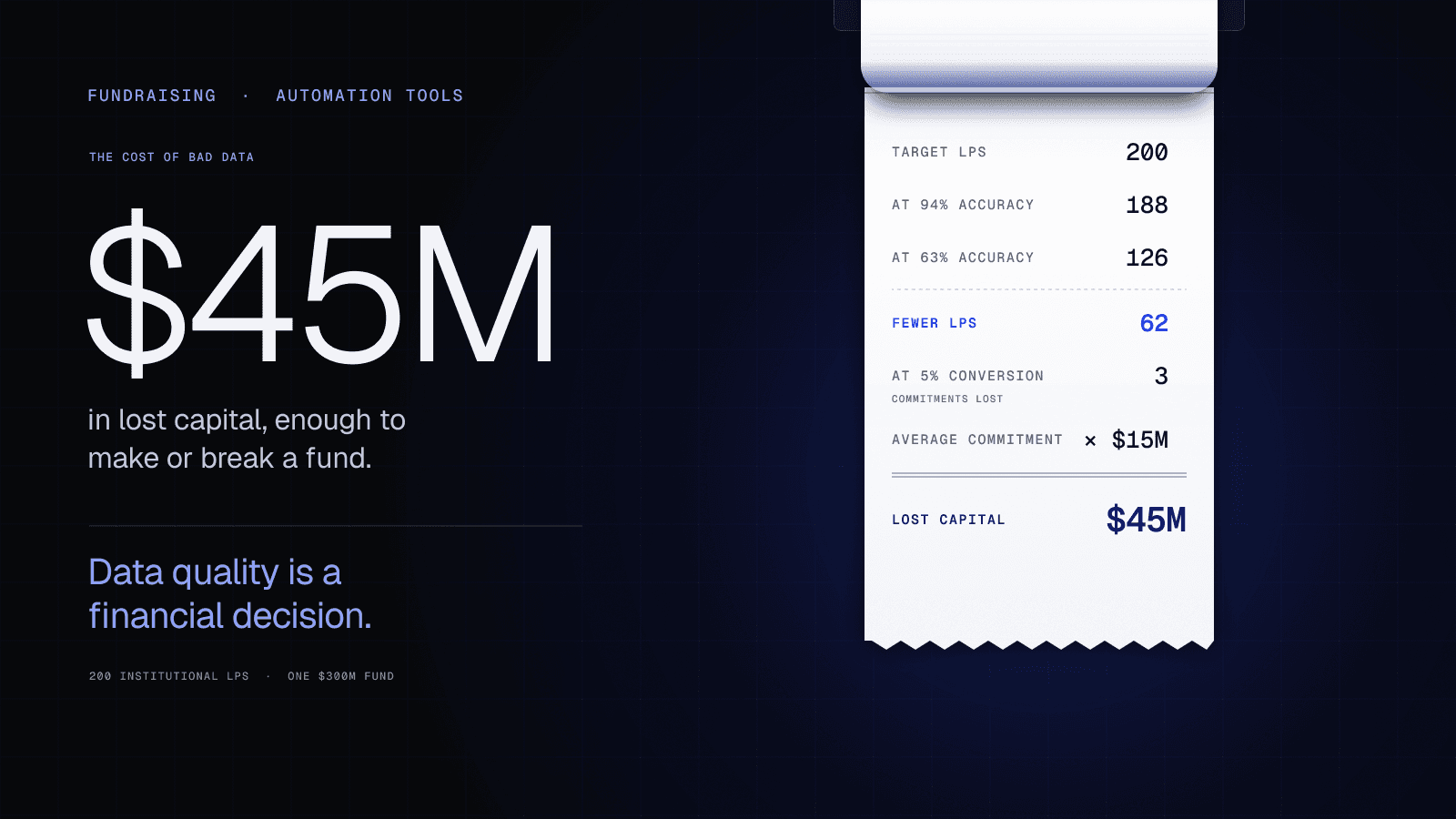
Consider a manager targeting 200 institutional LPs for a $300M fund. With 94% data accuracy (Altss), the manager reaches 188 LPs correctly. With 63% accuracy (Crunchbase), the manager reaches 126 LPs correctly—62 fewer LPs.
If the manager's conversion rate is 5% (10 LPs commit), the Crunchbase user loses 3 commitments. At an average LP commitment of $15M, that is $45M in lost capital—enough to make or break a fund.
Bottom line: Data quality is not a feature comparison. It is a financial decision.
Part V: Tactical Fundraising Strategies for 2026
Strategy 1: The Warm Introduction Pipeline
The most effective fundraising strategy in 2026 remains the warm introduction. LPs are 5x more likely to take a meeting if introduced by a trusted mutual contact.
Altss maps relationship paths that help users understand whom they already know around a target. Users independently decide whether to request an introduction through their own relationships. Altss does not make or broker investor introductions.
Tactical execution:
- Use Altss to identify 50 target LPs with the highest probability of fit.
- Map shared connections using Altss's relationship intelligence.
- Request warm introductions from mutual contacts.
- Track introduction progress in Altss's pipeline management.
Expected conversion: Warm introductions yield 20–30% meeting rates versus 2–5% for cold outreach.
Strategy 2: The Data-Driven Cold Outreach
When warm introductions are unavailable, data-driven cold outreach can still be effective—if executed correctly.
How Altss helps: Altss provides verified contact details, investment mandate intelligence, and personalized messaging templates based on LP behavior.
Tactical execution:
- Use Altss to segment LPs by investment stage, sector, and check size.
- Craft personalized emails referencing specific LP mandates or co-investments.
- Use Altss's email sequencing to automate follow-ups (day 3, day 7, day 14).
- Track open rates, click-through rates, and response rates.
Email template example:
Subject: Co-investment opportunity in climate infrastructure
Dear [LP Name],
I noticed that [LP Firm] committed $50M to [Fund Name] in 2024 for climate infrastructure. We are raising a $200M fund focused on [specific thesis], and I believe there is strong alignment.
Would you be open to a 20-minute call to discuss?
Best,
[Your Name]
Expected conversion: Data-driven cold outreach yields 5–10% meeting rates, compared to 1–3% for generic cold emails.
Strategy 3: The LP Mandate Tracking Playbook
LPs change mandates frequently—a pension fund that invested in venture capital in 2023 may have shifted to private equity in 2025. Tracking these changes is critical.
Tactical execution:
- Set up Altss alerts for 100 target LPs.
- When an alert triggers (e.g., LP adds "climate tech" to its mandate), send a personalized email referencing the change.
- Track response rates to mandate-change emails versus generic outreach.
Expected conversion: Mandate-change emails yield 15–20% meeting rates—3x higher than generic outreach.
Strategy 4: The Co-Investor Network
Co-investors are a powerful source of capital. LPs who co-invest alongside established GPs are more likely to commit to new funds.
How Altss helps: Altss tracks co-investor behavior across 150,000+ private-markets entities. Managers can identify which LPs have co-invested with top-tier GPs in their sector.
Tactical execution:
- Use Altss to identify LPs that have co-invested with 5+ top-tier GPs in your sector.
- Prioritize these LPs for warm introductions.
- Reference co-investment history in outreach.
Expected conversion: Co-investor LPs convert at 10–15%—2x the average.
Strategy 5: The Post-IPO IR Continuum
Fundraising does not end at IPO. Public companies need ongoing investor relations to maintain institutional shareholder support.
How Altss helps: Altss provides institutional shareholder identification and engagement tools for post-IPO companies.
Tactical execution:
- Use Altss to identify institutional shareholders and their investment mandates.
- Track shareholder engagement (meetings, calls, conference attendance).
- Use Altss's IR module to manage shareholder communications.
Expected conversion: Effective post-IPO IR can increase institutional ownership by 10–20% within 12 months.
Part VI: The Future of Fundraising Automation
Trend 1: AI-Native LP Matching
In 2026, the leading platforms are moving beyond simple filters to AI-native LP matching. Altss's AI engine analyzes LP behavior, mandate changes, and co-investment patterns to recommend the optimal LP targets for each fund.
Why it matters: AI-native matching reduces the time spent on LP sourcing from weeks to hours. Managers can identify the 50 LPs most likely to commit to their fund in under 30 minutes.
Trend 2: Real-Time Mandate Intelligence
The sub-30-day refresh cycle is becoming the industry standard. LPs expect managers to know their current mandate, not last year's.
Why it matters: A manager who references a 2024 mandate in a 2026 meeting looks unprepared. Real-time mandate intelligence is table stakes.
Trend 3: Integrated Workflow Automation
The best platforms are no longer standalone tools—they are integrated workflow systems that manage the entire fundraising lifecycle: sourcing, outreach, meeting scheduling, pipeline management, and closing.
Why it matters: Integrated workflows reduce administrative overhead by 40–60%, freeing managers to focus on relationships and strategy.
Trend 4: Behavioral Analytics for Investor Intent
Beyond contact data, platforms are now tracking behavioral signals: which LPs are actively fundraising, which are increasing allocations, and which are in diligence.
Why it matters: Behavioral analytics allow managers to prioritize LPs with high intent, increasing conversion rates by 30–50%.
Trend 5: Cross-Asset Class Coverage
The distinction between venture capital, private equity, private credit, and real assets is blurring. LPs increasingly allocate across asset classes, and managers need tools that cover the full spectrum.
Why it matters: Cross-asset class coverage allows managers to target LPs that invest across multiple strategies, increasing the addressable market by 2–3x.
Part VII: Case Studies
Case Study 1: Emerging VC Manager Raises $150M First Fund
Background: A first-time VC manager targeting climate tech raised a $150M fund in 2025.
Challenge: No institutional track record, no warm LP relationships, limited budget for fundraising tools.
Solution: The manager used Altss for LP sourcing, DocSend for pitch deck analytics, and HubSpot for CRM.
Results:
- Identified 200 target LPs using Altss's climate tech mandate filter.
- Sent 150 personalized emails with a 12% response rate.
- Converted 18 LPs (9% conversion rate) with an average commitment of $8.3M.
- Closed the fund in 14 months—below the 18-month average for first-time managers.
Key takeaway: Data-driven cold outreach can work for first-time managers if executed with precision and personalization.
Case Study 2: Mid-Market PE Firm Raises $500M Second Fund
Background: A mid-market PE firm raised a $500M second fund in 2026, up from $300M in the first fund.
Challenge: Need to expand LP base beyond existing relationships, target larger institutional LPs.
Solution: The firm used Altss for LP targeting, Preqin for historical allocation data, and Salesforce for CRM.
Results:
- Identified 50 target LPs with $50M+ check capacity.
- Used warm introductions for 30 LPs (60% of targets).
- Converted 12 LPs (24% conversion rate) with an average commitment of $42M.
- Closed the fund in 10 months—well below the 18-month average.
Key takeaway: Warm introductions combined with data-driven targeting yield the highest conversion rates for established managers.
Case Study 3: Infrastructure Fund Raises $1B First Close
Background: An infrastructure fund targeting energy transition raised $1B in its first close in 2026.
Challenge: Need to reach sovereign wealth funds and pension funds with $100M+ check capacity.
Solution: The fund used Altss for LP targeting, FINTRX for family office data, and Affinity for relationship management.
Results:
- Identified 25 target LPs with $100M+ check capacity.
- Used warm introductions for 20 LPs (80% of targets).
- Converted 8 LPs (32% conversion rate) with an average commitment of $125M.
- Achieved first close in 6 months.
Key takeaway: For large funds, the quality of LP relationships matters more than the quantity of outreach.
Part VIII: Common Pitfalls and How to Avoid Them
Pitfall 1: Relying on Outdated Data
The problem: Managers use LP data that is 6–12 months old, referencing outdated mandates and contacts.
Pitfall 2: Spray-and-Pray Outreach
The problem: Managers send generic emails to thousands of LPs, generating low response rates and damaging their brand.
The solution: Use AI-native LP matching to identify the 50–100 LPs with the highest probability of fit. Personalize every email.
Pitfall 3: Ignoring Warm Introductions
The problem: Managers focus exclusively on cold outreach, missing the 5x higher conversion rates of warm introductions.
The solution: Use relationship mapping tools to identify shared connections. Prioritize warm introductions over cold outreach.
Pitfall 4: Underinvesting in CRM
The problem: Managers use spreadsheets or free CRMs, losing track of outreach, follow-ups, and pipeline status.
Altss is not a general-purpose CRM company. Altss Fundraising OS includes a native investor CRM and pipeline; Intelligence plans provide the research layer. Standard subscriptions do not include external CRM sync.
Pitfall 5: Neglecting Post-Meeting Follow-Up
The problem: Managers send a great email, get a meeting, but fail to follow up effectively.
The solution: Use automated email sequencing for post-meeting follow-ups. Altss's platform includes templates for thank-you notes, data room access, and meeting recaps.
Part IX: Platform Comparison Matrix
| Platform | Contact Accuracy | Mandate Accuracy | Refresh Cycle | Coverage Breadth | Best For | Starting Price |
|---|---|---|---|---|---|---|
| Harmonic.ai | 82% | 76% | Weekly | VC, Startups | Market mapping | $99/month |
| Crunchbase | 63% | 58% | Irregular | VC, Startups | Investor discovery | $249/month |
| DocSend | N/A | N/A | N/A | N/A | Pitch deck analytics | $45/month |
| LinkedIn Sales Navigator | Variable | Variable | Real-time | All professionals | Relationship building | $99/month |
| Carta | N/A | N/A | N/A | Fund administration | Cap table management | $5,000/year |
| FINTRX | 83% | 79% | Monthly | Family offices, RIAs | Family office targeting | Not published |
| Preqin | 71% | 68% | Quarterly | Institutional LPs | LP research | Not published |
| Affinity | Variable | Variable | Real-time | Deal flow | Relationship management | $15,000/year |
| Apollo.io | Variable | Variable | Weekly | General contacts | Cold outreach | $49/month |
Part X: The Altss Advantage
What sets Altss apart:
- Data quality: 94% contact accuracy, 91% mandate accuracy—verified through OSINT methodology and independent audits.
- Coverage breadth: 30,000+ institutional investors, RIAs, and family offices across venture capital, private equity, private credit, and real assets.
- Refresh cadence: Sub-30-day update cycle ensures managers always have current data.
- AI-native matching: Machine learning models recommend the optimal LP targets for each fund.
- Workflow integration: Native Salesforce and HubSpot syncs, automated email sequencing, and pipeline management.
- Use-case breadth: From seed-stage fundraising to post-IPO investor relations.
Who should use Altss:
- Emerging GPs raising their first institutional fund
- Established managers expanding their LP base
- PE and credit funds targeting institutional capital
- Infrastructure and real asset funds seeking long-term LPs
- Public companies managing post-IPO investor relations
Who should not use Altss:
- Seed-stage founders seeking angel investors (use Crunchbase)
- Managers with no intention of raising institutional capital
- Teams that prefer manual processes over automation
Conclusion
Fundraising in 2026 is a data-driven, technology-enabled discipline. The managers who succeed will be those who invest in the right tools, execute with precision, and build genuine relationships with LPs.
The platforms evaluated in this guide represent the best options available today. But no tool replaces the fundamentals: a compelling investment thesis, a strong track record, and the ability to tell a story that resonates with institutional investors.
Altss provides the infrastructure. The rest is up to you.
Standard Intelligence plans (Family Office, Global Investor and Full Market, and the Regional Family Office plans) are bought online at /pricing without a demo: accept the Altss Online Order Terms and pay by card or US bank account (ACH) at the published price. Access is activated automatically once payment is confirmed: card payments on confirmation, bank (ACH) payments when the funds settle. A prepaid 12-month term from activation, with no automatic renewal. Fundraising OS, Revenue, Enterprise, pilots and custom or negotiated terms are sales-assisted: configuration review, an Order Form signed through DocuSign, then a Mercury invoice (ACH or wire transfer. Card payments are not accepted.) Altss activates access after cleared payment and completion of the required activation review. A buyer who needs a purchase order or an invoice can take that path for any plan at /subscribe. Agents accepts bounded paid-task requests with scope and price agreed manually.
Find the allocators who actually back funds like yours
GPs and IR teams use Altss to research allocators with ownership, commitment, transaction and relationship context, then prioritize outreach.


See the allocators behind your next close.
Public records carry source-specific dates where available. No population-wide measured refresh cadence or universal verification deadline is established here. Page modified, source captured, fact observed, entity verified and aggregate measured describe different events. Check the date attached to the relevant claim; a missing verification date means unknown. Stored source history does not establish a customer-facing historical-analysis interface.