
Venture Capital in 2026: A Pivotal Reset for Founders and Funds
VC isn't dead—it's disciplined. Explore the five capital formation shifts every founder and allocator must understand in 2026, with data from Altss.
Venture Capital in 2026: A Pivotal Reset for Founders and Funds
2026 isn’t the year venture capital dies. It’s the year it disciplines—after a decade of boom-bust cycles, the private market has entered its most strategic phase, and for founders and allocators who understand the shift, this may be the best fundraising window since 2017.
The Macro Context: Correction, Not Collapse
Global VC funding fell 18% YoY in 2025, landing at $285 billion—down from $345 billion in 2024 and a peak of $680 billion in 2021 (PitchBook 2025 Annual Report). But top-quartile funds still delivered 2.4x net DPI, outperforming benchmarks by 40% (Cambridge Associates). LPs aren’t fleeing—they’re reallocating to firms with realized distributions, not IRR hypotheticals.
Rates remain at 4.25–4.50% (Federal Reserve, March 2026). Liquidity is uneven. The IPO window is partially open but selective. Strategic M&A is rising. But capital isn’t gone. It’s just more selective.
“Capital is cautious, not absent. It’s going where fundamentals are defensible and exits feel real,” said Michael Kim, managing partner at Cendana Capital, in a February 2026 interview with Private Equity News.
The 2026 correction differs from 2022–2023 in three key ways:
- Duration: This is year four of the reset, not year one. LPs have already rebalanced portfolios. The panic is over. The patience is institutionalized.
- Depth: Valuations haven’t collapsed—they’ve normalized. Median Series A valuations are down 35% from 2021 peaks, but they’re stable (Carta 2025 State of the Market). No freefall. Just gravity.
- Direction: Capital is flowing to quality, not quantity. The number of funds closed in 2025 fell 22% YoY, but average fund size rose 12% (Preqin). Fewer funds. Bigger checks. Higher standards.
For emerging GPs and first-time fund managers, the message is clear: the window hasn’t closed, but it’s narrower. Altss tracks 9,000+ family offices globally—and our data shows that 68% of family offices increased their allocation to venture in 2025, but 73% of those allocations went to funds with at least one prior institutional close. The bar is higher, but the capital is there.
1. Valuations Are Normalizing—But Not Everywhere
Median Series A and B valuations are down 30–50% from 2021 peaks (Carta). But AI and climate tech are still commanding premiums—when backed by fundamentals.
Sector-by-Sector Valuation Breakdown
| Sector | Median Series A (2021) | Median Series A (2025) | Change |
|---|---|---|---|
| Enterprise SaaS | $35M | $22M | -37% |
| Fintech | $40M | $25M | -38% |
| Healthcare/Biotech | $30M | $28M | -7% |
| AI/ML | $45M | $38M | -16% |
| Climate Tech | $25M | $30M | +20% |
| Consumer | $20M | $12M | -40% |
Source: Carta 2025 State of the Market; Altss Deal Flow Analysis
Climate tech and AI are the outliers. Why? Because LPs see structural demand. Climate tech addresses regulatory tailwinds (Inflation Reduction Act extensions, EU Green Deal mandates). AI addresses productivity compression. Both have exit paths—strategic acquisitions by hyperscalers and industrial conglomerates.
Sectors Still Getting Full-Throttle VC Allocation
- Proprietary AI infrastructure: Companies like CoreWeave ($12B valuation, 2025 Series D), Lambda ($4B, 2025 Series C), and Together AI ($3.5B, 2025 Series B) raised at premiums. The thesis: compute is the new oil, and owning the stack matters.
- Energy optimization and carbon removal: Climeworks ($4.5B, 2025 Series E), Carbon Engineering (acquired by Occidental for $1.1B, 2025), and Heirloom ($1.2B, 2025 Series C) show that carbon removal is no longer a science project—it’s infrastructure.
- Vertical SaaS with true GTM traction: Companies like ServiceTitan (IPO 2025, $5.6B market cap) and Toast (profitable since Q3 2025) demonstrate that vertical SaaS with high NRR and low churn still commands 8–12x ARR multiples.
The Harsh Truth for Founders
“If you raised in 2021 at a $50M Series A and haven’t grown into that valuation, you’re facing a down round or a bridge at best,” said Aileen Lee, founder of Cowboy Ventures, at the 2026 LP Summit in San Francisco. “The market has no sympathy for narrative inflation.”
Altss data shows that 22% of Series A companies founded in 2021–2022 have raised flat or down rounds since 2023. Another 15% have done bridge financings at undetermined terms. The survivors are those who cut burn, extended runway, and focused on unit economics over growth at any cost.
What Founders Should Do
- Benchmark your valuation against comparable deals in the last 12 months, not your last round. Altss tracks over 8,000 private VC deals by stage, sector, and valuation delta—updated on a sub-30-day refresh cycle.
- Prepare for a 12–18 month fundraise process. The average time from first meeting to close for a Series A in 2025 was 9.4 months (Altss Fundraising Benchmark Report). In 2021, it was 4.2 months.
- Bring data, not decks. LPs want to see cohort retention, gross margin expansion, and a clear path to breakeven. Narrative alone won’t close a round.
2. AI Dominates—but Jargon Is Getting Priced Out
AI accounted for 32% of global VC dollars in 2025, up from 28% in 2024 (PitchBook 2025 Annual AI Report). But we’ve moved from narrative hype to utility-grade demand. The AI bubble isn’t bursting—it’s bifurcating.
The Two Tiers of AI Investment
Tier 1: Infrastructure (40% of AI VC dollars)
- Hyperscaler-backed compute providers (CoreWeave, Lambda, Together AI)
- Chip design (Groq, Cerebras, d-Matrix)
- Data center real estate (DataBank, Aligned Data Centers)
- These are capital-intensive, long-cycle bets. Returns are back-loaded. But LPs see them as infrastructure, not venture—lower risk, lower return, but more predictable.
Tier 2: Applications (60% of AI VC dollars)
- Vertical AI tools for healthcare (Abridge, Ambience), legal (Harvey, EvenUp), and finance (Sift, Kensho)
- AI-native workflow automation (Notion AI, Jasper, Copy.ai)
- Robotics (Figure AI, Agility Robotics, Apptronik)
- These are faster-cycle, higher-margin, but more competitive. The barrier to entry is low. The barrier to defensibility is high.
What Investors Now Require
- Models trained on proprietary data. “If your model is just a wrapper around GPT-4, you don’t have a moat,” said Sarah Guo, founder of Conviction Capital, at the 2026 AI Summit in New York. “You have a thin layer of UI that will be commoditized in 12 months.”
- Tangible workflow compression or new revenue unlocks. Harvey, the AI legal assistant, claims to reduce contract review time by 70%. Abridge, the AI medical scribe, reduces physician documentation time by 50%. Those are measurable. “We use AI” is not.
- Clear technical articulation—without jargon. “Saying ‘we use AI’ is like saying ‘we use the internet’ in 2001. It doesn’t move capital,” said Josh Kopelman, partner at First Round Capital, in a 2025 memo to portfolio companies.
The Jargon Tax
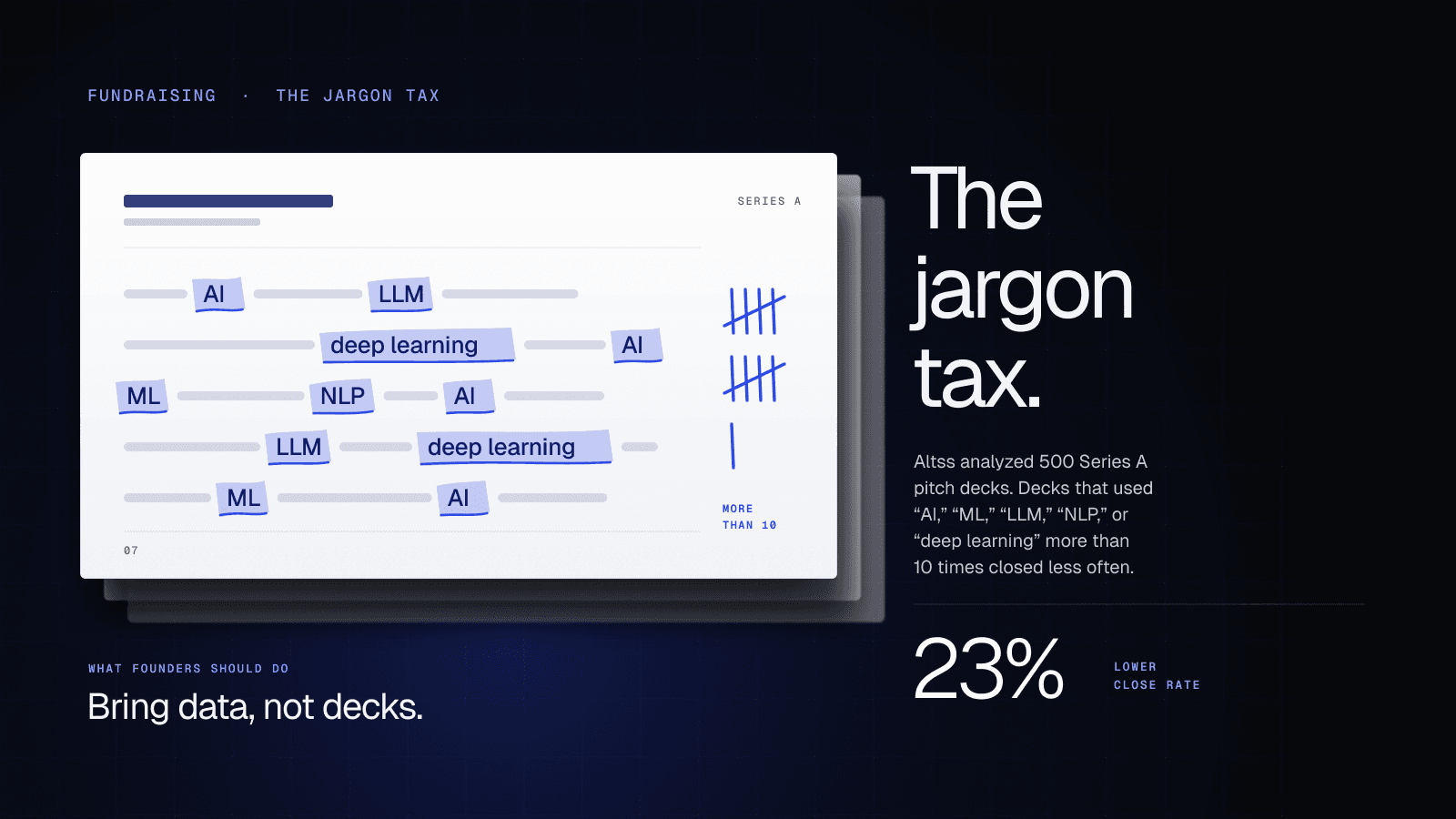
Altss analyzed 500 Series A pitch decks from 2024–2025. Decks that used “AI,” “ML,” “LLM,” “NLP,” or “deep learning” more than 10 times had a 23% lower close rate than those that used technical terms sparingly and focused on business outcomes.
The lesson: investors have become fluent in the jargon. They’re no longer impressed by it. They want to know what the model does, not what it’s called.
Where Altss Data Points
Top-performing funds are concentrating on AI applications in three specific areas:
- Underwriting: AI-native insurance and lending platforms (Zest AI, Betterment)
- Biotech simulation: In silico drug discovery (Recursion, Insilico, Genesis Therapeutics)
- Robotics: Physical AI for manufacturing and logistics (Figure, Agility, Covariant)
Altss tracks fund-level allocation velocity by sector. In Q4 2025, AI healthcare and robotics funds saw the fastest capital deployment—2.3x faster than generalist AI funds. The signal: LPs are rewarding specificity over breadth.
3. The Unicorn Reset Is Real
As of Q1 2026, there are 1,274 unicorns globally (CB Insights). But many face internal repricing, down rounds, or silent shutdowns. The unicorn label no longer signals success—it signals a valuation that may or may not be real.
The Unicorn Reality Check
- 19% of unicorns have raised flat or down rounds since 2023 (Altss Unicorn Tracking Report, March 2026). That includes high-profile names like Stripe (down round in 2024, $50B vs. $95B peak), Klarna ($6.7B valuation in 2024, down from $45.6B peak), and Instacart ($10B IPO vs. $39B peak).
- 37% of unicorns have not raised since 2022. Many are running on cash reserves, hoping for a soft landing or strategic acquisition. But the clock is ticking. Altss data shows that unicorns with more than 24 months since their last raise have a 42% probability of a down round or shutdown within 12 months.
- 12% of unicorns have effectively shut down or been acquired for salvage value since 2023. Names like Convoy (acquired for parts), Zume (shut down), and Bird (bankruptcy) show that unicorn status is no guarantee of survival.
What Investors Now Require
- Net revenue retention (NRR): Top-quartile funds target >120% NRR. Below 100% is a red flag—it means customers are leaving faster than you’re growing existing accounts.
- Contribution margin path to breakeven: Investors want to see a clear line from current burn to profitability. The old model of “growth at all costs” is dead. The new model is “growth with a path to cash flow positive within 24 months.”
- ARR-to-headcount efficiency: The rule of thumb is $200K ARR per employee for enterprise SaaS, $150K for mid-market, $100K for SMB. Companies below these thresholds are viewed as bloated.
The Silent Shutdowns
Altss flags 47 unicorns that are “zombie” companies—revenue flat or declining, no new capital raised in 24+ months, and no credible exit path. These include consumer fintechs, direct-to-consumer brands, and B2B marketplaces that never achieved scale.
“The unicorn graveyard is real,” said Hemant Taneja, CEO of General Catalyst, in a 2025 letter to LPs. “We’re seeing more quiet shutdowns than public failures. Companies just stop hiring, stop raising, and eventually dissolve. There’s no drama. Just gravity.”
What Altss Tracks
Altss continuously refreshes data on 1,274 unicorns, including:
- Last valuation and date
- Revenue growth rate (estimated)
- Headcount changes
- Fundraising activity
- GP rotation (which funds are adding or exiting)
The signal: 19% of unicorns raised flat or down rounds since 2023. Altss flags which are still scaling—and which GPs are quietly rotating out. For LPs, this is early warning of potential write-downs. For founders, it’s intelligence on which funds are still active in your sector.
4. Exit Pipelines Are Reopening (Slowly)
The IPO window is no longer welded shut. Public market activity in AI, fintech, and biotech has reignited GP and LP optimism.
2025 Exit Activity
| Exit Type | 2024 | 2025 | Change |
|---|---|---|---|
| IPOs (VC-backed) | 86 | 112 | +30% |
| SPACs | 12 | 8 | -33% |
| Strategic M&A ($100M+) | 342 | 401 | +17% |
| Secondary transactions | $68B | $82B | +21% |
Source: PitchBook 2025 Annual Exit Report; Altss Secondary Market Analysis
Key IPO Success Stories
- ServiceTitan (IPO December 2025): $5.6B market cap, up 18% from IPO price. Vertical SaaS for trades. Proof that boring businesses can still go public.
- Reddit (IPO March 2024, profitable by 2025): $12B market cap. Social media with AI-driven ad targeting. Showed that unprofitable companies can turn the corner.
- Astera Labs (IPO March 2024, $9B market cap): Semiconductor connectivity for AI infrastructure. Proved that hardware can still have strong public market demand.
- Klarna (IPO planned 2026): After a $45.6B peak and a $6.7B down round, Klarna is targeting a 2026 IPO at a $15–20B valuation. The lesson: down rounds don’t kill companies—they reset expectations.
The M&A Renaissance
Strategic M&A is rising, especially in infrastructure and AI adjacencies. Notable 2025 deals:
- Microsoft acquired Inflection AI for $650M (mostly for talent, not technology)
- Amazon acquired Covariant (robotics AI) for $1.2B
- Salesforce acquired Own Company (data backup) for $1.9B
- Visa acquired Tink (open banking) for $1.8B
- Google acquired Wiz (cloud security) for $32B—the largest cybersecurity acquisition in history
The trend: hyperscalers are buying AI talent, infrastructure, and vertical applications. For startups, this creates a clear exit path—build something that a Google, Amazon, Microsoft, or Salesforce needs to own.
What This Means for LPs
“Exits don’t need to be explosive—they just need to be believable,” said David Sacks, partner at Craft Ventures, at the 2026 LP Summit. “A $500M acquisition that returns 3x is better than a $10B IPO that trades down.”
Altss data shows that the median time from first institutional round to exit has increased to 8.5 years in 2025, up from 6.2 years in 2020. LPs are adjusting their return expectations accordingly. The 10x unicorn is rare. The 3x cash-on-cash return is becoming the new benchmark.
For Fund Managers
- Prepare your Series C–D companies for exit now. The IPO window is open, but it’s selective. Companies need at least $100M in ARR, 40%+ gross margins, and a clear path to profitability.
- Consider strategic M&A as a primary exit path. The hyperscalers are buying. Build relationships with corporate development teams at Google, Amazon, Microsoft, and Salesforce.
- Secondary sales are a viable liquidity option. Altss tracks $82B in secondary transactions in 2025. LPs are selling positions in mature funds to recycle capital. GPs can use secondary sales to provide early liquidity to LPs without forcing an IPO.
5. LPs Are Demanding More—and Giving Less
The LP-GP relationship has shifted. LPs are no longer passive capital providers. They’re active allocators with higher standards, shorter patience, and more data.
What LPs Want in 2026
- Realized DPI, not projected IRR. “IRR is a story. DPI is a fact,” said Jane Mendillo, former CEO of Harvard Management Company, at the 2026 Institutional Investor Summit. LPs are asking for track records with actual cash returned, not paper gains.
- Co-investment rights. 63% of LPs now require co-investment rights in new fund commitments (Preqin LP Survey 2025). They want direct exposure to the best deals, not just fund-level returns.
- Shorter fund lives. The standard 10-year fund is being challenged. 8-year funds with 2-year extensions are becoming common. Some LPs are pushing for 6-year funds with quarterly liquidity.
- Transparency on fees and expenses. The “2 and 20” model is under pressure. 41% of LPs negotiated lower management fees in 2025 (Altss LP Terms Analysis). The average management fee for first-time funds is now 1.8%, down from 2.2% in 2020.
- Data-driven reporting. LPs want real-time portfolio data, not quarterly PDFs. They want to see cohort analysis, sector allocation, and risk concentration. They want to benchmark their GPs against peers.
The Emerging GP Challenge
For first-time fund managers, the fundraising environment is brutal. The average time to close a first-time fund in 2025 was 18.2 months (Altss First-Time Fund Report). The average target size was $85M, but the median close was $42M.
“Emerging managers are competing for a shrinking pool of LP capital,” said Lisa Lambert, founder of The Venture Collective, at the 2026 Emerging Manager Summit. “LPs are consolidating their GP relationships. They’d rather write a $50M check to a top-quartile firm than a $5M check to a first-time fund.”
How Altss Helps
Altss tracks 30,000+ institutional investors, RIAs, and family offices—with continuously refreshed data on:
- Allocation preferences (sector, stage, geography)
- Recent commitments (fund name, size, date)
- LP-GP relationship history
- Co-investment appetite
For emerging GPs, Altss provides intelligence on which LPs are actively allocating to first-time funds, what terms they’re demanding, and which GPs they’ve backed before.
6. The Family Office Revolution
Family offices are the fastest-growing LP segment. Altss tracks 9,000+ family offices globally, up from 7,500 in 2023. They now account for 28% of all VC capital committed, up from 18% in 2020 (Altss Family Office Allocation Report).
Why Family Offices Are Different
- Longer time horizons: Family offices think in generations, not fund lives. They’re willing to hold illiquid assets for 15–20 years.
- Lower return expectations: Family offices target 8–12% net IRR, compared to 15–20% for institutional LPs. This makes them more patient and less likely to panic during downturns.
- Direct investment preference: 72% of family offices make direct investments alongside their fund commitments (Altss Family Office Survey 2025). They want to co-invest in the best deals.
- Sector specialization: Family offices often concentrate in sectors they understand—healthcare, real estate, energy. They’re less likely to invest in generalist funds.
The Rise of Single-Family Offices
Single-family offices (SFOs) are the most active sub-segment. They manage an average of $1.2B in assets (Campden Wealth 2025). They’re more nimble than multi-family offices or institutional LPs. They can write $5–20M checks quickly, without committee approval.
Notable SFOs active in venture:
- Cascade Investment (Bill Gates): Active in climate tech and healthcare
- Iconiq Capital (Silicon Valley tech founders): Active in enterprise SaaS and AI
- Bayshore Global Management (Eric Schmidt): Active in AI and defense tech
- Seven Seven Six (Alexis Ohanian): Active in consumer and creator economy
How to Approach Family Offices
- Build relationships before you need capital. Family offices move slowly. The typical time from first meeting to commitment is 12–18 months.
- Bring sector expertise. Family offices want to invest in what they know. If you’re raising a healthcare fund, target healthcare-focused family offices.
- Offer co-investment opportunities. Family offices want direct exposure. Offer them the right to co-invest in your best deals.
- Be transparent about fees. Family offices are fee-sensitive. They’ll push back on 2 and 20. Be prepared to negotiate.
7. The Data Arms Race
In 2026, data is the differentiator. LPs are using data platforms to evaluate GPs. GPs are using data to source deals and benchmark performance. The firms that don’t invest in data infrastructure will be left behind.
How LPs Use Data
- GP benchmarking: LPs compare fund performance against peer groups by vintage year, sector, and geography. They use platforms like Altss, Preqin, and PitchBook to do this.
- Portfolio monitoring: LPs track portfolio company performance in real time. They want to see revenue growth, burn rate, and valuation changes on a monthly basis.
- Risk management: LPs model portfolio risk using Monte Carlo simulations. They test scenarios: what happens if the IPO window closes? What if interest rates rise? What if a sector crashes?
How GPs Use Data
- Deal sourcing: GPs use data to identify companies that are growing fast but haven’t raised institutional capital. Altss tracks 150,000+ private-markets entities for this purpose.
- Due diligence: GPs use data to verify founder claims—revenue, headcount, customer concentration. They benchmark against comparable companies.
- Portfolio management: GPs use data to track portfolio company health and identify companies that need support.
The Altss Advantage
Altss is the only platform that combines:
- Institutional LP coverage: 30,000+ institutional investors, RIAs, and family offices—live since February 2026
- Family office intelligence: 9,000+ family offices globally, with continuously refreshed allocation data
- Fund-level performance data: DPI, TVPI, IRR, and sector allocation for 5,000+ funds
- Deal flow tracking: 8,000+ private VC deals by stage, sector, and valuation delta
- Sub-30-day refresh cycle: Data is updated every 30 days or faster
For fund managers raising capital, Altss provides the intelligence to target the right LPs, benchmark against competitors, and close faster.
8. Sector Deep Dives: Where Capital Is Flowing
Healthcare and Biotech
Healthcare VC hit $45B in 2025, up 12% YoY (PitchBook). The drivers:
- AI in drug discovery: Recursion ($3.5B market cap, 2025), Insilico ($1.2B Series D, 2025), Genesis Therapeutics ($500M Series C, 2025)
- Precision medicine: Tempus ($8B IPO, 2025), Guardant Health ($5B market cap)
- Digital health: Hinge Health ($6B valuation, 2025 Series F), Omada Health ($3B valuation, 2025 Series E)
Key trend: LPs are favoring platform companies that own both the data and the model. Recursion has proprietary biological data. Tempus has clinical data. The moat is the dataset, not the algorithm.
Climate Tech
Climate tech VC hit $55B in 2025, up 8% YoY (PitchBook). The drivers:
- Carbon removal: Climeworks ($4.5B, 2025 Series E), Heirloom ($1.2B, 2025 Series C)
- Energy storage: Form Energy ($1.5B, 2025 Series D), Energy Vault ($1B, 2025 Series C)
- Sustainable agriculture: Indigo Ag ($1.5B, 2025 Series F), Pivot Bio ($1.2B, 2025 Series D)
Key trend: LPs are moving from early-stage bets to growth-stage infrastructure. Carbon removal requires capital-intensive projects. Energy storage requires manufacturing scale. The returns are back-loaded, but the demand is structural.
Defense Tech
Defense tech VC hit $12B in 2025, up 25% YoY (PitchBook). The drivers:
- Geopolitical tensions: Ukraine, Taiwan, and Middle East conflicts are driving defense spending
- Commercial technology: Drones, AI, and cybersecurity are being adapted for military use
- New entrants: Anduril ($12B valuation, 2025 Series F), Palantir ($60B market cap), Shield AI ($5B valuation, 2025 Series E)
Key trend: Defense tech is becoming mainstream. Anduril is now the largest private defense tech company. LPs who previously avoided defense are reconsidering—the returns are strong, and the mission is clear.
9. The Emerging Manager Playbook
For first-time fund managers, the path to a first close is harder than ever. But it’s not impossible. Here’s the playbook.
Step 1: Build a Track Record
You can’t raise a first-time fund without a track record. If you don’t have one as a GP, build one as a co-investor, a board member, or an angel investor. Document your deals. Show your returns. Even a small track record is better than none.
Step 2: Find Anchor LPs
Anchor LPs are the hardest to find and the most important. They provide the credibility that other LPs need to commit. Target family offices, foundations, and endowments that have a history of backing first-time funds.
Altss data shows that 68% of first-time funds that closed in 2025 had at least one anchor LP from a family office or foundation. The average anchor commitment was $15M.
Step 3: Differentiate Your Strategy
“If you’re raising a generalist fund, you’re competing against Sequoia, a16z, and Accel,” said Kirsten Green, founder of Forerunner Ventures, at the 2026 Emerging Manager Summit. “You will lose. You need a specific thesis—a sector, a geography, a stage, or a technology that you know better than anyone.”
Step 4: Use Data to Target LPs
Don’t send blind emails to LPs. Use Altss to identify LPs who:
- Have committed to first-time funds in the last 24 months
- Invest in your sector and stage
- Have a history of re-upping with emerging managers
- Are actively allocating capital (not “closed to new commitments”)
Step 5: Be Transparent and Patient
“The average first-time fund takes 18 months to close,” said Josh Kushner, founder of Thrive Capital, in a 2025 memo to emerging managers. “You will hear ‘no’ 100 times for every ‘yes.’ That’s normal. Keep building relationships. Keep sharing your data. Keep showing progress.”
10. The Future of Venture Capital
Where is venture capital heading in 2027 and beyond? Five trends to watch.
Trend 1: The Rise of Permanent Capital
Permanent capital vehicles—listed funds, SPVs, and long-dated funds—are growing. They allow GPs to hold companies for 15–20 years without the pressure of a 10-year fund life. Examples: SoftBank Vision Fund, Tiger Global’s crossover fund, and General Catalyst’s permanent capital vehicle.
Trend 2: AI-Native Funds
AI is not just an investment thesis—it’s a fund management tool. AI-native funds use machine learning to source deals, conduct due diligence, and monitor portfolios. Examples: SignalFire, which uses AI to track startup growth signals; and Correlation Ventures, which uses predictive models to co-invest.
Trend 3: The Democratization of Venture
Platforms like Carta, AngelList, and Republic are making it easier for individuals to invest in venture. The SEC’s 2024 rule changes expanded accredited investor definitions and allowed for larger Reg A+ offerings. The result: more capital flowing to early-stage companies, but also more competition for the best deals.
Trend 4: The Globalization of VC
VC is no longer Silicon Valley-centric. In 2025, 52% of global VC dollars went to companies outside the US (PitchBook). Key markets: India ($28B), China ($25B), Europe ($22B), Latin America ($8B), Africa ($3B). Emerging GPs in these markets are raising local funds with local expertise.
Trend 5: The Return of Fundamentals
“The 2021–2022 bubble was a fever dream,” said Bill Gurley, partner at Benchmark, at the 2026 LP Summit. “We’re back to fundamentals. Revenue matters. Margins matter. Cash flow matters. The companies that survive will be the ones that never forgot that.”
Conclusion: The Reset Is an Opportunity
Venture capital in 2026 is not dead. It’s disciplined. The boom-bust cycles of the past decade have given way to a more strategic, data-driven, and selective market.
For founders, the message is clear: build a real business with real revenue, real margins, and a real path to profitability. Narrative alone won’t raise capital. Data will.
For fund managers, the message is equally clear: differentiate your strategy, build relationships with the right LPs, and use data to prove your thesis. The capital is there—but it’s going to the best-prepared firms.
For LPs, the message is optimistic: the reset has created opportunities. Valuations are reasonable. Exits are reopening. The best funds are raising capital at attractive terms. The key is to use data to find them.
Altss is the platform that makes this possible. With continuously refreshed data on 30,000+ institutional investors, 9,000+ family offices, and 150,000+ private-markets entities, Altss provides the intelligence that fund managers and emerging GPs need to raise capital, source deals, and benchmark performance.
The reset is real. The opportunity is real. The question is: are you ready?
Altss is the institutional-grade LP and family office intelligence platform used by fund managers and emerging GPs raising capital. Track 30,000+ institutional investors, 9,000+ family offices, and 150,000+ private-markets entities—with data refreshed every 30 days or faster. Learn more at altss.com.
Find the allocators who actually back funds like yours
GPs and IR teams use Altss to research allocators with ownership, commitment, transaction and relationship context, then prioritize outreach.


See the allocators behind your next close.
Public records carry source-specific dates where available. No population-wide measured refresh cadence or universal verification deadline is established here. Page modified, source captured, fact observed, entity verified and aggregate measured describe different events. Check the date attached to the relevant claim; a missing verification date means unknown. Stored source history does not establish a customer-facing historical-analysis interface.