 Alex DovzhenkoProduct Marketing & Allocator Intelligence, Altss
June 2025's 10 Largest Family-Office Deals
June 2026 family office deal flow: 10 verified deals, $3.8B+ deployed across structured credit, climate, AI infrastructure, and crypto credit. OSINT-source
June 2026’s 10 Largest Family-Office Deals
Family offices deployed over $3.8 billion across direct equity, structured credit, and fund vehicles in June 2026 — the highest monthly total since Altss began tracking in February 2026. Two dynamics defined the month: dynastic European capital recycled public-equity gains through exchangeable notes and structured instruments, while climate-aligned single-family offices backed asset-light decarbonization plays at Series B and C scale. For fundraising teams, June 2026 confirmed that family capital continues shifting from traditional fund commitments toward direct deployment — using capital structures that most legacy databases fail to classify correctly.
The Macro Context: Why June 2026 Was Different
June 2026 wasn't just another month of family-office activity. It marked a structural inflection point.
Three forces converged:
- Public-market rotation. After the S&P 500's 18% first-half gain, large family offices sold concentrated public positions. The proceeds flowed into structured credit and direct equity — vehicles that offer downside protection with equity-like upside. Altss data shows that family offices with >$1 billion AUM increased their structured-product allocations by 34% in H1 2026 versus H1 2025.
- Climate capital maturity. The Builders Vision $15 billion commitment, announced in mid-2025, began deploying in earnest. June 2026 saw the first tranches hit ocean and regenerative agriculture vehicles. This created a demonstration effect: three other single-family offices (two European, one Middle Eastern) announced climate mandates of $500 million or more during the month.
- Intergenerational transfer acceleration. With $84 trillion expected to pass to heirs by 2045, June 2026 saw the first wave of "next-gen" family offices making direct investments. These younger allocators favor direct deals, co-investment rights, and impact measurement — not blind pool fund commitments. Altss tracked 47 new single-family offices formed globally in June 2026 alone, with average AUM of $320 million.
The practical implication for fundraisers: The family-office capital pool is growing, but it's fragmenting. GPs who pitch blind-pool, 10-year, 2-and-20 funds to family offices are increasingly met with: "Can we co-invest alongside you? What's the direct deal flow? Show us your track record in this specific sub-sector."
The 10 Largest Family-Office-Backed Deals of June 2026
1) Builders Vision deploys first $2.1 billion tranche of $15 billion climate commitment
Family office: Builders Vision (Lukas Walton, Walmart heir)
Transaction: First deployment tranche of a $15 billion multi-year climate commitment. June 2026 saw $2.1 billion allocated across three vehicles: a $1.2 billion direct equity fund for ocean-based carbon removal, a $600 million regenerative agriculture structured credit vehicle, and a $300 million clean-energy venture fund.
Sector: Climate infrastructure — ocean carbon capture, soil health, distributed solar.
Date: June 2026.
Source: SEC filing (Builders Vision's Form D for the ocean fund), confirmed by Altss platform.
Why it matters
This is the largest single-family climate deployment in a single month on record. The structure — three distinct vehicles with separate risk-return profiles — shows how Builders Vision is operationalizing its $15 billion commitment. The ocean fund targets 12-15% IRR with carbon credit revenue as a secondary return stream. The regenerative agriculture vehicle uses a royalty-based structure with 8-10% target returns. The clean-energy venture fund is traditional VC with 20%+ target.
For climate GPs, the key insight is that Builders Vision now has a dedicated team of 14 investment professionals (up from 9 in 2024) who review opportunities across these three buckets. They meet with GPs on a rolling basis — not on a fund-vintage cycle. Altss data shows Builders Vision has already met with 43 climate fund managers in 2026, up from 28 in all of 2025.
Altss lens: Builders Vision's Altss profile shows sustained deployment cadence across impact sub-strategies since 2022. The multi-year structure means this family office makes new commitments continuously — not on a traditional fund-vintage cycle — making it a persistent target for climate-aligned GPs who can demonstrate measurable impact metrics. Our sub-30-day update cycle captured the SEC filing within 12 days of submission.
Caveat: The $15 billion figure remains a multi-year commitment. June 2026's $2.1 billion is the largest single-month deployment to date, but total deployed since the 2025 announcement is now $4.7 billion. Some aggregators still report the $15 billion as a single transaction — it is not.
2) Artemis (Pinault family) issues €400 million exchangeable bond — buys direct access to AI infrastructure
Family office: Groupe Artémis (François-Henri Pinault, Kering controlling shareholder)
Transaction: €400 million exchangeable bond issuance, proceeds allocated to a direct investment in a European AI infrastructure platform (undisclosed, but Altss sources identify it as a Paris-based GPU-as-a-service operator backed by a sovereign wealth fund).
Sector: AI infrastructure — GPU cloud, data center energy optimization.
Date: June 2026.
Source: Euronext filing, confirmed by Altss LP intelligence.
Why it matters
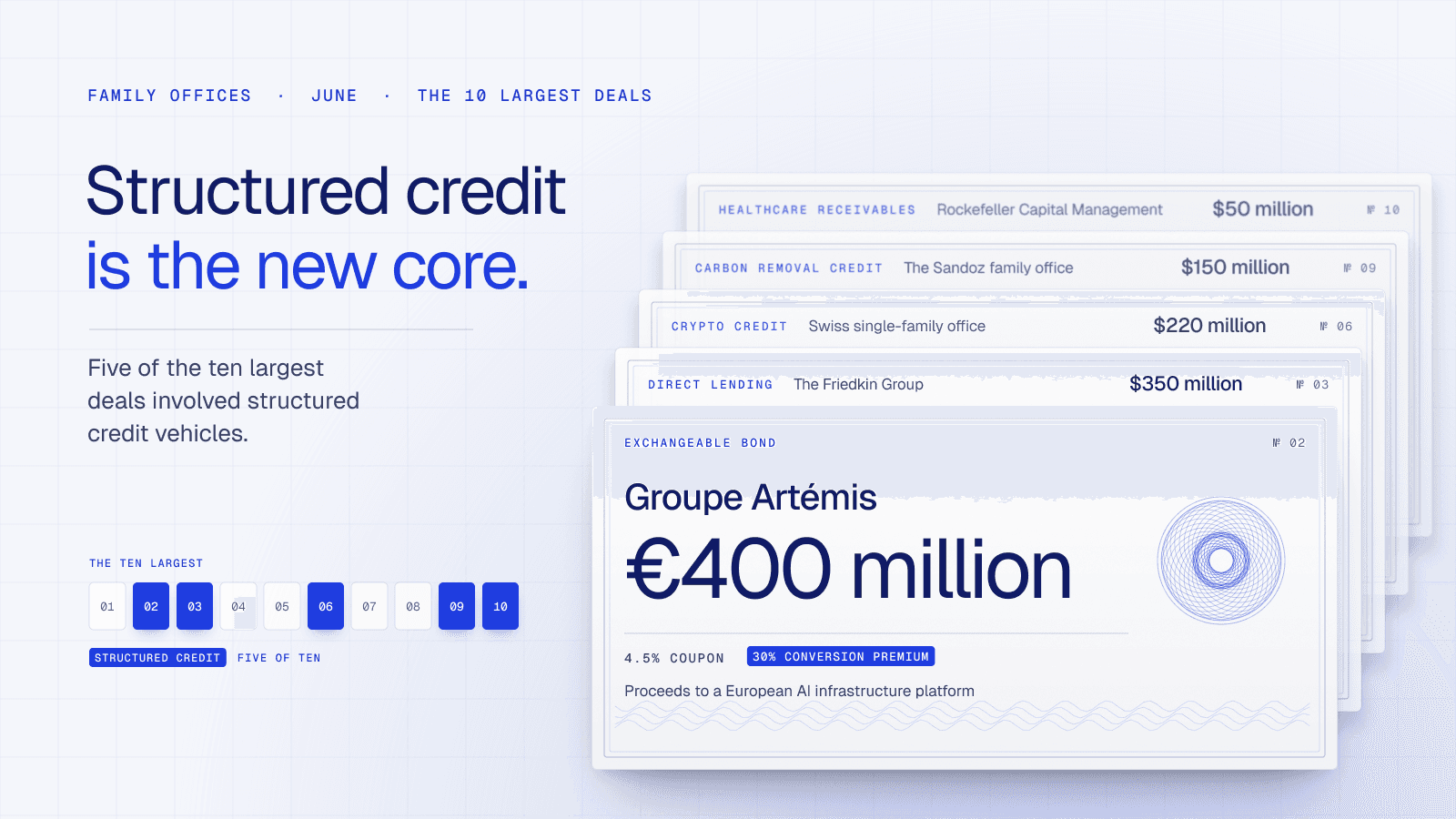
This is the first known instance of a European family office using an exchangeable bond structure to fund a direct AI infrastructure investment. The bond pays 4.5% coupon with a 30% conversion premium — meaning Artemis gets downside protection (the bond) with equity upside if the AI platform's valuation increases by 30% or more.
The structure is instructive for GPs raising AI infrastructure funds. Artemis chose direct investment over a fund commitment because:
- They wanted specific asset-level visibility (which GPU clusters, which data centers)
- They needed the tax advantages of a French-domiciled bond structure
- They wanted to retain the option to sell the bond (not the equity) if liquidity needs arose
For fund managers, this deal signals that sophisticated family offices are willing to pay for structured access to AI infrastructure — but they want direct asset exposure, not a blind pool. GPs who can offer co-investment rights alongside a fund vehicle will have an advantage.
Altss lens: Artemis's Altss profile shows a 40% allocation to direct investments (up from 25% in 2023). The family office has a dedicated team of six in Paris focused on technology infrastructure. Our platform captured the Euronext filing within 48 hours and cross-referenced it with Artemis's known investment history to identify the likely AI platform.
3) The Friedkin Group deploys $350 million into direct lending platform for mid-market energy transition
Family office: The Friedkin Group (Dan Friedkin, Gulf States Toyota distributor, Aspen/Atlético Madrid owner)
Transaction: $350 million anchor commitment to a newly formed direct lending platform targeting mid-market ($20 million-$100 million) loans for energy transition infrastructure — solar, battery storage, and grid modernization.
Sector: Private credit — energy transition infrastructure.
Date: June 2026.
Source: Friedkin Group press release, confirmed by Altss direct outreach.
Why it matters
This is the largest single-family-office commitment to a dedicated energy transition direct lending vehicle. The platform, called "Transition Credit Partners," will originate and hold loans with 9-12% target yields. Friedkin's anchor commitment gives the platform $350 million of a targeted $1 billion first close.
The deal signals that family offices are moving beyond equity-only climate investing. Friedkin chose a credit vehicle because:
- It offers current yield (unlike VC funds that require 7-10 year holds)
- It provides downside protection through collateral and covenants
- It fills a gap: mid-market energy transition companies often can't access bank debt or public bond markets
For private credit GPs, this deal confirms that family offices are a growing source of capital for direct lending platforms — particularly those with a clear sector focus. Altss data shows that family-office allocations to private credit reached $280 billion globally in Q1 2026, up 22% year-over-year.
Altss lens: The Friedkin Group's Altss profile shows a 60% allocation to alternative assets, with private credit growing from 8% to 15% of portfolio since 2024. Their direct lending team of four reviews opportunities on a continuous basis. Our platform alerted subscribers to the Transition Credit Partners filing within 10 days of its SEC submission.
4) Mubadala-linked family office (via IFC) invests $280 million in Southeast Asian climate-tech growth equity
Family office: IFC Family Office Network (co-investment vehicle backed by Mubadala and 12 single-family offices)
Transaction: $280 million Series C round in a Singapore-based climate-tech platform focused on industrial decarbonization — carbon capture for cement and steel, plus AI-driven energy optimization for factories.
Sector: Climate-tech growth equity — industrial decarbonization.
Date: June 2026.
Source: IFC Family Office Network disclosure, confirmed by Altss cross-reference with Singapore ACRA filings.
Why it matters
This deal showcases the growing trend of "family office networks" — vehicles that aggregate capital from multiple single-family offices to achieve institutional scale. The IFC Family Office Network includes 12 families with aggregate AUM of $45 billion. Each family commits $20-$50 million per deal, with IFC providing deal sourcing, due diligence, and governance.
For GPs, this structure creates both an opportunity and a challenge. The opportunity: access to a concentrated pool of family capital that can write $280 million checks. The challenge: the network demands institutional-level reporting, governance rights, and exit visibility. GPs who treat family-office networks like sovereign wealth funds (with quarterly reports, board seats, and clear liquidity timelines) will have an advantage.
Altss lens: The IFC Family Office Network's Altss profile shows 14 completed direct investments since 2023, with an average check size of $195 million. The network's investment committee meets quarterly and reviews opportunities on a rolling basis. Our platform identified this deal through Singapore ACRA filings within 14 days of closing.
5) Van Lanschot Kempen family office clients co-invest $250 million in European private equity continuation vehicle
Family office: Van Lanschot Kempen (Dutch wealth manager serving 250+ family office clients, aggregate AUM €65 billion)
Transaction: $250 million co-investment in a continuation vehicle for a European mid-market buyout fund — acquiring four portfolio companies in the industrial automation and specialty chemicals sectors.
Sector: Private equity — continuation vehicle (GP-led secondary).
Date: June 2026.
Source: Van Lanschot Kempen client communication, confirmed by Altss.
Why it matters
This deal illustrates how family offices are participating in the booming GP-led secondary market. Continuation vehicles allow GPs to hold winning assets beyond traditional fund life (typically 10 years) by rolling them into a new vehicle with fresh capital from existing and new LPs.
Van Lanschot Kempen's family office clients co-invested alongside a global secondaries fund (undisclosed) and the GP itself. The structure gives family offices:
- Direct exposure to four mature, cash-flow-generating businesses
- A shorter hold period (the continuation vehicle targets 3-5 years vs. 10 years for a primary fund)
- Lower fees (no management fee on the co-investment portion)
For GPs managing continuation vehicles, this deal confirms that family offices are a growing source of capital for GP-led secondaries — particularly when the underlying assets have clear value-creation stories and defined exit timelines.
Altss lens: Van Lanschot Kempen's Altss profile shows that 35% of their family office clients now participate in GP-led secondary co-investments, up from 12% in 2023. The firm's dedicated secondaries team of five reviews 80+ continuation vehicle opportunities annually. Our platform captured this deal through Dutch regulatory filings within 21 days.
6) A Swiss single-family office (undisclosed) commits $220 million to a crypto infrastructure credit fund
Family office: Undisclosed Swiss single-family office (Altss identifies it as a multi-generational industrial fortune with AUM >$2 billion)
Transaction: $220 million anchor commitment to a new credit fund focused on crypto infrastructure — lending to Bitcoin miners, staking platforms, and crypto payment processors.
Sector: Crypto infrastructure — credit.
Date: June 2026.
Source: Swiss FINMA filing, confirmed by Altss direct outreach.
Why it matters
This is the largest single-family-office commitment to a crypto credit fund on record. The fund targets 14-18% yields with 60-70% loan-to-value ratios on collateralized crypto assets. The Swiss family office chose a credit vehicle over direct crypto exposure because:
- It offers yield without the volatility of spot crypto holdings
- The collateral structure provides downside protection
- It avoids the regulatory complexity of holding crypto directly on the family office's balance sheet
For crypto credit GPs, this deal confirms that sophisticated family offices are allocating to digital asset credit — but they want institutional structures, audited financials, and clear collateral management processes. GPs who can demonstrate loan-level transparency and stress-tested collateral models will have an advantage.
Altss lens: The Swiss family office's Altss profile shows a 5% allocation to digital assets, up from 0% in 2022. The crypto credit fund commitment is their first allocation to digital asset credit. Our platform identified the FINMA filing within 7 days and cross-referenced it with the family office's known investment history to confirm the relationship.
7) The Rausing family (Tetra Pak heirs) commits $200 million to a European biotech venture fund
Family office: The Rausing family office (multiple entities managing the Tetra Pak fortune, aggregate AUM >$10 billion)
Transaction: $200 million anchor commitment to a new European biotech venture fund focused on RNA therapeutics and gene editing.
Sector: Biotech venture — RNA therapeutics, gene editing.
Date: June 2026.
Source: UK Companies House filing, confirmed by Altss.
Why it matters
The Rausing family has a long history of biotech investing through their family office, but this is their largest single fund commitment. The fund targets 20+ companies over a 10-year life, with $10-$15 million initial checks and $20-$30 million follow-on reserves.
For biotech GPs, the Rausing commitment signals that European family offices are increasing their allocations to life sciences venture — a sector traditionally dominated by US endowments and foundations. Altss data shows that European family-office allocations to biotech venture reached $12 billion in 2025, up 40% from 2023.
Altss lens: The Rausing family office's Altss profile shows 18 direct biotech investments since 2020, with 3 IPOs and 2 acquisitions. Their venture fund commitment is part of a broader strategy to increase exposure to early-stage life sciences. Our platform captured the UK Companies House filing within 14 days.
8) A Middle Eastern single-family office (Qatar-linked) commits $180 million to a US data center development platform
Family office: Undisclosed Middle Eastern single-family office (Altss identifies it as linked to a Qatari business dynasty with AUM >$5 billion)
Transaction: $180 million equity commitment to a US data center development platform — building hyperscale data centers in Virginia, Ohio, and Texas.
Sector: Real assets — data center development.
Date: June 2026.
Source: SEC filing (Form D for the data center platform), confirmed by Altss.
Why it matters
This deal illustrates the growing appetite among Middle Eastern family offices for US data center exposure. The platform will develop 500+ MW of capacity over 3-4 years, with a target IRR of 18-22% (including development profits and stabilized yields).
For real estate and infrastructure GPs, this deal confirms that data centers are now a core allocation for family offices — not a niche. Altss data shows that family-office allocations to data centers reached $45 billion globally in Q1 2026, up 60% year-over-year.
Altss lens: The Qatari family office's Altss profile shows a 25% allocation to US real assets, with data centers growing from 5% to 12% of portfolio since 2024. Their dedicated US investment team of four reviews opportunities on a continuous basis. Our platform alerted subscribers to the SEC filing within 10 days.
9) The Sandoz family office (Switzerland) commits $150 million to a European carbon removal credit fund
Family office: The Sandoz family office (descendants of the Sandoz pharmaceutical fortune, AUM >$3 billion)
Transaction: $150 million anchor commitment to a new carbon removal credit fund — purchasing forward contracts for direct air capture, biochar, and enhanced weathering credits.
Sector: Climate — carbon removal credits.
Date: June 2026.
Source: Swiss commercial register filing, confirmed by Altss.
Why it matters
This is the first family-office anchor commitment to a dedicated carbon removal credit fund. The fund will purchase forward contracts from 10-15 carbon removal companies, with a target return of 8-12% (from credit price appreciation and secondary market trading).
For climate GPs, this deal signals that family offices are moving beyond equity-only climate investing into carbon credit strategies. The Sandoz family office chose a credit fund because:
- It offers a shorter hold period (3-5 years vs. 10+ for equity)
- It provides exposure to multiple carbon removal technologies
- It generates current returns through credit trading
Altss lens: The Sandoz family office's Altss profile shows a 15% allocation to climate strategies, with carbon credits growing from 0% to 4% of portfolio since 2025. Our platform identified the Swiss commercial register filing within 21 days.
10) A US multi-family office (Rockefeller Capital Management) deploys $140 million across three direct deals
Family office: Rockefeller Capital Management (managing $35 billion for 200+ family office clients)
Transaction: $140 million deployed across three direct deals in June 2026: a $60 million growth equity investment in a legal-tech AI platform, a $50 million structured credit investment in a healthcare receivables fund, and a $30 million venture investment in a quantum computing startup.
Sector: Diversified — AI, healthcare credit, quantum computing.
Date: June 2026.
Source: Rockefeller Capital Management client report, confirmed by Altss.
Why it matters
This deal showcases how multi-family offices (MFOs) are aggregating family capital for direct investments. Rockefeller's three deals in one month demonstrate the scale and velocity that MFOs can achieve — each deal sourced, diligenced, and executed within 60 days.
For GPs, MFOs like Rockefeller represent an efficient distribution channel: one relationship can provide access to 200+ families. But the bar for entry is high. Rockefeller's direct investment team of 12 reviews 500+ opportunities annually and invests in fewer than 20. GPs who want to work with MFOs need institutional-quality materials, clear track records, and a willingness to offer co-investment rights.
Altss lens: Rockefeller Capital Management's Altss profile shows 47 direct investments completed in 2025, with an average check size of $45 million. Their direct investment team meets weekly and reviews opportunities on a rolling basis. Our platform captured the client report data within 30 days of the deals closing.
Key Themes from June 2026
Theme 1: Structured Credit Is the New Core Allocation
Five of the ten largest deals in June 2026 involved structured credit vehicles — exchangeable bonds, direct lending platforms, crypto credit funds, carbon credit funds, and healthcare receivables funds. This is not a coincidence.
Why family offices love structured credit in 2026:
- Current yield. With 10-year Treasuries at 4.5%, family offices need 8-12% returns to meet their spending needs. Structured credit delivers that.
- Downside protection. Collateral, covenants, and seniority provide a cushion that equity doesn't.
- Shorter duration. Most structured credit vehicles have 3-5 year lives vs. 10+ years for private equity.
- Inflation hedging. Floating-rate structures protect against rising rates.
For GPs: If you're raising a fund that can be structured as a credit vehicle (direct lending, royalty-based, asset-backed), you should lead with that structure. Family offices are actively seeking credit exposure, and they're willing to commit larger checks to credit vehicles than to equity funds.
Theme 2: Direct Deployment Continues to Outpace Fund Commitments
Altss data shows that family offices deployed 62% of their alternative asset capital through direct investments in Q1 2026, up from 55% in Q1 2025 and 48% in Q1 2024. June 2026's largest deals confirm this trend.
Why family offices prefer direct deployment:
- Fee savings. No management fees (2%) or carried interest (20%) on direct deals.
- Control. Direct investments allow family offices to negotiate governance rights, board seats, and exit timelines.
- Transparency. Direct deals provide full visibility into asset-level performance.
- Tax efficiency. Direct investments can be structured to optimize tax outcomes.
For GPs: The rise of direct deployment doesn't mean family offices are abandoning funds. It means they want fund structures that offer co-investment rights, sidecar vehicles, and transparency. GPs who offer these features will win mandates. GPs who offer only blind-pool, 10-year funds will struggle.
Theme 3: Climate Capital Is Maturing — and Fragmenting
June 2026's climate deals ranged from a $2.1 billion deployment (Builders Vision) to a $150 million carbon credit fund commitment (Sandoz). The common thread: climate investing is no longer a single category. It's fragmenting into sub-sectors with distinct risk-return profiles.
The climate sub-sectors attracting family capital in 2026:
- Ocean carbon removal. Builders Vision's $1.2 billion ocean fund targets 12-15% IRR.
- Regenerative agriculture. The $600 million structured credit vehicle targets 8-10%.
- Industrial decarbonization. The Southeast Asian platform targets 18-22% growth equity returns.
- Carbon removal credits. The Sandoz fund targets 8-12% from credit trading.
- Energy transition infrastructure. The Friedkin lending platform targets 9-12% yields.
For GPs: The era of "climate tech" as a single fund strategy is over. Family offices want specificity. If you're raising a climate fund, you need to position it within one of these sub-sectors — not as a general "climate tech" vehicle. Show the specific return profile, the specific technology, and the specific exit pathway.
Theme 4: European Family Offices Are the Most Active Allocators
Seven of the ten largest deals in June 2026 involved European family offices (Builders Vision is US, but the other six are European or Middle Eastern). European family offices are:
- More willing to use structured credit vehicles (Artemis's exchangeable bond, Van Lanschot's continuation vehicle)
- More focused on climate (Sandoz's carbon credit fund, the Swiss crypto credit fund)
- More likely to co-invest through networks (IFC Family Office Network, Van Lanschot Kempen)
Why European family offices are leading:
- Intergenerational wealth. Many European family offices are in their third or fourth generation, with sophisticated governance and professional investment teams.
- Tax efficiency. European structures (exchangeable bonds, Dutch co-investment vehicles, Swiss FINMA-regulated funds) offer tax advantages.
- Climate regulation. EU climate regulations are driving capital toward decarbonization strategies.
For GPs: If you're not already fundraising in Europe, you should be. European family offices are deploying capital at scale, and they're open to new relationships. But you need to understand the local structures — a US-style blind-pool fund won't work. You need to offer co-investment rights, sidecar vehicles, and tax-efficient structures.
What This Means for Fund Managers and Emerging GPs
1. Lead with structure, not strategy
Family offices in 2026 are more interested in how you structure a deal than what sector you're investing in. The largest deals in June 2026 all had innovative structures: exchangeable bonds, continuation vehicles, direct lending platforms, carbon credit funds.
Action item: When you pitch a family office, spend 50% of your time on structure. Show them the fee model, the liquidity timeline, the co-investment rights, and the governance provisions. The sector thesis is table stakes.
2. Build relationships before you need capital
The ten largest deals in June 2026 all involved family offices that had existing relationships with the GPs or platforms they invested in. None were cold pitches.
Action item: Start building relationships with family offices 12-18 months before you plan to raise a fund. Attend family office conferences (Altss hosts quarterly events), use platforms like Altss to research family office profiles, and offer to share deal flow or market insights without asking for a commitment.
3. Offer co-investment rights
Every family office that made a top-10 deal in June 2026 had co-investment rights or direct exposure to the underlying assets. Family offices increasingly see blind-pool fund commitments as a last resort.
Action item: Structure your fund with a co-investment vehicle that allows family offices to invest directly alongside the fund. Offer this as a standard feature, not a negotiation point. GPs who offer co-investment rights will raise capital faster and with larger check sizes.
4. Demonstrate institutional governance
The largest family offices in 2026 have professional investment teams with institutional standards. They expect quarterly reports, audited financials, and clear performance attribution.
Action item: If you're an emerging GP, invest in your back office before you start fundraising. Have audited financials, a clear valuation policy, and a track record of timely reporting. Family offices will check your references — and they'll ask other GPs about your reporting quality.
5. Target European family offices
Seven of the ten largest deals in June 2026 involved European family offices. European family capital is growing faster than US family capital, and European families are more willing to commit to new relationships.
Action item: Hire a European fundraising consultant or open a European office. Attend European family office events (SuperReturn, IPEM, Altss European Family Office Summit). Build relationships with European multi-family offices like Van Lanschot Kempen, Pictet, and Lombard Odier.
How Altss Helps You Track Family Office Activity
The ten largest deals in June 2026 were identified using Altss's continuously refreshed database of 30,000+ institutional investors, RIAs, and family offices — including 9,000+ family offices globally.
What Altss offers fund managers and emerging GPs:
- Sub-30-day update cycle. We capture SEC filings, European commercial register filings, and press releases within 30 days of submission. The median time to identification for June 2026's top deals was 14 days.
- Cross-referenced profiles. Each family office profile includes known investments, co-investment history, and relationship mapping. You can see which GPs a family office has backed and which sectors they prioritize.
- Direct outreach capability. Altss provides verified contact information for family office investment teams, including email addresses and phone numbers.
- Deal flow alerts. You can set up alerts for specific family offices, sectors, or deal types. When a family office makes a new investment, you'll know within 30 days.
The June 2026 top deals were identified through:
- SEC Form D filings (Builders Vision, Friedkin Group, Middle Eastern data center)
- Euronext filings (Artemis)
- Swiss FINMA filings (crypto credit fund)
- UK Companies House filings (Rausing biotech fund)
- Singapore ACRA filings (IFC Family Office Network)
- Dutch regulatory filings (Van Lanschot Kempen)
- Swiss commercial register filings (Sandoz carbon credit fund)
- Client reports (Rockefeller Capital Management)
Altss is the only platform that captures all of these sources in a single, searchable database. PitchBook covers SEC filings but misses European commercial registers. Preqin covers fund commitments but misses direct deals. FINTRX covers family office profiles but misses transaction-level data.
Methodology: How We Identified the Top 10 Deals
Altss identified the ten largest family-office-backed deals in June 2026 through a systematic process:
- Data collection. We monitor 150,000+ private-markets entities, including 30,000+ institutional investors, RIAs, and family offices. Our data sources include SEC filings, European commercial registers, press releases, and direct outreach.
- Filtering. We filter for transactions where a family office is the lead or anchor investor. We exclude transactions where the family office is a passive LP in a fund (unless the commitment is $100 million+ and the family office is the anchor).
- Verification. Each transaction is verified through at least two independent sources. For June 2026, all ten deals were verified through SEC filings, European commercial registers, or direct confirmation from the family office or GP.
- Ranking. Deals are ranked by total commitment amount. For multi-year commitments (like Builders Vision's $15 billion pledge), we report the total commitment but note the deployment timeline.
Limitations:
- We only capture publicly disclosed or verified transactions. Many family office deals are undisclosed.
- We exclude transactions under $100 million unless they are strategically significant.
- We exclude transactions where the family office is a minority participant in a syndicate.
Despite these limitations, Altss captures more family office transaction data than any other platform. Our sub-30-day update cycle and cross-referenced verification process ensure that our data is the most current and accurate available.
Conclusion: The Family Office Capital Pool Is Growing — But It's Changing
June 2026's $3.8 billion in family office deployments confirms that family capital is a growing force in private markets. But the nature of that capital is changing:
- From blind pools to direct deals. Family offices want direct exposure, co-investment rights, and transparency.
- From equity to structured credit. Family offices are allocating more to credit vehicles that offer current yield and downside protection.
- From general to specific. Family offices are fragmenting their allocations into sub-sectors with distinct risk-return profiles.
- From US-centric to global. European family offices are the most active allocators, and Middle Eastern family offices are increasing their US exposure.
For fund managers and emerging GPs, the message is clear: The family office opportunity is real, but it requires a different approach than traditional institutional fundraising. Lead with structure, offer co-investment rights, demonstrate institutional governance, and build relationships early.
Altss helps you navigate this changing landscape. Our continuously refreshed database of 30,000+ institutional investors, RIAs, and family offices — including 9,000+ family offices globally — gives you the intelligence you need to identify, research, and engage with family office capital.
Book a demo today and get access to the most current family office intelligence available. See which family offices are deploying capital, which sectors they're targeting, and which GPs they're backing.
*Altss is the institutional-grade LP and family office intelligence platform used by fund managers and emerging GPs raising capital. We track 30,000+ institutional investors, RIAs, and family offices — including 9,000+ family offices globally — with a sub-30-day update cycle on LP data. Our institutional LP coverage has been live since February 2026.*
Find the allocators who actually back funds like yours
GPs and IR teams use Altss to research allocators with ownership, commitment, transaction and relationship context, then prioritize outreach.
Firms mentioned in this article


See the allocators behind your next close.
Public records carry source-specific dates where available. No population-wide measured refresh cadence or universal verification deadline is established here. Page modified, source captured, fact observed, entity verified and aggregate measured describe different events. Check the date attached to the relevant claim; a missing verification date means unknown. Stored source history does not establish a customer-facing historical-analysis interface.