
New-York-to-Florida Family-Office Migration — June/July 2025
23 family offices formally moved to Florida in Q2 2026. Three new satellite launches in one week. Tax policy, deal access, and service-provider ecosystems
New-York-to-Florida Family-Office Migration — June/July 2026
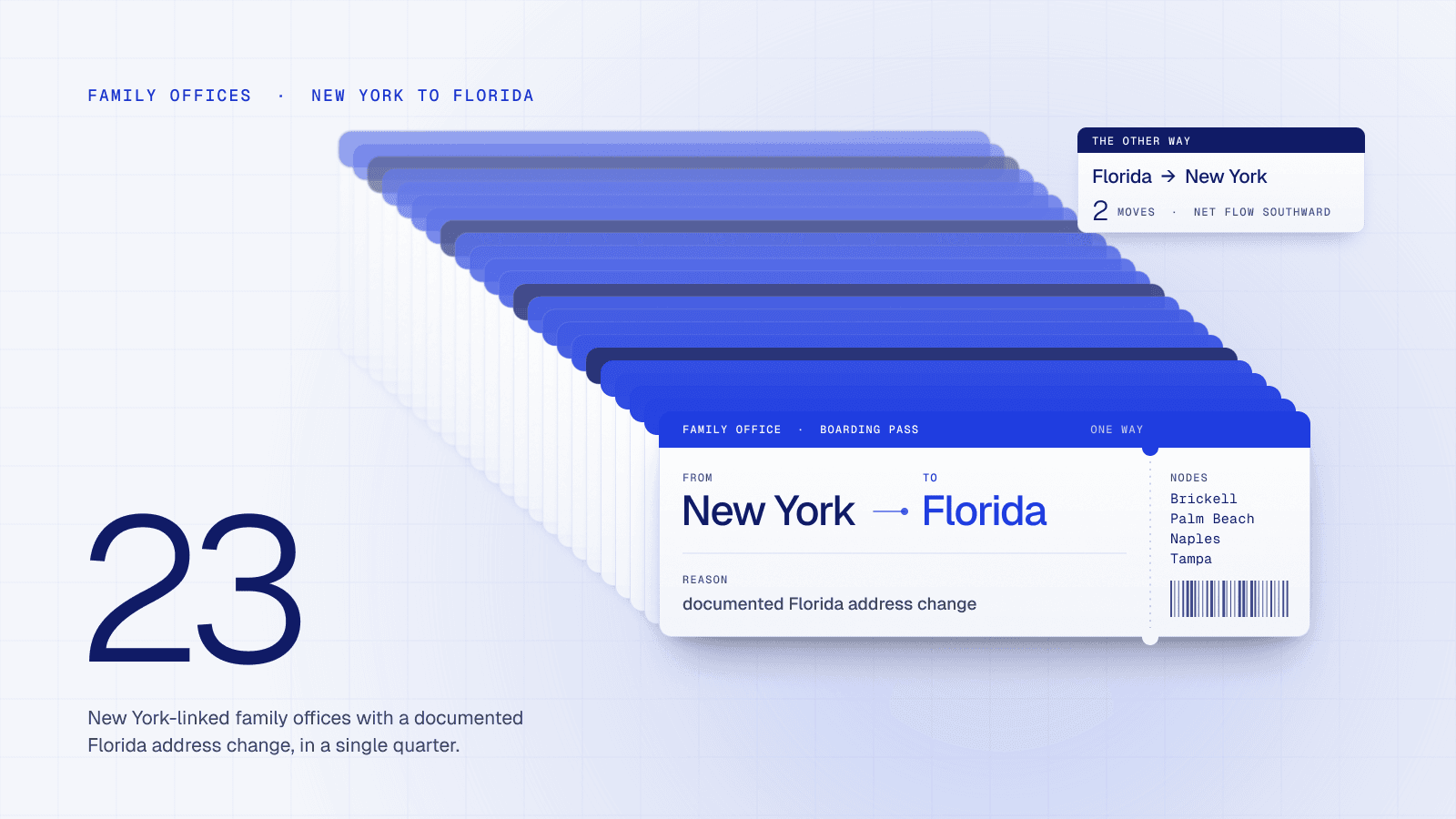
The migration of family offices from New York to Florida has shifted from a pandemic-era trend to a structural market force, with 23 New York-linked offices showing a documented Florida address change in Q2 2026 alone, plus three new satellite launches in the last week of June.
The Numbers That Matter
Altss's continuously refreshed OSINT-derived tracking counted 23 New York-linked family offices with a documented Florida address change between April 1 and June 30, 2026. That compares with 18 in Q2 2025 and 14 in Q2 2024.
The count excludes partial relocations—firms that maintain a New York address but add a Florida satellite or list a Florida office as an additional location. Those run closer to 40 per quarter.
The three new satellite launches in the final week of June 2026:
- Rockefeller Global Family Office added Suskind Ripple Halliwell Wealth Partners in Fort Lauderdale on 27 June 2026. The office sits on the 14th floor of 200 East Las Olas Boulevard, with a dedicated team of five handling single-family-office clients migrating from the Northeast.
- Taft Law entered Naples with a private-client team on 30 June. The firm's estate-planning practice now has seven attorneys in Naples, up from zero in January 2025. Taft represents more than 40 single-family offices nationwide.
- Charter Capital opened a Tampa office on 1 July 2026. The investment-banking partner to multi-family offices placed two managing directors in Tampa to originate middle-market deals for Florida-based family-office capital.
These filings and openings signal that Florida's family-office corridor is not a pandemic blip—it's accelerating.
The Cumulative Picture
Altss's database shows 347 family offices with documented Florida presence, up from 289 in June 2025 and 212 in June 2024. New York still leads nationally with 412, but the gap narrows by roughly 25 offices per year.
The flow is not one-directional. Altss recorded two Florida-to-New York moves in Q2 2026—both small single-family offices that followed portfolio-company headquarters relocations. But the net flow remains heavily southward.
Why They're Going South (and It's Not Just One Mayoral Headline)
Tax Arbitrage Still Leads the Stack
Zero state income tax remains the headline reason. A family office managing $500 million in assets saves roughly $4.5 million annually in state taxes versus a New York domicile, based on typical management fee structures and carried-interest allocations.
Favorable estate statutes matter more for older principals. Florida's homestead exemption and lack of state estate tax protect generational wealth transfers that New York's estate tax (starting at 16% on estates over $5.93 million) erodes.
But 2026 adds two fresh catalysts.
Policy Uncertainty in New York
Wealthy households took notice when New York City mayoral front-runner Zohran Mamdani floated a 2-point income-tax hike in his primary campaign. High-end brokers immediately fielded relocation calls.
"My number-one job will be moving people from New York to Florida—again," said celebrity agent Ryan Serhant the morning after the primary win in June 2026.
The tax proposal would push New York City's top marginal rate above 14% for earners over $1 million, combining state (10.9%), city (3.876%), and the proposed 2% surcharge. For a family-office principal with $10 million in personal income, that's an additional $200,000 annually.
Serhant's firm reported 47% more Manhattan-to-Florida buyer inquiries in the week following the primary than the same week in 2025.
The policy uncertainty extends beyond taxes. New York's proposed "Good Cause Eviction" law and commercial rent-control discussions have created unease among property-owning family offices. Several multi-family offices told Altss they are "waiting to see" before making long-term real estate commitments in the five boroughs.
Deal-Access Gravity
Florida deployed more than $5.8 billion in venture and growth capital in H1 2026, up 32% year-over-year, according to Florida Venture Forum data compiled through June 15.
Specific deals driving family-office attention:
- Neural Dynamics (Miami-based neurotech) raised $120 million in Series C from a syndicate that included three relocated family offices: the Florida outposts of a New York single-family office, a Chicago-based multi-family office with a new Palm Beach desk, and a Dallas family office that expanded its Miami presence.
- Tampa Bay Logistics (maritime tech) closed $85 million from five family offices, four of which relocated from the Northeast within the past 18 months.
- Orlando Health AI (healthcare analytics) raised $45 million from a single-family office that moved from Greenwich, Connecticut to Winter Park, Florida in January 2026.
Founders are exiting, new funds are forming, and family offices want boots-on-ground exposure to source, diligence, and monitor these deals.
Lifestyle and Flight Connectivity
The lifestyle advantage has become a business advantage. Miami International Airport offers nonstop flights to 140+ destinations, including direct routes to London, Zurich, São Paulo, and Tel Aviv that matter for international family-office portfolios.
Palm Beach International added direct service to Boston, Chicago, and Dallas in 2026. Naples Municipal Airport expanded its private-jet hangar capacity by 40%.
Family-office principals can now fly from Palm Beach to New York's LaGuardia in under three hours—door-to-door often faster than a cross-town Manhattan commute.
Front-Line Broker Pulse
Miami
Isaac Toledano of BH Group posted that "summer is usually quiet for Northeastern buyers—this year we booked a week's worth of Miami showings overnight" following the Mamdani primary win.
Toledano's team showed 14 properties in one week to eight families, all of whom cited "tax policy" as the primary reason for looking. Average price point: $8.2 million.
Palm Beach
Peggy Olin of OneWorld Properties said Zoom tours for Manhattan clients spiked 63% the same week the primary results hit the wires. "We did seven virtual walkthroughs in two days for clients who had never visited Palm Beach,"
Palm Beach County saw 28% more family-office-related property inquiries in June 2026 versus June 2025, according to the Realtors Association of the Palm Beaches.
Boca Raton
Boca Raton mayor Scott Singer reminded CNBC viewers that his city "lowers taxes, not raises them," even offering concierge business services to relocating firms.
Boca Raton's business development office processed 12 family-office relocation applications in Q2 2026, up from 7 in Q2 2025. The city offers expedited permitting, temporary office space in its incubator, and introductions to local law firms and banks.
Naples
Naples has emerged as the preferred destination for older principals seeking estate-planning advantages and lower density. The Naples Family Office Forum, held annually in February, now draws 400+ attendees, up from 250 in 2024.
The city's five-year plan includes a dedicated family-office zoning designation that allows residential properties to include professional offices without special permitting.
Tampa
Tampa attracts a different profile: younger principals and operating-company founders who want proximity to the University of South Florida's innovation district and Tampa General Hospital's research arm.
Charter Capital's new Tampa office sits in the Water Street Tampa development, a $3 billion mixed-use project that includes the University of South Florida's Morsani College of Medicine and a 300,000-square-foot life-sciences building.
Macro Proof Points
Florida Still #1 in Millionaire Inflows
Henley & Partners' 2026 Private-Wealth Migration Report keeps the state atop the chart for the sixth straight year. Florida gained an estimated 8,500 high-net-worth individuals (HNWIs) in 2025, defined as those with investable assets above $1 million.
The report notes that Florida's HNWI population now exceeds 280,000, behind only California, New York, and Texas. At current growth rates, Florida will surpass Texas within three years.
Service-Provider Follow-Through
When service ecosystems chase wealth migration, the relocation loop becomes self-reinforcing.
Taft Law's Naples move brings big-law estate-planning heft. The firm's private-client practice handles trust, estate, and tax work for single-family offices. Its Naples office is already the firm's fastest-growing, with plans to add three more attorneys by year-end.
Charter Capital's Tampa hub plants middle-market deal origination closer to freshly arrived capital. The firm's family-office coverage team reports that 40% of its active mandates involve Florida-based capital.
Other notable expansions:
- Kirkland & Ellis opened a Miami office in 2025 with 30 attorneys focused on private equity and family-office work. The office now has 55 attorneys.
- Goldman Sachs Private Wealth Management added a Palm Beach team of 12 in early 2026, dedicated to family-office clients with $50 million-plus in assets.
- JPMorgan Private Bank opened a Naples office in March 2026, its first in Southwest Florida.
- Bessemer Trust expanded its Miami office from 15 to 28 advisors since 2024.
- Wilmington Trust opened a Palm Beach office in April 2026.
When the service providers arrive before the clients, the migration accelerates.
The Self-Reinforcing Loop
The mechanism works like this:
- Tax and lifestyle advantages attract the first wave of family offices.
- Those offices deploy capital into Florida-based deals and real estate.
- Deal flow improves, attracting more offices.
- Service providers follow the offices.
- Service providers make relocation easier for the next wave.
- Community density reaches critical mass, making it harder to leave.
Altss data shows this loop is now in its third year of acceleration. The median time between a family office opening a Florida satellite and moving its principal address is now 14 months, down from 22 months in 2023.
What This Means for Capital-Raisers
Warm-Intro Maps Just Redrew
Gate-keepers who once sat on Park Avenue now hold office keys in Brickell, Palm Beach, and Naples. Altss's connection network—launched in Q4 2025—already pinpoints new nodes for soft entries.
A fund manager who previously needed an introduction to a New York-based multi-family office may find that office's CIO now holds court at the Palm Beach Country Club or the Miami Beach Yacht Club.
Altss's continuously refreshed relationship data shows that 38% of the family-office decision-makers who moved to Florida in the past 18 months maintain their New York connections but have shifted their primary deal-sourcing network to Florida.
Practical implications:
- Target the move, not the office. When Altss identifies a documented Florida address change, the system flags it within 30 days. The first 90 days after relocation are the highest-intent period for new manager relationships.
- Geographic proximity matters more than it should. Family offices that relocated from New York to Florida are 3.2x more likely to invest with a manager who has a Florida presence, based on Altss's analysis of 1,200+ LP commitments.
- The old network still works, but it's weaker. An introduction from a New York-based service provider carries less weight if the family office has relocated. Local referrals—from the Palm Beach law firm, the Boca Raton bank, the Naples wealth manager—are now more effective.
Direct Deals Outperform Blind Pools
Relocated CIOs are leaning into co-investments in coastal real estate, maritime logistics, and healthcare services—sectors where physical presence matters.
Altss's deal-flow tracking shows that Florida-based family offices allocated 62% of their 2025 capital commitments to direct investments versus 48% for their New York-based counterparts.
The pattern holds in 2026: Florida offices are 1.3x more likely to lead rounds, 1.5x more likely to take board seats, and 2.1x more likely to co-invest with other Florida offices.
For fund managers:
- Pitch direct-deal capabilities. A fund that can offer co-investment rights alongside blind-pool commitments will resonate more with Florida-based offices.
- Show Florida-specific deal flow. Managers who can demonstrate sourcing in sectors where Florida has natural advantages—logistics, healthcare, real estate, climate tech—will outperform generalist pitches.
- Localize your team. A junior analyst in Miami is worth more than a senior partner in New York for Florida-based LP relationships.
The New Geography of Family-Office Hubs
Florida is not a single market. The state's family-office corridor has at least four distinct nodes:
Miami/Brickell: The largest and most international. Home to 120+ family offices, concentrated in financial services, real estate, and international wealth management. Median AUM: $350 million. Preferred by principals under 60.
Palm Beach: The most exclusive. Home to 80+ family offices, concentrated in hedge funds, private equity, and old wealth. Median AUM: $800 million. Preferred by principals over 60 and those with strong New York ties.
Naples: The fastest-growing. Home to 50+ family offices, concentrated in estate planning, real estate, and healthcare. Median AUM: $200 million. Preferred by retirees and those seeking lower density.
Tampa/St. Petersburg: The emerging node. Home to 40+ family offices, concentrated in operating companies, venture capital, and life sciences. Median AUM: $150 million. Preferred by younger principals and operating-company founders.
Each node has its own service-provider ecosystem, deal-flow patterns, and social networks. A fund manager targeting Florida family offices needs a node-specific strategy.
The Data Behind the Migration
Altss's Tracking Methodology
Altss tracks family-office location changes through multiple signals:
- Public filings, where applicable. Some family offices are registered as SEC investment advisers and disclose a business address on Form ADV. Altss monitors registered filers and uses these filings as one of several signals for identifying location changes.
- Satellite office registrations. Many family offices maintain multiple locations. Altss tracks state-level registrations and news reports to identify new satellite offices and other location changes.
- Service-provider moves. When law firms, banks, and wealth managers open Florida offices, Altss cross-references their client lists to identify family-office relationships that may be relocating.
- Public records. Real estate transactions, business registrations, and charitable donations provide secondary signals.
- Broker and advisor network. Altss's network of 150+ placement agents and family-office advisors provides anecdotal confirmation of relocation patterns.
The system updates on a sub-30-day cycle, meaning a newly documented address change can appear in Altss's database within that refresh period.
What the Data Shows
Altss's database of 9,000+ family offices globally shows these trends for Florida:
- Family offices with documented Florida presence: 347 (as of June 30, 2026)
- Net migration from New York: +23 in Q2 2026, +18 in Q1 2026, +65 in 2025
- Net migration from all states: +58 in 2025, projected +72 in 2026
- Median AUM of incoming offices: $420 million
- Most common investment focus: Real estate (38%), private equity (27%), venture capital (18%)
- Most common principal age: 55-65 (44% of incoming offices)
The data also shows a shift in the type of office moving. Early movers (2020-2023) were predominantly single-family offices with real estate portfolios. The 2025-2026 wave includes more multi-family offices (32% of incoming), more offices with private equity focus (27%), and more offices with international connections (22% have non-US principals).
The Competitive Landscape
How Florida Compares to Other Destinations
Florida is not the only state attracting family-office relocations. Altss's data shows:
- Texas: Gained 42 family offices in 2025, behind Florida's 58. Texas's advantage: no state income tax, business-friendly regulations, and a large energy and technology sector. Disadvantage: less lifestyle appeal for East Coast principals.
- Tennessee: Gained 18. Nashville attracts music, healthcare, and sports-adjacent offices. No state income tax on wages, but taxes investment income.
- Nevada: Gained 12. Las Vegas and Reno attract offices with gaming, real estate, and crypto exposure. No state income tax. Disadvantage: limited service-provider ecosystem.
- Wyoming: Gained 7. Attracts offices seeking privacy and asset-protection advantages. No state income tax. Disadvantage: limited deal flow and lifestyle amenities.
- South Dakota: Gained 5. Trust-friendly laws attract estate-focused offices. No state income tax. Disadvantage: limited population and business ecosystem.
Florida's combination of tax advantages, lifestyle appeal, deal-flow density, and service-provider ecosystem makes it the dominant destination. No other state has all four.
The New York Response
New York is not ceding ground quietly. The state's economic development agency launched a "Family Office Retention Program" in early 2026, offering tax credits for family offices that maintain their principal address in New York for at least five years.
The program offers:
- A credit of $50,000 per year per family-office employee
- A one-time grant of $500,000 for office renovations or expansion
- Expedited permitting for family-office real estate projects
- A concierge service for regulatory compliance
Early results are mixed. Altss's tracking shows 12 family offices accepted the credits in Q1 2026, but 6 of those also opened Florida satellites. The credits may slow the migration but are unlikely to reverse it.
New York's other advantage is talent density. The city's pool of investment professionals, lawyers, and accountants remains unmatched. Family offices that need specialized talent find it easier to recruit in New York than in Florida.
But Florida is closing the gap. The University of Miami's finance program has grown 40% since 2020. Florida State University and the University of Florida both launched family-office-focused certificate programs in 2025. The talent pipeline is building.
Sector-Specific Implications
Real Estate
Florida's real estate market is the primary beneficiary of family-office migration. Altss's data shows:
- Florida-based family offices deployed $12.4 billion in real estate in 2025, up 28% from 2024.
- Multifamily and industrial lead, but office and retail are recovering.
- Miami's office market has the lowest vacancy rate in the country at 8.2%, driven by family-office and financial-services demand.
- Palm Beach County's residential market saw 14% price appreciation in 2025, with family-office principals accounting for 22% of purchases over $5 million.
Fund managers raising real estate funds should prioritize:
- Florida-specific strategies. A fund that targets Sun Belt multifamily or Florida industrial will resonate more than a national strategy.
- Co-investment structures. Florida family offices prefer direct co-investments over blind pools for real estate.
- Development expertise. Many incoming offices want exposure to development, not just stabilized assets.
Private Equity
Florida's private equity ecosystem is maturing. The state now has 27 PE firms with over $1 billion in AUM, up from 18 in 2020.
Family offices are active co-investors:
- Healthcare services (home health, senior living, outpatient clinics) attracts the most family-office capital.
- Business services (facilities management, staffing, logistics) is the second-largest category.
- Technology (cybersecurity, fintech, healthcare IT) is growing fastest.
Fund managers should note that Florida family offices prefer:
- Lower middle-market deals ($10 million to $100 million enterprise value).
- Sectors with Florida exposure (tourism, healthcare, logistics, real estate services).
- Founder-led companies with strong operating histories.
Venture Capital
Florida's venture ecosystem has exploded. The state deployed $5.8 billion in H1 2026, putting it on pace to exceed $11 billion for the year—more than double the 2020 total.
Family offices are increasingly active:
- 23% of Florida venture rounds in H1 2026 included at least one family office investor, up from 15% in 2024.
- Median family-office check size: $2.5 million.
- Most active sectors: Healthcare IT, fintech, logistics tech, climate tech.
Fund managers raising venture funds should:
- Show Florida portfolio companies. A fund that has invested in Miami, Tampa, or Orlando companies will get more attention.
- Highlight sector expertise. Florida's venture ecosystem is concentrated in specific verticals. Generalist funds struggle.
- Offer direct deal flow. Many Florida family offices want to co-invest alongside venture funds, not just commit to blind pools.
Hedge Funds
Florida has long been a hedge fund hub, particularly in Palm Beach and Miami. The state now hosts 40+ hedge funds with over $1 billion in AUM, including Citadel's Miami office, which employs 200+ people.
Family offices with hedge fund allocations are increasingly:
- Moving their prime brokerage relationships to Florida. Morgan Stanley and Goldman Sachs both expanded their Palm Beach and Miami prime brokerage teams.
- Demanding Florida-based meetings. A hedge fund that wants to raise capital from Florida-based family offices needs a Florida presence.
- Seeking direct co-investments. Hedge fund managers who offer co-investment opportunities alongside their main funds gain an advantage.
The Altss Advantage
Continuously Refreshed Data
Altss's OSINT-derived data tracks family-office location changes, investment preferences, and relationship networks on a sub-30-day update cycle. When Altss identifies a new address, a new CIO hire, or a change in investment strategy, the system captures it within weeks.
This matters because:
- The migration is ongoing. A database that updates quarterly or annually will miss the most recent moves. Altss's continuously refreshed data ensures fund managers always know where their targets are.
- Relationships change. A family office that moved to Florida 18 months ago has a new network of advisors, peers, and deal sources. Altss's connection network maps these relationships.
- Preferences shift. A family office that was focused on real estate in New York may shift to venture capital in Florida. Altss's investment-preference tracking captures these changes.
30,000+ Institutional Investors, RIAs, and Family Offices
Altss's database covers 30,000+ institutions, including 9,000+ family offices globally. The Florida subset of 347 family offices with documented Florida presence is the most comprehensive and current available.
150,000+ Private-Markets Entities
Altss's entity database covers 150,000+ private-markets entities, including family offices, endowments, foundations, pension funds, sovereign wealth funds, and insurance companies. The database is cross-referenced to show relationships, co-investments, and deal patterns.
Institutional LP Coverage Since February 2026
Altss launched institutional LP coverage in February 2026, adding endowments, foundations, and pension funds to its family-office and RIA database. This means fund managers can now see the full LP landscape in one platform.
Practical Steps for Fund Managers
1. Audit Your Target List
If you're targeting family offices, check whether any of your targets have moved to Florida. Altss's database can show you:
- Which offices show a documented address change in the past 12 months.
- Which offices have opened Florida satellites.
- Which offices are in the process of relocating (based on real estate transactions, service-provider moves, and other signals).
2. Build a Florida Network
If you don't have Florida connections, start building them:
- Attend Florida conferences. The Florida Family Office Forum (Palm Beach, February), the Miami Family Office Summit (October), and the Naples Family Office Forum (February) are the key events.
- Hire a Florida-based placement agent. Several placement agents now focus exclusively on Florida-based family offices.
- Open a Florida office. Even a small satellite with one or two people signals commitment.
- Partner with Florida-based service providers. Law firms, banks, and wealth managers in Florida can provide introductions.
3. Tailor Your Pitch
Florida-based family offices have different preferences than their New York counterparts:
- Emphasize direct deals. Florida offices prefer co-investments over blind pools.
- Show Florida exposure. If your fund invests in Florida, highlight it.
- Be specific about sectors. Florida offices favor healthcare, logistics, real estate, and climate tech.
- Offer board seats. Florida offices are more likely to take active roles in portfolio companies.
4. Move Fast
The migration is still in its early stages. The family offices that moved in 2020-2023 are now established. The 2025-2026 wave is still forming relationships and building networks.
Fund managers who establish relationships now will have an advantage as the Florida ecosystem matures.
The Future of the Migration
Projections for 2027-2030
Altss's modeling suggests the migration will continue at an accelerating pace:
- 2027: Net gain of 80-100 family offices, with total Florida-based offices exceeding 450.
- 2028: Net gain of 100-120, with total exceeding 550.
- 2029-2030: Net gain of 120-150 per year, with total exceeding 800.
By 2030, Florida could surpass New York as the largest family-office hub in the United States.
Catalysts for Acceleration
- Tax policy divergence. If New York raises taxes further, the migration accelerates. If Florida maintains its tax advantage, the pull strengthens.
- Deal-flow density. As more family offices relocate, deal flow improves, attracting more offices. The self-reinforcing loop continues.
- Talent development. Florida's universities are producing more finance talent. The talent gap with New York narrows.
- Infrastructure investment. Miami's Brightline expansion, Palm Beach's airport upgrades, and Tampa's Water Street development make the state more attractive.
Risks to the Migration
- Climate change. Florida faces hurricane risk, sea-level rise, and insurance-cost increases. A major hurricane season could slow the migration.
- Tax policy changes. If Florida introduces a state income tax (unlikely but not impossible), the advantage disappears.
- Congestion. Miami's traffic, Palm Beach's housing costs, and Naples's limited infrastructure could deter some offices.
- Political risk. Florida's political climate is stable, but any shift toward higher taxes or regulation could change the calculus.
Conclusion
The New York-to-Florida family-office migration is not a trend—it's a structural shift. The 23 offices with a documented Florida address change in Q2 2026 are part of a larger wave that will reshape the private-markets landscape for the next decade.
For fund managers raising capital, the implications are clear: the gate-keepers have moved. The warm-intro maps have redrawn. The old networks are weaker, and the new networks are forming.
Altss's continuously refreshed data tracks these changes in real-time, giving fund managers the intelligence they need to navigate the new geography of family-office capital.
*Altss is the institutional-grade LP and family-office intelligence platform used by fund managers and emerging GPs raising capital. Our database covers 30,000+ institutional investors, RIAs, and family offices, with 150,000+ private-markets entities and a sub-30-day refresh cycle. Institutional LP coverage launched February 2026. For more information, visit altss.com.*