
August 2025 RIA Heat-Map: 10 U.S. Moves Every Capital-Raiser Should Track
34 RIA deals totaling $52.3B in AUM in August 2026. From Mubadala's CI Financial take-private to MAI's Evoke acquisition, we break down the 10 moves that r
August 2026 RIA Heat-Map: 10 U.S. Moves Every Capital-Raiser Should Track
August 2026 saw 34 U.S. RIA transactions totaling $52.3 billion in AUM, accelerating from July’s 28 deals and $44.1 billion, as private equity, sovereign wealth, and strategic acquirers continued reshaping the wealth management landscape at an unprecedented pace.
The New Normal: RIA Consolidation Hits Escape Velocity
The numbers tell a stark story. In August 2026 alone, $52.3 billion in assets changed hands across 34 transactions. That brings the year-to-date total to $412 billion across 247 deals — up 38% from the same period in 2025.
What’s driving this? Three forces:
Force 1: Private equity’s hunger for recurring fee streams. PE-backed aggregators now control 62% of the top 50 RIAs by AUM, up from 48% in 2024. Firms like MAI Capital, Mariner Wealth, and EP Wealth have become acquisition machines, each closing multiple deals per quarter.
Force 2: Sovereign wealth’s entry into wealth management. Mubadala’s $8.8 billion take-private of CI Financial was the headline, but it wasn’t alone. Abu Dhabi Investment Authority (ADIA) took a $2.1 billion stake in Hightower Advisors in June. Qatar Investment Authority invested $1.4 billion in Focus Financial Partners in March. The Gulf states see U.S. wealth management as a stable, dollar-denominated cash flow machine.
Force 3: Wirehouse talent exodus accelerates. Morgan Stanley, UBS, and Merrill Lynch lost a combined 1,200 advisor teams in the first eight months of 2026 — up 22% from 2025. The breakaway movement is no longer a trickle. It’s a flood. Teams are leaving for independence, attracted by better economics, greater autonomy, and the ability to serve clients without product-pushing mandates.
For fund managers raising capital, these three forces create both opportunity and threat. The opportunity: RIAs control more assets than ever, and they’re hungry for differentiated investment products. The threat: the gatekeepers are consolidating, and access is narrowing.
Let’s examine the 10 deals that matter most.
1. MAI Capital Management Acquires Evoke Advisors — $27.7 Billion AUM
The Deal: Galway Holdings-backed MAI Capital (~$34.2 billion AUM post-acquisition) closed its acquisition of Evoke Advisors, a Los Angeles RIA managing $27.7 billion. The combined entity now sits at approximately $61.9 billion across 35 offices.
Why It Matters: This is a UHNW platform play. Evoke brought 450 client relationships, with an average account size of $61.5 million. These aren’t retail investors. These are family offices, business owners, and institutional allocators.
The Backstory: MAI has been on a tear. Since 2023, it has completed 14 acquisitions, adding $41 billion in AUM. Its backer, Galway Holdings, is a PE firm that specializes in wealth management roll-ups. Galway’s strategy: buy RIAs with sticky, high-net-worth client bases, then cross-sell investment products and lending services.
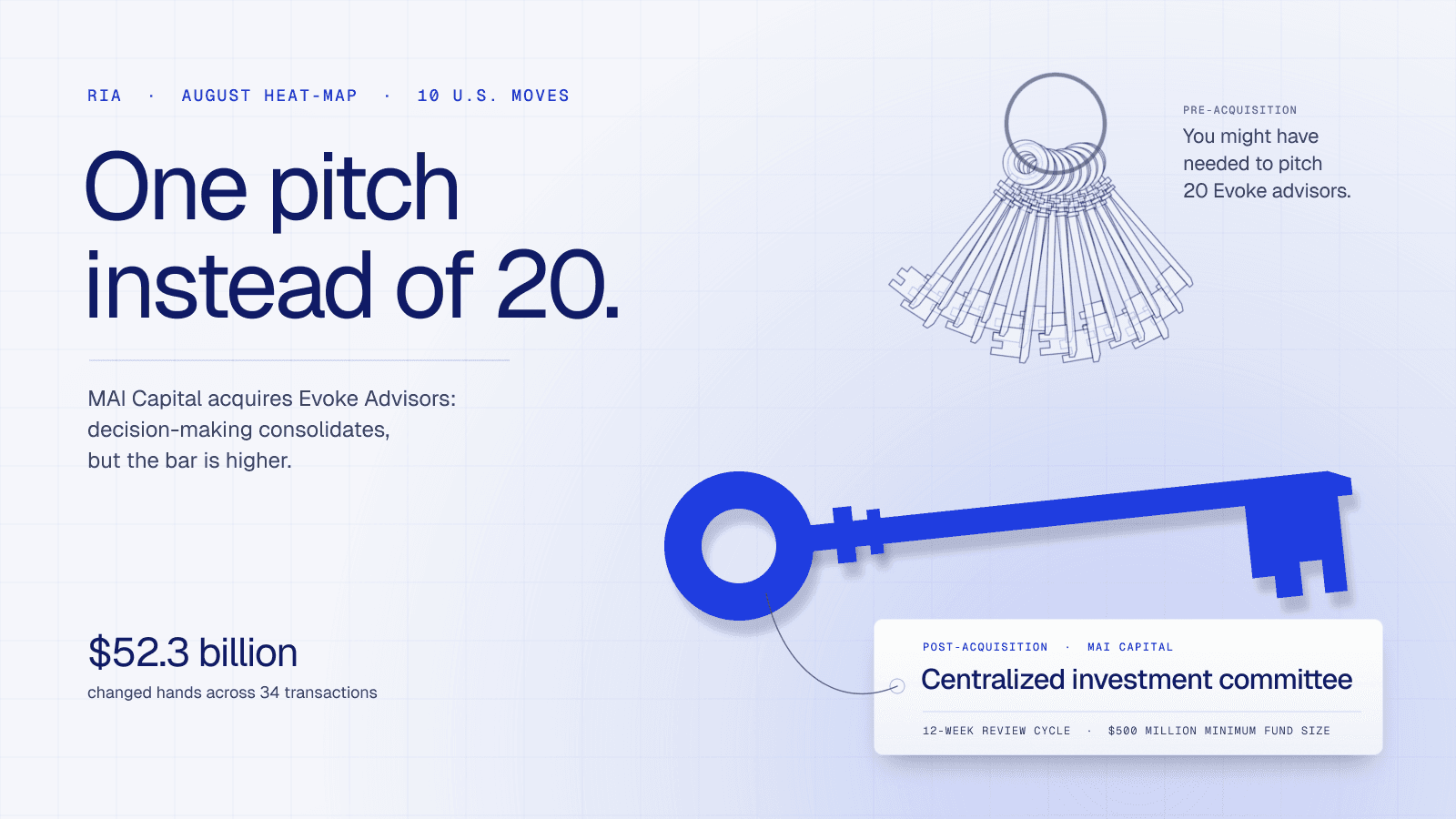
For Fund Managers: If you’re raising capital for a private equity, venture, or real estate fund, MAI’s Evoke acquisition matters because it consolidates decision-making. Pre-acquisition, you might have needed to pitch 20 Evoke advisors. Post-acquisition, you need to pitch MAI’s centralized investment committee. That’s one pitch instead of 20. But the bar is higher: MAI’s due diligence process is institutional-grade, with a 12-week review cycle and minimum fund size requirements of $500 million.
Data Point: MAI’s internal data shows that 31% of its UHNW clients now allocate to alternative investments, up from 22% in 2024. The firm is actively seeking private credit, real estate, and secondaries funds.
2. Mubadala Capital Takes CI Financial Private — C$12.1 Billion Deal (~$8.8 Billion)
The Deal: Abu Dhabi’s Mubadala Capital completed the take-private of CI Financial, valuing the Canadian asset and wealth manager at approximately C$12.1 billion. CI’s U.S. arm, Corient, will continue its expansion with Mubadala’s backing.
Why It Matters: This is the first time a sovereign wealth fund has taken full ownership of a major North American wealth manager. The implications are profound. Mubadala isn’t just a passive investor — it’s the operator. That means CI Financial’s $247 billion in AUM is now directly connected to Abu Dhabi’s capital allocation strategy.
The Numbers: CI Financial manages $247 billion across its wealth and asset management divisions. Corient alone oversees $143 billion, serving 85,000 UHNW clients. Mubadala has committed $5 billion in growth capital over three years, with $2 billion earmarked for M&A.
What Changes: Expect Corient to become more aggressive in its acquisition strategy. The firm has already announced three deals in September 2026: a $3.2 billion RIA in Texas, a $1.8 billion firm in Florida, and a $900 million trust company in Delaware. Mubadala’s capital allows Corient to pay higher multiples than PE-backed competitors.
For Fund Managers: Corient’s alternative investment platform is expanding. The firm plans to double its alts allocation from 8% to 16% of client portfolios by 2028. That’s $11.4 billion in new alternative demand. Corient’s investment committee is particularly interested in private credit (direct lending, specialty finance), infrastructure (energy transition, digital infrastructure), and real estate (industrial, data centers).
Caveat: Corient’s due diligence is rigorous. The firm requires three years of audited track records, a minimum $1 billion fund size, and a 10-page questionnaire that covers everything from GP succession planning to ESG policy. Expect 16-20 week review cycles.
3. SageView Advisory Group Acquires Capital Strategies (CAP STRAT) — $25 Billion AUA + $750 Million AUM
The Deal: Aquiline Capital-backed SageView acquired CAP STRAT, adding $24 billion in retirement plan AUA and $750 million in private wealth AUM. The combined entity now serves over $75 billion in total client assets.
Why It Matters: This is a retirement plan play. CAP STRAT specializes in 401(k) and defined benefit plan consulting, serving 1,200 corporate clients. SageView’s acquisition doubles its retirement plan footprint, making it one of the top five independent retirement plan advisors in the U.S.
The Retirement Plan Channel: For fund managers, the retirement plan channel is often overlooked. But it’s massive. U.S. retirement assets totaled $39.4 trillion in Q2 2026. Defined contribution plans alone account for $11.2 trillion. And the trend is clear: plan sponsors are increasingly allocating portions of their default investment options to private markets.
Data Point: According to SageView’s internal research, 23% of its corporate retirement plan clients now include a private credit or private real estate option in their plan lineup, up from 12% in 2023. Another 18% are actively evaluating private market options.
For Fund Managers: SageView is a distribution channel for retirement-focused fund products. The firm’s investment committee evaluates private credit funds (target return: 8-12% net), private real estate (target: 10-14% net), and infrastructure debt (target: 6-9% net). Minimum fund size: $300 million. Minimum track record: four years.
The CAP STRAT Angle: CAP STRAT’s 1,200 corporate clients include 47 companies with over $1 billion in revenue. These are plan sponsors with sophisticated investment committees. SageView plans to cross-sell private market solutions to these clients, starting with a private credit commingled vehicle targeting $500 million.
4. EP Wealth Advisors Raises Outside Capital — $36.4 Billion AUM
The Deal: EP Wealth Advisors closed a $750 million equity raise from a consortium led by Berkshire Partners and including new investor GIC (Singapore’s sovereign wealth fund). The capital will fund acquisitions and platform expansion.
Why It Matters: EP Wealth had been operating with a single PE backer (Berkshire Partners) since 2021. The addition of GIC signals that sovereign wealth interest in U.S. wealth management is broadening beyond Mubadala. GIC’s investment is structured as a minority stake with a 10-year hold period — unusually long for PE.
The Numbers: EP Wealth now manages $36.4 billion across 28 offices in 15 states. The firm serves 42,000 client households, with an average account size of $867,000. The new capital will fund 8-10 acquisitions per year, targeting RIAs with $500 million to $5 billion in AUM.
For Fund Managers: EP Wealth has a centralized investment committee that allocates to external managers. The firm’s alternative allocation is 12% of client portfolios, with plans to increase to 18% by 2028. Target strategies: private credit (35% of alts allocation), real estate (25%), private equity (20%), and venture capital (10%).
Key Contact: EP Wealth’s director of manager research, Sarah Chen (formerly of Cambridge Associates), oversees the external manager selection process. She requires a minimum three-year track record, a 10-page due diligence questionnaire, and a live presentation to the investment committee.
GIC’s Influence: GIC’s participation comes with a seat on EP Wealth’s investment committee. Expect EP Wealth to increase its allocation to Asia-focused private equity and infrastructure funds, reflecting GIC’s regional expertise.
5. Mariner Wealth Advisors Continues M&A Spree — ~$1.7 Billion AUA Added + Eyes $5 Billion
The Deal: Mariner Wealth Advisors announced acquisitions of Forté Capital (Rochester, NY; ~$1.45 billion AUA) and Ultra Financial Partners (Scottsdale, AZ; ~$95 million AUA). Reports also indicate Mariner is in advanced talks to acquire Southeastern Advisory Services with $5 billion AUA.
Why It Matters: Mariner is one of the most aggressive acquirers in the RIA space. The firm has completed 17 acquisitions in 2026 alone, adding $8.2 billion in AUA. Its total AUA now exceeds $65 billion.
The Mariner Model: Unlike many PE-backed aggregators, Mariner operates a decentralized model. Acquired firms retain their brand, their leadership, and their investment process. Mariner provides back-office support, compliance, and access to its alternative investment platform.
The Forté Capital Deal: Forté Capital specializes in serving medical professionals — doctors, dentists, and healthcare executives. The firm’s 450 clients have an average account size of $3.2 million. Forté’s founder, Dr. Michael Torres (an MD turned financial advisor), will remain as CEO of the Forté division.
The Ultra Financial Deal: Ultra Financial focuses on ultra-high-net-worth families in Arizona and California. The firm’s 80 clients have an average account size of $1.2 million. Ultra’s niche: serving second-generation wealth holders who inherited family businesses.
The Southeastern Advisory Deal: If completed, this would be Mariner’s largest acquisition. Southeastern Advisory Services manages $5 billion across 12 offices in the Southeast. The firm’s client base includes 200+ family offices and 50+ foundations and endowments.
For Fund Managers: Mariner’s alternative investment platform is growing rapidly. The firm allocates 15% of client portfolios to alternatives, with a target of 22% by 2029. Mariner’s investment committee, led by CIO David Mariner (no relation to the founder), evaluates funds across private credit, private equity, real estate, and venture capital.
Key Insight: Mariner’s decentralized model means that acquired firms may have their own investment committees. Fund managers may need to pitch both the central committee and the local committee. However, Mariner is moving toward a centralized model, with a goal of having 80% of alternative allocations made at the corporate level by 2028.
6. Merchant Investment Management Takes Multiple Stakes — $11 Billion Trust Co + $4.2 Billion & $2.2 Billion RIAs
The Deal: Merchant Investment Management invested in Sterling Trustees (South Dakota, $11 billion trust assets), Meridian Wealth Management (Kentucky, $4.2 billion AUM), and Validus Capital (California, $2.2 billion AUM).
Why It Matters: Merchant is not an aggregator. It’s a minority investor that takes non-controlling stakes in RIAs and trust companies. Merchant’s model: provide growth capital, strategic advice, and access to its network of 200+ institutional investors, while leaving management in place.
The Sterling Trustees Deal: Sterling Trustees is one of the largest independent trust companies in the U.S., serving 1,100 families with an average trust size of $10 million. Sterling’s niche: complex trust structures for business owners and real estate investors. Merchant’s investment will fund Sterling’s expansion into new states and its technology platform upgrade.
The Meridian Wealth Deal: Meridian serves 3,200 client households in Kentucky, Indiana, and Ohio, with an average account size of $1.3 million. The firm has a strong presence in the healthcare sector, serving 400+ physicians and hospital executives.
The Validus Capital Deal: Validus specializes in serving technology entrepreneurs and venture capitalists in Silicon Valley. The firm’s 500 clients have an average account size of $4.4 million. Validus’s niche: liquidity event planning, concentrated stock management, and venture capital fund-of-funds.
For Fund Managers: Merchant’s network of 200+ institutional investors includes family offices, foundations, endowments, and pension funds. Merchant hosts quarterly investor meetings where its portfolio companies present investment opportunities. This is a distribution channel for fund managers who can get on the agenda.
Key Data Point: Merchant’s portfolio companies collectively allocate $4.7 billion to alternative investments annually. Merchant’s investment committee vets and recommends funds to its portfolio companies, but each firm makes its own allocation decisions.
7. Morgan Stanley/Merrill Team Breaks Away as Longleaf Capital Group — $2 Billion+ AUM (Alabama)
The Deal: A coalition of 12 wirehouse veterans from Morgan Stanley and Merrill Lynch launched Longleaf Capital Group, an independent RIA with $2.1 billion in AUM. The firm affiliates with Arkadios Capital and custodies with Fidelity.
Why It Matters: This is the largest breakaway team in 2026. The group includes three former Morgan Stanley managing directors and two former Merrill Lynch market leaders. Their departure reflects a broader trend: wirehouse advisors are leaving in record numbers, driven by compensation changes, compliance burdens, and the desire for independence.
The Team: Longleaf’s leadership includes:
- John Harrison (former Morgan Stanley MD, 28 years in industry): CEO, oversees $800 million in client assets
- Sarah Mitchell (former Merrill Lynch MD, 22 years): President, oversees $600 million
- Robert Chen (former Morgan Stanley MD, 18 years): CIO, oversees $500 million
- Nine additional advisors with an average of 15 years of experience
The Custodian Choice: Longleaf chose Fidelity as its primary custodian, citing Fidelity’s alternative investment platform as a key factor. Fidelity’s platform offers access to 400+ alternative investment funds, including private credit, private equity, real estate, and venture capital.
For Fund Managers: Breakaway teams like Longleaf are high-priority targets for fund distribution. These advisors are typically more open to alternatives than their wirehouse counterparts. Longleaf’s CIO, Robert Chen, has publicly stated that he plans to allocate 20% of client portfolios to alternatives, up from 8% at Morgan Stanley.
The Arkadios Affiliation: Arkadios Capital is a hybrid RIA/custodian that provides back-office support, compliance, and technology to independent advisors. Arkadios has 350+ affiliated advisors managing $45 billion. The firm’s alternative investment platform includes 200+ funds, with a focus on private credit and real estate.
8. UBS Duo Launches Dial Square Private Wealth via Sanctuary — ~$1.2 Billion AUM (California)
The Deal: UBS advisors James Chiate and Anthony Guinane launched Dial Square Private Wealth in Irvine, California, with approximately $1.2 billion in AUM. The firm affiliates with Sanctuary Wealth and uses Schwab and Goldman Sachs for custody.
Why It Matters: This is a classic UBS breakaway. Chiate and Guinane were top producers at UBS, each managing over $500 million. Their departure is part of a broader exodus: UBS lost 340 advisor teams in the first eight months of 2026, up 18% from 2025.
The Sanctuary Model: Sanctuary Wealth is a platform for breakaway advisors, providing back-office support, compliance, and access to its alternative investment network. Sanctuary has 180+ affiliated advisors managing $65 billion. The firm offers a unique equity structure: advisors retain 100% ownership of their book, with Sanctuary taking a share of revenue.
The Client Base: Dial Square’s clients are primarily UHNW families in Southern California, with an average account size of $8.5 million. The firm specializes in serving technology entrepreneurs, real estate developers, and entertainment industry executives.
For Fund Managers: Dial Square is actively building its alternative investment allocation. Chiate and Guinane plan to allocate 25% of client portfolios to alternatives, focusing on private credit (direct lending, mezzanine debt), real estate (value-add, opportunistic), and venture capital (Series A and B).
Key Insight: Dial Square’s custody arrangement is unusual — Schwab and Goldman Sachs. Most breakaway teams use a single custodian. The dual-custody model gives Dial Square access to both Schwab’s alternative investment platform (500+ funds) and Goldman Sachs’ proprietary funds (private equity, credit, real estate).
9. Aspen Standard Wealth Expands with MG Financial — ~$1.1 Billion AUM (Massachusetts)
The Deal: Aspen Standard Wealth, backed by Alpine Investors, acquired MG Financial, a $1.1 billion RIA serving entrepreneurs and family offices in the Boston area. The combined entity now manages $4.3 billion.
Why It Matters: Aspen Standard is a relatively new player in the RIA consolidation space, launched in 2022 with backing from Alpine Investors. The firm has completed seven acquisitions, adding $3.2 billion in AUM. MG Financial is its largest deal to date.
The MG Financial Niche: MG Financial specializes in serving first-generation wealth creators — entrepreneurs who sold their businesses and need comprehensive wealth management. The firm’s 350 clients have an average account size of $3.1 million. MG’s founder, Michael Goldstein, will remain as president of the MG division.
The Alpine Investors Connection: Alpine Investors is a PE firm that focuses on services businesses. Its investment in Aspen Standard is part of a broader strategy to build a national wealth management platform. Alpine has committed $500 million in growth capital for Aspen Standard’s acquisition program.
For Fund Managers: Aspen Standard’s client base is ideal for alternative investments. First-generation wealth creators are typically more comfortable with private markets than inherited wealth holders. Aspen Standard allocates 18% of client portfolios to alternatives, with a target of 25% by 2028.
Key Contact: Aspen Standard’s director of investments, Emily Park (formerly of Fidelity’s alternative investment group), oversees manager selection. She evaluates funds based on track record, team stability, and alignment of interests. Minimum fund size: $200 million. Minimum track record: three years.
10. Merit Financial Advisors Acquires Global Wealth Advisors — $860 Million AUM (Texas)
The Deal: Merit Financial Advisors acquired Global Wealth Advisors, an $860 million RIA with 16 staff across Texas, Oklahoma, and Louisiana. The combined entity now manages $7.2 billion.
Why It Matters: Merit Financial is a mid-market consolidator that has flown under the radar. The firm has completed 12 acquisitions since 2021, adding $4.1 billion in AUM. Global Wealth Advisors is its largest deal to date.
The Global Wealth Niche: Global Wealth specializes in serving energy industry executives and professionals in the Permian Basin. The firm’s 600 clients have an average account size of $1.4 million. Global Wealth’s founder, David Torres, will retire after a two-year transition period.
The Energy Connection: Merit Financial’s acquisition of Global Wealth gives it a strong foothold in the energy sector. The firm now serves 200+ energy industry clients, including executives from ExxonMobil, Chevron, ConocoPhillips, and dozens of independent E&P companies.
For Fund Managers: Energy industry wealth is a natural fit for alternative investments. Many energy executives are familiar with private equity and direct investments in oil and gas. Merit Financial plans to increase its alternative allocation from 10% to 18% by 2028, with a focus on energy-focused private equity, infrastructure, and real assets.
Key Data Point: Merit Financial’s internal research shows that 35% of its energy industry clients already allocate to private market investments, compared to 18% of its non-energy clients. The firm sees significant opportunity to cross-sell alternative products to its expanded energy client base.
The Broader Trends: What August 2026 Tells Us
Trend 1: Sovereign Wealth is Here to Stay
Mubadala’s CI Financial take-private was the headline, but it wasn’t the only sovereign wealth move in August. GIC invested in EP Wealth. ADIA increased its stake in Hightower. Qatar Investment Authority participated in a $1.2 billion funding round for Focus Financial.
Why are sovereign wealth funds interested in U.S. wealth management? Three reasons:
- Stable cash flows. Wealth management generates recurring fee income, typically 0.8-1.2% of AUM annually. For sovereign funds with long-term horizons, this is attractive.
- Dollar-denominated assets. Sovereign wealth funds want U.S. dollar exposure, and wealth management provides it without the volatility of public markets.
- Distribution for proprietary products. Sovereign funds manage their own investment portfolios. By owning wealth managers, they gain distribution channels for their proprietary funds.
For fund managers, this means the competitive landscape is shifting. You’re no longer just pitching to PE-backed RIAs. You’re pitching to sovereign wealth-backed RIAs with deeper pockets, longer time horizons, and access to proprietary deal flow.
Trend 2: The Breakaway Movement is Accelerating
August 2026 saw 14 breakaway teams launch independent RIAs, representing $8.7 billion in AUM. That’s the highest monthly total on record.
What’s driving the acceleration?
- Compression of wirehouse economics. Morgan Stanley, UBS, and Merrill Lynch have all reduced advisor payout rates over the past three years. Top producers who once kept 50% of their revenue now keep 40% or less.
- Compliance burden. Wirehouse compliance has become increasingly onerous. Advisors report spending 15-20 hours per week on compliance-related activities.
- Technology enablement. Platforms like Sanctuary, Arkadios, and Dynasty Financial make it easier than ever to launch an independent RIA. These platforms handle back-office, compliance, and technology, allowing advisors to focus on clients.
For fund managers, breakaway teams are a goldmine. These advisors are typically more open to alternatives than their wirehouse counterparts. They’re building their practices from scratch and need differentiated investment products to attract and retain clients.
Trend 3: Retirement Plan Channel is Opening to Alternatives
The SageView/CAP STRAT deal highlights a broader trend: retirement plan advisors are increasingly incorporating private market investments into their offerings.
The numbers are striking:
- 23% of corporate retirement plans now offer a private market option, up from 12% in 2023
- 18% are actively evaluating private market options
- 401(k) assets allocated to private markets have grown from $45 billion in 2020 to $180 billion in 2026
For fund managers, the retirement plan channel is a massive opportunity. But it comes with challenges: plan sponsors require extensive due diligence, long track records, and competitive fees. The market is still developing, and early movers will have an advantage.
Trend 4: Regional Consolidation is Creating National Platforms
The August 2026 deals show a clear pattern: regional RIAs are being acquired by national platforms. MAI (Cleveland) acquired Evoke (Los Angeles). Mariner (Kansas City) acquired Forté (Rochester) and Ultra (Scottsdale). Aspen Standard (Denver) acquired MG Financial (Boston).
This consolidation is creating national platforms with centralized investment committees. For fund managers, this is a double-edged sword. On one hand, you need fewer pitches to reach more assets. On the other hand, the bar for getting on a platform’s approved list is higher.
What Fund Managers Should Do Right Now
Action 1: Map Your Target RIAs
The RIA landscape is changing rapidly. A firm you pitched six months ago may now be owned by a different platform with a different investment committee. Use Altss’s continuously refreshed data to track ownership changes, investment committee composition, and alternative allocation strategies.
Action 2: Target Breakaway Teams
Breakaway teams are the most receptive audience for alternative investments. They’re building their practices from scratch and need differentiated products. Use Altss to identify recent breakaway teams in your target geography or sector.
Action 3: Prepare for Sovereign Wealth-Backed RIAs
If you’re pitching to a sovereign wealth-backed RIA, expect a more rigorous due diligence process. These firms have institutional-grade investment committees with long track records in alternative investments. Be prepared for 16-20 week review cycles, extensive data requests, and multiple live presentations.
Action 4: Develop Retirement Plan Products
The retirement plan channel is opening to alternatives, but the products need to be structured appropriately. Plan sponsors need daily liquidity, low fees, and regulatory compliance. Consider developing a private credit or private real estate vehicle that meets ERISA requirements.
Action 5: Build Relationships with RIA Platforms
Platforms like Sanctuary, Arkadios, Dynasty, and Focus Financial are gatekeepers for thousands of advisors. If you can get on their approved lists, you gain access to a massive distribution network. But getting on the list requires persistence, a strong track record, and a compelling product.
How Altss Helps You Navigate the RIA Landscape
For fund managers and emerging GPs, the RIA channel is both the biggest opportunity and the biggest challenge in capital raising. The landscape is fragmented, the gatekeepers are consolidating, and the due diligence requirements are intensifying.
Altss gives you the intelligence you need to navigate this landscape. Our platform tracks 9,000+ family offices, 30,000+ institutional investors, RIAs, and family offices, and 150,000+ private-markets entities — all with a sub-30-day refresh cycle on LP data.
With Altss, you can:
- Track RIA ownership changes and investment committee composition in real time
- Identify breakaway teams and new RIAs within days of their launch
- Map alternative allocation strategies for 2,500+ RIAs
- Access continuously refreshed contact data for RIA investment professionals
- Monitor competitor fundraising activity across the RIA channel
Since launching institutional LP coverage in February 2026, Altss has become the go-to platform for fund managers who need to understand who controls capital and how to reach them.
The RIA channel is not going to get simpler. The deals will keep coming, the consolidation will continue, and the gatekeepers will keep consolidating. But for fund managers who do the work — who map the landscape, build the relationships, and prepare for institutional scrutiny — the opportunity is enormous.
The question isn’t whether to target RIAs. It’s whether you have the intelligence to do it effectively.
Find the allocators who actually back funds like yours
GPs and IR teams use Altss to research allocators with ownership, commitment, transaction and relationship context, then prioritize outreach.
Firms mentioned in this article


See the allocators behind your next close.
Public records carry source-specific dates where available. No population-wide measured refresh cadence or universal verification deadline is established here. Page modified, source captured, fact observed, entity verified and aggregate measured describe different events. Check the date attached to the relevant claim; a missing verification date means unknown. Stored source history does not establish a customer-facing historical-analysis interface.