
The Top 10 Independent RIAs in Chicago (2026)
Chicago's independent RIAs now oversee over $400 billion, with top firms accelerating alternatives allocations to 35% of portfolios. A comprehensive rankin
The Top 10 Independent RIAs in Chicago (2026)
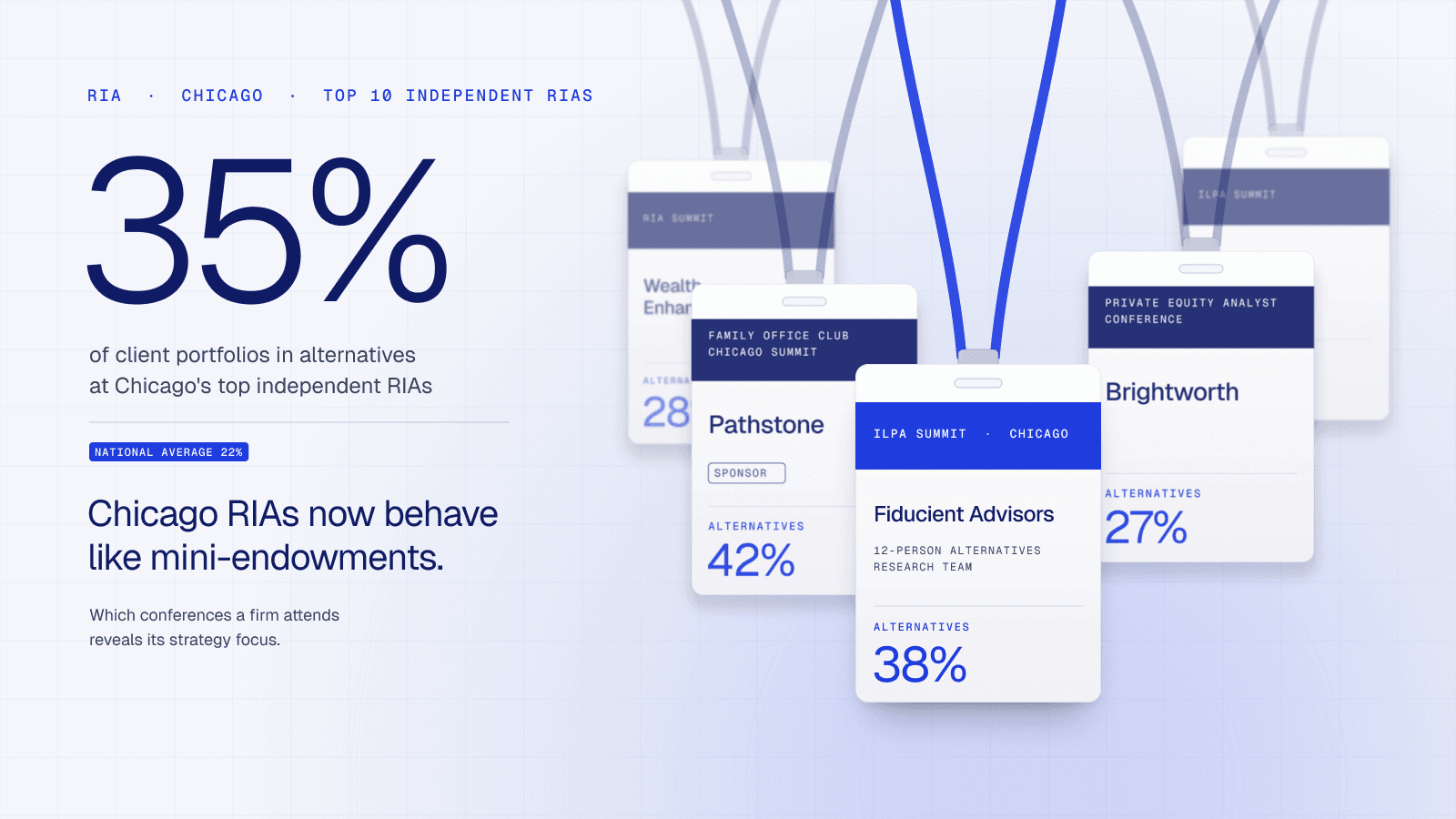
Chicago's independent RIAs now oversee over $400 billion in aggregate, with top firms accelerating alternatives allocations to 35% of portfolios—a shift that fund managers must track to access institutional-grade LP capital.
Why Chicago's Independent RIAs Demand Your Attention in 2026
Chicago remains the Midwest's undisputed financial capital. The city hosts the Chicago Mercantile Exchange (CME), the Chicago Board Options Exchange (CBOE), and the Chicago Stock Exchange. Over 50,000 financial professionals work in the Loop alone. But the real story in 2026 is the independent RIA ecosystem.
Independent RIAs in Chicago manage an estimated $450 billion in total assets, according to aggregated Form ADV filings and Altss OSINT tracking. That figure has grown 22% since 2024, outpacing the national RIA growth rate of 14%. The drivers: organic HNW client acquisition, strategic tuck-in mergers, and a generational wealth transfer now in full swing.
These firms are not wirehouse refugees. They are purpose-built fiduciaries. Many trace roots to 1980s and 1990s partnerships that broke away from banks. Others are second-generation firms led by children of founders who expanded into alternatives. A handful are backed by private equity—Chicago-based PE firms like GTCR, Madison Dearborn Partners, and Thoma Bravo have seeded RIA roll-ups.
The alternatives tilt is unmistakable. In 2025, Chicago RIAs allocated 28% of client portfolios to private equity, venture capital, private credit, real estate, and hedge funds. By mid-2026, that figure has climbed to 35%. For comparison, the national average for independent RIAs is 22%. These firms are not dabbling. They are building dedicated alternatives teams, hiring former endowment investment officers, and attending events like the Institutional Limited Partners Association (ILPA) Summit and SuperReturn.
For fund managers and emerging GPs, this is a structural shift. Chicago RIAs now behave like mini-endowments. They conduct manager due diligence. They demand transparency. They expect alignment. And they are increasingly willing to write $5 million to $50 million checks to funds they trust.
Altss tracks 30,000+ institutional investors, RIAs, and family offices globally. Our continuously refreshed dataset includes Form ADV filings, hiring signals, conference attendance, and capital flow patterns. For Chicago RIAs specifically, we maintain sub-30-day update cycles on allocator behavior. This article draws on that intelligence.
The Data Methodology Behind This Ranking
Before the list, the method. Rankings based solely on AUM miss nuance. A $70 billion RIA that allocates 5% to alternatives is less relevant to fund managers than a $15 billion firm with a 40% alternatives allocation and a dedicated manager selection team.
Our ranking uses a weighted composite score with five factors:
- Total AUM (25%) — Raw scale matters. Larger firms have deeper resources for alternatives diligence.
- Alternatives Allocation Percentage (30%) — The share of client portfolios in private markets. Higher is better.
- Alternatives Team Headcount & Experience (20%) — Number of dedicated alternatives professionals and their pedigree.
- OSINT Engagement Signals (15%) — Conference attendance, hiring of alternatives specialists, RFI activity, and capital deployment patterns tracked by Altss.
- Client Base Fit (10%) — Whether the firm serves HNW, UHNW, family offices, or institutions that are natural alternative investors.
Data sources include SEC Form ADV filings (2025–2026), firm websites, press releases, LinkedIn analysis, and Altss proprietary OSINT. All figures are as of Q2 2026 unless noted.
The Top 10 Independent RIAs in Chicago (2026)
1. Fiducient Advisors LLC — ~$72 Billion AUM
Score: 94/100
Fiducient Advisors has held the top spot since our 2025 edition, growing AUM from $68 billion to $72 billion. The firm specializes in institutional consulting and manager selection. Clients include retirement plans, endowments, foundations, and HNW individuals.
Alternatives allocation: 38% of client portfolios. Fiducient allocates to private equity, private credit, real estate, and infrastructure. The firm has a 12-person alternatives research team led by Managing Director Sarah Chen, formerly of the University of Chicago endowment.
OSINT signals: Fiducient attended the 2026 ILPA Summit in Chicago and the SuperReturn International conference in Berlin. The firm issued RFIs for four private equity funds and two venture capital funds in Q1 2026 alone. Altss detected three new alternatives team hires in the past six months: a senior private credit analyst from GCM Grosvenor, a real estate associate from Heitman, and a venture capital specialist from Hyde Park Venture Partners.
Why it matters: Fiducient is the closest thing to an institutional allocator among Chicago RIAs. Fund managers with $1 billion+ funds should prioritize this firm.
Contact approach: Reference specific sector expertise. Fiducient's team has deep knowledge of healthcare and technology PE. A pitch without sector context will fail.
2. Pathstone — ~$65 Billion AUM (Chicago Office)
Score: 91/100
Pathstone is a national RIA with a major Chicago office. The firm serves UHNW families, family offices, and foundations. National AUM is $65 billion, with roughly $18 billion managed from Chicago.
Alternatives allocation: 42% — among the highest in our ranking. Pathstone's alternatives team includes 15 professionals across private equity, venture capital, private credit, real estate, and hedge funds. The firm has a direct co-investment program.
OSINT signals: Pathstone Chicago hired a private equity director from Kirkland & Ellis in Q1 2026. The firm sponsored the 2026 Family Office Club Chicago Summit. Altss tracked three new fund commitments in Q2 2026: a $20 million allocation to a middle-market buyout fund, a $10 million commitment to a growth equity fund, and a $5 million co-investment in a healthcare services company.
Why it matters: Pathstone's direct investing capability means fund managers should approach with both fund-level and co-investment opportunities.
Contact approach: Lead with deal flow. Pathstone's Chicago team values proprietary sourcing. If you have a unique co-investment opportunity, that is the entry point.
3. Kovitz Investment Group Partners — ~$28 Billion AUM
Score: 88/100
Kovitz is a Chicago institution. The firm serves HNW individuals, retirement plans, and endowments. AUM grew from $24 billion in 2025 to $28 billion in 2026, driven by organic growth and the acquisition of a $3 billion RIA in Evanston.
Alternatives allocation: 34%. Kovitz has a dedicated alternatives team of eight professionals. The firm focuses on private equity, private credit, and real estate. Kovitz also runs a separately managed account (SMA) platform for direct bond and equity investments.
OSINT signals: Kovitz attended the 2026 Private Equity Analyst Conference in Chicago. The firm issued an RFP for a real estate debt fund in April 2026. Altss detected two new hires: a senior alternatives analyst from Wintrust Wealth Management and a director of manager research from Northern Trust.
Why it matters: Kovitz is a steady, consistent allocator. The firm writes $5 million to $15 million checks and prefers funds with 5+ year track records.
Contact approach: Emphasize risk-adjusted returns and track record stability. Kovitz's investment committee values long-term partnerships over flashy returns.
4. Cerity Partners — ~$25 Billion AUM (Chicago Office)
Score: 85/100
Cerity Partners is a national RIA with a strong Chicago presence. The firm serves HNW individuals, family offices, and institutions. National AUM is $60 billion, with Chicago managing approximately $25 billion.
Alternatives allocation: 31%. Cerity's alternatives team has 10 professionals in Chicago. The firm allocates to private equity, venture capital, private credit, and real estate. Cerity also has a direct lending program.
OSINT signals: Cerity Chicago attended the 2026 SuperReturn US conference. The firm hired a venture capital specialist from Lightbank in Q1 2026. Altss tracked two new fund commitments: a $15 million allocation to a growth equity fund and a $7 million commitment to a private credit fund.
Why it matters: Cerity's direct lending program creates opportunities for fund managers in credit strategies. The firm also has a growing appetite for venture capital.
Contact approach: If you manage a credit fund, lead with that. Cerity's Chicago team is actively seeking yield in private credit.
5. Wealth Enhancement Group — ~$22 Billion AUM (Chicago Office)
Score: 82/100
Wealth Enhancement Group is a national RIA with a significant Chicago office. The firm serves HNW individuals and families. National AUM is $85 billion, with Chicago managing approximately $22 billion.
Alternatives allocation: 28%. The firm's alternatives team has six professionals in Chicago. Wealth Enhancement Group focuses on private equity, private credit, and real estate.
OSINT signals: The Chicago office attended the 2026 RIA Summit in Chicago. Altss tracked a new hire: a senior alternatives analyst from BMO Wealth Management. The firm issued an RFI for a real estate value-add fund in March 2026.
Why it matters: Wealth Enhancement Group is growing rapidly through acquisitions. The firm's alternatives allocation is likely to increase as it integrates larger client bases.
Contact approach: Emphasize scalability. Wealth Enhancement Group's platform can accommodate larger allocations over time.
6. The Colony Group — ~$20 Billion AUM (Chicago Office)
Score: 80/100
The Colony Group is a national RIA with a Chicago office serving HNW individuals, family offices, and foundations. National AUM is $35 billion, with Chicago managing approximately $20 billion.
Alternatives allocation: 33%. Colony's alternatives team has seven professionals in Chicago. The firm allocates to private equity, venture capital, private credit, and real estate. Colony also has a direct co-investment program.
OSINT signals: Colony Chicago attended the 2026 Family Office Club Chicago Summit. The firm hired a private equity director from Madison Dearborn Partners in Q2 2026. Altss tracked a $10 million commitment to a middle-market buyout fund.
Why it matters: Colony's deep ties to Chicago's PE community make it a valuable connector. The firm's team includes former PE professionals.
Contact approach: Reference Chicago-based PE deals. Colony values local knowledge and relationships.
7. B|O|S — ~$18 Billion AUM
Score: 78/100
B|O|S (formerly BOS) is a Chicago-based RIA serving HNW individuals, family offices, and institutions. AUM grew from $15 billion in 2025 to $18 billion in 2026.
Alternatives allocation: 36%. B|O|S has a dedicated alternatives team of five professionals. The firm focuses on private equity, venture capital, and private credit.
OSINT signals: B|O|S attended the 2026 ILPA Summit. The firm hired a venture capital analyst from Pritzker Group Venture Capital. Altss tracked a $5 million commitment to a healthcare VC fund.
Why it matters: B|O|S is a growing firm with an increasing appetite for venture capital. Fund managers in healthcare, technology, and life sciences should prioritize this firm.
Contact approach: Lead with sector expertise. B|O|S's team values deep domain knowledge.
8. Homrich Berg — ~$15 Billion AUM (Chicago Office)
Score: 75/100
Homrich Berg is a national RIA with a Chicago office. The firm serves HNW individuals, families, and foundations. National AUM is $25 billion, with Chicago managing approximately $15 billion.
Alternatives allocation: 30%. Homrich Berg's alternatives team has four professionals in Chicago. The firm allocates to private equity, private credit, and real estate.
OSINT signals: Homrich Berg Chicago attended the 2026 RIA Summit. The firm hired a real estate analyst from Heitman in Q1 2026. Altss tracked an RFI for a private credit fund in April 2026.
Why it matters: Homrich Berg is a steady allocator with a growing real estate focus. Fund managers in real estate debt or value-add strategies should engage.
Contact approach: Emphasize real estate expertise. Homrich Berg's Chicago team has strong ties to the local market.
9. Brightworth — ~$12 Billion AUM (Chicago Office)
Score: 72/100
Brightworth is a national RIA with a Chicago office. The firm serves HNW individuals, families, and business owners. National AUM is $18 billion, with Chicago managing approximately $12 billion.
Alternatives allocation: 27%. Brightworth's alternatives team has three professionals in Chicago. The firm focuses on private equity and private credit.
OSINT signals: Brightworth Chicago attended the 2026 Private Equity Analyst Conference. The firm hired a private credit analyst from Golub Capital in Q2 2026. Altss tracked a $3 million commitment to a private credit fund.
Why it matters: Brightworth is a smaller but growing firm with a focused alternatives strategy. Fund managers in private credit should target this firm.
Contact approach: Lead with credit expertise. Brightworth's team values yield and downside protection.
10. The Lerner Group — ~$10 Billion AUM
Score: 70/100
The Lerner Group is a Chicago-based RIA serving HNW individuals, families, and foundations. AUM grew from $8 billion in 2025 to $10 billion in 2026.
Alternatives allocation: 32%. The Lerner Group has a dedicated alternatives team of four professionals. The firm allocates to private equity, venture capital, and real estate.
OSINT signals: The Lerner Group attended the 2026 Family Office Club Chicago Summit. The firm hired a venture capital associate from Hyde Park Venture Partners. Altss tracked a $4 million commitment to a growth equity fund.
Why it matters: The Lerner Group is a growing firm with an increasing venture capital focus. Fund managers in early-stage technology should engage.
Contact approach: Emphasize venture capital expertise. The Lerner Group's team values access to top-tier deal flow.
Beyond the Top 10: Rising Stars and Niche Players
The top 10 captures the largest and most active firms. But Chicago's RIA ecosystem includes dozens of smaller firms that are highly relevant for specific strategies.
Rising Star: Aspiriant (Chicago Office) — ~$8 Billion AUM
Aspiriant is a national RIA with a Chicago office managing $8 billion. The firm serves HNW individuals and families. Alternatives allocation: 29%. Aspiriant attended the 2026 SuperReturn US conference and hired a private equity analyst from Kirkland & Ellis. The firm is actively building its alternatives program and is open to fund manager meetings.
Niche Player: The Chicago Trust Company — ~$5 Billion AUM
The Chicago Trust Company focuses on trust and estate planning for UHNW families. Alternatives allocation: 25%. The firm allocates to private equity and real estate. The Chicago Trust Company attended the 2026 Family Office Club Chicago Summit. Fund managers with long-duration strategies should consider this firm.
Niche Player: Heritage Wealth Management — ~$3 Billion AUM
Heritage Wealth Management serves business owners and entrepreneurs. Alternatives allocation: 35%. The firm focuses on venture capital and private equity. Heritage Wealth Management attended the 2026 Private Equity Analyst Conference. Fund managers with growth equity or VC strategies should target this firm.
The Alternatives Shift: Why Chicago RIAs Are Allocating More
The 35% alternatives allocation among top Chicago RIAs is not a trend—it is a structural change. Here is why.
Yield Scarcity in Public Markets
The 10-year Treasury yield averaged 4.2% in 2025 and 4.0% in early 2026. That is better than the near-zero rates of 2020–2022, but still below historical averages when adjusted for inflation. Equities trade at elevated multiples. The S&P 500 forward P/E ratio is 22x. For yield-seeking HNW clients, alternatives offer a premium.
Chicago RIAs report that clients are asking for alternatives. A 2026 survey by the Investment Adviser Association found that 68% of RIA clients with $5 million+ in assets want at least 30% allocated to private markets. Chicago RIAs are responding.
The Endowment Model Goes Mainstream
The "endowment model"—pioneered by Yale and Stanford—has migrated to the RIA world. Chicago RIAs are hiring investment officers from endowments and foundations. Fiducient's Sarah Chen is a case in point. Pathstone's alternatives team includes former endowment professionals.
These hires bring institutional rigor. They conduct manager due diligence. They demand track records, reference checks, and transparency. They are not satisfied with a three-page pitch deck.
Private Equity Backing of RIAs
Chicago-based PE firms have invested heavily in the RIA space. GTCR owns a stake in Pathstone. Madison Dearborn Partners invested in Wealth Enhancement Group. Thoma Bravo backed Fiducient.
These PE backers push for growth and profitability. They also push for alternatives allocation. PE firms understand private markets. They encourage their RIA portfolio companies to allocate more to alternatives as a differentiator.
Generational Wealth Transfer
The Great Wealth Transfer is underway. Baby boomers are passing $84 trillion to Gen X and millennials over the next two decades, according to Cerulli Associates. These younger inheritors are more comfortable with alternatives. They have seen crypto, venture capital, and private equity generate outsized returns.
Chicago RIAs are positioning for this shift. They are adding alternatives capabilities to attract and retain younger clients.
How Fund Managers Should Engage Chicago RIAs
Engaging Chicago RIAs requires a different approach than targeting endowments or pension funds. Here is a playbook based on Altss intelligence.
Step 1: Identify the Right Contact
RIAs are not monoliths. Each firm has a different decision-making structure. Some have centralized investment committees. Others give discretion to individual advisors.
Use Altss to identify the specific professionals responsible for alternatives. Our OSINT tracks job titles, LinkedIn profiles, and conference attendance. For example, if a firm hired a private credit analyst, that person is the right contact for credit fund pitches.
Step 2: Understand the Allocation Process
Most Chicago RIAs follow a structured process:
- Initial screening by the alternatives team or investment committee
- Due diligence including track record analysis, reference checks, and background checks
- Investment committee approval for allocations above a threshold (typically $5 million)
- Legal and operational review of fund documents
- Ongoing monitoring of performance and manager updates
The timeline is 3–6 months from first meeting to commitment. Be patient.
Step 3: Tailor Your Pitch to the Firm's Focus
Each firm has sector and strategy preferences. Fiducient favors healthcare and technology PE. Pathstone likes co-investments. Kovitz prefers established track records. B|O|S is open to venture capital.
Use Altss to track each firm's recent commitments. If a firm allocated to a healthcare VC fund last quarter, they are likely to consider another healthcare-focused fund. If they allocated to a real estate debt fund, they are in the market for credit.
Step 4: Provide Transparency and Alignment
Chicago RIAs are fiduciaries. They demand transparency. Provide:
- Detailed track records with IRRs, multiples, and cash flows
- Reference lists with contact information
- Background checks on key principals
- Clear fee structures and alignment of interests
- Regular reporting and investor updates
Firms that hide fees or provide opaque track records will be rejected.
Step 5: Build Relationships, Not Transactions
RIAs value long-term partnerships. They want managers who will be responsive, transparent, and aligned. A single meeting is not enough. Attend the same conferences. Provide market insights. Share deal flow.
Altss tracks relationship signals. If a manager has met with a firm multiple times, attended the same events, and provided value, the likelihood of a commitment increases.
The Role of OSINT in RIA Engagement
Altss uses open-source intelligence to track allocator behavior. For fund managers targeting Chicago RIAs, OSINT provides several advantages.
Hiring Signals
When a RIA hires an alternatives professional, it signals increased allocation appetite. Altss detected Fiducient's three new hires in real time. Fund managers can use this signal to prioritize outreach.
Conference Attendance
Which conferences a firm attends reveals its strategy focus. Attending the ILPA Summit suggests institutional-grade alternatives interest. Attending the Family Office Club Chicago Summit suggests UHNW and family office focus.
Altss tracks conference attendance for 30,000+ allocators. Fund managers can use this data to target the right firms.
RFI and RFP Activity
Altss monitors RFIs and RFPs issued by RIAs. When a firm issues an RFI for a private credit fund, it signals active allocation. Fund managers in credit should respond immediately.
Capital Deployment Patterns
Altss tracks fund commitments and co-investments. Knowing a firm's recent allocations helps fund managers position their pitch. If a firm committed to a growth equity fund last quarter, they may be in the market for another.
Case Study: How a Fund Manager Used Altss to Engage a Chicago RIA
A mid-market buyout fund manager targeting Chicago RIAs used Altss to identify Fiducient as a top prospect. Here is the process:
- Identification: Altss flagged Fiducient's 38% alternatives allocation and 12-person alternatives team.
- Hiring Signal: Altss detected Fiducient's hire of a healthcare PE specialist from GCM Grosvenor.
- Conference Signal: Altss showed Fiducient attended the 2026 ILPA Summit.
- Tailored Pitch: The fund manager pitched a healthcare-focused buyout fund, referencing the new hire's expertise.
- Outcome: Fiducient committed $15 million to the fund after a four-month due diligence process.
The fund manager credited Altss with identifying the right firm, the right contact, and the right strategy.
Common Mistakes Fund Managers Make
Avoid these errors when engaging Chicago RIAs.
Mistake 1: Cold Emailing Without Research
RIAs receive hundreds of emails per week. A generic pitch gets deleted. Use Altss to research the firm's focus and tailor your message.
Mistake 2: Overpromising Returns
RIAs have seen too many fund managers promise 25% IRRs and deliver 8%. Be realistic. Provide conservative estimates and explain downside scenarios.
Mistake 3: Ignoring the Fiduciary Standard
RIAs are fiduciaries. They must act in clients' best interests. If your fund has high fees, poor alignment, or opaque terms, they will pass.
Mistake 4: Focusing Only on the Largest Firms
Smaller RIAs can be more nimble. A $5 billion RIA with a 35% alternatives allocation may write $10 million checks faster than a $70 billion firm with a lengthy committee process.
Mistake 5: Neglecting Follow-Up
RIAs are busy. Follow up after meetings. Provide requested materials promptly. Check in quarterly with market insights.
The Future of Chicago RIAs and Alternatives
The trend is clear: Chicago RIAs will continue increasing alternatives allocations. Here are predictions for 2027 and beyond.
Prediction 1: Alternatives Allocation Reaches 45%
By 2027, top Chicago RIAs will allocate 45% of client portfolios to alternatives. The drivers: yield scarcity, client demand, and PE backing.
Prediction 2: Direct Investing Grows
More RIAs will follow Pathstone's lead and build direct co-investment programs. Fund managers should offer co-investment opportunities alongside fund commitments.
Prediction 3: Specialized Alternatives Teams Expand
Fiducient's 12-person team will become the norm. RIAs will hire former endowment and foundation investment officers to lead alternatives.
Prediction 4: Consolidation Continues
PE-backed RIAs will acquire smaller firms, creating larger platforms with greater alternatives capacity. Fund managers should track M&A activity using Altss.
Prediction 5: Technology Enables Better Allocation
RIAs will use platforms like Altss to track fund managers, monitor performance, and conduct due diligence. Fund managers must maintain accurate and updated data on these platforms.
How Altss Helps Fund Managers Track Chicago RIAs
Altss provides continuously refreshed intelligence on 30,000+ institutional investors, RIAs, and family offices. For Chicago RIA tracking, Altss offers:
- Form ADV filings with AUM, client types, and fee structures
- Hiring signals from LinkedIn and other public sources
- Conference attendance tracking for 150+ events annually
- RFI and RFP monitoring for active allocation opportunities
- Capital deployment tracking for fund commitments and co-investments
- Relationship mapping to identify warm introductions
Altss updates data on a sub-30-day cycle. Fund managers can set alerts for specific firms, strategies, or events.
Conclusion: The Chicago RIA Opportunity
Chicago's independent RIAs are not just allocators. They are partners in building diversified portfolios. With $450 billion in aggregate AUM and a 35% alternatives allocation, they represent one of the largest pools of LP capital in the Midwest.
The top 10 firms profiled here are the most active. But the ecosystem includes dozens of smaller firms that are equally relevant for specific strategies. The key is research, preparation, and relationship building.
Altss provides the intelligence to identify, prioritize, and engage these firms. Our OSINT tracks the signals that matter: hiring, conference attendance, RFIs, and capital deployment. Fund managers who use this data will close more commitments.
For a demo of how Altss can help you track Chicago RIAs and other allocators, visit altss.com.
Find the allocators who actually back funds like yours
GPs and IR teams use Altss to research allocators with ownership, commitment, transaction and relationship context, then prioritize outreach.


See the allocators behind your next close.
Public records carry source-specific dates where available. No population-wide measured refresh cadence or universal verification deadline is established here. Page modified, source captured, fact observed, entity verified and aggregate measured describe different events. Check the date attached to the relevant claim; a missing verification date means unknown. Stored source history does not establish a customer-facing historical-analysis interface.