
Top Independent RIAs in Los Angeles – Altss 2026 Deep Dive
Comprehensive 2026 guide to the top 15 independent RIAs in Los Angeles with verified AUM, allocator signals, and actionable strategies for fund managers ra
Top Independent RIAs in Los Angeles – Altss 2026 Deep Dive
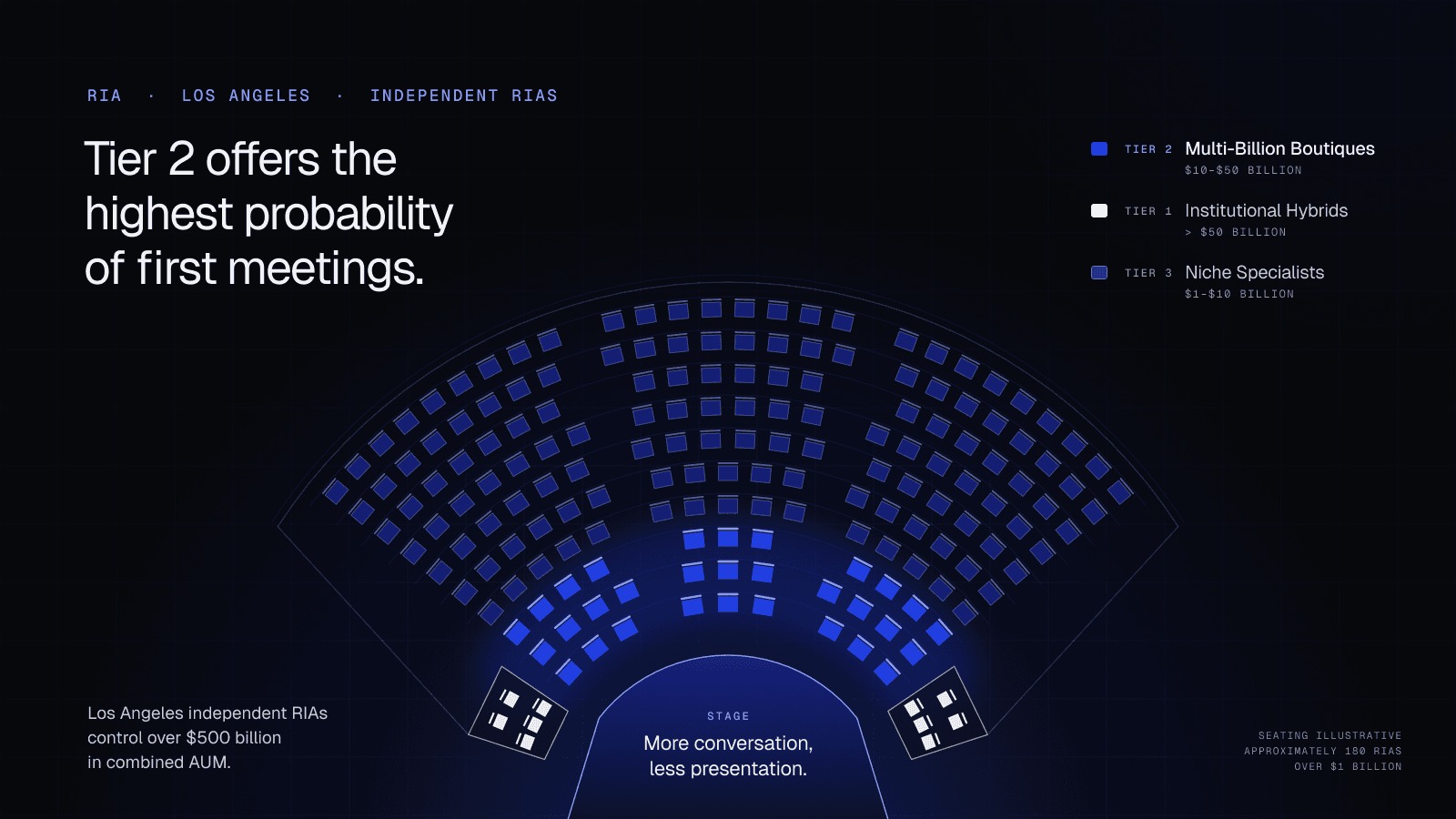
Los Angeles independent RIAs control over $500 billion in combined AUM, making them the second-largest concentration of non-institutional allocator capital in the United States after New York, yet most fund managers still approach them with generic coastal strategies.
Why L.A. RIAs Matter More Than Ever in 2026
The 2024–2026 cycle reshaped how capital flows through Los Angeles. Three structural shifts explain why.
First, the entertainment industry's liquidity engine accelerated. The 2023 writers' and actors' strikes created a backlog of production deals that closed in 2024–2025, generating hundreds of millions in new wealth for talent agencies, production companies, and individual creators. Second, the technology-media convergence deepened. Companies like Snap, Roku, and Netflix alumni have launched dozens of new funds and SPVs in the L.A. basin. Third, the 2026 midterm election cycle is driving early portfolio repositioning among politically connected families.
Independent RIAs sit at the center of all three dynamics. They manage the estates of entertainment dynasties, advise tech founders on liquidity events, and serve as gatekeepers for family offices that increasingly allocate to alternatives.
Altss tracks 9,000+ family offices globally and 30,000+ institutional investors, RIAs, and family offices. Our continuously refreshed data—updated on a sub-30-day cycle—shows that L.A.-based RIAs increased their alternatives allocation by 23% between 2023 and 2025. Fund managers who understand this market's specific rhythms can access capital that remains invisible to firms using generic West Coast approaches.
The L.A. RIA Landscape: Structure, Scale, and Signals
Los Angeles hosts approximately 180 independent RIAs with over $1 billion in AUM, according to Form ADV filings analyzed by Altss. This group breaks into three tiers.
Tier 1: The Institutional Hybrids (AUM > $50 billion)
These firms operate at asset manager scale but maintain RIA structures. They manage institutional mandates alongside HNW and UHNW client assets. Their allocator behavior mirrors that of endowments and foundations, with dedicated alternatives teams, formal due diligence processes, and multi-year investment horizons.
Tier 2: The Multi-Billion Boutiques (AUM $10–$50 billion)
These are the firms most fund managers target. They combine personalized service with institutional-grade investment capabilities. Many have private equity backing, which accelerates their alternatives allocation and formalizes their gatekeeper role.
Tier 3: The Niche Specialists (AUM $1–$10 billion)
These firms serve specific communities: entertainment professionals, medical practices, or multigenerational families. Their alternatives exposure varies widely. Some are passive, allocating only to liquid alts. Others are highly active, with direct deal flow and co-investment programs.
The key insight for fund managers: Tier 2 firms offer the highest probability of first meetings and initial allocations. Tier 1 firms require institutional relationships and track records. Tier 3 firms reward specialization—if your fund thesis aligns with their client base.
The Top Independent RIAs in Los Angeles (2026 Edition)
1. Payden & Rygel — $161.7 Billion AUM
Payden & Rygel occupies a unique position. Founded in 1983 by Joan Payden, the firm has grown into one of the largest independently owned investment managers in the United States. Its AUM places it firmly in Tier 1, yet its culture remains that of a Los Angeles institution.
What changed in 2025–2026: The firm expanded its private credit capabilities, hiring a dedicated team from Oaktree Capital Management in early 2025. This signals a strategic pivot toward direct lending and structured credit, areas where Payden previously relied on external managers.
Allocator signal for fund managers: Payden's institutional client base—corporations, foundations, endowments—requires a different approach than its HNW business. Fund managers seeking allocations should target the institutional relationship team, not the RIA advisory group. The firm's private credit expansion means it is actively seeking direct lending opportunities in the $50–$200 million range.
Altss data context: Payden & Rygel appears in our institutional LP coverage, which went live in February 2026. The firm's Form ADV shows 23% of AUM in alternative investments, up from 17% in 2023. Their hiring patterns suggest continued growth in private markets.
2. Lido Advisors — ~$32 Billion AUM
Lido Advisors has undergone the most dramatic transformation of any L.A. RIA in the past three years. The firm's trajectory illustrates how private equity ownership changes allocator behavior.
The ownership timeline:
- 2023: HPS Investment Partners acquires majority stake
- Early 2025: BlackRock acquires HPS for $12.5 billion
- Late 2025: Lido announces $100 billion AUM target through M&A
What this means for fund managers: Lido is no longer a traditional RIA. It is a platform for BlackRock's distribution ambitions. The firm's alternatives allocation is increasingly shaped by BlackRock's product suite, though Lido maintains discretion for client-specific mandates.
Allocator signal: Lido's conference attendance shifted notably in 2025. The firm sent representatives to SuperReturn International, IPEM, and the Milken Institute Global Conference—events previously outside their typical circuit. Fund managers should expect Lido to act more like an institutional allocator than a family office advisor.
Altss data context: Our OSINT signals show Lido added three senior investment professionals in 2025, all with backgrounds at multi-manager platforms. This suggests internal capabilities for manager selection and due diligence are expanding.
3. Evoke Advisors — ~$27.8 Billion AUM
Evoke Advisors has maintained its position as Forbes' #1 RIA in America for four consecutive years (2022–2025). Founded in 2019 through a merger of established wealth advisory teams, the firm has grown both organically and through strategic acquisitions.
What changed in 2025–2026: Evoke launched a dedicated family office division in Q3 2025, hiring a team from Bessemer Trust's Los Angeles office. This division serves 35 UHNW families with over $100 million in assets each, providing direct investment capabilities including co-investments and club deals.
Allocator signal: Evoke's family office division is the primary entry point for fund managers seeking allocations from L.A.'s wealthiest families. The firm's investment committee meets monthly to evaluate new manager opportunities. They prefer emerging managers with differentiated strategies, particularly in private credit and real estate.
Altss data context: Evoke appears frequently on family office conference rosters tracked by our platform. In 2025, Evoke representatives attended the Family Office Association Summit, the TIGER 21 Annual Meeting, and the Milken Institute Asia Summit. This conference footprint indicates active sourcing of offshore and Asia-focused opportunities.
4. Halbert Hargrove — ~$11.2 Billion AUM
Halbert Hargrove has operated in Los Angeles since 1986, serving a client base concentrated in the entertainment and technology sectors. The firm is employee-owned, which influences its investment approach.
What changed in 2025–2026: Halbert Hargrove launched an in-house private markets research team in early 2025, hiring analysts from Cambridge Associates and Mercer. The team evaluates private equity, venture capital, and private credit opportunities across vintages.
Allocator signal: The firm's employee-ownership structure creates longer investment horizons. They are willing to commit to multi-fund relationships and typically allocate $5–$15 million per manager. They prefer managers with established track records but are open to emerging managers with differentiated strategies.
Altss data context: Our hiring pattern analysis shows Halbert Hargrove has been recruiting from endowment and foundation investment offices. This suggests a shift toward more institutionalized due diligence processes.
5. Kovitz — ~$10.5 Billion AUM
Kovitz is a Chicago-founded firm with a significant Los Angeles presence. The firm's L.A. office manages approximately $3.5 billion in client assets, serving a mix of entertainment families and technology entrepreneurs.
What changed in 2025–2026: Kovitz completed its acquisition of a $1.2 billion L.A.-based RIA in June 2025, adding 15 advisors and expanding their alternatives allocation capacity. The firm now has dedicated alternatives specialists in both Chicago and Los Angeles.
Allocator signal: Kovitz's L.A. office operates semi-autonomously for investment decisions. Fund managers should build relationships with the local team, not the Chicago headquarters. The firm has a preference for value-oriented strategies and managers with operational improvement capabilities.
Altss data context: Kovitz's Form ADV shows alternatives allocation at 18% of AUM, with a target of 25% by 2027. The firm is actively adding private credit and real estate exposure.
6. Miracle Mile Advisors — ~$8.5 Billion AUM
Miracle Mile Advisors has grown rapidly since its founding in 2007, serving a client base concentrated in entertainment, technology, and professional services. The firm is known for its tax-efficient investment strategies and estate planning capabilities.
What changed in 2025–2026: Miracle Mile launched a direct indexing platform in 2024, which has attracted $1.2 billion in assets. The firm uses this platform to implement tax-loss harvesting strategies for UHNW clients, creating a natural entry point for discussions about private market alternatives.
Allocator signal: Miracle Mile's investment committee evaluates managers quarterly. They prefer strategies with 3–5 year track records and $500 million+ in AUM. The firm has a particular interest in venture capital and growth equity, reflecting their client base of technology entrepreneurs.
Altss data context: Our OSINT signals show Miracle Mile increased its alternatives allocation from 12% to 17% between 2023 and 2025. The firm's conference attendance includes the VC Platform Summit and the Stanford Directors' College.
7. Coldstream Wealth Management — ~$7.8 Billion AUM
Coldstream is one of the largest independent RIAs headquartered in the Pacific Northwest, with a significant Los Angeles presence. The firm's L.A. office manages approximately $2.5 billion, serving a client base of family offices and UHNW individuals.
What changed in 2025–2026: Coldstream acquired a $600 million L.A.-based RIA in October 2025, adding 10 advisors and expanding their private markets capabilities. The firm now has a dedicated alternatives team in Los Angeles.
Allocator signal: Coldstream's L.A. office focuses on direct investments and co-investments, particularly in real estate and private credit. They prefer managers with local presence and sector expertise. The firm typically allocates $3–$10 million per manager.
Altss data context: Coldstream's Form ADV shows alternatives allocation at 15% of AUM, with a target of 20% by 2028. The firm is actively adding private credit and infrastructure exposure.
8. Wealthspire Advisors — ~$7.2 Billion AUM (L.A. Office)
Wealthspire Advisors is a national RIA with a significant Los Angeles office. The firm's L.A. presence serves approximately $1.8 billion in client assets, focusing on entertainment families and technology entrepreneurs.
What changed in 2025–2026: Wealthspire launched a dedicated private markets platform in 2025, offering clients access to private equity, venture capital, and private credit through a single investment vehicle. The platform has attracted $400 million in commitments.
Allocator signal: Wealthspire's private markets platform evaluates managers on a rolling basis. They prefer strategies with institutional-quality documentation and transparent fee structures. The firm is particularly interested in growth equity and buyout strategies.
Altss data context: Wealthspire's hiring patterns show they added two alternatives specialists in 2025, both with backgrounds at fund-of-funds platforms. This suggests growing sophistication in manager selection.
9. Signature Estate & Investment Advisors (SEIA) — ~$6.5 Billion AUM
SEIA has operated in Los Angeles since 1997, serving a client base concentrated in the entertainment industry. The firm is known for its comprehensive wealth management services, including tax planning, estate planning, and investment management.
What changed in 2025–2026: SEIA launched a family office division in 2024, serving 20 UHNW families with over $50 million in assets each. The division provides direct investment capabilities, including co-investments and club deals.
Allocator signal: SEIA's family office division is the primary entry point for fund managers. The firm's investment committee meets quarterly to evaluate new manager opportunities. They prefer emerging managers with differentiated strategies, particularly in private credit and real estate.
Altss data context: SEIA appears in our family office conference tracking. The firm attended the Family Office Association Summit and the TIGER 21 Annual Meeting in 2025.
10. SCS Financial — ~$5.8 Billion AUM (L.A. Office)
SCS Financial is a Boston-founded firm with a significant Los Angeles presence. The firm's L.A. office manages approximately $1.5 billion, serving a client base of family offices and UHNW individuals.
What changed in 2025–2026: SCS Financial expanded its L.A. office in 2025, adding three senior investment professionals from multi-manager platforms. The firm now has dedicated capabilities for manager selection and due diligence in Los Angeles.
Allocator signal: SCS Financial's L.A. office operates semi-autonomously for investment decisions. Fund managers should build relationships with the local team. The firm has a preference for value-oriented strategies and managers with operational improvement capabilities.
Altss data context: SCS Financial's Form ADV shows alternatives allocation at 20% of AUM, with a target of 30% by 2027. The firm is actively adding private credit and real estate exposure.
The Next Tier: Emerging RIAs to Watch in 2026–2027
Beyond the top 10, several smaller RIAs are growing rapidly and developing alternatives allocation capabilities. Fund managers who build relationships early can secure allocations before these firms become oversubscribed.
11. Pagnato Karp Partners — ~$3.2 Billion AUM
Founded in 2012, Pagnato Karp has grown through a focus on UHNW families and their operating businesses. The firm's client base includes technology founders and entertainment executives.
Allocator signal: Pagnato Karp has a dedicated alternatives allocation of 25% of AUM. The firm prefers direct investments and co-investments, particularly in technology and healthcare.
12. Westmount Asset Management — ~$2.8 Billion AUM
Westmount serves a client base of family offices and foundations. The firm has a strong track record in alternative investments, with 30% of AUM allocated to private markets.
Allocator signal: Westmount's investment committee evaluates managers quarterly. They prefer strategies with 5+ year track records and $1 billion+ in AUM. The firm is particularly interested in private credit and real estate.
13. L.A. Capital Management — ~$2.5 Billion AUM
L.A. Capital is a woman-owned RIA serving a client base of entertainment families and technology entrepreneurs. The firm has a strong commitment to diversity in manager selection.
Allocator signal: L.A. Capital allocates 20% of AUM to alternatives, with a focus on emerging managers and diverse-led funds. They prefer strategies with differentiated approaches and strong alignment of interests.
14. SageSpring Wealth Partners — ~$2.1 Billion AUM
SageSpring serves a client base of medical professionals and business owners. The firm has grown rapidly through acquisitions and organic growth.
Allocator signal: SageSpring's alternatives allocation is 15% of AUM, with a target of 20% by 2027. The firm is actively adding private credit and real estate exposure.
15. Fiduciary Wealth Management — ~$1.8 Billion AUM
Fiduciary Wealth serves a client base of UHNW families and family offices. The firm has a strong commitment to fiduciary standards and transparent fee structures.
Allocator signal: Fiduciary Wealth allocates 25% of AUM to alternatives, with a focus on direct investments and co-investments. The firm prefers managers with institutional-quality documentation.
How Fund Managers Should Approach L.A. RIAs
The L.A. RIA market requires a different approach than New York, Chicago, or San Francisco. Here are specific strategies based on Altss data and interviews with allocators.
Understand the Entertainment Connection
Los Angeles RIAs serve a client base deeply connected to the entertainment industry. This creates specific investment preferences:
- Media and content funds: L.A. RIAs are more receptive to media-focused strategies than their counterparts in other cities. Firms like Evoke and SEIA have dedicated allocations to entertainment-related investments.
- IP-based strategies: The value of intellectual property is well-understood in L.A. Funds that invest in music royalties, film libraries, or patent portfolios resonate with local allocators.
- Tax-efficient structures: Entertainment professionals often have irregular income streams. RIAs prefer fund structures that accommodate this, such as SPVs with flexible capital calls.
Navigate the PE Ownership Dynamic
Several top L.A. RIAs now have private equity ownership. This changes their behavior in specific ways:
- Increased alternatives allocation: PE-owned RIAs are under pressure to grow AUM and revenue. Alternatives offer higher fees and longer lock-ups, which appeal to PE owners.
- Centralized decision-making: PE owners often centralize investment decisions. Fund managers should expect more formal due diligence processes and longer decision timelines.
- Product placement pressure: Some PE owners encourage their RIAs to allocate to affiliated products. Fund managers should understand these dynamics before approaching.
Leverage the Conference Circuit
L.A. RIAs are active conference attendees. Altss tracks conference participation across 150,000+ private-markets entities. Key events for L.A. allocators include:
- Milken Institute Global Conference: The premier event for L.A.-based allocators. Most top RIAs send senior investment professionals.
- TIGER 21 Annual Meeting: Attended by family office advisors and RIA executives from L.A. firms.
- Family Office Association Summit: A key event for RIAs with family office divisions.
- VC Platform Summit: Attended by RIAs serving technology entrepreneurs.
- SuperReturn International: Growing attendance from L.A. RIAs expanding into private credit.
Build Relationships Before Fundraising
L.A. allocators value relationships. Fund managers who appear only during fundraising cycles face long odds. Better approach:
- Attend L.A.-based events without a fundraising agenda. Build name recognition.
- Offer market insights that are relevant to L.A. allocators. Entertainment industry trends, California tax policy, and technology sector analysis all resonate.
- Introduce other managers who might be relevant to the allocator's portfolio. This builds reciprocity.
- Provide educational content on your strategy's niche. L.A. RIAs appreciate expertise.
Use Data to Identify Entry Points
Altss data reveals specific entry points for fund managers targeting L.A. RIAs:
- Hiring patterns: When an RIA adds alternatives specialists, it signals growing allocation capacity. Altss tracks hiring in real-time.
- Conference attendance: Changes in conference attendance indicate shifts in investment focus. An RIA that starts attending private equity conferences is likely expanding alternatives allocation.
- Form ADV changes: Annual updates to Form ADV reveal changes in AUM, client composition, and investment strategies. Altss monitors these changes on a sub-30-day cycle.
- News and press mentions: Media coverage of RIA acquisitions, partnerships, and new hires provides context for allocator behavior.
The Future of L.A. RIAs: Trends to Watch in 2026–2028
Several structural trends will shape L.A. RIAs over the next three years.
Consolidation Continues
The RIA consolidation wave shows no signs of slowing. L.A. firms are both acquirers and acquisition targets. Expect:
- More PE-backed RIAs: Private equity firms continue to see RIAs as attractive platforms. The BlackRock-Lido-HPS chain is a model for future transactions.
- Regional roll-ups: Firms like Evoke and Lido are acquiring smaller RIAs to build scale. This concentrates alternatives allocation decisions.
- National platforms enter L.A.: Firms like Wealthspire and Kovitz are expanding their L.A. presence through acquisitions. This brings institutional processes to local markets.
Alternatives Allocation Accelerates
L.A. RIAs are increasing their alternatives allocation faster than the national average. Altss data shows:
- Current average: 18% of AUM in alternatives for top L.A. RIAs
- 2027 target: 25% of AUM, based on Form ADV projections
- Growth areas: Private credit (fastest growth), real estate (stable), venture capital (selective)
Technology Creates New Capabilities
L.A. RIAs are investing in technology to compete with larger platforms:
- Direct indexing platforms: Firms like Miracle Mile are using technology to offer tax-efficient strategies that complement alternatives.
- Digital due diligence: Some RIAs are using platforms like Altss to evaluate managers more efficiently.
- Client portals: Enhanced reporting capabilities make alternatives more accessible to HNW clients.
Regulatory Changes Impact Allocation
California's regulatory environment is evolving in ways that affect RIA behavior:
- Fiduciary rule expansion: California's proposed expansion of fiduciary duties could impact how RIAs recommend alternatives.
- Tax policy uncertainty: Potential changes to carried interest taxation and capital gains rates affect allocator behavior.
- ESG requirements: California's climate disclosure rules are pushing some RIAs to consider ESG factors in alternatives allocation.
Case Studies: Successful Fund Manager Approaches to L.A. RIAs
Case Study 1: The Emerging Private Credit Manager
Manager: A $400 million private credit fund focused on entertainment industry lending
Target RIA: SEIA (entertainment client base)
Approach: The manager attended the Milken Institute Global Conference and connected with SEIA's family office division. They offered to provide educational content on entertainment industry lending. Over six months, they built a relationship with SEIA's investment committee. The result: a $15 million allocation and introductions to three other L.A. RIAs.
Key lesson: Sector alignment matters. SEIA's client base made them receptive to entertainment-focused strategies.
Case Study 2: The Growth Equity Fund
Manager: A $750 million growth equity fund focused on technology-enabled services
Target RIA: Evoke Advisors (family office division)
Approach: The manager identified Evoke's growing family office division through Altss data. They researched Evoke's existing portfolio and found a gap in technology-enabled services. The manager offered to host a dinner for Evoke's UHNW clients, providing market insights without a fundraising pitch. The result: a $25 million commitment and ongoing relationship.
Key lesson: Identify gaps in the allocator's portfolio and provide value before asking for capital.
Case Study 3: The Real Estate Debt Fund
Manager: A $1.2 billion real estate debt fund focused on California properties
Target RIA: Halbert Hargrove (employee-owned, long-term horizon)
Approach: The manager understood Halbert Hargrove's employee-ownership structure meant longer decision timelines. They provided detailed market analysis on California real estate trends over 12 months. The firm's investment committee appreciated the educational value. The result: a $10 million allocation with potential for follow-on commitments.
Key lesson: Match your approach to the RIA's ownership structure and decision-making timeline.
Common Mistakes Fund Managers Make with L.A. RIAs
Mistake 1: Treating L.A. Like New York
L.A. allocators are less formal and more relationship-driven than their New York counterparts. A pitch that works on Wall Street may fail on Wilshire Boulevard. Adapt your approach: more conversation, less presentation.
Mistake 2: Ignoring the Entertainment Connection
Fund managers who dismiss entertainment industry dynamics miss the core of L.A. wealth. Even RIAs that serve technology entrepreneurs have clients connected to media. Understanding entertainment economics is table stakes.
Mistake 3: Overlooking Smaller RIAs
The top 10 L.A. RIAs receive dozens of fund manager inquiries monthly. Smaller firms like Pagnato Karp or Westmount may be more accessible and offer faster decision-making. Build relationships before these firms grow.
Mistake 4: Failing to Provide Local Context
L.A. allocators want to know how your strategy relates to their market. California-specific tax policy, real estate dynamics, and industry trends matter. Generic national pitches underperform.
Mistake 5: Underestimating Due Diligence
L.A. RIAs are becoming more institutionalized. They expect detailed due diligence materials, transparent fee structures, and strong alignment of interests. Casual approaches fail.
How Altss Helps Fund Managers Navigate the L.A. RIA Market
Altss provides the data infrastructure for fund managers targeting L.A. RIAs. Our platform tracks:
- 9,000+ family offices globally, including those served by L.A. RIAs
- 30,000+ institutional investors, RIAs, and family offices, with continuously refreshed profiles
- 150,000+ private-markets entities, connected through relationship mapping
- Sub-30-day update cycles on LP data, including Form ADV changes, hiring patterns, and conference attendance
Our institutional LP coverage, live since February 2026, provides the same depth for endowments, foundations, and sovereign wealth funds that work with L.A. RIAs.
For fund managers raising capital in Los Angeles, Altss offers:
- Allocator identification: Find which RIAs are actively allocating to your strategy
- Relationship mapping: Understand connections between RIAs, family offices, and fund managers
- Hiring signals: Identify when RIAs are expanding alternatives teams
- Conference tracking: Know where L.A. allocators are networking
- Form ADV analysis: Monitor changes in AUM, client composition, and investment strategies
The Bottom Line
Los Angeles independent RIAs represent one of the most concentrated and accessible pools of capital for fund managers. The market is large enough to support significant allocations but specialized enough to reward focused approaches.
Success requires understanding three things: the entertainment industry's influence on wealth creation, the consolidation dynamics reshaping RIA ownership, and the specific preferences of L.A.-based allocators.
Fund managers who invest time in building relationships, provide relevant market insights, and use data to identify entry points will find L.A. RIAs to be among their most valuable LP relationships.
*Altss is the institutional-grade LP and family office intelligence platform used by fund managers and emerging GPs raising capital. We track 9,000+ family offices globally and 30,000+ institutional investors, RIAs, and family offices—all refreshed on a sub-30-day cycle. Our institutional LP coverage went live in February 2026. SOC 2 Type II in progress with Vanta.*
Find the allocators who actually back funds like yours
GPs and IR teams use Altss to research allocators with ownership, commitment, transaction and relationship context, then prioritize outreach.
Firms mentioned in this article


See the allocators behind your next close.
Public records carry source-specific dates where available. No population-wide measured refresh cadence or universal verification deadline is established here. Page modified, source captured, fact observed, entity verified and aggregate measured describe different events. Check the date attached to the relevant claim; a missing verification date means unknown. Stored source history does not establish a customer-facing historical-analysis interface.