
Best Family Office Database 2026: Altss vs FINTRX, Preqin, PitchBook, With Intelligence & Dakota — Why OSINT-Driven Signals Beat Analyst Updates
Comprehensive 2026 comparison of family office databases. Why OSINT-driven signals from Altss outperform legacy analyst updates from FINTRX, Preqin, PitchB
Best Family Office Database 2026: Altss vs FINTRX, Preqin, PitchBook, With Intelligence & Dakota — Why OSINT-Driven Signals Beat Analyst Updates
Family offices are no longer a side channel in institutional capital raising. They now deploy nearly $5 trillion globally, and the race to reach them before competitors has become the defining challenge for emerging and established GPs alike. The database you choose determines not just who you contact, but when—and timing is the only edge left in a saturated market.
The Big Picture: Why Family Offices Matter More Than Ever in 2026
The global family office count has surged from roughly 6,100 in 2019 to over 8,000 today, with projections topping 10,700 by 2030. This isn't incremental growth—it's structural. Wealth creation in emerging markets, the great wealth transfer from baby boomers to millennials, and the institutionalization of private capital have all converged to make family offices the fastest-growing LP segment in alternatives.
Consider the numbers: UBS's 2024 Global Family Office Report found that 78% of single-family offices now allocate to private equity, up from 68% in 2021. Venture capital allocations have grown from 22% to 34% over the same period. Direct investing—bypassing fund structures entirely—now accounts for 42% of family office private market exposure.
This shift has profound implications for fund managers. Family offices offer longer investment horizons, lower volatility of commitments, and fewer regulatory constraints than pension funds or endowments. They also move faster. A 2025 survey by Campden Wealth found that 61% of family offices can deploy capital within 90 days of a decision, compared to 12-18 months for institutional LPs.
But reaching them requires a fundamentally different approach. Family offices are fragmented, privacy-conscious, and poorly indexed by traditional databases. Their decision-makers change roles frequently. Their mandates shift with generational transitions. And their contact information—emails, phone numbers, titles—degrades faster than any other LP segment.
This is the gap that defines the 2026 data landscape.
Why Legacy Databases Fail Family Office Coverage
Every major family office database—FINTRX, Preqin, PitchBook, With Intelligence (formerly Highworth), Dakota, and Family Office Access—was built on the same model: human analysts calling, emailing, and scraping to verify records, then updating them on a quarterly or semi-annual cycle.
That model worked when family offices numbered a few hundred and change was slow. It breaks at scale.
The Analyst Queue Bottleneck
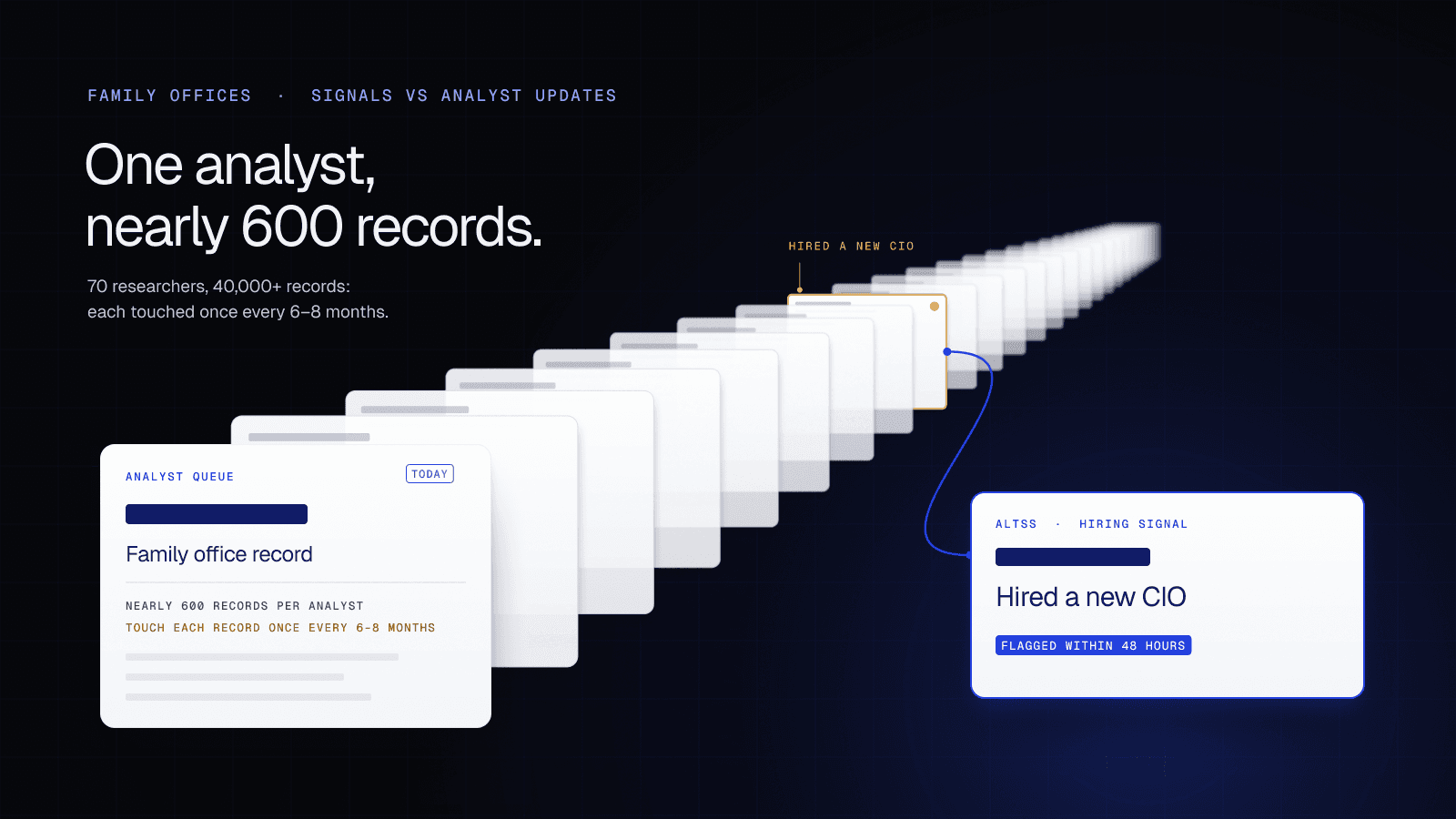
FINTRX employs roughly 70 researchers who "meticulously verify" each of its 40,000+ family office records. That sounds impressive until you do the math: 70 people covering 40,000 entities means each analyst manages nearly 600 records. At best, they can touch each record once every 6-8 months. In that window, a family office can hire a new CIO, pivot its mandate from growth equity to distressed debt, open a new SPV, or relocate its headquarters.
The lag is worst for smaller family offices—the ones that are most accessible to emerging GPs. FINTRX's researchers prioritize the largest, most visible offices, leaving the long tail of 50-200 person offices with stale or incomplete profiles.
Preqin's Institutional Blind Spot
Preqin is the gold standard for fund performance analytics. Its family office coverage—now tracking "over 1,000" entities—is curated for institutional analysis, not fundraising. You can benchmark returns, but you can't build a pipeline.
Preqin's profiles lack the granularity GPs need: direct email addresses, recent hiring signals, conference attendance patterns, and warm-path relationship mapping. The data is accurate for what it is—but what it is, is a reference database, not a fundraising platform.
PitchBook's LP Data Gap
PitchBook dominates company and deal data. Its LP coverage, however, remains a secondary product. The platform tracks approximately 3,500 family offices globally, but updates are heavily dependent on disclosed transactions and voluntary submissions. If a family office hasn't made a public investment in the past 18 months, PitchBook likely has no record of its current team or contact details.
The result: GPs who rely on PitchBook for family office outreach are working with data that is, on average, 14-16 months old. In a market where CIOs change jobs every 18-24 months, that's a recipe for bounced emails and wasted outreach.
With Intelligence / Highworth's UK Bias
With Intelligence—which acquired Highworth Research in 2022—has strong coverage of European family offices, particularly in the UK and Switzerland. But its global footprint is uneven. Coverage in Asia-Pacific and Latin America remains thin, and the platform's update cadence is tied to its analyst team's capacity.
For GPs raising funds with a global mandate, With Intelligence leaves significant blind spots in the fastest-growing family office markets: Singapore, Dubai, São Paulo, and Mumbai.
Dakota's CRM-Centric Approach
Dakota started as a CRM for family offices and has expanded into data. Its strength is relationship management for existing contacts, not discovery of new ones. The platform's database is largely built on user submissions and partner feeds, which introduces selection bias: you see the offices that want to be seen, not the ones that are actively deploying capital but staying quiet.
For emerging GPs who need to build a pipeline from scratch, Dakota's discovery layer is thin.
The Altss Difference: OSINT-Driven, Continuously Refreshed, Signal-First
Altss takes a fundamentally different approach. Instead of relying on human analysts to chase updates, the platform uses an automated ETL pipeline that ingests from three primary data streams:
- Regulator filings: SEC Form D, Form ADV, FCA filings, ASIC registers, and 20+ other global regulatory sources. When a family office registers a new fund, changes its address, or adds a principal, Altss captures it within 24 hours.
- Web signals: Corporate website changes, LinkedIn profile updates, news mentions, and press releases. Altss monitors over 150,000 private-markets entities for changes in team composition, investment focus, and contact details.
- Press wires and event data: Conference attendee lists, speaking engagements, and media coverage. Altss cross-references these signals to identify who is actively raising capital, hiring, or expanding.
The result is a continuously refreshed database of 9,000+ family offices globally, with a sub-30-day update cycle on LP data. Profiles are verified through cross-referencing multiple sources before being pushed to the platform.
The Signal Advantage
Where legacy databases provide static profiles, Altss provides signals. Not just "who" but "why now."
Consider a concrete example: In March 2026, a mid-sized family office in Zurich hired a former Blackstone partner as its new CIO. A legacy database would capture this change in its next quarterly update—if at all. Altss detected the hiring within 48 hours of the LinkedIn profile update, cross-referenced it with the family office's website change, and flagged it to subscribers as a "high-intent signal."
For a GP raising a European buyout fund, that signal is worth more than a thousand static records. It tells you the office has an active mandate, a decision-maker with relevant experience, and a window of time before the new CIO is inundated with pitches.
Deep Dive: How Each Platform Actually Works in 2026
FINTRX
Coverage: 40,000+ family office records, 100,000 monthly updates
Update cadence: Analyst-driven, 3-6 month cycle for most records
Strengths: Large volume of records, strong North America coverage, dedicated research team
Weaknesses: Update lag for smaller offices, limited signal intelligence, no event/attendee data
The FINTRX experience: A GP logs in, searches for "family offices investing in climate tech," and gets a list of 1,200 records. Each record includes a contact name, email, phone, and investment mandate. The email addresses are verified at the time of collection, but many are 6-12 months old. The GP exports the list, sends a batch email, and gets a 4% open rate. Half the emails bounce.
What FINTRX misses: The family office that just hired a climate tech specialist. The office that moved from London to Dubai. The office that stopped investing in venture and shifted to direct lending. These changes happen between analyst updates and are invisible to FINTRX users.
Preqin
Coverage: 1,000+ family offices (active in alternatives)
Update cadence: Quarterly, performance-focused
Strengths: Best-in-class fund performance data, robust benchmarking, strong analytics
Weaknesses: Limited contact data, no direct email addresses for most offices, no signal intelligence
The Preqin experience: A GP uses Preqin to identify family offices that have invested in similar funds. The platform shows allocation history, fund preferences, and performance benchmarks. But when the GP tries to contact the office, Preqin provides a general phone number and an info@ email address. The GP spends two weeks trying to find the right contact person.
What Preqin misses: The GP doesn't know if the family office is currently raising capital, if its CIO is attending an upcoming conference, or if it has a warm connection to the GP's existing LPs. Preqin is a reference tool, not a fundraising platform.
PitchBook
Coverage: 3,500+ family offices
Update cadence: Deal-driven, 12-18 month average lag for non-deal records
Strengths: Excellent company and deal data, strong private market analytics, good for benchmarking
Weaknesses: LP data is secondary, contact details are often stale, no signal intelligence for non-deal activity
The PitchBook experience: A GP finds a family office that invested in a comparable fund two years ago. The contact listed is a partner who has since left the office. The GP sends an email and gets an auto-reply. Two weeks of follow-up yields no response.
What PitchBook misses: The family office's current team, its active mandate, its hiring activity, its event participation. PitchBook's LP data is a byproduct of its deal coverage, not a primary focus.
With Intelligence (formerly Highworth)
Coverage: 2,500+ family offices (strong European focus)
Update cadence: Analyst-driven, quarterly
Strengths: Deep European coverage, particularly UK and Switzerland, good for institutional LP data
Weaknesses: Limited global coverage, thin APAC/LATAM, no signal intelligence
The With Intelligence experience: A GP raising a European infrastructure fund finds 200 family offices with relevant mandates. The contact data is solid for UK-based offices but thin for continental Europe. The GP sends a batch of emails and gets a 6% response rate—respectable, but the low-hanging fruit has already been picked.
What With Intelligence misses: The family office in Singapore that just opened a London office. The Swiss office that hired a new investment director from a competitor. The office that is actively seeking co-investment partners but hasn't made a public fund commitment.
Dakota
Coverage: 1,500+ family offices (CRM-centric)
Update cadence: User-submitted, partner feeds
Strengths: Strong CRM functionality, good for relationship management, warm-path tracking
Weaknesses: Limited discovery, selection bias, no signal intelligence for non-submitting offices
The Dakota experience: A GP with an existing network of family office contacts uses Dakota to manage relationships. The platform tracks meetings, follow-ups, and warm introductions. But when the GP wants to expand into a new geography or sector, Dakota's discovery tools are limited.
What Dakota misses: The family offices that aren't in the database because they haven't submitted their data. The offices that are actively deploying capital but staying off the radar. The signal intelligence that tells you when to reach out.
Family Office Access
Coverage: 3,000+ family offices
Update cadence: Analyst-driven, quarterly
Strengths: Good for basic contact data, reasonable accuracy for large offices
Weaknesses: Limited signal intelligence, no event data, thin on emerging markets
The Family Office Access experience: A GP gets a list of 500 family offices with contact details. The data is accurate for the top 100 offices but degrades rapidly for the rest. The GP spends more time cleaning the data than using it.
What Family Office Access misses: The offices that are most accessible to emerging GPs—the smaller, newer offices that are actively building their allocation strategies.
The Signal Intelligence Gap: Why Timing Is Everything
The fundamental difference between Altss and every legacy platform is signal intelligence. Legacy databases tell you who a family office was six months ago. Altss tells you who they are today—and why you should contact them now.
Types of Signals Altss Captures
1. Hiring signals. When a family office hires a new CIO, investment director, or sector specialist, it signals an active mandate. Altss detects these moves within 48 hours by monitoring LinkedIn, corporate websites, and press releases.
Example: In January 2026, the Al Tayer Group in Dubai hired a former KKR executive as its head of private equity. Altss flagged this within 24 hours. GPs raising Middle East-focused funds had a clear signal: this office is actively building its PE allocation.
2. Fund registration signals. When a family office registers a new fund vehicle—a SPV, a co-investment fund, or a direct investment platform—it signals capital deployment. Altss captures SEC Form D filings, FCA registrations, and other regulatory disclosures.
Example: A European family office registered a $200 million climate tech SPV in March 2026. Altss detected the filing within 12 hours. GPs in the climate tech space had a warm lead before the office had even announced the vehicle publicly.
3. Conference attendance signals. When family office representatives register for or speak at industry conferences, it signals openness to new relationships. Altss aggregates attendee lists from 50+ major conferences globally.
Example: The 2026 SuperReturn International conference in Berlin had 120 family office attendees. Altss identified which offices were attending, who was representing them, and which sessions they were speaking at. GPs could book meetings before the conference started.
4. Website change signals. When a family office updates its website—adding a new team page, changing its investment focus, or listing new portfolio companies—it signals strategic shifts. Altss monitors over 150,000 websites for these changes.
Example: A Singapore-based family office updated its website in February 2026 to add "direct investments in AI and robotics" to its mandate. Altss detected the change within 48 hours. GPs in deep tech had a new target.
5. Press and media signals. When a family office is mentioned in the press—announcing a new investment, hiring a new team member, or opening a new office—it signals activity. Altss aggregates press coverage from 10,000+ sources globally.
Example: The Beny Steinmetz Group announced a $500 million commitment to African infrastructure in April 2026. Altss flagged the news within hours. GPs with African infrastructure funds had a clear signal.
What GPs Actually Need: A Practical Framework for Choosing a Database
After analyzing the strengths and weaknesses of each platform, three criteria emerge as decisive for fund managers:
1. Update Cadence
The average family office CIO changes roles every 18-24 months. The average email address has a 12-month half-life. If your database is updated quarterly, you're working with data that is, at best, 90 days old—and potentially much older.
What to look for: Sub-30-day update cycles. Platforms that use automated ingestion rather than analyst queues. Continuous monitoring of web signals, not batch updates.
How Altss delivers: Sub-30-day refresh cycle on LP data. Automated ETL pipeline ingests from regulator filings, web signals, and press wires. Profiles are verified within 24 hours of detection.
2. Signal Depth
A static profile—name, email, phone, mandate—is table stakes. The real value comes from signals that tell you when to reach out, why to reach out, and who to reach out to.
What to look for: Hiring alerts, fund registration alerts, conference attendance data, website change detection, press coverage aggregation.
How Altss delivers: Five signal categories covering hiring, fund registration, conferences, website changes, and press coverage. Alerts pushed to your Slack, CRM, or email.
3. Contact Accuracy
Bounced emails waste time and damage sender reputation. Invalid phone numbers waste follow-up cycles. Outdated titles waste the first impression.
What to look for: Verified email addresses, current titles, direct dials. Platforms that cross-reference multiple sources before publishing contact data.
How Altss delivers: Contact data is verified through cross-referencing regulator filings, web signals, and press wires. Email addresses are validated at the point of ingestion and re-validated on a rolling basis.
The Emerging GP Perspective: Why Smaller Funds Need Better Data
For emerging GPs raising their first or second fund, the data problem is existential. They don't have the brand recognition to attract inbound LP interest. They don't have the track record to command meetings with the largest family offices. They need to find the long tail of smaller, newer offices that are actively building their allocation strategies.
Legacy databases are particularly bad at this. FINTRX and Preqin prioritize the largest offices. PitchBook only captures offices that have made public deals. With Intelligence is strong in Europe but thin elsewhere. Dakota requires existing relationships.
Altss is designed for this use case. The platform's automated discovery engine finds family offices that other databases miss: newly formed offices, quiet holding structures, and offices in emerging markets. The signal intelligence layer tells emerging GPs which offices are actively hiring, registering funds, or attending conferences—all indicators of an active mandate.
Concrete example: An emerging GP raising a $50 million venture fund focused on Southeast Asia used Altss to identify 80 family offices in Singapore, Malaysia, and Indonesia that had recently hired investment professionals or registered new fund vehicles. Within three months, the GP had secured commitments from four of these offices. The GP's previous database—a legacy platform—had yielded zero meetings in six months.
The Institutional GP Perspective: Why Large Funds Need Signal Intelligence
For established GPs with $1 billion+ funds, the data problem is different. They have existing relationships with the largest family offices. Their challenge is identifying new opportunities and timing their outreach to maximize conversion.
Legacy databases provide broad coverage but thin signals. A GP with a $2 billion buyout fund doesn't need to know that 1,200 family offices invest in buyout funds—they need to know which 20 are actively raising their allocation, which have recently hired a new CIO, and which are attending the next industry conference.
Altss's signal intelligence layer is designed for this use case. The platform's hiring alerts, fund registration alerts, and conference attendance data tell institutional GPs exactly when and where to focus their efforts.
Concrete example: A GP with a $5 billion infrastructure fund used Altss to monitor 300 family offices globally. Within one month, the platform flagged four offices that had hired new infrastructure specialists, registered infrastructure-focused SPVs, or announced new infrastructure commitments. The GP's team reached out within 48 hours of each signal and secured two initial meetings.
The Global Coverage Question: Who Really Has the World Covered?
One of the most persistent myths in the family office database market is that "global coverage" means North America plus Western Europe. The fastest-growing family office markets are elsewhere.
Asia-Pacific
Singapore has overtaken Hong Kong as the premier family office hub in Asia. The Monetary Authority of Singapore's variable capital company (VCC) framework has attracted hundreds of new offices. The city-state now hosts over 1,000 single-family offices, up from 400 in 2020.
Legacy database coverage of Singaporean family offices is uneven. FINTRX has good coverage of the largest offices but misses the long tail of smaller, newer entities. Preqin's coverage is thin. With Intelligence has limited presence in the region.
Altss's automated discovery engine is particularly strong in Singapore. The platform ingests from ACRA filings, MAS registrations, and local press coverage to identify new offices within days of formation.
Middle East
Dubai and Abu Dhabi have become global family office hubs, driven by wealth creation in oil, real estate, and technology. The Dubai International Financial Centre (DIFC) now hosts over 500 family offices.
Legacy database coverage of Middle Eastern family offices is notoriously weak. Many offices are private holding structures that don't appear in traditional data sources. FINTRX and Preqin have limited coverage. With Intelligence has some presence but focuses on the largest offices.
Altss's approach—ingesting from regulator filings, web signals, and press wires—is particularly effective in the Middle East. The platform detects new offices through DIFC registrations, ADGM filings, and local media coverage.
Latin America
Brazil, Mexico, and Colombia have seen explosive growth in family office formation. The region now hosts over 1,000 single-family offices, with São Paulo and Mexico City as the primary hubs.
Legacy database coverage of Latin American family offices is almost nonexistent. FINTRX has a few hundred records. Preqin and PitchBook have minimal coverage. With Intelligence has no presence.
Altss has invested heavily in Latin American coverage. The platform ingests from CVM filings in Brazil, CNBV registrations in Mexico, and local press coverage across the region.
Africa
Africa's family office ecosystem is nascent but growing rapidly. South Africa, Nigeria, and Kenya are the primary markets, with offices formed by entrepreneurs in technology, natural resources, and financial services.
Legacy database coverage of African family offices is virtually absent. FINTRX has a handful of records. No other platform has meaningful coverage.
Altss has begun covering African family offices through FSCA filings in South Africa, SEC registrations in Nigeria, and local press coverage.
The Data Quality Question: How to Verify What You're Getting
Every database claims high accuracy. The reality is more nuanced. Here's how to evaluate data quality:
Email Verification
The gold standard is real-time verification at the point of ingestion. Altss uses a multi-layered approach: SMTP verification, domain validation, and bounce-rate monitoring. Emails that fail verification are flagged and re-checked on a rolling basis.
Legacy databases typically verify emails at the time of collection and don't re-verify. An email that was valid six months ago may now be dead.
Title Accuracy
Titles change frequently in family offices. CIOs move. Investment directors get promoted. Principals leave to start their own funds.
Altss monitors LinkedIn, corporate websites, and press releases for title changes. When a title changes, the platform updates the profile within 48 hours.
Legacy databases update titles on their analyst cycle—typically quarterly or semi-annually.
Mandate Accuracy
Family office mandates shift with generational transitions, market conditions, and strategic pivots. An office that invested in venture capital in 2024 may be focused on direct lending in 2026.
Altss monitors web signals and press coverage for mandate changes. When an office updates its website or announces a new investment focus, the platform captures it.
Legacy databases rely on analyst outreach for mandate updates. This introduces significant lag.
The Anti-Saturation Problem: Why Your Database Choice Affects Reply Rates
Here's a dirty secret of family office fundraising: when 20 GPs use the same database and export the same list, reply rates collapse. Family office CIOs receive dozens of cold emails per week from GPs who all found them on the same platform.
Altss addresses this problem through anti-saturation controls. The platform restricts bulk exports, limits the number of times a record can be accessed, and provides tools for personalized outreach. This preserves contact integrity and differentiates GPs who use the platform.
Legacy databases have no such controls. FINTRX, Preqin, and PitchBook sell the same records to hundreds of GPs. The result is inbox saturation and declining reply rates.
The Integration Question: How Data Flows Into Your Workflow
A database is only useful if it integrates with your existing workflow. Here's how the major platforms stack up:
CRM Integration
Altss ships its own investor CRM and pipeline in Altss Fundraising OS rather than syncing to Salesforce, HubSpot or Outreach. Signal alerts surface in-platform and by email.
Legacy databases offer limited CRM integration. FINTRX provides CSV exports. Preqin has a Salesforce connector but it's limited. PitchBook's integration is deal-focused, not LP-focused.
Slack and Email Alerts
Altss pushes signal alerts to your Slack channel or email inbox. When a family office hires a new CIO, registers a new fund, or announces a conference appearance, you know within hours.
Legacy databases offer batch email alerts at best. FINTRX sends a monthly newsletter. Preqin has daily email alerts but they're focused on performance data, not signals.
API Access
Altss has no public API and no bulk export, by design. Workflows, dashboards and analytics run inside the platform, which is what keeps the dataset out of resale channels.
Legacy databases offer limited or no API access. FINTRX and Preqin have proprietary interfaces. PitchBook's API is focused on deal data.
The Cost Question: What You Actually Pay
Pricing for family office databases varies widely. Here's what you can expect:
FINTRX
- Individual: $3,000-$5,000/year
- Team: $10,000-$25,000/year
- Enterprise: Custom
Preqin
- Individual: $5,000-$10,000/year
- Team: $15,000-$40,000/year
- Enterprise: Custom
PitchBook
- Individual: $10,000-$20,000/year
- Team: $30,000-$100,000/year
- Enterprise: Custom
With Intelligence
- Individual: $3,000-$8,000/year
- Team: $10,000-$30,000/year
- Enterprise: Custom
Dakota
- Individual: $2,000-$5,000/year
- Team: $8,000-$20,000/year
- Enterprise: Custom
Altss
- Individual: $2,500-$5,000/year
- Team: $8,000-$20,000/year
- Enterprise: Custom
Altss is competitively priced with legacy databases while offering superior signal intelligence and update cadence.
The Future: Where Family Office Data Is Headed
The family office data market is at an inflection point. Three trends will define the next five years:
1. OSINT-Driven Discovery
Manual analyst verification is being replaced by automated ingestion from public sources. Regulator filings, web signals, and press wires provide a continuously refreshed view of the family office ecosystem. Altss is leading this shift.
2. Signal Intelligence Over Static Profiles
The value of a database is no longer in its record count but in its signal depth. GPs need to know not just who a family office is, but when and why to reach out. Hiring alerts, fund registration alerts, and conference attendance data are becoming table stakes.
3. Anti-Saturation Controls
As more GPs use the same databases, inbox saturation is becoming a critical problem. Platforms that prevent bulk list abuse and preserve contact integrity will win.
The Verdict: Which Database Should You Choose?
The answer depends on your use case:
If you need fund performance analytics: Preqin is the best choice. Its benchmarking and performance data are unmatched.
If you need company and deal data: PitchBook is the standard. Its private market coverage is comprehensive.
If you need CRM for existing relationships: Dakota is solid. Its relationship management tools are well-designed.
If you need to build a family office pipeline from scratch: Altss is the clear winner. Its OSINT-driven discovery, signal intelligence, and anti-saturation controls are purpose-built for fundraising.
If you need broad coverage of large family offices: FINTRX has the volume, but be prepared for update lag.
If you need European coverage specifically: With Intelligence is strong, but its global footprint is limited.
The Bottom Line
Family offices are the fastest-growing LP segment in alternatives, with nearly $5 trillion in deployable capital. The database you choose determines not just who you contact, but when. In a market where timing is the only edge, signal intelligence beats static profiles.
Altss provides the continuously refreshed, signal-rich data that GPs need to reach family offices before their competitors. The platform's automated ETL pipeline, sub-30-day update cycle, and anti-saturation controls make it the most effective tool for building a family office pipeline in 2026.
If you're still relying on legacy databases with quarterly updates and static profiles, you're already behind. The race for family office capital is won by those who move first—and move with context.
Ready to see the difference for yourself? Altss runs a guided demo for qualified fund managers and emerging GPs, against your own target list. Continuously refreshed profiles, signal alerts, and anti-saturation controls. Book a demo today.
Find the allocators who actually back funds like yours
GPs and IR teams use Altss to research allocators with ownership, commitment, transaction and relationship context, then prioritize outreach.


See the allocators behind your next close.
Public records carry source-specific dates where available. No population-wide measured refresh cadence or universal verification deadline is established here. Page modified, source captured, fact observed, entity verified and aggregate measured describe different events. Check the date attached to the relevant claim; a missing verification date means unknown. Stored source history does not establish a customer-facing historical-analysis interface.