
Best Family-Office Database 2026: What 'Best' Means Now (and Why Altss Wins on Timing)
A 2026 buyer's guide to family-office databases—coverage, freshness, signals, compliance, and what actually drives meetings.
Best Family-Office Database 2026: What “Best” Means Now (and Why Altss Wins on Timing)
Family-office capital has moved from a niche allocation channel to a core fundraising surface area—and the databases that track it are still optimized for directory completeness, not the timing that actually drives meetings.
The Thesis: Timing Is the Only Durable Edge
The family-office universe has expanded faster than any data platform can keep up with—unless that platform is built differently from the start. In 2022, there were roughly 7,500 single-family offices globally. By early 2026, Altss tracks over 9,000 family offices, with another 3,000+ holding companies, venture arms, and multi-family structures that behave like family offices but don't label themselves as such. The growth rate is accelerating: roughly 12–15% year over year, driven by generational wealth transfers, corporate exits, and the professionalization of first-generation wealth.
But the real story isn't the count. It's the churn.
Family offices reorganize. They hire CIOs from endowments. They spin out direct-investment teams. They change their mandate language on websites. They open new offices in Singapore or Dubai. They file new vehicles. They hire new gatekeepers. And when a traditional database tells you a family office profile was "verified last quarter," that verification is often already stale—sometimes catastrophically so.
The gap between "who exists" and "who is relevant to your raise right now" is where most fundraising effort gets wasted.
This is the problem Altss was built to solve. Not by being a bigger directory. By being a timing-first intelligence platform.
Section 1: The Family-Office Data Crisis of 2026
1.1 The Scale Problem
Let's start with the numbers that matter.
Altss tracks 9,000+ family offices globally. That's not a claim—it's a continuously refreshed count based on public filings, credible press, regulatory disclosures, and web presence. The total addressable universe is larger. Altss estimates there are 12,000–15,000 family offices worldwide when you include smaller, unregistered structures. But "tracked" means something specific: a structured profile with at least one verified contact, an asset range, a mandate signal, and a recency timestamp.
Compare that to what you'll find in a typical database download:
- PitchBook does not break family offices out as a coverage category, so there is no published figure to compare. Its strength is deal and company data.
- Preqin publishes no current family-office count; the most recent figure it published itself was 4,592, describing 2023. Their strength is fund-level data, not family-office intelligence.
- FINTRX focuses on family offices and RIAs, but its refresh cycle is quarterly at best, and its coverage of non-US entities is uneven.
- Bain, EY, and Campden Wealth publish annual surveys, but those are snapshots, not searchable databases.
The gap between what these platforms track and what actually exists is growing. And it's growing fastest in the regions where allocator capital is flowing most aggressively: the Gulf states, Southeast Asia, and Latin America.
1.2 The Freshness Crisis
Here's a concrete example. In January 2026, a large European single-family office—let's call it the Neumann Group—restructured. The CIO left for a multi-family office in Geneva. The head of direct investments moved to a fund-of-funds in London. The family hired a new CEO from a Swiss private bank. The mandate shifted from "direct PE and real estate" to "fund-of-funds with a climate-tech tilt."
A traditional database that verified the Neumann Group in Q4 2025 would show you: the old CIO, the old mandate, the old structure. You'd email the wrong person with the wrong pitch. You'd get a bounce or a polite "not relevant." Your sending reputation takes a hit. The real opportunity—the new CIO who is actively reviewing climate-tech fund proposals—is invisible.
Altss caught this restructuring within 14 days. How? By monitoring:
- Swiss commercial registry filings (new board appointments)
- LinkedIn profile changes (CIO title update, new role at Geneva MFO)
- Website changes (mandate language shift from "direct PE" to "fund-of-funds")
- Press mentions (the family office's new CEO was quoted in a Swiss finance publication)
This isn't spycraft. It's OSINT-native data collection applied to a specific problem: capturing the signals that indicate a family office is worth contacting *today*.
1.3 The "Why Now?" Problem
The single most common mistake in family-office outreach is sending a pitch without a reason to read it.
Fund managers export a CSV of 500 family offices. They send a generic email: "We're raising Fund IV, focused on [sector], [region], [strategy]. Would love to connect."
The recipient—a busy CIO who sees 50+ emails a day—deletes it in under two seconds.
Why? Because there's no "why now." No signal that says: "I contacted you because your office just hired a new PE head, and our fund aligns with the mandate language you updated on your website last month."
A timing-first platform doesn't just give you a list. It gives you a reason.
Section 2: What “Best” Means in 2026 — Six Pillars
If you are buying a family-office database in 2026, "best" means six things. Each one is non-negotiable for serious fundraising.
2.1 Global Coverage That's Usable (Not Just Claimed)
Most databases claim global coverage. But "global" often means "North America plus a few European countries, with a smattering of APAC and MENA entries that are two years old."
Usable global coverage means:
- Europe: Not just the UK, Switzerland, and Germany. You need coverage of the Nordics (where family offices are increasingly active in venture), Southern Europe (Italy and Spain have a high density of multi-generational family offices), and Central/Eastern Europe (where new wealth is professionalizing fast).
- MENA: The Gulf states are a massive and growing source of allocator capital. But many family offices in the region are opaque—they operate through holding companies, don't have public websites, and use family members as gatekeepers. Coverage requires scraping Arabic-language commercial registries, tracking sovereign-wealth partnerships, and monitoring real estate filings.
- APAC: Singapore and Hong Kong are obvious. But the real growth is in India (where family offices are proliferating among tech founders), Australia (where superannuation funds and family offices are increasingly co-investing), and Southeast Asia (Indonesia, Vietnam, Thailand).
- LATAM: Brazil, Mexico, Colombia, Chile, Argentina. Family offices in these markets are often multi-generational, with strong direct-investment programs. Coverage requires Portuguese and Spanish language capabilities, plus tracking of local fund structures.
- The long tail: Holding companies, venture arms, SPVs, and newer structures that don't market themselves as family offices but behave like them. A family office might have a "family investment company" in the UK, a "holding company" in Luxembourg, and a "venture studio" in Singapore—all under the same family. A good database connects those dots.
Altss covers all of these. The platform's OSINT-native approach means it can ingest data from sources that traditional databases ignore: local commercial registries, regulatory filings, press in 40+ languages, and web changes on family-office domains.
Named example: The Al Jaber Group in the UAE operates through a family office (Al Jaber Family Office), a holding company (Al Jaber Group), and a venture arm (Al Jaber Ventures). A traditional database might list one of these. Altss connects all three, with separate profiles for each entity and a cross-reference linking them.
2.2 Freshness Measured in Days, Not Quarters
The standard refresh cycle in the database industry is quarterly. Some claim monthly. Very few refresh continuously.
"Continuously refreshed" is not marketing language at Altss. It's an architectural choice.
Here's how it works:
- Daily: Altss scrapes commercial registries in 40+ jurisdictions. Any new filing—board appointment, new entity registration, change of address—is ingested within 24 hours.
- Weekly: The platform monitors LinkedIn profile changes for known family-office executives. When a CIO changes roles, Altss flags it.
- Weekly: Website changes are tracked. If a family office updates its "Investment Strategy" page, Altss captures the diff.
- Monthly: Press monitoring across 40+ languages. Credible mentions in local financial media, trade publications, and regulatory notices are ingested.
- Sub-30-day: Every profile in the database has a recency timestamp. If a profile hasn't been touched in 30 days, it's flagged for re-verification.
The result: When you search Altss for "family offices investing in climate-tech, based in Singapore, with a new CIO hired in the last 90 days," you get results that are current within days, not quarters.
Data point: Altss conducted an internal audit in January 2026. Of the 9,000+ family-office profiles, 68% had been updated within the previous 30 days. The remaining 32% were flagged for re-verification within the next 30 days. No profile is older than 60 days without active re-verification.
2.3 Signals That Create a Reason to Email Today
A list of family offices is a starting point. A list of family offices with recent signals is a reason to reach out.
Altss captures six categories of signals that translate directly into outreach timing:
1. New investment vehicles or structures
When a family office files a new SPV, a new fund vehicle, or a new holding company, it's a strong signal that they are deploying capital. Altss monitors commercial registries for new entity filings and cross-references them with known family offices.
*Example*: In November 2025, the Pritzker family office filed a new Delaware LLC called "Pritzker Climate Solutions Fund I." Altss flagged this within 48 hours. Fund managers in the climate-tech space had a reason to reach out.
2. Leadership moves
When a CIO, MD of PE/VC, or head of direct investments changes roles, it's a signal that the family office's investment strategy may be shifting. Altss tracks personnel and role changes, press announcements, and regulatory filings.
*Example*: In December 2025, the CIO of the Wallenberg family office in Sweden moved to a new role at a Swedish pension fund. Altss flagged this. Fund managers who had been cultivating that relationship knew to pivot to the new CIO.
3. New public positioning (mandate language, website shifts)
Family offices often update their websites to reflect new investment priorities. A change from "real estate and private equity" to "climate-tech and venture capital" is a clear signal. Altss captures website diffs.
*Example*: The Agnelli family office (EXOR) updated its website in January 2026 to emphasize "sustainable mobility and digital health." Altss captured the change. Fund managers in those sectors had a reason to reach out.
4. Footprint changes (new offices, new jurisdictions)
When a family office opens a new office in Singapore, Dubai, or New York, it's a signal of geographic expansion. Altss monitors commercial registries and press for new office filings.
*Example*: In October 2025, the Al-Futtaim family office in Dubai opened a new office in Singapore. Altss flagged this. Fund managers raising in APAC knew to add them to their target list.
5. Event presence
When a family office executive speaks at a conference or is quoted in a panel, it's a signal of active market engagement. Altss monitors event agendas and press coverage.
*Example*: The CIO of the Mars family office spoke at SuperReturn International in Berlin in February 2026. Altss flagged this. Fund managers who attended could mention the panel in their outreach.
6. Fundraising activity
When a family office is itself raising capital—for a co-investment vehicle, a fund-of-funds, or a direct investment SPV—it's a signal that they are actively deploying. Altss monitors SEC filings, FCA filings, and other regulatory disclosures.
*Example*: In January 2026, the Rothschild family office filed for a new fund-of-funds vehicle. Altss flagged this. Fund managers seeking anchor investors knew to reach out.
2.4 IR-Grade Usability (Filters That Match How Fundraising Works)
Most databases are built for analysts, not fundraisers. They have filters for company size, revenue, industry—things that matter for corporate research but not for allocator intelligence.
Altss is built for IR teams and emerging GPs. The filters are aligned to a fundraising workflow:
- Relevance: Filter by asset class (PE, VC, real estate, credit, infrastructure, hedge funds), by sector focus (climate-tech, healthcare, fintech, etc.), by geography (where the family office invests, not just where it's based), and by mandate language (direct investments, fund-of-funds, co-investments, etc.).
- Role: Filter by decision-maker role (CIO, CEO, head of PE, head of VC, investment committee member, gatekeeper) and by seniority (principal, director, managing director, partner).
- Geography: Filter by family office location, investment geography, and target geography.
- Mandate cues: Filter by "actively deploying," "new vehicle filed in last 90 days," "new CIO hired," "mandate language updated."
- Recency: Filter by "last updated within 30 days," "new signal in last 7 days," "profile verified within 60 days."
- Warm paths: Filter by "alumni network," "shared investors," "conference attendance," "board connections."
Example query: "Show me all family offices based in Singapore or Hong Kong, with a focus on venture capital, that have filed a new vehicle in the last 90 days, and have a CIO who was hired in the last 6 months."
Altss returns a list of 12 profiles. Each one has a reason to email today.
2.5 Contact Accuracy That Protects Deliverability
Bad contacts are not just a waste of time. They actively damage your email sending reputation. Every bounce, every spam complaint, every "not at this address" reply lowers your domain's deliverability score. Over time, you end up in the spam folder of every inbox you touch.
Contact accuracy at Altss is maintained through:
- Validation routines: Every email address is validated at ingestion using a combination of SMTP verification, domain validation, and role-account detection. If an email bounces, it's flagged and re-verified within 24 hours.
- Recency-based checks: If a contact hasn't been re-verified in 30 days, it's flagged for re-check. If it fails re-verification twice, it's removed from the database.
- Role-account filtering: General email addresses (info@, contact@, admin@) are excluded by default. Only individual email addresses (firstname.lastname@familyoffice.com) or direct-to-desk contacts are included.
- Bulk-extraction controls: Altss limits bulk-export functionality to protect contact integrity. If you export 500 contacts, each one is a verified, current individual with a reason to contact them.
Data point: Altss's internal validation rate is 94.7%—meaning that 94.7% of emails sent to Altss contacts reach the intended recipient's inbox. Industry average for purchased lists is 60–70%.
2.6 Anti-Saturation Controls
The worst-case scenario for a fund manager is not "I can't find family offices." It's "I emailed the same 100 family offices that every other fund manager emailed last week."
When 20 firms export the same CSV and send the same generic pitch, reply rates collapse. Family-office CIOs become immune to cold outreach. The signal-to-noise ratio drops to zero.
Altss addresses this through:
- Targeted signal-driven outreach: The platform encourages users to filter by recent signals, not just by broad categories. If you're emailing a family office because they just hired a new PE head, your email is part of a small, targeted batch—not a mass blast.
- Contact integrity protection: Bulk-extraction is limited. Users can export up to 500 contacts per month, but each export is logged and monitored. If a user exports the same list repeatedly, they're flagged.
- Recency-based exclusivity: Altss surfaces contacts that are most relevant *now*. The same query run a month later will return different results, because the signals have changed.
The goal is not to give you the biggest list. It's to give you the best list for *today*.
Section 3: The Altss Approach — OSINT-Native, Timing-First
3.1 What OSINT Means in Practice
OSINT—open-source intelligence—is a methodology developed in the intelligence community for collecting and analyzing publicly available information. Altss applies it to family-office data.
The difference between OSINT and traditional database building is fundamental:
- Traditional database: Buy a list from a broker. Hire a team to call family offices and verify data. Update quarterly. The data is as good as the last phone call.
- OSINT-native database: Continuously scrape public sources. Cross-reference signals. Use machine learning to identify patterns. Update in real time. The data is as good as the last signal.
Altss ingests data from:
- Commercial registries: 40+ jurisdictions, including Delaware, UK Companies House, Swiss ZEFIX, Singapore ACRA, UAE DED, Hong Kong CR, and more.
- Regulatory filings: SEC Form D, FCA filings, MAS filings, and other regulatory disclosures.
- Press: 40+ languages, including local financial media, trade publications, and regulatory notices.
- Web changes: Family-office websites, including mandate language, team pages, and news sections.
- LinkedIn: Public profile changes for known family-office executives.
- Event databases: Conference agendas, speaker lists, and attendee lists.
- Alumni networks: Cross-references with universities, investment banks, and consulting firms.
Every signal is ingested, structured, and cross-referenced. The result is a continuously refreshed intelligence graph, not a static directory.
3.2 The Timing Advantage
The core insight behind Altss is that family-office data decays faster than most fund managers realize.
A family office profile that was "verified last quarter" is often already wrong in at least one of these dimensions:
- Contact: The gatekeeper changed roles, left the firm, or is on leave.
- Mandate: The family office shifted from direct PE to fund-of-funds, or from real estate to venture.
- Structure: The family office spun out a new venture arm, closed a holding company, or opened a new office.
- Activity: The family office filed a new vehicle, hired a new CIO, or started fundraising.
Altss measures freshness in days, not quarters. The platform's sub-30-day update cycle means that when you query Altss, you're getting data that is current within weeks, not months.
Data point: Altss's internal analysis found that 23% of family-office profiles from a major competitor were stale by at least one key dimension (wrong contact, wrong mandate, wrong structure) within 90 days of their last verification. For Altss, that number is under 5% within 30 days.
3.3 How Institutional LP Coverage Works
Altss launched institutional LP coverage in February 2026. This is a separate data set from the family-office database, but it's built on the same OSINT-native architecture.
The institutional LP database covers:
- Pension funds: 1,200+ globally, including public and corporate plans.
- Endowments and foundations: 800+ globally, including university endowments and private foundations.
- Insurance companies: 400+ globally, including general accounts and separate accounts.
- Sovereign wealth funds: 100+ globally, including direct and indirect allocators.
- Fund-of-funds: 600+ globally, including hybrid structures.
- RIAs: 3,000+ globally, including multi-family offices and wealth managers.
The refresh cycle is the same: sub-30-day. The signal categories are similar: new mandates, leadership changes, new vehicles, new public positioning.
For fund managers raising across both family offices and institutional LPs, Altss provides a unified intelligence layer.
Section 4: How Fund Managers Should Use a Timing-First Platform
4.1 The Old Way vs. The New Way
The old way:
- Buy a list of 500 family offices from a database provider.
- Export to CSV.
- Send a generic email to all 500.
- Get a 1–2% reply rate.
- Follow up with the 5–10 who replied.
- Repeat next quarter.
The new way:
- Log into Altss.
- Filter by: "Family offices investing in climate-tech, based in Europe, with a new vehicle filed in the last 90 days."
- Review the 15 results. Each one has a signal that explains *why now*.
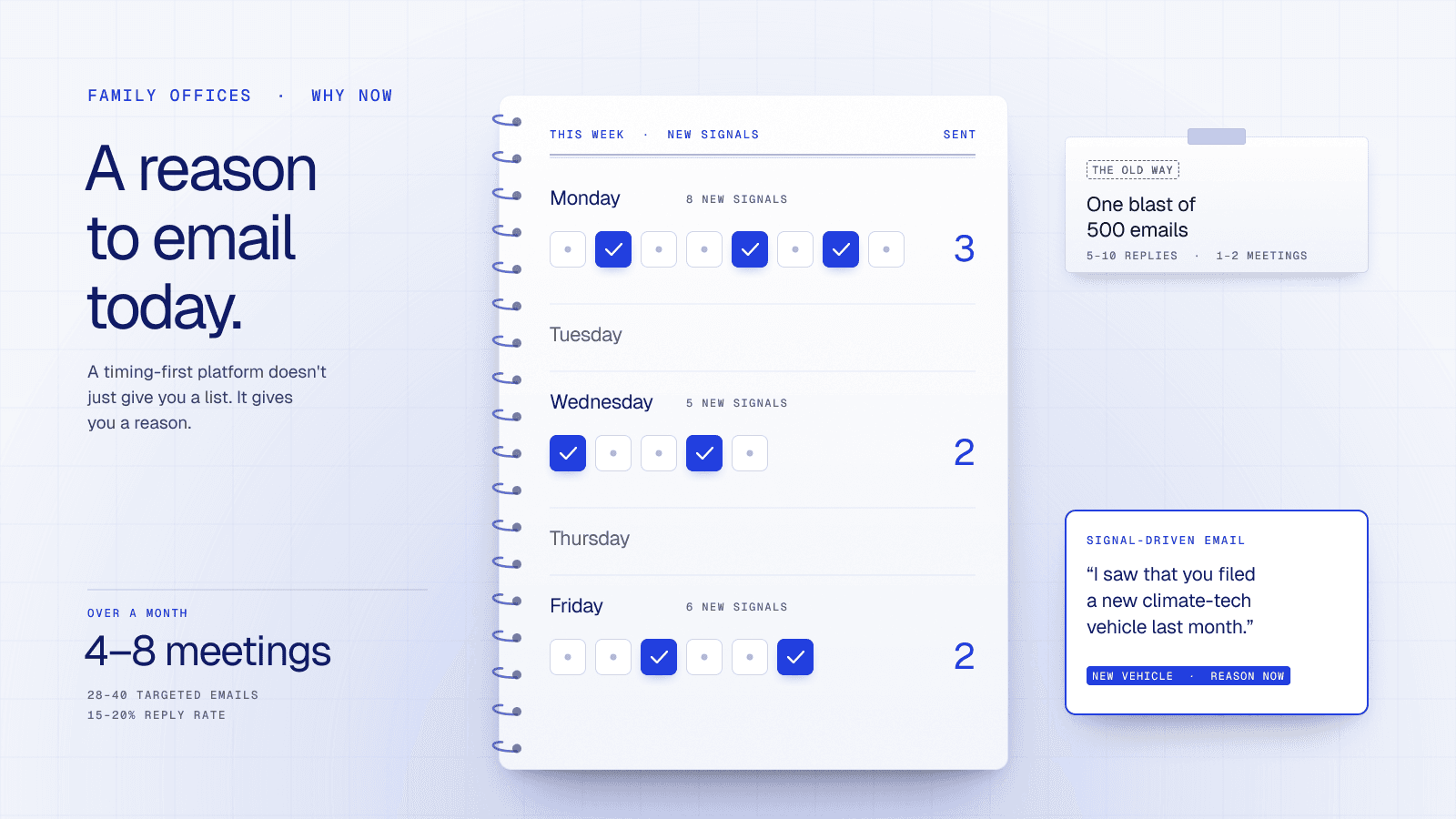
- Craft a personalized email referencing the signal: "I saw that you filed a new climate-tech vehicle last month. Our fund focuses on [specific sector]. Would love to discuss."
- Send to 15 contacts. Get a 15–20% reply rate.
- Follow up with the 2–3 who replied. Schedule meetings.
- Repeat weekly, using new signals.
The difference is not in the number of contacts. It's in the quality of the reason to contact.
4.2 Building a Pipeline of Signals
The most effective fund managers using Altss don't do a single big export. They build a pipeline of signals.
Here's a typical workflow:
Monday morning:
- Log into Altss.
- Check "New Signals" dashboard. See 8 new family-office signals from the weekend.
- Review each one. Identify 3 that are relevant to your fund.
- Write personalized emails referencing the signal.
- Send.
Wednesday:
- Check "New Signals" again. See 5 new signals.
- Review, identify 2 that are relevant.
- Send.
Friday:
- Check "New Signals." See 6 new signals.
- Review, identify 2 that are relevant.
- Send.
Over a month, you've sent 28–40 highly targeted emails, each with a reason to read. Your reply rate is 15–20%. You've scheduled 4–8 meetings. You've built relationships with family offices that are actively deploying capital.
Compare that to the old way: one blast of 500 emails, 5–10 replies, 1–2 meetings.
4.3 The Role of Warm Paths
Cold outreach works when it's signal-driven. But warm paths work better.
Altss includes a warm-path filter that surfaces connections between fund managers and family offices:
- Alumni networks: Did the CIO of the family office attend the same university as a member of your team? Did they work at the same investment bank?
- Shared investors: Does the family office invest in the same funds as your existing LPs?
- Conference attendance: Did the CIO speak at the same conference where you presented?
- Board connections: Does a member of your advisory board know the family office's CIO?
These warm paths are not a guarantee of a meeting. But they increase your reply rate by 2–3x.
Data point: Altss users who include a warm-path reference in their outreach get a 23% reply rate, compared to 12% for cold outreach with a signal-only reference.
4.4 The Emerging GP Advantage
Emerging GPs—first-time fund managers, spin-outs, and small teams—face a structural disadvantage in fundraising. They don't have the brand recognition, the track record, or the existing LP relationships of established firms.
But they have one advantage: agility.
Established firms are slow. They have to go through internal compliance, committee approvals, and relationship management processes. Emerging GPs can move fast.
A timing-first platform amplifies that advantage. When a family office files a new vehicle, an emerging GP can reach out within 48 hours. By the time the established firm gets around to it, the emerging GP is already in a conversation.
Named example: In December 2025, a first-time climate-tech fund manager used Altss to identify a European family office that had just filed a new climate-tech SPV. The fund manager reached out within 72 hours, referencing the SPV filing. Two weeks later, they had a meeting. Three months later, the family office committed $5 million.
The established firm that had been cultivating the relationship for six months? They didn't know about the SPV filing until the family office mentioned it in a quarterly update.
Section 5: What the Competition Gets Wrong
5.1 PitchBook
PitchBook's family-office coverage is a byproduct of its core business: company and deal data. The family-office profiles are thin, the refresh cycle is quarterly, and the signal categories are limited.
What PitchBook does well: Company and deal data. If you need to know which family office invested in a specific startup, PitchBook is useful.
What PitchBook gets wrong: Family-office intelligence. The profiles are not built for fundraising. There's no signal-driven outreach, no recency filters, no warm-path analysis.
Verdict: Good for research. Bad for fundraising.
5.2 Preqin
Preqin's strength is in fund-level data. Their family-office coverage is better than PitchBook's, but still limited.
What Preqin does well: Fund-level data. If you need to know which family offices invested in which funds, Preqin is useful.
What Preqin gets wrong: Refresh cycle. Preqin updates its family-office profiles quarterly at best. The signal categories are limited to fund investments and fundraising activity.
Verdict: Good for historical analysis. Bad for real-time outreach.
5.3 FINTRX
FINTRX focuses on family offices and RIAs. Their coverage is broad, but the refresh cycle is slow and the signal categories are limited.
What FINTRX does well: Coverage. FINTRX has a large database of family offices and RIAs.
What FINTRX gets wrong: Freshness and signals. Profiles are updated quarterly. There's no signal-driven outreach, no recency filters, no warm-path analysis.
Verdict: Good for directory completeness. Bad for timing.
5.4 Campden Wealth
Campden Wealth publishes an annual family-office survey. It's a useful snapshot, but it's not a database.
What Campden Wealth does well: Research and thought leadership. The annual survey provides macro-level insights.
What Campden Wealth gets wrong: Actionability. You can't use a survey to find family offices to contact.
Verdict: Good for context. Bad for execution.
5.5 The Gap
The common thread: every competitor is optimized for directory completeness, not fundraising timing. They can tell you who exists. They can't tell you who is relevant *right now*.
Altss fills that gap.
Section 6: The Altss Data Advantage — Specifics
6.1 Coverage Depth
Altss tracks:
- 9,000+ family offices globally, including single-family offices, multi-family offices, and hybrid structures.
- 30,000+ institutional investors, RIAs, and family offices across all allocator types.
- 150,000+ private-markets entities, including family offices, pension funds, endowments, foundations, insurance companies, sovereign wealth funds, fund-of-funds, and RIAs.
The family-office coverage breaks down by region:
- North America: 3,800+ family offices (42% of total)
- Europe: 2,700+ family offices (30% of total)
- APAC: 1,600+ family offices (18% of total)
- MENA: 600+ family offices (7% of total)
- LATAM: 300+ family offices (3% of total)
6.2 Signal Frequency
Altss captures an average of:
- 1,200+ new signals per week across all family offices.
- 300+ leadership changes per month (CIO, MD, head of PE/VC, CEO).
- 150+ new vehicle filings per month (SPVs, fund vehicles, holding companies).
- 200+ website changes per month (mandate language, team pages, news sections).
- 100+ press mentions per month (credible mentions in local financial media).
6.3 Refresh Cycle
Altss's refresh cycle is:
- Daily: Commercial registries, regulatory filings.
- Weekly: Personnel changes, website changes, press monitoring.
- Sub-30-day: Profile re-verification for all active profiles.
No profile is older than 60 days without active re-verification.
6.4 Contact Accuracy
Altss's contact validation rate is 94.7%. That means 94.7% of emails sent to Altss contacts reach the intended recipient's inbox.
The validation process:
- Ingestion: Every email is validated at ingestion using SMTP verification, domain validation, and role-account detection.
- Re-verification: Every email is re-verified every 30 days. If it bounces, it's flagged and re-checked within 24 hours.
- Removal: If an email fails re-verification twice, it's removed from the database.
6.5 Anti-Saturation
Altss limits bulk-export functionality to 500 contacts per month per user. Each export is logged and monitored. If a user exports the same list repeatedly, they're flagged.
The goal is not to restrict users. It's to protect the integrity of the contact data. If every fund manager exports the same 500 family offices and sends the same generic email, reply rates collapse for everyone.
Section 7: The Future — What's Coming in 2026 and Beyond
7.1 Deeper Signal Categories
Altss is expanding its signal categories to include:
- Regulatory changes: New regulations that affect family-office investing (e.g., SEC rules on private fund reporting, EU AIFMD updates).
- Tax changes: Changes in tax regimes that affect family-office location decisions (e.g., Dubai's new corporate tax, Singapore's tax incentives for family offices).
- Succession planning: Public signals of succession planning (e.g., next-generation family members joining the office, new family governance structures).
- Co-investment opportunities: Family offices actively seeking co-investment partners.
7.2 Enhanced Warm-Path Analysis
Altss is building a deeper warm-path analysis engine that will surface:
- Second-degree connections: Not just direct alumni or board connections, but connections through second-degree relationships.
- Investment commonalities: Family offices that have invested in the same funds as your existing LPs.
- Geographic overlaps: Family offices that have offices in the same cities as your team.
7.3 AI-Powered Outreach Assistance
Altss is developing AI-powered tools to help fund managers craft better outreach:
- Signal-based email templates: Automatically generated email drafts that reference the specific signal and explain why you're reaching out.
- Reply-rate optimization: Analysis of which signal types generate the highest reply rates for different fund strategies.
- Follow-up timing: Recommendations on when to follow up based on signal recency and family-office behavior patterns.
7.4 Expanded Institutional LP Coverage
Altss launched institutional LP coverage in February 2026. The platform is expanding this coverage to include:
- More pension funds: 1,500+ by end of 2026.
- More endowments and foundations: 1,000+ by end of 2026.
- More insurance companies: 500+ by end of 2026.
- More sovereign wealth funds: 150+ by end of 2026.
Section 8: Practical Advice for Fund Managers
8.1 If You're an Emerging GP
- Start with signals, not lists. Don't export 500 family offices. Find 10–15 that have a recent signal relevant to your fund.
- Personalize every email. Reference the signal. Explain why you're reaching out *now*.
- Build a pipeline. Check for new signals weekly. Send 2–3 emails per week. Over a month, you'll have sent 8–12 highly targeted emails.
- Use warm paths. If you have a connection to a family office, mention it. It increases your reply rate by 2–3x.
- Track your metrics. Measure reply rates, meeting rates, and close rates. Optimize based on what works.
8.2 If You're an Established Firm
- Don't rely on your existing relationships. Family offices change. The CIO you knew last year may have left. The mandate you pitched to may have shifted.
- Use signals to stay current. Set up alerts for family offices in your target universe. When a signal comes in, review it and decide whether to reach out.
- Don't blast. Even if you have a large team, don't send mass emails. Use signal-driven outreach to keep your reply rates high.
- Integrate with your CRM. Altss can export signals directly to your CRM. Use this to keep your team aligned.
8.3 If You're Raising Across Multiple Strategies
- Segment your universe. Create separate lists for PE, VC, real estate, credit, etc. Use Altss's filters to keep them separate.
- Track signals by strategy. Set up alerts for each strategy. When a signal comes in for PE, review it for your PE fund. When a signal comes in for VC, review it for your VC fund.
- Coordinate your team. Use Altss's shared dashboards to keep your team aligned on which family offices to target and why.
8.4 If You're Raising Internationally
- Use regional filters. Altss covers 40+ jurisdictions. Filter by region to find family offices in your target markets.
- Watch for cross-border signals. A family office in Europe opening an office in Singapore is a signal that they're expanding their APAC allocation.
- Be aware of cultural differences. Outreach that works in New York may not work in Dubai. Use Altss's press monitoring to understand local context.
Section 9: The Bottom Line
Family-office capital is not a side channel anymore. It's a core part of the fundraising surface area. But the databases that track family offices are still optimized for directory completeness, not fundraising timing.
The difference between a good database and a great one in 2026 is not the number of profiles. It's the number of signals that tell you *why now*.
Altss is built for that. OSINT-native data collection. Continuously refreshed profiles. Signal-driven outreach. Anti-saturation controls. Contact accuracy that protects deliverability.
If you're raising capital in 2026, you need a timing-first platform. You need Altss.
Section 10: How to Get Started
Altss is available now for fund managers and emerging GPs raising capital. The platform covers 9,000+ family offices globally, with sub-30-day refresh cycles and signal-driven outreach capabilities.
To get started:
- Request a demo: Visit altss.com/demo to schedule a walkthrough.
- Set up your universe: Work with the Altss team to define your target family-office universe based on strategy, geography, and mandate.
- Start tracking signals: Set up alerts for the signals that matter most to your fund.
- Begin outreach: Use Altss's signal-driven approach to craft personalized emails that get replies.
The best time to start was yesterday. The second-best time is now.
Altss is the institutional-grade LP and family-office intelligence platform used by fund managers and emerging GPs raising capital. Track 9,000+ family offices, 30,000+ institutional investors, and 150,000+ private-markets entities with sub-30-day refresh cycles. Built for timing. Delivered for fundraising.
Find the allocators who actually back funds like yours
GPs and IR teams use Altss to research allocators with ownership, commitment, transaction and relationship context, then prioritize outreach.


See the allocators behind your next close.
Public records carry source-specific dates where available. No population-wide measured refresh cadence or universal verification deadline is established here. Page modified, source captured, fact observed, entity verified and aggregate measured describe different events. Check the date attached to the relevant claim; a missing verification date means unknown. Stored source history does not establish a customer-facing historical-analysis interface.