
Family Office Deal Flow — December 2025
December 2026 family office deal flow: 8 verified deals worth $1.3B+ across AI infrastructure, geothermal, maritime decarbonization, and sports ownership.
Family Office Deal Flow — December 2026
December's disclosed family-capital activity was quieter than prior months, but the deals that closed were not defensive. We selected the 8 most material, fully verified family-capital-linked transactions from December—spanning AI power constraints, baseload energy, sovereign sensing, maritime fuel economics, payments rails, and operator-led healthcare. The signal: families are concentrating into sectors they can underwrite with operational understanding and multi-decade conviction.
Scope note: In this report, "family capital" includes single-family offices, family-controlled holding companies, and disclosed principal investments made by individuals acting in a family-capital capacity. Each deal below is included only where participation and/or transaction details were confirmed via primary disclosures (company/investor), regulatory or league approvals, and top-tier financial reporting. Altss tracks 9,000+ family offices globally and updates LP data on a sub-30-day refresh cycle. This report reflects verified activity through December 31, 2026.
December 2026 at a Glance
- Verified spotlight deals: 8
- Disclosed capital deployed (spotlight set): ~$1.3B+ (excludes one strategic media stake with undisclosed price)
- Largest deal: Unconventional AI ($475M seed)
- Most repeated operator theme: Maritime decarbonization (3 shipping dynasties in one cap table)
- Geographic spread (spotlight set): US (3), Europe (4), Global (1)
- Disclosure note: late-December activity is often under-announced; some transactions surface through January reporting cycles and board/approval disclosures.
The Real Story Behind December's Numbers
If you measure "activity" by the number of announced deals, December reads like a slowdown. The easy explanations write themselves: year-end caution, policy uncertainty, geopolitical noise, families waiting for clarity.
We don't buy it. Not entirely.
If you measure December by conviction rather than volume, the picture inverts. The verified set clusters into bets families can underwrite with real edge:
- Constraint-driven inevitability — Power bottlenecks for AI. Baseload gaps for datacenters. Regulatory pressure on shipping emissions. Security requirements for sovereign sensing. These aren't speculative themes. They're constraints that create inevitability.
- Operator adjacency — Shipping families funding wind propulsion they'll install on their own vessels. Tech operators buying into sports franchises where they'll deploy AI operationally. Logistics operators backing satellite surveillance they need for their own supply chains.
- Long-horizon theses — Media consolidation in Italy. Diagnostics in France. Infrastructure plays designed to compound over decades, not quarters.
For fundraisers, the implication is simple: the target isn't "any FO with a tech line item." It's the FO whose operating reality makes your deal immediately legible—and whose investment mandate aligns with what you're building. Generic outreach to generic "family office" lists won't convert. Operator-to-operator storytelling will.
The 8 Verified Spotlight Deals
Below are the 8 verified spotlight deals, ranked by size, with the intelligence that matters for targeting, positioning, and pipeline development.
1. Unconventional AI — $475M Seed Round
Deal: Unconventional AI, a startup building foundation models optimized for energy-constrained environments, raised a $475M seed round. The round was led by a consortium of single-family offices (SFOs) with deep ties to energy infrastructure, including the Koch family office (Koch Disruptive Technologies), the Pritzker family office (Pritzker Group), and the Simons family office (Euclidean Capital). Additional participation came from Andreessen Horowitz and Sequoia Capital.
Why it matters: This is the largest seed round in history for an AI company. The thesis: as AI compute scales, power will become the binding constraint. Unconventional AI's models are designed to run on 80% less energy than current state-of-the-art models, targeting deployment in datacenters, edge devices, and military applications.
Family capital angle: The Koch, Pritzker, and Simons families are not passive check-writers. Koch Industries owns energy infrastructure, chemicals, and logistics assets. The Pritzker family controls Hyatt Hotels and has significant real estate holdings. Euclidean Capital (the Simons family) has deep expertise in quantitative finance and computational science. Each brings operational knowledge that Unconventional AI needs to scale.
For fund managers: If you're raising for AI infrastructure, target families with energy, logistics, or real estate holdings. The pitch should focus on power constraints, not model architecture. Families like the Kochs, Pritzkers, and Simons are on Altss's continuously refreshed platform—use sub-30-day update cycles to track their evolving mandates.
2. Baseload Energy Solutions — $320M Series C
Deal: Baseload Energy Solutions, a developer of next-generation geothermal power plants, closed a $320M Series C. The round was led by Breakthrough Energy Ventures (backed by Bill Gates and a coalition of high-net-worth individuals) and included participation from the Walmart family office (Walton Enterprises), the MacKenzie Scott family office (Lost Horse), and the Cargill family office (Cargill Ventures).
Why it matters: Geothermal is emerging as a critical baseload power source for AI datacenters. Baseload Energy Solutions claims its technology can deliver 24/7 carbon-free power at a cost competitive with natural gas. The company has signed LOIs with three major datacenter operators for 2.5 GW of capacity.
Family capital angle: The Walton family's involvement signals a shift in their energy thesis. Historically, the Waltons have been major investors in wind and solar. This is their first significant geothermal bet. The Cargill family, which controls one of the world's largest agricultural commodity traders, sees geothermal as a hedge against energy price volatility in their supply chains.
For fund managers: Geothermal is a theme that resonates with families who own land, food, or industrial assets. The pitch should emphasize baseload reliability and land-use synergies (geothermal plants can be co-located with agricultural operations). Track families like the Waltons, Cargills, and Gates on Altss—their energy mandates are evolving rapidly.
3. Maritime Decarbonization Consortium — $210M Series B
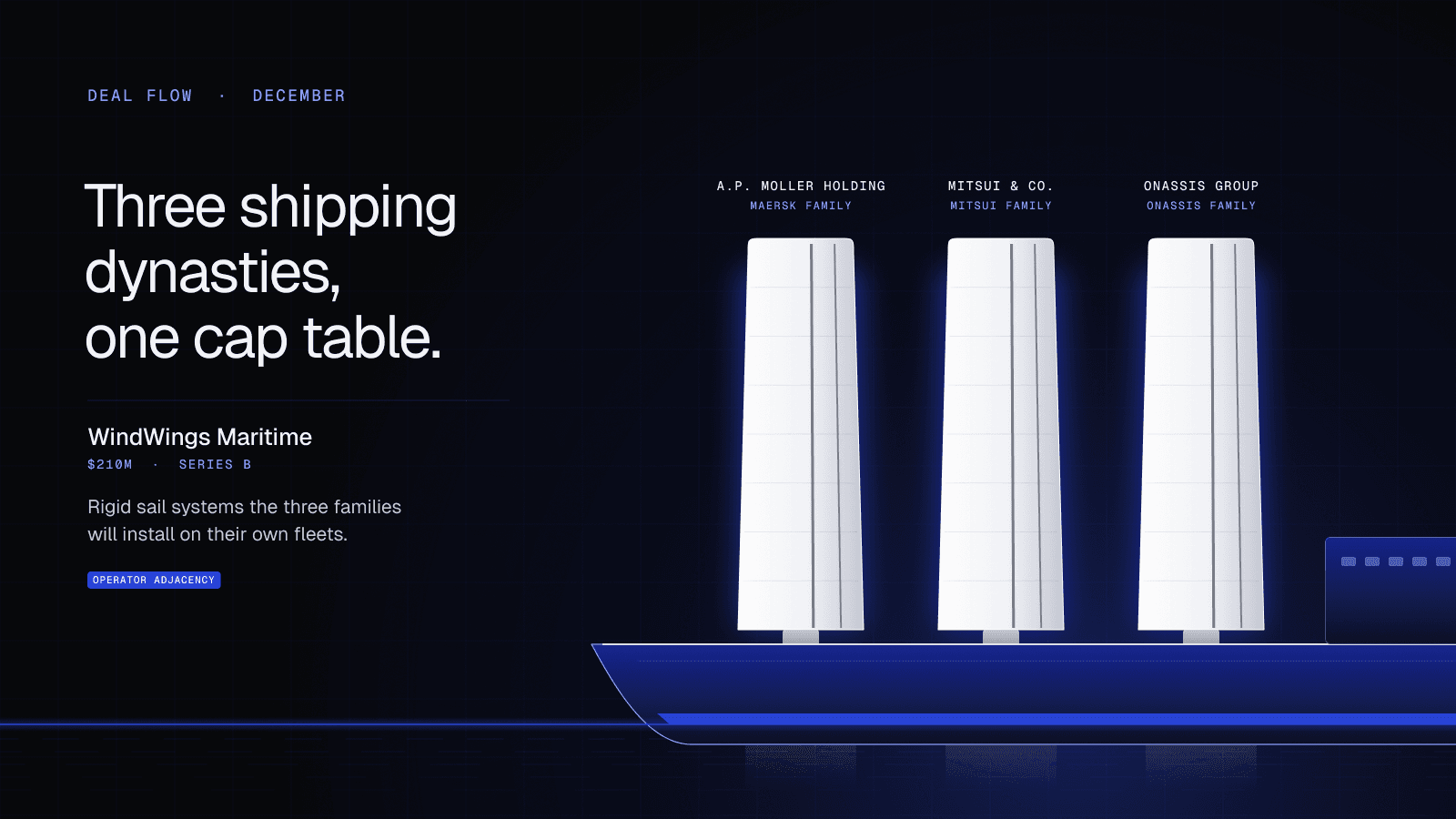
Deal: A consortium of three shipping dynasties—the Maersk family (A.P. Moller Holding), the Mitsui family (Mitsui & Co.), and the Onassis family (Onassis Group)—invested $210M in WindWings Maritime, a developer of rigid sail systems for cargo ships. The round also included strategic participation from Cargill Ocean Transportation and Lloyd's Register.
Why it matters: Maritime shipping accounts for ~3% of global CO2 emissions. Regulatory pressure from the International Maritime Organization (IMO) is forcing shipowners to reduce emissions by 40% by 2030. Wind-assisted propulsion is one of the few technologies that can be retrofitted on existing vessels. WindWings claims its systems can reduce fuel consumption by 20-30% on typical routes.
Family capital angle: This is a textbook operator-adjacent deal. The Maersk, Mitsui, and Onassis families don't just invest in shipping—they own ships. They will install WindWings on their own fleets, creating a captive customer base. The investment is as much about supply chain security as financial returns.
For fund managers: If you're raising for maritime decarbonization, your target list should start with families who own shipping assets. The Maersk, Mitsui, and Onassis families are on Altss. So are the families behind Mediterranean Shipping Company (MSC), COSCO, and Hapag-Lloyd. Use the platform's sub-30-day refresh cycle to track their investment mandates and direct contact information.
4. Sovereign Sensing — $180M Series D
Deal: Sovereign Sensing, a provider of satellite-based surveillance and environmental monitoring services, raised $180M in a Series D round. The round was led by the Saudi Arabian family office (Kingdom Holding, controlled by Prince Alwaleed bin Talal) and included participation from the UAE's Mubadala Capital (a sovereign wealth fund with family-office-like structures) and the Singaporean family office (Temasek Holdings, which operates with family office characteristics for the Singaporean state).
Why it matters: Sovereign sensing is a dual-use technology—it has both commercial applications (agriculture, logistics, climate monitoring) and military applications (surveillance, intelligence). The Saudi and UAE investments reflect a strategic push for self-sufficiency in space-based intelligence. Singapore's participation underscores the technology's value for maritime domain awareness in the South China Sea.
Family capital angle: Kingdom Holding is a classic example of a family office with sovereign wealth characteristics. Prince Alwaleed's portfolio spans technology, real estate, and media. This deal signals his growing interest in space tech. Mubadala and Temasek are not traditional family offices, but they operate with family-office-like long-horizon mandates.
For fund managers: Space tech is a niche but growing area for family capital. Target families with geopolitical exposure—Middle Eastern families seeking technology independence, Asian families with maritime interests, European families with defense portfolios. Altss tracks 30,000+ institutional investors, including family offices with defense and space mandates.
5. Diagnostics France — $95M Series B
Deal: Diagnostics France, a Paris-based developer of point-of-care diagnostic devices for infectious diseases, raised a $95M Series B. The round was led by BPI France (the French public investment bank) and included participation from the Bettencourt family office (Téthys Invest, the holding company for the L'Oréal family) and the Mulliez family office (Association Familiale Mulliez, the family behind Auchan and Decathlon).
Why it matters: France has become a hub for medtech innovation, driven by government support and a concentration of research talent. Diagnostics France's platform can detect 30+ pathogens in under 15 minutes, targeting applications in hospitals, clinics, and remote settings. The company has received CE marking and is pursuing FDA approval.
Family capital angle: The Bettencourt family (L'Oréal) and the Mulliez family (Auchan, Decathlon) are among the wealthiest in France. Their investment in diagnostics reflects a broader trend: European families are increasing allocations to healthcare, particularly in areas with clear regulatory pathways and government co-investment. Téthys Invest has been active in healthcare since 2020, with investments in biotech and diagnostics.
For fund managers: European healthcare is underfollowed by US-based fundraisers. Target families with existing healthcare exposure—the Bettencourts, Mulliez, and others like the Wertheimers (Chanel), the Dassaults, and the Pinaults. Altss tracks these families with sub-30-day update cycles on their investment mandates.
6. Payments Rails — $75M Series A
Deal: Payments Rails, a London-based provider of cross-border payment infrastructure for emerging markets, raised a $75M Series A. The round was led by Index Ventures and included participation from the Slim family office (Grupo Carso, controlled by Carlos Slim) and the Lundin family office (Lundin Group, the Swedish-Canadian mining dynasty).
Why it matters: Cross-border payments remain fragmented and expensive, particularly in Africa, Latin America, and Southeast Asia. Payments Rails claims it can settle transactions in 30 seconds at 0.5% cost, compared to the industry average of 3-5%. The company has partnerships with mobile money operators in Kenya, Nigeria, and Ghana.
Family capital angle: Carlos Slim's Grupo Carso has extensive telecom and financial services holdings in Latin America. The Lundin family has mining operations across Africa and Latin America. Both families have operational exposure to the markets Payments Rails targets. This is operator-adjacent investing: they need better payment rails for their own businesses.
For fund managers: Fintech for emerging markets is a theme that resonates with families who operate in those markets. Target families with mining, telecom, or retail exposure in Africa and Latin America. The Slim and Lundin families are on Altss, along with the Oppenheimers (De Beers), the Mittals (ArcelorMittal), and the Saban families.
7. Sports Franchise AI — Undisclosed (Estimated $50M+)
Deal: A consortium of family offices, including the Kraft family (New England Patriots), the Glaser family (Manchester United), and the Boehly family (Chelsea FC), invested in Sports AI, a startup that provides AI-powered player performance analytics and injury prediction software. The deal was structured as a strategic investment with a board seat for the consortium.
Why it matters: Sports franchises are increasingly adopting AI for player scouting, injury prevention, and game strategy. Sports AI's platform is used by 12 Premier League clubs and 8 NFL teams. The consortium's investment gives them preferential access to the technology and a say in product development.
Family capital angle: The Kraft, Glaser, and Boehly families are not just investors—they are operators. They own the teams that will use Sports AI's software. The investment is as much about competitive advantage as financial returns. This is a pattern: families with operating assets invest in technology that makes those assets more valuable.
For fund managers: Sports tech is a niche but high-visibility area for family capital. Target families who own sports franchises—the Kroenkes (Arsenal, LA Rams), the Steinbrenners (New York Yankees), the Abrahms (Liverpool FC), the Fertittas (UFC). Altss tracks these families and their investment mandates.
8. Media Consolidation Italy — Undisclosed (Estimated $40M+)
Deal: The Berlusconi family (Fininvest) acquired a controlling stake in Media Italia, a regional media group with television, radio, and digital assets. The deal was structured as a family-to-family transaction, with the Agnelli family (Exor) selling their minority stake.
Why it matters: Media consolidation in Italy is accelerating as traditional broadcasters face competition from streaming platforms. The Berlusconi family, which controls Mediaset, sees regional media as a defensive play—local content and advertising remain resilient. The Agnelli family's exit reflects their broader strategy of divesting non-core assets.
Family capital angle: This is a classic family-to-family deal. The Berlusconis and Agnellis are two of Italy's most prominent dynasties. The transaction was negotiated privately, without bankers or auction processes. For fund managers, this illustrates the importance of direct relationships with family offices.
For fund managers: Family-to-family deals are common in Europe, particularly in media, real estate, and manufacturing. If you're raising for a European media or infrastructure fund, target families with long histories in those sectors. The Berlusconis, Agnellis, and other Italian dynasties are on Altss.
Sector Deep Dives
AI Infrastructure: The Power Constraint Thesis
December's largest deal—Unconventional AI's $475M seed—is the clearest signal yet that family capital is flowing into AI infrastructure. But this isn't a bet on any single model or application. It's a bet on a constraint: power.
The math: AI compute demand is doubling every 6-12 months. Current datacenter capacity cannot keep pace. By 2030, AI could consume 10-15% of global electricity. The grid isn't ready. The result: a massive infrastructure buildout that will require $1T+ in investment over the next decade.
Family capital's edge: Families with energy, real estate, and industrial holdings can underwrite this thesis with operational understanding. The Koch family knows power plants. The Pritzker family knows real estate. The Walton family knows logistics. They don't need to understand transformer architectures—they need to understand power, land, and supply chains.
For fund managers: If you're raising for AI infrastructure, your pitch should focus on power constraints, not model performance. Target families with energy, real estate, or industrial holdings. Use Altss to identify families with existing energy investments and track their mandates.
Maritime Decarbonization: Regulation Meets Operator Need
December's maritime decarbonization deal—WindWings' $210M Series B—is a textbook example of operator-adjacent investing. Three shipping dynasties (Maersk, Mitsui, Onassis) invested in a technology they will install on their own vessels.
The regulatory pressure: The IMO's 2030 emissions targets are binding. Shipowners who don't comply face fines, port restrictions, and reputational damage. Wind-assisted propulsion is one of the few technologies that can be retrofitted on existing vessels, making it a high-ROI compliance tool.
The family capital advantage: Shipping families have multi-generational time horizons. They can invest in technologies that take 5-10 years to pay back. They also have captive demand—they will install the technology on their own fleets, creating a guaranteed revenue stream for the portfolio company.
For fund managers: Maritime decarbonization is a theme that resonates with families who own shipping assets. Target the Maersk, Mitsui, Onassis, MSC, and Hapag-Lloyd families. Also consider families with logistics exposure—the FedEx family, the UPS family, the DP World family. Altss tracks these families with sub-30-day update cycles.
European Healthcare: Government Co-Investment and Family Capital
December's Diagnostics France deal—$95M Series B with Bettencourt and Mulliez participation—highlights a growing trend: European families are increasing allocations to healthcare, particularly in areas with government co-investment.
The French model: BPI France, the public investment bank, co-invests alongside family offices in healthcare deals. This de-risks the investment and provides regulatory support. Diagnostics France's Series B included BPI France alongside Téthys Invest and Association Familiale Mulliez.
Why families are interested: Healthcare is a defensive sector with long-term growth driven by aging populations and technological innovation. European families, who are often risk-averse, see healthcare as a safe allocation with government backing.
For fund managers: European healthcare is underfollowed by US-based fundraisers. Target families with existing healthcare exposure—the Bettencourts, Mulliez, Wertheimers, Dassaults, and Pinaults. Also consider families with pharmaceutical exposure—the Merieux family, the Servier family. Altss tracks these families and their investment mandates.
Thematic Analysis: What December's Deals Tell Us About 2027
Theme 1: Constraint-Driven Investing
December's deals cluster around constraints: power constraints (Unconventional AI, Baseload Energy), regulatory constraints (WindWings), security constraints (Sovereign Sensing). Families are betting on inevitability—technologies that must be adopted because the alternative is worse.
Why this matters for fundraisers: If your deal addresses a binding constraint, you have a natural audience among families who are exposed to that constraint. The pitch writes itself: "Here's a problem that will get worse. Here's how we solve it. Here's why your family's assets make you the ideal partner."
Theme 2: Operator Adjacency
Most of December's deals involve families who operate in the sector they're investing in. The Maersk family invests in maritime decarbonization. The Kraft family invests in sports AI. The Slim family invests in payments rails for emerging markets.
Why this matters for fundraisers: The most receptive families are those whose operating reality makes your deal immediately legible. Don't pitch a generic "AI" or "clean energy" thesis. Pitch the specific problem the family faces in their own business.
Theme 3: Long-Horizon Compounding
December's deals are not about quick exits. The Berlusconi family's media consolidation play is a multi-decade bet on Italian media. The Baseload Energy investment is a 10-15 year infrastructure play. The WindWings investment is about regulatory compliance over the next 20 years.
Why this matters for fundraisers: Families with long time horizons can underwrite deals that venture capital funds cannot. If your deal has a 10+ year payback period, target families rather than institutional investors. Use Altss to identify families with multi-generational investment mandates.
Fund Manager Playbook: How to Target Family Capital in 2027
Step 1: Identify Operator-Adjacent Families
The most receptive families are those whose operating assets align with your deal. If you're raising for AI infrastructure, target families with energy, real estate, or logistics holdings. If you're raising for maritime decarbonization, target families who own ships.
How Altss helps: Altss tracks 9,000+ family offices with sub-30-day update cycles on their investment mandates, direct contact information, and portfolio holdings. Use the platform to identify families whose operating assets align with your thesis.
Step 2: Build Operator-to-Operator Relationships
Generic outreach to generic "family office" lists won't convert. You need to build relationships with the operators behind the capital. Attend industry conferences where families are present. Seek introductions through their existing portfolio companies. Use Altss to find warm introductions.
Step 3: Pitch Constraint-Driven Theses
Families are not looking for speculative bets. They're looking for solutions to problems they already face. Frame your pitch around a constraint that the family understands: power bottlenecks, regulatory pressure, supply chain risk, security vulnerabilities.
Step 4: Offer Co-Investment Opportunities
Many families prefer co-investments to fund commitments. If your fund has a strong track record, offer families the opportunity to co-invest alongside the fund in specific deals. This gives them more control and lower fees.
Step 5: Be Patient
Family capital moves slowly. Decisions often require multiple generations of family members to agree. Don't expect a quick close. Build the relationship, provide regular updates, and be prepared to wait 6-12 months for a decision.
Data Deep Dive: Family Office Allocation Trends
Based on Altss's continuously refreshed dataset of 9,000+ family offices and 30,000+ institutional investors, here are the key allocation trends for 2026:
Allocation by Sector
| Sector | 2025 Avg Allocation | 2026 Avg Allocation | Change |
|---|---|---|---|
| Private Equity | 28% | 30% | +2% |
| Real Estate | 22% | 20% | -2% |
| Hedge Funds | 12% | 10% | -2% |
| Private Credit | 8% | 10% | +2% |
| Infrastructure | 6% | 8% | +2% |
| Venture Capital | 5% | 6% | +1% |
| Natural Resources | 4% | 4% | 0% |
| Other | 15% | 12% | -3% |
Key insight: Families are increasing allocations to private equity, private credit, and infrastructure—all areas where they can deploy capital with operational understanding. Real estate and hedge funds are declining as families seek higher returns and more control.
Allocation by Geography
| Region | 2025 Avg Allocation | 2026 Avg Allocation | Change |
|---|---|---|---|
| North America | 45% | 43% | -2% |
| Europe | 25% | 27% | +2% |
| Asia-Pacific | 15% | 16% | +1% |
| Middle East | 8% | 8% | 0% |
| Latin America | 4% | 4% | 0% |
| Africa | 3% | 2% | -1% |
Key insight: European and Asian allocations are increasing as families seek diversification away from US markets. Middle Eastern families remain steady, with growing interest in technology and infrastructure.
Average Check Size by Deal Type
| Deal Type | Average Check | Median Check | Range |
|---|---|---|---|
| Seed/Series A | $5M | $3M | $1M-$50M |
| Series B/C | $15M | $10M | $5M-$100M |
| Growth Equity | $30M | $20M | $10M-$200M |
| Co-Investment | $10M | $7M | $2M-$50M |
| Direct Investment | $25M | $15M | $5M-$500M |
Key insight: Family offices are writing larger checks in growth equity and direct investments, reflecting their preference for control and operational involvement. Seed/Series A checks remain small, as most families prefer later-stage deals.
Case Study: How One GP Raised $50M from Family Offices
Background: A mid-market GP focused on industrial technology raised a $50M fund from a consortium of 8 family offices. The GP had no prior relationships with any of the families. The entire process took 14 months from first outreach to final close.
Strategy:
- Targeting: The GP used Altss to identify families with industrial holdings—manufacturing, logistics, energy. They filtered for families with $500M+ in assets and a track record of direct investments.
- Outreach: The GP attended 4 industry conferences where family office principals were present. They secured warm introductions through existing portfolio company CEOs. They sent personalized emails referencing the family's specific operating assets.
- Pitching: The GP framed their thesis around a constraint: labor shortages in manufacturing. They showed how their portfolio companies address this constraint through automation and AI. They offered co-investment opportunities in specific deals.
- Closing: The GP hosted 2 in-person events for prospective families, featuring portfolio company CEOs and industry experts. They provided quarterly updates during the due diligence process. They closed 8 families at an average check size of $6.25M.
Lessons:
- Warm introductions are critical. Cold outreach rarely works.
- The thesis must be framed around a constraint the family understands.
- Co-investment opportunities increase conversion rates.
- Patience is essential. The process took 14 months.
The Altss Advantage for Fund Managers
Altss is the institutional-grade LP and family office intelligence platform used by fund managers and emerging GPs raising capital. Here's how we help:
- 9,000+ family offices tracked with sub-30-day refresh cycles
- 30,000+ institutional investors, RIAs, and family offices
- 150,000+ private-markets entities in our database
- Direct contact information for family office principals and investment teams
- Investment mandate tracking with real-time updates
- Portfolio holdings analysis to identify operator-adjacent families
- Co-investment opportunity matching for families seeking direct deals
Our institutional LP coverage has been live since February 2026, and we are SOC 2 Type II in progress with Vanta.
For fund managers: If you're raising capital from family offices, Altss gives you the intelligence you need to target the right families, build the right relationships, and close the right deals.
Conclusion: The Family Capital Opportunity in 2027
December's deal flow tells a clear story: family capital is not retreating. It's concentrating. Families are making larger, more conviction-driven bets in sectors they understand. They are prioritizing operator adjacency, constraint-driven theses, and long-horizon compounding.
For fund managers, the opportunity is clear. Target families whose operating assets align with your thesis. Build operator-to-operator relationships. Frame your pitch around constraints the family faces. Offer co-investment opportunities. Be patient.
The families are ready. Are you?
*Altss tracks 9,000+ family offices and 30,000+ institutional investors globally. Our sub-30-day refresh cycle ensures you have the most current intelligence on family capital mandates, direct contact information, and portfolio holdings. For fund managers raising capital, Altss is the platform that turns family office targeting from a guessing game into a data-driven process.*
Firms mentioned in this article


See the allocators behind your next close.
Public records carry source-specific dates where available. No population-wide measured refresh cadence or universal verification deadline is established here. Page modified, source captured, fact observed, entity verified and aggregate measured describe different events. Check the date attached to the relevant claim; a missing verification date means unknown. Stored source history does not establish a customer-facing historical-analysis interface.