
Family Office Targeting Strategy (2026): From Research to First Meeting
Why family office outreach fails and how to fix it. A 4-layer qualification model with research workflows, scoring frameworks, and post-meeting conversion.
Family Office Targeting Strategy (2026): From Research to First Meeting
Family office outreach fails for five predictable reasons—mandate mismatch, vehicle incompatibility, timing gaps, wrong decision-chain contact, and poor sender infrastructure—and this guide provides an operating system for fixing all five.
The Core Problem: Why Most Outreach Fails
The numbers are brutal. A typical emerging GP sends 200–300 family office emails per quarter. They get 5–10 responses. One converts to a first meeting. That's a 0.3–0.5% conversion rate.
The cost is worse than the low conversion. Each failed outreach degrades sender reputation, burns warm introductions, and wastes months of a team's limited time. For a lean fundraising team of two people, 300 bad emails represent roughly 60 hours of work—gone.
The five failure modes are consistent across every firm we've analyzed:
Mandate mismatch: You pitch a buyout fund to an office that only does venture. They said "alternatives" on their website. Their actual behavior shows zero buyout commitments in five years.
Vehicle incompatibility: You offer a blind pool. They only do direct deals. Or you offer a 10-year locked vehicle. Their liquidity plan requires annual redemptions.
Timing gaps: You reach out in January. They completed their 2026 allocations in November. Your email arrives during their "no new manager" window.
Wrong decision-chain contact: You email the CIO. The CIO delegates all first-pass screening to an investment analyst who filters everything. You never reach the decision maker.
Poor sender infrastructure: Your email lands in spam. Or your domain lacks authentication. Or your CRM triggers their security protocols. The content never gets read.
These five failures compound. A target that fails on mandate fit will also likely fail on timing. A target where you contact the wrong person will also likely fail on vehicle compatibility because you never get far enough to discuss terms.
The fix isn't working harder. It's working with a system that prevents these failures before you send the first email.
What's Changed in 2026
1) Allocation preferences are now more explicit
Family offices still allocate materially to alternatives. The 2026 change is granularity. Preferences are increasingly expressed by sub-strategy, structure, and liquidity profile. "Alternatives" is not a useful filter by itself.
Consider two family offices that both report "20% allocation to alternatives":
- Office A: A single-family office managing $800M for a manufacturing dynasty. Their alternatives allocation breaks down as 60% buyout (control positions, $50M+ checks), 25% real assets (timber, farmland), 15% venture (only deep tech, only Series B+). They prefer blind pools with 10-year terms. They meet new managers twice per year, in Q2 and Q4.
- Office B: A multi-family office managing $1.2B across 14 families. Their alternatives allocation is 40% direct real estate (multifamily, self-storage), 35% private credit (direct lending, CLOs), 25% secondaries. They never do blind pools. They only invest through separately managed accounts. They meet managers on a rolling basis.
Both allocate to "alternatives." Both are fundamentally different targets. Office A should get your buyout fund pitch. Office B should get your direct lending SMA proposal. Send the wrong product to the wrong office and you've wasted the introduction.
The only way to distinguish: look at what they've actually backed, not what they say they do. Altss tracks 9,000+ family offices globally with sub-30-day refresh cycles on LP data. The difference between stated preferences and revealed preferences is where targeting errors live.
2) The quality bar has risen because noise has risen
Family offices are receiving more outreach than ever. The 2026 estimate: the average office receives 40–60 unsolicited fund pitches per month, up from 20–30 in 2023. This includes:
- Templated emails from capital introduction platforms
- Generic thought leadership newsletters
- Mass "we're raising a fund" blasts
- Cold LinkedIn connection requests with pitch decks attached
- Automated CRM sequences that don't respect reply status
When noise rises, recipients shift to filters. The three filters that matter in 2026:
Trusted referrals: A warm introduction from a lawyer, accountant, or fellow family office carries 10x the weight of a cold email. The referral signals that someone they trust has vetted you.
Observable behavior signals: Did you attend the same conference? Did you write a paper they read? Did you invest in a company they know? These signals create context for the outreach.
Clear mandate alignment: Can you state in one sentence why this specific office should meet you? If you can't, they won't figure it out for themselves.
This is why a 2026 targeting system must be auditable internally. You should be able to show why a target belongs on the list and what evidence supports the fit claim. If a team member asks "why are we reaching out to the Smith Family Office?" and you can't answer immediately, that target doesn't belong on the list.
3) Outreach mechanics are stricter
Email deliverability in 2026 is harder than it was in 2023. The major providers (Gmail, Outlook, Yahoo) have tightened authentication requirements. Low-quality targeting compounds into delivery problems because it produces weak engagement and higher complaint risk.
The mechanics that matter:
Domain authentication: SPF, DKIM, and DMARC are non-negotiable. Without them, your emails go to spam or get blocked entirely.
Warm-up protocols: New domains need 4–6 weeks of gradual send volume increase before they can handle fundraising-scale outreach.
Bounce management: Hard bounces above 2% trigger provider penalties. Soft bounces above 5% hurt sender reputation.
Complaint monitoring: Each spam complaint above 0.1% degrades your domain. At 0.3%, you're blacklisted.
Reply management: Automated sequences that ignore replies damage relationships. Every reply should trigger a human response within 24 hours.
Spray-and-pray fails twice: it converts poorly, and it degrades your sender reputation. A burned domain takes months to recover. For a fundraising team sending 50–100 emails per week, domain health is infrastructure, not an afterthought.
4) Compliance and marketing governance are operational
If you operate under regulated marketing constraints (SEC, FCA, MAS, etc.), what you say and how you present performance can create downstream friction. The 2026 regulatory environment is stricter on:
- Past performance presentation: You need clear disclaimers, consistent time periods, and net-of-fee calculations. Cherry-picking vintage years or benchmark comparisons creates regulatory risk.
- Target return language: "Targeting 20% IRR" without probability disclosures or methodology notes triggers scrutiny.
- Forward-looking statements: Market commentary that implies guaranteed outcomes creates liability.
- Testimonials and endorsements: Using LP quotes or logos without explicit permission and regulatory review is increasingly risky.
The managers who treat compliance as a marketing advantage—clean materials, clear disclosures, auditable claims—stand out. The ones who cut corners create friction that kills deals.
The 4-Layer Qualification Model
Every target in your pipeline should pass through four qualification layers. If a target fails any layer, they don't get outreach. This prevents the five failure modes before they happen.
Layer 1: Mandate Fit
Question: What do they actually allocate to (not what they claim)?
Most family offices have a public story and a private reality. The public story is what's on their website: "We invest in alternatives, real estate, and private equity." The private reality is what their portfolio actually shows: 60% direct real estate, 20% venture, 10% buyout, 10% cash. The private reality is what matters for targeting.
How to assess mandate fit:
- Review historical commitments: Look at the last 3–5 years of known investments. What strategies, vehicles, check sizes, and geographies appear? Pattern recognition matters more than stated preferences.
- Check for sub-strategy specificity: Do they do growth equity or control buyouts? Direct lending or distressed credit? Early-stage venture or growth-stage? The more specific you can get, the better your fit assessment.
- Look for consistency: An office that has done 10 venture investments and 0 buyout investments in five years is not a buyout target, regardless of what their website says.
- Identify exclusions: Some offices explicitly avoid certain sectors (energy, healthcare, defense) or structures (blind pools, 10-year locks, fund-of-funds). These exclusions are as important as inclusions.
Example: The Chen Family Office ($500M AUM) states they "invest across private equity." Their actual commitments over four years: seven venture deals (Series A–C, $2M–$5M checks), two growth equity deals ($10M–$15M), zero buyout, zero credit, zero real assets. They are a venture/growth target. Pitching a buyout fund wastes everyone's time.
Layer 2: Capacity Fit
Question: Are they in a manager-add window right now?
Mandate fit tells you what they do. Capacity fit tells you whether they're currently doing it. Many family offices operate on annual or biannual allocation cycles. If you contact them in the wrong window, the answer is no regardless of fund quality.
How to assess capacity fit:
- Identify allocation cadence: Do they meet new managers quarterly, semi-annually, or annually? Some offices have a "2026 allocation" that was decided in Q4 2025. They won't consider new managers until Q4 2026.
- Check for recent commitments: An office that committed to three new funds in the past six months is likely saturated. An office that hasn't made a new commitment in 18 months may be in a "no new managers" period.
- Look for liquidity events: Offices that just completed a large exit (company sale, IPO, real estate disposition) often have fresh capital to deploy. This creates a 6–12 month window for new commitments.
- Monitor team changes: A new CIO, investment director, or family member joining the investment committee often triggers a review of existing relationships and openness to new ones.
- Assess overallocation risk: If their alternatives allocation is already at 25% and their target is 20%, they're overallocated. They won't add new managers until they get distributions or change their target.
Example: The Patel Family Office ($300M) has a 25% target allocation to alternatives. They're currently at 27% after a large direct investment. Their CIO confirmed they're in a "harvest mode" for 12–18 months. No new manager meetings until Q3 2027. Contacting them now is a waste.
Layer 3: Timing Fit
Question: What's your documented "reason now" thesis for this specific target?
Timing fit is the most overlooked layer. Many fund managers have a generic reason for outreach: "We're raising fund IV." That's not a reason for a specific office to meet you. The reason must be specific to the target.
How to build a timing thesis:
- Identify a trigger event: Recent personnel change at the target, a new mandate from their investment committee, a liquidity event that creates deployment need, a sector shift that aligns with your strategy.
- Connect your fund to their current needs: "Your recent focus on healthcare direct investments aligns with our fund's med-tech concentration. Our last three exits were in this space."
- Reference their portfolio context: "You're overweight in growth equity and underweight in credit. Our direct lending fund offers yield diversification without the volatility of your current credit exposure."
- Provide a time-bound opportunity: "We're closing the fund in 60 days. The final close offers the most favorable terms for new LPs."
- Show awareness of their constraints: "We know you prefer SMAs. We can offer a separately managed account with customized terms."
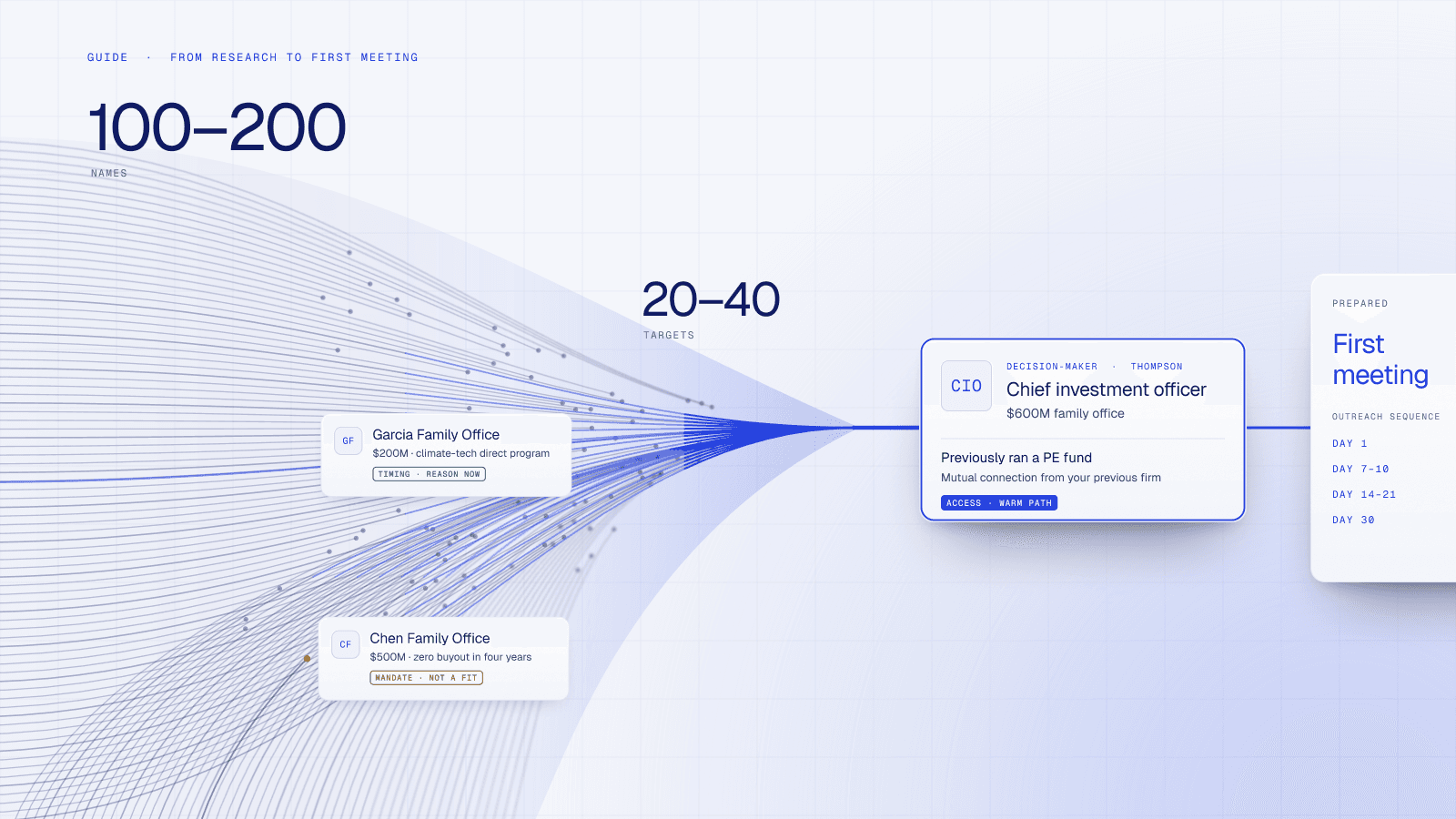
Example: The Garcia Family Office ($200M) has been building a direct investment capability in climate tech. They've made three direct investments in the past year. Your fund focuses on climate tech growth equity. Your timing thesis: "Your climate tech direct investment program aligns with our sector expertise. We can offer co-investment opportunities alongside our fund, providing deal flow and due diligence support for your direct program."
Layer 4: Access Fit
Question: What's the realistic route to a meeting?
Access fit is about the path to the decision maker. Cold email works, but it has the lowest conversion rate. Warm introduction has the highest. Semi-warm (mutual conference attendance, shared advisor, industry connection) falls in between.
How to assess access fit:
- Map the decision chain: Who screens? Who decides? Who influences? For many family offices, the CIO screens, the investment committee decides, and the family members influence. You need to reach the screener with a message that gets passed up.
- Identify warm paths: Do you know their lawyer? Their accountant? A fellow LP? A portfolio company CEO? Any of these can provide an introduction.
- Find semi-warm paths: Do you attend the same conferences? Belong to the same industry groups? Share a board member? These create context for outreach.
- Assess cold routes: If you have no warm path, can you craft a cold email that demonstrates genuine research and specific fit? Generic cold emails fail. Specific ones sometimes work.
- Plan the approach sequence: First touch should be low-friction (email or LinkedIn). Second touch should add value (research note, event invitation). Third touch should be the ask (meeting request). Most people give up after one touch.
Example: The Thompson Family Office ($600M) is managed by a CIO who previously ran a PE fund you know. You have a mutual connection from your previous firm. The warm path: ask the mutual connection for an introduction. The semi-warm path: reference the CIO's previous fund and your shared industry experience. The cold path: standard outreach with no context.
Rule: If you can't identify at least a semi-warm path, deprioritize this target until you can build one.
The Research Workflow: From Name to Decision-Ready Target
Turning a family office name into a decision-ready target requires a systematic research workflow. Here's the process we recommend for lean fundraising teams.
Phase 1: Identification (Week 1)
Goal: Build a raw list of potential targets.
Sources:
- Altss platform: 30,000+ institutional investors, RIAs, and family offices with continuously refreshed data
- Industry databases: FINTRX, Preqin, PitchBook (use for cross-referencing, not primary targeting)
- Conference attendee lists: SuperReturn, IPEM, Family Office Forum, Milken
- Industry publications: Family Office Review, Private Equity International, Wall Street Journal
- Portfolio company investor lists: Who invested in companies similar to your portfolio?
Output: A list of 100–200 family offices that could plausibly invest in your strategy. No filtering yet. Just names.
Phase 2: Qualification (Week 2–3)
Goal: Apply the 4-layer model to filter the list.
Process:
- For each target, research mandate fit (historical commitments, stated preferences, sector focus)
- Assess capacity fit (allocation cadence, recent commitments, liquidity events)
- Build timing thesis (trigger events, portfolio context, time-bound opportunities)
- Map access fit (decision chain, warm paths, semi-warm paths)
Scoring framework: Score each layer 0–3 (0 = no fit, 1 = weak fit, 2 = moderate fit, 3 = strong fit). Multiply the four scores for a composite score. Maximum: 81. Minimum: 0.
- 60+: Tier 1 target — high priority, warm outreach
- 40–59: Tier 2 target — moderate priority, semi-warm or specific cold outreach
- 20–39: Tier 3 target — low priority, cold outreach only
- Below 20: Remove from list
Example scoring:
- Mandate fit: 3 (they actively invest in your strategy)
- Capacity fit: 2 (they're in a manager-add window but saturated)
- Timing fit: 3 (you have a strong reason now)
- Access fit: 2 (semi-warm path through a conference connection)
- Composite: 3 × 2 × 3 × 2 = 36 (Tier 2)
Output: A prioritized list of 20–40 Tier 1 and Tier 2 targets.
Phase 3: Deep Research (Week 3–4)
Goal: Build a detailed profile for each Tier 1 target.
For each target, document:
- Firm overview: AUM, structure (SFO/MFO), family background, investment team size
- Investment strategy: Current allocation, target allocation, sub-strategy preferences, geographic focus, check size range
- Portfolio holdings: Known investments, fund commitments, direct deals, co-investments
- Decision-making process: Who decides? Who influences? What's the meeting-to-commitment timeline?
- Relationship map: Who do they know? Who do they trust? What conferences do they attend?
- Recent activity: New hires, exits, liquidity events, mandate changes, conference appearances
- Communication preferences: Email, phone, in-person meetings? Preferred contact method and timing?
Research sources:
- Altss platform: Sub-30-day refresh cycle on LP data, including allocation changes and new commitments
- SEC filings: Form D, ADV (for registered investment advisors)
- Industry databases: Cross-reference with PitchBook, Preqin, FINTRX
- News and media: Google News alerts, industry publications, local business journals
- Social media: LinkedIn (team member profiles, posts, connections), Twitter (if active)
- Conference materials: Speaker bios, panel descriptions, attendee lists
- Portfolio company press releases: Who invested in recent rounds?
Output: A 2–3 page profile for each Tier 1 target, ready for outreach.
Phase 4: Outreach Planning (Week 4–5)
Goal: Design the outreach sequence for each target.
Sequence structure:
- Touch 1 (Day 1): Initial email or LinkedIn message. Short, specific, value-oriented. State your thesis in one sentence. Include a reason for reaching out now.
- Touch 2 (Day 7–10): Value add. Send a relevant research note, market insight, or event invitation. No ask. Just value.
- Touch 3 (Day 14–21): Meeting request. Reference your previous touches. State your specific ask (30-minute call, coffee meeting, conference side meeting).
- Touch 4 (Day 30): Follow-up. If no response, send a brief note acknowledging the silence. Offer to reconnect at a future date. Do not send a fifth touch unless you have new information.
For warm introductions:
- Ask the mutual connection to make the introduction via email. Provide a one-paragraph blurb the connection can forward.
- The connection sends the introduction email to the target, copying you.
- You respond to the thread within 24 hours with your specific ask.
- You follow up with the connection to thank them and update them on progress.
Output: A detailed outreach plan for each Tier 1 target, including sequence, timing, and messaging.
Phase 5: Execution and Tracking (Ongoing)
Goal: Execute the outreach plan and track results.
Tracking metrics:
- Emails sent per week
- Open rate (target: 40%+ for warm, 20%+ for cold)
- Reply rate (target: 15%+ for warm, 5%+ for cold)
- Meeting conversion rate (target: 10%+ for warm, 2%+ for cold)
- Time from first touch to first meeting
- Time from first meeting to commitment
- Commitment rate (target: 5–10% of meetings convert to commitments)
CRM requirements:
- Track all touches, responses, and meeting notes
- Set reminders for follow-ups
- Tag targets by tier, status, and next action
- Generate weekly pipeline reports
- Integrate with email for tracking opens and clicks
Output: A weekly pipeline report showing progress, bottlenecks, and next actions.
Scoring Frameworks: Stop Debating Targets Emotionally
The biggest problem in family office targeting is emotional decision-making. "I have a good feeling about this one." "The CIO seemed nice at the conference." "This office is prestigious, so they must be a good target."
Emotional targeting leads to wasted time. You spend weeks researching an office that has no mandate fit because you liked their website.
The fix: a scoring framework that forces objective assessment.
The Altss 4-Layer Scoring Model
Score each layer 0–3. Multiply the four scores. Use the composite to prioritize.
Layer 1: Mandate Fit (0–3)
| Score | Criteria |
|---|---|
| 3 | Direct match: They actively invest in your specific strategy, sub-strategy, and structure. Multiple historical commitments confirm the fit. |
| 2 | Adjacent match: They invest in your strategy but prefer a different sub-strategy or structure. Or they invest in your strategy but have no recent commitments. |
| 1 | Weak match: They invest in related strategies but not yours. Or they have a stated interest but no evidence of action. |
| 0 | No match: They don't invest in your strategy. Their portfolio shows zero commitments in your space. |
Layer 2: Capacity Fit (0–3)
| Score | Criteria |
|---|---|
| 3 | Open window: They are actively adding new managers. They have fresh capital to deploy. No saturation or overallocation issues. |
| 2 | Neutral window: They are open to new managers but have no urgency. They may be at target allocation but still considering selective additions. |
| 1 | Restricted window: They are in a "no new managers" period but may open in 6–12 months. Or they are saturated but could make exceptions. |
| 0 | Closed window: They are overallocated, in harvest mode, or have a formal freeze on new commitments. |
Layer 3: Timing Fit (0–3)
| Score | Criteria |
|---|---|
| 3 | Strong thesis: You have a specific, documented reason why this target should meet you now. The reason is connected to their current situation. |
| 2 | Moderate thesis: You have a general reason for outreach, but it's not specific to this target's current situation. |
| 1 | Weak thesis: Your reason is generic ("we're raising a fund") and not connected to the target's needs. |
| 0 | No thesis: You have no reason for reaching out now. You're just hoping for the best. |
Layer 4: Access Fit (0–3)
| Score | Criteria |
|---|---|
| 3 | Warm path: You have a mutual connection who can make an introduction. The connection is trusted by the target. |
| 2 | Semi-warm path: You have a shared context (conference, industry group, board member) that creates a natural opening. |
| 1 | Cold path: You have no connection or shared context. You're reaching out cold. |
| 0 | No path: You can't find a way to reach the decision maker. The contact information is unavailable or unreliable. |
Composite Score: Multiply the four scores. Range: 0–81.
Prioritization:
- 60+: Tier 1 — High priority. Start outreach immediately. Use warm paths.
- 40–59: Tier 2 — Moderate priority. Plan outreach within 2–4 weeks. Use semi-warm or specific cold outreach.
- 20–39: Tier 3 — Low priority. Consider cold outreach only if you have bandwidth. Otherwise, deprioritize.
- Below 20: Remove from list. Revisit in 6–12 months if circumstances change.
The "One-Sentence Test"
Before any target gets outreach, apply the one-sentence test: Can you write a single sentence explaining why this specific target belongs on your list?
Good one-sentence thesis: "The Chen Family Office has committed to seven venture deals in the past four years, all in climate tech, and they're in a manager-add window after a large exit from their portfolio company GreenGrid."
Bad one-sentence thesis: "The Chen Family Office is a large family office that might invest in our fund."
If you can't pass the one-sentence test, the target doesn't get outreach. Precision targeting isn't just better fundraising—it's the only approach that scales without degrading trust and deliverability.
Outreach Architecture: Earning Meetings Without Sounding Mass-Produced
The outreach message is where most fund managers fail. They write generic emails that sound like they were copied from a template. Family offices receive 40–60 of these per month. They delete them in seconds.
The fix: write emails that demonstrate genuine research and specific fit.
The 4-Part Outreach Email Structure
Part 1: The Hook (1 sentence)
State who you are and why you're reaching out. Be specific. Reference something about the target that shows you've done your homework.
*Bad hook*: "I'm reaching out because we're raising a new fund and think your office might be interested."
*Good hook*: "I noticed the Thompson Family Office has committed to three growth equity deals in climate tech this year. Our fund focuses on the same sector."
Part 2: The Thesis (2–3 sentences)
Explain why this specific fit exists. Connect your fund to their portfolio, strategy, or current needs.
*Bad thesis*: "Our fund invests in growth-stage technology companies. We think there's a good fit with your portfolio."
*Good thesis*: "Our last fund deployed $150M across 12 climate tech companies, with three exits in the past 18 months. Given your direct investment program in this space, we believe co-investment opportunities from our pipeline could complement your portfolio."
Part 3: The Ask (1 sentence)
State what you're asking for. Be specific and low-friction.
*Bad ask*: "Would you be interested in learning more about our fund?"
*Good ask*: "Would you be open to a 20-minute call next week to discuss how our pipeline could support your direct investment program?"
Part 4: The Close (1 sentence)
Provide a clear next step. Include your calendar link if appropriate.
*Bad close*: "Let me know if you're interested."
*Good close*: "I've attached a one-page overview. If this aligns with your current priorities, I'd welcome a brief call. Here's a link to my calendar: [link]."
The Full Email Template
```
Subject: Climate tech co-investment opportunities / Thompson Family Office
Hi [Name],
I noticed the Thompson Family Office has committed to three growth equity deals in climate tech this year. Our fund focuses on the same sector.
Our last fund deployed $150M across 12 climate tech companies, with three exits in the past 18 months. Given your direct investment program in this space, we believe co-investment opportunities from our pipeline could complement your portfolio.
Would you be open to a 20-minute call next week to discuss how our pipeline could support your direct investment program?
I've attached a one-page overview. If this aligns with your current priorities, I'd welcome a brief call. Here's a link to my calendar: [link].
Best,
[Your Name]
[Title]
[Firm]
```
The Warm Introduction Template (for the mutual connection)
```
Subject: Introduction: [Your Name] / Thompson Family Office
Hi [Target Name],
I wanted to introduce [Your Name], who I've worked with at [Previous Firm]. [Your Name] is now raising a climate tech growth fund at [Current Firm].
I thought you might be interested because of your direct investment program in climate tech. [Your Name]'s fund has a strong pipeline of co-investment opportunities that could complement your portfolio.
I'll let [Your Name] share more details. [Your Name], over to you.
Best,
[Mutual Connection]
```
The Follow-Up Email Template
```
Subject: Re: Climate tech co-investment opportunities / Thompson Family Office
Hi [Name],
Following up on my note from last week. I know how busy things get.
If the timing isn't right, I completely understand. I'll check back in a few months.
In the meantime, I've attached a recent market insight piece on climate tech trends that might be relevant to your portfolio.
Best,
[Your Name]
```
Common Outreach Mistakes to Avoid
- Sending attachments without context: Never send a pitch deck as the first touch. Send a one-page overview or a relevant research note.
- Using generic subject lines: "Fundraising" or "Investment Opportunity" get deleted. Use specific, personalized subject lines.
- Writing too much: Keep the email under 150 words. If you can't make your point in 150 words, you don't understand it well enough.
- Asking for too much too soon: Don't ask for a meeting in the first sentence. Build context first, then ask.
- Not following up: 80% of responses come after the second or third touch. Most people give up after one.
- Following up too aggressively: One follow-up per week maximum. After three touches with no response, move on.
- Blaming the target for not responding: "I sent you an email last week and didn't hear back." This is passive-aggressive. Don't do it.
- Using false urgency: "We're closing in two weeks" is only credible if it's true. If you say this and don't close, you lose credibility.
Post-Meeting Conversion: Creating Clean Diligence Paths
Getting the meeting is not the goal. Getting the commitment is. The meeting is where conversion starts, not where it ends.
The First Meeting: What to Cover
Structure (30–60 minutes):
- Introduction (5 minutes): Who you are, your background, your firm's history.
- Investment thesis (10 minutes): What you invest in, why now, your edge.
- Portfolio and performance (10 minutes): Track record, representative deals, exits.
- Fund terms (5 minutes): Structure, fees, terms, target size.
- Why this target (5 minutes): Your specific thesis for why they should invest.
- Q&A (15–25 minutes): Let them drive the conversation.
Key principles:
- Listen more than you talk: The best fund managers spend 60% of the meeting listening. Understand their constraints, preferences, and concerns.
- Be specific: Use concrete examples. "We invested in Company X in 2022 and generated a 3.5x return in 18 months" is better than "We have a strong track record."
- Address concerns proactively: If you know a potential objection (size, track record, team depth), address it before they ask.
- End with clear next steps: "I'll send you the due diligence materials by Friday. We'll follow up in two weeks to discuss any questions."
Post-Meeting Follow-Up
Within 24 hours:
- Send a thank-you email
- Recap key discussion points
- Attach any promised materials
- Confirm next steps and timeline
Within 1 week:
- Send a follow-up with additional information they requested
- Provide references (if appropriate)
- Share a relevant research note or market insight
Within 2 weeks:
- Check in to see if they have questions
- Offer to schedule a follow-up call or meeting
- Provide an update on fund progress (closing timeline, new commitments)
Within 30 days:
- If no response, send a final follow-up
- Acknowledge the silence and offer to reconnect at a future date
- Move to "nurture" status in your CRM
The Diligence Process
When a family office enters formal diligence, the process typically follows this path:
- Initial screening: CIO or investment analyst reviews the fund. 1–2 weeks.
- Deep diligence: Team reviews materials, calls references, analyzes performance. 2–4 weeks.
- Investment committee review: Formal presentation to the investment committee. 1–2 weeks.
- Legal documentation: Subscription agreement, side letter negotiation, AML/KYC. 2–4 weeks.
- Funding: Capital transfer. 1–2 weeks.
Total timeline: 6–12 weeks from first meeting to funding.
What you can do to accelerate:
- Have all due diligence materials ready before the first meeting
- Provide references who are prepared to speak
- Be responsive to requests (within 24 hours)
- Offer to meet with the investment committee directly
- Have legal documents pre-reviewed
Common Conversion Killers
- Inconsistent messaging: Different team members tell different stories about the fund. This creates confusion and erodes trust.
- Slow response times: Taking more than 24 hours to respond to due diligence requests signals disorganization.
- Missing materials: Not having the PPM, financial statements, or legal documents ready delays the process.
- Poor references: References who are unprepared or give lukewarm endorsements kill deals.
- Term disputes: Arguing over standard terms (management fees, carry, notice periods) creates friction.
- Timeline pressure: Rushing the process makes the target suspicious. "We need your commitment by Friday" is rarely credible.
- Lack of transparency: Hiding negative information (bad deals, team departures, regulatory issues) destroys trust when discovered.
Weekly Operating Cadence for Lean Fundraising Teams
For a team of 2–3 people managing the fundraising process, here's a recommended weekly cadence.
Monday: Planning and Research
- Morning (2 hours): Review pipeline status. Update CRM. Prioritize targets for the week.
- Afternoon (3 hours): Research new targets. Update profiles for Tier 1 and Tier 2 targets. Identify warm paths.
Tuesday: Outreach
- Morning (3 hours): Send outreach emails. Follow up on previous touches. Manage warm introduction requests.
- Afternoon (2 hours): Respond to inbound inquiries. Schedule meetings for the coming weeks.
Wednesday: Meetings and Follow-Up
- Morning (2–3 hours): Conduct scheduled meetings (phone calls, video calls, in-person).
- Afternoon (2 hours): Send post-meeting follow-ups. Prepare materials for upcoming meetings.
Thursday: Diligence and Documentation
- Morning (3 hours): Respond to due diligence requests. Prepare materials. Update the data room.
- Afternoon (2 hours): Review legal documents. Coordinate with legal counsel.
Friday: Review and Planning
- Morning (2 hours): Weekly pipeline review. Track metrics. Identify bottlenecks.
- Afternoon (2 hours): Plan next week's outreach. Research new targets. Update target profiles.
Weekly Metrics to Track
- Pipeline size: Number of Tier 1, Tier 2, and Tier 3 targets
- Outreach volume: Emails sent per week
- Response rate: Replies / emails sent
- Meeting conversion: Meetings / outreach attempts
- Pipeline velocity: Time from first touch to first meeting, meeting to commitment
- Commitment rate: Commitments / meetings
- Capital raised: Total commitments, average check size
Monthly Review
- First Friday of the month: Full pipeline review. Score all targets. Re-prioritize based on new information.
- Second Friday: Review outreach effectiveness. Which messages are working? Which targets are responding?
- Third Friday: Review competitive landscape. What are other funds in your space doing? Are they targeting the same LPs?
- Fourth Friday: Strategy review. Is your targeting strategy working? Do you need to adjust your thesis, messaging, or approach?
Advanced Strategies for 2026
Strategy 1: The "Invisible" Warm Introduction
The most effective warm introduction is one where the target doesn't realize they're being introduced. Here's how it works:
- Identify a mutual connection who interacts with the target regularly (same conference circuit, shared advisor, industry group).
- Ask the mutual connection to mention your fund in a casual conversation with the target. "I was talking to [Your Name] at [Conference] and they mentioned their new climate tech fund. It sounds relevant to your direct investment program."
- The target expresses interest. The mutual connection offers to make an introduction.
- The introduction happens naturally, with the target already primed.
This approach works because the target feels like they discovered you, rather than being sold to.
Strategy 2: The "Reverse" Due Diligence
Instead of waiting for the target to request due diligence materials, proactively send them in a structured format. This shows organization and confidence.
The reverse due diligence package:
- Executive summary: One-page overview of the fund
- Investment thesis: Detailed explanation of your strategy and edge
- Portfolio and performance: Track record with representative deals
- Team bios: Background and experience of key team members
- Fund terms: Structure, fees, terms, target size
- Market analysis: Why now is the right time for this strategy
- Risk factors: Honest assessment of risks and how you mitigate them
- References: Contact information for current LPs (with their permission)
Send this package after the first meeting, before they ask for it. This accelerates the diligence process and signals professionalism.
Strategy 3: The "No Ask" Approach
For targets where you have a warm introduction but the timing isn't right, use the "no ask" approach:
- Meet for coffee or a call.
- Share your investment thesis and portfolio.
- Do not ask for a commitment.