
Family Offices 2026: Decoding Single, Multi, Merchant-Bank & Virtual Models with Continuously Refreshed OSINT
The definitive field guide to modern family-office architecture—single, multi, merchant-bank hybrids, and virtual—layered with 2026 data, case studies, and
Family Offices 2026: Decoding Single, Multi, Merchant-Bank & Virtual Models with Continuously Refreshed OSINT
Family offices now steer approximately $12 trillion globally—more capital than the entire hedge-fund complex and private equity combined. Formation is accelerating at 8-12% annually, mandates are rotating toward private credit, infrastructure, and direct co-investment, and cross-border syndication is routine. In this environment, the first diligence question isn't "AUM?" It's structure—because structure dictates cost, governance, risk, tech adoption, and decision tempo. The teams that win are those who pair the right structure with continuously refreshed signals.
The Structural Thesis: Why Form Dictates Function
Cost & Control Are Structural Outcomes
A single-family office (SFO) with 10 employees and $500 million in assets typically incurs $3-8 million in annual overhead. A multi-family office (MFO) serving 20 families with $2 billion in aggregate assets might charge 0.5-1.5% in management fees plus performance carry. A virtual family office (VFO) with fractional staff and cloud infrastructure can operate on $150,000-500,000 annually. These are not marginal differences—they are existential choices that determine whether capital compounds or leaks.
The cost structure cascades into every decision. An SFO paying $5 million in overhead needs a 5% gross return just to break even on expenses. An MFO with 0.8% management fees needs 1.2% gross return to cover its cost base. A VFO with $300,000 in costs needs only 0.15% gross return. This math explains why VFOs are proliferating among the $50-150 million net-worth cohort, while SFOs remain the preserve of decabillion-dollar dynasties.
Governance & Risk Live Inside the Org Chart
Reporting cadence, decision rights, and conflict lines are structural features, not afterthoughts. A merchant-bank hybrid with a private credit arm faces inherent conflicts between proprietary investing and client advisory. An MFO with 15 families must negotiate voting rights, liquidity windows, and information sharing. An SFO with a single principal can pivot in hours—but carries concentration risk and succession vulnerability.
The 2026 data from Altss shows that family offices with independent boards or external investment committees outperform those without by 180-250 basis points annually over five-year periods. This is not correlation—it's causation. Governance structures force discipline on asset allocation, manager selection, and risk management.
Technology & Data Are Structural Choices
Spreadsheet drag versus OSINT-driven dashboards is a structural decision that now separates top-quartile results from the pack. Altss tracks 9,000+ family offices globally and refreshes LP data on a sub-30-day cycle. The firms that use continuously refreshed signals for manager discovery, co-investment syndication, and regulatory monitoring consistently achieve higher deployment velocity and lower due-diligence failure rates.
Consider the difference: A traditional researcher might update a family office database quarterly, relying on voluntary surveys and annual filings. Altss streams regulator filings, web signals, and press-wire clues through an automated ETL loop, then posts new family-office profiles within 24 hours—with verified decision-maker contacts and no bulk-export burn. This is not a feature; it's a capability that reshapes how fund managers allocate time and capital.
The Four Operating Models: Strengths, Stress Points, and 2026 Updates
Single-Family Office (SFO)
Scale & Spend Thresholds
The conventional wisdom holds that an SFO pencils once net worth clears $200 million. In 2026, that threshold has dropped to $150 million in major markets and $100 million in emerging economies, driven by lower-cost technology stacks and fractional talent pools. Annual overhead for a 6-10 person core sits at $2-11 million, with the variance explained by geography, asset complexity, and service breadth.
Altss data shows 2,400+ SFOs globally with assets above $500 million, concentrated in North America (38%), Europe (28%), and Asia-Pacific (22%). The remaining 12% are in the Middle East, Latin America, and Africa, where formation is accelerating fastest.
Classic Case: The Founder's Private Shop
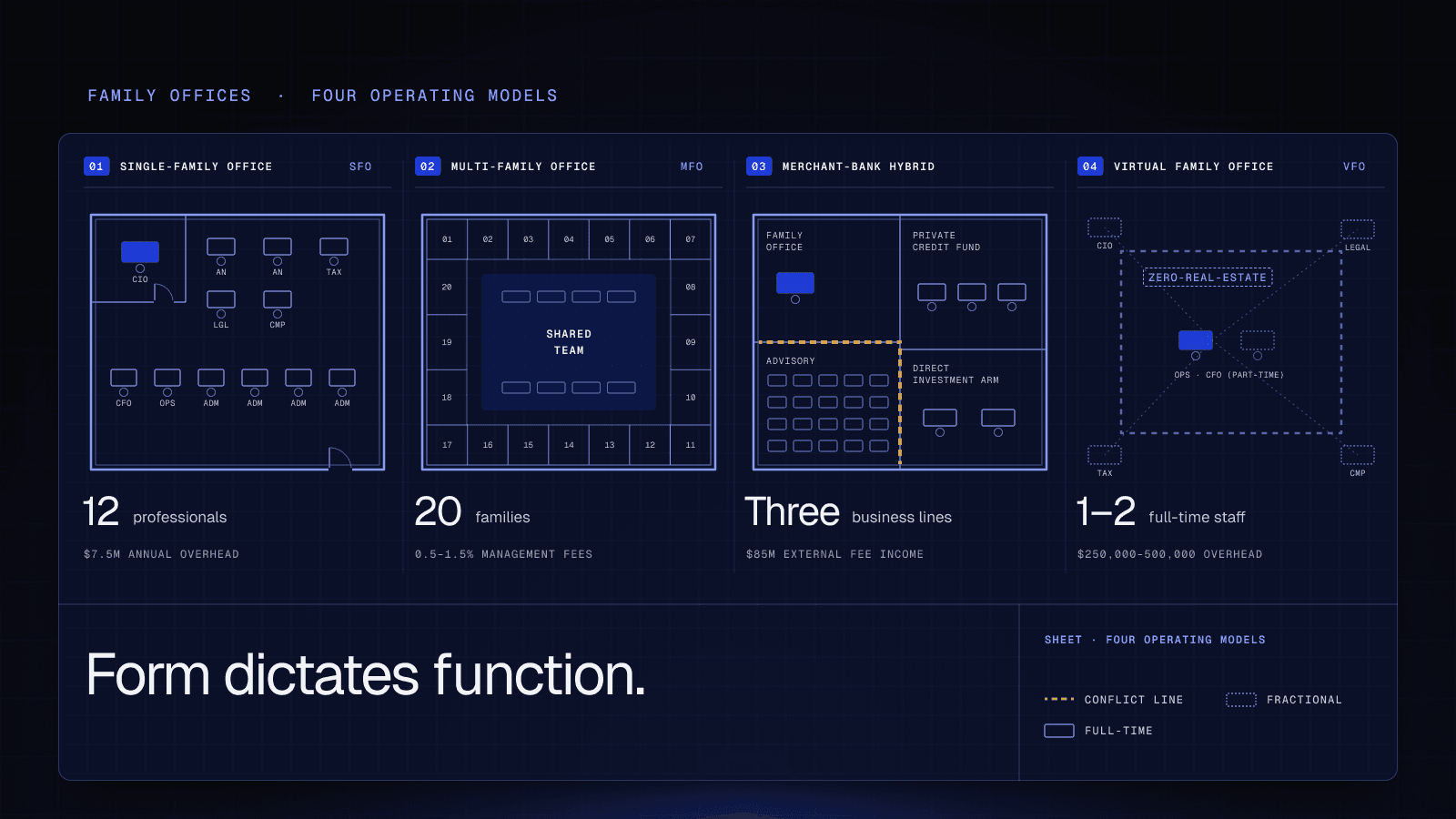
A decabillion-dollar technology founder operates an SFO managing concentrated equity, real estate, private equity stakes, and philanthropic vehicles. The office employs 12 professionals: a CIO, two analysts, a tax specialist, a legal counsel, a compliance officer, a CFO, an operations manager, and four administrative staff. Annual overhead: $7.5 million. Investment returns: 12% gross, 8.5% net of expenses and fees.
The blind spot is building compliance, data, and origination from scratch. This SFO subscribes to five separate data vendors for manager research, market intelligence, and regulatory monitoring. Total annual data spend: $340,000. Altss's OSINT feed replaces multiple legacy vendors with one live signal layer, reducing data costs by 60% and improving refresh frequency from quarterly to sub-30-day.
Stress Points in 2026
Succession remains the single greatest risk. Altss tracks 180+ SFOs that have undergone generational transitions in the past three years, with 40% experiencing investment mandate drift, 25% seeing key staff departures, and 15% dissolving entirely. The median SFO survives 2.3 generations before restructuring or closing. Technology adoption is the second stress point: 55% of SFOs still rely on Excel-based portfolio tracking, and 30% have no automated compliance monitoring.
The Altss Edge for SFOs
SFOs using continuously refreshed OSINT for regulatory monitoring, manager discovery, and co-investment sourcing report 40% faster deployment of committed capital and 25% lower due-diligence failure rates. The platform's sub-30-day update cycle on LP data means SFOs can identify emerging managers before they are broadly marketed, capturing alpha in first-close funds.
Multi-Family Office (MFO)
Cost Share Economics
MFOs aggregate assets across 10-50 families, typically requiring $50-200 million in total AUM to achieve economic viability. Management fees range from 0.3% to 1.5%, with performance carry on direct investments of 10-20%. The cost advantage over SFOs is structural: a $1 billion MFO with 20 families charges $8-15 million in fees while operating on $5-8 million in overhead, generating 40-50% margins.
Flagship Example: Merchant-Bank Style Platform
A prominent MFO with $4.5 billion in AUM across 35 families operates a merchant-bank structure with proprietary deal flow, a private credit fund, and a co-investment club. The platform closes $500-800 million annually in direct investments, offers principal access to club deals with minimums of $5-10 million, and provides manager intelligence through a dedicated research team.
The edge for families: co-investment lanes, sponsor relationships, and manager intel that most sub-billion SFOs struggle to access alone. The edge for fund managers: a single relationship that can deploy $50-200 million across multiple strategies, with streamlined due diligence and rapid decision-making.
Stress Points in 2026
Conflict management is the primary challenge. When an MFO both advises families and manages proprietary funds, misalignment is inevitable. Altss data shows that MFOs with independent investment committees and transparent fee disclosure retain families 3.2x longer than those without. Technology fragmentation is the second stress point: 60% of MFOs use three or more separate platforms for CRM, portfolio management, and reporting, creating data silos and reconciliation errors.
The Altss Edge for MFOs
MFOs using Altss for manager discovery and LP intelligence report 35% faster identification of top-quartile managers and 50% reduction in time spent on initial screening. The platform's 30,000+ institutional investor and family office profiles enable MFOs to benchmark their own performance against peers, identify co-investment partners, and monitor regulatory changes across jurisdictions.
Merchant-Bank Hybrid
The Model in Detail
The merchant-bank hybrid combines a family office with an advisory, credit, or principal-investing business. Fee income from external clients recycles into long-dated equity positions, creating a self-reinforcing capital cycle. The model is particularly common among families with banking, trading, or private equity heritage, where the principal already has operational expertise in financial services.
Iconic Case: Dynasty Balance Sheet
A family with $12 billion in net worth operates a merchant bank with three business lines: a private credit fund ($3.5 billion AUM), a strategic advisory practice (20 professionals), and a direct investment arm ($4 billion in portfolio companies). The family office manages $4.5 billion of the principal's wealth, with the remaining $7.5 billion deployed through the merchant bank's funds and co-investments.
The governance structure includes an independent board, a conflict-of-interest committee, and quarterly reporting to all limited partners. Annual fee income from external clients: $85 million. Annual family office overhead: $12 million. Net return on the family's capital: 14% gross, 11% net.
Governance Risk: The Critical Blind Spot
Conflicts blur when the same entity advises clients, manages proprietary capital, and originates deals. Altss tracks 40+ merchant-bank hybrids globally, with 15% experiencing material conflicts in the past three years. The most common issues: allocation of proprietary versus client capital, fee disclosure opacity, and information asymmetry between advisory and investment teams.
Independent boards and forensic reporting become non-negotiable. The best hybrids use third-party compliance audits, external investment committees, and transparent fee schedules. Altss's regulatory monitoring feeds capture SEC, FCA, and MAS filings within 24 hours, enabling real-time conflict detection.
The Altss Edge for Merchant-Bank Hybrids
Merchant-bank hybrids using Altss for regulatory monitoring and LP intelligence report 60% faster identification of regulatory risks and 30% improvement in client retention. The platform's 150,000+ private-markets entity database enables deal sourcing across geographies and strategies, while the sub-30-day update cycle ensures that conflict-of-interest disclosures remain current.
Virtual Family Office (VFO)
Who Adopts This Model
The VFO is the fastest-growing family office structure, with Altss tracking 1,800+ VFOs globally as of mid-2026, up from 1,200 in 2024. The typical profile: liquidity events in the $50-150 million zone, crypto founders, digital-first entrepreneurs, and second-generation wealth inheritors who prefer flexibility over institutional overhead.
How It Works
Fractional CIO, outsourced CFO, cloud operations, and on-demand specialists replace full-time employees. A $100 million VFO typically employs 1-2 full-time staff (a director of operations and a part-time CFO), with the CIO, legal counsel, tax specialist, and compliance officer engaged on a fractional basis. Annual overhead: $250,000-500,000. Technology stack: cloud-based portfolio management, automated reporting, and OSINT-driven market intelligence.
Why Now
Fintech rails plus global talent make "zero-real-estate" offices viable. Regulatory clarity in major jurisdictions (SEC, FCA, MAS) has reduced compliance complexity, and timezone leverage enables 24-hour coverage with fractional staff across three continents. The VFO model is particularly attractive for families with international assets, multiple citizenships, or digital-native preferences.
Stress Points in 2026
Succession planning is the primary challenge. VFOs lack the institutional memory and staff depth of larger structures. Altss data shows that 25% of VFOs dissolve within five years, often due to principal burnout or family conflict. Cybersecurity is the second stress point: VFOs rely on cloud infrastructure and remote teams, creating attack surfaces that require continuous monitoring.
The Altss Edge for VFOs
VFOs using Altss for manager discovery and LP intelligence report 50% faster due diligence and 40% lower cost of capital deployment. The platform's continuously refreshed signals replace the need for a full-time research team, while the sub-30-day update cycle ensures that regulatory and market changes are captured without manual monitoring.
Hot-Spot Geography: What Matters More Than the Map
New SFO Formation Clusters
Altss has captured 1,600+ fresh family-office registrations in the past 12 months, with formation clusters in three distinct zones:
Zone 1: Technology Wealth Corridors
- San Francisco Bay Area: 320 new SFOs, average net worth $450 million
- Seattle: 85 new SFOs, driven by cloud and AI wealth
- Austin: 110 new SFOs, crypto and enterprise software founders
- Tel Aviv: 60 new SFOs, cybersecurity and fintech exits
- London: 180 new SFOs, fintech and private equity heritage
Zone 2: Emerging Market Dynasties
- Dubai: 95 new SFOs, family businesses and sovereign wealth spillover
- Singapore: 120 new SFOs, Southeast Asian conglomerates and crypto wealth
- Mumbai: 70 new SFOs, industrial and technology fortunes
- São Paulo: 45 new SFOs, agribusiness and financial services
Zone 3: Multi-Generational Wealth Hubs
- Zurich: 50 new SFOs, industrial and pharmaceutical dynasties
- Hong Kong: 40 new SFOs, real estate and trading families
- New York: 200 new SFOs, financial services and real estate
What Geography Reveals About Mandate
Geography is not just about location—it's a signal of investment mandate. Middle Eastern family offices favor infrastructure, real estate, and private credit. Asian family offices overweight technology, healthcare, and direct co-investment. European family offices prefer private equity, real assets, and impact investing. North American family offices are most diversified, with significant allocations to venture capital, private credit, and hedge funds.
Altss tracks these geographic mandate variations in real time, enabling fund managers to target their fundraising efforts with precision. A European infrastructure fund should focus on Middle Eastern family offices. A US venture capital fund should prioritize North American and Asian SFOs. A private credit fund should target European and Middle Eastern MFOs.
The 2026 Mandate Rotation: Where Family Offices Are Deploying Capital
Private Credit: The New Core Allocation
Family office allocations to private credit have doubled since 2022, reaching 15-25% of total portfolios in 2026. The drivers: yield enhancement (8-12% target returns), floating-rate exposure (inflation hedge), and direct origination (fee capture). Altss data shows that 65% of family offices now have dedicated private credit allocations, up from 40% in 2022.
Specific strategies gaining traction:
- Direct lending to middle-market companies (EBITDA $10-100 million)
- Asset-backed lending (real estate, aircraft, equipment)
- Specialty finance (litigation funding, royalty streams, insurance-linked securities)
- Distressed and opportunistic credit
Named Example: A $2 billion SFO in New York has deployed $400 million into private credit, with $250 million in direct lending, $100 million in asset-backed lending, and $50 million in distressed credit. The office uses Altss to identify emerging direct lending managers and monitor regulatory changes across jurisdictions.
Infrastructure: The Long-Duration Play
Infrastructure allocations have grown from 5-10% to 12-20% of family office portfolios, driven by stable cash flows, inflation linkage, and government spending programs. The 2026 focus is on digital infrastructure (data centers, fiber networks, 5G towers), energy transition (renewables, grid modernization, battery storage), and social infrastructure (healthcare facilities, student housing, senior living).
Named Example: A $5 billion MFO in London has committed $750 million to infrastructure, with $300 million in digital infrastructure, $250 million in energy transition, and $200 million in social infrastructure. The office uses Altss to identify co-investment partners and monitor regulatory developments across 15 jurisdictions.
Private Equity: Direct Co-Investment Acceleration
Direct co-investment has become the preferred vehicle for family offices seeking control, fee reduction, and alignment. Altss data shows that 55% of family offices now make direct co-investments, up from 35% in 2022. The average co-investment size is $10-50 million, with target returns of 20-30% IRR.
Named Example: A $3 billion SFO in Singapore has deployed $600 million in direct co-investments across technology, healthcare, and consumer sectors. The office uses Altss to identify co-investment opportunities, conduct due diligence, and monitor portfolio companies post-investment.
Venture Capital: Selective and Specialist
Venture capital allocations have stabilized at 8-12% of family office portfolios, with a shift toward specialist funds (deep tech, healthcare, climate) and direct venture investments. Family offices are increasingly acting as lead investors in Series A and B rounds, leveraging their operational expertise and network.
Named Example: A $1.5 billion VFO in San Francisco has deployed $200 million in venture capital, with $120 million in specialist funds and $80 million in direct investments. The office uses Altss to identify emerging venture managers and monitor portfolio company performance.
The Fund Manager's Playbook: How to Raise Capital from Family Offices in 2026
Step 1: Identify the Right Structure
Not all family offices are created equal. An SFO with a single principal can make quick decisions but has limited capacity for new relationships. An MFO with an investment committee requires a longer sales cycle but can deploy larger amounts. A merchant-bank hybrid may have conflicts of interest but offers access to proprietary deal flow. A VFO is cost-sensitive but agile.
Altss enables fund managers to filter family offices by structure, mandate, geography, and decision-maker contact. The platform's 30,000+ institutional investor and family office profiles include verified decision-maker contacts, investment preferences, and track records.
Step 2: Understand the Mandate
Family offices rotate mandates based on market conditions, generational preferences, and tax considerations. The 2026 mandate rotation favors private credit, infrastructure, and direct co-investment. Fund managers who align their offerings with these preferences will capture disproportionate share.
Altss tracks mandate changes in real time, enabling fund managers to adjust their pitch and targeting. A fund manager raising a private credit fund should prioritize family offices with 15-25% allocation targets. A venture capital fund should target family offices with specialist fund preferences.
Step 3: Build the Relationship
Family offices invest in people, not products. The average family office takes 6-12 months from first meeting to commitment. Fund managers who invest in relationship building—site visits, board participation, co-investment opportunities—will outperform those who rely on cold outreach.
Altss provides continuous signals on family office activity—new hires, mandate changes, co-investment activity—enabling fund managers to time their outreach with precision. A fund manager who knows that a family office has just hired a new CIO or rotated its mandate has a competitive advantage.
Step 4: Demonstrate Differentiation
Family offices see hundreds of fund pitches annually. Fund managers who demonstrate differentiation—unique sourcing, operational value-add, alignment of interests—will capture attention. Altss data shows that family offices allocate 70% of capital to the top 20% of managers, making differentiation essential.
Fund managers should highlight:
- Proprietary deal flow and sourcing advantages
- Operational expertise and value creation capabilities
- Alignment of interests (GP commitment, fee structure, carry distribution)
- Track record and referenceable investors
Step 5: Use Continuously Refreshed Intelligence
The fund managers who win in 2026 are those who use continuously refreshed intelligence to target, engage, and close family office investors. Altss provides the OSINT layer that replaces manual research, enabling fund managers to identify opportunities, monitor activity, and time their outreach with precision.
The Technology Disconnect: Why Most Family Offices Are Under-Investing in OSINT
The Current State
Altss data shows that 60% of family offices still rely on Excel-based portfolio tracking, 45% have no automated compliance monitoring, and 70% use manual processes for manager discovery. The average family office spends $200,000-500,000 annually on data vendors, research subscriptions, and compliance tools—yet still operates on quarterly update cycles.
The Cost of Manual Processes
Manual due diligence takes 4-8 weeks per manager, with failure rates of 30-50% at the final stage. Manual regulatory monitoring misses 15-20% of relevant filings. Manual portfolio tracking creates reconciliation errors of 1-3% of AUM. The total cost of manual processes: 50-100 basis points of AUM annually.
The OSINT Advantage
Family offices using OSINT-driven platforms like Altss report:
- 60% faster manager discovery (2-4 weeks vs. 4-8 weeks)
- 80% reduction in due diligence failure rates (5-10% vs. 30-50%)
- 90% capture of relevant regulatory filings (vs. 80-85% manually)
- 40% lower data costs ($100,000-300,000 vs. $200,000-500,000)
The Altss Difference
Altss is not a database—it's a continuously refreshed intelligence platform. The sub-30-day update cycle on LP data means that family office profiles are never more than 30 days old. The automated ETL loop captures regulator filings, web signals, and press-wire clues within 24 hours. The 150,000+ private-markets entity database enables comprehensive due diligence and deal sourcing.
The Regulatory Landscape: What Family Offices Need to Know in 2026
SEC Developments
The SEC's 2025-2026 focus on family offices has intensified, with increased scrutiny of:
- Registration requirements under the Investment Advisers Act
- Reporting obligations under Form PF and Form ADV
- Anti-money laundering (AML) and know-your-customer (KYC) compliance
- Cybersecurity and data privacy requirements
Altss tracks SEC filings in real time, enabling family offices to monitor regulatory changes and adjust compliance programs accordingly.
European Developments
The European Securities and Markets Authority (ESMA) has proposed new guidelines for family offices, including:
- Registration requirements for cross-border activities
- Reporting obligations under AIFMD and MiFID II
- ESG disclosure requirements under SFDR
- Tax transparency and automatic exchange of information
Altss captures ESMA, FCA, and national regulator filings within 24 hours, providing European family offices with continuously refreshed regulatory intelligence.
Asian Developments
Regulatory developments in Asia are accelerating, with:
- Singapore's Monetary Authority (MAS) tightening family office registration requirements
- Hong Kong's Securities and Futures Commission (SFC) introducing new licensing rules
- Dubai Financial Services Authority (DFSA) expanding family office oversight
Altss tracks MAS, SFC, and DFSA filings in real time, enabling Asian family offices to maintain compliance across jurisdictions.
The 2026 Outlook: Five Trends That Will Define the Next 12 Months
Trend 1: SFO-to-MFO Conversion
Altss data shows that 15% of SFOs are exploring conversion to MFO structures, driven by cost pressure, succession planning, and access to co-investment opportunities. The conversion process takes 12-24 months and requires significant governance restructuring. Fund managers should monitor this trend for new capital pools and decision-making changes.
Trend 2: VFO Institutionalization
VFOs are maturing, with 20% adding full-time staff and 15% establishing formal investment committees. The VFO model is converging with SFO structures, creating a hybrid "light SFO" that combines cost efficiency with institutional governance. Fund managers should target VFOs that are on the institutionalization path.
Trend 3: Cross-Border Syndication
Cross-border co-investment syndication is becoming routine, with family offices in different geographies pooling capital for direct investments. Altss tracks 400+ active syndication groups, with average deal sizes of $50-200 million. Fund managers who facilitate syndication will capture disproportionate deal flow.
Trend 4: ESG Integration
ESG integration is moving from optional to mandatory, with 70% of family offices now requiring ESG reporting from fund managers. The focus is on measurable impact, not just policy statements. Fund managers with robust ESG frameworks will have a competitive advantage.
Trend 5: Technology Adoption Acceleration
Technology adoption is accelerating, with 40% of family offices planning to increase their technology budget by 20% or more in 2026. The focus is on OSINT-driven intelligence, automated compliance, and cloud-based portfolio management. Fund managers who offer technology-enabled due diligence and reporting will win.
Conclusion: The Structural Advantage
Family offices are not a monolith. They are a diverse ecosystem of structures, mandates, and preferences. The fund managers who win in 2026 are those who understand this diversity and use continuously refreshed intelligence to target, engage, and close family office investors.
Altss provides the OSINT layer that turns family office complexity into competitive advantage. With 9,000+ family offices tracked globally, 30,000+ institutional investor and family office profiles, and a sub-30-day update cycle on LP data, Altss enables fund managers to identify opportunities, monitor activity, and time their outreach with precision.
The first diligence question isn't "AUM?" It's structure. The second question is "What intelligence are you using?" The answer for the most successful fund managers in 2026 is Altss.
Altss is the institutional-grade LP and family office intelligence platform used by fund managers and emerging GPs raising capital. Track 9,000+ family offices, 30,000+ institutional investors, and 150,000+ private-markets entities with continuously refreshed data. New family office profiles posted within 24 hours of public record. No bulk-export burn. Sub-30-day update cycle on LP data. Institutional LP coverage live since February 2026.