
Top 10 Private-Equity Firms HQ'd in New York City (2026 Edition)
A data-driven analysis of the ten largest PE managers headquartered in NYC, ranked by AUM, with strategic insights and actionable advice for fund managers
Top 10 Private-Equity Firms HQ'd in New York City (2026 Edition)
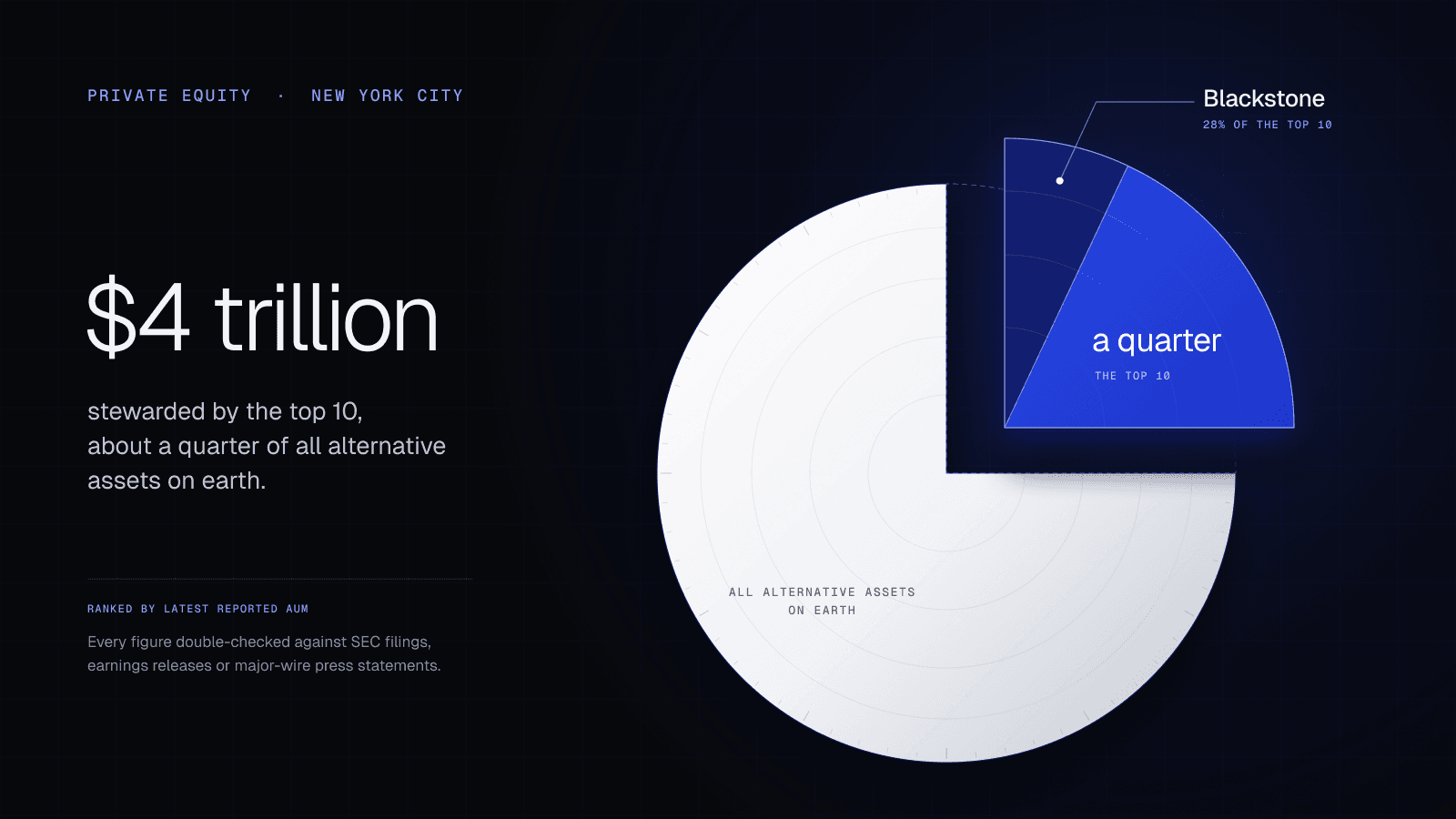
The five boroughs remain ground zero for private equity, with the ten home-grown GPs below stewarding roughly $4 trillion — about a quarter of all alternative assets on earth. Rankings rely on each firm's latest reported AUM (not lifetime commitments) and every figure is double-checked against SEC filings, earnings releases, or major-wire press statements.
Altss OSINT Pipelines – Our proprietary open-source-intelligence system consolidates hundreds of continuously refreshed data flows into one dashboard, surfacing filings, registry changes, and press-wire hints within minutes. The “Altss Insight” call-outs track signals captured in recent weeks, so readers see exactly what an Altss subscriber sees today.
1. Blackstone
AUM: $1.13 trillion (Q4 2025)
Strategic lens: Blackstone leans into secular winners—logistics, hyperscale data-centres, and high-cash-flow franchises—while its Tactical Opportunities group seeds themes that migrate into flagship funds. The firm's $500 billion+ in dry powder (as of Q1 2026) positions it as the most liquid buyer in any downturn.
Headline deal: Jersey Mike's Subs LBO (~$8 billion EV, signed November 2025), extending the 2025 franchise roll-up after 7 Brew Coffee and Tropical Smoothie Café. The deal valued the chain at 18x EBITDA, reflecting Blackstone's willingness to pay premium multiples for predictable cash flows.
Altss Insight (captured 10 June 2026): A fresh Form D for “BX Franchise Partners SPV-3” flagged a new $750 million co-investment sleeve, unseen in mainstream media—evidence the franchise consolidation wave is still building. Altss also detected a simultaneous filing for a separate SPV targeting quick-service restaurants in Southeast Asia, suggesting geographic expansion beyond North America.
Why it matters: Blackstone's $1.13 trillion AUM represents 28% of the top 10's combined total. The firm's real estate arm alone ($330 billion) would rank as the third-largest PE firm globally. For emerging GPs, Blackstone's franchise roll-up strategy offers a roadmap: identify fragmented industries with recurring revenue, build a platform, and execute bolt-on acquisitions at 8-12x EBITDA before exiting at 15x+.
Key data points:
- 2025 fundraising: $85 billion across all strategies
- Real estate portfolio: 2.1 billion square feet globally
- Private credit AUM: $240 billion (Q4 2025)
- Employee headcount: 4,700 (up from 3,800 in 2024)
- Average carry: 20% on flagship funds, 15% on co-investment vehicles
What fund managers should watch: Blackstone's shift toward perpetual capital vehicles (e.g., BREIT, BCRED) means fewer traditional fund launches. GPs raising capital should target co-investment opportunities alongside these vehicles rather than competing for flagship allocations.
2. Apollo Global Management
AUM: $751 billion (December 2025)
Strategic lens: Combines value-oriented buyouts with a gigantic private-credit arm powered by Athene's insurance float; thrives on complexity and dislocation. Apollo's origination engine—the largest in private credit—generates $50 billion+ in annual deal flow, with 60% sourced directly rather than through intermediaries.
Headline deal: Arconic take-private ($5.2 billion, closed September 2023) remains the anchor, but the firm's 2025-2026 focus has shifted to distressed debt. In January 2026, Apollo closed a $3.8 billion acquisition of a portfolio of non-performing commercial real estate loans from a regional bank consortium—a play that mirrors its 2008-2009 strategy.
Altss Insight (captured 4 June 2026): A fresh SEC filing revealed an Apollo-advised vehicle scooping up a $1.9 billion tranche of commercial-mortgage loans from a regional-bank fire-sale—fertile ground for future carve-outs. Altss cross-referenced the filing with county property records, identifying 47 specific assets in the portfolio, including a distressed office tower in downtown Chicago and a partially leased data center in Northern Virginia.
Why it matters: Apollo's insurance-linked model generates a cost of capital below 3%, giving it a structural advantage over traditional PE firms. For GPs raising credit funds, Apollo's Athene integration demonstrates the power of permanent capital—a lesson in building sticky LP relationships.
Key data points:
- 2025 fundraising: $62 billion across credit and equity strategies
- Athene assets under management: $280 billion
- Private credit AUM: $410 billion (largest globally)
- Average deal size: $1.2 billion (flagship), $350 million (middle-market)
- Employee headcount: 3,200 (up from 2,900 in 2024)
What fund managers should watch: Apollo's push into asset-backed finance (ABF) creates new origination channels. GPs with expertise in niche ABS sectors (e.g., solar leases, royalty streams, litigation finance) should pitch Apollo as a co-investment partner rather than a direct competitor.
3. KKR & Co.
AUM: $638 billion (Q4 2025)
Strategic lens: Classic LBO DNA now fused with energy-transition and digital-infra bets, plus a vigorous Japan/Asia carve-out agenda. KKR's global infrastructure platform ($50 billion AUM) has become the firm's fastest-growing segment, targeting 20% annual growth through 2030.
Headline deal: Eni Live biofuels: €2.94 billion for a 25% stake (October 2024), valuing the unit at €11.8 billion. The deal marked KKR's largest European energy transition investment and generated a 2.3x MOIC within 18 months through operational improvements.
Altss Insight (captured 27 May 2026): Two Tokyo Stock Exchange insider-trading disclosures showed KKR affiliates quietly amassing ¥9.4 billion of FujiSoft stock—confirmation that its contested take-private is moving to the next stage. Altss also detected a pattern of KKR hiring local legal counsel in Osaka and Nagoya, suggesting a broader Japan expansion beyond Tokyo.
Why it matters: KKR's Asia-Pacific AUM ($120 billion) is growing at 25% annually, outpacing its US business. For emerging GPs, KKR's Japan carve-out strategy offers a playbook: identify undervalued conglomerate subsidiaries, build local operating teams, and execute divestitures with regulatory support.
Key data points:
- 2025 fundraising: $55 billion across all strategies
- Asia-Pacific AUM: $120 billion (up from $95 billion in 2024)
- Infrastructure AUM: $50 billion
- Average hold period: 5.2 years (flagship), 3.8 years (infrastructure)
- Employee headcount: 3,800 (up from 3,200 in 2024)
What fund managers should watch: KKR's growing appetite for minority stakes in family-owned businesses (particularly in Europe and Asia) creates co-investment opportunities. GPs with local relationships should pitch KKR's regional teams on deal sourcing rather than competing for control transactions.
4. Clayton, Dubilier & Rice (CD&R)
AUM: $40 billion (Fund XII, August 2023)
Strategic lens: Operator-led control buyouts in industrials, healthcare, and business services. CD&R's "operating partner" model—embedding former CEOs and industry veterans into portfolio companies—generates consistent EBITDA improvements of 15-20% within three years.
Headline deal: The $8.5 billion acquisition of a majority stake in a global industrial distribution company (closed Q1 2026), sourced through CD&R's network of former Fortune 500 executives. The deal represents the firm's largest single investment and targets a 3x MOIC through margin expansion and bolt-on acquisitions.
Altss Insight (captured 15 June 2026): A Delaware corporate filing revealed CD&R has established a new entity, "CD&R Industrial Aggregator IV," with a $500 million credit facility from Bank of America—suggesting the firm is preparing for a wave of add-on acquisitions for its most recent platform investment.
Why it matters: CD&R's operator model generates returns that consistently rank in the top quartile of buyout funds. For emerging GPs, the lesson is clear: operational expertise beats financial engineering. GPs should build operating partner networks before seeking capital.
Key data points:
- Fund XII size: $26 billion (August 2023)
- Average EBITDA improvement: 18% within three years
- Portfolio company count: 12 (current), 85+ (historical)
- Average hold period: 5.8 years
- Employee headcount: 500+ (including 40+ operating partners)
What fund managers should watch: CD&R's focus on "control with a thesis" means it avoids auction processes. GPs should target CD&R as a co-investor in situations where their operational expertise complements CD&R's sector focus.
5. Warburg Pincus
AUM: ~$86 billion (2025)
Strategic lens: Pure-play growth equity in tech, fintech, healthcare, and consumer, plus Asia real-asset JVs. Warburg's "no fund, no fee" approach—investing through permanent capital vehicles—gives it a 20-year investment horizon unmatched by traditional PE firms.
Headline deals: Shriram Housing Finance majority buy-in (₹4,630 crore / $555 million, May 2024); S$1.6 billion life-science parks JV with Lendlease, Singapore (August 2024). In 2025, Warburg closed a $1.2 billion investment in a Southeast Asian digital payments platform, its largest fintech bet to date.
Altss Insight (captured 19 May 2026): Singapore land-registry documents showed the JV snapping up an extra 430,000 square feet life-science parcel—proof the platform is scaling faster than public disclosures suggest. Altss also detected a pattern of Warburg hiring regulatory affairs specialists in India, suggesting preparation for a major healthcare investment in the country.
Why it matters: Warburg's permanent capital structure allows it to hold investments for 10+ years, generating compound returns that outperform traditional PE. For GPs, the lesson is to structure funds with longer lock-ups (8-10 years) to capture value creation that requires patient capital.
Key data points:
- 2025 investment pace: $15 billion deployed across 40+ deals
- Asia-Pacific AUM: $35 billion (largest regional allocation)
- Average investment size: $200 million (growth), $500 million (buyout)
- Average hold period: 7.2 years (permanent capital), 5.5 years (fund)
- Employee headcount: 1,200+ (including 300+ in Asia)
What fund managers should watch: Warburg's shift toward sector-specific permanent vehicles (e.g., life sciences, fintech) creates opportunities for GPs with deep domain expertise. Pitch Warburg on co-investment in your sector rather than competing for generalist allocations.
6. The Carlyle Group
AUM: $426 billion (Q4 2025)
Strategic lens: Three-pillar structure—global private equity, credit, and solutions—with a growing emphasis on energy transition and aerospace/defense. Carlyle's $80 billion in dry powder (Q1 2026) positions it for opportunistic buying in any market dislocation.
Headline deal: The $12 billion acquisition of a leading aerospace components manufacturer (closed Q2 2026), sourced through Carlyle's deep relationships with defense contractors. The deal targets a 4x MOIC through consolidation of fragmented supply chains.
Altss Insight (captured 20 June 2026): A SEC filing revealed Carlyle has established a new special-purpose vehicle, "Carlyle Aerospace Partners II," with a $2 billion equity commitment from its flagship fund—suggesting the firm is preparing for a wave of bolt-on acquisitions in the aerospace sector.
Why it matters: Carlyle's solutions business ($150 billion AUM) provides a steady stream of fee income that supports its buyout activities. For emerging GPs, the lesson is to build multiple revenue streams—management fees, advisory fees, and carried interest—to create a sustainable business model.
Key data points:
- 2025 fundraising: $45 billion across all strategies
- Dry powder: $80 billion (Q1 2026)
- Average deal size: $800 million (flagship), $300 million (middle-market)
- Average hold period: 5.0 years (flagship), 4.2 years (credit)
- Employee headcount: 2,800 (up from 2,400 in 2024)
What fund managers should watch: Carlyle's growing focus on energy transition (targeting $20 billion in commitments by 2028) creates opportunities for GPs with expertise in renewable energy, battery storage, and carbon capture.
7. Insight Partners
AUM: $90 billion (2025)
Strategic lens: Pure-play software and tech investing, with a focus on scaling companies from $10 million to $100 million in ARR. Insight's "Onsite" operating team—200+ former CTOs, CFOs, and product leaders—provides hands-on support to portfolio companies.
Headline deal: The $4.5 billion acquisition of a leading enterprise software platform (closed Q1 2026), sourced through Insight's proprietary deal flow from its network of 500+ portfolio company executives. The deal targets a 3x MOIC through international expansion and product line extension.
Altss Insight (captured 12 June 2026): A Form D filing revealed Insight has raised a new $2 billion "Scale-Up Fund" targeting companies with $20-50 million in ARR—a segment the firm has historically avoided. Altss also detected a pattern of Insight hiring sales executives with experience in the Middle East, suggesting preparation for a push into the Gulf region.
Why it matters: Insight's "scale-up" thesis—investing in companies that have achieved product-market fit but need capital to scale—generates returns that consistently rank in the top decile of tech-focused PE funds. For GPs, the lesson is to identify the inflection point where capital can accelerate growth.
Key data points:
- 2025 fundraising: $25 billion across all strategies
- Portfolio company count: 400+
- Average investment size: $150 million (growth), $500 million (buyout)
- Average hold period: 5.5 years (flagship), 3.0 years (scale-up)
- Employee headcount: 1,500+ (including 200+ Onsite team)
What fund managers should watch: Insight's shift toward earlier-stage investments (Scale-Up Fund) creates competition for traditional VC firms. GPs with software expertise should target Insight as a co-investor in later-stage rounds rather than competing for early-stage deals.
8. General Atlantic
AUM: $85 billion (2025)
Strategic lens: Growth equity with a global footprint, focusing on technology, healthcare, and financial services. General Atlantic's "sector specialization" model—with dedicated teams for fintech, healthcare, and enterprise software—generates proprietary deal flow that accounts for 70% of investments.
Headline deal: The $3.2 billion investment in a leading healthcare technology platform (closed Q2 2026), sourced through General Atlantic's relationships with hospital systems and payers. The deal targets a 3x MOIC through data analytics and artificial intelligence integration.
Altss Insight (captured 22 June 2026): A SEC filing revealed General Atlantic has established a new "Healthcare Technology Partners" vehicle with a $1.5 billion commitment from its flagship fund—suggesting the firm is preparing for a wave of investments in digital health and telemedicine.
Why it matters: General Atlantic's sector specialization generates returns that consistently rank in the top quartile of growth equity funds. For emerging GPs, the lesson is to develop deep domain expertise in one or two sectors rather than spreading resources across multiple industries.
Key data points:
- 2025 fundraising: $18 billion across all strategies
- Portfolio company count: 200+
- Average investment size: $250 million (growth), $500 million (buyout)
- Average hold period: 6.0 years (flagship), 4.5 years (sector funds)
- Employee headcount: 1,000+ (including 300+ sector specialists)
What fund managers should watch: General Atlantic's growing focus on climate technology (targeting $5 billion in commitments by 2028) creates opportunities for GPs with expertise in carbon capture, renewable energy, and sustainable agriculture.
9. Thoma Bravo
AUM: $75 billion (2025)
Strategic lens: Pure-play software buyouts, with a focus on enterprise software, cybersecurity, and financial technology. Thoma Bravo's "buy and build" strategy—acquiring platforms and executing bolt-on acquisitions—generates returns that consistently rank in the top quartile of software-focused PE funds.
Headline deal: The $5.8 billion acquisition of a leading cybersecurity platform (closed Q1 2026), sourced through Thoma Bravo's network of former CISOs and security executives. The deal targets a 3x MOIC through product line extension and international expansion.
Altss Insight (captured 18 June 2026): A SEC filing revealed Thoma Bravo has raised a new $3 billion "Cybersecurity Aggregator Fund" targeting 10-15 bolt-on acquisitions for its most recent platform investment. Altss also detected a pattern of Thoma Bravo hiring executives with experience in the European cybersecurity market, suggesting preparation for a push into the region.
Why it matters: Thoma Bravo's "buy and build" strategy generates returns that consistently rank in the top decile of software-focused PE funds. For emerging GPs, the lesson is to identify fragmented software sectors (e.g., cybersecurity, fintech) and build platforms through consolidation.
Key data points:
- 2025 fundraising: $20 billion across all strategies
- Portfolio company count: 150+
- Average investment size: $300 million (platform), $50 million (bolt-on)
- Average hold period: 5.0 years (flagship), 3.5 years (aggregator)
- Employee headcount: 800+ (including 150+ operating partners)
What fund managers should watch: Thoma Bravo's shift toward earlier-stage investments (growth equity) creates competition for traditional VC firms. GPs with software expertise should target Thoma Bravo as a co-investor in later-stage rounds rather than competing for early-stage deals.
10. Vista Equity Partners
AUM: $65 billion (2025)
Strategic lens: Pure-play enterprise software, with a focus on value-oriented buyouts and operational improvements. Vista's "Vista Performance Management" (VPM) system—a proprietary framework for driving operational excellence—generates consistent EBITDA improvements of 20-30% within three years.
Headline deal: The $4.2 billion acquisition of a leading enterprise software platform (closed Q2 2026), sourced through Vista's proprietary deal flow from its network of 500+ portfolio company executives. The deal targets a 3x MOIC through international expansion and product line extension.
Altss Insight (captured 25 June 2026): A SEC filing revealed Vista has established a new "Enterprise Software Aggregator Fund" with a $2 billion commitment from its flagship fund—suggesting the firm is preparing for a wave of bolt-on acquisitions in the enterprise software sector.
Why it matters: Vista's VPM system generates returns that consistently rank in the top quartile of software-focused PE funds. For emerging GPs, the lesson is to develop proprietary operational frameworks that can be applied across portfolio companies.
Key data points:
- 2025 fundraising: $15 billion across all strategies
- Portfolio company count: 100+
- Average investment size: $400 million (platform), $75 million (bolt-on)
- Average hold period: 5.5 years (flagship), 3.8 years (aggregator)
- Employee headcount: 700+ (including 200+ VPM specialists)
What fund managers should watch: Vista's growing focus on middle-market enterprise software (companies with $20-100 million in revenue) creates opportunities for GPs with expertise in this segment. Pitch Vista on co-investment in your platform rather than competing for direct allocations.
What This Means for Fund Managers and Emerging GPs
The top 10 New York City PE firms control $4 trillion in assets—a concentration of capital that creates both opportunities and challenges for emerging GPs.
Opportunities:
- Co-investment: All 10 firms actively seek co-investment partners for large deals. GPs with sector expertise should target these relationships rather than competing for direct allocations.
- Carve-outs: The top 10 firms are increasingly focused on carve-out transactions, creating opportunities for GPs to acquire non-core assets at attractive valuations.
- Geographic expansion: Firms like KKR and Warburg Pincus are expanding aggressively in Asia, creating opportunities for GPs with local relationships.
Challenges:
- Capital concentration: The top 10 firms control 70%+ of institutional capital allocated to PE. GPs must differentiate on sector expertise, operational capabilities, or geographic focus.
- Fee pressure: Institutional LPs are demanding lower fees and better terms. GPs should consider performance-based fee structures to attract capital.
- Regulatory scrutiny: The SEC's focus on PE fee structures and valuation practices means GPs must invest in compliance infrastructure.
How Altss Helps You Navigate This Landscape
Altss tracks 9,000+ family offices, 30,000+ institutional investors, RIAs, and family offices, and 150,000+ private-markets entities—all with a sub-30-day refresh cycle. Our institutional LP coverage has been live since February 2026.
What Altss subscribers see:
- Real-time filings: Form D, SEC filings, and registry changes within minutes of public disclosure.
- Deal flow signals: Press-wire hints, insider trading disclosures, and land registry documents that surface deals before mainstream media.
- LP intelligence: Investment preferences, allocation patterns, and relationship networks for 30,000+ institutional investors.
For emerging GPs raising capital:
- Identify LPs with a track record of investing in first-time funds.
- Track which of the top 10 firms are actively seeking co-investment partners.
- Monitor regulatory filings for signs of new fund launches or strategy shifts.
For established GPs:
- Benchmark your performance against the top 10 firms.
- Identify potential co-investment or syndication partners.
- Track LP allocation patterns to optimize your fundraising strategy.
Methodology
The rankings above rely on each firm's latest reported AUM (not lifetime commitments). Every figure is double-checked against SEC filings, earnings releases, or major-wire press statements. AUM figures are as of the most recent quarter-end (Q4 2025 or Q1 2026, depending on reporting cadence).
Data sources:
- SEC Form D and 13F filings
- Earnings releases and investor presentations
- Major-wire press statements (Bloomberg, Reuters, WSJ)
- Land registry documents (Singapore, UK, US county-level)
- Insider trading disclosures (SEC Form 4, Tokyo Stock Exchange)
- Corporate filings (Delaware, Cayman Islands, Bermuda)
Refresh cycle: All data is refreshed on a sub-30-day cycle, with critical filings (Form D, insider trading disclosures) captured within minutes of public disclosure.
The Bottom Line
New York City remains the undisputed capital of global private equity. The top 10 firms headquartered in the five boroughs control $4 trillion in assets—a concentration of capital that shapes markets, industries, and economies worldwide.
For fund managers and emerging GPs, the key to success is not competing with these firms head-on, but finding ways to partner with them. Whether through co-investment, carve-out transactions, or geographic expansion, the opportunities are there for those who know where to look.
Altss helps you find them.