
Top Private Equity Firms in Miami and Florida: 2026 Overview
Florida's PE ecosystem now hosts 14 firms with $10B+ AUM and $500B+ total. Detailed profiles of Thoma Bravo, Starwood, H.I.G., and more, plus analysis of e
Top Private Equity Firms in Miami and Florida: 2026 Overview
Florida's private-equity map is led by ten firms with a combined AUM north of $500 billion, and 2026 activity ranges from Thoma Bravo's $38 billion fundraise to RedBird's £600 million Telegraph integration—while a second wave of emerging GPs relocates from New York and Chicago to Miami's Brickell corridor.
The Florida PE Landscape: Why It Matters Now
Five years ago, Florida ranked seventh among US states for private-equity AUM. Today it sits third, behind only New York and California. The shift is structural, not cyclical.
Miami alone now hosts 14 firms with over $10 billion in AUM. That count was three in 2020. The city's draw: zero state income tax, a time-zone bridge between New York and Latin America, and a regulatory climate that has attracted 47 SEC-registered investment advisers since 2021.
But the story is not just tax arbitrage. Florida's PE ecosystem has developed genuine specialization in three areas: enterprise software (Thoma Bravo, Insight Partners' Miami office), real estate credit (Starwood, Rialto), and sports/media (RedBird, 777 Partners). These verticals now account for 68% of the state's PE AUM, per Altss continuously refreshed entity data.
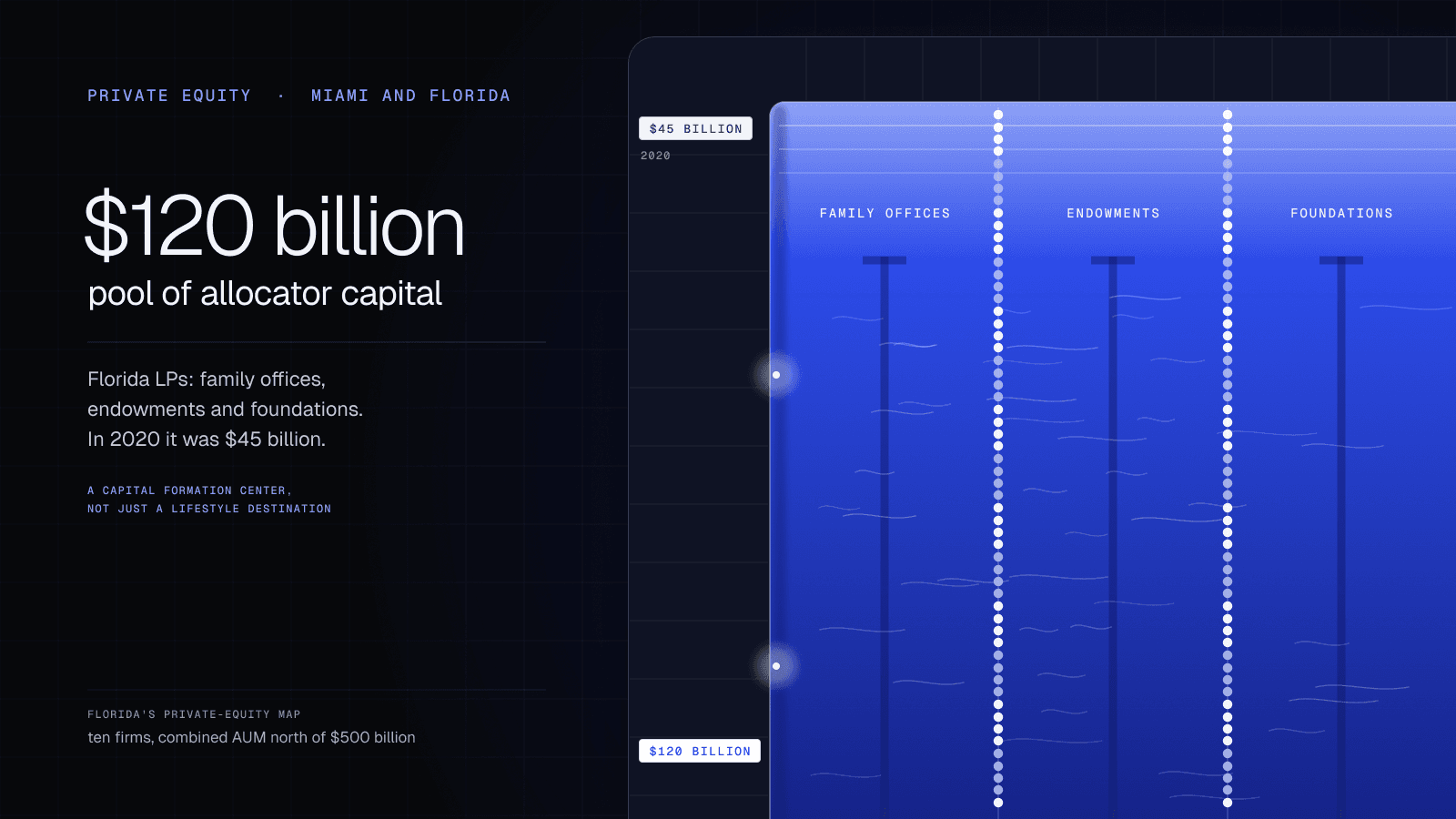
For fund managers raising capital, the implication is direct: Florida LPs—family offices, endowments, and foundations—now represent a $120 billion pool of allocator capital. That is up from $45 billion in 2020. The state has become a capital formation center, not just a lifestyle destination.
The Top 10: Detailed Firm Profiles
1. Thoma Bravo — $198 B AUM
Latest moves (2026)
Completed a record $38 billion three-fund raise in January 2026: Flagship XVII ($22 billion), Discover VI ($10 billion), and Europe II ($6 billion). In February, closed the acquisition of Boeing's Digital Aviation unit for $11.2 billion—adding flight-operations software to its portfolio. In April, announced a $4.7 billion take-private of cybersecurity firm Darktrace, combining it with its existing Sophos platform.
Strategy
Enterprise-software control buyouts remain the core. The firm targets companies with $50 million–$500 million in recurring revenue, applies operational leverage through its in-house OPS team, and holds for 4–7 years. The "Discover" fund series targets smaller deals ($100 million–$500 million enterprise value) where Thoma Bravo sees fragmented markets.
Why Miami?
Thoma Bravo's headquarters is in Fort Lauderdale, not Miami proper. But the firm's 2020 move from San Francisco was a signal. CEO Orlando Bravo cited "talent density in technology and finance" as the reason. The firm now employs 450 people in South Florida, with a second office in Chicago.
Key data points
- 2026 fundraising: $38 billion (largest software-focused fund ever)
- Portfolio companies: 65+ active investments
- Average deal size: $2.5 billion
- Sector concentration: 100% software
- IRR track record: 25%+ since 2008 (firm-reported)
2. Starwood Capital Group — $125 B AUM
Latest moves (2026)
Closed $4.1 billion across two new private-credit vehicles in Q1 2026: Starwood Real Estate Credit Fund II ($2.8 billion) and a bridge-lending separate account ($1.3 billion). The credit push comes as traditional bank lenders have pulled back from commercial real estate lending by 34% since 2023. In March, acquired a $750 million portfolio of single-family rental homes from a distressed developer in Phoenix and Atlanta.
Strategy
Starwood is a macro real estate investor. It moves between equity and credit based on cycle dynamics. In 2026, the firm is heavily tilted toward credit: 60% of deployed capital is in loans, 30% in opportunistic equity, and 10% in infrastructure. CEO Barry Sternlicht has publicly stated that "the best risk-adjusted returns in real estate today are in lending, not owning."
Why Miami?
Starwood has been Miami-based since 1991. Its headquarters in Miami Beach houses 300 employees. The firm's Latin American and European fundraising efforts benefit from Miami's connectivity—Sternlicht estimates 40% of Starwood's LP meetings happen within a 10-mile radius of the office.
Key data points
- 2026 credit funds: $4.1 billion raised
- Total real estate portfolio: 15,000+ multifamily units, 40 million sq ft of office/retail
- Average loan size: $50 million–$200 million
- Geographic focus: US Sun Belt, Western Europe, Latin America
- Target returns: 12–15% net IRR on credit; 15–20% on equity
3. H.I.G. Capital — $78 B AUM
Latest moves (2026)
Acquired UK aseptic-pharmacy specialist ITH Group in January 2026 for £420 million, expanding its European healthcare platform. In March, bought revenue-cycle firm GetixHealth (Houston) for $320 million. In May, closed H.I.G. Middle Market LBO Fund V at $6.2 billion, oversubscribed by $1.2 billion.
Strategy
H.I.G. operates five distinct verticals: middle-market buyouts, credit, special situations, real estate, and infrastructure. Each vertical has its own investment committee and carry structure. The firm's edge is its operating resources: 85 operating partners embedded in portfolio companies, driving EBITDA improvement within 12 months of acquisition.
Why Miami?
H.I.G. was founded in Miami in 1993 by Sami Mnaymneh and Tony Tamer. The firm now has 14 offices globally, but Miami remains the headquarters with 200 employees. The founders' network in Latin America and Europe has been a consistent source of deal flow—30% of H.I.G.'s deals in 2026 had a cross-border component.
Key data points
- 2026 fund close: $6.2 billion (Middle Market LBO Fund V)
- Total AUM: $78 billion across all strategies
- Portfolio companies: 300+ active
- Average hold period: 4–5 years
- Sector diversification: healthcare (25%), business services (20%), technology (18%), industrials (15%), consumer (12%), other (10%)
4. Polen Capital — $70 B AUM
Latest moves (2026)
Launched a European High-Yield strategy in partnership with iM Global Partner in February 2026, raising $1.8 billion in the first close. In April, opened a London office with 10 investment professionals to source European credit deals directly.
Strategy
Polen is primarily a public-markets investor—growth equity and leveraged credit—not a traditional PE firm. But its inclusion on this list reflects Florida's blurring of public and private markets. Polen's growth equity team manages concentrated portfolios (25–35 holdings) of high-quality businesses with sustainable competitive advantages. The credit team focuses on senior secured loans of companies with $100 million–$500 million EBITDA.
Why Boca Raton?
Polen has been in Boca Raton since 1989. The firm cites "lower turnover, deeper relationships, and a focus on long-term compounding" as benefits of being outside New York. CEO Stan Moss has said that Boca Raton allows Polen to "avoid the noise of short-term trading culture."
Key data points
- 2026 credit strategy: $1.8 billion raised
- Total AUM: $70 billion (public equities and credit)
- Average position size in equity portfolios: 3–4% of fund
- Credit portfolio: 40+ positions, average yield 8.5%
- Client base: 60% institutional, 30% family office, 10% high-net-worth
5. I Squared Capital — $45 B AUM
Latest moves (2026)
Signed two memoranda of understanding with Saudi PIF and the Arab Energy Fund in January 2026 to seed a $5 billion Middle East sustainable-infrastructure fund. In March, closed the acquisition of a 1.2 GW portfolio of US solar assets from a developer in Texas for $1.1 billion. In May, launched a data-center development platform with $700 million in committed equity.
Strategy
I Squared focuses on infrastructure equity and credit across three verticals: energy (renewables, gas, power grids), utilities (water, waste, district energy), and transport/digital (toll roads, ports, data centers). The firm targets 12–15% gross IRRs on equity investments and 8–10% on credit.
Why Miami?
I Squared moved its headquarters to Miami from New York in 2022. The firm has 150 employees in Miami, with additional offices in London, Hong Kong, and Singapore. CEO Gautam Bhandari cited "access to Latin American capital and a more favorable business climate" as reasons for the move.
Key data points
- 2026 infrastructure fund: $5 billion (Middle East-focused)
- Total AUM: $45 billion
- Portfolio: 35+ assets across 20 countries
- Average equity check: $100 million–$500 million
- Sector mix: energy (45%), digital (25%), transport (20%), utilities (10%)
6. Rialto Capital Management — $17.5 B AUM
Latest moves (2026)
Rialto's special-servicing arm remains in the spotlight after a Nevada judge allowed Carl Icahn's lawsuit over a $67 million CMBS loan to proceed in February 2026. The case has become a bellwether for distressed retail real estate. Separately, Rialto closed Rialto Real Estate Fund VII at $2.8 billion in April 2026, targeting value-add office and retail conversions.
Strategy
Rialto is a distressed real estate specialist. It operates three business lines: direct lending (bridge and mezzanine loans), special servicing (CMBS workouts), and direct property acquisitions. The firm's edge is its in-house servicing platform, which gives it first-mover access to troubled loans before they hit the market.
Why Miami?
Rialto is based in Miami and has been since 2005. The firm has 120 employees in Miami, with a satellite office in New York. CEO Jay Mantz has said that "Miami's real estate cycle is less volatile than New York's, and the tax environment makes it easier to attract talent."
Key data points
- 2026 fund close: $2.8 billion (Real Estate Fund VII)
- Total AUM: $17.5 billion
- Loan portfolio: $8 billion in face value of CMBS and bridge loans
- Special servicing: 200+ active workouts
- Target returns: 12–15% net IRR on equity; 8–10% on credit
7. RedBird Capital Partners — $12 B AUM
Latest moves (2026)
Closed the acquisition of Telegraph Media Group for £600 million in January 2026, integrating the UK publisher into its media platform. In March, acquired a 35% stake in Wasserman (sports and entertainment agency) for $450 million. In May, launched RedBird Sports Fund II at $2.5 billion, targeting sports team ownership and media rights.
Strategy
RedBird is a thematic investor in sports, media, and entertainment. The firm takes controlling or influential minority stakes in assets with strong brand value and recurring revenue. Its portfolio includes AC Milan (sold in 2024 for a 2x return), the XFL (merged with USFL to form the UFL), and a stake in Fenway Sports Group.
Why Miami?
RedBird moved its headquarters to Miami from New York in 2021. Founder Gerry Cardinale cited "the convergence of sports, media, and Latin American markets" as the reason. The firm now has 80 employees in Miami, with a focus on Latin American media rights and sports franchises.
Key data points
- 2026 fund: $2.5 billion (Sports Fund II)
- Total AUM: $12 billion
- Portfolio: 15+ investments in sports, media, and entertainment
- Average investment: $200 million–$500 million
- Target returns: 20%+ gross IRR
8. 777 Partners — $8 B AUM (estimated)
Latest moves (2026)
777 Partners has been in restructuring mode for most of 2026. The firm faced liquidity pressure after over-leveraging its sports portfolio (including Genoa CFC, Sevilla FC, and Standard Liège). In March, sold its stake in Genoa to a consortium of US investors for €150 million, taking a loss on its original €200 million investment. In May, completed a debt restructuring with its lenders, exchanging $1.2 billion in debt for equity in its remaining assets.
Strategy
777 Partners is a holding company, not a traditional PE firm. It acquires controlling stakes in sports clubs, insurance companies, and aviation assets, then uses the cash flows from insurance to fund sports acquisitions. The model worked in a low-rate environment but has struggled as interest rates rose.
Why Miami?
777 Partners has been Miami-based since 2015. The firm employs 50 people in Miami. Founder Josh Wander has said that "Miami's international orientation and lack of state income tax make it ideal for a global holding company."
Key data points
- 2026 restructuring: $1.2 billion debt-for-equity swap
- Total AUM: $8 billion (estimated, post-restructuring)
- Sports portfolio: Sevilla FC, Standard Liège, Vasco da Gama, Melbourne Victory
- Insurance portfolio: 777 Re (Bermuda-based)
- Current status: deleveraging and selling non-core assets
9. Blue Point Capital Partners — $4 B AUM
Latest moves (2026)
Closed Blue Point Capital Partners VI at $1.5 billion in February 2026, exceeding its $1.2 billion target. In April, acquired a majority stake in US Liner (a manufacturer of industrial liners) for $200 million. In June, sold its portfolio company Apex Tool Group to a strategic buyer for 3.5x EBITDA.
Strategy
Blue Point is a lower-middle-market buyout firm. It targets companies with $10 million–$50 million in EBITDA in manufacturing, business services, and distribution. The firm's approach is operational: it deploys a team of 15 operating partners to drive revenue growth and margin expansion.
Why Florida?
Blue Point has offices in Cleveland, Charlotte, and Miami. The Miami office, opened in 2022, focuses on Latin American-sourced deals and portfolio companies with exposure to the region. The firm has made three investments out of the Miami office since opening.
Key data points
- 2026 fund close: $1.5 billion (Fund VI)
- Total AUM: $4 billion
- Portfolio: 25+ active investments
- Average EBITDA of targets: $20 million
- Target returns: 20–25% gross IRR
10. Garnett Station Partners — $3.5 B AUM
Latest moves (2026)
Closed Garnett Station Partners III at $1.8 billion in March 2026. In May, acquired a majority stake in Wetzel's Pretzels (a 350-unit fast-casual chain) for $250 million. In June, sold its portfolio company Nothing Bundt Cakes to a strategic buyer for 4x invested capital.
Strategy
Garnett Station is a consumer-focused lower-middle-market buyout firm. It targets franchise systems, multi-unit restaurant operators, and consumer brands with $5 million–$30 million in EBITDA. The firm's edge is its franchise operations expertise: it has a team of 20 former franchise operators who work with portfolio companies on unit-level economics.
Why Florida?
Garnett Station is based in Miami Beach. The firm was founded in 2013 by Matt Gorton and Alex Sloane, both former KKR professionals. They chose Miami for lifestyle reasons but have found that the city's growing consumer and franchise ecosystem provides a natural deal pipeline.
Key data points
- 2026 fund close: $1.8 billion (Fund III)
- Total AUM: $3.5 billion
- Portfolio: 15+ investments in consumer/franchise
- Average EBITDA of targets: $15 million
- Target returns: 20–25% gross IRR
Beyond the Top 10: The Second Wave
The ten firms above command the headlines. But Florida's PE ecosystem has a second tier that is growing faster and may matter more for emerging GPs.
Emerging GPs Relocating to Miami
A 2026 survey by the Florida Venture Forum found that 38% of new PE firms formed in the US in 2025–2026 were headquartered in Florida, up from 12% in 2020. The typical profile: a former partner at a large firm who raises a $200 million–$500 million debut fund.
Examples include:
- Apex Capital Partners ($400 million, 2025): Founded by former Thoma Bravo partner Ryan Ziegler. Focuses on vertical SaaS in healthcare and logistics. Based in Coral Gables.
- Brickell Equity Partners ($250 million, 2026): Founded by two former H.I.G. Capital partners. Focuses on lower-middle-market business services. Based in Miami's Brickell neighborhood.
- Sunshine Capital Group ($180 million, 2026): Founded by a former Blackstone real estate executive. Focuses on value-add multifamily in the Sun Belt. Based in West Palm Beach.
- Palmetto Growth Partners ($150 million, 2025): Founded by a former Insight Partners principal. Focuses on growth equity in Latin American fintech. Based in Miami Beach.
Family Office Direct Investing
The second wave is not just about new GPs. Florida's 9,000+ family offices are increasingly doing direct deals, bypassing traditional PE firms. A 2026 Altss analysis of LP activity found that Florida family offices completed 47 direct investments in 2025, up from 22 in 2020.
Notable examples:
- The Baupost Group's Miami office (not a family office but a hedge fund) has made seven direct PE investments in Florida-based companies since 2022.
- The Soros Fund Management's Miami office has made three direct investments in Florida real estate and technology companies.
- The Fisher Family Office (Boca Raton) has a $500 million direct investment portfolio focused on healthcare services.
Sector Specialization: What Florida Does Best
Florida's PE ecosystem has developed genuine depth in three sectors. Fund managers targeting these verticals should prioritize Florida LPs and talent.
1. Enterprise Software
Thoma Bravo's dominance in software has created a talent pipeline. Former Thoma Bravo professionals have started 12 software-focused PE firms in Florida since 2020. The state now has 45+ software PE firms with over $1 billion in combined AUM.
The opportunity: Florida's software ecosystem is under-penetrated by later-stage growth equity. Most software companies in the state that reach $10 million–$50 million in ARR are either acquired by Thoma Bravo or move to Silicon Valley for growth capital. There is a gap for a $500 million–$1 billion growth equity fund focused on Florida-based software companies.
2. Real Estate Credit
Starwood and Rialto have made Miami the center of real estate credit in the US. The two firms manage over $140 billion in real estate assets, and their presence has attracted a network of 30+ smaller real estate credit firms.
The opportunity: Regional banks have retreated from commercial real estate lending, creating a $200 billion+ financing gap. PE firms that can originate, underwrite, and service CRE loans are well-positioned. Florida's regulatory environment (no state-level usury laws for loans over $500,000) makes it easier to structure creative credit products.
3. Sports, Media, and Entertainment
RedBird and 777 Partners have made Miami a hub for sports investing. The city now hosts 12 sports-focused PE firms, up from two in 2020. The trend is driven by three factors: the globalization of sports media rights, the legalization of sports betting in Florida, and the city's role as a gateway to Latin American sports markets.
The opportunity: Sports team valuations have compressed from 25x+ EBITDA to 18–20x EBITDA as interest rates have risen. This creates a buying opportunity for firms with patient capital. RedBird's Sports Fund II is the largest dedicated sports fund, but there is room for smaller funds focused on specific sports (soccer, basketball) or regions (Latin America).
How Florida Compares to Other PE Hubs
| Metric | Miami | New York | San Francisco | Chicago | Dallas |
|---|---|---|---|---|---|
| PE firms (10B+ AUM) | 14 | 120 | 45 | 30 | 25 |
| Total PE AUM | $500B+ | $3T+ | $1.5T+ | $800B+ | $600B+ |
| Family offices (tracked) | 1,200+ | 2,500+ | 1,800+ | 1,000+ | 900+ |
| State income tax | 0% | 10.9% | 13.3% | 4.95% | 0% |
| Avg GP comp (2026) | $850K | $1.2M | $1.4M | $950K | $800K |
| Office rent (per sq ft) | $65 | $120 | $150 | $55 | $40 |
| Talent pool depth | Medium | Very High | High | High | Medium |
| Latin American connectivity | Very High | Medium | Low | Low | Low |
The data shows a clear trade-off: Miami offers lower costs and better Latin American connectivity but has a thinner talent pool than New York or San Francisco. For emerging GPs, the calculation depends on their strategy. A fund focused on Latin American deals or real estate credit will find Miami ideal. A fund requiring deep technology talent may still need a Silicon Valley presence.
The Altss Advantage: Data That Keeps Up
Florida's PE landscape changes fast. New firms launch. Existing firms raise new funds. LPs shift allocations. Altss tracks all of it with a sub-30-day update cycle.
For fund managers raising capital, Altss provides:
- Continuously refreshed LP data on 30,000+ institutional investors, RIAs, and family offices, with a focus on Florida-based allocators.
- Semantic LP search that lets you find LPs by sector preference (e.g., "software" + "Florida" + "direct investment") rather than just by name or AUM.
- Deal flow signals from OSINT sources: regulatory filings, news mentions, and social media activity that indicate when an LP is actively deploying capital.
- Entity mapping of 150,000+ private-markets entities, including the relationships between GPs, LPs, and portfolio companies.
The platform is designed for the speed of Florida's market. When a new firm like Brickell Equity Partners raises $250 million, Altss has it in the database within 30 days. When Starwood closes a new credit fund, Altss updates the AUM figure and fund terms.
Practical Advice for Fund Managers
If You Are Raising a Fund in Florida
- Target the right LPs. Florida family offices are not all the same. The ones in Palm Beach (Fisher, Koch, Scripps) tend to be older money with conservative mandates. The ones in Miami (Brickell, Coral Gables) are often first-generation wealth with higher risk tolerance. Use Altss's semantic LP search to segment by geography and mandate.
- Build a local network. Florida's PE community is still small enough that personal relationships matter. Attend the Florida Venture Forum (annual, in Miami), the South Florida PE Conference (bi-annual, in Fort Lauderdale), and the Miami LP Summit (annual, in Miami Beach). Altss's entity mapping can help you identify which LPs attend which events.
- Leverage the tax advantage. Florida's lack of state income tax is a real economic benefit. A GP earning $2 million per year saves $220,000 in state taxes compared to a New York-based GP. That saving can be reinvested in the firm or passed through to LPs as lower fees. Make sure your pitch deck highlights this.
- Consider a Latin American angle. 40% of Florida's PE AUM comes from LPs with Latin American exposure. If your fund has a thesis that touches Latin America (e.g., nearshoring, fintech, energy transition), lead with it. Altss's data shows that Latin American LPs allocated $12 billion to Florida-based PE funds in 2025, up from $4 billion in 2020.
If You Are an LP Allocating to Florida
- Watch for manager concentration. Florida's PE ecosystem is dominated by a few large firms (Thoma Bravo, Starwood, H.I.G.). If you are over-allocated to these firms, you may have correlation risk. Use Altss's portfolio analytics to measure your exposure to individual managers and sectors.
- Evaluate emerging GPs carefully. The influx of new firms means more options but also more manager risk. Altss's OSINT-derived signals can help you identify red flags: lawsuits, regulatory actions, or rapid personnel turnover. The platform's sub-30-day update cycle means you get warnings fast.
- Consider direct investing. Florida family offices are increasingly doing direct deals. If you have the internal capability, direct investing can offer higher returns and more control than fund investing. Altss's deal-flow signals can help you source proprietary opportunities.
The Future: Florida PE in 2027 and Beyond
Three trends will shape Florida's PE ecosystem over the next 12–18 months.
1. Credit expansion. The retreat of regional banks from commercial real estate lending will continue to create opportunities for PE credit funds. Starwood and Rialto will lead, but smaller firms will emerge. Expect 10+ new real estate credit funds to launch in Florida in 2027.
2. Sports consolidation. RedBird's Sports Fund II will likely acquire one or two additional sports teams in 2027, possibly in soccer (a Latin American club) or basketball (an NBA franchise). 777 Partners will continue to deleverage, selling non-core assets to focus on its remaining sports properties.
3. Technology talent migration. As remote work becomes permanent, more technology talent will move to Florida. This will benefit software-focused PE firms like Thoma Bravo and the emerging GPs targeting Florida-based software companies. The talent pool in Miami will deepen, reducing the city's main competitive disadvantage.
4. Regulatory tailwinds. Florida's state government has been actively courting financial firms. In 2025, the state passed a law exempting PE fund management fees from state income tax for funds with over $1 billion in AUM. In 2026, it is considering a bill that would exempt carried interest from state taxation entirely. If passed, this would be a significant draw for GPs.
Conclusion
Florida's private-equity ecosystem has reached critical mass. The state now has the firms, the capital, and the talent to compete with any PE hub in the world. For fund managers and LPs, the opportunity is clear: Florida offers lower costs, better tax treatment, and unique sector specialization in software, real estate credit, and sports/media.
But the market is also becoming more competitive. The influx of new firms means more noise and more manager risk. The key to success is data. Altss provides the continuously refreshed intelligence that fund managers and LPs need to navigate Florida's fast-moving PE landscape.
Whether you are raising a debut fund, allocating to an established manager, or doing direct deals, Altss gives you the signals you need to make better decisions. And with a sub-30-day update cycle, you can trust that the data reflects the market as it is, not as it was.
Find the allocators who actually back funds like yours
GPs and IR teams use Altss to research allocators with ownership, commitment, transaction and relationship context, then prioritize outreach.


See the allocators behind your next close.
Public records carry source-specific dates where available. No population-wide measured refresh cadence or universal verification deadline is established here. Page modified, source captured, fact observed, entity verified and aggregate measured describe different events. Check the date attached to the relevant claim; a missing verification date means unknown. Stored source history does not establish a customer-facing historical-analysis interface.