
Top 10 Private-Equity Firms in Texas (2026 Edition)
Texas PE firms manage $580B+ in assets. Ranked by AUM with deal analysis, LP insights, and fundraising advice for emerging GPs.
Top 10 Private-Equity Firms in Texas (2026 Edition)
Texas private-equity firms now manage more than $580 billion in assets — and 2026's biggest deals are being shaped by energy transition, software roll-ups, and infrastructure bets tied to the 2026 World Cup.
Why Texas Still Punches Above Its PE Weight
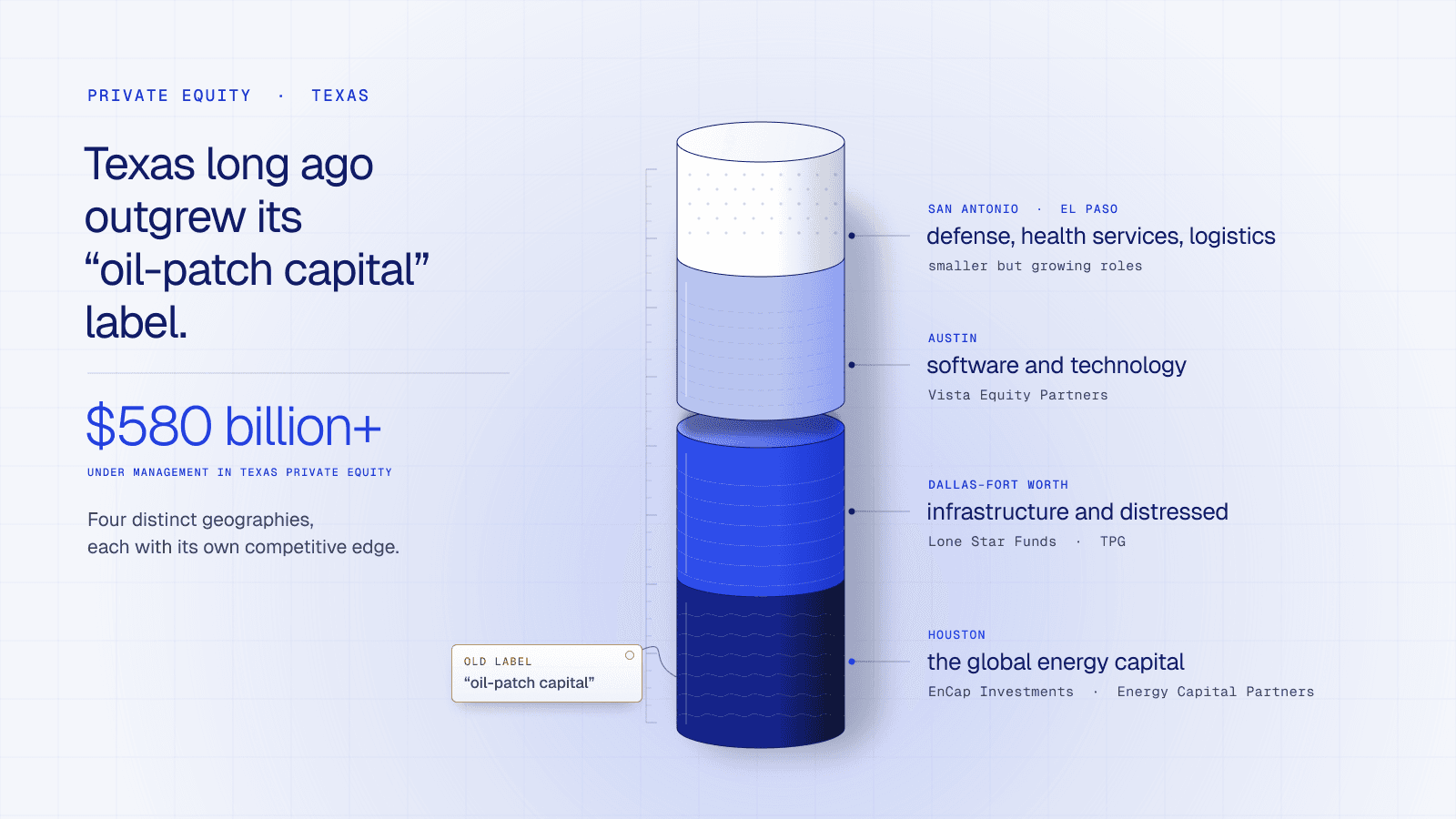
Texas long ago outgrew its "oil-patch capital" label. The state's private-equity ecosystem now spans four distinct geographies, each with its own competitive edge:
Dallas–Fort Worth has become the dominant hub for infrastructure and distressed investing, anchored by firms like Lone Star Funds and TPG's Fort Worth headquarters. The Metroplex also benefits from DFW Airport's position as the second-busiest in the world by passenger traffic, making it a logistics and travel infrastructure magnet.
Houston remains the global energy capital, but its PE landscape has diversified into industrials, healthcare (the Texas Medical Center is the world's largest), and energy-transition assets. EnCap Investments and Energy Capital Partners call Houston home, and the city's $500 billion-plus GDP rivals entire countries.
Austin has emerged as the software and technology corridor, led by Vista Equity Partners. The city's venture ecosystem now supports over 6,000 tech startups, and its cost of living relative to San Francisco continues to attract talent and capital. Austin's median home price remains roughly half of the Bay Area's, a gap that persists even after the post-2020 surge.
San Antonio and El Paso play smaller but growing roles. San Antonio's healthcare and military presence (Fort Sam Houston, Lackland AFB) creates niche opportunities in defense and health-services PE. El Paso's border economy generates logistics and manufacturing deals.
The state's business-friendly tax regime — no corporate or personal income tax — is a structural advantage. But the real story is depth of talent: Texas now produces more private-equity professionals than any state except New York, according to Altss's continuously refreshed LP talent database, which tracks 30,000+ institutional investors, RIAs, and family offices globally.
Below is a deal-driven look at the ten firms that matter most in 2026, ranked by assets under management (AUM) and filtered for brand recognition, recent activity, and institutional LP demand.
1. TPG | Fort Worth · $258 B AUM
Snapshot. Founded in 1992 out of the old Bass family offices, TPG today runs eight distinct platforms spanning buyout, growth, impact, secondaries, and credit. Its regulatory AUM reached $258 billion after closing TPG Partners IX in March 2026 — the firm's largest flagship fund to date.
Latest move. In April 2026, TPG agreed to acquire Columbus-based Peppertree Capital, a portfolio of 12,900 wireless towers, for $1.5 billion. The deal is a direct bet on 5G densification ahead of the 2026 World Cup, which will bring an estimated 6 million international visitors to the U.S. and generate demand for mobile data capacity in host cities including Dallas, Houston, and Austin.
Why it matters. TPG's infrastructure platform, launched in 2019, now accounts for roughly 15% of total AUM. The Peppertree acquisition follows a pattern: TPG is buying physical assets that generate predictable cash flows from long-term contracts, not speculative tech. The firm's infrastructure team, led by former Goldman Sachs partner David Foley, targets assets with 10- to 20-year concession periods and inflation-linked revenue streams.
Recent deal flow (2025–2026):
- TPG Rise Climate — Launched in 2021 with $5.4 billion, the climate fund has deployed capital into carbon capture (Svante, $318 million Series F), sustainable aviation fuel (LanzaJet, $86 million Series C), and grid-scale battery storage (Form Energy, $450 million Series E).
- TPG Healthcare Partners — Acquired a controlling stake in U.S. Anesthesia Partners in a $2.8 billion carve-out from Mednax (closed March 2025).
- TPG Secondaries — Closed a $4.2 billion dedicated secondaries fund in February 2026, one of the largest in the market.
LP perspective. TPG's LP base includes 900+ institutional investors, with sovereign wealth funds (GIC, ADIA, Temasek) representing roughly 35% of capital commitments. The firm's 2026 investor day highlighted a 1.7x net multiple on realized investments across the past five vintages — above the industry median of 1.4x.
Altss insight. For emerging GPs raising capital in Texas, TPG's institutional LP roster is a useful proxy for which investors are active in the region. Altss tracks 9,000+ family offices globally, including 1,200+ with Texas exposure, and our sub-30-day update cycle on LP data means fund managers can see which of TPG's LPs are currently deploying into first-time funds.
2. Vista Equity Partners | Austin · $100 B AUM
Snapshot. Vista's software-only focus remains intact even after topping $100 billion in assets. The firm manages capital across three core strategies: flagship buyout (Vista Equity Partners Fund VIII, $16 billion), Endeavor (growth equity, $4.2 billion), and Perennial (permanent capital, $12 billion). Vista's portfolio companies generate aggregate annual revenue exceeding $60 billion.
Latest moves.
- Energy Exemplar — Joint $1.6 billion take-private with Blackstone (October 2023). The company provides energy market simulation software used by grid operators and utilities. Vista is now integrating AI-based demand forecasting modules.
- Acumatica — Definitive agreement announced May 29, 2026; price approximately $2 billion, closing expected Q3 2026. Acumatica is a cloud ERP provider competing with Oracle NetSuite and Microsoft Dynamics 365. Vista plans to double the company's salesforce and expand into the mid-market manufacturing vertical.
Deal thesis. Vista targets enterprise software companies with recurring revenue models, high customer retention rates (above 90%), and room for operational improvement. The firm's "Vista Way" playbook includes installing new management teams, modernizing sales compensation, and expanding into adjacent verticals. Since 2000, Vista has completed over 400 acquisitions and 200-plus divestitures.
Recent portfolio performance (2025–2026):
- Apptio — Sold to IBM in June 2023 for $4.6 billion (3.2x cost). The deal generated $1.8 billion in net returns for Vista's Fund VII LPs.
- Diligent — Acquired by Insight Partners in July 2024 for $1.9 billion. Vista had owned Diligent since 2016 and grew revenue from $120 million to $400 million.
- Cvent — Taken private in a $1.2 billion deal with Apollo Global Management (March 2025). Vista retains a minority stake.
LP demand. Vista's flagship funds are consistently oversubscribed. Fund VIII (2021) had a hard cap of $16 billion but received $22 billion in commitments. LPs are attracted to Vista's sector specialization and track record: the firm's 10-year net IRR stands at 18.3%, versus the Cambridge Associates PE benchmark of 13.7%.
Austin ecosystem. Vista's headquarters at 200 West 6th Street anchors Austin's "Silicon Hills" corridor. The firm employs 1,200+ people in the city and is the largest private-equity employer in Texas. Vista's presence has attracted other tech-focused PE firms to Austin, including Thoma Bravo (which opened an Austin office in 2022) and Silver Lake (which established a permanent Austin team in 2024).
3. Lone Star Funds | Dallas · $95 B AUM
Snapshot. The distressed-assets specialist has raised $95 billion across 25 funds since 1995. Lone Star operates through four regional platforms: Lone Star Real Estate, Lone Star Opportunity (corporate debt and equity), Lone Star Credit (distressed credit), and Lone Star Real Estate Partners (U.S. and Europe).
Latest move. Sale of resins maker AOC to Nippon Paint closed March 3, 2026, returning $1.8 billion to investors. AOC, acquired by Lone Star in 2015 for $1.1 billion, is a manufacturer of polyester resins used in marine, construction, and automotive applications. The deal generated a 2.4x gross multiple and 14.2% gross IRR.
Deal history. Lone Star's strategy is cyclical: raise capital during market downturns, acquire assets at distressed prices, hold for 3–7 years, and exit during recoveries. The firm's best vintage was Fund IV (2002–2005), which generated a 3.8x net multiple on $5.2 billion of capital. Fund V (2006–2009) returned 2.1x despite the global financial crisis.
Recent activity (2025–2026):
- Lone Star Real Estate Fund VII — Closed at $8.5 billion in January 2026, targeting U.S. and European commercial real estate. The fund is focused on office-to-residential conversions in central business districts, a bet on post-pandemic urban revival.
- Lone Star Opportunity Fund XII — Raised $12.3 billion, with 40% allocated to energy-related distressed debt and 30% to corporate carve-outs.
- Portfolio company exits — Sold industrial packaging firm Signode to Crown Holdings for $3.1 billion (December 2025); divested European logistics platform Logisteed to a consortium of sovereign wealth funds for $2.4 billion (March 2026).
LP base. Lone Star's LP roster includes 750+ institutional investors, with significant allocations from U.S. public pensions (CalPERS, CalSTRS, Texas Teachers) and Asian sovereign wealth funds (KIC, GPIF). The firm's 2026 investor letter noted that 40% of capital came from existing LPs, a sign of strong satisfaction with past vintages.
Dallas presence. Lone Star's headquarters at 300 Crescent Court in Uptown Dallas houses 400 employees. The firm is one of the largest private-equity employers in the city and has contributed to Dallas's emergence as a distressed-debt hub, alongside Oaktree Capital Management (which maintains a Dallas office) and Cerberus Capital Management.
4. EnCap Investments | Houston · $47 B Commitments
Snapshot. The energy-sector veteran has raised 25 funds and $47 billion since inception. EnCap operates three distinct platforms: EnCap Energy Capital (upstream E&P), EnCap Flatrock Midstream (midstream infrastructure), and EnCap Energy Transition (renewables and decarbonization).
Latest move. EnCap-backed Mach Natural Resources completed an $815 million Anadarko Basin bolt-on acquisition in December 2025 and remains on the hunt for additional Mid-Continent acreage. Mach, formed in 2021, now controls 450,000 net acres in the Anadarko Basin and produces 85,000 barrels of oil equivalent per day.
Deal thesis. EnCap focuses on the "lower 48" U.S. onshore basins — Permian, Eagle Ford, Bakken, and Anadarko. The firm provides equity capital to management teams with deep operating experience, typically taking a 60–80% ownership stake. EnCap's average hold period is 5–7 years, and the firm has completed over 400 investments since 1988.
Recent fund performance:
- EnCap Energy Capital Fund XII — Closed at $5.8 billion in 2023. The fund is 65% deployed, with investments in 14 portfolio companies. Early exits include the sale of 4R Energy to Chevron (2024, 2.1x gross multiple).
- EnCap Flatrock Midstream Fund IV — Raised $3.2 billion in 2025. The fund targets natural gas gathering, processing, and fractionation assets in the Permian and Haynesville basins.
- EnCap Energy Transition Fund I — Closed at $1.5 billion in 2024. Investments include solar developer Sundial Energy (500 MW pipeline) and battery storage operator GridFlex (1.2 GW under management).
Energy transition pivot. EnCap's energy transition fund represents a strategic shift. The firm has hired 15 professionals from renewable energy backgrounds and opened a Denver office to be closer to Rocky Mountain wind and solar assets. EnCap's transition strategy focuses on "hard-to-abate" sectors: industrial heat, hydrogen, and carbon capture.
Houston ecosystem. EnCap's headquarters at 1100 Louisiana Street in downtown Houston puts the firm at the center of the world's largest energy industry cluster. Houston is home to 4,600+ energy-related companies, including 14 Fortune 500 firms. EnCap's LPs include the Texas Permanent School Fund, the University of Texas Investment Management Company (UTIMCO), and the Teacher Retirement System of Texas.
5. NGP Energy Capital | Irving/Dallas · $24 B Commitments
Snapshot. With $24 billion raised, NGP straddles conventional E&P and energy-transition themes. The firm has invested in 200+ companies since 1988 and maintains a portfolio of 25 active investments.
Latest move. Backed the $250 million formation of Greenlake II, a Delaware-Basin development vehicle led by ex-Parsley Energy CEO Matt Gallagher (May 2026). Greenlake II will drill 120 wells over three years, targeting the Wolfcamp and Bone Spring formations. NGP committed $150 million of equity, with the remainder from co-investors.
Deal thesis. NGP focuses on the "people, not assets" approach: the firm backs management teams with proven track records and gives them operational autonomy. NGP's typical investment is $50–$200 million for a 30–60% equity stake. The firm avoids auctions and instead cultivates relationships with operators over years.
Recent portfolio activity:
- NGP Royalty Partners II — Closed at $1.8 billion in 2025. The fund acquires mineral and royalty interests in the Permian and Haynesville basins. NGP's royalty portfolio now generates $400 million in annual cash flow.
- Portfolio company IPO — NextEra Energy Partners spin-off GridLiance (2024, $1.2 billion market cap). NGP retains a 15% stake.
- Exit — Sold Bakken operator Kraken Oil & Gas to ConocoPhillips for $1.5 billion (March 2026, 2.8x gross multiple).
Energy transition exposure. NGP has allocated 20% of Fund XV (2022, $3.5 billion) to energy-transition investments, including carbon capture (Carbonvert), geothermal (Fervo Energy), and lithium extraction (Standard Lithium). The firm's transition strategy is pragmatic: it targets technologies that can compete without subsidies within five years.
Dallas–Fort Worth presence. NGP's headquarters at 5221 N. O'Connor Boulevard in Irving places the firm in the Las Colinas business district, home to 200+ corporate headquarters. The area's proximity to DFW Airport makes it a hub for energy executives who travel frequently to the Permian Basin (a 90-minute flight to Midland).
6. Energy Capital Partners | Houston & Summit, NJ · $31 B AUM
Snapshot. ECP manages $31 billion across power, renewables, and energy-transition assets. The firm is the largest pure-play power and renewables private-equity firm in the U.S., with a portfolio spanning natural gas generation, wind, solar, battery storage, and electric transmission.
Latest moves.
- Triple Oak Power wind portfolio — Acquired from EnCap in January 2025 for $1.2 billion. The portfolio includes 1.8 GW of operating wind farms in Texas, Oklahoma, and Kansas.
- Bridgepoint merger — Folded into London-listed Bridgepoint in an £835 million ($1.05 billion) cash-and-shares deal that closed August 2025. The transaction gave ECP a European fundraising umbrella and access to Bridgepoint's LP base in the UK, Nordics, and Middle East.
Deal thesis. ECP targets infrastructure assets with long-term contracts, regulated returns, or investment-grade off-takers. The firm's average hold period is 10–15 years, and it generates returns through operational improvements and contract optimization rather than financial engineering.
Recent fund performance:
- Energy Capital Partners Fund V — Closed at $8.5 billion in 2024. The fund is 50% deployed, with investments in 12 assets across U.S. and European power markets.
- Portfolio company — Calpine Corporation (49% stake). Calpine operates 27 GW of natural gas and geothermal capacity. ECP acquired its stake in 2021 for $4.5 billion and has since improved EBITDA margins from 28% to 35%.
- Exit — Sold 1.2 GW of solar assets to NextEra Energy Partners for $1.8 billion (December 2025, 1.5x gross multiple).
Energy transition strategy. ECP's transition investments focus on "grid reliability" — assets that support intermittent renewables, including battery storage (1.5 GW under management), pumped hydro (300 MW), and natural gas peaker plants (2 GW). The firm argues that the energy transition requires massive investment in grid infrastructure, not just renewable generation.
Houston–New Jersey dual presence. ECP's Houston office at 1000 Louisiana Street manages the firm's upstream and midstream energy investments. The Summit, New Jersey office handles power markets and renewables. This geographic split reflects the firm's thesis that energy transition is a national phenomenon requiring local market expertise.
7. The Sterling Group | Houston · $9.4 B AUM
Snapshot. Middle-market industrial buyout specialist with $9.4 billion under management. Sterling targets companies in the manufacturing, distribution, and industrial services sectors with enterprise values of $100 million to $1 billion.
Latest move. Announced $1.33 billion exit of Artisan Design Group to Lowe's (signing April 14, 2026). Artisan is a manufacturer and installer of flooring, countertops, and cabinetry for new-home construction. Sterling acquired Artisan in 2019 for $450 million and grew revenue from $600 million to $1.8 billion through 12 add-on acquisitions.
Deal thesis. Sterling's "buy and build" strategy focuses on fragmented industries where consolidation can create value. The firm typically acquires a platform company, installs a new management team, and executes 5–10 add-on acquisitions over 4–6 years. Sterling's average investment is $150 million for a 60–80% equity stake.
Recent portfolio activity:
- Sterling Group Fund VI — Closed at $2.8 billion in 2023. The fund is 70% deployed across 8 platform investments.
- Portfolio company — Industrial solutions provider Applied Maintenance (acquired 2022, $300 million enterprise value). Sterling has completed 7 add-ons, expanding into the Gulf Coast chemical plant maintenance market.
- Exit — Sold packaging manufacturer Pactiv Evergreen's specialty films division to Apollo Global Management for $1.1 billion (October 2025, 3.1x gross multiple).
Houston industrial ecosystem. Sterling's Houston location at 1000 Main Street puts the firm in the heart of the city's industrial services cluster. Houston is home to 3,000+ industrial services companies, and Sterling's deal sourcing benefits from deep relationships with family-owned businesses in the Gulf Coast region.
LP demand. Sterling's Fund VI was oversubscribed, with $3.2 billion in commitments against a $2.5 billion target. LPs include the Texas Permanent School Fund, the Employees Retirement System of Texas, and several large family offices. Sterling's 10-year net IRR of 15.2% places it in the top quartile of middle-market buyout funds.
8. Brazos Private Equity Partners | Dallas · $3.2 B AUM
Snapshot. Lower-middle-market buyout firm focused on Texas-based companies with enterprise values of $50 million to $300 million. Brazos has raised $3.2 billion across seven funds since 1999.
Latest move. Acquired Houston-based oilfield services company Wellbore Integrity Solutions from private equity firm Blue Water Energy for $400 million (March 2026). Wellbore provides casing and cementing services for oil and gas wells. Brazos plans to expand the company into the Permian Basin and Haynesville Shale.
Deal thesis. Brazos targets "Texas middle-market" companies — family-owned businesses in manufacturing, distribution, and business services with $20 million to $100 million in EBITDA. The firm provides operational support through its "Brazos Operating Partners" program, which includes former CEOs of industrial companies.
Recent portfolio activity:
- Brazos Fund VII — Closed at $750 million in 2024. The fund is 40% deployed across 6 investments.
- Portfolio company — Texas-based logistics provider Lone Star Trucking (acquired 2023, $120 million enterprise value). Brazos has grown revenue from $80 million to $150 million through route optimization and fleet expansion.
- Exit — Sold industrial valve manufacturer ValvTechnologies to Rotork for $350 million (September 2025, 2.8x gross multiple).
Dallas presence. Brazos's headquarters at 200 Crescent Court in Uptown Dallas places the firm in the same building as Lone Star Funds. The firm's team of 25 professionals focuses exclusively on Texas-based investments, giving them deep local market knowledge.
LP base. Brazos's LPs include the Texas County & District Retirement System, the Dallas Police & Fire Pension System, and several Texas-based family offices. The firm's Fund VII had a 90% re-up rate from existing LPs.
9. Tailwater Capital | Dallas · $2.8 B AUM
Snapshot. Energy infrastructure private-equity firm with $2.8 billion under management. Tailwater focuses on midstream assets — natural gas gathering, processing, and transportation — as well as renewable natural gas (RNG) and hydrogen.
Latest move. Acquired a 50% stake in the Permian Highway Pipeline from Kinder Morgan for $1.2 billion (January 2026). The pipeline transports 2.1 billion cubic feet per day of natural gas from the Permian Basin to Gulf Coast markets. Tailwater plans to optimize the pipeline's capacity through compression upgrades.
Deal thesis. Tailwater targets "energy infrastructure with a transition tilt" — assets that support natural gas as a bridge fuel while investing in low-carbon alternatives. The firm's portfolio includes 5,000 miles of pipelines, 3.5 Bcf/d of processing capacity, and 12 RNG facilities.
Recent portfolio activity:
- Tailwater Energy Fund IV — Closed at $1.8 billion in 2025. The fund is 35% deployed.
- Portfolio company — RNG operator GreenGasUSA (acquired 2023, $500 million enterprise value). Tailwater has expanded the company's landfill gas-to-RNG footprint from 8 to 18 facilities.
- Exit — Sold Gulf Coast crude oil terminal operator Seabridge to Enbridge for $900 million (August 2025, 2.2x gross multiple).
Dallas presence. Tailwater's headquarters at 5950 Berkshire Lane in North Dallas houses 40 employees. The firm's investment team includes 15 professionals with backgrounds in energy investment banking and midstream operations.
10. Greenbriar Equity Group | Dallas & Rye, NY · $2.5 B AUM
Snapshot. Transportation and logistics private-equity firm with $2.5 billion under management. Greenbriar targets companies in freight, logistics, aviation, and supply chain technology.
Latest move. Acquired Texas-based refrigerated trucking company KLLM Transport Services from an affiliate of Investcorp for $650 million (April 2026). KLLM operates 1,800 trucks and 3,500 trailers serving the food and beverage industry. Greenbriar plans to invest in autonomous trucking technology and expand into the Mexican cross-border market.
Deal thesis. Greenbriar focuses on "transportation infrastructure" — assets that benefit from secular trends like e-commerce growth, nearshoring, and supply chain reshoring. The firm's average investment is $200 million for a controlling stake.
Recent portfolio activity:
- Greenbriar Fund VI — Closed at $1.5 billion in 2024. The fund is 60% deployed.
- Portfolio company — Aviation parts distributor Aero Support (acquired 2022, $400 million enterprise value). Greenbriar has completed 8 add-on acquisitions, expanding into the Asia-Pacific market.
- Exit — Sold intermodal logistics provider ITS to Brookfield Asset Management for $1.2 billion (November 2025, 2.5x gross multiple).
Dallas presence. Greenbriar's Dallas office at 2001 Ross Avenue opened in 2023 and now houses 20 professionals. The office focuses on logistics and supply chain investments, leveraging Dallas's position as a major freight hub (DFW Airport is the world's second-busiest by cargo volume).
What This Means for Fund Managers Raising Capital in 2026
The Texas PE landscape offers both opportunity and competition for emerging GPs. Here's what the data shows:
Where LP capital is flowing:
- Energy transition — EnCap and NGP are allocating 20–30% of new funds to transition assets. LPs are demanding exposure to renewable energy, carbon capture, and hydrogen. Emerging GPs with credible transition strategies have a fundraising advantage.
- Infrastructure — TPG and ECP are raising large infrastructure funds. LPs see infrastructure as a hedge against inflation and volatility. Texas's power grid (ERCOT) is a particular focus: the state's population growth and industrial expansion are driving demand for new generation and transmission.
- Software — Vista's dominance in enterprise software creates a "halo effect" for Austin-based tech PE. Emerging GPs targeting B2B SaaS can leverage Vista's LP relationships and talent pool.
Where emerging GPs can compete:
- Lower-middle-market industrials — Sterling, Brazos, and Tailwater dominate the $50–$300 million enterprise value range, but the market is fragmented. Emerging GPs with deep sector expertise in niche industrial verticals (e.g., aerospace manufacturing, chemical distribution) can find attractive opportunities.
- Texas-focused funds — LPs are increasingly interested in "local" allocations. Texas-based family offices, which Altss tracks at 1,200+ entities, prefer to invest in funds with a Texas focus. Emerging GPs headquartered in Houston, Dallas, or Austin can differentiate themselves.
- Co-investment opportunities — TPG, Vista, and Lone Star regularly offer co-investment opportunities to their LPs. Emerging GPs with strong LP relationships can access these deals and build track records.
The data advantage:
Altss tracks 9,000+ family offices globally, including 1,200+ with Texas exposure. Our sub-30-day refresh cycle on LP data means fund managers can identify which LPs are actively deploying into first-time funds, which Texas-based family offices have made co-investments in the past 12 months, and which institutional investors are increasing their allocation to energy transition.
For example, Altss data shows that Texas-based family offices increased their allocation to private equity by 22% in 2025, with 35% of that capital going to first-time funds. This represents a $2.8 billion opportunity for emerging GPs who can articulate a clear thesis and demonstrate operational expertise.
2026 Outlook: Five Trends Shaping Texas PE
1. The World Cup effect. The 2026 FIFA World Cup will be hosted across 16 U.S. cities, including Dallas (AT&T Stadium), Houston (NRG Stadium), and Austin (Q2 Stadium). The event is expected to generate $5 billion in economic impact for Texas, creating opportunities in hospitality infrastructure, transportation, and telecommunications. TPG's Peppertree acquisition is a direct bet on this trend.
2. Energy transition acceleration. Texas is the largest producer of wind and solar energy in the U.S., and the Inflation Reduction Act (IRA) has accelerated investment in clean energy. EnCap, NGP, and ECP are all raising dedicated transition funds. Emerging GPs should note that LPs are demanding "real" transition strategies — not just greenwashing — and are willing to pay a premium for credible teams.
3. Reshoring and nearshoring. The shift of manufacturing from Asia to Mexico and the U.S. is creating demand for logistics infrastructure, industrial real estate, and transportation assets. Texas's border with Mexico and its deepwater ports (Houston, Corpus Christi, Brownsville) make it a natural hub for reshoring-related investments.
4. Software consolidation. Vista's acquisition of Acumatica signals continued consolidation in the enterprise software space. Austin's tech ecosystem is producing a steady stream of $50–$200 million ARR companies that are attractive acquisition targets for both PE firms and strategic buyers.
5. LP demand for data. Institutional LPs are increasingly demanding granular, continuously refreshed data on fund managers, portfolio companies, and co-investment opportunities. Altss's platform, with its sub-30-day update cycle on 30,000+ institutional investors and 150,000+ private-markets entities, is becoming a standard tool for fund managers raising capital in Texas and beyond.
How Altss Helps Fund Managers Navigate Texas PE
For emerging GPs and established fund managers raising capital, Altss provides the institutional-grade intelligence needed to identify, prioritize, and close LP relationships.
What Altss offers:
- 9,000+ family offices globally — Including 1,200+ with Texas exposure, each with detailed profiles on investment preferences, allocation history, and contact information.
- 30,000+ institutional investors — Updated on a sub-30-day refresh cycle, so you know which LPs are actively deploying capital.
- 150,000+ private-markets entities — Fund managers, portfolio companies, and advisors, all mapped with entity relationships.
- LP coverage live since February 2026 — Institutional-grade data built for the fundraising professionals who need accuracy and timeliness.
Use cases for Texas-focused fund managers:
- Identify which 50 Texas-based family offices are most likely to invest in a first-time energy transition fund.
- Track which institutional LPs have increased their allocation to Texas-based PE firms in the past 12 months.
- Monitor co-investment activity by TPG, Vista, and Lone Star to identify deal flow opportunities.
- Benchmark your fund's performance against the top-quartile Texas PE firms.
Altss is the platform that fund managers use to turn LP data into closed commitments. No other intelligence provider offers the combination of family office depth, institutional LP coverage, and sub-30-day refresh cycles that Altss delivers.
Texas private-equity firms manage $580+ billion in assets, and 2026's biggest deals are being shaped by energy transition, software roll-ups, and World Cup infrastructure. Altss tracks the LPs behind these firms — 9,000+ family offices and 30,000+ institutional investors — with data refreshed every 30 days.