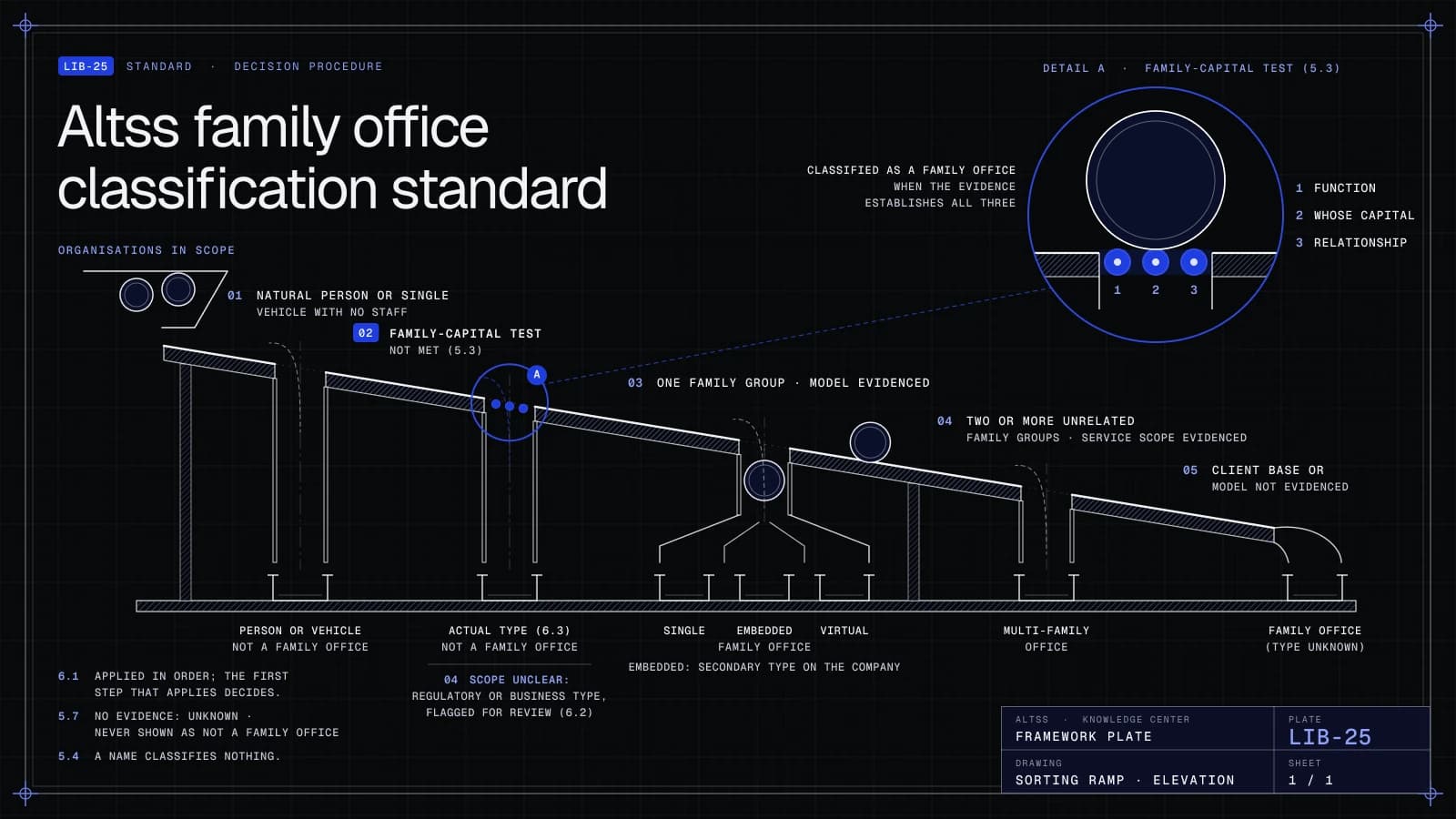
Family Offices
Family Offices are private allocators managing one or multiple families’ wealth across private markets and direct investments. Their decisions are shaped by liquidity posture, governance dynamics, concentration risk, and preference for control, with SFOs often driven by conviction and MFOs by defensibility and client explainability.
Family Offices are private investment entities created to manage the wealth of one or multiple families. They allocate across private equity, venture capital, private credit, real estate, infrastructure, and public markets, often combining fund commitments with direct and co-investments.
The defining feature of a family office is not simply “private wealth.” It’s the mandate: preserve purchasing power, grow capital responsibly, and support multi-decade family objectives—often including liquidity planning, governance continuity, and legacy considerations.
Family Offices also do not behave like institutions. Their decision-making is shaped by human realities that institutional LPs rarely face in the same way:
- Principal liquidity needs and lifestyle obligations
- Concentration from an operating business or a legacy asset base
- Generational transition and shifting risk preferences
- Internal governance dynamics and decision authority
- Preference for control and proximity versus diversification
- Appetite for direct deals, co-invests, and “special situations”
This is why “family office” is not a strategy. It’s an allocator profile with distinct risk psychology.
TL;DR
- Family Offices allocate through a lens of capital preservation, long-duration compounding, and family objectives, not just benchmark returns
- They are most predictable when you understand liquidity posture, governance, and concentration risk
- SFOs typically move on conviction and control; MFOs move on defensibility and client explainability
- The best managers win Family Offices with clarity, downside control, and a steady communication cadence, not hype
- Position your strategy as a portfolio role with controlled risk, not as a “hot opportunity”
Single-Family Offices (SFO) vs Multi-Family Offices (MFO)
Family Offices are often grouped into two operating models:
Single-Family Offices (SFOs) serve one family. They tend to optimize for control, conviction, and alignment. Decision-making can be fast when the thesis resonates and the family trusts the sponsor, but diligence is often deeply personal and concentrated around a small number of decision-makers.
Multi-Family Offices (MFOs) serve multiple families. They tend to optimize for defensibility, repeatability, and client communication. Even when an MFO likes a strategy, it must pass a second test:
“Can we explain this clearly to our clients and stand behind it through volatility?”
This distinction matters in fundraising.
SFOs often move on conviction.
MFOs often move on narrative defensibility and operational maturity.
How Family Offices fit into allocator portfolios
Family Offices use private markets to achieve a mix of:
- Long-duration compounding with identifiable drivers
- Exposure to operating businesses and value creation
- Inflation resilience through real assets and contractual yield
- Optionality via selective high-upside investments
- Reduced correlation to public market volatility and liquidity shocks
What changes from one Family Office to another is not whether they want these outcomes—but which outcome dominates. The same FO may behave conservatively when the family’s liquidity needs are high, and opportunistically when liquidity is abundant and governance is stable.
A practical way to think about it: many Family Offices are not optimizing for “max return.” They are optimizing for return with lifestyle and legacy constraints.
How Family Offices evaluate managers
Family Offices typically do not convert because a manager has a big brand story. They convert when they believe:
The strategy is understandable
Downside is controlled in a way that matches their risk psychology
The manager communicates like a long-term partner
Across styles, conviction increases when a manager demonstrates:
- Clear focus and edge (and a crisp explanation of what they do not do)
- Downside thinking that is structural, not rhetorical
- A simple, defensible narrative without jargon or pressure
- Evidence of sourcing quality without paying “competitive premium” for access
- Transparency about mistakes, learning, and risk controls
- Communication cadence that is consistent through good and bad periods
Family Offices rarely respond well to high-pressure fundraising. They want to know:
“Do I understand exactly what you do, and will I still trust you when the market tightens?”
What slows Family Office decisions
Family Offices tend to slow down when they sense ambiguity, misalignment, or “story-first” positioning:
- Generalist positioning (“we invest in everything”) with no sourcing edge
- Momentum language that signals trend-chasing rather than discipline
- Overconfident deployment claims without risk controls
- Weak governance clarity on direct/co-invest deals (decision rights, reporting, conflicts)
- Unclear time allocation from senior decision-makers
- Communication that feels polished but not honest
In many cases, a Family Office is underwriting the relationship as much as the returns.
Common misconceptions about Family Offices
- “Family Offices are unpredictable.”
They are often predictable once you understand liquidity posture, concentration risk, and governance authority. - “Family Offices don’t back emerging managers.”
Many do, but only when the manager explains how downside is controlled and what the learning loop looks like. - “Family Offices only want direct deals.”
Some do, many don’t. The preference usually tracks the family’s background and confidence in underwriting. - “Performance is everything.”
Performance matters, but trust, clarity, and consistency often determine the allocation decision.
Key allocator questions during DD
- Where is your edge that repeats across cycles—structural, not social?
- When do you say “no,” and what triggers exclusion?
- What breaks first in a tight market, and what is your playbook?
- How do you communicate during volatility—frequency, tone, transparency?
- What is your co-invest policy and capacity, and how do you avoid conflicts?
- Who is the real decision-maker, and how do you guarantee senior time?
Key Takeaways
- Family Offices allocate for long-term outcomes under real human constraints: liquidity, governance, concentration, legacy
- SFOs often prioritize conviction and control; MFOs prioritize defensibility and client explainability
- The strongest managers win by being clear, disciplined, and consistent—especially when conditions tighten
- The most persuasive positioning frames the strategy as a portfolio role with controlled risk, not a “must-do opportunity”