
Altss vs PitchBook vs Preqin vs Dakota vs FINTRX: Which LP Database Wins in 2026?
The definitive comparison of LP databases for 2026 fundraising. Altss, PitchBook, Preqin, Dakota, and FINTRX evaluated on timing, routing, and conversion.
Altss vs PitchBook vs Preqin vs Dakota vs FINTRX: Which LP Database Wins in 2026?
Fundraising in 2026 is not a volume problem. It is a conversion problem. Capital is still deploying, but it is deploying selectively, unevenly, and with higher scrutiny on fit, timing, and credibility.
The 2026 Fundraising Landscape: Why This Comparison Matters Now
The private-markets fundraising environment entering 2026 is structurally different from 2024 or even early 2025. Three macro shifts have redefined what "a good LP database" actually means.
Start a database comparison with the manager's actual research task, coverage needs and permitted workflow. Market-wide fundraising statistics do not establish which product is suitable for an individual team.
A vendor's published record count needs its population definition and measurement date. It is not a count of all active LPs or a substitute for checking strategy-specific coverage.
Timing has become the most underrated variable. Allocators are slower to commit, faster to dismiss, and increasingly intolerant of generic outreach. A well-targeted email sent two weeks before a commitment decision lands differently than the same email sent during a blackout period or after the allocation is full. The difference between a meeting and a delete is often a matter of days.
For emerging managers, lean IR teams, and cross-border funds, this shift has changed what "a good LP database" actually means. Coverage alone is no longer sufficient. Lists do not close funds. Conversion does.
This article compares five platforms—Altss, PitchBook, Preqin, Dakota, and FINTRX—based on how they perform against modern fundraising workflows in 2026: research, benchmarking, execution, and conversion.
TL;DR: The 30-Second Decision
PitchBook remains the benchmark for private-market deal intelligence and company research. It is essential for market context, competitive analysis, and diligence—but it is not designed around fundraising execution or continuously refreshed LP activity.
Preqin, following its acquisition by BlackRock in 2024, remains strongest in institutional benchmarking, historical allocator behavior, and structured private-markets datasets. Its center of gravity is analysis, not outreach conversion.
Dakota is purpose-built for U.S. institutional fundraising execution, especially for teams running Salesforce-first IR workflows and relying on curated allocator coverage. Check a current offer before comparing annual cost.
FINTRX functions best as a family office research layer—useful for profile depth and qualification, particularly in the U.S.—but often supplemented with tools that provide timing and routing signals.
Altss is designed for allocator signal intelligence and conversion: outreach timing, decision-maker routing, private-wealth visibility, relationship context, and execution-ready workflows.
If your priority is market research, PitchBook (and often Preqin) is foundational. If your priority is U.S. institutional execution inside Salesforce, Dakota is hard to ignore. If your priority is family office research, FINTRX is worth evaluating. If your priority is fundraising velocity—timing, routing, warm paths, and global private-wealth reach—Altss is built for that job.
The Full Comparison: Five Platforms, Five Dimensions
1. PitchBook: The Market Research Standard
Best for: Deal sourcing, company research, market benchmarking, competitive analysis
Weakness: Fundraising workflow, LP timing signals, private-wealth coverage
Pricing: Compare a current written offer for the specific coverage, modules, named users, integration requirements and data-use rights being evaluated.
PitchBook is the most widely used private-markets data platform in the world, with over 150,000 private-markets entities tracked across its core database. Its strength lies in company and deal coverage. If you need to understand what a specific VC firm invested in last quarter, or benchmark your fund's performance against peers, PitchBook is the default.
What PitchBook does well:
- Company-level intelligence. PitchBook tracks over 3.5 million companies globally, with detailed financials, funding history, cap tables, and M&A activity. For GPs doing market mapping or competitive analysis, this is irreplaceable.
- Deal flow visibility. The platform captures over 50,000 private-market transactions annually, with deal sizes, valuations, and investor participation. This enables managers to identify which firms are active in their sector.
- Performance benchmarking. PitchBook's fund-level performance data, while not as deep as Preqin's historical series, is useful for understanding quartile thresholds and vintage-year returns.
Where PitchBook falls short for fundraising:
- LP data is a secondary feature. PitchBook's allocator profiles exist primarily to contextualize deal activity. They are not designed for outreach execution. Contact information is often stale—Altss tracks a sub-30-day refresh cycle on LP data, while PitchBook's update frequency for LP contacts is quarterly at best.
- No timing signals. PitchBook does not tell you when an allocator is actively deploying capital, which funds they are evaluating, or whether they are in a commitment cycle. You get a profile, not a signal.
- Private-wealth coverage is thin. Family offices, RIAs, and high-net-worth individuals are poorly represented. PitchBook's database skews heavily toward institutional LPs visible through fund documents and regulatory filings.
Concrete example: A Fund I VC raising a $50 million vehicle targeting insurance company LPs. PitchBook will show you which insurance companies have made VC commitments historically. It will not tell you which ones are currently underwriting new GP relationships, who the decision-maker is, or how to route your introduction.
Compare price and scope together: users, modules, integrations, territory and data-use rights should be stated in the same dated offer.
2. Preqin: The Institutional Benchmarking Authority
Best for: Institutional LP research, historical performance data, allocator behavior analysis
Weakness: Real-time fundraising execution, private-wealth coverage, outreach routing
Pricing: Compare a current written offer for the specific coverage, modules, named users, integration requirements and data-use rights being evaluated.
Preqin, acquired by BlackRock in 2024 for approximately $3 billion, remains the gold standard for institutional allocator research and private-markets benchmarking. Its dataset covers over 190,000 funds, 60,000 fund managers, and 30,000 institutional investors globally.
What Preqin does well:
- Historical allocator behavior. Preqin tracks LP commitments over time, enabling managers to understand which allocators have consistently backed certain strategies, geographies, or vintage years. This is critical for targeting.
- Performance data depth. Preqin's IRR and TVPI data series are among the most comprehensive in the industry, with historical data going back to the 1990s. For benchmarking your fund's projected returns against peers, Preqin is the reference.
- Institutional coverage breadth. Preqin covers pension funds, endowments, foundations, sovereign wealth funds, and insurance companies across 90+ countries. If you are targeting large institutional LPs, Preqin's profiles are a solid starting point.
Where Preqin falls short for fundraising:
- Data freshness is uneven. Preqin's LP data refresh cycle varies by region and allocator type. For U.S. public pension funds with quarterly public disclosures, data is relatively current. For European family offices and Asian sovereign wealth funds, updates can lag by six months or more.
- No outreach workflow. Preqin is a research tool, not an execution platform. It does not integrate with CRM systems, provide email sequencing, or track outreach cadence. You export data and manage relationships elsewhere.
- Private-wealth gap. Preqin's family office coverage, while improving, remains incomplete. The platform tracks approximately 3,000 family offices globally—Altss tracks 9,000+ and continuously refreshes contact data.
Concrete example: A growth equity firm raising a $200 million fund targeting endowments and foundations. Preqin will show you which institutions have committed to similar strategies in the past three years. It will not tell you that the CIO of a $5 billion foundation just left, that the foundation is in a commitment pause, or that the best warm introduction comes through a board member of a portfolio company.
Post-acquisition uncertainty: Since the BlackRock acquisition, Preqin has shifted focus toward institutional analytics and away from fundraising execution tools. Some users report reduced investment in the LP database module relative to the performance analytics suite. BlackRock's interest in Preqin is primarily about data for its Aladdin platform and index products, not about helping emerging GPs raise capital.
3. Dakota: The U.S. Institutional Execution Engine
Best for: U.S. institutional fundraising, Salesforce-native IR workflows, curated allocator coverage
Weakness: Global coverage, private-wealth reach, timing signals, non-Salesforce environments
Pricing: Compare a current written offer for the specific coverage, modules, named users, integration requirements and data-use rights being evaluated.
Dakota is the most specialized platform in this comparison. It is purpose-built for U.S. institutional fundraising execution, with a focus on pension funds, endowments, foundations, and insurance companies. Its core value proposition is curated allocator coverage integrated into Salesforce.
What Dakota does well:
- Salesforce-native IR workflows. Dakota is built on top of Salesforce, meaning it integrates directly with the CRM that many institutional fundraising teams already use. This eliminates data export/import friction and enables seamless tracking of outreach, meetings, and commitments.
- Curated allocator profiles. Dakota's team manually curates and verifies allocator information, focusing on quality over quantity. For the approximately 3,000 U.S. institutional allocators it covers, profile depth is strong—including investment history, team structure, and contact details.
- Meeting tracking and pipeline management. Dakota's workflow tools are designed for IR teams managing complex, multi-year fundraising cycles. You can track meeting cadence, follow-up tasks, and commitment status within the platform.
Where Dakota falls short for fundraising:
- U.S.-centric coverage. Dakota's coverage outside the United States is limited. If you are raising a fund with European, Middle Eastern, or Asian LPs, Dakota is not the right primary tool.
- Private-wealth blind spot. Family offices, RIAs, and high-net-worth individuals are not Dakota's focus. For funds targeting private wealth—which now accounts for over 50% of private-markets capital according to McKinsey's 2025 report—Dakota provides minimal value.
- Timing signals are absent. Like PitchBook and Preqin, Dakota does not tell you when an allocator is actively deploying. You get a profile and a history, but no indication of current appetite or commitment cycle.
- No warm routing. Dakota does not provide relationship context—who knows whom, which portfolio company board members connect to which allocators, or how to get a warm introduction.
Concrete example: A middle-market buyout fund raising a $500 million vehicle targeting U.S. public pensions and corporate pension plans. Dakota's curated coverage of these allocators, combined with Salesforce integration, makes it a strong choice for managing the IR workflow. The fund would still need a separate tool for understanding timing and warm paths.
Compare total cost with a dated offer that identifies the subscription, requested users and any separately contracted software or integration work. Do not assume those additional costs are included in a vendor license.
4. FINTRX: The Family Office Research Layer
Best for: U.S. family office research, profile depth, wealth data
Weakness: Institutional coverage, timing signals, global reach, outreach workflow
Pricing: Compare a current written offer for the specific coverage, modules, named users, integration requirements and data-use rights being evaluated.
FINTRX has carved a specific niche: family office data and research. Its database covers approximately 8,000 family offices globally, with a focus on the United States. Profile depth includes assets under management, investment preferences, team composition, and direct contact information.
What FINTRX does well:
- Family office profile depth. FINTRX's family office profiles are among the most detailed available. They include investment strategy preferences, geographic focus, direct vs. fund investment tendencies, and historical activity.
- Contact data quality. FINTRX invests in verifying direct dials and email addresses for family office principals and investment professionals. For U.S. family offices, contact accuracy is generally strong.
- Wealth data integration. FINTRX incorporates wealth data from public sources, enabling managers to estimate a family office's capacity for private-markets allocations.
Where FINTRX falls short for fundraising:
- Institutional coverage is weak. FINTRX is not designed for pension funds, endowments, or sovereign wealth funds. If your target allocator set includes institutions, FINTRX is not sufficient as a primary tool.
- No timing or routing signals. FINTRX provides a static profile. It does not tell you whether a family office is actively evaluating new GP relationships, which funds they are considering, or how to get a warm introduction.
- Global coverage is uneven. Outside the United States, FINTRX's family office coverage drops significantly. European and Asian family offices are underrepresented.
- No workflow integration. FINTRX does not integrate with Salesforce, HubSpot, or other CRMs natively. Data exports require manual processing.
Concrete example: A real estate fund raising $100 million from U.S. family offices. FINTRX provides detailed profiles of 2,000+ family offices with real estate investment mandates. The fund manager can identify targets and get contact information. What they cannot get is insight into which family offices are currently underwriting real estate funds, who the decision-maker is for a specific family, or how to get a warm introduction.
Pricing and positioning: FINTRX is often used as a supplement to other tools. A fund might use PitchBook for market research, Dakota for institutional workflow, and FINTRX for family office profiles. The cost is moderate, but the value is limited to a specific use case.
5. Altss: The Conversion Platform
Best for: Fundraising velocity, allocator timing signals, warm routing, private-wealth coverage, global reach
Weakness: Market research depth (relative to PitchBook), historical performance data (relative to Preqin)
Pricing: Altss publishes annual Intelligence plans with one named user included. Check the current pricing page for standard, qualifying emerging-manager, additional-user and Fundraising OS terms.
Altss is designed for a specific problem that other platforms do not solve: converting LP research into closed commitments. It is not a market research tool first—it is a fundraising execution platform that layers signal intelligence on top of allocator data.
What Altss does well:
- Allocator timing signals. Altss tracks which allocators are actively deploying capital, which funds they are evaluating, and whether they are in a commitment cycle. This information is continuously refreshed on a sub-30-day update cycle, enabling managers to prioritize outreach to allocators who are "in market" rather than those who are not.
- Warm routing intelligence. Altss provides relationship context: which portfolio company board members, advisors, or existing LPs can provide warm introductions to target allocators. This is not a generic "shared connections" feature—it is curated relationship mapping specific to fundraising.
- Private-wealth coverage. Altss tracks 9,000+ family offices globally, along with RIAs and high-net-worth individuals. This coverage is continuously refreshed with contact data, investment preferences, and decision-maker identification.
- Global reach. Altss covers institutional investors, family offices, and RIAs across 90+ countries. For cross-border funds, this breadth is critical.
- Execution-ready workflows. Altss ships its own investor CRM rather than syncing to Salesforce or HubSpot, so outreach, meetings and commitments are tracked in one place. The platform includes AI-assisted email sequencing, a meeting notetaker, and pipeline management.
Where Altss falls short:
- Market research depth. Altss is not designed to replace PitchBook for company-level deal sourcing or competitive analysis. If you need to understand a specific VC firm's portfolio or benchmark fund performance, PitchBook or Preqin are better choices.
- Historical performance data. Altss does not offer the depth of historical IRR and TVPI data that Preqin provides. For institutional benchmarking, Preqin remains the reference.
- Brand recognition. Altss is newer than PitchBook and Preqin. Some allocators may not recognize the platform, though this is irrelevant to the quality of the data.
Concrete example: A Fund I VC raising a $50 million vehicle targeting a mix of U.S. family offices, European institutional investors, and Middle Eastern sovereign wealth funds. Altss provides:
- Timing signals showing which family offices are actively deploying into first-time funds
- Warm routing intelligence identifying which portfolio company board members connect to target allocators
- Coverage across all three geographies in a single platform
- Execution workflow integrated with the team's HubSpot CRM
Altss publishes annual Intelligence pricing and starting prices for Fundraising OS configurations. Use the current pricing page and the terms of the offer being evaluated rather than an estimated cross-vendor price range.
The Five-Dimension Decision Matrix
| Dimension | PitchBook | Preqin | Dakota | FINTRX | Altss |
|---|---|---|---|---|---|
| Market Research | ★★★★★ | ★★★★ | ★★ | ★ | ★★ |
| Institutional LP Coverage | ★★★★ | ★★★★★ | ★★★★ | ★★ | ★★★★ |
| Family Office Coverage | ★★ | ★★★ | ★ | ★★★★ | ★★★★★ |
| Timing Signals | ★ | ★ | ★ | ★ | ★★★★★ |
| Warm Routing | ★ | ★ | ★ | ★ | ★★★★★ |
| CRM Integration | ★★ | ★ | ★★★★★ | ★ | ★★★★ |
| Global Coverage | ★★★★ | ★★★★★ | ★★ | ★★ | ★★★★★ |
| Data Freshness | ★★★ | ★★★ | ★★★★ | ★★★ | ★★★★★ |
| Fundraising Workflow | ★ | ★ | ★★★★ | ★ | ★★★★★ |
| Price (Lower=Better) | ★★ | ★★★ | ★★★★ | ★★★★ | ★★★ |
The Cost of the Wrong Tool: A Worked Example
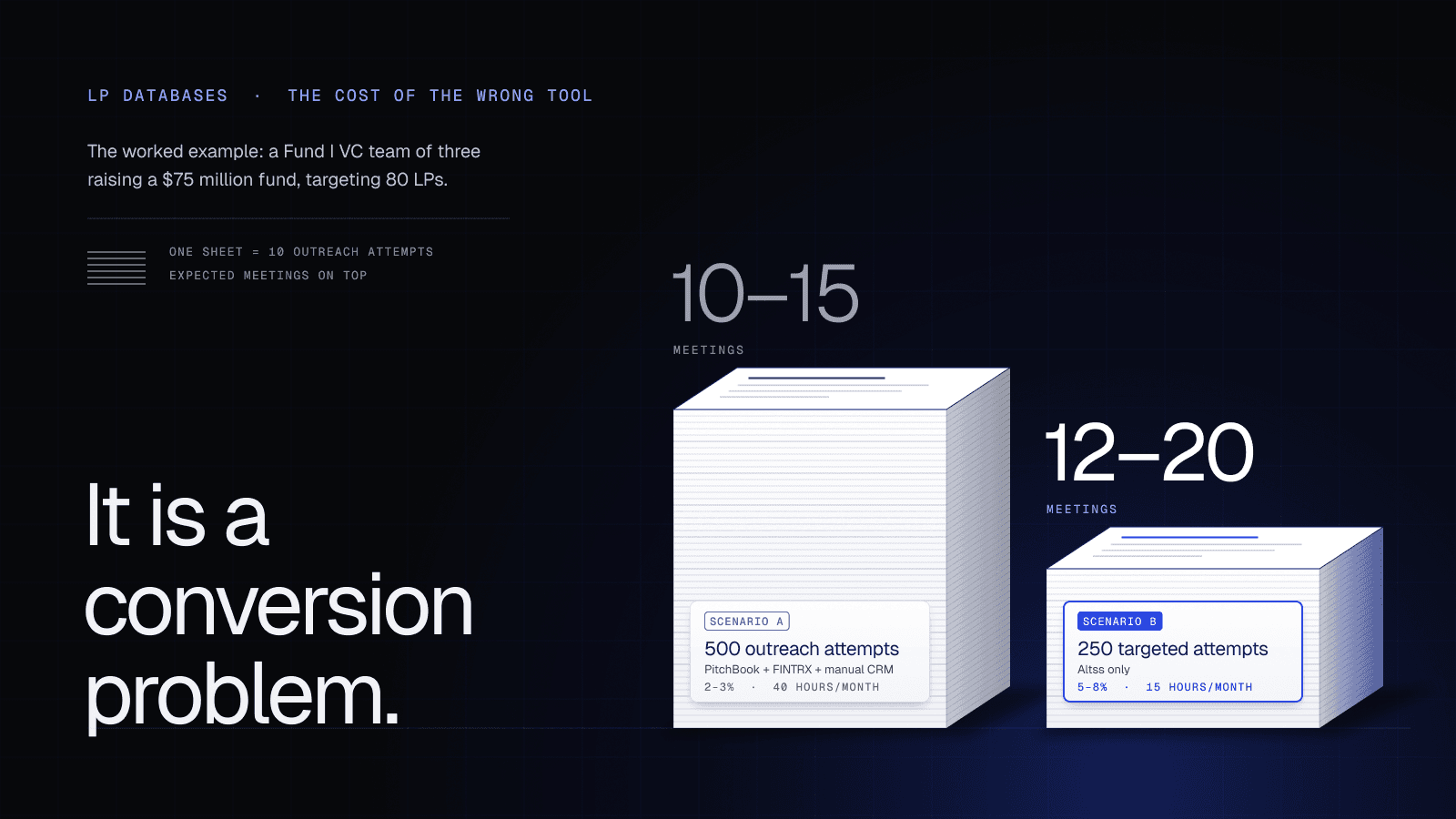
Consider a Fund I VC team of three raising a $75 million fund targeting 80 LPs across three segments: (1) U.S. family offices, (2) European institutional investors, and (3) Middle Eastern sovereign wealth funds.
Scenario A: PitchBook + FINTRX + manual CRM
- Annual cost: PitchBook and FINTRX both decline to publish pricing, so the combined figure depends entirely on what each quotes you.
- Time spent: 40 hours/month on data reconciliation, manual outreach sequencing, and relationship mapping
- Conversion rate: Industry average of 2–3% for cold outreach to target allocators
- Expected meetings from 500 outreach attempts: 10–15
Scenario B: Altss only
- Annual cost: Custom pricing (comparable to Scenario A for equivalent team size)
- Time spent: 15 hours/month on outreach execution, with timing signals and warm routing reducing wasted effort
- Conversion rate: Altss users report 5–8% conversion from targeted outreach to first meeting
- Expected meetings from 250 targeted outreach attempts: 12–20
The difference is not just cost—it is time-to-close. A fund that can schedule 20 meetings in three months instead of 12 has a meaningful advantage in a competitive market.
The Future of LP Data: What Changes in 2026–2027
Three trends will reshape this landscape over the next 18 months.
1. Timing signals become table stakes. As more allocators adopt structured commitment cycles and publish capital deployment calendars, platforms that capture and surface this information will win. Altss is ahead here, but expect PitchBook and Preqin to invest in timing data.
2. Private-wealth coverage deepens. With family offices and RIAs now accounting for over 50% of private-markets capital, platforms that cannot cover this segment will become irrelevant for a growing share of fundraising. Dakota and PitchBook face the most pressure here.
3. AI-powered routing becomes standard. The next frontier is not just knowing who to contact—it is knowing how to get introduced. Platforms that can automatically map relationship paths and suggest warm introduction strategies will differentiate. Altss is already investing in this capability.
The Specific Playbook: Which Platform for Which Fund
Fund I VC ($25M–$100M target)
Primary tool: Altss
Supplement: PitchBook for market research and competitive analysis
Rationale: Fund I teams need conversion velocity more than institutional benchmarking. Timing signals and warm routing are critical for breaking through with allocators who are skeptical of first-time managers.
Mid-Market Buyout ($200M–$1B target)
Primary tool: Dakota (U.S. institutional focus) or Altss (global/private-wealth focus)
Supplement: Preqin for performance benchmarking
Rationale: Established buyout firms often have existing LP relationships. The priority is managing a complex IR workflow and identifying new institutional allocators. Dakota is strong for U.S.-only funds; Altss is better for global reach.
Cross-Border Fund (any size)
Primary tool: Altss
Supplement: Preqin for institutional research in specific geographies
Rationale: No other platform offers the combination of global coverage, timing signals, and warm routing that cross-border fundraising requires. PitchBook and Dakota are too U.S.-centric.
Family Office-Focused Fund (any size)
Primary tool: Altss
Supplement: FINTRX for additional profile depth on specific U.S. family offices
Rationale: Altss covers more family offices globally and provides timing and routing signals that FINTRX lacks. FINTRX can add profile depth for a subset of U.S. targets.
Real Estate / Infrastructure Fund
Primary tool: Altss or Dakota (depending on LP mix)
Supplement: Preqin for sector-specific benchmarking
Rationale: Real estate and infrastructure funds often target a mix of institutional and private-wealth LPs. The choice depends on which segment dominates.
The Verdict: No Single Platform Is Enough
The honest answer to "which LP database wins in 2026" is that no single platform covers all use cases. The optimal setup depends on your fund size, strategy, geography, and target LP mix.
If you are a Fund I or Fund II team with limited IR resources and a need for conversion velocity, Altss provides the best ROI. The combination of timing signals, warm routing, and private-wealth coverage is unmatched for emerging managers.
If you are an established institutional firm with a dedicated IR team and a Salesforce-native workflow, Dakota is a strong choice for U.S. institutional fundraising. Supplement with Preqin for benchmarking and Altss for private-wealth and global coverage.
If you are a market research-driven team that needs company-level intelligence and deal flow visibility, PitchBook is essential. But do not confuse market research with fundraising execution.
If you are a family office specialist focused on the U.S., FINTRX provides useful profile depth. But you will likely need Altss for timing signals and warm routing.
The bottom line: Lists do not close funds. Conversion does. Choose the platform that helps you convert.
*Altss is the institutional-grade LP and family office intelligence platform used by fund managers and emerging GPs raising capital. With coverage of 9,000+ family offices, 30,000+ institutional investors, RIAs, and family offices, and 150,000+ private-markets entities—all refreshed on a sub-30-day cycle—Altss provides the signal intelligence that turns research into commitments. Institutional LP coverage has been live since February 2026. For a demo, visit altss.com.*
Altss Research editorial update, October 15, 2026: Removed inconsistent price estimates and unsourced market ratios, and linked current Altss pricing and methodology. This scoped correction does not certify every remaining historical comparison claim.
Sources for this editorial update: Altss… | Private Markets Intelligence & Fundraising OS; Altss Methodology | Evidence Origin, Derivation, Validation


See the allocators behind your next close.
Public records carry source-specific dates where available. No population-wide measured refresh cadence or universal verification deadline is established here. Page modified, source captured, fact observed, entity verified and aggregate measured describe different events. Check the date attached to the relevant claim; a missing verification date means unknown. Stored source history does not establish a customer-facing historical-analysis interface.