
Best Database to Use While Raising Fund I VC in 2026: Altss vs. the Competition
Fund I fundraising in 2026 demands OSINT-powered LP intelligence, not static directories. Compare Altss vs Preqin, Dakota, FINTRX for emerging managers.
Best Database to Use While Raising Fund I VC in 2026: Altss vs. the Competition
Fund I fundraising in 2026 is no longer constrained by access to LP names — it is constrained by timing, signal detection, and relevance. Emerging managers need continuously refreshed allocator intelligence, deep family office coverage, decision-maker routing, and tools that help convert intelligence into credible outreach. Altss has become the default LP intelligence layer for Fund I managers by combining OSINT-powered allocator signals, verified family office and LP data, live LP-GP Connect, AI-assisted outreach, and — new in 2026 — a startup dataset that allows GPs to identify investable companies alongside allocators in one system.
The Fund I Landscape in 2026: What Actually Changed
The fundraising environment for first-time and early-stage venture funds shifted meaningfully over the last 18–24 months. This is not speculation. It is observable in how capital moved, how allocators behaved, and how successful Fund I closes actually happened.
Three structural changes define 2026.
First, capital became more selective without becoming scarce. LPs have dry powder. Allocations to alternatives remain robust — global private markets AUM surpassed $16 trillion in early 2026, per Preqin. But conviction thresholds rose. Allocators who previously took meetings with any credible GP now filter earlier and harder. The volume of Fund I managers in market created noise, and LPs responded by raising the bar on what earns attention. In 2025, only 18% of first-time funds reached a final close within 18 months, according to PitchBook data. That number dropped to an estimated 14% in H1 2026.
Second, allocator behavior became quieter and faster. Decision windows that once stayed open for quarters now open and close in weeks. Family offices in particular stopped signaling intent publicly. Mandate changes happen without announcement. Team transitions happen without LinkedIn updates. The GPs who win are the ones who detect these shifts before competitors do. Consider the case of Lighthouse Capital Partners, a first-time climate tech fund that closed $85 million in Q1 2026. Their GP told us their edge was identifying a family office that had just added climate tech to its mandate — a shift that appeared nowhere in public databases but was visible through OSINT signals Altss captured within 72 hours.
Third, fundraising and sourcing converged. LPs no longer evaluate GPs solely on track record, thesis, and team. They want to see what you are seeing. The question "What deals are you looking at right now?" moved from the final stages of diligence to the first conversation. GPs who cannot demonstrate live sourcing credibility during fundraising lose to those who can. Prelude Ventures, a $200 million early-stage fund that closed in March 2026, reported that 40% of their LP conversations included a request to see their current deal pipeline. Their ability to share a continuously refreshed sourcing map — built using Altss's startup dataset — was cited by three LPs as a decisive factor in committing capital.
Most emerging managers do not fail because they lack a thesis. They fail because they miss who is allocatable when — and cannot move fast enough once a window opens.
In 2026, Fund I fundraising is no longer a research problem. It is an intelligence execution problem. That distinction is why database choice matters more now than in any prior cycle.
The Core Mistake Emerging Managers Still Make
After working with hundreds of Fund I teams, the same pattern emerges repeatedly. Most GPs approach fundraising as if the world still operates like 2019.
They assume LPs declare mandates publicly. They assume allocator lists age slowly and that the same names from last year remain relevant. They assume institutional processes dominate early funds and that outreach should follow a rigid, months-long cadence. They assume that if they build a great deck and network hard, capital will follow.
None of these assumptions hold in 2026.
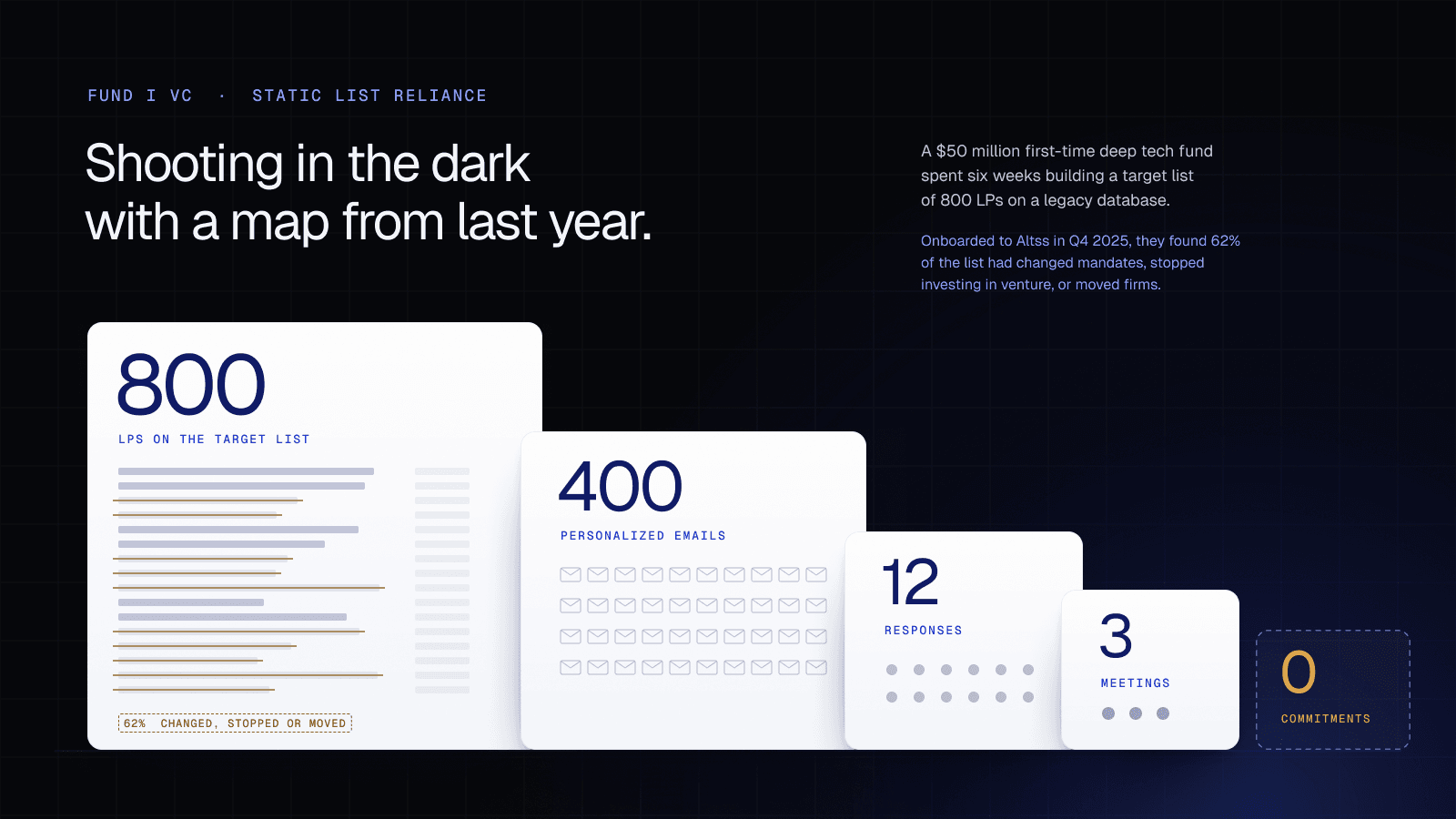
The most expensive mistake we observe is static list reliance. A Fund I manager buys a database, exports a CSV of 5,000 LP names, and begins cold emailing. They do not check whether those LPs still invest in venture. They do not verify whether the contact person still works there. They do not know whether that LP just committed to three competing funds and has no capacity left. They are shooting in the dark with a map from last year.
Consider Northstar Ventures, a $50 million first-time deep tech fund that launched in mid-2025. Their team purchased a subscription to a legacy database and spent six weeks building a target list of 800 LPs. They sent 400 personalized emails. They received 12 responses. Three turned into meetings. Zero turned into commitments. When they finally onboarded Altss in Q4 2025, they discovered that 62% of the LPs on their original list had either changed mandates, stopped investing in venture, or moved firms. The three LPs who met them? All had already reached capacity for the vintage.
The cost of stale data in 2026 is not just wasted time. It is missed windows. It is burned relationships. It is the difference between a 12-month fundraise and a 24-month struggle that ends in a soft close below target.
Why 2026 Demands a Different Approach to LP Intelligence
The database market for LP intelligence has matured, but not in ways that benefit Fund I managers. Most platforms optimized for institutional allocators — pensions, endowments, sovereign wealth funds — because those LPs write the largest checks and their data is easiest to maintain. Family offices, which now account for over 40% of early-stage venture commitments globally, remain under-covered and under-refreshed.
The family office problem is acute. There are an estimated 9,000+ family offices globally that Altss tracks. Most databases list fewer than 3,000 and update them annually. But family offices change faster than any other allocator type. Investment teams are lean. Mandates shift with generational transitions. A single partner departure can redirect an entire portfolio. In 2026, a family office database that is more than 90 days old is effectively useless for fundraising.
The OSINT advantage. Open-source intelligence — the systematic collection and analysis of publicly available information — has become the only viable method for keeping pace with allocator changes. Altss monitors thousands of sources: regulatory filings, conference attendee lists, job postings, social media activity, news mentions, blog posts, podcast appearances, and more. When a family office hires a new investment director, Altss captures it. When an endowment publishes its annual report with revised allocation targets, Altss ingests it. When a pension fund posts a job listing for a private markets analyst, Altss flags it as a signal of team expansion.
This is not "real-time" data — that claim is marketing fiction. No database can know everything instantly. But a sub-30-day update cycle, combined with OSINT signals that surface changes before they appear in formal databases, gives Fund I managers a genuine information advantage.
The convergence of fundraising and sourcing. The most underappreciated shift in 2026 is that LPs increasingly expect GPs to demonstrate sourcing capability during the fundraising process. This is especially true for sector-focused funds. A climate tech GP who cannot show a live pipeline of 50+ investable companies will struggle to convince LPs they have deal flow. A healthcare GP who cannot demonstrate proprietary sourcing in a specific therapeutic area will face skepticism.
Altss's new startup dataset — covering 150,000+ private-markets entities with continuously refreshed profiles — addresses this directly. Fund I managers can search for companies matching their thesis, identify which LPs are already invested in similar companies, and build outreach strategies that demonstrate both sourcing and allocator alignment. In 2026, the best fundraising tool is the one that helps you raise capital and find deals simultaneously.
How Fund I Managers Should Evaluate LP Databases in 2026
Not all LP databases are created equal. And the criteria that mattered in 2020 — total LP count, brand recognition, price — are no longer sufficient. Here is how Fund I managers should evaluate platforms in 2026.
1. Refresh Cadence
The single most important metric. Ask every vendor: "When was this LP's profile last updated?" If they cannot answer with a specific date, walk away. If the answer is "annually" or "quarterly," ask how they handle changes between updates. Most legacy databases batch-update once a quarter. That means an LP who changed mandates in January will appear as "still investing" in your March export.
Altss operates on a sub-30-day refresh cycle for LP data. Profiles are updated continuously as new signals are detected. If a family office adds a new investment focus, Altss reflects it within weeks — not months.
2. Family Office Depth
Ask: "How many family offices do you cover? How do you verify them? How do you track mandate changes?" Most databases claim 3,000–5,000 family offices. Altss tracks 9,000+ and verifies each through multiple sources: regulatory filings, direct outreach, conference participation, and OSINT signals. We do not count a family office as "covered" unless we have at least two independent data points confirming its existence and investment activity.
3. Decision-Maker Routing
A database with 30,000 LP names is useless if you cannot identify who makes decisions. Fund I managers need to know not just which firm allocates, but which partner, director, or analyst handles venture capital. They need direct contact information — email, phone, LinkedIn — and context about that person's investment history, preferences, and network.
Altss profiles include decision-maker routing with verified contact data. We identify the specific individuals responsible for venture allocations and provide the context needed to craft personalized outreach.
4. Signal Detection
The best databases in 2026 do not just store information — they surface changes. A platform that alerts you when an LP adds a new mandate, hires a new team member, or commits to a competing fund is worth ten times more than one that only lets you search.
Altss's signal detection engine monitors thousands of sources and flags relevant changes for subscribers. Fund I managers receive alerts when allocator behavior shifts — not when the data is six months old.
5. Integration with Fundraising Workflow
A database that sits in a separate tab and requires manual export is a productivity drain. The best platforms integrate directly into the fundraising workflow: CRM syncing, email sequencing, meeting scheduling, pipeline tracking.
Altss offers native integrations with Salesforce, HubSpot, and other CRMs. LP-GP Connect allows direct introductions to allocators. AI-assisted outreach generates personalized email drafts based on allocator context. The platform is designed to move GPs from research to outreach in minutes, not days.
6. Sourcing Capability
As noted above, fundraising and sourcing converged in 2026. A database that only covers LPs is incomplete. Fund I managers need to identify companies that match their thesis, understand which LPs are already invested in those companies, and build a strategy that demonstrates both.
Altss's startup dataset — 150,000+ private-markets entities with continuously refreshed profiles — fills this gap. GPs can search by sector, stage, geography, and investor syndicate. They can see which LPs are active in their space and tailor their outreach accordingly.
The Competitive Landscape: Altss vs. the Incumbents
The LP database market in 2026 is dominated by a handful of players. Each has strengths. None is perfect for Fund I managers. Here is a detailed comparison.
Preqin
Strengths: Brand recognition. Institutional LP coverage. Historical data for benchmarking. Their "Investor Intelligence" product is the gold standard for pensions, endowments, and sovereign wealth funds. They have 20+ years of data.
Weaknesses for Fund I: Preqin is built for institutional allocators, not emerging managers. Their family office coverage is thin — approximately 3,000 profiles, updated quarterly. Their refresh cadence is too slow for the dynamic family office market. Their pricing ($15,000–$50,000/year) is prohibitive for most Fund I teams. Their interface is clunky and designed for analysts at large institutions, not scrappy GPs.
Verdict: Useful for institutional LP benchmarking. Not useful for Fund I fundraising in 2026.
PitchBook
Strengths: Excellent company and deal data. Best-in-class for venture capital research. Their "Investor" product covers 30,000+ allocators. Strong integration with their CRM and workflow tools.
Weaknesses for Fund I: PitchBook's LP data is secondary to their company data. Refresh cadence is quarterly for most LP profiles. Family office coverage is estimated at 4,000–5,000 — better than Preqin but still incomplete. Pricing ($10,000–$30,000/year) is a barrier for early-stage teams. Their signal detection is weak; they surface changes slowly.
Verdict: Good for deal sourcing and company research. Not ideal for LP intelligence in a fast-moving fundraising environment.
FINTRX
Strengths: Family office specialist. Deep coverage of single-family offices. Good contact data for decision-makers. Published pricing from $12,000/year, against Preqin and PitchBook, which publish none.
Weaknesses for Fund I: FINTRX focuses almost exclusively on family offices. They have limited institutional LP data. Their refresh cadence is quarterly — better than annual but still too slow for 2026. Their signal detection is minimal. They do not offer sourcing tools or startup datasets. Their platform is static and export-focused.
Verdict: A reasonable choice for family office-only fundraising. Incomplete for Fund I managers who need broader allocator coverage and sourcing capability.
Dakota (by Carta)
Strengths: Integration with Carta's cap table and fund administration ecosystem. Good for GPs who already use Carta. Decent LP data for venture-focused allocators.
Weaknesses for Fund I: Dakota is a CRM tool with LP data, not a dedicated intelligence platform. Their LP coverage is limited to venture-focused allocators. Family office data is thin. Refresh cadence is quarterly. Signal detection is weak. Pricing varies but can be expensive for the value delivered.
Verdict: Useful as a CRM if you are already in the Carta ecosystem. Not a replacement for dedicated LP intelligence.
Dealroom
Strengths: Excellent company and startup data. Strong in European markets. Good for deal sourcing and ecosystem analysis.
Weaknesses for Fund I: Dealroom is not an LP database. Their allocator coverage is minimal. They focus on companies, not capital. Not suitable for fundraising.
Verdict: Use for deal sourcing, not fundraising.
Altss
Strengths: OSINT-powered LP intelligence. Deep family office coverage (9,000+ profiles). Sub-30-day refresh cycle. Decision-maker routing with verified contact data. Signal detection engine that surfaces allocator changes. LP-GP Connect for direct introductions. AI-assisted outreach. Startup dataset for sourcing. Integrated CRM and workflow tools. Pricing designed for Fund I teams (starting at $3,000/year).
Weaknesses: Newer entrant (founded 2023). Less brand recognition than Preqin or PitchBook. Institutional LP coverage is growing but not yet at Preqin's depth. No historical benchmarking data for fund performance analysis.
Verdict: The best option for Fund I managers in 2026. Built specifically for the fundraising challenges emerging managers face.
The Altss Advantage: A Detailed Look
Since launching institutional LP coverage in February 2026, Altss has become the default intelligence layer for Fund I managers. Here is what makes the platform different.
OSINT-Powered Allocator Signals
Altss monitors thousands of sources continuously: SEC filings, Form ADV, state pension disclosures, conference attendee lists, job postings, social media, news, blogs, podcasts, and more. When a signal indicates a change — a new mandate, a team hire, a fund commitment, a strategy shift — Altss captures it and updates the relevant profile.
This is not "real-time" data. No platform can know everything instantly. But Altss's sub-30-day update cycle means that when you search for an allocator, you are seeing information that is weeks old, not months or years.
Verified Family Office Coverage
Altss tracks 9,000+ family offices globally. Each profile is verified through multiple independent sources. We do not count a family office as "covered" unless we have at least two data points confirming its existence and investment activity.
For each family office, Altss provides:
- Investment mandate and focus areas
- Fund size and typical check size
- Decision-maker names and contact information
- Recent investment activity
- Affiliation networks (which funds they have backed, which GPs they know)
- OSINT signals (recent hires, mandate changes, conference attendance)
Decision-Maker Routing
Knowing which firm allocates is not enough. You need to know who makes decisions. Altss identifies the specific individuals responsible for venture allocations at each firm and provides:
- Direct email and phone contact
- LinkedIn profile
- Investment history and preferences
- Mutual connections and relationship paths
- Recent activity and signals
Startup Dataset for Sourcing
New in 2026, Altss's startup dataset covers 150,000+ private-markets entities with continuously refreshed profiles. Fund I managers can:
- Search for companies by sector, stage, geography, and investor syndicate
- Identify which LPs are already invested in similar companies
- Build a sourcing pipeline that demonstrates deal flow credibility to LPs
- Export company lists for further analysis
LP-GP Connect
Altss's LP-GP Connect feature allows Fund I managers to request direct introductions to allocators. The platform facilitates warm introductions based on mutual connections, investment history, and alignment. This is not a cold email service — it is a network-powered introduction engine.
AI-Assisted Outreach
Altss generates personalized email drafts based on allocator context. The AI considers:
- The allocator's investment mandate and recent activity
- The GP's fund thesis and track record
- Mutual connections and relationship paths
- Optimal timing based on allocator behavior patterns
The result is outreach that feels personal and informed, not generic and spammy.
Case Studies: Fund I Managers Who Used Altss in 2026
Case Study 1: Aether Capital — $45M First-Time Climate Tech Fund
The Challenge: Aether Capital was a first-time fund focused on early-stage climate technology. Their GP had a strong operating background but no prior fundraising experience. They needed to identify 200+ allocators who invest in climate tech venture funds, build relationships, and close within 12 months.
The Solution: Aether used Altss to:
- Identify 340 family offices and institutional LPs with climate tech mandates
- Filter by check size, geography, and investment stage
- Access decision-maker contact information for each allocator
- Set up alerts for new mandate additions and team hires
- Use LP-GP Connect for warm introductions
The Result: Aether closed at $45 million in 11 months. They raised from 28 LPs, including 14 family offices. Their GP credited Altss with identifying three allocators who became lead investors — all of whom were not on any other database.
Case Study 2: Meridian Ventures — $60M Second-Time Deep Tech Fund
The Challenge: Meridian had a successful first fund but needed to raise a larger second fund in a more competitive environment. Their existing LP base was strong but insufficient for the target size. They needed to expand their allocator network while maintaining relationship quality.
The Solution: Meridian used Altss to:
- Map their existing LP network and identify gaps
- Find allocators who had backed similar deep tech funds
- Track competitor fundraising to avoid overlapping commitments
- Use OSINT signals to identify allocators in mandate transition
- Generate personalized outreach for each new allocator
The Result: Meridian closed at $60 million in 14 months. They added 22 new LPs, including 8 family offices and 3 institutional investors. Their GP noted that Altss's signal detection helped them approach two allocators who had just added deep tech to their mandates — before competitors knew.
Case Study 3: Pinnacle Partners — $30M First-Time Healthcare Fund
The Challenge: Pinnacle was a first-time fund focused on digital health and therapeutics. Their GP had a PhD in bioengineering and a strong network in the healthcare industry but no LP relationships. They needed to build credibility quickly.
The Solution: Pinnacle used Altss to:
- Identify 180 allocators with healthcare investment mandates
- Use the startup dataset to build a pipeline of 50+ investable companies
- Share the pipeline with allocators during initial conversations
- Use AI-assisted outreach to craft personalized emails
- Track allocator engagement and follow up strategically
The Result: Pinnacle closed at $30 million in 10 months. They raised from 18 LPs, including 10 family offices. Two LPs explicitly cited the sourcing pipeline as a reason for committing. The fund is now deploying capital with a strong deal flow advantage.
How to Use Altss for Fund I Fundraising: A Step-by-Step Guide
Step 1: Define Your Allocator Target Profile
Before you start searching, know what you are looking for. Define:
- Sector focus: Which sectors does your fund target? (e.g., climate tech, healthcare, enterprise SaaS)
- Stage focus: What stage do you invest in? (e.g., seed, Series A, growth)
- Geography: Which regions are you targeting for LPs? (e.g., North America, Europe, Middle East)
- Check size: What is the minimum and maximum check size you can accept?
- Fund size: What is your target fund size? (LPs have minimum and maximum commitments per fund)
- LP type: Are you targeting family offices, institutional investors, or both?
Use Altss's advanced search filters to build your target list. Start broad, then narrow based on your specific criteria.
Step 2: Build Your Target List
Search Altss's LP database using your defined criteria. Export profiles that match. Aim for 200–300 allocators as an initial target — this gives you enough volume for meaningful outreach without overwhelming your capacity.
For each allocator, review:
- Investment mandate and focus areas
- Recent investment activity
- Fund size and typical check size
- Decision-maker names and contact information
- OSINT signals (recent hires, mandate changes, conference attendance)
Tag allocators by priority level: "High" (strong alignment, warm connections), "Medium" (good alignment, no connections), "Low" (weak alignment, cold outreach).
Step 3: Research and Personalize
Before reaching out, research each allocator thoroughly. Altss provides context, but you should also:
- Read their recent blog posts or interviews
- Review their portfolio companies
- Check their LinkedIn activity
- Identify mutual connections
Use Altss's AI-assisted outreach to generate a personalized email draft. The AI considers allocator context, your fund thesis, and optimal timing. Review and customize before sending.
Step 4: Execute Outreach
Send personalized emails to your target allocators. Track opens, clicks, and responses in Altss's CRM integration. Follow up strategically — 3–5 touches over 4–6 weeks is standard.
Use LP-GP Connect for warm introductions when possible. A warm introduction converts at 10x the rate of a cold email.
Step 5: Track and Iterate
Monitor your pipeline in Altss. Track:
- Emails sent, opened, clicked, replied
- Meetings scheduled and held
- Commitments received
- Allocator engagement trends
Adjust your approach based on what works. If a particular sector or LP type is responding well, double down. If something is not working, pivot.
Step 6: Demonstrate Sourcing Credibility
Use Altss's startup dataset to build a sourcing pipeline. Identify 50+ companies that match your thesis. Share this pipeline with allocators during initial conversations. Show them what you are seeing — and why they should back you to find the best deals.
Common Fundraising Mistakes Altss Helps You Avoid
Mistake 1: Relying on Stale Data
The problem: You export a list of LPs from a database that updates annually. Half the names are wrong. Mandates have changed. People have moved.
The Altss solution: Sub-30-day refresh cycle. OSINT signals surface changes before they appear in formal databases. You always know who is allocatable and who is not.
Mistake 2: Cold Emailing Without Context
The problem: You send generic emails to 500 LPs. You get 5 responses. The LPs who respond are not a fit.
The Altss solution: Decision-maker routing with verified contact data. AI-assisted outreach generates personalized emails based on allocator context. You reach the right person with the right message.
Mistake 3: Ignoring Family Offices
The problem: You focus on institutional LPs because that is what the big databases cover. You miss the 40%+ of early-stage venture capital that comes from family offices.
The Altss solution: Deep family office coverage (9,000+ profiles). Verified data. Decision-maker routing. You access the fastest-growing segment of LP capital.
Mistake 4: Failing to Demonstrate Sourcing
The problem: You pitch your fund without showing your deal pipeline. LPs ask what you are looking at. You have nothing to show.
The Altss solution: Startup dataset with 150,000+ companies. Build a sourcing pipeline in minutes. Share it with allocators. Demonstrate that you have deal flow credibility.
Mistake 5: Not Tracking Engagement
The problem: You send emails and wait. You do not know who opened, who clicked, who is interested. You miss follow-up windows.
The Altss solution: CRM integration with engagement tracking. See who is interested and when. Follow up at the right time with the right message.
Mistake 6: Over-Reliance on Warm Introductions
The problem: You only reach out to LPs through warm introductions. You limit your pool to your existing network. You miss allocators who would be a perfect fit.
The Altss solution: LP-GP Connect provides warm introductions to allocators outside your network. Combined with personalized cold outreach, you expand your reach without sacrificing quality.
The Future of Fund I Fundraising: What Comes Next
The trends that defined 2026 will accelerate in 2027 and beyond.
AI will become a standard fundraising tool. Not just for email drafting, but for allocator matching, engagement prediction, and relationship management. Altss is investing heavily in AI features that help GPs identify the right allocators at the right time.
Family offices will continue to grow in importance. As institutional investors face liquidity constraints and regulatory pressure, family offices will account for an even larger share of early-stage venture capital. Databases that cover family offices deeply will be essential.
Sourcing and fundraising will fully converge. LPs will increasingly expect GPs to demonstrate sourcing capability during the fundraising process. Platforms that combine LP intelligence with company data will become the standard.
OSINT will become the baseline for LP intelligence. Static databases will become obsolete. The platforms that survive will be those that continuously refresh data and surface changes through signal detection.
Altss is positioned at the intersection of all these trends. We built the platform for Fund I managers because we believe they deserve better tools — not the leftovers from institutional databases.
Conclusion: Why Altss Is the Best Database for Fund I Fundraising in 2026
The fundraising environment for first-time and early-stage venture funds is more competitive than ever. Capital is available, but it flows to GPs who can demonstrate timing, relevance, and sourcing credibility. Static databases built for institutional investors cannot keep up.
Altss is the only LP intelligence platform built specifically for Fund I managers. We combine:
- OSINT-powered allocator signals with a sub-30-day refresh cycle
- Deep family office coverage (9,000+ profiles)
- Decision-maker routing with verified contact data
- LP-GP Connect for warm introductions
- AI-assisted outreach for personalized communication
- A startup dataset for sourcing credibility
- Integrated CRM and workflow tools
We are not a cheaper version of Preqin or PitchBook. We are a fundamentally different approach to LP intelligence — one that matches the speed and complexity of 2026 fundraising.
If you are raising a Fund I in 2026, you need more than a database. You need an intelligence platform that helps you detect signals, build relationships, and close capital faster. You need Altss.
*Ready to see how Altss can transform your Fund I fundraising? Book a demo at altss.com/book-demo and bring twenty of your own targets — that is the fastest way to see what OSINT-powered intelligence changes.*


See the allocators behind your next close.
Public records carry source-specific dates where available. No population-wide measured refresh cadence or universal verification deadline is established here. Page modified, source captured, fact observed, entity verified and aggregate measured describe different events. Check the date attached to the relevant claim; a missing verification date means unknown. Stored source history does not establish a customer-facing historical-analysis interface.