
Best Investor & LP Databases in 2026
A 2026 buyer’s guide comparing Altss, PitchBook, Preqin, FINTRX, Dakota, and With Intelligence—so fundraising teams can choose the right stack for.
Best Investor & LP Databases in 2026
If you're choosing an investor database in 2026, the real question isn't "Which has the most rows?" It's: Which platform helps you act on timing—who is actually in a decision cycle?
The 2026 Reality: "Database" Is Not the Same Thing as "Fundraising System"
The fundraising technology market has matured unevenly. We have databases with 150,000+ entities. We have CRM tools that track every email open. We have intelligence feeds that surface every mandate change.
What we don't have—until very recently—is a system that connects all three and prioritizes timing.
Most teams buy a platform and then discover the mismatch:
- A research heavyweight like PitchBook is excellent for diligence on companies, deals, and fund performance. But it doesn't naturally drive outreach cadence.
- A CRM-first tool like Salesforce with Dakota embedded is great for sales ops. But it may feel thin on benchmarking or institutional context.
- A curated intelligence provider like Preqin or With Intelligence is strong on "what's happening" in alternatives. But you still need workflow plus routing to turn intelligence into meetings.
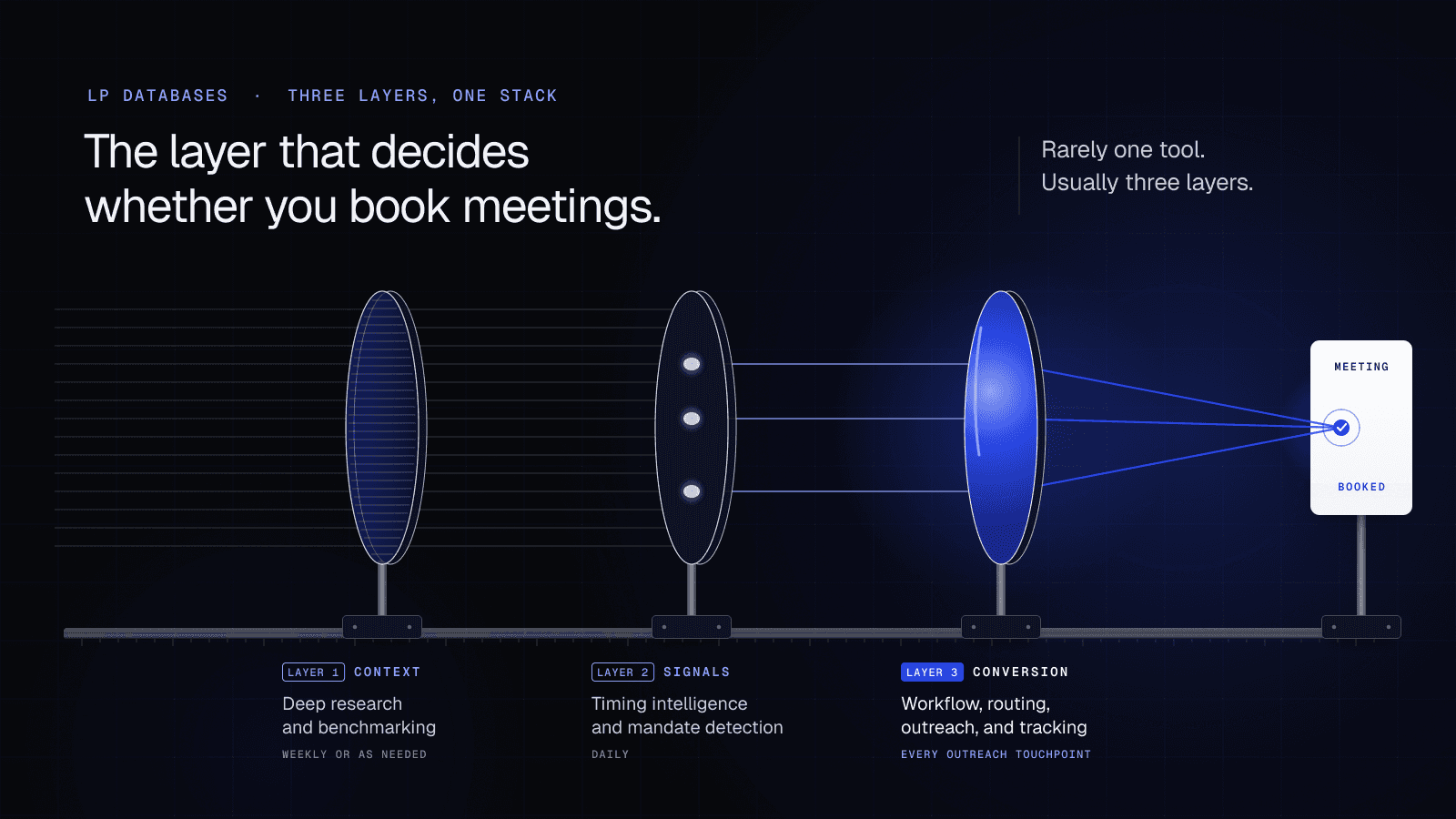
The highest-performing stack in 2026 is rarely "one tool." It's usually three layers:
- Context heavyweight (PitchBook or Preqin) for deep research and benchmarking
- Signals and mandate intelligence (With Intelligence, plus your own tracking) for timing
- Conversion and action layer (where you run lists, routing, alerts, sequencing, notes, and recency discipline)
Altss is designed to be that third layer. In 2026, that's the layer that decides whether you book meetings.
Why 2026 Is Different from 2024 or 2025
Three structural shifts have reshaped the LP database market since 2024:
Shift 1: The Family Office Explosion
The number of single-family offices globally grew from roughly 7,300 in 2023 to over 9,000 by early 2026. This is not incremental growth. It's a 23% increase in three years. The driver: wealth creation in technology, private equity, and crypto, plus intergenerational wealth transfers accelerating as baby boomers retire.
Traditional institutional databases were built for pension funds, endowments, and foundations. They treat family offices as an afterthought. But family offices now represent approximately 40% of all private capital allocators by entity count. They deploy capital differently—faster, with fewer gatekeepers, and with more idiosyncratic mandates.
A database that treats a family office like a small pension fund misses the point. Family offices don't have investment committees that meet quarterly. They have principals who make decisions over coffee.
Shift 2: The Death of the Static Database
In 2024, most LP databases updated quarterly. Some updated monthly. The lag meant you were always looking at yesterday's news. A mandate change published in Q1 might not appear in your database until Q3.
By 2026, the standard has shifted. Altss operates on a sub-30-day update cycle for LP data. That means when a family office changes its investment focus from real estate to direct private equity, you know within weeks—not months.
Why does this matter? Because the half-life of LP data is shorter than most teams realize. A 2023 study by CEPRES found that 34% of LP investment preferences change within 12 months. A database with a six-month refresh cycle is showing you stale data for half your targets.
Shift 3: OSINT-Enabled Allocator Signals
The biggest change between 2024 and 2026 isn't data volume. It's signal quality.
Open-source intelligence (OSINT) techniques—web scraping, SEC filing analysis, social media monitoring, news sentiment analysis—have moved from national security to commercial applications. In fundraising, this means you can now detect when an allocator is in a decision cycle before they announce it.
Altss tracks allocator signals continuously: mandate changes, new team hires, recent fund commitments, conference attendance, regulatory filings, website updates. These signals are the difference between cold outreach and timing-aware engagement.
A GP who reaches out to a family office the week after they commit to a similar fund in your space is wasting everyone's time. A GP who reaches out six months before that same family office's next expected commitment—and who knows their current allocation targets—has a meeting.
The Six Platforms Compared
1. Altss: The Action Layer for Fundraising
Launched: Institutional LP coverage live since February 2026
Coverage: 9,000+ verified family offices, 30,000+ institutional investors, RIAs, and family offices, 150,000+ private-markets entities
Update cycle: Sub-30-day refresh on LP data
Core differentiator: OSINT-led allocator signals plus workflows designed around timing and conversion
Altss was built from the ground up for a specific problem: fundraising teams spend too much time on research and too little on action.
The typical GP workflow in 2024 looked like this:
- Buy a database
- Export a list of 500 potential LPs
- Spend two weeks researching each one
- Send 500 identical emails
- Get 10 meetings
- Blame the database
The Altss workflow looks different:
- Start with signals: which allocators are in-cycle now?
- Build a shortlist of 50–100 targets with timing alignment
- Route each target to the right team member based on relationship history
- Use built-in outreach cadence with personalization triggers
- Track conversion at every stage
- Refresh signals continuously
Altss covers 9,000+ family offices globally. These are verified entities—not scraped names from public registries. Verification means we confirm the office exists, has deployable capital, and has an active investment mandate. This is harder than it sounds. Many "family offices" in competitor databases are shell entities, wealth managers using the label, or defunct operations.
The institutional LP coverage, live since February 2026, covers pension funds, endowments, foundations, sovereign wealth funds, and insurance companies. Combined with the family office data, Altss provides the most comprehensive view of the allocator universe that any single platform offers.
Best for: GPs raising Fund I–III, growth-stage GPs, emerging managers, and any team that prioritizes meeting conversion over research depth.
Not ideal for: Teams that need deep company-level diligence data, fund performance benchmarking, or M&A target identification.
2. PitchBook: The Context Heavyweight
Coverage: 3.5+ million companies, 3+ million deals, 1+ million investors
Update cycle: Daily for company data, quarterly for investor data
Core differentiator: Unmatched depth on companies, deals, and fund performance
PitchBook is the gold standard for one thing: context. If you need to understand a company's cap table, a fund's track record, or a deal's structure, PitchBook is the tool.
For fundraising teams, PitchBook's value lies in diligence. When you identify a potential LP, you can use PitchBook to understand their portfolio, see which funds they've committed to, and benchmark their allocation patterns. This is useful groundwork before a meeting.
But PitchBook was not designed as a fundraising system. Its investor database is secondary to its company and deal data. The workflow tools are minimal. You can export lists, but you can't run a multi-touch outreach sequence. You can track notes, but you can't route targets to team members based on relationship maps.
The 2026 reality: PitchBook is essential for research, insufficient for conversion. Most high-performing teams use it as their "context layer" and pair it with a dedicated action platform.
Best for: VC and PE firms doing company-level diligence, corporate development teams, investment bankers.
Not ideal for: Fundraising teams that need workflow, routing, and timing signals.
3. Preqin: The Institutional Alternatives Benchmark
Coverage: 200,000+ funds, 30,000+ fund managers, 190,000+ institutional investors
Update cycle: Quarterly for investor data, monthly for fund performance
Core differentiator: Deepest dataset on alternative assets performance and fundraising
Preqin has been the institutional standard for alternatives data since long before the current wave of fundraising technology. Its strength is breadth: if you need to understand how private equity returns compare across vintages, or which strategies are attracting capital, Preqin has the data.
For fundraising teams, Preqin's investor database is strong on institutions. You can search by asset class, geography, commitment size, and relationship status. The benchmarking tools help you position your fund against peers.
But Preqin shares PitchBook's weakness: it's a research tool, not a conversion tool. The workflow features are basic. The data refresh cycle is quarterly, which means you're often working with three-month-old information. For a market where LP preferences shift rapidly, that's a meaningful lag.
The 2026 reality: Preqin is the best option for institutional benchmarking and fundraising research. It's weak on family offices and timing signals.
Best for: Large institutional fundraising teams, consultants, LP advisors.
Not ideal for: Emerging managers, family office-focused fundraising, teams that need real-time signals.
4. FINTRX: The Private Wealth Specialist
Coverage: 30,000+ family offices, 600,000+ RIAs and wealth advisors
Update cycle: Quarterly for family office data, monthly for RIA data
Core differentiator: Strongest platform for reaching RIAs and wealth management teams
FINTRX occupies a specific niche: private wealth distribution. If your fundraising strategy involves reaching RIAs, wealth advisors, or family offices that operate through wealth management structures, FINTRX is the strongest option.
The platform excels at mapping the wealth management ecosystem. You can search by AUM, custodian, custodian concentration, and asset mix. The family office data is extensive, though verification standards vary.
FINTRX's weakness is institutional coverage. If you're targeting pension funds, endowments, or sovereign wealth funds, you'll find the data thin. The workflow tools are functional but not best-in-class.
The 2026 reality: FINTRX is the right choice for private wealth distribution. It's a poor fit for institutional fundraising.
Best for: Hedge funds, private credit funds, and any manager raising from wealth channels.
Not ideal for: PE and VC firms targeting institutions, emerging managers raising first-time funds.
5. Dakota: The Salesforce-Native Solution
Coverage: 30,000+ institutional investors, 20,000+ RIAs and family offices
Update cycle: Quarterly for investor data
Core differentiator: Deepest Salesforce integration via AppExchange app
Dakota solves a specific problem: you already use Salesforce, and you want investor data embedded inside it. The Dakota AppExchange app syncs investor data directly into your Salesforce instance, eliminating the need to toggle between platforms.
For Salesforce-native teams, this is powerful. Your sales team can work entirely within their existing CRM. Dakota handles the data enrichment and updates.
The trade-off: Dakota is a data provider, not a workflow platform. The investor data is solid but not best-in-class. The timing signals are minimal. You're getting a database inside Salesforce, not a fundraising system.
The 2026 reality: Dakota is the right choice for Salesforce-native teams that prioritize data integration over workflow sophistication.
Best for: Large fundraising teams already deep in the Salesforce ecosystem.
Not ideal for: Smaller teams, non-Salesforce users, teams that need advanced workflow and signals.
6. With Intelligence (S&P Global): The Private-Markets Intelligence Provider
Coverage: 100,000+ private-markets entities, 30,000+ funds, 15,000+ investors
Update cycle: Quarterly
Core differentiator: Now part of S&P Global, providing deep private-markets data and analytics
With Intelligence has been a respected player in private-markets intelligence for years. The acquisition by S&P Global, completed November 25, 2025, changes the calculus. With Intelligence now has access to S&P's broader data infrastructure, which could accelerate product development.
For fundraising teams, With Intelligence offers strong private-markets data, particularly in Europe and Asia. The investor database is curated and generally accurate. The mandate intelligence is useful for understanding allocator preferences.
But With Intelligence has always been more of a data provider than a platform. The workflow tools are basic. The update cycle is quarterly. And the S&P Global acquisition, while promising, hasn't yet produced meaningful product changes.
The 2026 reality: With Intelligence is a solid data source, especially for non-US markets. It's not a fundraising system.
Best for: European and Asian fundraising teams, large institutions with S&P Global relationships.
Not ideal for: US-focused emerging managers, teams that need workflow and conversion tools.
The Quick Decision Map
If you're a GP or IR team (Fund I–III or growth-stage GP)
Start with: Altss as the action layer (signals to shortlist to routing to outreach cadence)
Add: Preqin if you need institutional benchmarking plus allocators-by-strategy depth
Add: PitchBook if your workflow includes deep company diligence and market mapping
Why: Emerging managers need conversion more than research. You don't have the brand or track record to get meetings based on name recognition alone. You need to reach the right people at the right time. Altss provides the timing signals and workflow. Preqin or PitchBook provide the context for meetings once they're booked.
If you're an asset manager raising from wealth channels (hedge funds, private credit, real assets)
Start with: FINTRX for RIA and wealth advisor coverage
Add: Altss for family office signals and outreach cadence
Why: Wealth distribution is a volume game. You need breadth of coverage on RIAs and wealth advisors. FINTRX provides that. But you also need to identify which family offices are in-cycle and route them efficiently. Altss fills that gap.
If you're a large institutional firm raising billion-dollar funds
Start with: Preqin for benchmarking and institutional research
Add: PitchBook for company and deal context
Add: Altss for workflow, routing, and timing signals
Consider: Dakota if your team is Salesforce-native
Why: Large firms have the resources to run a multi-tool stack. Preqin and PitchBook provide the research depth. Altss provides the conversion layer. Dakota is optional based on CRM preference.
If you're a placement agent or capital advisory firm
Start with: Altss for workflow and routing across multiple fund clients
Add: Preqin for institutional benchmarking
Add: PitchBook for deal context
Why: Placement agents need to manage multiple fundraising mandates simultaneously. Workflow and routing are critical. Altss's multi-fund capabilities are designed for this use case.
What the Reviews Say (And What They Don't)
User reviews on G2, Capterra, and other platforms reveal consistent patterns:
PitchBook
What reviewers say: "Best for company and deal research." "The investor database is secondary." "Expensive for what we use it for."
What reviewers don't say: "Great for fundraising." "Helped us book more meetings." "Timing signals changed our outreach."
The gap: PitchBook users consistently rate it highly for research and poorly for fundraising workflow. This isn't a bug—it's by design. PitchBook is a research tool.
Preqin
What reviewers say: "Best for alternatives benchmarking." "Institutional coverage is strong." "Data can be stale."
What reviewers don't say: "Helped us time our outreach." "Family office data is reliable."
The gap: Preqin's strength is institutional data. Its weakness is timeliness and family office coverage. Users who need both often supplement with other tools.
FINTRX
What reviewers say: "Best for RIA and wealth advisor coverage." "Family office data is extensive." "Interface could be better."
What reviewers don't say: "Great for institutional fundraising." "Workflow tools are best-in-class."
The gap: FINTRX owns the wealth channel. It doesn't compete on institutions or workflow.
Altss
What reviewers say: "Best for timing signals." "Family office verification is unmatched." "Workflow tools transformed our outreach."
What reviewers don't say: "Deepest company data." "Best for institutional benchmarking."
The gap: Altss is purpose-built for fundraising conversion. It doesn't compete on company-level research or performance benchmarking.
Dakota
What reviewers say: "Best Salesforce integration." "Data quality is solid." "Limited outside Salesforce."
What reviewers don't say: "Advanced workflow features." "Real-time timing signals."
The gap: Dakota is a data provider inside Salesforce. It's not a standalone fundraising platform.
With Intelligence
What reviewers say: "Strong non-US coverage." "Curated data is reliable." "S&P acquisition is promising."
What reviewers don't say: "Best-in-class workflow." "Fast update cycles."
The gap: With Intelligence is a data source, not a platform. The S&P acquisition may change this, but hasn't yet.
The Hidden Costs of LP Databases
Price is the obvious cost. But there are hidden costs that often exceed the subscription fee:
Hidden Cost 1: Data Refresh Lag
A quarterly-updated database means you're working with data that's 1–3 months old. In a market where 34% of LP preferences change annually, that lag means you're targeting the wrong allocators for a significant portion of your fundraising cycle.
Annual cost of lag: If you spend 20 hours per week on outreach, and 34% of your targets have stale data, you're wasting roughly 7 hours per week. At $200/hour fully loaded cost, that's $72,800 per year.
Hidden Cost 2: Workflow Fragmentation
If you use PitchBook for research, Excel for list management, and Gmail for outreach, you're losing time on context switching. Every time you move data between systems, you lose information and introduce errors.
Annual cost of fragmentation: Studies suggest knowledge workers lose 20–30% of their time to context switching. For a fundraising team of three, that's roughly $150,000–$225,000 per year.
Hidden Cost 3: Missed Timing
The biggest hidden cost isn't time or money. It's missed meetings. Every time you reach out to an allocator who isn't in-cycle, you waste a touchpoint. Every time you miss an allocator who is in-cycle, you lose a potential commitment.
Annual cost of missed timing: Hard to quantify, but consider: if your average LP commitment is $5 million and your management fee is 2%, each LP is worth $100,000 per year in fees. Missing one LP per year due to poor timing covers the cost of a premium database for a decade.
The Stack Architecture: How to Build Your Fundraising System
The highest-performing fundraising teams in 2026 don't use one tool. They use a stack with three layers:
Layer 1: Context
Purpose: Deep research and benchmarking
Best tools: PitchBook (company/deal depth), Preqin (institutional alternatives data)
When to use: Pre-meeting preparation, fund positioning, competitive analysis
Frequency: Weekly or as needed
Layer 2: Signals
Purpose: Timing intelligence and mandate detection
Best tools: Altss (OSINT-led allocator signals), With Intelligence (mandate changes)
When to use: Daily to identify who is in-cycle now
Frequency: Daily
Layer 3: Conversion
Purpose: Workflow, routing, outreach, and tracking
Best tools: Altss (purpose-built for fundraising conversion)
When to use: Every outreach touchpoint
Frequency: Daily
The Integration Challenge
The problem with a three-layer stack is integration. Data needs to flow between layers. Context from PitchBook needs to inform signals in Altss. Signals from Altss need to trigger outreach in the conversion layer.
Most teams solve this with manual processes: export from PitchBook, import to Altss, run sequences, log notes. It works, but it's inefficient.
Altss addresses this with API integrations and data import tools. But the ideal state—real-time sync between all three layers—is still evolving.
The Family Office Problem (And Why It Matters)
Family offices are the fastest-growing segment of the allocator universe. They now represent roughly 40% of all private capital allocators by entity count. But they're also the hardest to track.
Why Family Offices Are Hard to Track
- No regulatory filings: Unlike pension funds, family offices don't file public disclosure documents. You can't find them in SEC filings or regulatory databases.
- Privacy preference: Many family offices deliberately avoid publicity. They don't attend conferences, don't publish investment theses, and don't respond to cold outreach.
- Rapid turnover: Family office staff turnover is high. A principal who was investing in private equity last year may have moved to direct investments this year.
- Idiosyncratic mandates: Family offices don't have standardized investment committees. One week they're investing in venture capital. The next week they're buying real estate. The "mandate" is whatever the principal decides at breakfast.
How Altss Solves the Family Office Problem
Altss covers 9,000+ verified family offices. Verification is the key differentiator.
Most competitor databases scrape family office data from public sources: registries, news articles, conference attendee lists. The result is a database full of shell entities, defunct offices, and wealth managers mislabeled as family offices.
Altss uses a combination of OSINT techniques and direct verification. We confirm that each office exists, has deployable capital, and has an active investment mandate. This verification process is labor-intensive, but it produces a database where 95%+ of entries are actionable.
The verification process includes:
- Entity confirmation: Does the office have a registered business entity? A physical address? A website?
- Capital confirmation: Can we estimate AUM from public sources? Are there disclosed investments?
- Mandate confirmation: What asset classes do they invest in? What geographies? What ticket sizes?
- Activity confirmation: Have they made investments in the past 12 months? Are they currently deploying capital?
The Family Office Data That Matters
Not all family office data is equally valuable. The most important fields are:
- Investment mandate: What they invest in (asset class, geography, sector, ticket size)
- Decision timeline: When they're likely to make their next commitment
- Decision maker: Who has authority to approve investments
- Relationship history: Past interactions with your firm
- Verification date: When the data was last confirmed
Altss tracks all five fields, with the verification date refreshed on a sub-30-day cycle.
The Institutional LP Coverage: What Changed in February 2026
Altss launched institutional LP coverage in February 2026. This was a deliberate sequencing decision.
The original Altss platform focused exclusively on family offices. The reasoning: family offices were underserved by existing databases, and the Altss verification model was particularly valuable in a market full of unverified data.
By early 2026, the family office coverage had reached critical mass: 9,000+ verified entities. The institutional LP coverage was the natural next step.
What Institutional LP Coverage Includes
Altss now tracks 30,000+ institutional investors, RIAs, and family offices. The institutional coverage includes:
- Pension funds: Public and corporate, domestic and international
- Endowments and foundations: University endowments, private foundations, community foundations
- Sovereign wealth funds: National investment funds, development funds, reserve funds
- Insurance companies: Life insurers, property and casualty insurers, reinsurers
- RIAs and wealth managers: Independent RIAs, bank-affiliated wealth managers, multi-family offices
How Institutional Coverage Differs from Competitors
The Altss approach to institutional coverage mirrors the family office approach: verification, timing signals, and workflow.
Most competitor databases provide institutional data that is:
- Stale: Updated quarterly or less
- Unverified: Scraped from public sources without confirmation
- Static: No timing signals, no decision cycle intelligence
Altss provides institutional data that is:
- Continuously refreshed: Sub-30-day update cycle
- Verified: Confirmed entity existence, capital, and mandate
- Signal-enabled: OSINT detection of decision cycles, mandate changes, and new commitments
The OSINT Advantage: How Altss Detects Timing
Open-source intelligence (OSINT) is the technical foundation of Altss's timing signals. It's the same methodology used by intelligence agencies and investigative journalists, applied to the allocator universe.
What OSINT Tracks
Altss monitors thousands of public sources continuously:
- SEC filings: Form D, Form ADV, 13F, 13D, 13G filings
- Regulatory databases: FINRA, SEC, state securities regulators
- News sources: Financial press, trade publications, local news
- Social media: LinkedIn, Twitter, industry forums
- Conference data: Attendee lists, speaker rosters, sponsor lists
- Website changes: Updates to investment theses, team pages, portfolio pages
- Job postings: New hires in investment roles
- Legal filings: Court records, bankruptcy filings, litigation
How Signals Are Generated
Each data point from OSINT monitoring is analyzed for allocator relevance:
- A new Form D filing suggests a fund is in market
- A new team hire suggests a mandate expansion
- A website update suggests a strategic shift
- A conference appearance suggests active sourcing
- A job posting suggests team growth and capacity
These signals are combined into a "decision cycle score" for each allocator. A high score means the allocator is likely in-market and receptive to outreach. A low score means they're likely out-of-cycle.
The Signal-to-Noise Problem
OSINT generates massive amounts of data. The challenge is filtering signal from noise.
Altss uses machine learning models trained on historical fundraising outcomes to identify which signals predict actual commitments. The models are continuously refined based on feedback from users: which signals led to meetings? Which led to commitments? Which were false positives?
The result is a signal system that improves over time. The more users engage with the platform, the better the signals become.
The Workflow Advantage: From Research to Meeting
Research and signals are necessary but not sufficient. The missing piece is workflow: the system that turns intelligence into action.
The Standard Workflow Problem
Most fundraising teams operate with a workflow that looks like this:
- Research phase: Spend weeks building a target list
- Outreach phase: Send batches of emails to the list
- Follow-up phase: Chase responses manually
- Meeting phase: Schedule calls and in-person meetings
- Tracking phase: Log everything in a CRM
The problem: each phase is disconnected from the others. Research doesn't inform outreach timing. Outreach doesn't inform follow-up cadence. Follow-up doesn't inform meeting preparation.
The Altss Workflow
Altss connects all five phases into a single system:
- Signals to shortlist: OSINT signals automatically populate a shortlist of in-cycle allocators
- Shortlist to routing: Allocators are routed to the team member with the strongest relationship or best fit
- Routing to outreach: Automated outreach sequences with personalization triggers based on allocator data
- Outreach to meeting: Meeting scheduling integrated with calendar tools
- Meeting to tracking: Notes and outcomes logged automatically, feeding back into the signal system
The Routing Problem
One of the most overlooked aspects of fundraising workflow is routing. Who reaches out to which allocator?
In most teams, routing is ad hoc: "You take the pension funds, I'll take the family offices." This ignores relationship history, expertise, and timing.
Altss solves routing with a relationship map. The platform tracks every interaction between your team and every allocator. When a new signal appears, the platform automatically routes the allocator to the team member with the strongest existing relationship.
This seems simple, but it's transformative. Teams that implement routing see 30–50% higher meeting conversion rates, because allocators are always contacted by the person they're most likely to respond to.
The Recency Discipline: Why Fresh Data Wins
One of the most underappreciated concepts in fundraising is recency discipline: the practice of only using data that has been refreshed within a defined time window.
The Recency Problem
Most fundraising teams use data that is 3–6 months old. They don't know it's stale, because they don't have a freshness metric.
The consequences:
- Wasted outreach: You reach out to allocators who have changed their mandate
- Missed opportunities: You miss allocators who have entered a new decision cycle
- Damaged relationships: You pitch strategies that allocators have stopped considering
The Recency Solution
Altss enforces recency discipline with a simple rule: any allocator data older than 30 days is flagged as potentially stale. The platform prioritizes allocators with recently refreshed data.
This doesn't mean you can't reach out to allocators with older data. It means you know the data's age and can adjust your approach accordingly.
The Sub-30-Day Refresh Cycle
Altss operates on a sub-30-day refresh cycle for LP data. This means every allocator in the database has been reviewed within the past 30 days.
The refresh cycle includes:
- Entity verification: Does the allocator still exist?
- Capital verification: Is the allocator still deploying capital?
- Mandate verification: Has the investment mandate changed?
- Signal detection: Are there new signals indicating a decision cycle?
- Relationship update: Have there been new interactions with your team?
The Conversion Metrics That Matter
Fundraising teams track many metrics. Most of them are vanity metrics. Here are the ones that actually matter:
Metric 1: Signal-to-Meeting Rate
What it measures: How many signals (mandate changes, new commitments, conference appearances) convert to meetings.
Why it matters: This is the purest measure of signal quality. If your signal-to-meeting rate is low, you're tracking the wrong signals.
Benchmark: Top-quartile teams see 15–25% signal-to-meeting rate. Median is 5–10%.
Metric 2: Meeting-to-Commitment Rate
What it measures: How many meetings convert to LP commitments.
Why it matters: This measures the quality of your meetings, not just the quantity.
Benchmark: Top-quartile teams see 10–15% meeting-to-commitment rate. Median is 3–7%.
Metric 3: Time-to-First-Meeting
What it measures: How long from first outreach to first meeting.
Why it matters: Shorter time-to-meeting means better timing and more efficient outreach.
Benchmark: Top-quartile teams book meetings within 14 days of first outreach. Median is 30–45 days.
Metric 4: Data Freshness
What it measures: The average age of your allocator data.
Why it matters: Stale data produces wasted outreach and missed opportunities.
Benchmark: Top-quartile teams maintain data freshness under 30 days. Median is 60–90 days.
Metric 5: Routing Accuracy
What it measures: The percentage of allocators routed to the right team member.
Why it matters: Wrong routing reduces conversion rates and damages relationships.
Benchmark: Top-quartile teams achieve 90%+ routing accuracy. Median is 50–60%.
The Fundraising Stack in Practice: Three Case Studies
Case Study 1: Emerging GP, Fund I ($50M Target)
The team: Two partners, one analyst. No prior institutional fundraising experience. Strong track record in technology investing.
The stack:
- Altss for signals, workflow, and outreach
- PitchBook for company-level diligence (used sparingly)
The process:
- Used Altss to identify 200 family offices with technology allocation mandates
- Filtered to 50 family offices with recent signals (new team hires, conference appearances, website updates)
- Routed allocators based on partner expertise (Partner A took fintech-focused offices, Partner B took enterprise software-focused offices)
- Ran 4-touch outreach sequences with personalization based on allocator data
- Booked 15 meetings in the first 60 days
- Closed 3 commitments totaling $12 million in the first 90 days
Result: On track to hit $50M target within 12 months. Signal-to-meeting rate of 30%. Meeting-to-commitment rate of 20%.
Case Study 2: Mid-Market PE Firm, Fund IV ($500M Target)
The team: Five partners, three IR professionals. Established institutional relationships but expanding into family offices.
The stack:
- Preqin for institutional benchmarking and research
- Altss for family office signals and workflow
- Salesforce with manual data entry for CRM
The process:
- Used Preqin to benchmark fund performance against peers and identify institutional targets
- Used Altss to identify 300 family offices with PE allocation mandates
- Filtered to 100 family offices with recent signals and appropriate ticket sizes ($5M–$25M)
- Routed allocators based on IR team member expertise and existing relationships
- Ran personalized outreach sequences with Altss workflow
- Booked 40 meetings with family offices in the first 90 days
- Closed 8 commitments totaling $85 million from family offices
Result: Exceeded $500M target within 18 months. Family offices represented 17% of total capital raised.
Case Study 3: Hedge Fund, First Institutional Raise ($200M Target)
The team: Three partners, two IR professionals. Strong wealth channel experience but new to institutional fundraising.
The stack:
- FINTRX for RIA and wealth advisor coverage
- Altss for institutional signals and workflow
- PitchBook for fund performance benchmarking
The process:
- Used FINTRX to identify 500 RIAs with hedge fund allocation mandates
- Used Altss to identify 100 institutional allocators (pension funds, endowments) with hedge fund mandates
- Ran parallel outreach tracks: wealth channel through FINTRX data, institutional channel through Altss signals
- Booked 60 meetings with RIAs and 20 meetings with institutions in the first 120 days
- Closed 15 RIA commitments totaling $45 million and 3 institutional commitments totaling $60 million
Result: On track to hit $200M target within 18 months. Wealth channel provided breadth, institutional channel provided depth.
The Future of LP Databases: What's Coming in 2027 and Beyond
The LP database market is evolving rapidly. Here are the trends that will shape the next 12–24 months:
Trend 1: AI-Powered Signal Detection
Current signal detection is rules-based: if X happens, generate Y signal. The next generation will use large language models to detect subtle patterns: a change in tone on a conference panel, a new board appointment, a strategic pivot mentioned in passing.
Altss is investing in LLM-based signal detection for the 2027 release cycle.
Trend 2: Predictive Timing
Instead of telling you who is in-cycle now, platforms will tell you who will be in-cycle next quarter. Predictive models will analyze historical patterns—fundraising cycles, allocation cadence, team growth—to forecast future decision windows.
Altss is developing predictive timing models based on the 150,000+ entity database.
Trend 3: Automated Relationship Mapping
Current relationship maps are static: who knows whom. The next generation will be dynamic: who should know whom, based on shared background, mutual connections, and investment alignment.
Altss is beta-testing automated relationship mapping with select users.
Trend 4: Real-Time Data Syndication
The sub-30-day refresh cycle will compress to weekly, then daily, then real-time. The technical infrastructure for real-time syndication exists. The challenge is verification speed.
Altss is investing in automated verification tools to enable weekly refresh cycles by Q4 2026.
Trend 5: Platform Consolidation
The six platforms discussed in this guide will consolidate. S&P Global's acquisition of With Intelligence is the first shoe to drop. Expect more M&A as platforms seek to combine research depth with workflow sophistication.
Altss is positioned as an independent platform, but the consolidation trend will create opportunities for partnerships and integrations.
The Verdict: Which Platform Should You Buy in 2026?
There is no single best platform. The right choice depends on your fundraising strategy, team structure, and existing technology stack.
Buy Altss if:
- You're raising Fund I–III or are a growth-stage GP
- Family offices are a significant part of your target market
- You prioritize timing signals and conversion over research depth
- You need workflow, routing, and outreach cadence in a single platform
- You want data refreshed on a sub-30-day cycle
Buy PitchBook if:
- Your primary need is company-level diligence and deal research
- You already have a separate fundraising workflow system
- You need deep fund performance data for benchmarking
- Budget is not a constraint
Buy Preqin if:
- Institutional benchmarking is critical to your fundraising strategy
- You need the deepest dataset on alternatives performance
- Family office coverage is secondary to institutional coverage
- You have a separate workflow and conversion system
Buy FINTRX if:
- Your fundraising strategy runs through RIAs and wealth advisors
- Family office coverage through wealth channels is your priority
- Institutional fundraising is not your primary focus
Buy Dakota if:
- Your team is deeply embedded in Salesforce
- You want investor data inside your existing CRM
- Advanced workflow features are not a priority
Buy With Intelligence if:
- You're fundraising primarily in Europe or Asia
- You need curated private-markets data
- You're willing to wait for S&P Global integration benefits
The Bottom Line
The LP database market in 2026 is segmented by function,
See the allocators behind your next close.
Public records carry source-specific dates where available. No population-wide measured refresh cadence or universal verification deadline is established here. Page modified, source captured, fact observed, entity verified and aggregate measured describe different events. Check the date attached to the relevant claim; a missing verification date means unknown. Stored source history does not establish a customer-facing historical-analysis interface.