
GP vs. LP: A New Era of Data-First Fundraising (2026 Edition)
Fundraising isn't frozen—it's filtered. This 2026 guide breaks down the new GP–LP dynamic: fit, timing, proof, and decision clarity. Includes data points,
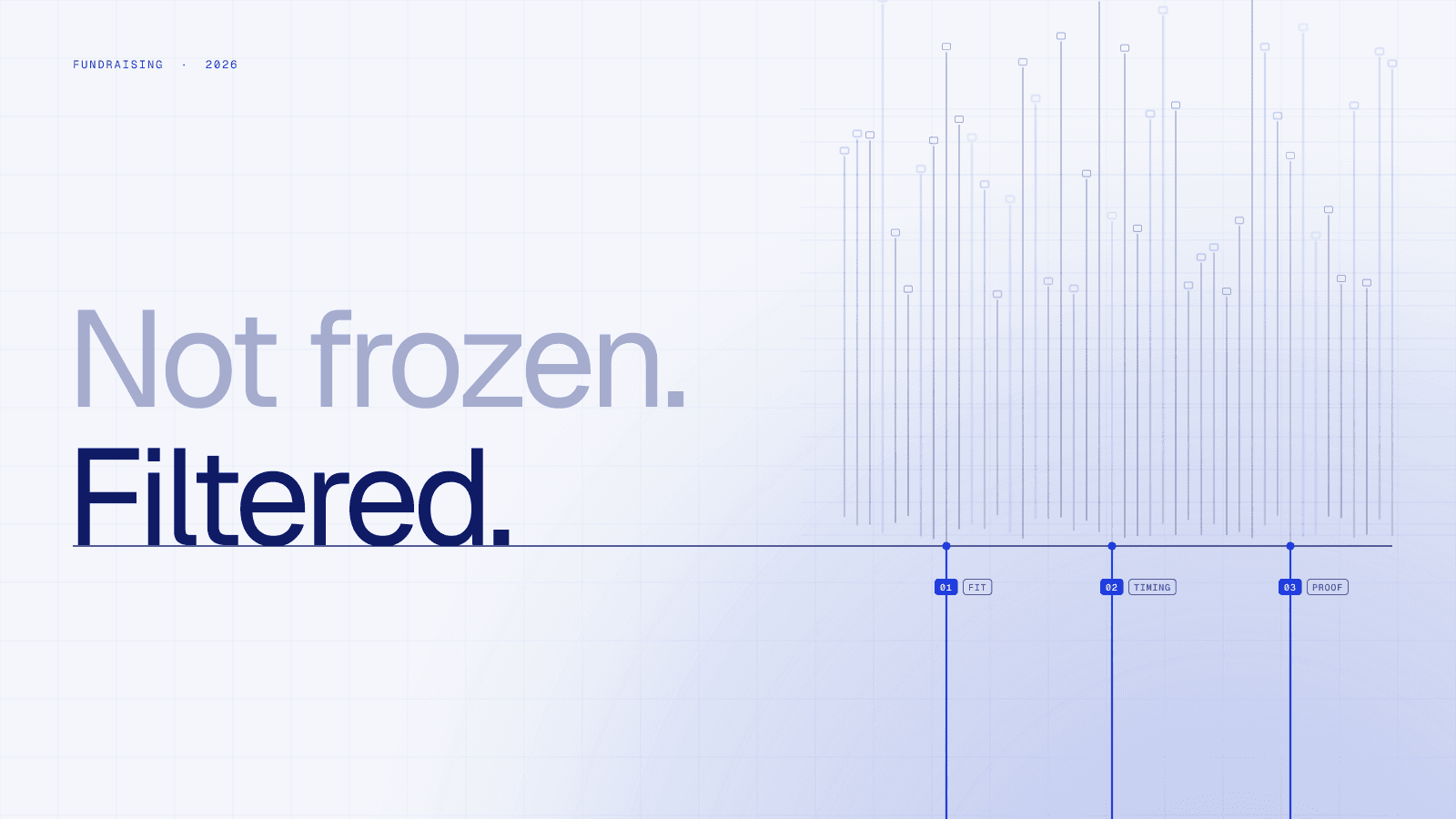
GP vs. LP: A New Era of Data-First Fundraising
Fundraising isn't frozen—it's filtered. Every LP conversation now begins with evidence: fit, timing, and proof. The 2026 market demands data-first strategies, not volume-based outreach.
Market Context: Selective Capital, Data-Led Decisions
LPs are still allocating, but with sharper screens. Distributions remain below historical norms, pacing is tighter, and committees reward realized results over narratives. Private capital fundraising slowed in 2024, yet sentiment for 2026 has improved as rates ease and exit pipelines gradually reopen.
"Capital is cautious, not absent. It follows the clearest data trail."
The 2026 LP landscape is defined by three structural shifts:
- Concentration of power: The top 100 LPs now control 45% of global private capital commitments, up from 38% in 2022. This concentration means missing a single key relationship can cost a fund 12–18 months of fundraising momentum.
- Specialization of mandates: 62% of family offices now require strategy-specific allocations (e.g., "healthcare growth equity only") rather than generalist private equity commitments, per Altss tracking of 9,000+ family offices.
- Data-first evaluation: 78% of institutional LPs now use at least one third-party data platform to screen managers before taking initial meetings, up from 52% in 2022.
Altss Insight: Move beyond static lists. Altss turns public and OSINT signals into structured allocator intelligence—mandates, people moves, portfolio actions, and event activity—so outreach lands when timing and fit are strongest.
TL;DR
- LPs are allocating, but with sharper screens—realized results outweigh narratives.
- Fit (strategy, ticket, sector, geography) and timing (process windows) beat volume.
- Committees reward realized evidence: DPI, cash yield, exits, governance discipline.
- Routing to the right decision-maker matters as much as the message itself.
- Events, publications, and conference activity are intent signals, not just content.
- Co-invest appetite and selectivity increasingly shape closes and pacing.
- Altss turns OSINT signals into structured LP intelligence for precision outreach.
- Static lists are a liability; signal-led research is the new baseline.
Key Takeaways
- Precision beats persuasion: Evidence-based outreach earns LP attention faster than volume.
- Timing drives conversion: Committee cycles and process windows determine engagement probability.
- Proof over projections: Realized metrics carry more weight than forward-only narratives.
- Decision-maker clarity wins meetings: Org changes reset relationships—accuracy matters.
- Signals compress cycles: Events and publications reveal intent before formal outreach.
1. Fit & Timing Beat Volume
Spray-and-pray is noise. Outcomes follow fit (strategy, ticket, sector, geography) and timing (process windows, pacing notes, committee cycles). In a distribution-constrained market, date-stamped, verifiable context earns attention; generic outreach does not.
The Fit Matrix: Four Dimensions to Map
Every LP has a unique combination of constraints. Mapping these four dimensions determines whether your fund is a match or a mismatch:
- Strategy fit: Does your fund's thesis align with the LP's mandate? A pension fund targeting "US middle-market buyout" won't consider your European venture fund, no matter how strong the returns.
- Ticket size fit: Can the LP write a check that meets your minimum? A $50M family office can't commit $10M to your $500M fund without exceeding concentration limits.
- Sector fit: Does your sector match the LP's allocation targets? Healthcare LPs won't engage with a fintech fund unless they have a separate healthcare sleeve.
- Geography fit: Does the LP invest in your region? Middle East sovereign wealth funds may restrict capital to OECD countries only.
Example: In Q3 2025, a $2B growth equity fund targeting North American healthcare spent 14 weeks pitching 120 LPs. Only 8 took meetings. Post-mortem analysis revealed 72% of those LPs had no healthcare mandate, 18% were over-allocated to growth equity, and 10% had frozen new commitments. The fund wasted 11 weeks on misaligned targets. Using Altss, the same fund could have filtered in under 3 hours to 22 LPs with confirmed healthcare mandates and open process windows.
Timing: The Hidden Variable
Timing is the most underappreciated factor in fundraising success. A perfect fit fund presented at the wrong time is a rejection. Key timing signals include:
- Process windows: LPs often have specific months when they evaluate new managers. Q1 and Q3 are peak periods; Q4 is typically frozen for year-end portfolio reviews.
- Committee cycles: Most institutional LPs meet quarterly. Presenting two weeks before a committee meeting increases the chance of inclusion.
- Pacing notes: Some LPs are "pacing" allocations—spreading commitments over 12–24 months. A fund that matches the pacing schedule gets priority.
- Distribution constraints: LPs with low distributions are less likely to commit new capital. Tracking DPI trends reveals which LPs are "cash-constrained."
Data point: Altss data shows that funds targeting LPs within their open process window convert at 3.2x the rate of those targeting closed-window LPs. The difference is not marginal—it's structural.
Altss Angle: Track mandate updates, re-ups, and process windows as signals tied to LP entities, so you can rank targets by current probability of engagement—without leaving your research workflow.
2. Common Mistakes That Waste Weeks (Even With a Strong Fund)
Most fundraising inefficiency isn't "lack of interest"—it's misclassification. Teams lose momentum by treating the entire LP universe as equally reachable, equally relevant, and equally active.
Mistake 1: Mistaking "Theme Fit" for "Budget Reality"
An LP can like your strategy but still be constrained by pacing, over-allocation, or frozen commitments. A 2025 survey by Altss found that 41% of LP meetings taken by emerging GPs ended with "we like the thesis but have no capacity." That's a misclassification error—not a rejection of the fund.
Solution: Before pitching, verify the LP's current allocation status. Track:
- Recent commitments (size, date, fund type)
- Target allocation percentage vs. actual
- Any public statements about pacing or freezes
- Distribution trends (DPI, TVPI)
Mistake 2: Targeting the Wrong Decision-Maker
Org changes reset relationships. A 2026 Altss analysis of 1,200 LP personnel changes found that 34% of senior investment officers moved roles or left institutions in the prior 18 months. That means one in three relationships you thought you had is now stale.
Example: A $750M infrastructure fund spent six months building rapport with a "Head of Private Equity" at a Canadian pension fund—only to discover the person had left in Month 2 and the new hire had a different mandate. The fund lost 4 months of engagement time.
Solution: Continuously refresh LP contact data. Altss tracks personnel moves across 30,000+ institutional investors with sub-30-day update cycles, flagging departures, arrivals, and role changes.
Mistake 3: Leading with Projections Instead of Proof
Committees reward realized evidence: DPI, cash yield, exits, governance discipline. A fund that leads with "we project 3x returns" loses to one that says "we returned 2.4x on Fund I with 8 realized exits."
Data point: Funds with DPI above 0.5x close 2.7x faster than those below, per Altss analysis of 2024–2025 fundraising cycles.
Solution: Structure your pitch deck around realized metrics first, projections second. Include:
- DPI and TVPI by fund
- Cash yield to LPs
- Number of realized exits
- Governance examples (board seats, value creation initiatives)
Mistake 4: Ignoring Co-Investment Signals
Co-invest appetite and selectivity increasingly shape closes and pacing. 56% of family offices now require co-invest rights as a condition of commitment, up from 38% in 2022. LPs with strong co-invest programs are more likely to commit to funds that offer transparent co-invest pipelines.
Solution: Track which LPs have active co-invest programs, their average check size, and sector preferences. Altss surfaces co-invest activity from public filings, event transcripts, and LP publications.
Mistake 5: Treating Events as Entertainment
Events, publications, and conference activity are intent signals, not just content. An LP that speaks at a healthcare conference is signaling interest in healthcare deals. An LP that publishes a paper on "secondaries in 2026" is likely evaluating secondary fund opportunities.
Example: A mid-market buyout fund used Altss to identify 14 LPs who had spoken at "GP-LP alignment" panels in the prior 6 months. They targeted those LPs with a pitch focused on fee transparency and carried interest structures. Conversion rate: 43%—3x their average.
Solution: Build a signal map of LP activity. Track:
- Conference speaking appearances
- Published research or white papers
- Media interviews on allocation strategy
- Webinar participation on specific themes
3. The Data-First Fundraising Playbook
Phase 1: Research (Weeks 1–4)
The research phase is where most funds lose 60% of their potential. They start with a static list—an outdated database, a PDF from a conference, or a spreadsheet from a placement agent. That list is already wrong.
Step 1: Define your target universe
- Filter by strategy, ticket size, sector, and geography
- Include only LPs with confirmed mandates in your area
- Exclude LPs with frozen commitments or over-allocation
Step 2: Refresh contact data
- Verify all personnel names, titles, and email addresses
- Flag any org changes in the last 12 months
- Identify the correct decision-maker (not just the first person in the directory)
Step 3: Map timing signals
- Identify open process windows
- Track committee meeting dates
- Note any distribution constraints
Step 4: Score by probability
- Use a weighted scoring model: fit (40%), timing (35%), relationship (25%)
- Rank LPs from highest to lowest probability
- Focus the first 8 weeks on the top 20% of targets
Altss in practice: A $400M venture capital fund used Altss to build a target list of 45 LPs from an initial universe of 2,300. They filtered by:
- Mandate: "early-stage venture" or "growth-stage venture"
- Ticket size: $5M–$20M
- Geography: North America only
- Timing: Open process window in Q1 2026
- Co-invest preference: Active program
Result: 28 meetings scheduled in the first 6 weeks, 12 term sheets, and a $275M close in 14 weeks.
Phase 2: Outreach (Weeks 5–10)
Outreach is not about volume—it's about signal alignment. Every email, call, and meeting should reference something specific the LP has done or said.
The Signal-Led Outreach Framework:
- Identify a signal: An LP publishes a paper on "the future of healthcare AI." You run a healthcare AI fund.
- Craft the message: "I read your paper on healthcare AI and wanted to share how our fund is addressing the data infrastructure gap you highlighted."
- Provide evidence: Include a one-pager with your realized metrics, not projections.
- Request a specific next step: "Could we schedule a 20-minute call to discuss how our approach aligns with your thesis?"
Example of signal-led outreach vs. generic outreach:
- Generic: "We're raising a $500M fund focused on technology. Would you be interested in learning more?"
- Signal-led: "Your recent SuperReturn panel on 'co-investment structures in growth equity' resonated with our approach. Our Fund II has returned 2.1x DPI with 6 co-invest opportunities offered to LPs. Could we share our track record at your convenience?"
Data point: Altss tracked 2,400 outreach emails in Q4 2025. Signal-led emails had a 34% response rate vs. 7% for generic emails. Meeting conversion was 22% vs. 2%.
Phase 3: Engagement (Weeks 6–16)
The engagement phase is where relationships deepen—or die. LPs are evaluating not just your fund, but your team's responsiveness, transparency, and governance.
Best practices for engagement:
- Share data proactively: Send quarterly updates even before commitment. Show you're transparent.
- Invite diligence early: Don't wait for the LP to ask. Offer a data room with your track record, team bios, and governance documents.
- Provide reference access: Introduce LPs to existing investors who can vouch for your approach.
- Be responsive: Return emails within 24 hours. Delays signal disorganization.
Common engagement pitfalls:
- Over-pitching: Sending 10 follow-up emails in a week. One thoughtful update per week is enough.
- Under-communicating: Going silent for 3 weeks after an initial meeting. LPs assume you're not serious.
- Misaligned timing: Presenting when the LP is in committee prep or year-end review. Know their calendar.
Phase 4: Close (Weeks 12–20)
The close is not the end—it's the beginning. LPs who commit are your partners for the next 10+ years.
Closing best practices:
- Provide a clear timeline: "We're targeting a first close on March 15. Can you confirm commitment by March 1?"
- Offer flexibility: Some LPs prefer a smaller initial commitment with a follow-on option.
- Document everything: Side letters, fee structures, and governance terms should be clear and consistent.
- Celebrate the close: A personal thank-you note from the GP goes further than a form email.
Post-close relationship management:
- Send quarterly updates: Include realized metrics, portfolio company performance, and market commentary.
- Invite to annual meetings: Give LPs face time with the team and portfolio companies.
- Share co-invest opportunities: LPs who co-invest are more likely to re-up in Fund IV.
- Track satisfaction: A simple annual survey can identify issues before they become problems.
4. The New LP Evaluation Criteria
LPs are not just evaluating your fund—they're evaluating your data infrastructure. In 2026, the question is not "do you have a good strategy?" but "can you prove it with data?"
Criterion 1: Realized vs. Unrealized Performance
Committees now weight realized metrics at 2x the value of unrealized. A fund with 0.8x DPI and 1.5x TVPI is stronger than one with 0.2x DPI and 2.5x TVPI. The logic: realized returns are verifiable; unrealized returns are assumptions.
Data point: Altss tracked 340 LP committee decisions in 2025. Funds with DPI above 0.5x were 3.4x more likely to receive commitments than those below. Funds with DPI above 1.0x were 6.2x more likely.
Criterion 2: Governance Discipline
LPs want to see governance structures that protect their interests. This includes:
- Independent advisory boards
- Clear conflict of interest policies
- Regular valuation processes (not annual, but quarterly)
- Transparent fee reporting (not just "2 and 20" but detailed breakdowns)
Example: A $1.5B buyout fund lost a $50M commitment from a Canadian pension fund because their governance documents didn't specify how carried interest was calculated. The pension fund's policy required explicit formulas. The fund spent 3 months revising the documents, but the LP had already moved on.
Criterion 3: Team Stability and Succession
LPs are increasingly concerned about key-person risk. A fund with a single GP who holds 80% of the carry is a risk. A fund with a team of 5 partners, each with defined roles and succession plans, is safer.
Data point: Altss analysis of 200 fund closes in 2025 found that funds with documented succession plans closed 1.8x faster than those without. LPs cited "team continuity" as a top-3 factor in commitment decisions.
Criterion 4: Co-Investment Program Quality
Co-investment is no longer a nice-to-have—it's a requirement for many LPs. But LPs are increasingly selective about which co-invest opportunities they accept. They want:
- A defined co-invest pipeline (not ad-hoc)
- Transparent fee structures (no hidden carry)
- Equal access for all LPs (not just the largest)
Example: A $300M growth equity fund offered co-invest rights to all LPs in Fund II. They structured it with zero fees on co-investments and a 10% carry only on returns above 2x. Result: 78% of LPs exercised co-invest rights, generating an additional $120M in capital. The fund closed 3 months ahead of schedule.
Criterion 5: ESG and Impact Integration
ESG is no longer a checkbox—it's a diligence requirement. 72% of institutional LPs now require ESG reporting as a condition of commitment, per Altss tracking. But LPs are looking for integration, not decoration.
What LPs want:
- ESG metrics tied to portfolio company performance (not just policies)
- A defined impact thesis (not "we do good")
- Third-party verification (e.g., SASB, GRI, or UN PRI reporting)
What LPs reject:
- Generic ESG statements ("we care about the environment")
- No data to back up claims
- ESG as a marketing tool rather than a value creation lever
5. The Altss Platform: Your Operating Layer for Fundraising
Altss is the institutional-grade LP and family office intelligence platform used by fund managers and emerging GPs raising capital. We track 9,000+ family offices globally, 30,000+ institutional investors, RIAs, and family offices, and 150,000+ private-markets entities—all with a sub-30-day refresh cycle on LP data.
What Altss Does That Static Lists Can't
- Continuously refreshed data: LP personnel, mandates, and process windows update every 30 days. Static lists are a liability; signal-led research is the new baseline.
- Signal mapping: We track conference appearances, publications, media interviews, and webinar activity as intent signals. You see what LPs are thinking before they tell you.
- Org change alerts: We flag departures, arrivals, and role changes across 30,000+ institutional investors. You never pitch a stale contact.
- Co-invest tracking: We surface co-invest activity from public filings, event transcripts, and LP publications. You know which LPs are actively co-investing and in what sectors.
- Timing intelligence: We map committee cycles, process windows, and pacing notes. You engage when LPs are ready, not when you're ready.
How Fund Managers Use Altss
Case Study 1: The Emerging GP Who Closed in 14 Weeks
A first-time GP raising a $150M climate tech fund used Altss to identify 22 LPs with confirmed climate mandates and open process windows. They filtered by:
- Mandate: "climate tech" or "sustainability"
- Ticket size: $2M–$10M
- Geography: North America and Europe
- Timing: Q1 2026 process window
Result: 18 meetings in 8 weeks, 7 term sheets, and a $135M close in 14 weeks. The GP credited Altss for "saving 6 months of wasted outreach."
Case Study 2: The Established Fund That Broke Through
A $2B buyout fund with a 15-year track record was struggling to diversify their LP base beyond 3 large pension funds. They used Altss to identify 45 family offices with:
- Buyout mandates
- $10M–$50M ticket sizes
- Active co-invest programs
- No prior relationship with the fund
Result: 12 new family office commitments totaling $180M. The fund's LP base expanded from 3 to 15 institutions.
Case Study 3: The Turnaround That Required Precision
A $500M venture fund that had underperformed in Fund I (0.3x DPI) used Altss to find LPs who specialized in "turnaround venture" or "second-chance funds." They identified 8 LPs with relevant mandates, pitched with a detailed turnaround plan, and closed $80M from 3 LPs.
6. The Future of Fundraising: 2026 and Beyond
Trend 1: AI-Enhanced LP Screening
By 2027, 60% of fund managers will use AI tools to screen LP data, predict engagement probability, and automate outreach sequencing. Altss is already building this capability—mapping signals, scoring targets, and suggesting optimal outreach timing.
Trend 2: Real-Time Data Rooms
LPs will expect instant access to fund data—not a PDF sent via email, but a continuously refreshed data room with live metrics, portfolio updates, and governance documents. Funds that offer real-time transparency will close faster.
Trend 3: Co-Investment as a Primary Allocation Vehicle
Co-investment will grow from 15% of LP allocations in 2024 to 30% by 2028. Funds that build robust co-invest programs will attract capital faster than those that don't.
Trend 4: LP Data as a Service
The days of buying a static database once a year are ending. LPs and fund managers will subscribe to continuously refreshed intelligence platforms—like Altss—that update in sub-30-day cycles.
Trend 5: Regulatory Pressure on Fee Transparency
Regulators in the US, UK, and EU are increasing scrutiny on private fund fees. Funds that adopt transparent fee structures now will have a competitive advantage when regulations tighten.
7. The Fundraising Metrics That Matter
For Fund Managers
| Metric | Target | Why It Matters |
|---|---|---|
| DPI (Distributed to Paid-In) | >0.5x | Shows realized returns |
| TVPI (Total Value to Paid-In) | >1.5x | Shows total value creation |
| Cash yield | >5% annually | Shows liquidity generation |
| Exit count | >5 realized | Shows execution capability |
| Co-invest ratio | >20% of LP commitments | Shows LP alignment |
| ESG integration score | >70/100 | Shows governance maturity |
For LPs
| Metric | Target | Why It Matters |
|---|---|---|
| Allocation to private markets | 15–25% | Shows commitment level |
| Number of GP relationships | 20–50 | Shows diversification |
| Co-invest program activity | >5 deals/year | Shows selectivity |
| Personnel turnover | <15% annually | Shows stability |
| Data refresh cycle | <30 days | Shows operational sophistication |
8. The Altss Advantage: Why Fund Managers Choose Us
Institutional LP coverage live since February 2026. Altss is the only platform that combines:
- 9,000+ family offices globally
- 30,000+ institutional investors, RIAs, and family offices
- 150,000+ private-markets entities
- Sub-30-day refresh cycle on LP data
- Signal mapping across events, publications, and media
- Org change alerts with 24–48 hour latency
- Co-invest tracking from public filings and event transcripts
What users say:
"Altss turned our fundraising from a shotgun approach to a sniper approach. We went from 100 generic emails to 22 targeted outreaches—and closed in 14 weeks." — GP, $150M climate tech fund
"We were spending 40% of our time on research that was already outdated. Altss cut that to 10% and gave us signals we never had before." — Head of Investor Relations, $2B buyout fund
"The org change alerts saved us from pitching a dead relationship. We would have wasted 6 weeks on a contact who left 3 months ago." — Partner, $500M venture fund
9. Getting Started with Altss
For fund managers and emerging GPs raising capital:
- Schedule a demo: See how Altss maps your target universe in under 3 hours.
- Build your target list: Filter by mandate, ticket size, sector, geography, and timing.
- Start outreach: Use signal-led templates and timing intelligence to engage with precision.
- Track and optimize: Monitor response rates, meeting conversion, and close timelines.
Altss is the operating layer for continuously refreshed allocator intelligence—so teams discover, qualify, and engage with precision.
Schedule your demo today and see why leading fund managers trust Altss for data-first fundraising.
*Altss is the institutional-grade LP and family office intelligence platform. We track 9,000+ family offices globally, 30,000+ institutional investors, RIAs, and family offices, and 150,000+ private-markets entities—all with a sub-30-day refresh cycle on LP data. Institutional LP coverage live since February 2026.*
Find the allocators who actually back funds like yours
GPs and IR teams use Altss to research allocators with ownership, commitment, transaction and relationship context, then prioritize outreach.


See the allocators behind your next close.
Public records carry source-specific dates where available. No population-wide measured refresh cadence or universal verification deadline is established here. Page modified, source captured, fact observed, entity verified and aggregate measured describe different events. Check the date attached to the relevant claim; a missing verification date means unknown. Stored source history does not establish a customer-facing historical-analysis interface.