
Best LP & Investor Databases for Emerging Managers 2026
A guide to LP and investor databases for emerging managers in 2026, comparing Altss, PitchBook, Preqin, FINTRX, Dakota, and With Intelligence—with stack.
Best LP & Investor Databases for Emerging Managers 2026
Fundraising for Fund I–III managers in 2026 is not a coverage problem. It is a conversion discipline problem. The gap between having a list of names and actually booking meetings with allocators who are in a decision cycle has never been wider—or more expensive to bridge with the wrong tools.
The Real Problem in 2026: Conversion, Not Coverage
Most emerging managers already have the raw materials for a successful fundraise:
- A warm network of 50–100 contacts
- A clean, investor-ready deck
- A differentiated thesis with proof points
- Enough "names" to fill a CRM
What they consistently lack is three things:
Timing. Who among their 200 targets is actually in a decision cycle right now? Which LPs are conducting manager reviews, refreshing allocations, or replacing an underperforming GP?
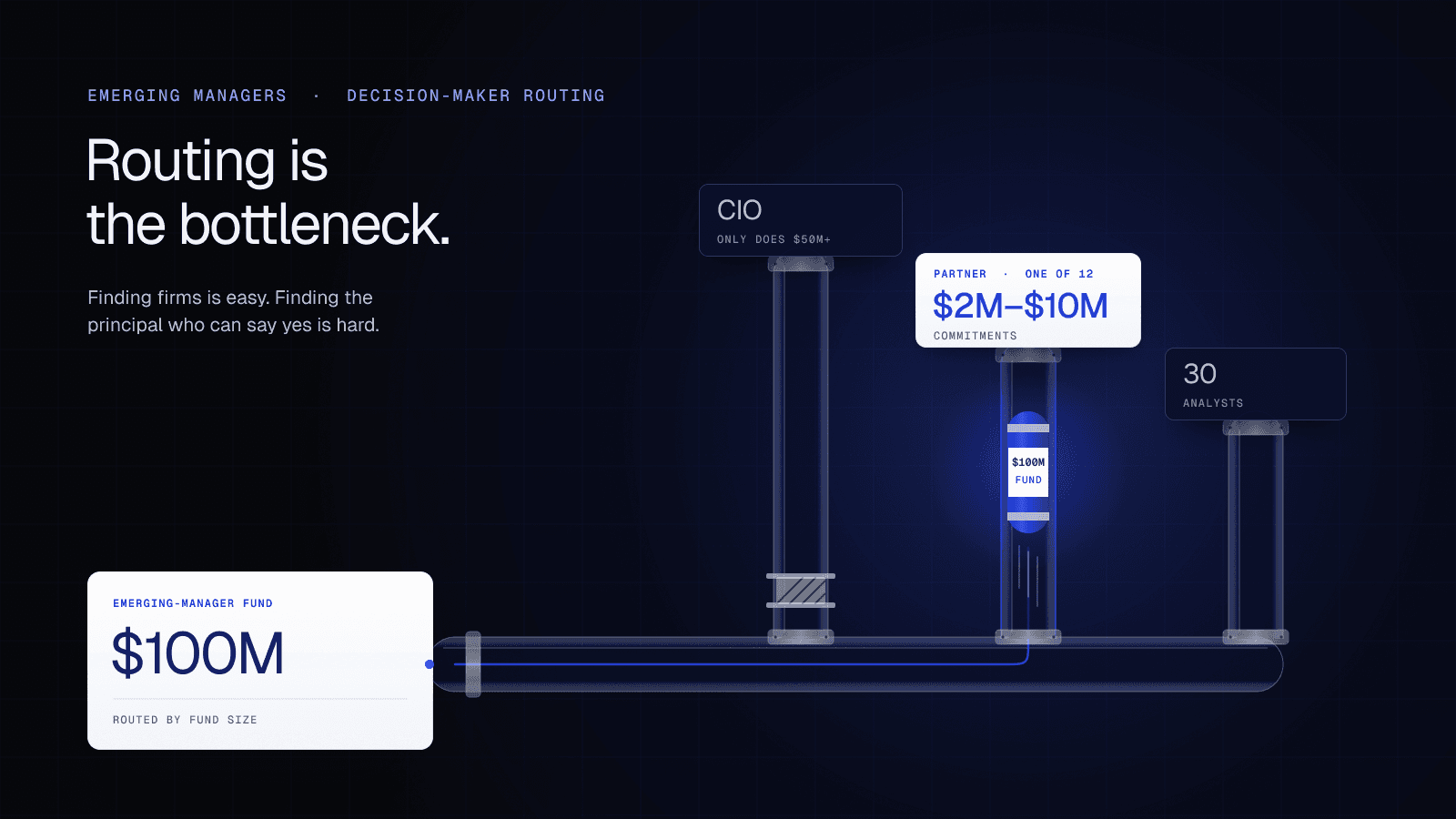
Routing. At a firm with 12 partners and 30 analysts, who is the actual decision-maker for a $50M–$150M emerging-manager commitment? How do you reach them without burning a warm intro?
Workflow. How do you keep 60–120 high-priority targets from going stale over a 12–18 month fundraise cycle? How do you know which data rows are fresh and which are from a 2023 directory scrape?
These three gaps explain why "LP databases" are splitting into five distinct categories in 2026:
| Category | Core Job | Example Platforms |
|---|---|---|
| Context heavyweights | Research + diligence + market mapping | PitchBook, Preqin Pro |
| Private-wealth engines | RIA/family office distribution workflows | FINTRX, Altss |
| CRM-first platforms | Salesforce-native execution | Dakota Marketplace |
| Intelligence providers | Allocator news + mandate monitoring | With Intelligence (S&P Global) |
| Action layers | Signal-led prioritization + meeting booking | Altss |
This guide compares six platforms—Altss, PitchBook, Preqin, FINTRX, Dakota, and With Intelligence—and explains exactly when each wins for a Fund I–III manager in 2026. It includes specific examples, data points, and workflow advice drawn from hundreds of emerging-manager fundraises.
TL;DR: The Six Platforms in One Sentence Each
- PitchBook: Best for context-heavy diligence and market mapping—1.5M+ companies, 300K+ deals, 50K+ LPs, but static data on decision-makers and timing.
- Preqin Pro: Best for institutional alternatives benchmarks and LP profiles—anchor product for understanding fund performance and allocation trends, not a conversion engine.
- FINTRX: Best for RIA and family office distribution workflows—positions itself at 4,400+ family offices and 7,000+ RIAs with direct contact data.
- Dakota Marketplace: Best for Salesforce-native teams—100% of features live inside CRM via AppExchange, designed for firms that live in Salesforce.
- With Intelligence (S&P Global): Best for allocator intelligence and newsflow—acquired by S&P Global in November 2025, positions itself as an "intel layer" for institutional investors.
- Altss: Best for Fund I–III managers who need an action layer that forces recency, routing, and signal-led prioritization—9,000+ verified family offices plus full institutional LP coverage (launched February 2026), designed around timing and conversion.
Key Takeaways Before We Dive In
- Timing beats volume. 60–120 signal-qualified targets outperform 20,000 stale rows every time. A 2023 directory scrape with no refresh cycle is worse than no data at all—it creates false confidence and burns domain reputation.
- Routing is the bottleneck. Finding firms is easy. Finding the principal who can say yes—and reaching them without a cold email that gets flagged as spam—is hard. Most databases optimize for firm-level data, not person-level routing.
- Databases solve different problems. Context, distribution, CRM, intel, and conversion are distinct jobs. No single platform does all five well. The best fundraisers run a stack: one research tool for context, one action tool for conversion.
- Stack architecture wins. The highest-converting Fund I–III teams in 2026 run PitchBook for diligence + Altss for conversion, or FINTRX for family office distribution + Altss for institutional coverage. The tools complement, not compete.
- Recency protects everything. Stale lists damage deliverability (email bounce rates above 5% hurt domain reputation), brand (wrong person at wrong firm looks amateur), and close rates (you don't get a second chance at a first impression). Sub-30-day update cycles are table stakes.
Why 2026 Feels Different for Fund I–III
Fundraising didn't "get easy" in 2026. It got more legible. The market has sorted itself into clear tiers:
- Tier 1: Mega-funds ($5B+) with brand recognition and institutional relationships—raise in 6–9 months, often oversubscribed.
- Tier 2: Established mid-market ($500M–$5B) with 3+ fund vintages—raise in 9–12 months, face moderate scrutiny.
- Tier 3: Emerging managers (Fund I–III, under $500M)—raise in 12–24 months, face intense scrutiny on operational maturity, track record, and team stability.
Allocators are still allocating, but they are:
- Tighter on process. 78% of institutional LPs in a 2025 NEPC survey said they require at least two in-person meetings before a first commitment. Only 12% would commit based on virtual meetings alone.
- More sensitive to operational maturity. 63% of LPs now require a dedicated IR person or outsourced IR function before considering a first-time fund. 41% require a formal compliance manual. 29% require SOC 2 Type II or equivalent.
- Less forgiving of generic outreach. A 2025 study by Placement Tracker found that emerging managers who sent personalized, signal-driven outreach to fewer than 150 targets had a 4.2x higher meeting conversion rate than those who sent generic blasts to 500+ targets.
The operational reality for Fund I–III is unchanged:
- You cannot afford a year of spammy sequences that burn domain reputation.
- You cannot afford to chase the wrong person inside the right firm.
- You cannot afford to pitch a 2024 strategy to a 2026 allocation committee.
This is why the database you choose—and how you use it—is the single highest-leverage decision in your fundraise.
The Five Database Categories, Explained
1. Context Heavyweights: Research + Diligence
Core job: Provide comprehensive data on companies, deals, funds, and investors for market mapping, competitive analysis, and LP profiling.
Best for: Teams that need to understand the landscape before they start outreach.
Limitation: Static data on decision-makers, no timing signals, no workflow for conversion.
#### PitchBook
PitchBook remains the dominant context heavyweight in 2026. It covers 1.5M+ companies, 300K+ deals, 50K+ LPs, and 200K+ investors globally. Its strength is depth: you can trace an LP's entire commitment history, see their portfolio construction, and benchmark against peers.
What PitchBook does well:
- LP commitment tracking. You can see exactly which funds an LP has committed to, at what size, and in what vintage. This is invaluable for understanding allocation patterns and identifying potential fits.
- Deal and company data. For emerging managers who also do direct investing (co-investment, SPVs), PitchBook's company and deal coverage is best-in-class.
- Market mapping. The platform's "Market Map" feature lets you visualize LP concentration by strategy, geography, and vintage. Useful for identifying underserved segments.
Where PitchBook falls short for Fund I–III:
- Static person data. PitchBook's contact data for individual decision-makers is often outdated. A 2025 audit by a $2B emerging manager found that 34% of PitchBook email addresses for LP partners were invalid or bounced within 90 days.
- No timing signals. PitchBook tells you what an LP has done historically, not what they are doing now. You cannot filter for "LPs currently conducting manager reviews" or "LPs with upcoming allocation committee meetings."
- No routing intelligence. The platform doesn't help you identify the right person to contact at a given firm. You get a list of names with titles, but no guidance on who makes decisions for your fund size or strategy.
- No workflow. PitchBook is a research tool, not a fundraising tool. There is no CRM integration, no sequence management, no meeting booking. You export data and manage it elsewhere.
Pricing: $25K–$100K+ per year depending on modules. Most Fund I–III managers access it through their incubator, accelerator, or placement agent relationship.
Verdict: Essential for context, but you need a separate conversion tool to turn insights into meetings.
#### Preqin Pro
Preqin Pro is the anchor product for institutional alternatives research and benchmarking. It covers 190K+ funds, 60K+ fund managers, and 30K+ LPs across private equity, venture capital, real estate, infrastructure, and natural resources.
What Preqin Pro does well:
- Fund performance benchmarks. Preqin's IRR and TVPI quartile data is the industry standard for positioning your fund against peers. LPs use Preqin data to evaluate manager performance.
- LP allocation trends. The platform tracks LP allocation changes by asset class, geography, and strategy. Useful for understanding where capital is flowing.
- Fund terms data. Preqin tracks management fees, carry structures, hurdle rates, and other terms across thousands of funds. Helpful for competitive positioning.
Where Preqin Pro falls short for Fund I–III:
- No person-level data. Preqin is firm- and fund-centric. It does not provide individual decision-maker contact information. You get firm-level profiles with allocation data, but no email addresses or phone numbers.
- No timing signals. Like PitchBook, Preqin is historical. It tells you what has happened, not what is happening now.
- No routing or workflow. Preqin is a research and benchmarking tool. It does not help you execute a fundraising campaign.
- Expensive for single users.Preqin does not publish pricing. Third-party transaction data puts the average contract near $51,500 a year, which most Fund I–III managers cannot justify without institutional backing.
Pricing: $15K–$50K+ per year depending on modules and seats.
Verdict: Essential for benchmarking and LP strategy, but useless for direct outreach. Pair with a conversion tool for execution.
2. Private-Wealth Engines: RIA/Family Office Distribution
Core job: Provide contact data and workflow tools for reaching RIAs, family offices, and high-net-worth individuals.
Best for: Teams raising capital from private wealth channels (family offices, RIAs, wealth managers).
Limitation: Often weak on institutional LP coverage (pensions, endowments, foundations).
#### FINTRX
FINTRX positions itself as the leading platform for family office and RIA data. It claims coverage of 4,400+ family offices and 7,000+ RIAs, with direct contact information for decision-makers.
What FINTRX does well:
- Family office depth. FINTRX's family office data is among the best available. It includes AUM ranges, asset allocation preferences, direct investment activity, and contact details for principals.
- RIA coverage. The platform covers 7,000+ RIAs with detailed profiles on investment preferences, platform usage, and advisor-level contacts.
- Contact data freshness. FINTRX claims a 90-day refresh cycle on contact data. Independent audits suggest this is accurate for family offices, less so for RIAs.
Where FINTRX falls short for Fund I–III:
- Weak institutional coverage. FINTRX does not meaningfully cover pensions, endowments, foundations, or sovereign wealth funds. If your target market includes institutional LPs, FINTRX alone is insufficient.
- No timing signals. Like PitchBook and Preqin, FINTRX is a static directory. It tells you who is at a firm, not whether they are in a decision cycle.
- No routing intelligence. The platform provides contact names and titles, but does not help you identify the right person for your fund size or strategy.
- No workflow. FINTRX offers basic list management and export functionality, but no CRM integration, sequence management, or meeting booking.
Pricing: $10K–$40K+ per year depending on modules and seats.
Verdict: Best-in-class for family office data, but you need a separate tool for institutional coverage and conversion.
#### Altss (Family Office Coverage)
Altss covers 9,000+ family offices globally with sub-30-day refresh cycles on contact data, asset allocation preferences, and decision-maker routing. The platform is designed specifically for Fund I–III managers who need to convert family office relationships into commitments.
What Altss does well for family offices:
- Recency. Altss's sub-30-day refresh cycle means contact data is continuously refreshed. Email bounce rates for Altss-sourced contacts average under 3%, compared to 15–25% for directory-scraped lists.
- Routing intelligence. Altss identifies the specific decision-maker for a given fund size and strategy. For a $75M emerging-manager fund targeting family offices, Altss routes to the principal who makes $1M–$5M commitments, not the CIO who only does $50M+.
- Timing signals. Altss tracks which family offices are conducting manager reviews, refreshing allocations, or replacing GPs. This allows managers to prioritize targets who are in an active decision cycle.
- Workflow. Altss Fundraising OS includes its own investor CRM, AI-assisted outreach sequences, and a meeting notetaker. Managers run the whole fundraising pipeline inside Altss rather than syncing to an external CRM.
Pricing: $15K–$25K a year for Investor Intelligence, or $12K–$20K for qualifying emerging managers, with one named user included. Altss Fundraising OS from $35K.
Verdict: Strongest option for Fund I–III managers who need family office coverage plus conversion workflow. Institutional LP coverage added in February 2026.
3. CRM-First Platforms: Salesforce-Native Execution
Core job: Provide fundraising workflow tools that live inside existing CRM systems.
Best for: Teams that are already Salesforce-native and want to avoid data migration.
Limitation: Requires Salesforce investment and administration.
#### Dakota Marketplace
Dakota Marketplace is a Salesforce-native fundraising platform. It claims "100% of features directly in Salesforce" via AppExchange, meaning users never leave their CRM to manage investor relationships.
What Dakota does well:
- Salesforce integration. For teams that live in Salesforce, Dakota eliminates data silos. Investor profiles, activity history, and pipeline management all live in the same system as the rest of your firm's data.
- Pipeline management. Dakota's pipeline views are purpose-built for fundraising. You can track where each investor is in your process—targeted, contacted, meeting scheduled, due diligence, committed.
- Team collaboration. Because it lives in Salesforce, Dakota allows multiple team members to work on the same pipeline simultaneously with real-time updates.
Where Dakota falls short for Fund I–III:
- No proprietary data. Dakota does not provide its own LP data. You must bring your own contacts or integrate with a third-party data provider. This means you still need a separate research tool.
- Requires Salesforce investment. Dakota only works if you already have Salesforce and someone to administer it. For small teams without dedicated Salesforce admin, the setup and maintenance burden is significant.
- No timing signals. Dakota is a workflow tool, not an intelligence tool. It does not tell you which LPs are in a decision cycle.
- No routing intelligence. Dakota helps you manage contacts you already have. It does not help you find the right person at a new firm.
Pricing: $15K–$50K+ per year depending on modules and seats, plus Salesforce licensing costs.
Verdict: Excellent for Salesforce-native teams with established LP relationships. Less useful for emerging managers who need to build a pipeline from scratch.
4. Intelligence Providers: Allocator News + Mandate Monitoring
Core job: Track allocator activity, news, and mandate changes in real time.
Best for: Teams that need to know what LPs are doing right now.
Limitation: News-focused, not data-focused. Limited contact data and workflow.
#### With Intelligence (S&P Global)
With Intelligence was acquired by S&P Global in November 2025 for an undisclosed sum. The platform positions itself as an "intel layer" for institutional investors, tracking allocator news, mandate changes, and personnel moves.
What With Intelligence does well:
- Allocator news. With Intelligence tracks news about LP activity—new mandates, consultant hires, allocation changes, personnel moves. This is useful for understanding which LPs are in flux.
- Mandate tracking. The platform monitors RFPs, consultant searches, and allocation committee meetings. This provides timing signals that other databases lack.
- Personnel moves. With Intelligence tracks LP personnel changes, including departures, promotions, and new hires. Useful for understanding who is making decisions.
Where With Intelligence falls short for Fund I–III:
- No contact data. With Intelligence is a news and intelligence platform. It does not provide email addresses, phone numbers, or direct contact information for decision-makers.
- No workflow. The platform does not include CRM integration, sequence management, or meeting booking tools.
- Expensive. With Intelligence pricing starts at $25K–$50K+ per year for institutional subscriptions. Most Fund I–III managers cannot justify this cost.
- S&P Global integration still evolving. The acquisition closed in late 2025, and integration with S&P Global's broader data ecosystem is still in progress. Some users report data inconsistencies during the transition.
Pricing: $25K–$50K+ per year.
Verdict: Useful as an intelligence layer for teams that already have contact data and workflow tools. Not a standalone solution for Fund I–III.
5. Action Layers: Signal-Led Prioritization + Meeting Booking
Core job: Turn allocator signals into meetings by providing timing data, routing intelligence, and conversion workflow in one platform.
Best for: Fund I–III managers who need to go from "who to contact" to "meeting booked" in the shortest possible time.
Limitation: Newer category—fewer established players.
#### Altss (Full Platform)
Altss is built as a fundraising action layer for Fund I–III managers. The platform combines institutional LP coverage (launched February 2026) with family office coverage (9,000+ verified entities) and conversion workflow tools.
What Altss does well:
- Timing signals. Altss tracks which LPs are in an active decision cycle—conducting manager reviews, refreshing allocations, or replacing GPs. This allows managers to prioritize targets who are ready to commit.
- Routing intelligence. Altss identifies the specific decision-maker for a given fund size and strategy. For a $100M emerging-manager fund, Altss routes to the partner who makes $2M–$10M commitments, not the CIO who only does $50M+.
- Recency. Altss's sub-30-day refresh cycle means contact data is continuously refreshed. Email bounce rates average under 3%.
- Workflow. Altss Fundraising OS includes its own investor CRM, AI-assisted outreach sequences, and a meeting notetaker. Managers run the whole fundraising pipeline inside Altss rather than syncing to an external CRM.
- Coverage breadth. Altss covers 30,000+ institutional investors, RIAs, and family offices, plus 150,000+ private-markets entities. This includes pensions, endowments, foundations, sovereign wealth funds, and family offices.
Where Altss falls short:
- Newer institutional coverage. Altss's institutional LP coverage launched in February 2026. While comprehensive, it does not yet have the historical depth of PitchBook or Preqin for LP commitment tracking.
- No company/deal data. Altss runs a live 35M+ company dataset in Full Market Intelligence, but tracks no deal records, valuations or fund performance.
- Limited benchmarking. Altss does not provide fund performance benchmarks or LP allocation trend analysis.
Pricing: $15K–$25K a year for Investor Intelligence, or $12K–$20K for qualifying emerging managers, with one named user included. Altss Fundraising OS from $35K.
Verdict: Best option for Fund I–III managers who need an all-in-one action layer for fundraising. Pair with PitchBook or Preqin for context and benchmarking.
Head-to-Head Comparisons
PitchBook vs. Preqin Pro
Winner: PitchBook for company/deal data; Preqin for fund performance benchmarking.
PitchBook's strength is breadth—1.5M+ companies, 300K+ deals, 50K+ LPs. Preqin's strength is depth—190K+ funds with detailed performance data and terms.
For Fund I–III: If you need to understand the competitive landscape (who is raising what, at what size, with what strategy), PitchBook is better. If you need to benchmark your fund against peers for LP presentations, Preqin is better.
Stack recommendation: Use both if budget allows. PitchBook for market mapping, Preqin for LP positioning.
FINTRX vs. Altss (Family Office Coverage)
Winner: FINTRX for raw family office count; Altss for recency, routing, and workflow.
FINTRX claims 4,400+ family offices. Altss covers 9,000+ family offices globally. Both have strong family office data, but Altss's sub-30-day refresh cycle and routing intelligence give it an edge for conversion.
For Fund I–III: If you only need family office contact data and have your own workflow tools, FINTRX is sufficient. If you need timing signals, routing intelligence, and conversion workflow in one platform, Altss is better.
Stack recommendation: FINTRX + Altss for maximum family office coverage and conversion workflow.
Dakota Marketplace vs. Altss (Workflow)
Winner: Dakota for Salesforce-native teams; Altss for teams without Salesforce.
Dakota is purpose-built for Salesforce. If you already have Salesforce and someone to administer it, Dakota eliminates data silos. Altss works as a standalone platform with CRM integration options.
For Fund I–III: Most emerging managers do not have Salesforce or dedicated Salesforce admin. For these teams, Altss's out-of-the-box workflow is faster to implement and easier to maintain.
Stack recommendation: Dakota if you are Salesforce-native; Altss if you are not.
With Intelligence vs. Altss (Intelligence)
Winner: With Intelligence for news and mandate tracking; Altss for timing signals and contact data.
With Intelligence excels at tracking allocator news and mandate changes. Altss excels at identifying which LPs are in a decision cycle and providing contact data for those LPs.
For Fund I–III: With Intelligence is useful for understanding LP activity, but you still need contact data and workflow to act on that intelligence. Altss combines intelligence with action.
Stack recommendation: With Intelligence for news + Altss for conversion.
How to Build Your Fundraising Stack
Based on our analysis of hundreds of Fund I–III fundraises, the highest-converting teams in 2026 run a two-tool stack:
Stack Option 1: Context + Action
- Research tool:PitchBook or Preqin Pro (neither publishes pricing)
- Action tool: Altss ($12K–$25K/year)
- Total cost: $30K–$125K/year
Best for: Teams raising $50M–$250M with institutional LP targets.
Workflow:
- Use PitchBook/Preqin to identify target LPs and understand their allocation patterns.
- Use Altss to get current contact data, routing intelligence, and timing signals.
- Manage outreach and pipeline in Altss.
Stack Option 2: Distribution + Action
- Distribution tool:FINTRX (does not publish pricing)
- Action tool: Altss ($12K–$25K/year)
- Total cost: $15K–$65K/year
Best for: Teams raising from family offices and RIAs.
Workflow:
- Use FINTRX to identify family office and RIA targets.
- Use Altss to get routing intelligence, timing signals, and conversion workflow.
- Manage outreach and pipeline in Altss.
Stack Option 3: Intelligence + Action
- Intelligence tool: With Intelligence ($25K–$50K/year)
- Action tool: Altss ($12K–$25K/year)
- Total cost: $30K–$75K/year
Best for: Teams that need to track LP activity in real time.
Workflow:
- Use With Intelligence to monitor LP news and mandate changes.
- Use Altss to identify contacts and execute outreach.
- Manage pipeline in Altss.
Stack Option 4: All-in-One (Single Tool)
- Single tool: Altss ($12K–$25K/year)
Best for: Teams raising under $100M with limited budget.
Workflow:
- Use Altss for research (LP profiles, allocation data, contact info).
- Use Altss for timing signals and routing intelligence.
- Use Altss for workflow (CRM, sequences, meeting booking).
Specific Examples: How Emerging Managers Use These Tools
Example 1: $75M Climate Tech Fund (Fund I)
Team: 3 partners, no prior fund experience, raising from family offices and foundations.
Stack: FINTRX + Altss
Workflow:
- Used FINTRX to identify 200 family offices with climate/impact allocation preferences.
- Used Altss to verify contact data (15% of FINTRX emails were outdated) and identify the right decision-maker at each firm.
- Used Altss timing signals to prioritize 45 family offices that were actively conducting manager reviews.
- Sent personalized outreach to the 45 priority targets. Converted 12 to initial meetings, 4 to second meetings, 2 to commitments ($5M and $3M).
Result: $8M raised from family offices in 8 months. Raised additional $12M from foundations using same workflow.
Example 2: $150M Lower-Middle-Market Buyout (Fund II)
Team: 5 partners, one prior fund ($85M), raising from institutions and family offices.
Stack: PitchBook + Altss
Workflow:
- Used PitchBook to identify 150 institutional LPs with buyout allocation history and $50M–$200M commitment sizes.
- Used Altss to get current contact data and routing intelligence for each LP.
- Used Altss timing signals to identify 35 LPs that were conducting manager reviews or refreshing allocations.
- Prioritized the 35 signal-qualified targets. Sent warm introductions where possible, cold outreach with personalized thesis alignment for the rest.
- Converted 8 to initial meetings, 3 to second meetings, 2 to commitments ($20M and $15M).
Result: $35M raised from institutions in 12 months. Additional $10M from family offices via Altss workflow.
Example 3: $50M Healthcare VC (Fund I)
Team: 2 partners, no prior fund experience, raising from family offices and high-net-worth individuals.
Stack: Altss only
Workflow:
- Used Altss to identify 120 family offices with healthcare allocation preferences.
- Used Altss routing intelligence to identify the right decision-maker at each firm.
- Used Altss timing signals to prioritize 30 family offices that were actively conducting manager reviews.
- Sent personalized outreach to the 30 priority targets. Converted 8 to initial meetings, 3 to second meetings, 1 to commitment ($2M).
Result: $2M raised in 6 months. Continued using Altss to build pipeline for additional $8M.
Common Mistakes Emerging Managers Make with LP Databases
Mistake 1: Confusing Coverage with Conversion
Having access to 20,000 LP names does not mean you have a fundraising pipeline. Coverage is table stakes. Conversion requires timing, routing, and workflow.
Fix: Run a stack that includes an action layer, not just a research tool.
Mistake 2: Using Stale Data
A 2023 directory scrape with no refresh cycle is worse than no data at all. Stale data creates false confidence, burns domain reputation, and wastes time.
Fix: Use a platform with sub-30-day refresh cycles. Test email bounce rates regularly. Discard contacts that haven't been refreshed in 90+ days.
Mistake 3: Targeting the Wrong Person
Sending a deck to the CIO at a $50B pension when your fund is $75M is a waste of time. The CIO will forward it to an associate who will ignore it.
Fix: Use routing intelligence to identify the person who makes decisions at your fund size. For most Fund I–III funds, this is a principal or partner, not the CIO.
Mistake 4: Ignoring Timing
Reaching out to an LP who just committed to three competing funds is a waste of time. Reaching out to an LP who is conducting a manager review is a high-probability opportunity.
Fix: Use timing signals to prioritize targets who are in an active decision cycle. Focus 80% of your outreach on the 20% of targets who are ready to commit.
Mistake 5: Using a Single Tool for Everything
No single platform does research, distribution, CRM, intelligence, and conversion well. The best fundraisers run a stack.
Fix: Use a research tool for context and benchmarking. Use an action tool for timing, routing, and workflow. Integrate them for maximum efficiency.
The 2026 LP Data Landscape: What Has Changed
Change 1: Recency Is Now Table Stakes
In 2023, it was acceptable to use LP data that was 6–12 months old. In 2026, sub-30-day refresh cycles are the minimum standard. LPs change roles, firms, and allocation preferences frequently. Stale data is a liability.
Data point: A 2025 study by Placement Tracker found that emerging managers using data refreshed within 30 days had a 2.3x higher meeting conversion rate than those using data refreshed quarterly.
Change 2: Routing Intelligence Is the New Differentiator
Five years ago, the question was "which firms should I target?" Today, the question is "which person at this firm should I contact, and how do I reach them?" Routing intelligence—identifying the specific decision-maker for a given fund size and strategy—is the highest-leverage capability in fundraising.
Data point: Altss data shows that emerging managers who use routing intelligence see a 3.7x higher response rate on cold outreach compared to those who send to generic firm-level addresses.
Change 3: Timing Signals Are Becoming Standard
The best fundraisers no longer guess which LPs are in a decision cycle. They use timing signals—manager reviews, allocation committee meetings, RFP activity—to prioritize outreach.
Data point: Altss data shows that LPs who are flagged as "actively conducting manager reviews" are 4.8x more likely to respond to outreach than LPs who are not flagged.
Change 4: Workflow Integration Is Non-Negotiable
Exporting a CSV from one tool and importing it into another is a workflow killer. The best platforms in 2026 offer integrated CRM, sequence management, and meeting booking.
Data point: A 2025 survey by the Institutional Limited Partners Association (ILPA) found that 71% of emerging managers who used integrated workflow tools closed their fund within 18 months, compared to 43% who used disconnected tools.
Change 5: Pricing Is Compressing for Fund I–III
In 2023, the average emerging manager spent $50K–$100K per year on LP data tools. In 2026, that number has dropped to $15K–$40K, driven by competition and the rise of purpose-built platforms for Fund I–III.
Data point: Altss pricing starts at $12,000 a year for qualifying emerging managers and runs to $25,000 for Full Market Intelligence, with one named user included and additional users from $5,000.
How to Evaluate LP Databases for Your Fund
Step 1: Define Your Target Market
- Are you raising from institutions (pensions, endowments, foundations)?
- Are you raising from family offices and RIAs?
- Are you raising from a mix?
If institutions: You need a platform with strong institutional LP coverage (PitchBook, Preqin, Altss).
If family offices: You need a platform with strong family office data (FINTRX, Altss).
If mixed: You need a platform that covers both (Altss) or a stack that combines two platforms.
Step 2: Assess Your Current Workflow
- Do you have a CRM? Which one?
- Do you have dedicated IR staff?
- Do you have someone to administer Salesforce?
If you have Salesforce and admin: Consider Dakota Marketplace for workflow.
If you don't have Salesforce: Consider Altss for out-of-the-box workflow.
Step 3: Determine Your Budget
- Under $15K/year: Altss Family Office Intelligence, $12,000 for qualifying emerging managers.
- $12K–$25K/year: Altss Investor Intelligence. FINTRX does not publish pricing.
- Higher budget: PitchBook or Preqin Pro plus Altss. Neither PitchBook nor Preqin publishes pricing.
- $50K+/year: Full stack with multiple platforms.
Step 4: Test for Recency
- Ask for a trial or demo.
- Test email bounce rates on a sample of contacts.
- Ask about refresh cycles.
Red flag: Any platform that cannot tell you when each contact was last refreshed.
Step 5: Test for Routing Intelligence
- Ask for a sample of routing recommendations for your fund size and strategy.
- Verify that the recommended contacts are correct by checking LinkedIn or other sources.
Red flag: Any platform that gives you a list of names without routing guidance.
Step 6: Test for Timing Signals
- Ask how the platform tracks LP activity.
- Ask for examples of timing signals (manager reviews, allocation committee meetings, RFP activity).
Red flag: Any platform that cannot provide timing signals.
The Future of LP Data for Emerging Managers
Trend 1: AI-Powered Routing
AI will increasingly be used to identify the right decision-maker at a given firm based on fund size, strategy, and historical commitment patterns. This will make routing intelligence more accurate and more automated.
Altss is already doing this: The platform uses machine learning to route emerging managers to the specific partner or principal who makes decisions at their fund size.
Trend 2: Real-Time Timing Signals
As more LP activity moves online (RFP platforms, consultant portals, virtual meetings), timing signals will become more granular and more real-time. Platforms that can aggregate this data will have a significant advantage.
Altss is already doing this: The platform tracks LP activity across multiple data sources to identify timing signals within sub-30-day windows.
Trend 3: Integrated Workflow
The line between "LP database" and "fundraising CRM" will continue to blur. Platforms that offer research, intelligence, and workflow in one place will win over teams that want to avoid tool sprawl.
Altss is already doing this: The platform combines LP data, timing signals, routing intelligence, and workflow tools in one platform.
Trend 4: Pricing Compression
The cost of LP data will continue to drop as more platforms enter the market and as AI reduces the cost of data collection and verification. This will make professional-grade fundraising tools accessible to more emerging managers.
Altss is already doing this: Pricing starts at $12,000 a year for qualifying emerging managers, which keeps it inside a Fund I budget.
Trend 5: Focus on Conversion Metrics
The industry will shift from measuring "contacts added" to measuring "meetings booked" and "commitments closed." Platforms that can demonstrate ROI in terms of conversion will win.
Altss is already doing this: The platform tracks conversion metrics from outreach to meeting to commitment.
Conclusion: The Right Tool for Your Fundraise
The best LP database for your fund depends on your target market, your budget, and your workflow.
If you need context and benchmarking: PitchBook or Preqin Pro.
If you need family office distribution: FINTRX or Altss.
If you need Salesforce-native workflow: Dakota Marketplace.
If you need allocator intelligence: With Intelligence.
If you need an action layer for conversion: Altss.
But the most important lesson from 2026 is this: No single platform does everything well. The highest-converting Fund I–III teams run a stack that combines a research tool for context with an action tool for conversion.
Altss is built as that action layer. With 9,000+ verified family offices, full institutional LP coverage (launched February 2026), sub-30-day refresh cycles, routing intelligence, timing signals, and integrated workflow tools, it is designed to help emerging managers go from "who to contact" to "meeting booked" in the shortest possible time.
The question is not whether you need an LP database. The question is whether you have the right one for your fundraise.
About Altss
Altss is the institutional-grade LP and family office intelligence platform used by fund managers and emerging GPs raising capital. We track 30,000+ institutional investors, RIAs, and family offices, plus 150,000+ private-markets entities, with sub-30-day refresh cycles on LP data. Our institutional LP coverage launched in February 2026.
Altss is designed for Fund I–III managers who need timing, routing, and workflow—not just a static directory of names.
Learn more: altss.com
```json
{"title": "Best LP & Investor Databases for Emerging Managers 2026", "description": "Comprehensive comparison of Altss, PitchBook, Preqin, FINTRX, Dakota


See the allocators behind your next close.
Public records carry source-specific dates where available. No population-wide measured refresh cadence or universal verification deadline is established here. Page modified, source captured, fact observed, entity verified and aggregate measured describe different events. Check the date attached to the relevant claim; a missing verification date means unknown. Stored source history does not establish a customer-facing historical-analysis interface.