

Family Office Investment Criteria Framework
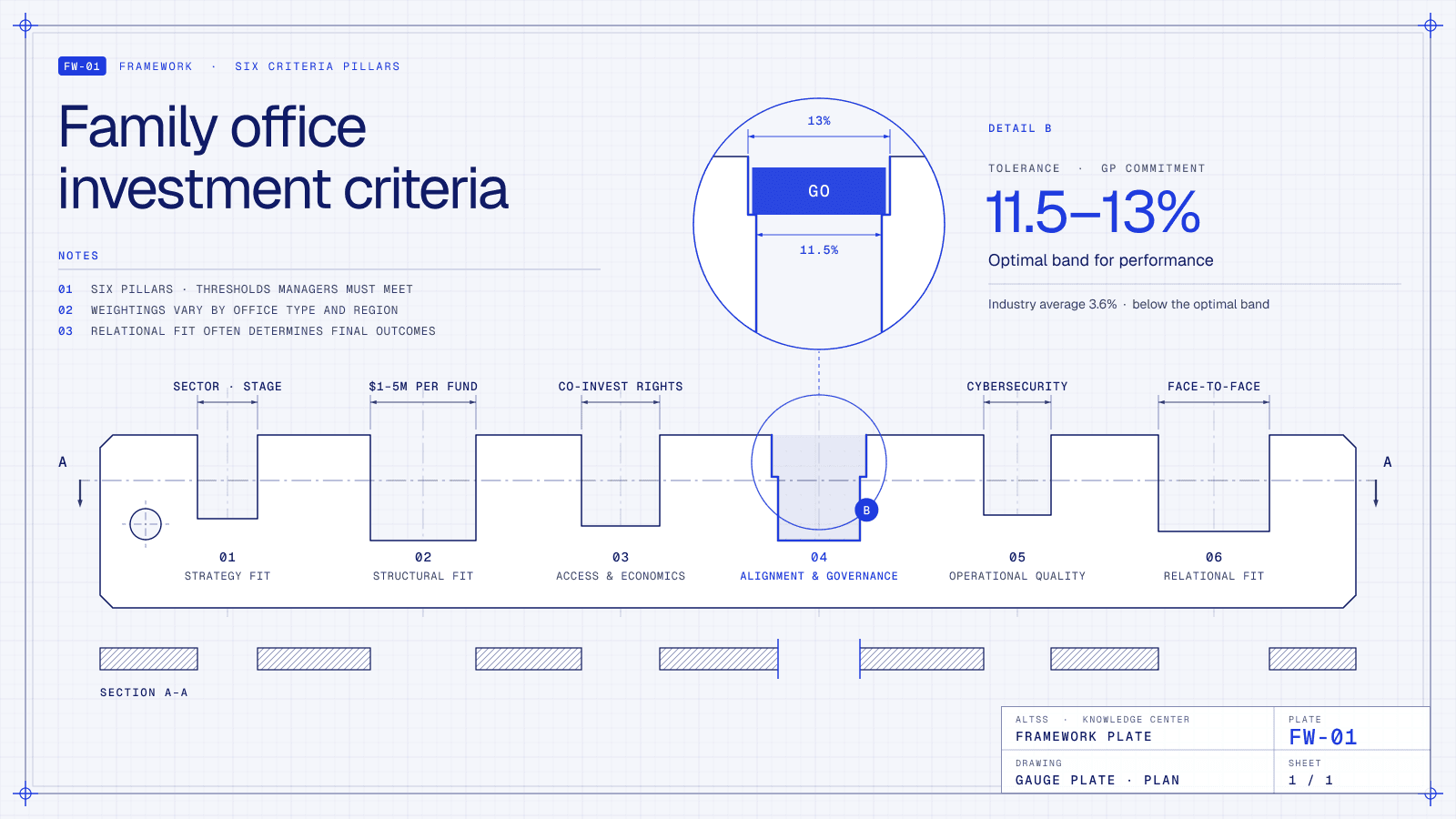
Family offices evaluate alternative investments through six interconnected criteria categories: strategy fit, structural alignment, access and economics, alignment and governance, operational quality, and relational fit. Unlike institutional LPs who apply standardized screens, family offices weight these criteria based on their source of wealth, generational stage, and investment philosophy. This framework maps precisely what family offices look for, how requirements differ by office type and region, and what kills deals at each stage of diligence.
Family offices now allocate 42-52% of portfolios to alternatives—the highest level in history. The 2024-2025 landscape reflects a post-correction recalibration: family offices have become more selective, shifted toward private credit and secondaries, and now prioritize liquidity alongside returns. Yet their structural advantages—patient capital, flexible governance, and multi-generational horizons—make them increasingly valuable partners for managers who understand their evaluation criteria.
What criteria do family offices use to evaluate funds?
Family offices evaluate alternative investment opportunities through six pillars that collectively determine allocation decisions. Each pillar contains specific sub-criteria with quantitative thresholds that managers must meet.
Strategy fit
Strategy fit begins with sector alignment. Technology dominates—77% of Asia-Pacific family office private equity investments target tech-focused ventures, and 58% expect portfolios overweight technology in the next 12 months. Geographic preferences reveal strong home bias: North American family offices allocate 60% to domestic investments. Stage preferences have shifted toward later-stage investments, with 70% of venture capital allocated to growth stage (Series B+) as family offices calibrate for lower risk post-2022.
Family offices evaluate sector focus, geography, stage preferences, and thesis clarity. Common disqualifiers include strategies that are too broad, lack differentiation, or show misaligned stage focus relative to the family office's existing portfolio construction.
Structural fit
Structural fit centers on minimum commitments and fund size. 62% of family offices commit $1-5 million per fund, while only 13% allocate over $10 million. The average minimum LP commitment stands at $8.8 million across private equity, though 37% of funds require the $10 million threshold. For direct investments, the average ticket size reaches $17.6 million.
Family offices evaluate fund size, minimum commitments, liquidity terms, and vehicle type. Common disqualifiers include minimums that exceed their typical allocation range, lockup periods incompatible with their liquidity needs, and funds too large to generate target returns.
Access and economics
Access and economics reflect sophisticated fee negotiation. 58% are unwilling to pay full fees unless funds deliver above-benchmark returns. Co-investment rights have become essential—83% of family office startup deals now structure as co-investments or club deals. Information rights expectations have intensified: family offices demand on-demand access to TVPI, capital account statements, and tax documents.
Family offices evaluate co-invest rights, fee structures, and information rights. Common disqualifiers include no co-investment access, full fees without demonstrated alpha generation, and limited or delayed reporting.
Alignment and governance
Alignment and governance focus heavily on GP commitment. The current industry average stands at 3.6%, though research indicates optimal GP commitment for performance falls between 11.5-13%. Family offices increasingly expect senior GP personal investment, not just fund-level commitments.
Family offices evaluate GP commitment levels, key-person provisions, and LP advisory committee participation. Common disqualifiers include low GP stake relative to personal wealth, absence of succession planning, and weak governance structures.
Operational quality
Operational due diligence criteria have tightened significantly. 40% of family offices cite cybersecurity as the top capability gap, with 24% having experienced a breach or fraud event. Background checks now encompass criminal records, civil litigation, regulatory sanctions, and social media review.
Family offices evaluate back-office infrastructure, compliance frameworks, reporting quality, and cybersecurity posture. Common disqualifiers include operational gaps in fund administration, compliance issues or regulatory concerns, and data security vulnerabilities.
Relational fit
Relational fit often determines final outcomes. Family offices describe investment decisions as "more about personal trust than company track record." Face-to-face meetings are required by nearly all family offices, with decision-making ranging from weeks to years depending on relationship depth. Communication preferences favor concise, focused interactions—calls typically last 15-30 minutes rather than hour-long institutional presentations.
Family offices evaluate communication style, responsiveness, and values alignment. Common disqualifiers include poor interpersonal chemistry, slow or inconsistent responses, and misaligned values or investment philosophy.
How do criteria differ by family office type?
The four primary family office structures evaluate alternatives through fundamentally different lenses. Understanding which type you're engaging determines how to position your fund.
Principal-led single family offices
Single-family offices led by family principals represent the most entrepreneurial segment. 56% of U.S. family offices are led by family principals versus only 26% internationally. First-generation founders bring entrepreneurial mindsets focused on wealth creation, allocating 27% to buyouts and 11% to venture capital—higher risk appetites than subsequent generations.
Decision-making can conclude after a single meeting when principals are directly engaged. The relationship dynamic differs fundamentally—these offices seek partners who understand founder mentalities and can engage at a peer level.
The primary decision-maker is the family principal directly. Criteria emphasis falls on relational fit, thesis resonance, and values alignment. Timelines range from days to weeks. Common blind spots include informal operational due diligence processes.
What they prioritize: Personal chemistry, thesis alignment with family's operating business expertise, direct access to GP, speed of decision-making, co-investment opportunities.
What they overlook: Formal operational due diligence, standardized reporting formats, benchmark comparisons.
CIO-led institutionalized offices
Single-family offices with professional CIOs mirror traditional institutional processes. Investment committees typically comprise 3-7 members including family representatives, internal executives like the CIO and CFO, and independent advisors. Only 56% of family offices have investment committees and only 44% have documented investment processes, indicating significant variation in formalization.
These offices conduct stress-testing, negotiate robust covenants, and establish clear enforcement pathways. Due diligence questionnaires run 25-150+ questions generating 50-100+ pages covering operations, legal structure, compensation, and portfolio composition.
The primary decision-maker is a professional CIO plus investment committee. Criteria emphasis falls on strategy fit and operational quality. Timelines run 2-4 months. Common blind spots include over-indexing on institutional norms at the expense of relationship-based alpha.
What they prioritize: Institutional-quality operations, documented processes, risk management frameworks, benchmark-relative performance, peer comparisons.
What they overlook: Relationship-based alpha, flexibility in structure, emerging manager potential.
Multi-family offices
Multi-family offices achieve cost efficiency by sharing resources across multiple families, enabling access to investments typically requiring $5 million+ minimums with initial commitments ranging $250K-$5M. Fee negotiation power proves substantial—combined buying power secures favorable structures unavailable to individual families.
The largest multi-family offices manage $60+ billion, rivaling major institutional allocators in influence and access. Due diligence benefits from shared intelligence across multiple wealthy families and institutional-style teams organized by function.
The primary decision-maker is the investment committee. Criteria emphasis falls on structural fit and scalability across client mandates. Timelines run 3-6 months. Common blind spots include requirements that work across multiple mandates, which can exclude highly customized or capacity-constrained strategies.
What they prioritize: Scalability across client base, standardized reporting, fee efficiency, operational infrastructure, regulatory compliance.
What they overlook: Highly customized structures, capacity-constrained strategies, relationship-intensive managers.
Embedded and virtual family offices
Embedded family offices operate within or alongside family operating businesses, leveraging existing relationships and industry knowledge but often lacking dedicated investment team expertise. 44% of U.S. family offices cite understaffing as a significant bottleneck.
These offices often rely on external RIAs or private banks, making placement agents and intermediaries more relevant access points.
The primary decision-maker is external advisors. Criteria emphasis falls on accessibility and simplicity. Timelines are variable and often irregular. Common blind spots include limited bandwidth and irregular pacing that can stall processes.
What they prioritize: Simplicity, alignment with operating business sector, trusted intermediary endorsement, low maintenance relationships.
What they overlook: Complex strategies, intensive reporting requirements, active co-investment programs.
How do criteria differ by asset class?
Each alternative asset class triggers distinct evaluation criteria shaped by family offices' structural advantages and constraints.
Private equity criteria
Private equity commands the largest alternative allocation at 21-27% of portfolios. Family offices prefer Fund III and onward—the optimal balance between institutional readiness and return potential. Value creation expectations target 20-25%+ IRR.
Medium-sized funds generate meaningfully higher returns than mega-funds. Family offices increasingly favor "buy and build" strategies over highly leveraged buyouts. The patient capital advantage allows indefinite holding periods—a structural edge over traditional PE funds facing exit pressures.
Key evaluation criteria include track record depth, value creation methodology, and sector expertise. Performance targets run 20-25% IRR. Primary concerns center on J-curve dynamics, fee drag on returns, and exit timing uncertainty.
Venture capital criteria
89% of family offices participate in venture capital versus 44% of broader institutional investors. Stage preferences have shifted: growth-stage companies (Series C/D) command 52% preference, reflecting post-2022 risk recalibration.
Fund size sweet spots favor capacity-constrained strategies—medium-sized VC funds generate 25% higher IRR than larger funds. Portfolio construction typically includes 30-40 direct investments with similar fund exposure, accepting that many will be written off while a few outliers significantly outperform.
Allocation ranges run 5-10% of portfolios. Key evaluation criteria include thesis differentiation, deal access quality, and founder network depth. Performance targets exceed 25% IRR. Primary concerns center on loss ratios, follow-on reserve adequacy, and vintage sensitivity.
Related: Family Offices That Lead Seed–Series A in 2025
Real estate criteria
Real estate maintains steady allocation at 10-15% of portfolios, with multifamily residential representing 36% of investments. Geographic preferences concentrate in Florida (52% of transactions), Texas (38%), and California (35%).
44% invest primarily directly in private real estate, leveraging operational expertise from family operating businesses. Tax benefits—depreciation, 1031 exchanges, opportunity zones, cost segregation—integrate with overall wealth planning.
Key evaluation criteria include asset quality, geographic focus, and operational capability. Performance targets run 12-18% IRR. Primary concerns center on leverage levels, geographic concentration, and liquidity constraints.
Related: Why Florida Is a Strategic Hub for Family Office Capital in 2025
Private credit criteria
Private credit allocation ranges from 3-8% of portfolios and has emerged as the fastest-growing allocation. The proportion of family offices without exposure fell to 26% from 36% in 2023, with 30% planning to increase allocations. Direct lending dominates preferences, offering control and 8-12%+ returns versus 3-5% from government bonds.
Default rates remain modest at 1.84%, validating the risk-return profile versus public credit markets. Family offices increasingly structure direct loans to operating companies in sectors where they have expertise.
Key evaluation criteria include yield consistency, downside protection mechanisms, and sourcing capabilities. Performance targets run 8-12% returns. Primary concerns center on default experience and recovery rate assumptions.
Hedge fund criteria
Hedge funds maintain steady 4-6% allocations focused on tail risk hedging and uncorrelated returns. Strategy preferences favor long/short equity and global macro, with quantitative strategies gaining favor.
Fee sensitivity runs highest in this asset class—family offices question the value of hedge fund fees relative to performance and their ability to protect wealth during downturns.
Key evaluation criteria include risk-adjusted returns, liquidity terms, and uncorrelated alpha generation. Performance targets run 8-12% returns. Primary concerns center on fee structures and drawdown protection during market stress.
Direct and co-investment criteria
Direct and co-investment allocation ranges from 10-15% of portfolios. 83% of family office deals now structure as co-investments or club deals. Key evaluation criteria include deal quality, execution capability, and timing alignment. Performance targets exceed 25% IRR. Primary concerns center on internal resource burden and decision speed requirements.
The $100 million rule suggests in-house direct investing becomes cost-efficient when PE allocation exceeds $100 million, implying minimum $500 million AUM to justify dedicated direct investment teams. For smaller allocations, co-investments offer fee-efficient exposure. Due diligence represents the primary challenge—66% cite it as the most difficult aspect—requiring comprehensive market analysis, quality-of-earnings reports, and external advisor engagement.
Related: July 2025's 10 Largest Family-Office Deals
What changes based on GP stage?
Family offices evaluate emerging managers, established managers, and scaled managers through different lenses, with criteria emphasis shifting at each stage.
Emerging managers (Fund I-II)
Criteria emphasis falls on thesis clarity, GP commitment, skin in the game, and institutional back-office partners.
What family offices worry about: Key-person risk, operational fragility, unproven cycle behavior, and reference limitations from limited track record.
What overcomes concerns:
Institutional-quality service providers demonstrate operational seriousness—reputable administrators, Big Four or equivalent auditors, and established fund counsel signal commitment to institutional standards. Anchor LP validation from respected institutions provides third-party credibility that emerging managers otherwise lack. Realistic fund size matching opportunity set shows discipline over ambition. Clear attribution from prior roles with specific deal-level contribution evidence validates claimed experience. Personal GP commitment above 5% demonstrates conviction when track record is limited.
Common mistakes by emerging managers:
Overselling track record from prior firms without clear attribution creates credibility gaps when references don't confirm claimed contributions. Fund size ambitions mismatched to opportunity set signal prioritizing fees over returns. Underinvesting in operations and compliance infrastructure suggests lack of institutional readiness. Weak answers to key-person and succession questions amplify the primary concern family offices already have. Projecting returns without acknowledging J-curve realities undermines credibility with sophisticated allocators.
Established managers (Fund III-V)
Criteria emphasis falls on performance persistence, team stability, capacity management, and LP concentration dynamics.
What family offices worry about: Style drift as strategies evolve, team turnover affecting continuity, AUM bloat affecting returns, and institutional LP influence changing fund character.
What overcomes concerns:
Consistent strategy execution across market cycles demonstrates process discipline rather than market-dependent results. Demonstrated succession planning with clear roles for next-generation leadership addresses longevity concerns. Disciplined fund sizing—including turning away capital—shows return prioritization over asset gathering. Strong re-up rates from existing LPs provide social proof of LP satisfaction. Transparent attribution across team members validates depth beyond key individuals.
Common mistakes by established managers:
Growing fund size faster than opportunity set expands dilutes returns to chase management fees. Allowing strategy drift to chase AUM undermines the differentiation that generated initial track record. Neglecting relationships with smaller LPs in favor of institutional allocators alienates family offices who value relationship continuity. Inadequate succession planning communication leaves the key-person question unanswered. Over-reliance on track record without forward thesis fails to address "what's next" questions.
Scaled managers (Fund VI+)
Criteria emphasis falls on access value, co-invest flow, relationship continuity, and differentiated terms for committed LPs.
What family offices worry about: Becoming just another LP in a commoditized investor base, losing information edge as reporting becomes standardized, commoditized access without differentiation, and fee drag on returns without commensurate value.
What overcomes concerns:
Dedicated family office coverage team demonstrates commitment to the segment rather than treating them as small institutional LPs. Meaningful co-investment allocation reserved for family offices provides tangible access value. Differentiated access tiers for committed LPs reward loyalty with information and opportunity advantages. Advisory board participation opportunities create engagement beyond passive capital provision. Direct GP relationship maintenance despite organizational scale preserves the relational element family offices value.
Common mistakes by scaled managers:
Treating family offices as small institutional LPs with standardized processes ignores their relationship orientation. Commoditized investor relations approach with templated communications undermines perceived partnership. Reducing co-investment allocation as fund scales eliminates a primary value driver for family offices. Losing personal touch with relationship-oriented investors as organizations grow creates re-up risk.
How do regional variations reshape criteria?
Geographic location fundamentally shapes family office criteria, from risk appetite and asset class preferences to governance expectations and ESG priorities.
North American family offices
North American family offices constitute the largest regional market with approximately 1,800+ offices managing ~$1.3 trillion collectively. Average AUM reaches $1.5 billion.
Criteria emphasis falls on liquidity (48% cite as top priority), de-risking (33%), and domestic focus (69% of direct real estate transactions occur in North America).
Current dynamics reflect notable caution: expected returns dropped to 5% (versus 11% in 2024), with 15% anticipating negative outcomes versus just 1% previously. Investment priorities emphasize improving liquidity and de-risking portfolios, marking a significant shift from growth-focused strategies.
What managers should know: Lead with liquidity provisions and downside protection. Emphasize risk management alongside return potential. Expect longer decision timelines as offices de-risk. North American family offices respond to discipline and capital preservation messaging more than growth narratives in the current environment.
Related: Global Family Office Migration and Regional LP Activity Trends 2025
European family offices
European family offices number over 2,000 with average AUM of $1.4 billion. Private markets allocations range 24-28%, with real estate at 11%—higher than global averages.
Criteria emphasis falls on ESG integration (45% engage in sustainable investing—highest globally), intergenerational wealth transfer (73% cite as top priority), and governance formalization (85% have investment committees versus 56% globally).
Regional variation proves substantial: UK offices maintain 52% alternative allocation with strong governance focus. Swiss offices prioritize intergenerational wealth transfer with conservative, wealth-preservation approaches. Nordic offices demonstrate distinctive ESG integration with sustainable investing as a baseline expectation.
What managers should know: ESG credentials matter significantly—prepare for detailed questions on responsible investing frameworks. Governance and compliance documentation should meet EU standards. Emphasize multi-generational alignment and wealth preservation alongside returns.
Related: Top 10 Largest Family Offices in Benelux (2025)
Asian family offices
Asia-Pacific family offices represent the fastest-growing segment, quadrupling in the past five years to exceed 5,000 offices. Singapore has emerged as the dominant hub with 2,000+ single family offices—a 43% increase from 1,400 in 2023. Hong Kong maintains 2,700+ offices with 42% of founders from mainland China.
Criteria emphasis falls on technology focus (77% of PE investments toward tech), succession planning (65% have formal plans—highest globally), and responsible investing (55%).
Structural requirements in Singapore include minimum AUM of $20 million (Section 13O) or $50 million (Section 13U) with 10% of AUM mandated in Singapore-based investments.
What managers should know: Technology thesis resonates strongly—AI exposure already reaches 86% of family offices. Compliance with local regulatory frameworks is essential. Many offices are first-generation with entrepreneurial decision-making styles closer to principal-led SFOs than institutional processes.
Middle Eastern family offices
Middle Eastern family offices number approximately 290 managing collective AUM of ~$159 billion. UAE offices reflect the region's inbound wealth migration—residents with $100M+ in liquid assets increased 110% over the past decade.
Criteria emphasis falls on real estate (15% versus 10% global average), private equity (28% versus 22% global average), and Sharia compliance considerations.
What managers should know: Approximately one-third of MENA family offices adhere to Islamic investment principles, requiring Sharia-compliant structures that prohibit interest-bearing investments and exposure to certain sectors. Relationship-building requires significant in-person presence—regional conferences and direct visits matter more than digital outreach.
Latin American family offices
Latin American family offices face distinct structural challenges. Approximately 75% of companies valued over $1 billion in the region operate as family dynasties, yet the talent pool remains limited.
Capital flight to the U.S.—particularly Miami—has accelerated, with North American allocation now three times higher than Latin American allocation. Dual family office structures have become common: domestic operations paired with international vehicles.
What managers should know: Impact investing momentum proves notable, with 80% of surveyed Latin American families maintaining impact allocations focused on climate, education, and poverty reduction. Miami has become the de facto hub for Latin American family office engagement.
What questions do family offices ask—and what are they really evaluating?
Every question in the family office evaluation process serves a deeper purpose. Understanding what's really being assessed enables more effective responses.
When a family office asks "Walk me through your track record," they're assessing attribution honesty—distinguishing luck from skill from market beta. They want to understand what portion of returns came from your decisions versus market conditions versus inherited positions.
When they ask "What's your edge?" they're evaluating whether they can explain this thesis to someone else in one sentence. If the CIO can't articulate your differentiation to the principal or investment committee, the process stalls.
When they ask "How much of your own capital is in the fund?" they're assessing alignment of incentives and personal conviction level. They want to see meaningful personal commitment relative to your net worth, not just a percentage of fund size.
When they ask "What happens if you get hit by a bus?" they're evaluating key-person risk and succession planning reality. Vague answers about "the team stepping up" don't satisfy—they want specific names and transition plans.
When they ask "Who else is in the fund?" they're seeking social proof and LP quality as a signal of manager quality. The identity of other LPs serves as a reference check before formal references.
When they ask "What's your biggest mistake?" they're assessing self-awareness, intellectual honesty, and learning orientation. Defensive answers or inability to identify genuine errors raises red flags.
When they ask "How do you communicate during downturns?" they're evaluating operational maturity and relationship orientation. This question reveals whether you'll be a partner or a source of anxiety during difficult periods.
When they ask "Why this fund size?" they're assessing discipline and whether you prioritize return of capital or return on capital. Fund sizes driven by opportunity set versus fundraising capacity signal different motivations.
When they ask "What deals have you passed on?" they're evaluating discipline, ability to say no, and pattern recognition. The quality of your passes often reveals more than the quality of your investments.
When they ask "How do you think about liquidity?" they're testing whether you understand family office constraints and can structure appropriately.
How to answer the most difficult questions
"What's your edge?"
Lead with specificity, not generalities. Tie to proprietary sourcing, expertise, or network that competitors cannot replicate. Demonstrate why this edge is sustainable over multiple fund cycles. Avoid: "We're generalists who find opportunities anywhere"—this signals undifferentiated strategy.
"Walk me through a deal that went wrong"
Own the outcome without excuse-making. Explain the decision logic at the time with the information available. Detail what you learned and what process changes resulted. Avoid: Blaming external factors or market conditions—this signals inability to accept responsibility.
"Why should we invest in Fund III when Fund I returned 1.2x?"
Acknowledge the result directly without minimizing. Explain vintage-specific factors honestly—entry valuations, market timing, specific deal outcomes. Show what changed in process, team composition, or strategy. Provide attribution clarity on winners and losers to demonstrate learning.
What signals build conviction versus erode trust?
Family offices develop conviction through specific signals—both verbal and behavioral—that indicate manager quality. Equally, certain patterns rapidly erode trust regardless of track record.
Phrases that build family office conviction
"Our strategy works in X conditions but struggles in Y—here's how we manage that." This demonstrates self-awareness and intellectual honesty about limitations.
"We sized the fund to match opportunity set, not fundraising capacity." This signals return prioritization over asset gathering.
"We passed on [notable deal] because [specific reason]." This demonstrates discipline and pattern recognition.
"Our largest LP re-upped because [specific reason]." This provides social proof with attribution.
"Here's exactly how we generated returns in Deal X—and what we'd do differently." This shows learning orientation and transparency.
"We're not the right fit for [specific LP type] because [honest reason]." This demonstrates self-awareness and saves everyone time.
"We turned down $X million because it would have compromised returns." This proves discipline with concrete evidence.
Phrases that erode family office trust
"We're generalists who can find opportunities anywhere." This signals undifferentiated strategy and lack of focus.
"Our returns speak for themselves." This avoids engagement and suggests inability to explain results.
"We don't see much competition in our space." This signals market blindness or arrogance.
"We're raising $X but flexible on size." This indicates unclear strategy or desperation.
"Our back-office is handled." Vague operational answers suggest inadequate infrastructure.
"We don't expect any major issues." This demonstrates lack of risk awareness.
"This is temporary; we're not worried." This dismisses legitimate concerns.
"We'll update if something changes." This signals reactive rather than proactive communication.
Behavioral signals that matter
Signals that build conviction:
Responsive communication with same-day replies demonstrates respect and operational capability. Proactive updates without being asked shows partnership orientation. Introducing LPs to each other signals confidence in relationships. Remembering personal details indicates genuine engagement. Following through on small commitments predicts behavior on large commitments. Transparency about challenges builds trust for difficult conversations ahead.
Signals that erode trust:
Slow or inconsistent communication suggests disorganization or deprioritization. Defensive responses to questions indicate inability to handle scrutiny. Overpromising and underdelivering destroys credibility quickly. Treating family offices as "small" institutional LPs misses their relationship orientation. Changing terms mid-process signals unreliability. Vague answers to specific questions suggest something to hide.
How does the LP decision cycle work from introduction to commitment?
The family office investment process follows a consistent pattern from initial contact through final commitment, with specific requirements at each stage.
Stage 1: Initial filter (30 seconds to 5 minutes)
Hard requirements apply at this stage. $100 million+ AUM secures meetings with 85-90% of family offices. Investment thesis clarity must be apparent within 5-10 minute review of materials. Teams of 6-8+ professionals minimum meet baseline expectations for most strategies. Competitive advantage must be immediately apparent—if not clear within the first review, materials are set aside.
What gets filtered out: AUM below thresholds regardless of other factors, unclear or generic thesis that doesn't differentiate, undersized teams that raise key-person concerns, and strategy misalignment with family office preferences or existing portfolio.
Stage 2: Preliminary diligence (2-4 weeks)
Typical process elements include one-pager review (5-10 minutes of focused attention), PowerPoint presentation (15-80 pages covering team, thesis, track record, and operations), 3-4 phone calls of 15-30 minutes each, and initial reference conversations.
What's being evaluated: thesis coherence and differentiation from competitors, team depth and stability over time, track record attribution at the deal level, and communication quality as a predictor of relationship dynamics.
Stage 3: Deep diligence (4-8 weeks)
Documentation required includes due diligence questionnaire (25-150+ questions generating 50-100+ pages), operational due diligence materials covering infrastructure and controls, compliance and regulatory documentation, and performance verification with supporting data.
On-site visit elements cover team interaction observation to assess culture and dynamics, operational infrastructure verification to confirm stated capabilities, culture and chemistry assessment with key personnel, and decision-making process review to understand how the firm operates.
Stage 4: Final approval (1-4 weeks)
Decision factors at this stage include reference verification (minimum 3 professional references with former colleagues and business partners carrying highest weight), background check completion, terms negotiation, and investment committee presentation if applicable.
Timeline benchmarks: Seed transactions average 3-5 months from introduction to commitment. Standard fund commitments run 2-6 months. For comparison, pension funds average 15-18 months.
What red flags cause family offices to walk away?
Certain patterns consistently kill deals regardless of other factors. Understanding these red flags allows managers to address concerns proactively.
Immediate disqualifiers
Track record inconsistencies that can't be explained with credible attribution end processes immediately. Background check issues including litigation history, regulatory actions, or verification failures are non-negotiable. Negative references from prior LPs or colleagues override positive factors. Key-person risk without credible succession plan amplifies the primary structural concern. Operational deficiencies in compliance or reporting infrastructure signal unacceptable risk.
Warning signs that accumulate
Defensive responses to reasonable questions suggest inability to handle LP scrutiny during difficult periods. Changing terms or projections during process signals unreliability or desperation. Slow or inconsistent communication predicts relationship problems post-commitment. "The other investors checked this already" mentality indicates shortcuts in process. Vague answers to specific operational questions suggest inadequate infrastructure. Unrealistic return projections without downside scenarios demonstrate lack of sophistication. Poor treatment of junior team members during meetings reveals culture problems.
When family offices walk away
Misalignment on values or investment philosophy creates ongoing friction that isn't worth the returns. Chemistry failures during on-site visits—particularly when principals are involved—override quantitative factors. Concerns raised by trusted network contacts carry significant weight given family office reliance on peer intelligence. Better opportunity in similar strategy makes continued process unproductive. Timing mismatch with allocation cycle means the opportunity doesn't fit current deployment plans. LP concentration concerns arise when a commitment would constitute too large a percentage of the fund.
Family office vs. institutional LP: Key differences
Understanding how family office criteria differ from endowments, pension funds, and foundations helps managers calibrate their approach.
Decision timeline: Family offices run 2-6 months from introduction to commitment while institutional LPs require 12-18 months on average. The primary driver differs as well—family offices emphasize relationship plus returns while institutional LPs focus on process plus returns.
Governance structures: Family offices maintain flexible, principal-driven decision-making while institutional LPs operate through formal committees and documented policies. Liquidity constraints follow different patterns: family offices operate with flexible capital and no redemption pressure while institutional LPs face policy-driven allocation bands that can force selling regardless of market conditions.
Fee sensitivity: Family offices demonstrate high sensitivity but will pay for demonstrated alpha; institutional LPs show moderate sensitivity driven by benchmark comparisons and peer practices. Co-investment appetite diverges sharply: family offices show very high appetite with 83% of deals structured as co-investments while institutional LPs demonstrate moderate interest constrained by internal resource limitations.
Reporting preferences: Family offices prefer on-demand, concise reporting while institutional LPs expect quarterly, standardized formats. ESG requirements follow distinct patterns: family offices apply values-driven, variable requirements while institutional LPs face policy-mandated, uniform standards.
Minimum check sizes: Family offices typically commit $1-5M while institutional LPs require $10-25M+ minimums. Re-up predictability follows different dynamics—family offices depend on relationship quality while institutional LPs depend on process outcomes and policy continuity.
FAQ: Family office investment criteria
What AUM threshold do I need to meet with family offices?
$100 million AUM secures meetings with 85-90% of family offices. Below this threshold, focus on family offices specifically targeting emerging managers—these represent approximately 10-15% of the family office universe and actively seek differentiated exposure that larger managers cannot provide.
How much GP commitment do family offices expect?
The industry average is 3.6%, but optimal GP commitment for performance falls between 11.5-13%. Family offices increasingly expect senior GP personal investment—meaningful relative to personal net worth—not just fund-level commitments that may represent a small portion of GP wealth.
How long does the family office decision cycle take?
Typical timeline runs 2-6 months from introduction to commitment. This compares favorably to pension funds (15-18 months) and foundations (12+ months). Principal-led SFOs can move in weeks when directly engaged, while CIO-led offices with formal committees require the longer end of the range.
Do family offices prefer funds or direct investments?
83% of family office deals structure as co-investments or club deals. Most prefer fund commitments with co-investment rights rather than pure direct investing, which requires substantial internal resources. The $100 million rule suggests direct investing only becomes cost-efficient when PE allocation exceeds $100 million, implying minimum $500 million AUM.
What's the typical family office commitment size?
62% commit $1-5 million per fund, while only 13% allocate over $10 million. Most won't constitute more than 5-10% of a fund's total capital, creating natural fund size constraints for managers seeking significant family office representation.
How important are references in the family office process?
Critical. Minimum 3 professional references are standard, with former colleagues and business partners carrying highest weight. Negative references are immediate disqualifiers. Family offices often conduct proactive reference gathering through their networks before contacting managers.
Do family offices care about ESG?
Varies significantly by region. European family offices show 45% engagement in sustainable investing—highest globally. North American engagement has declined to 26%. Next-generation family members (60%+) prefer values-aligned investments, making ESG increasingly important for multi-generational relationships.
Should I use a placement agent for family offices?
Depends on your network and resources. Family offices prefer direct GP relationships but will engage through trusted intermediaries. Placement agents can be valuable for accessing offices without existing connections, particularly for emerging managers building initial relationships or managers expanding into new regions.
Implementation checklist
Self-assessment scorecard
Rate your fund 1-5 on each criterion to identify gaps before engaging family offices:
Strategy clarity and differentiation from competitors. Structural fit with typical family office parameters including fund size and minimums. Fee competitiveness and co-invest offering relative to alternatives. GP commitment level as percentage of personal net worth. Operational infrastructure quality including administration, audit, and compliance. Team depth and succession planning documentation. Track record attribution clarity at the deal level. Communication responsiveness and proactive update cadence. Reference quality and availability across former colleagues, LPs, and business partners.
Materials audit
Ensure your materials address each criteria category before outreach:
One-pager communicates thesis in 5 minutes with clear differentiation. Deck addresses all six criteria pillars with specific evidence. DDQ responses are complete, current, and professionally formatted. Track record attribution is clear and verifiable with supporting documentation. Operational DD materials are institutional-quality and audit-ready. References are prepped, available, and briefed on likely questions.
Target list building
Filter family offices by fit indicators before outreach:
Strategy alignment covering sector focus, geography, and stage preferences. Structural fit including typical ticket size and fund size preferences. Current allocation status distinguishing active deployers from fully allocated. Access path availability through warm introductions versus cold outreach. Regional fit matching domestic versus international preferences.
Related: Elevate Family Office Fundraising with Altss
Methodology
This framework reflects Altss analysis of family office investment behavior across 9,000+ family offices globally. Data points derive from OSINT-powered tracking of allocation patterns, sector preferences, co-investment records, conference attendance, public filings, and portfolio company data. Behavioral signals and criteria weightings reflect direct observation of family office decision-making patterns rather than self-reported survey responses.
The framework updates quarterly to reflect evolving family office criteria and market dynamics. Regional variations incorporate jurisdiction-specific regulatory requirements and cultural factors affecting investment decision-making.
Key takeaways
Family offices evaluate through six criteria categories—strategy fit, structural alignment, economics, governance, operational quality, and relational fit—with weightings varying by office type and regional context.
62% of family offices commit $1-5M per fund; $100M+ AUM is required for access to 85-90% of offices.
Decision timelines run 2-6 months—significantly faster than institutional LPs at 12-18 months.
Regional variations reshape every criterion: North America prioritizes liquidity, Europe emphasizes ESG, Asia focuses on technology.
83% of deals structure as co-investments—family offices expect access beyond fund commitments.
Relationship quality often determines outcomes more than quantitative factors alone.
Altss tracks family office investment criteria, allocation history, sector preferences, and behavioral signals across 9,000+ family offices globally—helping managers identify offices where alignment already exists and accelerate the path from introduction to commitment.


See the allocators behind your next close.
Public records carry source-specific dates where available. No population-wide measured refresh cadence or universal verification deadline is established here. Page modified, source captured, fact observed, entity verified and aggregate measured describe different events. Check the date attached to the relevant claim; a missing verification date means unknown. Stored source history does not establish a customer-facing historical-analysis interface.