

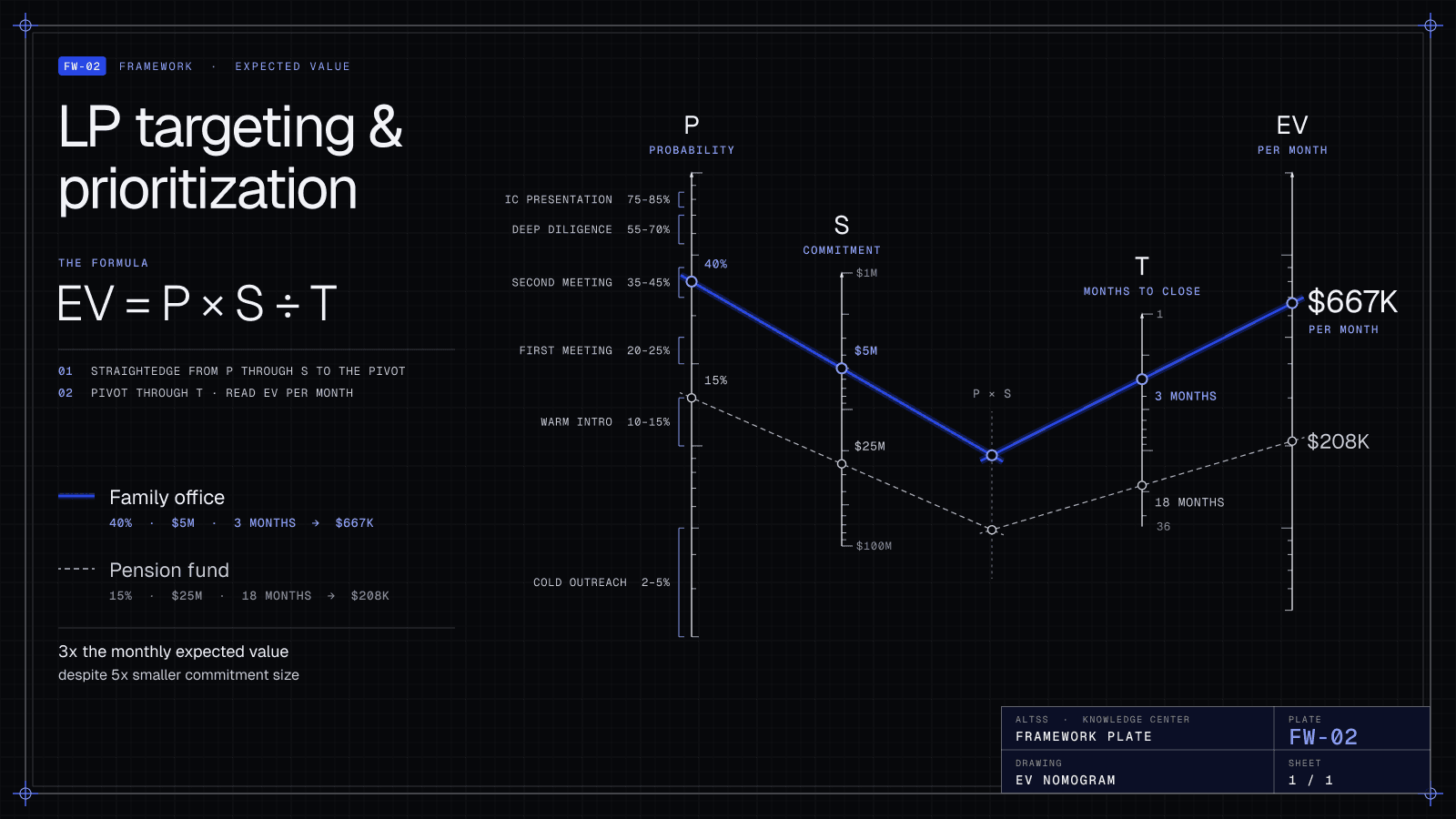
Effective LP targeting separates fundraises that close in 6 months from those that drag beyond 24. The difference is not effort—it's precision. Managers who treat fundraising as a volume game burn capital, reputation, and team bandwidth pursuing LPs who will never commit. Managers who target systematically convert fewer conversations into more capital with less friction.
This framework provides the complete methodology for segmenting LPs by fit, scoring prospects by conversion probability, timing engagement to allocation cycles, and managing pipeline capacity within realistic team constraints. The approach integrates intelligence-driven targeting with GP-side execution realities—because the best target list means nothing if your team lacks bandwidth to work it.
Why most targeting fails
The default approach to LP targeting produces predictable failure modes. Understanding what breaks—and why—prevents repeating mistakes that cost 12-18 months of wasted effort.
The volume fallacy
Most emerging managers approach fundraising as a numbers game: blast 500 LPs, book 50 meetings, close 10 commitments. The math seems reasonable until you account for what actually happens.
Generic outreach triggers spam filters and damages sender reputation. Cold emails to misaligned LPs produce meetings that waste both parties' time. Pursuing LPs with 18-month decision cycles when you need capital in 6 months creates pipeline that will never convert. Chasing institutional minimums you cannot meet signals desperation and burns relationships for future funds.
The volume approach treats all LPs as interchangeable. They are not. A single family office principal who decides in 3 weeks bears no resemblance to a pension fund that requires 15 months through consultant screens and board approvals. Targeting both with the same approach optimizes for neither.
Mandate blindness
Investment mandates are real constraints—not preferences to be overcome through better pitching. When an LP's policy limits alternatives allocation to 15% and they're already at 17%, no pitch will generate a commitment. When their ticket size floor is $25 million and your fund is $50 million total, the math cannot work.
Mandate blindness wastes time pursuing LPs who structurally cannot commit. It also damages credibility: sophisticated allocators recognize when managers haven't done basic homework. The signal sent is "this manager doesn't understand how LPs operate"—a red flag that extends beyond the current conversation.
Timing misalignment
LP capital deployment follows cycles driven by allocation policy, fiscal calendars, liquidity events, and committee schedules. Engaging an LP six months after their annual commitment budget was allocated produces polite interest but no capital. Engaging during their active deployment window—when they have approved budget and active mandate—produces meetings that convert.
Timing misalignment explains why many capable managers report "great meetings that went nowhere." The meetings were real; the timing was wrong. The LP genuinely liked the strategy but had no mechanism to allocate until the next budget cycle.
LP segmentation architecture
Effective targeting requires segmenting LPs across three dimensions simultaneously: institutional type, fit indicators, and behavioral characteristics. Each dimension filters the universe differently; the intersection identifies high-probability prospects.
Segmentation by LP type
Different LP categories operate through fundamentally different decision architectures, mandates, and timelines. Treating them uniformly guarantees suboptimal targeting.
Family offices comprise the largest addressable market for Fund I-III managers. Single family offices number 9,000+ globally with decision timelines ranging from 2 weeks (principal-led) to 6 months (CIO/committee-led). Multi-family offices aggregate capital across multiple families with standardized processes but variable decision authority—distinguishing discretionary from advisory-only is essential. Family offices typically write $1-10 million checks with flexibility on minimums and terms unavailable from institutions.
Endowments operate through formal investment committees with documented policies. Decision cycles run 4-12 months depending on size and governance complexity. Spending policy constraints create real liquidity needs that shape allocation behavior. Large endowments (Harvard, Yale, Stanford) run sophisticated internal teams; smaller endowments often work through consultants or OCIOs.
Pension funds represent the largest pool of institutional capital but the longest decision cycles—12-24 months through consultant recommendations, staff diligence, investment committee approval, and sometimes board ratification. Check sizes run $25-100+ million, creating concentration concerns for smaller funds. Public pensions face additional transparency requirements and political considerations that private pensions avoid.
Sovereign wealth funds deploy nation-state capital with strategic objectives beyond pure returns. Decision chains can involve multiple government stakeholders. Minimum tickets often exceed $100 million with preference for co-investment and direct access. Timelines extend 18-36 months for new relationships but accelerate dramatically for established managers.
Funds-of-funds provide institutional-quality diligence and diversified access for LPs who lack resources for direct manager selection. They face their own fundraising cycles, meaning deployment timing depends on when they closed their current vehicle. Emerging manager funds-of-funds (like those run by major allocators' EM programs) specifically target Fund I-III managers.
Registered investment advisors increasingly allocate to alternatives on behalf of high-net-worth clients. Decision processes vary widely—some run formal due diligence; others rely on principal conviction. Check sizes typically range $250K-$5M per client account, but aggregated across the RIA's client base, total deployment can reach $10-25M.
Segmentation by fit indicators
Within each LP type, fit indicators separate prospects who align with your strategy from those who structurally cannot commit.
Strategy alignment encompasses asset class, geography, sector, and stage. An LP with a growth equity mandate will not commit to a seed-stage venture fund regardless of track record quality. An LP focused on North American buyouts will not allocate to an Asia-focused credit strategy. Strategy misalignment is absolute—no amount of relationship quality overcomes it.
Structural fit covers fund size, minimum commitment, and LP concentration. Most family offices write $1-5M checks; asking for $10M eliminates 87% of the addressable market. Most institutions require managers to limit single-LP concentration to 10-20% of the fund; a $100M fund cannot accept a $50M commitment from an LP requiring 10% caps. Structural misfit creates deals that cannot close even when both parties want them to.
Ticket size alignment matches LP typical commitment range to your minimum and target. An LP who typically writes $50M checks will not conduct full diligence for a $2M commitment into your $25M fund—the effort-to-impact ratio makes no sense for their team. Conversely, asking an LP for $15M when their typical venture commitment is $3M signals you don't understand their constraints.
Governance compatibility addresses emerging manager tolerance, first-time fund appetite, and operational due diligence requirements. Some LPs cannot invest in Fund I by policy. Others specifically seek emerging managers through dedicated programs. Knowing which is which prevents pursuing LPs who will filter you out before the first meeting.
Segmentation by behavioral signals
Behavioral signals reveal LP readiness to deploy independent of stated mandate. These signals change over time and distinguish active deployers from passive interest.
Allocation status indicates whether an LP is actively deploying or fully committed. An LP over-allocated to alternatives cannot make new commitments regardless of strategy fit until distributions restore deployment capacity. Tracking allocation status prevents pursuing LPs in "deployment freeze" mode.
Recent commitment activity signals current deployment posture. An LP that committed to three managers last quarter is demonstrably active. An LP with no visible commitments in 18 months may be pausing, restructuring, or quietly pulling back.
Personnel changes often indicate mandate shifts. A new CIO frequently means strategy evolution. Investment team departures can create diligence bottlenecks. Principal transitions in family offices fundamentally reshape investment criteria.
Conference attendance reveals geographic focus and accessibility windows. An LP attending SuperReturn signals European or global activity. Presence at ALTSLA suggests U.S. family office focus. Conference timing creates meeting opportunities unavailable through standard outreach.
Re-up behavior with existing managers indicates commitment to alternatives. LPs actively re-upping are demonstrably deploying. LPs declining re-ups are signaling capacity constraints or strategy shifts.
Prioritization scoring methodology
Raw segmentation produces a filtered list. Prioritization scoring ranks that list by expected value—the combination of conversion probability, commitment size, and time investment required.
The fit-timing matrix
Two dimensions drive prioritization: strategy fit and deployment timing. The intersection creates four quadrants with different engagement strategies.
High fit + active timing (Tier A): These LPs align strategically and are currently deploying. They receive 50-60% of IR time with weekly-plus touchpoints. Every signal matters—personnel moves, conference attendance, portfolio company news. These conversations drive your close timeline.
High fit + timing misaligned (Tier B-Nurture): Strategic alignment exists but allocation cycles, budget timing, or current overallocation prevents near-term deployment. These LPs receive monthly updates and relationship maintenance for future fund cycles. They are tomorrow's Tier A prospects.
Moderate fit + active timing (Tier B-Convert): Some alignment exists but requires education or positioning adjustment. These LPs receive bi-weekly contact with thesis refinement messaging. Worth pursuing if Tier A pipeline is thin; otherwise deprioritize.
Low fit + any timing (Tier C): No strategic alignment regardless of deployment status. These LPs receive quarterly newsletter inclusion only—maintain awareness for future strategy evolution without consuming active bandwidth.
Conversion probability weighting
Probability weighting adjusts for realistic conversion expectations based on relationship stage, LP type, and competitive dynamics.
Pipeline stages and associated probabilities:
Initial contact (cold outreach): 2-5% conversion probability. Most prospects filter out before meaningful engagement begins.
Warm introduction: 10-15% conversion probability. Third-party validation significantly increases engagement rates.
First meeting completed: 20-25% conversion probability. Active interest demonstrated through time investment.
Second meeting + materials requested: 35-45% conversion probability. Genuine diligence underway.
Deep diligence (DDQ, ODD, references): 55-70% conversion probability. Substantial commitment of LP resources signals serious intent.
Investment committee presentation: 75-85% conversion probability. Internal advocacy committed.
Terms negotiation / subscription agreement review: 85-95% conversion probability. Commitment effectively secured pending documentation.
Expected value calculation
Expected value incorporates probability, commitment size, and time to close into a single metric for resource allocation decisions.
The formula: Expected Value = Conversion Probability × Potential Commitment Size ÷ Months to Close
A family office with 40% probability, $5M potential, and 3-month timeline yields $667K monthly expected value.
A pension fund with 15% probability, $25M potential, and 18-month timeline yields $208K monthly expected value.
This math often favors pursuing multiple smaller, faster commitments over single large institutional checks—particularly for emerging managers who need momentum and social proof. The family office provides 3x the monthly expected value despite 5x smaller commitment size.
Resource allocation implications
Expected value guides how to allocate finite IR bandwidth across the pipeline.
High expected value (top 20% of pipeline): Personal partner engagement, customized materials, proactive relationship management, flexible scheduling to accommodate LP preferences.
Medium expected value (middle 40%): Senior associate or IR professional engagement, templated materials with light customization, responsive but not proactive communication.
Lower expected value (bottom 40%): Automated nurture sequences, standard materials, quarterly touch points, minimal customization until signals indicate upgrade potential.
Timing engagement to LP cycles
LP deployment follows predictable rhythms. Aligning outreach to these cycles dramatically increases conversion by engaging when LPs are structurally able to commit.
Fiscal year and budget cycles
Institutional LPs set annual commitment budgets during their fiscal planning process. Engaging after budget approval but before full deployment produces the highest conversion rates.
Calendar-year LPs (most corporates, many pensions): Budget approval typically occurs in Q4. Optimal engagement window runs January-August before budget exhaustion.
Academic fiscal year (most endowments): July-June fiscal years mean budget approval in May-June. Optimal engagement runs July-February.
Q4 concentration: Industry data shows Q4 captures approximately 29% of LP commitments—managers who don't have pipeline mature by October miss a disproportionate share of annual deployment.
Allocation cycle position
LP allocation to alternatives operates through pacing models that spread commitments across vintage years. Understanding where an LP sits in their pacing cycle reveals deployment capacity.
Under-allocated LPs: Have capacity and often urgency to deploy. More receptive to new manager relationships, potentially faster diligence.
At-target LPs: Selective deployment to maintain exposure. Will commit to compelling opportunities but not urgently seeking managers.
Over-allocated LPs: Cannot make new commitments until distributions reduce exposure. Pursuing them wastes time regardless of strategy fit—they structurally cannot commit.
The denominator effect complicates allocation status: public market declines increase private market allocation percentage even without new commitments, potentially pushing LPs into over-allocated status.
Distribution-driven capacity
LP deployment capacity depends heavily on distributions from existing managers. When distributions exceed capital calls, LPs have cash to reinvest. When capital calls exceed distributions, LPs face liquidity pressure.
2024 marked the first year since 2015 where distributions exceeded contributions across the industry. This created renewed deployment capacity after years of constrained liquidity. However, approximately one-third of institutional LPs remain over-allocated, creating bifurcation between LPs with deployment capacity and those still constrained.
Re-up timing versus new LP timing
Existing LP relationships operate on different timelines than new LP acquisition.
Re-ups: Begin soft engagement 24 months before target close. Formal fundraising communication at 18 months. Term discussions at 12 months. Detailed diligence at 9 months. Commitment decision at 6 months.
New institutional LPs: Require 12-24 months from introduction to commitment. Begin relationship building 18+ months before you need the capital to close.
New family office LPs: Can move in 2-6 months but relationship quality matters more than timeline. Better to have 10 high-quality family office conversations than 50 cold pitches.
Conference timing as engagement accelerator
Industry conferences concentrate LP access into predictable windows. Strategic conference attendance compresses months of outreach into days of meetings.
Pre-conference (6-8 weeks before): Identify attendees, request meetings, prepare LP-specific talking points. Most value gets captured through pre-booked meetings, not chance encounters.
During conference: Execute scheduled meetings, capture overflow opportunities, observe LP behavior for targeting insights.
Post-conference (within 1 week): Personalized follow-ups referencing specific conversation points, next step proposals, materials delivery. Speed matters—LPs have hundreds of post-conference follow-ups competing for attention.
Related: How to Design Your 2025–2026 Fundraising Roadshow
Conversion benchmarks by LP type
Realistic conversion expectations calibrate pipeline size requirements and prevent both over-optimism and under-investment in outreach.
Time-to-close benchmarks
Average time from introduction to commitment varies dramatically by LP type:
Family offices (principal-led): 4-12 weeks when principal is directly engaged and interested. Principal conviction can compress timelines dramatically.
Family offices (CIO-led with committee): 3-6 months through formal process resembling smaller institutions.
Funds-of-funds: 4-8 months with structured diligence but smaller decision committees than institutions.
Endowments (small/mid): 6-12 months through investment committee processes with quarterly meeting cadence.
Endowments (large): 9-18 months with more extensive diligence, reference networks, and committee stages.
Pensions: 12-24 months through consultant recommendations, staff diligence, committee approval, and sometimes board ratification.
Sovereign wealth funds: 18-36 months for new relationships; accelerated for established managers with prior commitment history.
Meeting-to-commitment ratios
Converting initial interest to commitment requires sustained engagement:
Family offices: 3-6 substantive touchpoints (meetings, calls, follow-ups) from introduction to commitment for well-aligned prospects.
Endowments: 5-10 touchpoints including formal diligence meetings, reference calls, and committee presentations.
Pensions: 8-15 touchpoints spanning staff meetings, consultant presentations, committee appearances, and documentation review.
These ratios inform capacity planning: if your team can handle 50 active conversations, and family offices require 5 touchpoints over 4 months, your maximum committed pipeline is roughly 10 family offices per quarter.
Commitment size benchmarks by LP type
Typical commitment ranges inform realistic pipeline math:
Single family offices: $1-10M typical, with $2-5M most common. Commits above $10M require larger offices or exceptional conviction.
Multi-family offices: $5-25M aggregated across client families, depending on discretionary versus advisory model.
Small endowments (<$1B): $1-5M per manager, often through consultant platforms or fund-of-funds.
Mid-sized endowments ($1-10B): $5-15M per manager with direct relationships and formal diligence.
Large endowments (>$10B): $15-50M per manager with extensive operational due diligence requirements.
Pensions (state/municipal): $25-100M minimum, often requiring managers to demonstrate capacity for larger future commitments.
Pensions (corporate): $10-50M with more flexibility on minimums but conservative risk postures.
Pipeline capacity and team bandwidth
The most common targeting failure is building pipeline that exceeds team capacity to work effectively. Realistic bandwidth assessment prevents spread-too-thin execution.
Relationship capacity limits
A lean IR team (1-2 people) can realistically manage 50-80 active LP conversations during a fundraise and 30-50 substantive relationships between fundraises. "Active" means regular touchpoints, customized communication, and responsive engagement—not quarterly newsletters.
Exceeding capacity degrades quality across all relationships. Better to work 50 prospects well than 150 prospects poorly. LPs notice when they're receiving generic outreach or slow responses—signals that damage conversion probability.
Partner time allocation
During active fundraising, GP partners should expect 50-70% of time consumed by LP engagement. This creates real trade-offs with investment activity, portfolio management, and firm operations.
Recommended weekly allocation during fundraising:
Pipeline review and prioritization: 3-5 hours
List building and research: 3-5 hours
Outreach and meeting preparation: 5-8 hours
LP meetings (15-20 per week at peak): 10-15 hours
Follow-up documentation and materials: 3-5 hours
Total: 25-40 hours weekly on fundraising alone
New LP versus existing LP balance
Existing LPs re-up at higher rates than new LPs commit, but re-ups require cultivation—they're not automatic.
Recommended allocation for Fund II+:
First 60 days: 70% existing LP engagement, 30% new LP outreach. Secure re-ups before expanding.
Days 60-180: 50% existing, 50% new. Parallel tracks once existing LP momentum established.
Days 180+: 40% existing (stragglers and relationship maintenance), 60% new LP closing.
Fund I allocation:
100% new LP engagement with anchor LP prioritization until first close, then momentum-driven expansion.
Quality versus quantity trade-offs
The quality-quantity trade-off defines targeting strategy. Evidence consistently favors quality: bespoke go-to-market approaches outperform volume-driven outreach for sophisticated allocators.
Quality signals that improve conversion:
Customized outreach referencing specific LP mandate, recent activity, or mutual connections
Prompt, substantive responses to LP questions
Proactive updates without being asked
Remembering personal details and prior conversations
Following through on small commitments (sending materials, making introductions)
Quantity signals that degrade conversion:
Generic templates visible in outreach
Slow or inconsistent communication
Missing follow-up commitments
Lack of LP-specific knowledge in meetings
Treating family offices as "small institutional LPs"
Targeting by fund stage
LP accessibility and conversion dynamics shift dramatically across fund lifecycle. Targeting strategy must evolve accordingly.
Fund I targeting
First-time funds face the most constrained LP universe. Institutional LPs largely cannot commit by policy. The addressable market centers on family offices, high-net-worth individuals, emerging manager programs, and Fund I-focused funds-of-funds.
Primary targets:
Friends, family, and professional network: Often provide first 25-50% of Fund I capital. Conversion rates highest where relationship predates fundraising.
Single family offices with emerging manager appetite: Require fit + timing + relationship. Altss data shows approximately 35% of family offices have made emerging manager commitments in prior 24 months.
Institutional emerging manager programs: NY State CRF, CalPERS, and similar programs specifically target Fund I-II managers. Require early engagement—often 18+ months before commitment.
Fund I-focused funds-of-funds: Vehicles like Cendana Capital exist specifically for emerging managers. Due diligence process is rigorous but timelines can be faster than direct institutional.
Pipeline math for Fund I ($30M target):
If average commitment is $1.5M and conversion rate is 15% from first meeting, you need 133+ first meetings to close 20 LPs.
If sourcing 133 meetings requires 500+ qualified outreach attempts, the outreach effort is substantial.
This math explains why Fund I typically takes 12-18 months for disciplined managers and longer for those without existing networks.
Related: Anchor Investors for Emerging Managers
Fund II-III targeting
Proven managers with DPI from Fund I gain access to broader LP segments. The strategic priority shifts from "finding anyone who will commit" to "building the LP base for Fund IV+."
Expanded targets:
Broader family office universe: Fund II track record enables conversations with more conservative family offices who require proof points before emerging manager exposure.
Small/mid-sized endowments: Often accessible at Fund II-III with strong performance. Introduce relationships 12-18 months before you need commitments.
Consultant-recommended platforms: Placement agents and consultants begin meaningful representation at Fund III. Consider whether placement support accelerates access to otherwise inaccessible LPs.
Corporate venture arms: CVCs often invest alongside aligned VC/PE managers through fund commitments. Sector alignment is essential.
LP base construction priorities:
Diversification: Avoid over-concentration in any single LP type. Fund III should include family offices + endowments + funds-of-funds minimum.
Reference quality: Every LP becomes a reference for future funds. Prioritize sophisticated LPs whose endorsement carries weight.
Re-up reliability: Some LPs are transactional; others build long-term relationships. Identify and prioritize relationship-oriented LPs.
Fund IV+ targeting
Established managers with institutional track records access the full LP universe. The constraint shifts from accessibility to selectivity—choosing LPs who fit the firm's culture and long-term trajectory.
Institutional access:
Large pensions: Check sizes of $50-100M+ become available. Timelines remain long (12-24 months) but capacity for meaningful allocation exists.
Major endowments: Sophisticated LP base provides credibility and potential co-investment partnership.
Sovereign wealth funds: Strategic capital with very long horizons. Relationship-intensive but potentially transformative partnerships.
Strategic considerations at scale:
LP concentration management: Avoid single-LP dependence that creates re-up risk.
Co-investment capacity: Larger LPs increasingly expect co-investment access. Building direct deal capability alongside fund strategy.
Fee pressure: Institutional LPs negotiate harder on GP economics. Determine where you will flex and where you won't.
Regional targeting variations
Geographic context shapes LP behavior, mandate, and access pathways. Effective targeting adapts to regional norms.
North American LPs
North America represents the largest pool of deployable capital with the most developed LP infrastructure.
Family offices: Concentrated in major metros (NYC, SF, Miami, LA, Dallas, Chicago) with significant wealth migration to Florida and Texas. Many operate informally without institutional process. Direct relationship-building essential—intermediaries less effective.
Endowments: Range from sophisticated ($50B+ Yale/Harvard model) to consultant-dependent (smaller colleges). Large endowments run internal teams; smaller endowments work through OCIOs and consultants.
Pensions: Public pensions face transparency requirements and sometimes political constraints. Many work through consultant recommendations. Corporate pensions tend toward conservative allocation but faster decision processes.
Access paths: Direct relationships for family offices; consultant relationships for institutional LPs; conference networks for both.
European LPs
European LP behavior varies significantly by country, with institutional structures and regulatory environments creating distinct patterns.
Nordic pensions: Among the most active European allocators with sophisticated internal teams. Direct access often possible without consultants.
UK institutions: Strong alternatives allocation with established consultant ecosystem. Brexit created some structural changes but market remains active.
Swiss family offices: Conservative, wealth-preservation focused. Relationship-intensive with very long cultivation cycles.
ESG requirements: European LPs lead global ESG integration. Managers without credible sustainability positioning face screening out before first meeting.
Access paths: SuperReturn and regional conferences for institutional access; private banks and wealth advisors for family office introductions.
Middle Eastern LPs
Gulf wealth has become a decisive capital source, particularly through sovereign wealth funds and family offices.
Sovereign wealth funds: Mubadala, ADIA, PIF, QIA, and KIA collectively deploy hundreds of billions annually. Minimum tickets often exceed $100M with preference for co-investment and direct access.
Family offices: Growing segment, particularly in UAE, with entrepreneurs and merchant families building investment operations. Many first-generation offices with principal-led decision-making.
Sharia compliance: Approximately one-third of MENA family offices require Sharia-compliant structures. Know before you pitch.
In-person requirement: Relationship-building requires physical presence. Regional conferences and direct visits matter more than digital outreach.
Related: Global Family Office Migration Trends 2025
Asian LPs
Asia-Pacific combines distinct markets with different LP characteristics.
Singapore: Emerging as the dominant family office hub with 2,000+ SFOs and growing. Mix of first-generation entrepreneurs and multi-generational wealth.
Hong Kong: Maintains significant family office presence with strong China connections. Different regulatory environment from Singapore.
Japanese institutions: Large capital pools with distinct decision processes. Very long cultivation cycles but potentially meaningful allocations.
Australian supers: Sophisticated allocators with substantial alternatives exposure. Increasingly building internal teams for direct investment.
Access paths: Regional conferences (SuperReturn Asia) for broad access; city-specific presence for deep relationship building.
Common targeting mistakes
Avoiding systematic errors matters as much as executing best practices. These mistakes recur across fundraises.
LP type over-concentration
Building 80% of Fund I from family offices creates Fund II challenges when those LPs cannot scale commitment size to match fund growth. Conversely, spending two years pursuing only institutional LPs for Fund I wastes time on structurally inaccessible capital.
The fix: Build intentional LP base diversity from Fund I. Accept that some LPs are current-fund-only while others represent long-term platform relationships. Know which is which.
Mandate mismatch pursuit
Continuing to pursue LPs after mandate mismatch becomes clear wastes both parties' time and damages credibility. If their mandate is U.S. buyout and you're Asia-focused venture, no pitch refinement bridges that gap.
The fix: Validate mandate alignment before or during first interaction. If fundamental mismatch exists, thank them for their time and move on. The relationship may matter for a future strategy or referral—don't burn it by ignoring obvious misfit.
Timing misjudgment
Engaging LPs at the wrong point in their decision cycle produces meetings that convert to nothing. Q1 outreach to calendar-year LPs who deployed their budget in Q4 generates polite interest for "next year."
The fix: Understand LP-specific timing before engaging. Start relationships 6-12 months before you need commitment to align your ask with their deployment window.
Reference network neglect
LPs conduct proactive reference checks through their networks before formal diligence. If their network contacts have negative signals about you—from prior LP experiences, portfolio company interactions, or industry reputation—you're filtered out before you know it.
The fix: Actively manage your reference network. Know who speaks well of you and who doesn't. Assume sophisticated LPs will find the negative references through their own networks.
CRM discipline failure
Most emerging managers track LP interactions through scattered emails, calendar entries, and memory. This creates lost context, missed follow-ups, and duplicated outreach across team members.
The fix: Implement CRM discipline from Fund I. Track every interaction, record LP preferences and constraints, set follow-up reminders, and ensure team visibility. The investment in systems pays dividends across every subsequent fundraise.
Implementation: Building your target list
Theory becomes practice through systematic list building. This process transforms segmentation frameworks into actionable outreach priorities.
Step 1: Define your LP fit profile
Before building lists, define what "fit" means for your specific fund.
Strategy fit criteria: Asset class and strategy alignment Geographic focus match Stage/size preferences Sector overlap or exclusion
Structural fit criteria: Minimum check size you can accept Maximum single-LP concentration Fund size relative to typical commitments Emerging manager tolerance requirement
Behavioral fit criteria: Decision timeline compatibility Governance complexity tolerance Co-investment expectations Reporting requirements
Step 2: Source candidate LPs
Multiple sourcing channels feed your initial candidate list.
Existing network: Warm connections always convert higher. Map everyone you know who might invest directly, introduce you to investors, or validate your credibility.
Database research: Platforms tracking LP commitments, mandates, and activity provide systematic sourcing. Filter by fit criteria before generating outreach lists.
Conference attendee lists: Pre-registration lists reveal who will be accessible at upcoming events. Filter for fit, then request meetings.
Competitor LP bases: Other managers' LP disclosures (through regulatory filings, marketing materials, or industry knowledge) reveal LPs actively allocating to comparable strategies.
Advisor networks: Service providers (lawyers, administrators, auditors) who work with many managers can make warm introductions to LPs they know are actively seeking managers.
Step 3: Score and tier candidates
Apply the fit-timing matrix and expected value calculation to rank candidates.
Tier A (20% of list): High fit, active timing, meaningful expected value. These receive personalized outreach and priority scheduling.
Tier B (40% of list): Moderate fit or timing constraints. These receive tailored outreach with clear value proposition.
Tier C (40% of list): Lower priority due to fit gaps, timing misalignment, or capacity constraints. These receive scaled outreach or nurture-track assignment.
Step 4: Build outreach sequences
Different tiers receive different engagement approaches.
Tier A outreach: Research LP's recent activity, mandate shifts, and personnel changes Draft personalized message referencing specific fit points Request specific meeting (date, time, format) rather than generic "let's connect" Follow up within 48-72 hours if no response Engage mutual connections for warm introduction if cold fails
Tier B outreach: Segment-appropriate template with 2-3 customized elements Clear value proposition and fit statement Specific ask with flexibility on timing Automated follow-up sequence with manual personalization triggers
Tier C outreach: Newsletter or update distribution Quarterly touch points through automated sequences Monitoring for signal changes that would upgrade to higher tier
Step 5: Track and iterate
Pipeline tracking enables continuous improvement.
Metrics to track: Response rate by source, tier, and message type Meeting conversion rate from response Advancement rate through pipeline stages Time in stage by LP type Conversion rate to commitment by LP type, tier, and source
Iteration triggers: Response rates below 10% suggest messaging or targeting problems Meeting conversion below 20% suggests qualification problems Stage advancement stalls suggest diligence or timing issues Tier A underperformance suggests fit model needs recalibration
FAQ: LP targeting and prioritization
How many LPs should be in active pipeline?
For a lean team (1-2 IR professionals + GP engagement), 50-80 active conversations represents maximum capacity for quality engagement. Exceeding this degrades relationship quality across the pipeline. Better to work fewer prospects well than many poorly.
What conversion rate should I expect?
From first meaningful meeting to commitment, expect 15-25% conversion for well-targeted family offices, 10-20% for endowments, and 5-15% for pensions. These rates assume proper fit screening—conversion from unqualified outreach is much lower.
How do I prioritize when Tier A pipeline is thin?
If genuine Tier A prospects (high fit + active timing) are limited, either your fund has narrow appeal (strategy/structure issue) or your sourcing isn't reaching the right LPs (database/network issue). Diagnose which before expanding to Tier B—pursuing moderate-fit LPs with volume doesn't solve underlying problems.
When should I engage placement agents?
Placement agents add value when they provide access to LPs you cannot reach directly, particularly for emerging managers seeking institutional capital. They're less valuable for family office targeting where direct relationships matter more. Typical fees run 2-3% of capital raised. Evaluate whether the access they provide justifies the cost relative to your team's direct capabilities.
How do I track timing signals for LP deployment?
LP timing signals include: public commitment announcements, fiscal year budget cycles, allocation reports (for public pensions), personnel changes, conference attendance patterns, and distribution activity from existing managers. Systematic tracking through platforms or manual research surfaces deployment windows.
Should I pursue LPs who previously passed?
Depends why they passed. Mandate mismatch doesn't change—don't re-approach. Timing issues resolve—re-engage when their cycle aligns. Performance concerns require proof points—return when you have demonstrable improvement. Relationship friction requires either time or intermediary assistance to reset.
Signals that indicate LP readiness
Beyond timing cycles, specific signals reveal when individual LPs are actively deploying. Monitoring these signals enables opportunistic engagement when readiness spikes.
Personnel signals
New CIO or investment head: Often signals mandate evolution. New leadership typically brings new priorities. Engage within 60 days of announcement to shape the new regime's manager roster.
Investment team expansion: Hiring signals increased deployment capacity. Teams add resources when they expect activity to increase.
Departures without replacement: May indicate pullback, restructuring, or capacity constraints. Proceed with caution.
Principal succession (family offices): Generational transitions often dramatically reshape investment priorities. Next-generation principals frequently prefer technology, sustainability, and direct involvement.
Activity signals
Recent fund commitments: Public commitment announcements or industry reports showing recent activity indicate deployment posture.
Co-investment execution: Active co-investment participation signals both capacity and appetite for manager relationships.
Conference attendance patterns: Increased conference presence suggests active sourcing. Decreased presence may signal deployment pause.
Direct investment announcements: Family offices making direct investments demonstrate both capacity and willingness to deploy.
Structural signals
New vehicle launches: Family offices launching new holding structures or feeder vehicles often signal deployment preparation.
Advisor changes: Switching consultants, OCIOs, or advisors may indicate strategy evolution.
Portfolio company exits: Significant exits create distributable cash and potential re-deployment capacity.
What signals mean for outreach timing
Positive signal cluster (2+ positive signals): Accelerate engagement. Request meetings proactively. These LPs are actively deploying.
Neutral signal environment: Standard engagement cadence. Follow existing relationship rhythms.
Negative signal cluster (departures, reduced activity, overallocation indicators): Pause active pursuit. Maintain light-touch awareness for future engagement.
Related: Guide to Fundraising in 2025: Five Trends Every Fund Manager Should Know
CRM and workflow integration
Systematic targeting requires infrastructure. Ad-hoc tracking through emails and memory produces lost context, missed follow-ups, and inconsistent engagement.
Essential CRM fields for LP tracking
Identification fields: LP name, type, AUM, headquarters, key contacts with roles
Fit fields: Strategy alignment score (1-5), structural fit score, emerging manager tolerance, minimum ticket size, maximum allocation constraints
Behavioral fields: Current allocation status, recent commitment activity, deployment timing (fiscal year, typical cadence), re-up history
Relationship fields: Relationship owner, introduction source, meeting history, materials sent, follow-up commitments, notes from interactions
Pipeline fields: Current stage, probability score, expected commitment size, expected close timing, next action, last contact date
Workflow automation opportunities
Stage advancement triggers: When LP requests DDQ, automatically update stage and assign ODD preparation task.
Follow-up reminders: Automated alerts when LP hasn't been contacted within appropriate cadence for their tier.
Signal monitoring: Integration with news/filing feeds to surface relevant LP activity.
Meeting preparation: Automated pull of LP context (recent signals, prior conversations, fit profile) before scheduled meetings.
Team coordination requirements
When multiple team members engage LPs, coordination prevents mixed signals and duplicated effort.
Single relationship owner: Each LP has one designated relationship owner responsible for overall engagement strategy.
Shared visibility: All team members can see interaction history and current status.
Handoff protocols: Clear process when relationship ownership transfers (promotions, departures, strategic reassignment).
Conflict prevention: System flags when multiple team members schedule outreach to same LP.
Methodology
This framework reflects Altss analysis of LP targeting and prioritization patterns across thousands of GP-LP interactions globally. Conversion benchmarks derive from OSINT-powered tracking of commitment patterns, timeline progressions, and fundraising outcomes across fund stages and LP types.
Timing insights incorporate fiscal calendar analysis, allocation cycle tracking, and distribution pattern monitoring across institutional and family office LPs. Regional variations reflect direct observation of LP behavior differences across North America, Europe, Middle East, and Asia-Pacific.
The framework updates quarterly to reflect evolving LP deployment behavior and market dynamics.
Key takeaways
LP targeting separates successful fundraises from extended, resource-draining campaigns. Volume-based approaches fail; precision targeting converts.
Segment LPs by type, fit indicators, and behavioral signals simultaneously. The intersection identifies high-probability prospects.
Prioritize by expected value—conversion probability times commitment size divided by time to close. This math often favors faster, smaller commitments over slow institutional checks.
Time engagement to LP deployment cycles. Engaging when LPs have budget and mandate produces meetings that convert.
Respect team bandwidth limits. 50-80 active conversations is maximum for quality engagement with lean teams.
Adjust targeting by fund stage. Fund I accesses family offices and emerging manager programs; Fund IV+ accesses the full institutional universe.
Track everything. Pipeline metrics enable continuous improvement in targeting, messaging, and conversion.
Altss tracks LP deployment signals, mandate shifts, personnel changes, and commitment patterns across 9,000+ family offices and expanding institutional coverage—helping managers identify the LPs most likely to commit and engage at the right moment.


See the allocators behind your next close.
Public records carry source-specific dates where available. No population-wide measured refresh cadence or universal verification deadline is established here. Page modified, source captured, fact observed, entity verified and aggregate measured describe different events. Check the date attached to the relevant claim; a missing verification date means unknown. Stored source history does not establish a customer-facing historical-analysis interface.