
Fund of Funds — The Institutional LP Guide for Fund Managers (2026)
Complete guide to raising from fund of funds in 2026. FoF types, decision chains, diligence criteria, and access strategies for Fund I–III managers.
Fund of Funds — The Institutional LP Guide for Fund Managers (2026)
Fund of funds remain the most accessible institutional LP category for Fund I–III managers in 2026, with decision cycles running 3–6 months, mandates structurally favoring emerging talent, and commitments that signal credibility to pensions, endowments, and family offices.
Why Fund of Funds Matter for Emerging Managers
For managers raising their first, second, or third fund, the path to institutional capital runs through fund of funds first. This is not because FoFs are easier to access than pensions or endowments. It is because their mandates, decision structures, and return models are built differently—in ways that favor newer managers.
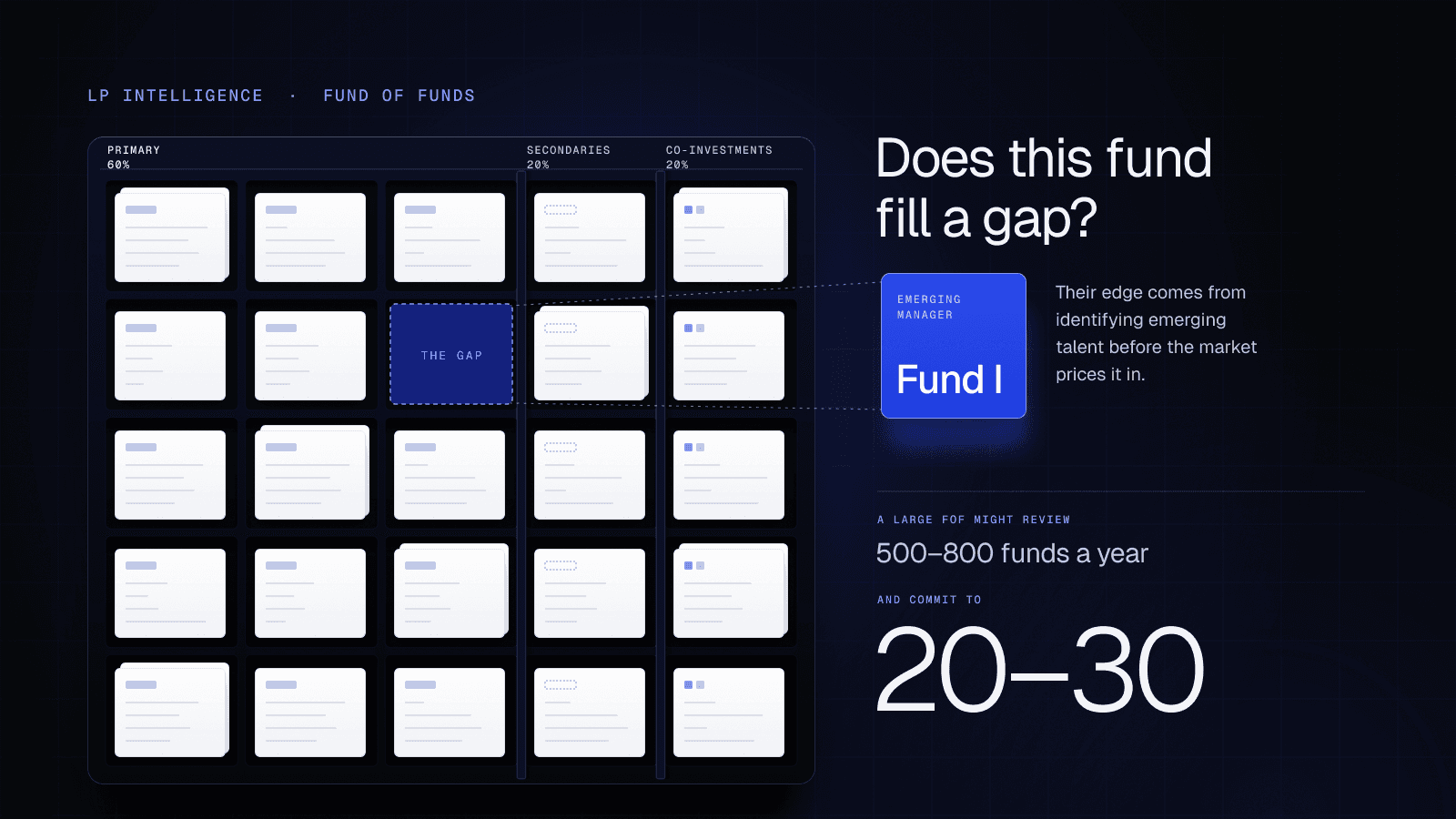
A fund of funds pools capital from its own investors and deploys it across a portfolio of underlying funds rather than directly into companies. This creates a structural incentive to find differentiated managers early. FoFs cannot generate alpha by accessing the same oversubscribed flagship funds as everyone else. Their edge comes from identifying emerging talent before the market prices it in.
This dynamic makes FoFs disproportionately valuable as anchor investors. When a credible FoF commits to a Fund I or Fund II, it sends a signal to other allocators that institutional-grade diligence has been completed. Pensions, endowments, and family offices routinely ask who else is in the fund. A recognized FoF name on the cap table compresses the fundraising timeline for everyone who follows.
The 2026 Context
The institutional fundraising drought troughed in 2025 at roughly one-third of 2021 volumes, according to Cambridge Associates. Capital has concentrated dramatically—the top 10 private equity groups captured approximately 46% of US PE fundraising in 2025, a share not seen since 2014. Yet this same environment has created opportunity for emerging managers with differentiated strategies. FoFs seeking alpha must look beyond oversubscribed flagships, and many are actively building emerging manager exposure as a result.
The decision mechanics also differ from other institutional LPs. Pensions and endowments often operate on annual or biannual allocation cycles, with investment committees that meet quarterly. FoFs, by contrast, have dedicated teams that evaluate managers continuously. A typical FoF decision cycle runs 3–6 months from first meeting to commitment. A public pension fund might take 12–18 months.
Why FoFs Are Not "Easier" Capital
FoFs are not a shortcut. They conduct diligence that is often more granular than what a pension fund performs. They visit your office. They interview your analysts. They model your fund economics against a portfolio of 50–100 other managers. They stress-test your track record with scenario analysis that would make a bank underwriter blush.
But they do it faster. And they do it with an open mind about emerging managers—because their business model depends on finding them.
The Fund of Funds Landscape in 2026
The fund of funds universe has consolidated significantly over the past decade. According to Preqin data analyzed by Altss, the number of active FoFs globally declined from approximately 1,800 in 2019 to roughly 1,400 in 2025. The survivors have larger AUM, more specialized mandates, and more sophisticated operations.
By Strategy
Primary FoFs — The traditional model. These FoFs build portfolios of underlying funds, typically holding 20–50 positions. They conduct full diligence on each manager and rebalance periodically. Primary FoFs are the most common entry point for emerging managers. Examples include Adams Street Partners, HarbourVest Partners, and Pantheon.
Secondary FoFs — These funds buy existing LP stakes in private equity funds. They provide liquidity to LPs who need to exit early or rebalance. Secondary FoFs have grown explosively—the secondary market reached $140 billion in transaction volume in 2025, up from $80 billion in 2021. Managers like Ardian, Coller Capital, and Lexington Partners dominate this space.
Co-investment FoFs — These funds invest alongside lead sponsors in direct deals, rather than into underlying funds. They offer LPs lower fees (typically no management fee on co-investments) and faster return profiles. Co-investment FoFs have proliferated as LPs demand more control over their portfolios. Examples include StepStone Group and Hamilton Lane.
Hybrid FoFs — Many FoFs now combine primary, secondary, and co-investment strategies. A hybrid FoF might allocate 60% to primary funds, 20% to secondaries, and 20% to co-investments. This model allows FoFs to manage liquidity, control pacing, and generate returns more predictably. HarbourVest's Dover Street series is a classic example.
Thematic FoFs — A growing category. These FoFs focus on specific sectors (healthcare, technology, climate), geographies (Asia, Latin America, Africa), or manager types (women-led, minority-led, veteran-led). Thematic FoFs are particularly valuable for emerging managers whose strategies align with the theme. Examples include the Rise Fund (impact investing) and the 57 Stars Global Emerging Manager Fund.
By Geography
North America — The largest FoF market by AUM. US-based FoFs manage approximately 60% of global FoF capital. The SEC's 2024 private fund adviser rule changes have increased compliance costs for FoFs, accelerating consolidation. Smaller FoFs (under $500 million AUM) are struggling to survive.
Europe — The second-largest market. European FoFs tend to be more conservative, with longer track records and lower return expectations. The UK, Switzerland, and Luxembourg are the primary hubs. European FoFs have been slower to adopt co-investment models but are catching up.
Asia-Pacific — The fastest-growing region. Japan's Government Pension Investment Fund (GPIF) and Singapore's Temasek have both increased FoF allocations. Chinese FoFs have grown rapidly but face regulatory headwinds. Australian superannuation funds are active FoF investors.
Middle East — Sovereign wealth funds in Abu Dhabi, Qatar, and Saudi Arabia have established their own FoF programs. The Saudi Public Investment Fund (PIF) has allocated tens of billions to external managers through FoF vehicles.
By Size
Mega-FoFs ($10B+ AUM) — Adams Street, HarbourVest, Pantheon, StepStone. These firms have hundreds of employees, dedicated research teams, and global presence. They are the hardest for emerging managers to access but offer the most credibility.
Mid-Market FoFs ($1B–$10B) — The sweet spot for emerging managers. These FoFs have the resources to conduct thorough diligence but are hungry for differentiated returns. Examples include Pathway Capital, GCM Grosvenor, and Portfolio Advisors.
Boutique FoFs ($100M–$1B) — Often focused on specific strategies or geographies. These FoFs are the most accessible for Fund I managers but offer less signaling value. They may lack the resources for deep diligence, which can be a double-edged sword.
Micro-FoFs (<$100M) — Typically family offices or small advisory firms that aggregate capital from high-net-worth individuals. These are the easiest to access but offer the least institutional credibility.
The FoF Decision Chain: Who Decides What
Understanding how a FoF makes decisions is the single most important thing an emerging manager can do. The decision chain varies by firm size and structure, but follows a general pattern.
Stage 1: Sourcing and Screening
FoFs receive thousands of fund marketing materials each year. A $10 billion FoF like Adams Street might review 500–800 funds annually and commit to 20–30. The screening process is brutal.
Who does it: Junior analysts and associates. These are typically recent MBAs or finance professionals with 2–4 years of experience. They are the gatekeepers.
What they look for: The first screen is usually quantitative. Does the fund meet minimum track record requirements? Is the strategy clear? Are the fees within acceptable ranges? Does the team have relevant experience? A fund that fails any of these criteria is rejected immediately.
How to pass: Your marketing materials must answer the first three questions in under 30 seconds. Lead with track record (even if limited), state your strategy in one sentence, and show fee transparency. Do not bury your team bios—put them front and center.
Named example: When HarbourVest evaluates a new manager, its screening team uses a proprietary scoring system that weights track record (40%), team quality (30%), strategy differentiation (20%), and market opportunity (10%). Funds scoring below a threshold are automatically rejected.
Stage 2: Initial Diligence
If a fund passes screening, it enters initial diligence. This phase typically takes 2–4 weeks.
Who does it: Senior analysts or vice presidents. These individuals have 5–10 years of experience and deep knowledge of specific strategies or sectors.
What they do: They request a detailed diligence package—usually 20–30 documents including fund documents, track record data, team resumes, reference lists, and financial projections. They conduct a 60–90 minute video call with the GP team. They begin reference checks.
What they evaluate:
- Team stability: Has the team worked together before? Has anyone left a previous firm under negative circumstances? FoFs are obsessed with team cohesion.
- Track record integrity: FoFs will reconstruct your track record from scratch. They will call former colleagues, competitors, and portfolio company executives. Any discrepancy is a red flag.
- Strategy coherence: Can you articulate your strategy in one paragraph? Do your past investments match your stated strategy? FoFs hate strategy drift.
- Alignment of interests: How much GP capital is in the fund? Are fees structured to align incentives? FoFs prefer high GP commitment and tiered fee structures.
How to pass: Prepare your diligence package before you start fundraising. Have every document ready to share within 24 hours of request. Conduct mock diligence sessions with advisors or mentors. Be transparent about weaknesses—FoFs will find them anyway.
Named example: GCM Grosvenor's initial diligence includes a mandatory site visit. The team spends a full day at the GP's office, interviewing every investment professional, reviewing internal systems, and observing team dynamics. This is non-negotiable.
Stage 3: Formal Diligence
If initial diligence is positive, the FoF moves to formal diligence. This phase takes 4–8 weeks.
Who does it: A dedicated diligence team led by a partner or managing director. The team may include specialists in legal, tax, operations, and compliance.
What they do: They conduct a deep dive into every aspect of the fund. This includes:
- Investment process review: How do you source deals? How do you evaluate opportunities? How do you monitor portfolio companies? FoFs want to see a repeatable, institutional process.
- Portfolio construction analysis: How do you size positions? How do you manage concentration risk? How do you handle fund-level liquidity?
- Operational due diligence: IT systems, cybersecurity, business continuity, insurance, compliance policies. FoFs are increasingly focused on operational risk.
- Legal and regulatory review: Fund documents, side letters, regulatory filings, litigation history. Any legal issue is a potential dealbreaker.
- Reference calls with 15–20 individuals: Former colleagues, current and former portfolio company CEOs, co-investors, service providers. FoFs triangulate every claim.
What they evaluate:
- Repeatability: Can you replicate your past success? FoFs are skeptical of one-hit wonders.
- Scalability: Can your team handle larger funds and more investments? FoFs want to see that you have the infrastructure to grow.
- Risk management: How do you handle down markets? Do you have contingency plans? FoFs want to see that you have thought about worst-case scenarios.
How to pass: Be prepared for intense scrutiny. Do not hide weaknesses—address them proactively. Provide references who will speak candidly. Be willing to share proprietary data. FoFs value transparency over polish.
Named example: When Pantheon evaluates a first-time fund, it requires the GP to provide a detailed "deal diary" for every past investment—including the initial thesis, key milestones, and lessons learned. This level of transparency is rare but highly valued.
Stage 4: Investment Committee
If formal diligence is positive, the FoF presents the opportunity to its investment committee. This is the final gate.
Who decides: The investment committee typically includes 5–10 senior partners. Some FoFs have external members. The committee meets weekly or biweekly.
What they decide: The committee votes on whether to commit capital, and at what size. Some FoFs have a single investment committee for all strategies; others have separate committees for primary, secondary, and co-investment.
What they evaluate:
- Portfolio fit: Does this fund fill a gap in the FoF's portfolio? Does it diversify existing exposures? FoFs manage their portfolios actively and will reject a great fund if it creates concentration risk.
- Return potential: What is the expected IRR and multiple? How does it compare to the FoF's target return? FoFs have specific return thresholds.
- Risk-adjusted return: FoFs evaluate risk-adjusted returns, not just raw returns. A fund with high expected returns but high volatility may be rejected.
- Manager relationship: Does the FoF want to build a long-term relationship with this manager? FoFs prefer to invest in managers they can re-up with over multiple funds.
How to pass: Build relationships with investment committee members before the formal process. Attend industry events where they speak. Connect through mutual contacts. The IC vote is often influenced by personal relationships.
Named example: StepStone's investment committee includes three external members who are former GPs. This ensures that the committee has direct experience evaluating managers. External members can veto a commitment.
Stage 5: Legal and Closing
If the investment committee approves, the FoF moves to legal documentation and closing. This phase takes 4–8 weeks.
Who does it: Legal teams at both the FoF and the GP. The FoF's legal team will review the fund's PPM, LPA, and side letters. They will negotiate key terms.
What they negotiate:
- Fee structure: FoFs often negotiate fee discounts or tiered fee structures. They may ask for reduced management fees for larger commitments.
- Side letters: FoFs typically request side letters covering most-favored-nation (MFN) status, reporting requirements, and key-person provisions.
- Reporting: FoFs require detailed quarterly reports, including portfolio valuations, performance data, and risk metrics. They may ask for access to the GP's internal systems.
How to pass: Have your legal documents prepared in advance. Be willing to negotiate on terms that matter to the FoF but are less critical to you. Build flexibility into your fund structure.
Named example: HarbourVest's standard side letter includes a provision requiring the GP to provide access to its internal portfolio management system. This allows HarbourVest to monitor performance in near-real-time.
The Diligence Criteria: What FoFs Actually Evaluate
FoFs evaluate managers on a structured set of criteria. Understanding these criteria—and how they weight them—is essential for positioning your fund.
Team (30–40% of Decision Weight)
FoFs invest in people first. They want to see:
- Relevant experience: Have you done this before? FoFs prefer teams with 10+ years of combined experience in the same strategy.
- Stability: Has the team worked together for at least 3–5 years? FoFs are wary of newly formed teams.
- Depth: Do you have enough investment professionals to execute the strategy? FoFs prefer teams of 5+ for a first fund.
- Incentives: Is compensation tied to fund performance? FoFs want to see that key professionals have meaningful carry.
- Succession planning: What happens if a key person leaves? FoFs want to see a clear succession plan.
Named example: When evaluating a first-time healthcare fund, Adams Street Partners focused on the team's operating experience. The GP had three former hospital executives on the team. Adams Street committed $50 million.
Track Record (25–35% of Decision Weight)
FoFs want to see a track record that demonstrates skill, not luck. They evaluate:
- Consistency: Have you generated returns across multiple market cycles? FoFs prefer 5+ years of track record.
- Benchmarking: How do your returns compare to relevant benchmarks? FoFs use public market equivalents (PMEs) and peer group comparisons.
- Attribution: What drove your returns? Sector selection? Deal selection? Execution? FoFs want to understand the source of alpha.
- Survivorship bias: Are you presenting only your best deals? FoFs will ask about every deal you have ever done, including failures.
Named example: Pantheon rejected a fund because the GP's track record was driven entirely by one investment—a single company that returned 5x. The rest of the portfolio was mediocre. Pantheon concluded the GP was lucky, not skilled.
Strategy (15–25% of Decision Weight)
FoFs want to see a clear, differentiated strategy. They evaluate:
- Clarity: Can you explain your strategy in one sentence? FoFs hate vague strategies.
- Differentiation: How are you different from competitors? FoFs want to see a unique edge.
- Market opportunity: Is there a large enough market for your strategy? FoFs want to see that you can deploy capital at scale.
- Sustainability: Can your strategy generate returns over multiple fund cycles? FoFs are wary of fads.
Named example: GCM Grosvenor committed to a second-time fund focused on lower-middle-market manufacturing. The GP's edge was deep industry knowledge and a proprietary deal-sourcing network. Grosvenor's diligence confirmed that the network was real.
Operations and Alignment (10–20% of Decision Weight)
FoFs evaluate operational quality and alignment of interests. They look for:
- GP commitment: How much of the GP's net worth is in the fund? FoFs prefer 5%+ GP commitment.
- Fee structure: Are fees reasonable? FoFs prefer tiered fee structures that align incentives.
- Reporting: Do you have robust reporting systems? FoFs want quarterly reports with detailed portfolio data.
- Compliance: Do you have strong compliance policies? FoFs require institutional-grade compliance.
Named example: StepStone rejected a fund because the GP's compliance program was inadequate. The GP had no written compliance manual and no designated compliance officer. StepStone viewed this as unacceptable risk.
Access Strategies: How to Get in Front of FoFs
Getting in front of the right FoF requires a systematic approach. Here is a step-by-step strategy.
Step 1: Identify Your Target FoFs
Not all FoFs are equal. You need to identify FoFs that:
- Invest in your strategy: Do they have a track record of investing in funds like yours? Check their portfolio on Altss or Preqin.
- Invest in your vintage: Do they have capacity for new commitments? Some FoFs are fully allocated for the year.
- Invest in emerging managers: Do they have a dedicated emerging manager program? Many large FoFs do.
- Are accessible: Do they accept unsolicited submissions? Some FoFs only accept referrals.
How to do it: Use Altss to search for FoFs by strategy, vintage, and emerging manager focus. The Altss platform tracks 9,000+ family offices and 30,000+ institutional investors, including FoFs. Filter by FoF type, minimum commitment size, and geographic focus.
Step 2: Build a Target List of 20–30 FoFs
Based on your research, build a target list of 20–30 FoFs. For each FoF, note:
- Contact information: Who is the right person to reach out to? Typically the head of primary investments or the emerging manager program lead.
- Decision cycle: When does the FoF make new commitments? Some FoFs have quarterly or annual cycles.
- Minimum commitment: Can the FoF commit to your fund size? Some FoFs require minimum commitments of $10 million or more.
- Relationship history: Do you have any mutual connections? Warm introductions are far more effective than cold outreach.
Step 3: Secure Warm Introductions
Cold emails to FoFs have a success rate of under 1%. Warm introductions have a success rate of 10–20%. You need to find mutual connections.
How to do it:
- Use your network: Ask your existing investors, advisors, and service providers for introductions. Your lawyer, accountant, or placement agent may have FoF relationships.
- Attend industry events: FoF partners speak at conferences like SuperReturn, PEI's Fundraising & Investor Relations Forum, and the Institutional Limited Partners Association (ILPA) events. Attend these events and seek introductions.
- Use Altss's relationship mapping: Altss can show you the shared connections between your network and target FoFs. This is a powerful tool for identifying warm introduction paths.
Step 4: Prepare Your Pitch
Your pitch to a FoF must be concise, credible, and compelling. You need:
- A one-page teaser: A one-page summary of your fund, including team, strategy, track record, and target returns. This is your first impression.
- A 10-slide deck: A detailed presentation covering the same topics. This is for the initial meeting.
- A diligence package: A comprehensive set of documents for formal diligence. This includes fund documents, track record data, team bios, reference lists, and financial projections.
What to emphasize:
- Your edge: Why are you different? What is your unique insight or advantage?
- Your team: Why is this team uniquely qualified to execute this strategy?
- Your track record: Show consistency and skill, not just raw returns.
- Your alignment: Show that you have meaningful GP commitment and aligned fee structures.
Step 5: Follow Up Systematically
FoFs are busy. They receive hundreds of submissions each month. You need to follow up systematically.
How to do it:
- Send a thank-you email within 24 hours of any meeting or call.
- Provide requested information within 48 hours. Speed signals professionalism.
- Check in every 4–6 weeks with a brief update on your fundraising progress or a new piece of content (e.g., a blog post, a market commentary).
- Do not be pushy. FoFs make decisions on their own timeline. Pushing too hard can backfire.
Building a Pipeline: The FoF Fundraising Timeline
Fundraising from FoFs is a marathon, not a sprint. A typical timeline looks like this:
Months 1–2: Preparation
- Identify target FoFs (20–30)
- Build relationship map
- Prepare marketing materials (teaser, deck, diligence package)
- Secure warm introductions
Months 3–4: Initial Outreach
- Send teasers to target FoFs
- Follow up with phone calls
- Schedule initial meetings (10–15 meetings)
- Begin initial diligence with interested FoFs
Months 5–8: Diligence
- Conduct formal diligence with 5–8 FoFs
- Provide diligence packages
- Host site visits
- Complete reference checks
- Negotiate terms
Months 9–12: Closing
- Receive commitments from 3–5 FoFs
- Finalize legal documents
- Close the fund
- Begin reporting and relationship management
The Reality Check
This timeline is optimistic. Most emerging managers take 12–18 months to close their first institutional fund. FoF commitments often come in later in the process, after other LPs have committed. Be prepared for a long journey.
The Role of Secondaries in FoF Portfolios
Secondaries have become a base layer in FoF portfolios, not an afterthought. In 2025, secondary transactions accounted for approximately 25% of FoF activity, up from 15% in 2020.
Why Secondaries Matter for FoFs
- Liquidity management: Secondaries allow FoFs to manage cash flows and pacing. They can sell stakes to raise capital for new commitments or buy stakes to deploy capital quickly.
- Portfolio optimization: Secondaries allow FoFs to rebalance their portfolios without waiting for fund distributions. They can exit underperformers and increase exposure to top-quartile managers.
- Access to closed funds: Secondaries allow FoFs to invest in funds that are closed to new commitments. This is particularly valuable for accessing top-tier managers like KKR, Apollo, or Blackstone.
How Secondaries Affect Emerging Managers
For emerging managers, secondaries create both opportunities and risks.
Opportunities:
- Liquidity for early investors: If a FoF needs to sell its stake in your fund, it may approach you first. You can negotiate a buyback or arrange a secondary sale to a new LP.
- Continuation vehicles: FoFs increasingly use continuation vehicles to hold fund stakes beyond the fund's original term. This can provide patient capital for your portfolio companies.
Risks:
- Early exits: If a FoF sells its stake in your fund, you lose a committed LP. You may need to replace that capital.
- Pricing pressure: Secondary buyers often demand discounts, which can affect your fund's reported returns.
Named example: In 2024, a $500 million FoF sold its stake in a second-time fund at a 15% discount to NAV. The GP was forced to find a new LP to replace the FoF's commitment. The process took six months and delayed the fund's closing.
Co-Investments: The New FoF Normal
Co-investments have become a standard feature of FoF portfolios. In 2025, co-investments accounted for approximately 20% of FoF capital deployed, up from 10% in 2020.
Why Co-Investments Matter for FoFs
- Fee reduction: Co-investments typically carry no management fee, which improves net returns for FoFs.
- Control: Co-investments give FoFs direct exposure to specific deals, allowing them to build concentrated positions in high-conviction opportunities.
- Speed: Co-investments can be executed in weeks, compared to months for primary fund commitments.
- Differentiation: Co-investments allow FoFs to generate alpha through deal selection, not just manager selection.
How Co-Investments Affect Emerging Managers
For emerging managers, co-investments are a double-edged sword.
Opportunities:
- Access to capital: FoFs that offer co-investment capital can provide additional funding for your portfolio companies. This can be a competitive advantage in deal sourcing.
- Relationship building: Co-investments allow you to build deeper relationships with FoFs. A FoF that co-invests with you is more likely to commit to your next fund.
Risks:
- Dilution: Co-investments dilute your ownership in portfolio companies. You need to manage this carefully.
- Complexity: Co-investments require additional legal and operational work. You need to have the infrastructure to manage multiple co-investors.
Named example: In 2025, a $300 million FoF committed $20 million to a first-time fund and an additional $10 million in co-investment capital for two portfolio companies. The GP used the co-investment capital to win a competitive auction for a healthcare services company.
Continuation Vehicles: The Liquidity Innovation
Continuation vehicles (CVs) have become a mainstream tool for FoFs. A CV is a new fund that acquires assets from an existing fund, providing liquidity to LPs who want to exit while allowing the GP to hold assets longer.
Why CVs Matter for FoFs
- Liquidity management: CVs allow FoFs to exit fund stakes without selling on the secondary market. This can be done at NAV or a premium, avoiding discounts.
- Portfolio optimization: CVs allow FoFs to extend their exposure to high-performing assets while exiting underperformers.
- Relationship management: CVs allow FoFs to maintain relationships with GPs they like while freeing up capital for new commitments.
How CVs Affect Emerging Managers
For emerging managers, CVs are a tool to manage LP relationships.
Opportunities:
- Patient capital: If a FoF wants to exit your fund, a CV can provide a structured solution. You can negotiate terms that work for both parties.
- Capital recycling: CVs allow you to return capital to LPs who want to exit while keeping your portfolio intact.
Risks:
- Complexity: CVs are legally and operationally complex. You need experienced legal counsel.
- Pricing disputes: CVs require valuation negotiations. Disputes can damage LP relationships.
Named example: In 2024, a $1 billion FoF used a continuation vehicle to hold its stake in a $200 million fund that had reached the end of its term. The CV allowed the FoF to maintain exposure to two high-performing portfolio companies while returning capital to other LPs.
The Altss Advantage: Data-Driven FoF Targeting
Altss provides fund managers with the data they need to target FoFs effectively. The platform tracks 9,000+ family offices globally and 30,000+ institutional investors, RIAs, and family offices, including 150,000+ private-markets entities.
What Altss Offers for FoF Targeting
- Comprehensive FoF database: Altss tracks 1,400+ active FoFs globally, including their AUM, strategy, geographic focus, and emerging manager programs.
- Relationship mapping: Altss shows you the shared connections between your network and target FoFs. This helps you identify warm introduction paths.
- Decision cycle tracking: Altss tracks FoF decision cycles, including when they make new commitments and how long the process takes.
- Diligence requirements: Altss provides detailed information on each FoF's diligence process, including what documents they require and what criteria they evaluate.
- Continuously refreshed data: Altss updates its data on a sub-30-day cycle, ensuring you have the most current information.
How to Use Altss for FoF Fundraising
- Search for FoFs by strategy and geography. Filter by FoF type, minimum commitment, and emerging manager focus.
- Identify warm introduction paths. Use Altss's relationship mapping to find shared connections.
- Prepare your pitch. Use Altss's diligence requirement data to tailor your materials to each FoF.
- Track your progress. Use Altss to monitor which FoFs are in diligence and when they are likely to make decisions.
- Follow up systematically. Use Altss's contact database to stay in touch with the right people.
Common Mistakes Emerging Managers Make with FoFs
Avoid these mistakes to increase your chances of success.
Mistake 1: Treating All FoFs the Same
FoFs vary dramatically in size, strategy, and decision process. A $10 billion FoF like Adams Street has different priorities than a $200 million boutique FoF. Tailor your approach to each FoF.
How to avoid: Research each FoF thoroughly before reaching out. Understand their portfolio, their decision process, and their emerging manager appetite.
Mistake 2: Overpromising and Underdelivering
FoFs will verify every claim you make. If you say you have a proprietary deal-sourcing network, they will call your sources. If you say your team has worked together for five years, they will check references.
How to avoid: Be conservative in your claims. Underpromise and overdeliver.
Mistake 3: Ignoring Operational Due Diligence
FoFs care deeply about operational quality. A weak compliance program or inadequate IT systems can kill a deal.
How to avoid: Invest in your operations before you start fundraising. Have a compliance manual, a cybersecurity policy, and a business continuity plan.
Mistake 4: Focusing Only on the Investment Committee
The investment committee makes the final decision, but the diligence team controls the process. Building relationships with analysts and associates is just as important as courting partners.
How to avoid: Treat every interaction as an interview. Be professional and responsive at every level.
Mistake 5: Giving Up Too Early
FoF fundraising is a long process. Most emerging managers receive rejections from 80–90% of the FoFs they approach. Persistence pays off.
How to avoid: Build a pipeline of 20–30 FoFs. Expect rejections. Learn from each one. Keep moving forward.
The Future of FoFs and Emerging Managers
Several trends will shape the FoF landscape over the next 3–5 years.
Trend 1: Continued Consolidation
The FoF market will continue to consolidate. Mega-FoFs will get larger, while boutique FoFs will struggle to survive. Emerging managers will need to focus on the mid-market FoFs that have the resources to conduct diligence but are hungry for differentiated returns.
Trend 2: Increased Specialization
FoFs will become more specialized. Thematic FoFs focused on climate, healthcare, and technology will grow. Emerging managers with specialized strategies will have an advantage.
Trend 3: Greater Use of Data and Analytics
FoFs will increasingly use data and analytics to evaluate managers. Platforms like Altss will become essential tools for FoF due diligence. Emerging managers who can provide clean, standardized data will have a competitive advantage.
Trend 4: More Co-Investment and Secondary Activity
Co-investments and secondaries will continue to grow as a share of FoF activity. Emerging managers who can offer co-investment opportunities to FoFs will have a fundraising advantage.
Trend 5: Regulatory Evolution
The SEC's private fund adviser rule changes will continue to affect FoFs. Compliance costs will rise, and smaller FoFs may be forced to merge or close. Emerging managers should stay informed about regulatory developments.
Conclusion: The FoF Advantage for Emerging Managers
Fund of funds remain the most accessible institutional LP category for Fund I–III managers in 2026. Their mandates structurally favor emerging managers, their decision cycles run faster than pensions or endowments, and their commitments signal credibility to other allocators.
But success requires a systematic approach. You need to identify the right FoFs, build relationships, prepare thorough diligence materials, and manage the process over 12–18 months.
The FoF landscape is evolving. Secondaries, co-investments, and continuation vehicles are becoming standard tools. Emerging managers who understand these dynamics and adapt their fundraising strategies will have a significant advantage.
Altss provides the data and tools you need to navigate this landscape. With 9,000+ family offices, 30,000+ institutional investors, and 150,000+ private-markets entities tracked on a sub-30-day refresh cycle, Altss gives you the intelligence you need to target, engage, and close FoF commitments.
Ready to build your FoF pipeline? Altss helps fund managers identify, research, and connect with the right fund of funds. Request a demo to see how Altss can accelerate your fundraising.