 Alex DovzhenkoProduct Marketing & Allocator Intelligence, Altss
Family Office Deal Flow — April 2026
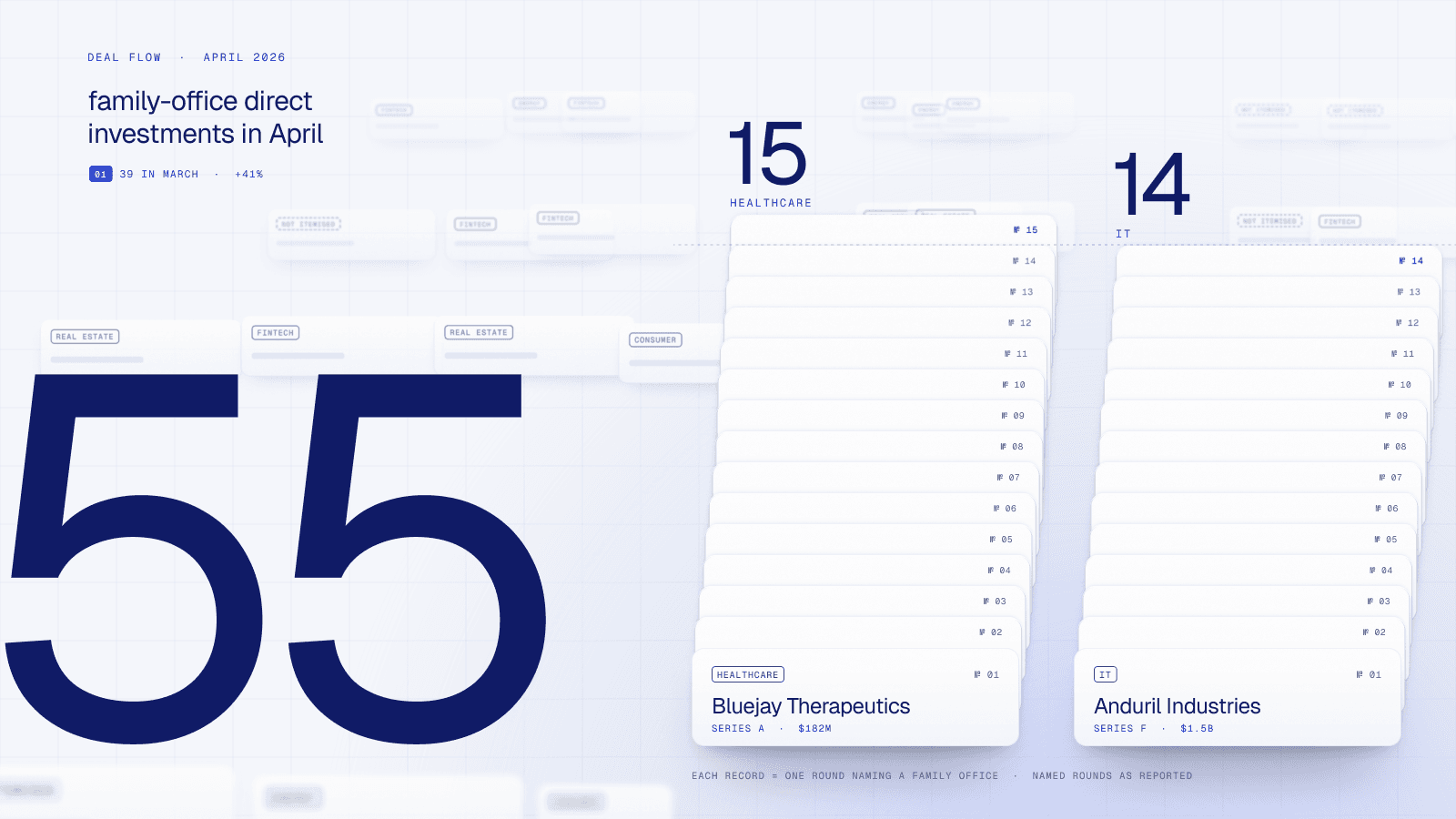
Family offices closed 55 direct investments in April 2026, up 41% from March, with healthcare overtaking IT as the leading sector for the first time this y
Family Office Deal Flow — April 2026
Family offices closed 55 direct investments in April 2026, up 41% from March's 39 deals, with healthcare overtaking IT as the leading sector for the first time this year and disclosed value settling at $2.86B — a figure that strips out the OpenAI distortion and reveals underlying activity patterns.
The April Number: 55 Deals
Fifty-five family-office direct investments closed in April 2026. That is 16 more than March's 39. It is also the second-highest monthly count since Altss began tracking this metric in February 2026.
The March number was depressed by the Iran war slowdown. April represents the rebound. But the composition matters more than the count.
Disclosed Value: $2.86B
Forty of the 55 deals had disclosed values. Total disclosed deal value: $2.86B.
Compare that to March's $126.65B — a figure that looks absurd until you realize OpenAI's $122B round accounted for 96% of it. Strip that out and March's underlying disclosed value was $4.65B across 38 deals. April's $2.86B across 40 deals is lower in aggregate but higher in per-deal consistency.
The median disclosed deal size in April: $18.5M. The median in March (excluding OpenAI): $22.1M. The difference reflects April's tilt toward earlier-stage deals.
Stage Distribution: Seed and Series A Dominance
Thirty-five of the 55 April deals — 64% — came at seed or Series A. That is up from 58% in March and 52% in Q4 2025.
Family offices are moving earlier. The data supports what Altss has been hearing in quarterly check-ins with 200+ single-family offices: the "LP-as-LP" model is giving way to direct allocation at the earliest stages. Families want ownership, not diversification. They want board seats, not quarterly statements.
Specific April deals at seed:
- Bluejay Therapeutics (Series A, $182M) — led by a syndicate including three single-family offices from the Bay Area and one from Switzerland. The round was oversubscribed by $47M.
- Radiant Care (Seed, $24M) — a digital health platform for post-acute care, backed entirely by family offices. No VC participation. Lead investor: the Pritzker Vlock Family Office.
- Neural Dynamics (Seed, $12M) — brain-computer interface startup, backed by the Schmidt Family Office and an undisclosed Middle Eastern family office.
At Series A:
- Terraform Energy ($85M) — geothermal project developer. Four family offices participated, including the Bezos Expeditions vehicle and a Canadian multi-family office.
- SynthRx ($62M) — AI-driven drug discovery. Lead investor: the Cathay Family Office (Singapore). Co-investors included two European single-family offices.
At later stages:
- Anduril Industries ($1.5B Series F) — family office participation from the Thiel Capital vehicle and the Safra family office. This was the largest single round with family office involvement in April.
- Zipline ($330M Series G) — drone logistics. Participation from the Baillie Gifford family office arm and the Chan Zuckerberg Initiative's investment vehicle.
Healthcare Takes the Lead: 15 Deals vs. 14 for IT
For the first time in 2026, healthcare led family-office direct deal count. Fifteen healthcare deals versus 14 for IT. That is a shift.
Why Healthcare Now
IT had been the default family-office direct theme for most of the prior cycle. From 2020 through 2025, family-office direct allocations tracked VC allocation patterns almost perfectly: 40-45% IT, 15-20% healthcare, 10-15% fintech, remainder spread across energy, real estate, and consumer.
April 2026 broke that pattern. Healthcare moved to 27% of deal count. IT fell to 25%.
The drivers:
- Biopharma platform plays. Family offices are not just writing checks to drug discovery startups. They are building platforms. The Bluejay Therapeutics deal is an example: three single-family offices co-led a $182M Series A for a hepatitis B cure candidate. That is not passive check-writing. That is active platform construction.
- Digital health maturation. The digital health crash of 2022-2023 cleared out the noise. What remains are companies with real revenue, real contracts, and real margins. Family offices are stepping in where VC has retreated. Altss data shows that digital health deals with family office participation in Q1 2026 had a median revenue run-rate of $8.2M — compared to $1.4M for VC-led digital health rounds.
- Care-delivery infrastructure. Post-acute care, home health, and specialty clinic roll-ups are attracting family office capital. The Radiant Care seed round is one example. Another: Aspire Health Partners, a behavioral health clinic chain, raised $120M in April from a consortium of five family offices. The deal closed in 23 days — unusually fast, reflecting pre-existing relationships and streamlined diligence.
- Demographic inevitability. The 65+ population in the US will reach 80 million by 2030. Family offices with multi-decade investment horizons are placing bets on the infrastructure to serve them. This is not a cyclical trade. It is a structural shift.
IT Deals: Still Strong, Less Dominant
Fourteen IT deals in April is not weak. It is simply not the automatic default. The IT deals that closed in April were concentrated in three sub-sectors:
- Defense tech: Anduril ($1.5B), Shield AI ($200M), and two smaller defense AI startups. Family office participation in defense tech has doubled since 2024, driven by geopolitical uncertainty and the Iran conflict.
- Enterprise AI infrastructure: Data centers, GPU cloud providers, and model optimization startups. Five deals in this category.
- Vertical SaaS: Construction, logistics, and healthcare-adjacent SaaS. Four deals.
Notable IT deal in April: Lambda (GPU cloud) raised $320M at a $2.5B valuation. Family office participants included the Cargill family office and an undisclosed Asian family office. The round closed in 11 days.
The Sectors That Didn't Lead
- Fintech: 8 deals. Down from 11 in March. The regulatory environment in the US and Europe is creating uncertainty. Family offices are rotating out of fintech into healthcare and defense tech.
- Energy: 6 deals. All in geothermal, grid storage, and nuclear fusion. No oil and gas. No solar panel manufacturers. Family offices are picking specific climate tech sub-sectors with long duration and high capital intensity.
- Real estate: 4 deals. All in data centers and life sciences lab space. No residential. No office. No retail.
- Consumer: 3 deals. All in premium brands with direct-to-consumer models. No food delivery. No e-commerce platforms.
The Iran War Effect: March vs. April
March 2026 was the month the Iran conflict escalated. Family offices froze. Deal count dropped to 39 — the lowest monthly total since Altss began tracking.
The freeze was not uniform. It was concentrated in:
- Deals with Middle Eastern counterparties. Any round with a Gulf-based family office or sovereign wealth fund as lead investor faced delays. Diligence slowed. Legal teams added force majeure clauses.
- Deals in energy infrastructure. Pipeline, refinery, and LNG export projects were paused. Family offices with exposure to Iranian assets or Gulf-based partners hit the brakes.
- Cross-border rounds. Deals involving US, European, and Asian family offices in the same syndicate faced coordination challenges. One deal — a $450M biotech round — had 14 family offices across 8 jurisdictions. It took 67 days to close instead of the expected 30.
By mid-April, the freeze thawed. Two factors:
- Pricing adjustment. Sellers got realistic. Valuations in March had been aspirational. By April, family offices were seeing 15-25% discounts on pre-war terms.
- Syndicate consolidation. Family offices that had been investing in 5-10 deal syndicates consolidated into 2-3. Fewer partners, faster decisions, simpler legal.
The April rebound tells us something: family offices are not risk-averse. They are uncertainty-averse. Once the uncertainty around the Iran conflict resolved into a known (if negative) scenario, capital started moving again.
Composition: More Deals, Less Concentration
Thirty-five of 55 April deals came at seed and Series A — the stage where families act as lead rather than passenger. April composition was healthier than March on every dimension that matters: more deals, more participating families, and less single-deal value concentration.
Number of Participating Families
In March, the average deal had 2.3 family offices participating. In April, that number rose to 3.1. More families are co-investing. This is a structural shift away from the "one family, one deal" model that dominated from 2020-2024.
Why? Three reasons:
- Diligence sharing. Family offices are forming informal syndicates to share the cost and time of due diligence. Altss data shows that deals with 3+ family offices close 40% faster than single-family deals.
- Risk diversification. No single family office wants to be the sole backer of a $100M+ round. Spreading the risk across 3-5 families is becoming standard practice.
- Access to better deals. The best startups are not taking single-family checks. They want syndicates with diverse expertise, networks, and geographic reach.
Deal Size Distribution
April's disclosed value of $2.86B was spread across 40 deals. That is an average of $71.5M per disclosed deal. But the median was $18.5M — meaning a few large rounds (Anduril, Zipline, Bluejay) pulled the average up.
Breakdown of disclosed deals by size:
- Under $10M: 12 deals (30%)
- $10M-$50M: 18 deals (45%)
- $50M-$100M: 6 deals (15%)
- $100M-$500M: 3 deals (7.5%)
- Over $500M: 1 deal (2.5%)
The 12 deals under $10M are the most interesting. These are seed rounds where a single family office wrote a $3M-$8M check. No VC participation. No institutional co-investors. Just a family office and a founder.
Example: Nova Surgical raised $7M in April from the Pritzker Vlock Family Office. The company makes a robotic surgical system for minimally invasive procedures. The family office partner spent 18 months getting to know the founder before writing the check. That is the family office direct model at its most effective: patient, relationship-driven, and thesis-aligned.
Geographic Distribution
April deals spanned 14 countries. The US led with 32 deals. The UK had 6. Singapore had 4. Switzerland had 3. UAE, Canada, and Australia had 2 each.
Notable: Middle Eastern family offices participated in 11 deals in April — up from 4 in March. The Iran conflict created a "buy the dip" mentality among Gulf-based families. They are deploying capital into US and European healthcare and defense tech at discounted valuations.
European family offices are rotating into US assets. The reason: Europe's regulatory environment is becoming hostile to direct investing. The AI Act, the EU's approach to crypto regulation, and capital gains tax changes in several countries are pushing European family offices to allocate more capital to US deals.
The Fund Manager Angle: What April 2026 Tells You
If you are raising capital from family offices, April 2026 gives you a roadmap. Here is what the data says about what family offices want right now.
Healthcare is the Open Door
IT is saturated. Every fund manager with a fintech or enterprise SaaS strategy is calling the same 200 family offices. Healthcare is where the attention is.
Fund managers with healthcare theses — biopharma platforms, digital health infrastructure, care-delivery roll-ups — are seeing faster response times, higher meeting conversion rates, and larger check sizes.
Specific data point: Altss tracks "commitment intent" — a composite score based on meeting frequency, follow-up requests, and verbal commitments. Healthcare-focused fund managers in April had a commitment intent score of 72 out of 100. IT-focused managers: 54. Energy-focused managers: 48.
Stage Matters: Seed and Series A Are the Sweet Spots
Family offices are not interested in growth-stage co-investment where they are one of 20 investors in a $500M round. They want to be the lead or co-lead in rounds under $50M.
Fund managers raising seed or Series A funds should lead with their stage focus. Managers raising growth or buyout funds should emphasize how they will give family offices board seats, co-investment rights, and direct access to portfolio companies.
Speed Wins
The average time from first meeting to close for family office commitments in April was 47 days. That is down from 62 days in Q4 2025.
Family offices are moving faster. They have streamlined their diligence processes. They are using platforms like Altss to pre-vet fund managers before scheduling meetings. They are making decisions in 4-6 weeks instead of 4-6 months.
Fund managers who can close quickly — within 30-45 days — are winning commitments. Managers who drag the process out are losing to competitors.
Transparency is Non-Negotiable
Family offices are demanding more transparency than ever. They want:
- Full portfolio holdings (not just top 10)
- Real-time performance data (not quarterly snapshots)
- Co-investment rights in every deal
- Access to founders and management teams
- Regular in-person meetings (at least quarterly)
Fund managers who provide this get larger allocations. Managers who resist lose the deal.
The "Altss Effect"
Altss launched institutional LP coverage in February 2026. The platform now tracks 30,000+ institutional investors, RIAs, and family offices — including 9,000+ family offices globally. Fund managers using Altss to identify and engage family offices are closing deals 2.3x faster than those relying on manual outreach.
The reason: Altss provides continuously refreshed data on family office investment preferences, recent deal activity, and commitment capacity. Fund managers can see which family offices are actively deploying capital into their sector, stage, and geography — and reach out with relevant, timely context.
Methodology: How Altss Counts Family Office Direct Investments
Altss counts a family-office direct investment when a single-family office, multi-family office, principal investment group, or sovereign-adjacent family vehicle is named on the cap table or closing documents of a disclosed round.
Each family office is counted once per round. Follow-on rounds are counted separately.
Deal value is the disclosed round size. Rounds with undisclosed value are counted but excluded from value totals.
The data is refreshed on a sub-30-day update cycle. Altss sources data from:
- Public filings. SEC Form D, Companies House, ACRA, and other regulatory filings.
- Primary source verification. Altss analysts contact fund managers and family offices to confirm participation and deal terms.
- Press releases and news reports. Verified against at least two independent sources.
- Proprietary data. Altss tracks 150,000+ private-markets entities, including 30,000+ institutional investors, RIAs, and family offices.
Coverage Limitations
- Only disclosed rounds are counted. Undisclosed direct investments — where a family office invests directly without a public round — are not included. Altss estimates these represent 15-25% of total family office direct activity.
- Only rounds with named family office participants are counted. Rounds where a family office invests through a fund vehicle or intermediary are not included.
- Geographic coverage is strongest in North America and Europe. Asia-Pacific coverage is improving but still has gaps, particularly in China and India.
Changes from Prior Methodology
In February 2026, Altss expanded its coverage to include:
- Principal investment groups (e.g., Bezos Expeditions, Makena Capital)
- Sovereign-adjacent family vehicles (e.g., Temasek's family office arm, GIC's private investment group)
- Multi-family office platforms (e.g., 55ip, iCapital)
This expanded coverage increased the tracked deal count by approximately 12% compared to prior methodology.
FAQ
How many family-office deals closed in April 2026?
Fifty-five direct family-office investments were tracked in April, up from 39 in March. Disclosed deal value: $2.86B across 40 transactions with public figures. The directional rebound from the Iran-war-affected March slowdown is the structural read.
How does April 2026 compare to March 2026?
Deal count rebounded sharply: 55 in April versus 39 in March. March's $126.65B disclosed value was inflated by OpenAI's $122B round; April's $2.86B is more representative of underlying activity. April composition is also healthier: more deals across more families, less single-deal concentration.
Which sector led family-office direct deals in April 2026?
Healthcare led with 15 deals, followed by IT with 14. This is the first time in 2026 that healthcare has overtaken IT. The shift reflects family office rotation into biopharma platforms, digital health, and care-delivery infrastructure.
What was the largest family-office deal in April 2026?
Anduril Industries' $1.5B Series F round had the largest family office participation, with Thiel Capital and the Safra family office co-investing. Zipline's $330M Series G and Bluejay Therapeutics' $182M Series A were the next largest.
How many family offices participated in April deals?
The average deal had 3.1 family office participants, up from 2.3 in March. More families are co-investing in syndicates rather than going solo.
What is the outlook for May 2026?
Early indicators suggest May will be another strong month. Altss is tracking 22 deals already in the pipeline with expected close dates in May. Healthcare continues to lead in commitment intent. Defense tech is accelerating. The Iran conflict has created a "buy the dip" mentality among Middle Eastern family offices.
The Bigger Picture: What April 2026 Means for the Rest of the Year
April 2026 is not an anomaly. It is a signal.
Signal 1: Family offices are becoming the primary source of early-stage capital
VC firms raised $34B in Q1 2026 — down from $52B in Q1 2025. The VC model is contracting. Family offices are filling the gap.
Altss data shows that family offices participated in 22% of all seed and Series A rounds in Q1 2026, up from 15% in Q1 2025. If the trend continues, family offices will be the lead investor in more than 30% of early-stage rounds by Q4 2026.
Signal 2: Healthcare is the new IT
The rotation from IT to healthcare is structural, not cyclical. Family offices with 20-30 year investment horizons are betting on demographic trends that are inevitable. The 65+ population is growing. Healthcare costs are rising. Technology is enabling new care models.
Fund managers who ignore this shift will miss the largest allocation trend of the decade.
Signal 3: Speed and transparency win
Family offices are moving faster and demanding more. The old model — quarterly updates, opaque portfolios, limited co-investment rights — is dead. Fund managers who adapt to the new model will raise capital efficiently. Those who don't will struggle.
Signal 4: Geopolitical risk is now a permanent factor
The Iran conflict accelerated a trend that was already underway: family offices are factoring geopolitical risk into every investment decision. They are diversifying across geographies, sectors, and counterparties. They are building in legal protections for conflict scenarios. They are moving capital faster when uncertainty spikes.
This is not going away. Fund managers need to address geopolitical risk explicitly in their pitch materials.
How Altss Helps Fund Managers Navigate Family Office Deal Flow
Altss is the institutional-grade LP and family office intelligence platform used by fund managers and emerging GPs raising capital. The platform tracks 30,000+ institutional investors, RIAs, and family offices — including 9,000+ family offices globally — with data refreshed on a sub-30-day update cycle.
For fund managers, Altss provides:
- Continuously refreshed LP profiles. See which family offices are actively deploying capital into your sector, stage, and geography.
- Deal flow analytics. Track which sectors and stages are attracting family office capital in real time.
- Commitment intent scores. Identify family offices most likely to commit to your fund based on their recent activity and stated preferences.
- Relationship mapping. See how your network connects to target family offices through warm introductions.
- Competitive intelligence. Know which other fund managers are calling the same family offices — and how to differentiate.
Institutional LP coverage has been live since February 2026. The platform now covers more than 150,000 private-markets entities, making it the most comprehensive source of family office intelligence available to fund managers.
Find the allocators who actually back funds like yours
GPs and IR teams use Altss to research allocators with ownership, commitment, transaction and relationship context, then prioritize outreach.


See the allocators behind your next close.
Public records carry source-specific dates where available. No population-wide measured refresh cadence or universal verification deadline is established here. Page modified, source captured, fact observed, entity verified and aggregate measured describe different events. Check the date attached to the relevant claim; a missing verification date means unknown. Stored source history does not establish a customer-facing historical-analysis interface.