
GP-LP Relationship Mapping Framework
A systematic approach to identifying, prioritizing, and converting LP relationships for private markets fundraising
Introduction
Relationship mapping is the operational foundation of private markets fundraising. Unlike transactional sales processes where outreach volume drives outcomes, private capital formation depends on network architecture, timing intelligence, and systematic relationship development that compounds across multiple fund cycles.
This framework reflects Altss analysis of GP-LP relationship patterns across thousands of fundraising interactions globally. The methodology applies to venture capital, private equity, private credit, and real asset managers seeking to build relationship-driven capital formation engines.
The distinction between successful and struggling fundraises increasingly comes down to relationship infrastructure. Altss data shows GPs with systematic relationship mapping close funds 6-9 months faster than those relying on opportunistic outreach. The efficiency gain compounds: established LP relationships cost roughly one-third of new investor acquisition in time, legal fees, and placement agent costs. Re-up relationships close 6-9 months faster than new investor acquisition because diligence requirements are reduced for known managers.
The 2024-2025 fundraising environment makes relationship mapping more critical than ever. Median fundraising timelines have stretched to 18-20 months from 15 months pre-pandemic. 38% of funds now take over two years to close versus just 9% in 2019. In this extended timeline environment, relationship infrastructure separates GPs who close efficiently from those who linger in market indefinitely.
Why relationship mapping differs from contact management
Contact databases list names and emails. Relationship mapping identifies decision authority, influence networks, introduction pathways, and timing signals that determine conversion probability. The difference is structural, not incremental.
A contact database tells you that Jane Smith works at ABC Family Office. Relationship mapping tells you that Jane has investment committee authority for allocations under $15 million, reports to a principal who previously backed your co-investor, attended the same industry conference last quarter, and has liquidity from a recent exit that creates near-term allocation capacity.
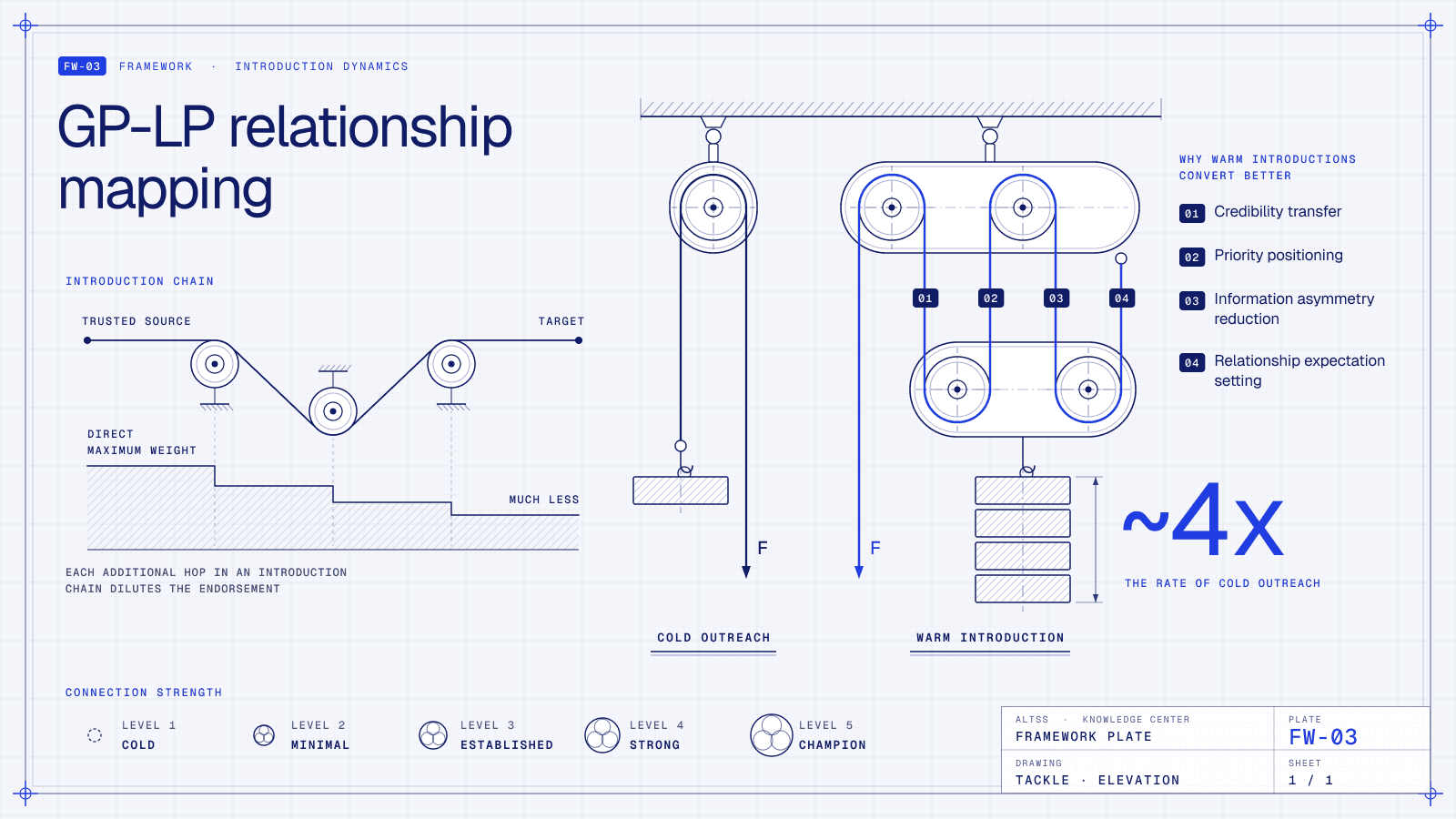
Limited partners evaluate managers through relationship lenses that contact data cannot capture. A cold email from an unknown general partner competes with dozens of similar messages. A warm introduction from a trusted peer or existing portfolio manager creates entirely different initial conditions. Altss tracking shows warm introductions convert at roughly 4x the rate of cold outreach across LP types—a finding consistent with industry research showing 74% conversion rates for LP commitments in the $100K-$150K range via warm introductions versus roughly 20% response rates (not commitment rates) for cold outreach.
The relationship mapping discipline requires GPs to think like allocators. Investment committees at institutional LPs follow formal processes with defined roles: who screens, who champions, who has veto authority, who influences without formal authority. Family offices concentrate decision authority but still operate through relationship filters that determine which opportunities receive attention.
Relationship mapping also creates compounding returns. A GP who systematically maps and maintains LP relationships across Fund I, II, and III builds an asset that competitors cannot replicate through data purchases or placement agent engagement. The relationship graph becomes proprietary infrastructure. Industry research shows that long-tenured LP syndicates generate 400 basis points of outperformance—relationship durability correlates with returns.
Decision-maker identification by LP type
Effective relationship mapping begins with accurate decision-maker identification. Authority structures vary dramatically by allocator type, and mis-targeting wastes limited GP bandwidth while potentially damaging reputation.
Pension funds
Pension fund decision-making follows formal governance hierarchies: board of trustees establishes policy, investment committee approves allocations, CIO and staff execute within delegated authority, and consultants provide recommendations that carry significant weight.
Decision authority depends on commitment size relative to policy thresholds. A $10 million allocation might require only CIO approval; a $50 million commitment might require full investment committee sign-off. Understanding these thresholds prevents wasted effort pursuing relationships with individuals who cannot actually approve your target ticket size.
Altss analysis shows smaller pension funds rely more heavily on investment consultants for manager selection, while larger funds with dedicated alternatives staff make more autonomous decisions. For consultant-dependent pensions, the relationship path runs through the consultant first. Mapping the consulting relationship—which firm, which specific consultant covers alternatives, what other managers they recommend—becomes essential.
Committee meeting cadence creates hard constraints. Most pension investment committees meet quarterly. Missing a committee cycle delays decisions by three months. Relationship mapping must incorporate timing intelligence: when does the committee meet, what materials do they need, how far in advance must staff prepare the IC memo.
Endowments and foundations
Endowments typically maintain sophisticated investment operations with CIO-led teams operating within investment policy statement parameters. Decision authority often sits with investment committees, but staff or CIO have delegated authority for allocations below defined thresholds.
Foundation decision-making involves additional complexity from board engagement and mission alignment considerations. IRS Form 990 filings reveal investment holdings, board members, compensation data, and grant distributions that inform relationship strategy. These public filings create OSINT opportunities for relationship intelligence that many GPs underutilize.
The endowment model pioneered by large university endowments created templates that smaller endowments and foundations follow with varying degrees of sophistication. Understanding where a specific institution sits on this spectrum—from highly institutionalized to effectively principal-led—determines appropriate relationship approach.
Governance cadence tends to be quarterly for significant decisions, though many endowments maintain more frequent informal engagement with existing managers. Building relationships 12-24 months before a fundraise allows GPs to be positioned as "known quantities" when formal evaluation begins.
Sovereign wealth funds
Sovereign wealth funds require white-glove approaches with senior-level engagement and multi-year relationship cultivation. Authority is structured and sometimes political. Governance defines approval thresholds and who can sponsor deals internally.
SWF decision chains are typically longer and more complex than other institutional allocators. Internal sponsors must navigate their own organizational dynamics to advance a manager through the process. Understanding who can sponsor, what internal relationships they have, and what positioning resonates with their stakeholders becomes critical. Decision chain mapping reduces wasted outreach significantly.
Geographic and political considerations add layers that don't exist with other LP types. Some SWFs have explicit investment mandates to develop domestic industries or support specific geopolitical objectives. Others operate purely commercially. Relationship mapping must capture these nuances.
The timeline reality: SWF relationships often develop over years, not months. Many top-quartile managers have no room for new SWF relationships because existing relationships consume available capacity. Breaking into SWF capital requires patient, strategic relationship building with realistic expectations about timeline.
Family offices
Single-family offices present the widest range of decision structures. A principal-led office might conclude investment after a single meeting with the wealth creator. A professionalized family office with CIO, investment committee, and formal governance might follow institutional timelines.
Altss tracks over 9,000 family offices globally, and the structural variation is significant. Key distinctions include: whether investment authority is centralized with a principal or delegated to professional staff; whether a formal investment committee exists and how frequently it meets; whether external advisors (lawyers, wealth advisors, consultants) influence decisions; and whether multiple family generations participate in investment decisions.
Multi-family offices add complexity because they may invest on behalf of multiple families with different mandates. Some MFOs have discretionary authority; others advise only. Understanding whether you're pitching a decision-maker or an influencer determines relationship strategy. Role validation is critical to avoid pitching someone who cannot allocate.
Family office relationship mapping must capture wealth origin and operating company background. A logistics family backing supply chain technology, a healthcare family backing biotech, a real estate family backing PropTech—these patterns reflect genuine alignment, not just capital availability.
Geographic culture matters significantly for family office engagement. Altss analysis shows U.S. family offices exhibit strong home bias and respond well to warm introductions. European offices tend toward more formal, process-driven evaluation. Asian offices prioritize face-to-face trust-building across multiple interactions. Middle Eastern family offices often prefer structured vehicles with clear downside protection. See Global Single-Family Office Migration and Regional LP Activity Trends 2025 for detailed regional analysis.
Fund of funds
Fund of funds are deeply analytical allocators that evaluate managers based on durability, repeatability, and clarity of edge. Their mandate is not to identify the most exciting strategy but to identify managers who can compound reliably across cycles.
FoFs evaluate decision quality and repeatability above excitement or novelty. They favor GPs with disciplined sourcing, diligence, and pacing models. Transparency and attribution outperform polished narratives. Common fundraising mistakes with FoFs include pitching excitement instead of process, saying "access" without demonstrating structural sourcing advantage, presenting deployment pacing as aspirational rather than modeled, and providing headline returns without explaining attribution.
A GP does not lose FoF interest because of imperfect numbers. They lose it when they cannot explain their decisions in a way that shows control rather than luck.
Mapping the decision ecosystem
Relationship mapping extends beyond the final decision-maker to encompass the full ecosystem of individuals who influence outcomes.
Influence categories
Final decision-makers hold actual approval authority—boards, investment committees, principals. These are the relationships that ultimately determine commitment.
Recommenders prepare materials, conduct diligence, and make recommendations to decision-makers. CIOs, investment directors, and senior staff typically occupy this role. Their endorsement doesn't guarantee approval, but their opposition usually prevents it.
Gatekeepers control access to decision-makers. External consultants, IR teams, junior screening staff, and executive assistants determine which opportunities reach evaluation. Effective relationship mapping identifies and cultivates gatekeeper relationships.
Influencers shape perspectives without formal authority. LPAC members, existing GP relationships, peer LPs, placement agents, and industry experts can all influence how an LP perceives a manager. Understanding who an LP trusts for manager insight creates introduction pathways.
Mapping all four categories for target LPs creates multiple relationship paths. If the direct decision-maker relationship is weak, a strong recommender relationship might create internal championship. If the gatekeeper relationship is blocking access, an influencer relationship might create alternative entry points.
Consultant and advisor dynamics
Investment consultants act as force multipliers for institutional LP access. A positive consultant relationship opens doors to multiple underlying clients. A negative consultant relationship can effectively close an entire category of institutional capital.
Consultant relationships require consistent cultivation. They expect performance reporting, transparent fee structures, strong operational infrastructure, clear investment thesis, and demonstrated value creation capabilities. Consultants are relationship-worthy when they're active in your strategy and geography.
Understanding which consultants cover which clients, which specific consultant leads alternatives coverage, and what managers they currently recommend creates actionable intelligence. Consultant recommendations carry significant weight with resource-constrained LP teams.
Network analysis methodologies
Systematic relationship mapping requires analytical frameworks that move beyond intuition.
Connection strength scoring
Most relationship-oriented CRMs use numeric scales for relationship strength:
Level 1: Cold or no relationship. Outbound only, no prior engagement, no mutual connections identified.
Level 2: Minimal engagement. Brief meeting, single conference interaction, email exchange but no substantive dialogue.
Level 3: Established relationship. Multiple interactions, periodic communication, mutual recognition, but not yet advocate status.
Level 4: Strong relationship. Regular communication, demonstrated trust, willingness to provide references or introductions, track record of responsiveness.
Level 5: Champion relationship. Active advocacy, proactive introduction offers, deep trust, past commitment history, personal relationship with GP principals.
Automated scoring platforms analyze email communications, meetings, response rates, and communication patterns to inform relationship strength assessments. Manual calibration remains essential—the CRM might score a relationship as Level 3 based on email frequency, but a GP who knows the relationship has cooled should override.
Introduction path analysis
Network analysis identifies introduction pathways through existing relationships. First-degree connections (people you know directly who know the target) provide the strongest introduction paths. Second-degree connections (people you know who know people who know the target) dilute endorsement but still outperform cold outreach.
Effective path analysis maps:
Board connections: Portfolio company boards, nonprofit boards, and industry association boards create connection overlap. A portfolio company CEO who serves on a board with a family office principal provides an introduction path.
Co-investor relationships: LPs who have co-invested in the same managers share evaluation frameworks. An existing LP introduction to a prospective LP carries weight because it implies endorsement of the GP.
Portfolio company executive networks: Portfolio company executives have their own networks of customers, partners, investors, and industry contacts. These networks sometimes include LP decision-makers.
Professional alumni networks: Business school, university, and prior employer networks create trust pathways. Shared professional background accelerates relationship formation.
Conference and event relationships: Industry conferences create repeated interaction opportunities. Someone you've met three times at SuperReturn is a warmer introduction path than someone you've never encountered. See How to Design Your 2025-2026 Fundraising Roadshow for strategic event selection.
The key insight: each additional hop in an introduction chain dilutes the endorsement. A direct introduction from a trusted source carries maximum weight. An introduction from someone who knows someone who knows the target carries much less.
Introduction dynamics and conversion
The mechanics of warm introductions significantly impact conversion probability.
Why warm introductions convert better
Warm introductions convert at approximately 4x the rate of cold outreach because they solve multiple problems simultaneously.
Credibility transfer: The introducer's reputation transfers partially to the introduced party. An LP trusts their network's judgment; if a trusted colleague thinks a GP is worth meeting, that carries implicit endorsement.
Priority positioning: LP decision cycles are governed by limited bandwidth. Investment teams with 2-5 professionals evaluating dozens of opportunities cannot give equal attention to every inbound. Warm introductions receive priority over cold inbound.
Information asymmetry reduction: Cold outreach requires the LP to independently verify everything the GP claims. Warm introductions come with context—the introducer can share their own experience with the GP, reducing diligence burden.
Relationship expectation setting: Cold outreach creates transactional dynamics. Warm introductions create relationship expectations that both parties honor.
Optimal introduction sources by LP type
For family offices, the most effective introduction paths include:
Lawyers, accountants, and wealth advisors who serve the family. These trusted advisors have earned the right to make introductions over years of relationship.
Other fund managers who have the family's trust. A GP who has delivered strong returns for a family can credibly introduce other managers.
Principals from operating companies in the family's industry. A successful tech entrepreneur introducing a tech-focused GP creates natural alignment.
Personal introductions through social or philanthropic connections. Some families invest primarily through personal relationship channels.
For pension funds, consultant relationships and existing manager introductions carry the most weight. A GP already on a pension's roster introducing another manager implies quality.
For endowments, peer CIO relationships and board member connections provide effective pathways. The endowment community is relatively small and interconnected.
For sovereign wealth funds, placement agents with international reach, diplomatic relationships, and large institutional LP referrals provide the most effective—and sometimes only—access paths.
Introduction request best practices
How you request introductions affects both success rate and relationship health with the introducer.
Keep requests specific and limited: Identify the exact individual you want to reach and why. Vague requests ("Can you introduce me to family offices?") burden the introducer with research and judgment calls.
Make it easy: Provide a ready-to-forward blurb the introducer can use with minimal editing. Include your LinkedIn profile, a brief description of your fund, and why this specific LP should be interested.
Explain the rationale: Articulate why this LP fits and why the timing makes sense. "ABC Family Office has been active in climate tech and recently had a liquidity event—we think our climate infrastructure strategy aligns well with their current investment mandate."
Limit volume: Requesting 3-5 specific introductions from someone is reasonable. Requesting 20 introductions exhausts social capital and suggests desperation.
Respect refusals: If an introducer declines or seems hesitant, accept gracefully. Pushing damages the relationship you're leveraging.
Close the loop: Update the introducer on outcome. This maintains the relationship and demonstrates that introductions lead to real engagement.
When introductions backfire
Not all warm introductions help. Same-stage investor introductions can create questions ("Why are they passing us off?"). Weak introducer-target relationships provide little credibility transfer. Misaligned expectations—when the GP doesn't actually fit the LP's mandate—waste everyone's time and damage the introducer's judgment reputation.
The quality filter: only pursue introductions where you have genuine reason to believe the LP is a fit. Introduction volume without quality degrades your network.
Relationship development timelines
Relationship mapping is not a fundraise-time activity. Effective GPs build relationships continuously, then activate those relationships during fundraising.
Pre-fundraise cultivation
Relationship building should begin 12-24 months before formal fundraise launch. This timeline allows:
Relationship formation without transactional pressure: LPs are more open to relationship building when you're not actively asking for capital. Coffee meetings, conference conversations, and periodic updates create familiarity.
Mandate alignment verification: Extended relationship development reveals whether an LP is actually a fit for your strategy—their real preferences, constraints, and decision-making style.
Trust development: Trust builds through consistent interaction over time. A GP who has provided thoughtful market perspectives and demonstrated reliability over 18 months starts a fundraise as a known quantity.
Timing intelligence: Ongoing relationships surface timing signals—upcoming allocation cycles, liquidity events, mandate changes—that inform fundraise launch timing.
The GPs who "always seem to know when to reach out" have earned that intelligence through sustained relationship investment, not luck.
Relationship maintenance between fundraises
Successful GPs maintain LP relationships across the full fund cycle, not just during capital formation. This requires systematic touchpoint management:
Quarterly updates: Brief, substantive communications that demonstrate continued value without asking for anything. Portfolio updates, market perspectives, and relevant industry insights.
Annual meetings: In-person or virtual engagement that deepens relationships and provides more comprehensive fund updates.
Ad hoc engagement: Relevant deal flow introductions, industry event coordination, or connections to portfolio companies that create value for the LP.
Responsiveness: When LPs reach out with questions or requests, prompt and thorough response maintains relationship quality.
They receive quarterly reports, audited financials, and distributions per the waterfall. LP rights and protections are defined in the LPA and side letters. LPACs provide a structured governance channel for conflicts and approvals. GPs who maintain at least three substantive touchpoints per quarter with key LPs experience approximately 15% higher re-up rates.
Re-up dynamics
Re-up relationships—existing LPs committing to subsequent funds—represent the highest-ROI fundraising activity. Re-ups cost roughly one-third of new investor acquisition in time and expenses. Re-up timelines compress by 6-9 months because diligence requirements are reduced for known managers.
But re-ups are not automatic. LPs continuously evaluate whether to re-commit based on performance, communication quality, portfolio company outcomes, team stability, and continued strategic fit. Poor communication between fundraises undermines re-up probability regardless of returns. 46% of LPs view GP reputation as more important than returns alone.
Relationship mapping for re-ups should track: communication history and quality, LP satisfaction indicators, any concerns or issues that arose during the fund, changes in LP situation (personnel, mandate, liquidity) that might affect re-up, and competitive positioning (what other managers are pitching the same LP).
Relationship infrastructure requirements
Systematic relationship mapping requires infrastructure—processes, tools, and data architecture that enable relationship intelligence at scale.
Essential CRM fields
Contact-level fields should capture:
Name, title, and organization (obvious but often poorly maintained)
Decision-making authority level (final decision-maker, recommender, gatekeeper, influencer)
Investment committee participation (voting member, advisory, not involved)
Communication preferences (email, phone, in-person, frequency preferences)
Historical relationship with firm members (who knows this person, how well, for how long)
Organization-level fields should capture:
LP type classification (pension, endowment, foundation, family office, SWF, FoF, etc.)
AUM and allocation to alternatives/private markets
Geographic investment focus and any geographic restrictions
Sector and stage preferences
Typical ticket size range
Re-up cycle timing (when do they typically evaluate managers)
Any ESG or impact requirements
Relationship history fields should track:
First contact date and source (how did the relationship originate)
Introduction pathway (who introduced, when, context)
Previous fund commitments (amounts, timing, any issues)
Co-investment participation history
LPAC membership or governance participation
Side letter terms and any special arrangements
Touchpoint tracking
Every LP interaction should be logged with:
Date, type (email, call, in-person meeting, conference interaction), and duration
Participants (which GP team members, which LP representatives)
Location (for in-person meetings—this matters for relationship building)
Substantive notes (what was discussed, what the LP cares about, what concerns emerged)
Action items and follow-up commitments
Sentiment or outcome indicators (positive momentum, concerns, neutral)
Documents shared or requested
The goal is creating institutional memory that transcends individual GP team members. When a partner moves on, the relationship history remains. When preparing for an LP meeting, the full interaction history informs approach.
Relationship scoring systems
Automated relationship scoring analyzes communication patterns to inform relationship strength assessments:
Touchpoint recency and frequency
Response rates and response time
Meeting attendance
Communication initiative (who reaches out first)
Conversation substance (deep engagement vs. administrative exchange)
Manual calibration layers GP judgment over automated signals. The CRM might score a relationship as strong based on email frequency, but a GP who knows the relationship has cooled should adjust.
Relationship decay alerts flag relationships that haven't received attention within defined timeframes. Strong relationships require maintenance; absence of communication erodes connection.
Relationship ownership assignment
Clear ownership prevents both neglect and over-contact:
Primary owner: The GP team member with the deepest relationship and primary responsibility for the LP relationship.
Secondary coverage: Backup coverage for when primary owner is unavailable, and for relationship continuity planning.
Escalation protocols: When issues arise or high-stakes interactions occur, who needs to be involved.
Handoff procedures: When personnel changes occur, how relationship transitions happen smoothly. Key person risk applies to IR functions too.
Geographic and LP-type specialization models work well for larger firms—dedicated coverage for European LPs, dedicated coverage for family offices, etc. Smaller firms may default to partner-level ownership with support.
LP-side relationship preferences
Effective relationship mapping requires understanding how LPs want to be engaged—what makes GPs "relationship-worthy" from the allocator perspective.
What LPs value in GP relationships
Altss analysis and LP survey data consistently identify these GP relationship qualities:
Transparency and credibility: LPs value GPs who communicate honestly about performance, challenges, and strategy evolution. Spin and promotional language erode trust.
Team quality and stability: LPs invest in teams, not just strategies. Turnover, key person risk, and unclear succession create relationship friction.
Alignment of interests: GP commitment to the fund, fee structures, and carried interest waterfall all signal alignment. Misaligned incentives undermine relationship quality.
Track record authenticity: LPs detect inflated performance claims. Attribution analysis—understanding what drove returns and whether it's repeatable—matters more than headline numbers. DPI and TVPI context matters.
Operational excellence: Infrastructure, compliance, reporting quality, and service provider relationships signal institutional quality.
Responsiveness: LPs expect GPs to respond promptly to questions, requests, and concerns. Slow responsiveness signals either capacity constraints or deprioritization.
What causes LPs to decline meetings
Understanding negative signals helps GPs avoid relationship-damaging behaviors:
Style drift: GPs whose actual investments diverge from stated strategy create concern about discipline and mandate adherence.
Unexpected turnover: Personnel changes that LPs learn about late suggest communication problems.
Chronically late reporting: Persistent delays in quarterly reporting signal operational weakness.
Inconsistent messaging: When different GP team members tell different stories, LPs question internal alignment.
Unclear performance explanations: GPs who can't clearly explain what drove performance lose credibility.
Over-optimistic projections: Return projections that exceed reasonable expectations signal either naivety or deliberate misrepresentation.
Concentration risk: When one investment drives returns, LPs question repeatability.
LP resource constraints
LP teams are smaller than most GPs assume. Over half of LP organizations have investment teams of just 2-5 professionals covering all alternatives strategies. These teams evaluate dozens of managers per year with limited bandwidth.
This constraint explains why warm introductions receive priority—LPs must triage inbound and filter for quality signals. It also explains why LP communication preferences matter—respecting their time and providing information in digestible formats makes relationships easier to maintain.
The practical implication: GPs who make LP relationships easy to maintain—clear communication, organized materials, respectful time management—create competitive advantage through relationship efficiency.
OSINT and relationship intelligence
Open-source intelligence has transformed relationship mapping capabilities. Information that previously required extensive networking or expensive data subscriptions is now accessible through systematic intelligence gathering.
Public filing intelligence
SEC Form ADV filings for registered investment advisers reveal investment holdings, AUM, fee structures, and personnel. For family offices with SEC registration, Form ADV provides substantial insight into investment behavior.
IRS Form 990 filings for foundations reveal grants, investments, board composition, and executive compensation. These filings create intelligence on foundation priorities and governance.
Pension fund annual reports and board materials (often publicly available) reveal allocation targets, manager rosters, and performance expectations.
Real-time filing monitoring—detecting when an LP files amended documents, changes registered address, or updates personnel—creates timing signals for relationship outreach. Since April 2025, EDGAR accepts fee filings until 10 p.m. ET, enabling same-day live data updates.
Digital footprint analysis
Professional network activity reveals career transitions, speaking engagements, and industry engagement. A CIO who recently joined an LP has different relationship needs than one who's been in seat for a decade.
Conference attendance and speaking patterns reveal priorities and accessibility. An LP who speaks frequently at industry events signals openness to engagement.
Media mentions, podcast appearances, and published perspectives reveal investment philosophy and current thinking that can inform relationship approach.
Board appointments and advisory roles reveal network connections and potential introduction pathways.
Behavioral signals
Beyond static profile data, behavioral intelligence tracks:
Recent investment activity: LPs who just made commitments may have reduced near-term capacity. LPs who haven't committed recently may be actively searching.
Mandate changes: Shifts in allocation targets, strategy additions, or geographic expansion create new relationship opportunities.
Personnel transitions: New CIOs typically review manager rosters. Key hires signal strategic priorities.
Liquidity events: Portfolio company exits create capital to deploy. Family business sales create new wealth to allocate.
Conference registration and attendance: Advance intelligence on who will attend specific events enables targeted relationship building.
Altss OSINT capabilities track these signals across 9,000+ family offices and expanding institutional LP coverage, surfacing relationship timing intelligence that enables precision outreach. See The Top 5 Family Office & Fundraising Intelligence Platforms (2025 Edition) for platform comparison.
Technology and relationship infrastructure
Technology has fundamentally changed relationship mapping capabilities, but implementation quality determines whether technology creates advantage or distraction.
Relationship intelligence platforms
Purpose-built relationship intelligence platforms for private markets—distinct from generic CRMs—provide:
Automated data capture: Email, calendar, and communication analysis that populates relationship records without manual entry.
Network mapping: Visualization of firm-wide relationship networks identifying warm introduction paths.
Relationship strength scoring: Algorithmic assessment of relationship quality based on interaction patterns.
Data enrichment: Integration with external data sources to maintain current LP profiles.
Alert systems: Notifications for relationship-relevant events—personnel changes, filing updates, news mentions.
The ROI calculation: relationship intelligence platforms reduce manual data entry time, surface relationship opportunities that would otherwise be missed, and prevent relationship decay through proactive alerting. For fundraising-intensive firms, the productivity gain justifies investment.
AI and relationship mapping
Artificial intelligence applications in relationship mapping include:
Pattern recognition: Identifying relationship patterns and introduction pathways that humans might miss.
Timing optimization: Predicting optimal outreach timing based on LP behavior patterns.
Content personalization: Tailoring communication based on LP preferences and interests.
Relationship health monitoring: Detecting relationship deterioration before it becomes critical.
The current state: AI augments human relationship judgment but doesn't replace it. GPs who treat AI as automation rather than augmentation typically generate poor results. AI-enabled relationship intelligence should surface insights for human decision-making, not automate relationship execution.
Altss analysis shows that half of family offices now apply AI tools to their investment processes, a 3x increase from 2024 to 2025. LPs expect GPs to demonstrate technological sophistication. Relationship mapping technology signals institutional quality.
Relationship mapping by fundraise stage
Relationship priorities shift across the fundraise lifecycle. Mapping strategies should adapt accordingly.
Pre-fundraise (12-24 months before launch)
Priority activities:
Relationship audit: Assess existing LP relationships for re-up probability and referral potential.
Gap analysis: Identify LP categories or geographies where relationship coverage is thin.
Cultivation targets: Select 50-100 prospective LPs for pre-fundraise relationship building.
Introduction sourcing: Map warm introduction paths to priority targets and begin activation.
Timing intelligence: Track LP allocation cycles, liquidity positions, and mandate evolution.
Relationship mapping focus: breadth over depth. Build awareness and initial relationships with a wide target set.
Early fundraise (first 6 months)
Priority activities:
Anchor identification: Focus relationship energy on potential anchor investors who can set terms and create momentum.
Re-up prioritization: Existing LP relationships represent highest conversion probability.
Qualification: Deepen relationships to understand true fit and commitment probability.
Reference preparation: Identify LPs who will provide strong references to prospects.
Relationship mapping focus: depth over breadth. Convert relationship awareness into relationship engagement with highest-probability targets.
Mid-fundraise (months 6-12)
Priority activities:
Pipeline acceleration: Identify relationships stuck in process and determine how to advance.
Competitive intelligence: Understand what other managers are pitching your relationship targets.
Objection resolution: Address concerns that emerge through deeper relationship engagement.
Momentum maintenance: Communicate progress to maintain interest from prospects in process.
Relationship mapping focus: conversion optimization. Map decision chains, identify blockers, and determine how to move relationships toward subscription agreement.
Late fundraise (final close push)
Priority activities:
Final close targeting: Identify relationships with highest probability of near-term commitment.
Urgency creation: Communicate allocation deadlines and limited remaining capacity.
Reference coordination: Deploy LP references strategically for final conversion.
Documentation readiness: Ensure relationships can convert to subscriptions without friction.
Relationship mapping focus: execution efficiency. Convert mature relationships into subscriptions while maintaining future relationship optionality.
Relationship metrics and optimization
What gets measured gets managed. Relationship mapping requires metrics that enable optimization.
Pipeline metrics
Coverage ratio: Relationship count relative to target commitment. If targeting $100 million from family offices, how many family office relationships exist at each strength level?
Conversion rates by stage: What percentage of relationships advance from Level 1 to Level 2, from Level 2 to Level 3, and so on? Where do relationships stall?
Time in stage: How long do relationships spend at each strength level? Relationships stuck at Level 2 for 18 months require different intervention than relationships progressing normally.
Introduction yield: What percentage of requested introductions actually happen? What percentage of introductions advance to meetings?
Relationship quality metrics
Touchpoint frequency: Are key relationships receiving adequate attention? Under-touched relationships decay.
Response rates: Do LPs respond to GP outreach? Declining response rates signal relationship problems.
Meeting acceptance: What percentage of meeting requests result in meetings? This indicates relationship health and GP prioritization by LPs.
Referral generation: Do existing LPs provide introductions to new prospects? High-quality relationships generate referrals.
Outcome metrics
Conversion rate by introduction source: Do warm introductions actually convert better than cold outreach? By how much?
Time to commitment by relationship strength: Do stronger relationships close faster?
Commitment size by relationship depth: Do deeper relationships commit larger amounts?
Re-up rate by relationship maintenance: Do relationships with consistent touchpoints re-up at higher rates?
These metrics enable relationship mapping optimization. If warm introductions convert at 4x cold outreach rates but the firm generates few warm introductions, the strategy should shift toward introduction pathway development.
Current environment considerations
The 2024-2025 fundraising environment creates specific relationship mapping challenges and opportunities.
Extended fundraising timelines
Median fundraising timelines have stretched to 18-20 months, with 38% of funds taking over two years to close versus just 9% in 2019. Extended timelines require relationship mapping that sustains engagement over longer periods.
Practical implications: relationship maintenance between touchpoints matters more when fundraises run longer. Relationships that would naturally advance over a 12-month fundraise may stall or decay during a 24-month process without proactive management.
LP selectivity and concentration
LP capital increasingly concentrates with fewer, larger managers. Breaking into allocator rosters requires differentiated positioning and stronger relationships than in previous cycles.
Relationship mapping response: quality over quantity. Deeper relationships with truly aligned LPs outperform broad, shallow coverage with many marginally interested prospects.
Liquidity pressures
Four consecutive years of negative LP cash flows through 2023, with DPI metrics lagging historical benchmarks, create LP liquidity constraints that affect new commitments.
Relationship intelligence opportunity: tracking LP liquidity positions—recent distributions, portfolio company exits, secondary market activity—identifies LPs with capacity to commit versus those constrained by existing exposure.
Technology adoption
AI and OSINT tools are transforming relationship intelligence capabilities. GPs who adopt relationship intelligence technology gain information advantages over those relying on manual processes and intuition.
Implementation framework
Converting relationship mapping concepts into operational practice requires structured implementation.
Phase 1: Infrastructure (Months 1-3)
Audit existing relationships: Document all LP relationships across the firm, including informal relationships individual partners may not have recorded.
Select and implement CRM: Choose a relationship intelligence platform appropriate to firm size and needs. Configure fields, workflows, and integrations.
Establish data governance: Define who enters data, data quality standards, and maintenance responsibilities.
Create relationship scoring framework: Define strength levels, scoring criteria, and calibration processes.
Assign relationship ownership: Clarify who owns each LP relationship and backup coverage.
Phase 2: Intelligence development (Months 3-6)
Map introduction pathways: For priority LP targets, identify all potential introduction paths through existing relationships.
Develop OSINT processes: Establish systematic monitoring of filing activity, personnel changes, and behavioral signals for target LPs.
Build LP profiles: Create comprehensive profiles for priority targets including decision structure, investment preferences, and relationship intelligence.
Calibrate relationship scores: Review automated scores against GP judgment and adjust scoring models as needed.
Phase 3: Activation (Months 6-12)
Execute introduction requests: Systematically request introductions through mapped pathways.
Implement touchpoint cadence: Establish regular communication rhythms with key relationships.
Track and optimize: Monitor relationship metrics and adjust strategies based on results.
Prepare for fundraise: Ensure relationship infrastructure is ready to support capital formation when fundraise launches.
Phase 4: Continuous improvement (Ongoing)
Review metrics quarterly: Assess relationship pipeline health, conversion rates, and maintenance quality.
Refine scoring models: Adjust relationship strength criteria based on observed outcomes.
Update LP intelligence: Maintain current profiles as LP situations evolve.
Expand coverage: Systematically build relationships with new priority targets.
GP preparation requirements
Effective relationship mapping requires GP-side preparation that many managers neglect.
Documentation readiness
LPs who advance through relationship stages expect professional documentation. Disorganized or incomplete materials undermine relationship progress.
Essential documentation includes:
Pitch book with clear investment thesis, strategy description, and differentiation
Track record presentation with attribution analysis showing what drove returns
Team biographies with relevant experience and credentials
Form ADV Part 2A (for SEC-registered advisers)
Audited financial statements
Compliance policies and procedures summary
Valuation policy
Service provider details (administrator, auditor, legal counsel, prime broker)
Reference list with contact information
Sample LP reporting
DDQ (due diligence questionnaire) responses ready or quickly completable
Team preparation
LP relationships span multiple GP team members. Consistency requires preparation:
Messaging alignment: All team members should tell the same story about strategy, differentiation, and performance.
Role clarity: Clear division of relationship responsibilities and who leads which conversations.
Reference preparation: Existing LPs and portfolio company executives should be prepared for reference calls, understanding what prospective LPs will ask.
Response protocols: Defined processes for how quickly and thoroughly to respond to LP inquiries.
Process organization
Relationship conversion requires operational efficiency:
CRM discipline: Consistent data entry so relationship intelligence is current and complete.
Pipeline management: Regular review of relationship stages, conversion probability, and required actions.
Response systems: Ability to respond quickly to LP requests with appropriate materials.
Scheduling coordination: Efficient meeting scheduling that respects LP time constraints.
See How to Raise a Fund Without a Placement Agent for additional operational guidance.
Conclusion
Relationship mapping is the infrastructure layer beneath successful private markets fundraising. Contact databases provide commodity data; relationship intelligence creates competitive advantage that compounds across fund cycles.
The methodology presented in this framework reflects Altss analysis of GP-LP relationship patterns across global private markets. The core principles remain constant: identify decision authority accurately, map influence ecosystems comprehensively, develop relationships before needing them, maintain relationships systematically, and convert relationship intelligence into capital formation advantage.
In an environment where LP capital increasingly concentrates, fundraising timelines extend, and allocator selectivity intensifies, the GPs who build systematic, technology-enabled relationship mapping capabilities will capture disproportionate share of committed capital. Those relying on opportunistic outreach and relationship intuition will struggle.
The difference between a 12-month and 24-month fundraise, between a 90% re-up rate and a 60% re-up rate, between an oversubscribed fund and one that lingers in market—these outcomes increasingly trace back to relationship infrastructure quality. Relationship mapping is not a fundraising tactic; it is the foundation of sustainable capital formation.
This framework reflects Altss analysis of allocator-GP relationship patterns. For more on LP intelligence and fundraising strategy, see Guide to Fundraising in 2025: Five Trends Every Fund Manager Should Know, Best LP & Investor Databases for Emerging Managers (2025), and Altss FAQ: The Institutional LP Database Built for Fundraisers.

See the allocators behind your next close.
Public records carry source-specific dates where available. No population-wide measured refresh cadence or universal verification deadline is established here. Page modified, source captured, fact observed, entity verified and aggregate measured describe different events. Check the date attached to the relevant claim; a missing verification date means unknown. Stored source history does not establish a customer-facing historical-analysis interface.