

Raising a first fund has never been more difficult. The 2025-2026 fundraising environment presents the most challenging conditions for emerging managers in over a decade.
This framework synthesizes Altss's ongoing OSINT tracking of LP allocation patterns, commitment signals, and emerging manager outcomes across 9,000+ family offices and expanding institutional coverage. The methodology combines public filing analysis, commitment announcement tracking, personnel movement monitoring, and direct market intelligence to provide actionable guidance for first-time fund managers navigating the current environment.
The emerging manager fundraising environment
Capital concentration has reached historic levels
Altss tracking of 2025 fund closes confirms dramatic capital concentration toward established managers. In H1 2025, only 12.4% of committed capital flowed to managers raising their first four funds—down from historical averages exceeding 20%. Simultaneously, 77.4% of all capital was allocated to funds exceeding $1 billion, the second-highest proportion in a decade. Experienced managers captured 87.6% of capital raised through mid-2025.
This concentration creates asymmetric opportunity for limited partners willing to back emerging talent. Altss analysis of vintage performance data confirms that emerging managers have historically outperformed established peers on median IRR, particularly during market recovery periods. The access constraints that will emerge when successful emerging managers scale—reduced allocation availability, higher minimums, less GP attention per LP—make early commitment economically rational for sophisticated allocators despite higher perceived risk.
The practical implication: first-time managers compete for roughly 12% of available capital against thousands of peers. Targeting strategy and LP qualification matter more than ever.
Timeline extension reflects structural shifts
Altss monitoring of fund formation filings and close announcements indicates first-time fundraises now typically require 12-18 months under favorable conditions, with 18-24 months common and extensions beyond two years increasingly frequent. PE funds closing through June 2025 averaged 15 months to final close. Top-performing emerging managers with strong pre-launch preparation have achieved closes in under 12 months, while managers launching without adequate infrastructure or network development frequently exceed 24 months.
The extension reflects compounding factors: LP due diligence processes have intensified with operational evaluation now receiving equal weight to investment assessment. Investment committee meeting frequency constrains approval timing regardless of manager quality. Distribution pressure has left most institutional LPs over-allocated, reducing capacity for new commitments even when investment appetite remains strong.
First-time managers should structure personal runway for 18-24 month processes and treat faster closes as upside rather than expectation.
The distribution crisis shapes all LP behavior
Altss analysis of LP portfolio data confirms severe liquidity pressure across institutional allocators. Distributions finally exceeded capital contributions in 2024 for the first time since 2015, providing marginal relief without resolving structural allocation pressure. The ratio of manager capital demand to LP allocation supply sits at approximately 3:1—three dollars seeking commitment for every dollar LPs can deploy.
The exit backlog has reached critical mass: over 30,000 portfolio companies valued at approximately $3.2 trillion await monetization, with 35% held longer than six years. Alternative liquidity mechanisms—minority sales, dividend recapitalizations, continuation vehicles, NAV facilities—have extracted roughly $410 billion from aging portfolios, demonstrating the severity of constraints.
LP prioritization has shifted decisively toward realized returns. Altss tracking of LP due diligence patterns shows 2.5x increase in emphasis on DPI as a "most critical" metric compared to three years ago. Managers with strong paper returns but limited distributions have failed to raise successor funds, while managers with moderate IRR but consistent cash generation have succeeded. First-time managers must articulate credible liquidity pathways—not just entry thesis and value creation—to address this scrutiny.
2025 market data
Altss aggregation of fund close data shows global private equity fundraising totaled approximately $480 billion for 2025, roughly 87% of the prior year and marking the third consecutive year of decline. Through Q3 2025, PE firms raised approximately $340 billion, pacing toward roughly 25% year-over-year decline. Global venture capital fundraising fell below $100 billion for the first time since 2015, with approximately $87 billion raised through November 2025.
Private debt fundraising remained comparatively robust: 82 funds raised $114.2 billion through June 2025, with 94.3% flowing to experienced managers. Infrastructure emerged as standout performer with capital raised surging 70% year-over-year through Q3 2025 as managers targeting energy transition, data centers, and telecommunications attracted substantial institutional interest.
Regional patterns reinforce flight to familiarity. North America captured 68.4% of PE capital in H1 2025—well above the decade average of 60.5%. Europe's share rose to 25.9% while Asia collapsed to 6.3%, down from 25.2% in 2018, reflecting geopolitical risk aversion and China-specific concerns.
The fundraising funnel: Conversion benchmarks
Altss analysis of emerging manager outcomes across hundreds of tracked fund formations reveals consistent conversion patterns that inform pipeline planning. For deeper context on allocator evaluation processes, see the LP decision cycle taxonomy.
Standard conversion funnel
The typical emerging manager funnel operates as follows: starting with 300 qualified LP targets, approximately 50% respond meaningfully to well-positioned outreach (150 responses). Of respondents, roughly 40% convert to substantive intro calls (60 calls). From intro calls, approximately 25% enter formal diligence processes (15 processes). Of diligence processes, roughly 20% convert to final commitments (3 commitments).
This mathematics implies that a manager seeking 15 LP commitments needs approximately 1,500 initial targets—five complete cycles through the funnel. A manager with network capacity for only 150 meaningful touchpoints should expect 1-2 commitments from that universe regardless of quality.
The emotional discipline required cannot be overstated: at roughly 1% overall conversion, 99 rejections mathematically precede each commitment. Top performers internalize this reality and maintain consistent outreach velocity. Treating fundraising as a systematic numbers game removes emotional weight from individual rejections and maintains momentum through inevitable dry periods.
Conversion rate variations
Altss tracking shows conversion rates vary substantially based on manager positioning and LP type:
Recognizable pedigree from top-tier fund background increases conversion 50-100% through brand association reducing perceived risk. A seeded portfolio with documented markups increases conversion 30-50% through demonstrated investment judgment. Warm introduction from existing LP increases conversion 200-300% through trust transfer. Family office LP versus institutional increases conversion 100-150% through shorter decision cycles. Strategy-specialist LP with mandate alignment increases conversion 75-100% through eliminated friction on fit questions.
Timeline within the funnel
Initial contact to meeting typically requires 2-4 weeks for private investors but 4-8 weeks for institutions. Meeting to diligence start runs 4-8 weeks for family offices versus 8-16 weeks for institutional LPs with formal processes. Diligence processes last 6-12 weeks for most investors but 12-24 weeks for institutions with consultants or advisors involved. IC approval to commitment takes 2-4 weeks for nimble investors but 4-12 weeks for institutions with quarterly committee cycles.
Small, enthusiastic LPs can close in as little as four weeks when conviction is strong. Institutional LPs with intermediary advisors typically require six months minimum regardless of interest level—the process itself creates irreducible timeline.
Pre-launch readiness assessment
First-time managers who approach LPs before achieving institutional readiness waste time and damage relationships that cannot be rebuilt. Altss analysis of failed fundraises consistently identifies premature launch as a primary failure mode.
Track record requirements by strategy
Altss tracking of successful first-time fund closes by strategy reveals differentiated LP expectations. For comprehensive guidance on documenting and presenting performance history, see the track record glossary entry.
Private equity buyout managers require 10+ years of relevant experience with deal-level attribution demonstrating leadership on transactions rather than participation. Full economic cycle experience (7+ years minimum) matters because buyout performance depends on entry timing, leverage decisions, and exit execution—skills verifiable only across varying market conditions. Critical proof points include multiple realized investments with documented value creation attribution.
Growth equity managers require 8-10 years with board-level value add and governance influence documentation. Evidence of revenue acceleration at portfolio companies and successful exits serves as critical proof.
Venture capital presents the widest acceptable range. Some LPs back managers with 5-7 years if that experience includes demonstrated investment judgment through angel portfolios, scout programs, or fund roles with documented sourcing attribution. Others require 10+ years with specific evidence of early identification of breakout companies before consensus recognition.
Hedge funds require 5-7 years of verifiable alpha generation through market cycles with documented risk-adjusted returns and drawdown management.
Real estate managers require 10+ years with asset-level returns and operating expertise demonstrating property type depth and geographic knowledge.
Private credit managers require 10+ years covering origination, workout, and restructuring with documented loss rates, recovery rates, and cycle performance.
The attribution challenge
Track record attribution represents the most common failure point Altss observes in first-time fund marketing. Managers presenting aggregate fund performance from prior firms without clear attribution to their specific decisions face immediate LP skepticism and extended diligence.
Effective attribution requires deal-level documentation: which investments did this manager source, lead, or significantly influence? What was their specific role in value creation? How did returns decompose between their contributions and broader firm or market factors?
Performance driver analysis should separate revenue growth (demonstrating operational value creation interpreted as repeatable skill), margin expansion (demonstrating efficiency capability interpreted as operational depth), multiple expansion (reflecting market timing interpreted as less repeatable), and leverage contribution (reflecting financial engineering interpreted as context-dependent). This granularity allows LPs to evaluate whether past performance derived from repeatable skill or favorable conditions unlikely to recur.
What top performers do differently in pre-launch
Altss analysis of the fastest successful closes identifies consistent pre-launch patterns:
Average performers begin fundraising when feeling "ready enough," prepare standard pitch materials, assume track record speaks for itself, and build service provider relationships during fundraising.
Top performers complete 6-12 months of relationship building before formal launch. They document deal-level attribution with contemporaneous investment memos created during their prior roles. They secure anchor LP soft commitments before public announcement. They contract all service providers and establish operational infrastructure at launch. They build comprehensive data rooms with complete diligence materials ready day one. They conduct mock diligence sessions with friendly allocators to identify weaknesses. Many establish seeded portfolios through deal-by-deal vehicles before formal fundraise.
The outcome differential is substantial: top performers reach first close in 9-12 months versus 15-18 months for average performers, with compounding benefits for momentum and LP psychology.
The deal-by-deal pathway
Altss tracking confirms deal-by-deal capital has moved from niche to mainstream as validated Fund I on-ramp. Over 1,500 active independent sponsors operate in the US market. LPs increasingly treat single-asset vehicles as operational pilots—first audits demonstrating how an emerging manager will run a commingled fund.
For managers considering this pathway, every single-asset or club vehicle should operate under full institutional scrutiny standards. Documentation quality, reporting cadence, valuation methodology, and investor communication in smaller vehicles directly inform LP expectations for Fund I. Excellence in pilot vehicles creates the operational track record that pure investment attribution cannot provide.
Service provider selection
Service provider quality directly affects LP perception and signals judgment to allocators evaluating manager sophistication.
Fund administration independence is non-negotiable. Self-administered funds face immediate rejection from sophisticated LPs due to obvious conflicts. Altss tracking of LP diligence patterns shows 56% of allocators now consider institutional-grade service providers a minimum operational requirement, with nearly three-quarters viewing absent independent fund administration as an immediate disqualifying red flag.
Institutional standards for administrators include established fund specialists. Self-administration triggers immediate rejection. Auditors should have documented fund audit experience—generalist auditors without fund expertise raise concerns. Legal counsel should be recognized fund formation specialists—generalist practices raise documentation quality concerns.
GP commitment expectations
Traditional commitments of 1-2% of fund size remain stated minimums, but LP expectations have shifted higher. Altss analysis across fund formations shows average GP commitment of 3.5%, with buyout funds averaging 3.9% and venture/growth averaging 2.7%.
Academic and allocator research points to 11-13% as optimal for behavioral alignment, though LPs recognize this is unrealistic for most first-time managers. The key LP consensus: GP commitment should be in cash, not management fee deferrals or carry waivers. Creative structures claiming GP commitment without actual capital contribution are recognized and discounted. LPs don't expect founders of $50 million funds to mortgage homes, but they expect visible sacrifice and meaningful capital at risk.
LP targeting strategy
Altss tracking of Fund I capital sources confirms nearly 70% comes from family offices or high-net-worth individuals. This concentration shapes targeting strategy: institutional capital is valuable but difficult to access for Fund I, while private wealth channels offer more realistic paths to initial closes. For detailed guidance on family office engagement, see Elevate Family Office Fundraising with Altss.
LP types by propensity
High-net-worth individuals offer fastest path to capital with very high Fund I propensity. Typical checks range $100K-$5M with 2-5 month decision timelines. Key requirements include existing relationship and trust. Decision authority rests with the individual, eliminating committee processes.
Single family offices show high propensity with typical checks of $1-10M and 2-6 month timelines. Strategy fit and access to differentiated opportunities drive decisions. Family offices represent approximately one-third of venture LP capital and increasingly favor emerging managers for opportunity access unavailable from large platforms. Altss tracks 9,000+ family offices with allocation pattern data informing targeting.
Multi-family offices show medium-high propensity with typical checks of $2-15M and 3-6 month timelines. Platform approval and investment committee alignment drive decisions.
Fund of funds show medium propensity with typical checks of $5-25M and 4-8 month timelines. Deep diligence capability and potential anchor role characterize these investors. FoF mandates explicitly include emerging manager exposure, and their scale allows concentrated positions in smaller funds where direct institutions cannot participate.
Emerging manager programs show medium propensity with typical checks of $5-50M and 6-12 month timelines. Program criteria and policy fit drive decisions. Many public pensions and endowments operate dedicated emerging manager allocations.
Mainstream institutional LPs show low Fund I propensity with typical checks of $10-50M+ and 12-18 month timelines. Size threshold, extensive track record, and full operational infrastructure requirements create high barriers.
Fund size determines LP accessibility
Funds under $10M access primarily HNWIs and small family offices, requiring 15-30 LPs with concentrated strategy. Funds of $10-25M access HNWIs, family offices, and small FoFs, requiring 20-40 LPs—the typical emerging VC range with average raises around $14.5 million. Funds of $25-75M access family offices, FoFs, and small institutions, requiring 25-50 LPs. Funds of $75-150M require broader family office and FoF coverage plus some institutional access, typically 30-60 LPs. Funds exceeding $150M require institutional anchors and full spectrum access, typically 40-75 LPs.
Introduction effectiveness
Altss analysis of meeting conversion by introduction source reveals dramatic differences:
Existing LP reference increases conversion 10-15x with highest receptivity. Portfolio company executive reference increases conversion 8-12x. Trusted advisor (attorney, accountant) increases conversion 6-10x. Peer family office referral increases conversion 5-8x. Industry contact increases conversion 3-5x. LinkedIn connection increases conversion only 1.5-2x with low receptivity.
The implication: managers should exhaust warm introduction pathways before cold outreach, and invest heavily in relationship development that creates introduction opportunities.
The LP meeting anatomy
Altss tracking of successful fundraises reveals consistent meeting progression patterns. Understanding what happens at each stage—and what LPs actually evaluate—allows managers to prepare effectively.
The intro call (30-45 minutes)
The intro call serves one purpose: determining whether a longer meeting is warranted. LPs evaluate three questions in this call. First, does this strategy fit my mandate? Managers should articulate strategy, geography, sector focus, and check size within the first five minutes, allowing LPs to self-select. Second, is this person credible? LPs assess communication quality, market knowledge, and whether the manager sounds like someone who can win deals and add value. Third, is there something differentiated here? LPs take hundreds of intro calls; they remember managers who articulate genuine edge rather than generic positioning.
Common intro call mistakes include talking too long without allowing LP questions, failing to research the LP's existing portfolio and mandate, presenting the full pitch deck when LPs want conversation, and asking for commitment or specific check size in the first meeting.
Successful intro calls end with the LP asking to schedule a longer session, requesting materials for internal review, or offering specific feedback on fit. If the LP ends with vague "let's stay in touch" language, the process has stalled.
The deep dive meeting (60-90 minutes)
The deep dive evaluates whether the LP has conviction to enter diligence. LPs probe four areas systematically.
Track record examination goes deal-by-deal: what did you source versus inherit, what was your specific role, how did value creation decompose, what went wrong and what did you learn? Managers should prepare two-page summaries for each relevant deal with quantified attribution.
Strategy pressure-testing explores edge cases: what happens to your thesis if rates stay higher longer, if your sector compresses, if your geography becomes crowded? LPs want to see intellectual honesty about risks and thoughtful responses to scenarios, not dismissive confidence.
Team evaluation assesses whether this group can execute: how do decisions get made, what happens if partners disagree, how do you handle a key person departure? For solo GPs, LPs probe how you'll scale and where the operational support comes from.
Economics discussion covers fund size rationale, fee structure, GP commitment, and whether terms are market-appropriate for an emerging manager.
The IC preparation meeting
Before presenting to their investment committee, LPs often schedule a final meeting to gather remaining information and test how the manager handles IC-style questions. This meeting is effectively a rehearsal—the LP is preparing to advocate internally.
Managers should ask what specific concerns the IC will likely raise and address them proactively. Common IC concerns for emerging managers include concentration risk in backing a new platform, operational risk with untested infrastructure, key person risk with small teams, and liquidity risk given current distribution environment.
The LP may request specific materials for IC: one-page fund summary, attribution analysis, reference list, or answers to particular questions. Responsiveness and quality of these materials directly affect the LP's ability to advocate effectively.
Common objections and responses
Altss analysis of LP feedback patterns identifies recurring objections:
"We don't do first-time funds" often means "convince me this is exceptional." Response: acknowledge the policy while providing specific evidence of de-risked execution—seeded portfolio, operational track record from deal-by-deal vehicles, or anchor LP commitment that validates quality.
"Fund size is too small for us" is sometimes genuine constraint, sometimes soft rejection. Response: probe for actual minimum, discuss potential for larger commitment in Fund II if Fund I execution is strong, or accept the mismatch gracefully.
"We need to see more track record" may mean attribution is unclear or insufficiently documented. Response: offer to provide additional deal-level analysis, arrange calls with co-investors or portfolio company executives, or acknowledge the limitation while articulating what proof points exist.
"Timing isn't right" can reflect genuine budget constraints or priority. Response: ask specifically when timing might improve, what would need to change, and whether maintaining contact quarterly would be welcome.
"We have concerns about [specific issue]" is valuable feedback. Response: address directly, acknowledge if the concern is legitimate, explain mitigation, and ask if resolution would change their view.
First close mechanics
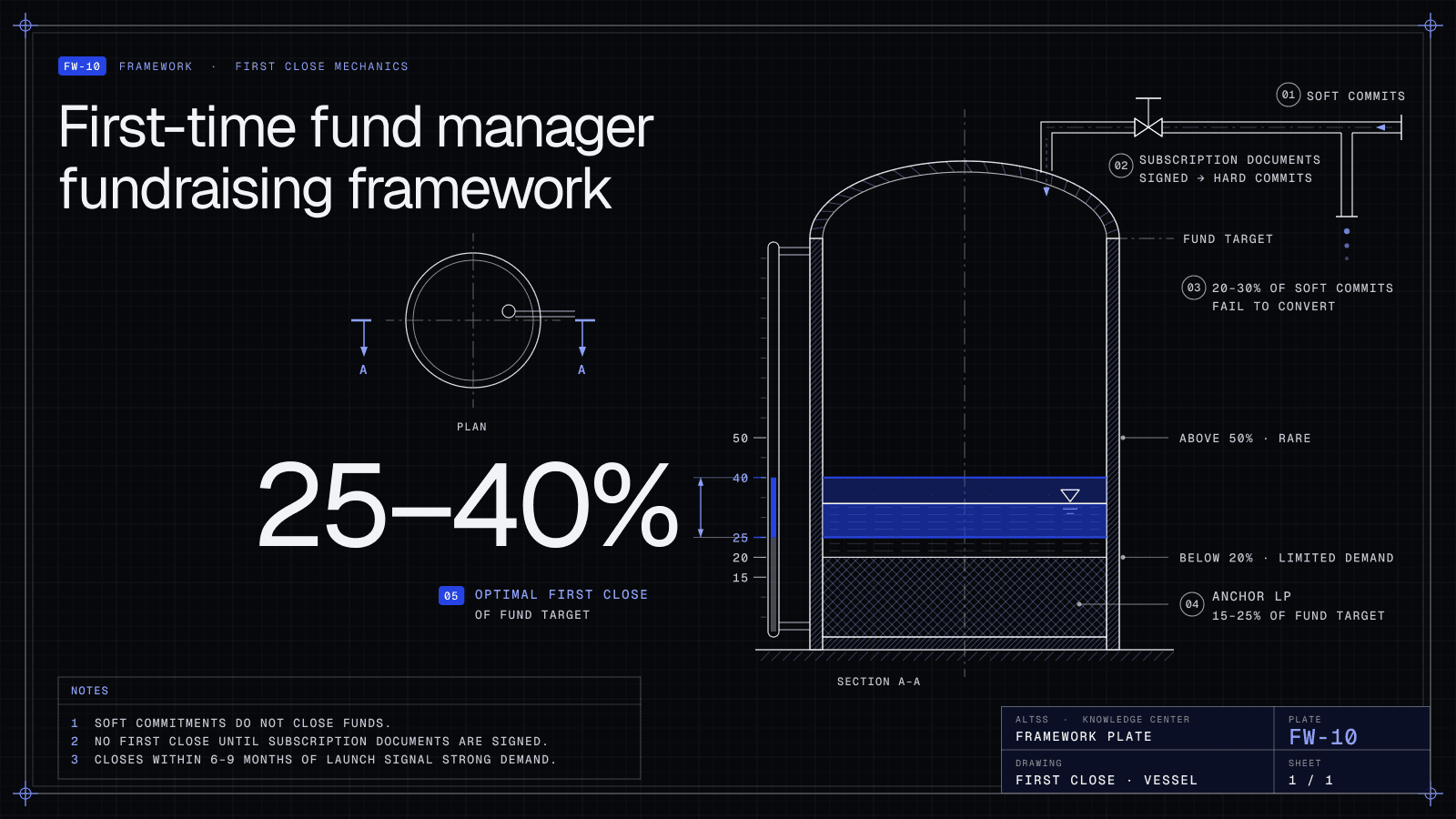
The first close represents the most critical milestone in fundraising. Altss tracking confirms that managers who reach strong first closes (25-40% of target) close funds faster and at higher amounts than managers with weak first closes. For comprehensive anchor investor guidance, see Anchor Investors for Emerging Managers.
The anchor LP
An anchor LP—typically committing 15-25% of fund target—transforms fundraising dynamics. The anchor provides capital mass that enables first close, validation signal that reduces perceived risk for subsequent LPs, often assists with introductions to other allocators, and may negotiate terms that become template for other investors.
Anchor economics vary. Some anchors request fee discounts (typically 25-50 basis points on management fee), enhanced co-investment rights, advisory committee seats, or capacity rights in successor funds. Managers should evaluate tradeoffs: an anchor accelerates timeline and validates quality, but aggressive terms create precedent that other LPs may request.
Ideal anchor profiles include fund of funds with emerging manager mandates, family offices with principal-led decision making and fast decision-making, or institutional emerging manager programs seeking differentiated access.
Converting soft commits to hard commits
Soft commitments—verbal indications of intent—do not close funds. Altss tracking shows substantial leakage between soft commit and subscription: approximately 20-30% of soft commits fail to convert to hard commitments due to changed circumstances, internal approval failures, or priority shifts.
Conversion tactics include setting specific timeline expectations at soft commit ("we're targeting first close on [date], I'll send subscription documents the week of [date]"), maintaining regular contact between soft commit and close, providing clear next steps and deadlines, addressing any lingering concerns before sending documents, and making subscription process as frictionless as possible.
Managers should not announce first close until subscription documents are signed and, ideally, capital is wired. Announced closes that slip damage credibility with pipeline LPs.
First close timing and psychology
Altss analysis of fundraising momentum reveals that first close timing significantly affects subsequent fundraising. Closes within 6-9 months of launch signal strong demand and create urgency for pipeline LPs. Closes extending beyond 12 months raise questions about market reception and may trigger LP concerns about manager quality or strategy fit.
Optimal first close reaches 25-40% of target with credible anchor participation. Closing below 20% of target suggests limited demand and may slow rather than accelerate subsequent fundraising. Closing above 50% on first close is rare but creates powerful momentum.
Post-first-close communication should emphasize progress, provide updated timeline to final close, and create appropriate urgency without appearing desperate. Pipeline LPs should feel they have a window to participate before capacity fills.
Data room organization
Altss tracking of LP diligence patterns reveals that data room quality directly affects diligence timeline and LP perception. Disorganized or incomplete data rooms extend processes by 4-8 weeks and signal operational weakness.
Required documents
Fund documents include draft or final Limited Partnership Agreement, Private Placement Memorandum, subscription agreement template, and summary of key terms.
Track record materials include deal-by-deal attribution analysis with investment date, exit date (if applicable), returns, and specific GP role; track record summary with aggregate performance metrics including TVPI and DPI; case studies on 3-5 representative investments with detailed value creation narrative; and loss analysis on any investments below 1.0x with lessons learned.
Operational documents include compliance manual and code of ethics, valuation policy, cybersecurity policy and incident response plan, business continuity plan, and organizational chart with team biographies.
Service provider information includes fund administrator confirmation and contact, auditor engagement letter, legal counsel confirmation, and compliance officer (internal or outsourced) details.
Diligence support materials include reference list with contact information (prepare 8-10 references expecting LPs to call 3-5), sample quarterly report from prior vehicle or template for new fund, and LP reporting calendar with expected deliverables.
Financial information includes pro forma fund budget, GP entity financials if applicable, and management fee calculation methodology.
Organization principles
Structure the data room by category with clear folder hierarchy. Use consistent naming conventions with dates. Include a master index document explaining contents. Update materials promptly when terms change or new information becomes available. Track LP access to understand which documents receive attention and which LPs are actively engaged.
Remove or explain any inconsistencies across documents—LPs conducting serious diligence will identify discrepancies and interpret them as sloppiness or intentional obfuscation.
The rejection taxonomy
Not all rejections are equal. Altss analysis of LP feedback patterns identifies distinct rejection types with different implications for re-engagement.
Timing rejections
"We've already committed our budget for this vintage" or "we're not looking at new managers until next year" reflects genuine capacity constraint rather than quality judgment. These LPs may be strong prospects for Fund II or, if timeline extends, later in Fund I process. Response: confirm when budget refreshes, ask to reconnect at appropriate time, maintain quarterly contact with brief updates. For more on how allocators plan commitments, see commitment pacing.
Fit rejections
"Your strategy doesn't match our mandate" or "we focus on different stages/sectors/geographies" reflects structural mismatch rather than quality judgment. These rejections are valuable information—the LP should not have been in the pipeline, indicating targeting methodology needs refinement. Response: accept gracefully, ask if they know others who might be better fit, remove from active pipeline but retain for potential future strategy evolution.
Capacity rejections
"Your fund is too small for our minimum check" or "we can't make the economics work at this size" reflects genuine constraint. Minimum check sizes exist for operational efficiency—managing a $500K position requires similar diligence and monitoring as a $5M position. Response: ask about Fund II interest if successful, inquire about affiliated vehicles with smaller minimums, or accept the mismatch.
Conviction rejections
"We're not convinced on the strategy" or "we have concerns about the team" reflects substantive judgment. These rejections warrant careful attention: is the concern idiosyncratic to this LP, or does it reflect broader market perception? Response: probe for specific concerns, address if possible, and evaluate whether multiple conviction rejections indicate positioning or presentation problems requiring adjustment.
Process failures
"We ran out of time" or "we couldn't get internal alignment" reflects LP organizational dynamics rather than manager quality. These situations often indicate the internal champion lacked sufficient conviction or capital to push through approval. Response: understand what happened internally, evaluate whether re-engagement is worthwhile, and learn what would have strengthened the internal case.
Reference call preparation
Altss tracking confirms that reference calls significantly influence LP decisions—a strong reference can accelerate commitment while a weak reference can derail an otherwise positive process. Managers should treat reference preparation with the same rigor as direct LP engagement.
Who LPs call
LPs conduct references across multiple categories: co-investors from prior deals to assess collaboration and judgment, portfolio company executives to assess value-add and board behavior, former colleagues to assess character and capability, service providers to assess professionalism and operational competence, and other LPs (often through back-channel) to assess reputation and process quality.
Managers should prepare 8-10 references expecting LPs to call 3-5 directly plus conduct back-channel references the manager cannot control.
What LPs ask
Standard reference questions probe several areas. On judgment: "Tell me about a time they were wrong and how they handled it." On collaboration: "How did they behave when deals got difficult or went sideways?" On integrity: "Would you invest with them again? Would you work with them again?" On value-add: "What specifically did they contribute beyond capital?" On weaknesses: "What should I know that might not be obvious from meeting them?"
LPs are skilled at detecting coached references. Authentic responses with specific examples carry more weight than generic praise.
Preparing references
Contact each reference before providing their information to LPs. Brief them on the fund strategy and positioning. Remind them of specific deals or interactions that demonstrate relevant qualities. Ask if they have any concerns they would raise—better to know before an LP calls than after. Thank them for their willingness to support the fundraise.
For portfolio company executives, ensure they understand the importance of the reference and are prepared to speak specifically about the manager's board contribution, strategic input, and behavior during challenging periods.
Monthly update framework
Altss tracking shows that managers who maintain consistent communication with pipeline LPs close faster than those who go silent between meetings. Monthly updates sustain engagement, demonstrate execution, and create natural touchpoints for re-engagement.
Update content
Effective monthly updates include fundraising progress (capital committed, notable LP additions without naming names if sensitive, timeline to next close), portfolio activity (new investments, follow-ons, material developments at existing companies, exits or markups), market perspective (brief observations on sector, geography, or deal flow relevant to strategy), and forward outlook (anticipated activity in coming month, any changes to timeline or process).
Updates should be concise—one page maximum—and factual rather than promotional. LPs receive hundreds of manager communications; brevity demonstrates respect for their time.
Update distribution
Send updates to all LPs in active pipeline (post-intro-call), soft commits awaiting documentation, committed LPs, and warm prospects who expressed interest in staying informed.
Do not send updates to LPs who explicitly declined or those who never responded to initial outreach—this appears tone-deaf and wastes credibility.
Timing and format
Send updates in the first week of each month covering prior month activity. Use consistent format so LPs can quickly scan for relevant information. Plain text email performs better than elaborate HTML or PDF attachments, which may trigger spam filters or go unread.
Seeder and anchor economics
Altss tracking of emerging manager formations shows increasing seeder involvement as fundraising has become more challenging. Understanding seeder economics helps managers evaluate whether this path makes sense.
Seeder structures
Seeders provide launch capital—typically $20-75M—in exchange for participation in GP economics. Standard seeder terms include revenue share of 10-25% of management fees and carried interest for a defined period (often 10-15 years or 2-3 funds), sometimes with declining participation over time as the manager scales.
Some seeders take direct GP equity stakes rather than revenue share, aligning them as permanent partners rather than temporary capital providers. Equity stakes typically range from 10-30% depending on capital provided and manager leverage.
Evaluating seeder tradeoffs
Seeders provide immediate benefits: launch capital that enables first close, operational support and infrastructure, brand association that may reduce LP perceived risk, and often LP introductions from seeder relationships.
Seeders create long-term costs: permanent dilution of GP economics reduces personal wealth creation from successful fund series, loss of full control over strategic decisions if seeder has governance rights, and potential perception issues if LPs view seeder involvement as signal of weakness.
Altss analysis suggests seeder economics make sense when manager has strong track record but limited personal network for fundraising, when market conditions make standalone fundraising extremely difficult, when manager prioritizes speed to market over long-term economics, or when seeder provides genuine value-add beyond capital (operational support, LP relationships, brand).
Seeder economics make less sense when manager has strong existing LP relationships, when fund size is small enough to raise from personal network, when manager has high confidence in standalone fundraising success, or when seeder terms are aggressive relative to capital provided.
Negotiating seeder terms
Seeder terms are negotiable. Key negotiation points include revenue share percentage and duration, sunset provisions that reduce or eliminate participation after certain milestones, governance rights and approval requirements, exclusivity provisions limiting manager's ability to raise from other sources, and performance hurdles that adjust economics based on fund outcomes.
Managers with multiple seeder options have leverage; managers with single interested seeder have limited negotiating position. The best negotiating leverage comes from demonstrable LP interest that suggests standalone fundraising is viable.
Placement agent decision framework
Altss tracking shows approximately 30-40% of emerging manager raises involve placement agents. Understanding when agents add value—and when they don't—helps managers make informed decisions. For comprehensive guidance on raising without agents, see How to Raise a Fund Without a Placement Agent.
What placement agents provide
Agents provide LP access through established relationships with allocators, process management including scheduling, follow-up, and documentation coordination, market intelligence on LP appetite, competitive positioning, and term expectations, and credibility signal as reputable agents screen managers before engagement.
Agent economics
Standard placement agent fees run 2% of capital raised from agent-introduced LPs, plus ongoing "tail" provisions covering capital from those LPs in successor funds (typically at reduced rate of 1% for Fund II, 0.5% for Fund III). Some agents charge retainers ($10-25K per month) against future success fees.
For a $50M raise, agent fees on agent-sourced capital might total $500K-1M over the fund series—meaningful economics that reduce GP take.
When agents add value
Agents add value when manager lacks LP relationships in target segments, when strategy requires accessing institutional LPs with high barriers to cold outreach, when manager's time is better spent on investment activity than fundraising process, or when market conditions are difficult and agent relationships can unlock otherwise unavailable capital.
Agents add less value when manager has strong existing LP relationships, when target fund size is achievable from personal network, when target LPs are primarily HNWIs and family offices accessible through direct relationship-building, or when agent's LP relationships don't match manager's target profile.
Selecting agents
Evaluate agents on LP relationship quality and relevance to your strategy, track record with similar managers (fund size, strategy, vintage), team continuity and specific individuals who would work on your fundraise, terms relative to market, and reference feedback from managers they've represented.
Avoid agents who promise unrealistic outcomes, who cannot name specific LPs they would approach, who lack recent experience with your fund size and strategy, or whose references report poor service or communication.
Fund II positioning
Altss analysis of successor fund fundraising reveals that Fund II preparation begins during Fund I execution—not after Fund I close. Managers who position for Fund II from day one raise faster and larger successor funds.
What LPs evaluate for Fund II
Fund II evaluation focuses on execution evidence: did the manager do what they said they would? Key evaluation areas include deployment pace (invested on schedule without forcing or rushing), portfolio construction (concentration, diversification, and check sizes match stated strategy), early performance signals (markups, write-offs, and trajectory), LP experience (reporting quality, communication, responsiveness to questions), and operational maturity (has infrastructure scaled appropriately).
Fund I behaviors that enable Fund II
Consistent, high-quality reporting builds LP confidence in operational capability. Proactive communication about challenges demonstrates honesty and judgment. Thoughtful capital calls that respect LP cash management create goodwill. Delivering on stated strategy without material drift validates manager discipline. Building relationships beyond the transaction—understanding LP portfolios, providing market insight, making valuable introductions—creates partnership dynamic rather than transactional relationship.
Timing Fund II
Optimal Fund II launch typically occurs when Fund I is 60-80% deployed and early portfolio signals are visible. Launching too early (under 50% deployed) raises questions about deployment pace and portfolio construction. Launching too late (fully deployed for extended period) may leave performance questions unanswered and create timeline pressure.
For a typical 4-5 year investment period, Fund II launch often occurs in years 3-4 of Fund I. Managers should begin Fund II preparation 12-18 months before formal launch—the same pre-launch relationship-building that enables Fund I success.
Operational due diligence requirements
Operational due diligence has become deal-breaker for sophisticated LPs. Altss tracking of LP diligence patterns shows four in five North American allocators have increased operational scrutiny. Research indicates approximately 50% of fund failures stem from operational risk rather than investment underperformance. The data shows 56% of allocators consider institutional-grade service providers minimum requirements, with nearly three-quarters viewing absent independent fund administration as immediate disqualification. For family office-specific diligence considerations, see the Family Office Due Diligence Process Framework.
ILPA DDQ 2.0 alignment
The ILPA Due Diligence Questionnaire 2.0 represents industry-standard framework for LP evaluation across 20 sections: firm general information, fund general information, succession planning and key persons, investment strategy, co-investments, GP-led secondaries and continuation funds, credit facilities, investment process, team, alignment of interests, market environment, fund terms, firm governance and risk and compliance, track record, accounting and valuation, reporting, legal, data security and technology, ESG, and diversity equity and inclusion.
First-time managers should prepare comprehensive responses before fundraising begins—reactive preparation during diligence creates delays and signals operational immaturity.
Critical documentation requirements
Organizational structure and ownership requires ownership charts with percentage stakes and vesting schedules, organizational charts showing management structure, and disclosure of outside business activities or time commitments.
Investment process documentation requires deal sourcing methodology, screening and diligence process with typical timeline, investment committee composition and decision-making authority, portfolio monitoring policy, and exit strategy criteria with historical analysis.
Valuation governance requires written valuation policy following IPEV guidelines, valuation committee composition and authority, third-party valuation provider usage, and historical mark-to-exit accuracy data.
Compliance infrastructure requires code of conduct, conflicts of interest policy, personal trading policy, AML/CFT procedures, political and charitable contributions policy, and whistleblower protections.
Cybersecurity and business continuity requires cyber/information security policy preferably aligned with NIST or ISO 27001, business continuity plan, disaster recovery plan, penetration testing frequency and results, and incident response procedures.
Red flags by severity
Tier 1 (immediate disqualification): self-administered fund without independent oversight, no written valuation policy, undisclosed conflicts of interest, regulatory violations or ongoing investigations, no cybersecurity policy or incident response plan.
Tier 2 (likely rejection without remediation): no third-party fund administrator, auditor with limited fund experience, no formal compliance function, inconsistent documentation across materials, no business continuity planning.
Tier 3 (concerns requiring explanation): auditor rotation within past two years, key person departure during fundraising, material changes from predecessor fund terms, limited third-party valuation usage, sparse ESG/DEI policies.
Tier 4 (improvement areas, not disqualifying): limited ILPA template adoption, basic rather than comprehensive policies, minimal technology infrastructure, developing rather than mature reporting.
The secondary market context
Understanding secondary market dynamics provides critical context for first-time managers, both as framework for LP liquidity evaluation and as pathway understanding that sophisticated LPs expect.
Altss tracking shows secondary transaction volume reached approximately $165 billion through Q3 2025, on pace for record year. GP-led volume hit $47 billion in H1 2025, up 68% year-over-year. Continuation vehicles represent approximately 87% of GP-led transactions. Through Q3 2025, 16% of sponsor exit volume came from GP-led secondaries, reflecting CV importance as liquidity mechanism.
Dedicated secondary dry powder reached approximately $315 billion as of Q3 2025. This capital availability creates liquidity options that sophisticated LPs evaluate when assessing managers. Nearly half of PE respondents now utilize GP-led secondaries or continuation vehicles to navigate fundraising challenges by expediting LP distributions—almost double the prior year.
For first-time managers, this context matters: LPs increasingly expect managers to understand secondary market mechanics as part of the exit toolkit. Articulating awareness of these pathways—without overpromising their availability—demonstrates market sophistication.
Common failure modes
Altss analysis of unsuccessful fundraises identifies consistent patterns that managers can avoid.
The over-targeting trap
The single most common mistake: launching with fund size targets exceeding realistic capacity. Fund size should approximate 10× confident inner circle capacity. If inner circle provides $3M confidently, realistic target is $25-35M—targeting $75M+ creates extended timeline and momentum problems. If inner circle provides $5M, realistic target is $40-50M. If inner circle provides $10M, realistic target is $75-100M.
Managers who over-target exhaust warm network at fraction of goal, then face cold outreach from position of weakness without momentum or proof points.
Pipeline mathematics
First-time fundraising requires 500+ LP touchpoints to close a fund. At 10% meeting conversion, 500+ contacts yield 50 meetings. At 20% diligence conversion, 50 meetings yield 10 processes. At 30% close conversion, 10 processes yield 3 commitments.
For a fund needing 15-20 LPs, the funnel must start with substantial scale. Managers underestimating pipeline requirements launch with inadequate prospects and exhaust universe before reaching target.
Pipeline management discipline
Effective management requires systematic tracking across stages: identified (on target list, no contact), contacted (outreach sent), engaged (meeting scheduled or held), interested (materials requested), diligence (formal process), IC ready (committee prepared), committed (verbal), closed (funded).
Top performers add bottom-of-funnel LPs to investor communication lists before commitment, creating inclusion psychology. They send monthly updates to all engaged prospects. They qualify early on fit criteria. They track conversion by LP type. They maintain "not now" prospects for Fund II.
Regional variations
United States
North America captured 68.4% of PE capital in H1 2025, well above decade average of 60.5%. The market offers deepest emerging manager ecosystem globally with most developed public pension emerging manager programs, highest family office density, SEC registration and Form ADV requirements, typical 18-24 month first-time fund timelines, and increasing diversity requirements in some programs.
US deal activity showed recovery signs: PE deal value rose roughly 8% year-over-year to approximately $195 billion in H1 2025. Dry powder dropped from record $1.3 trillion to approximately $880 billion, indicating meaningful deployment.
Europe
Europe's share rose to 25.9% of global PE capital in H1 2025. The market features higher ESG emphasis with often mandatory diligence requirements, AIFMD compliance for EU institutional marketing, strong fund of funds channel, typically longer timelines due to regulatory complexity, and key markets in UK, Germany, and Nordic countries.
European institutions are reconsidering US exposure amid policy uncertainty, with roughly one-third anticipating geographic allocation reductions.
Asia-Pacific
Asia's share collapsed to 6.3% in H1 2025 from 25.2% in 2018, reflecting geopolitical concerns and China-specific risk aversion. The market features highest relationship intensity globally, fastest SFO formation growth, higher co-investment expectations, and key markets in Singapore, Hong Kong, and Australia.
Middle East
The market features sovereign wealth fund dominance as primary institutional capital, critical multi-year relationship requirements, long-term investment orientation, key markets in UAE and Saudi Arabia, and Sharia compliance considerations for some allocators. Family offices in the region increasingly favor mid-market and lower mid-market GPs with multiple vintages generating consistent returns.
Conclusion
First-time fund fundraising in 2025-2026 demands more preparation, longer timelines, and higher standards than any period in recent memory. Typical timelines run 12-18 months under favorable conditions, frequently extending to 18-24 months. Only 12.4% of H1 2025 capital flowed to emerging managers, down from historical averages exceeding 20%. The 2.5x increase in DPI priority means managers must articulate credible liquidity pathways beyond entry thesis and value creation.
The funnel mathematics are unforgiving: approximately 1% overall conversion from target to commitment means 300+ targets to generate three investors. Every rejection is expected—persistence and systematic execution matter more than individual meeting outcomes.
Success requires realistic fund size targets at approximately 10× inner circle capacity. It requires institutional-grade operations before approaching institutional LPs with complete DDQ responses, contracted service providers, and documented policies. It requires deal-level track record attribution rather than aggregate fund returns from prior firms. It requires sequenced LP outreach from highest-probability network through progressively colder channels. It requires pipeline management discipline with systematic tracking, monthly updates, and early qualification. It requires preparation for every meeting type, from intro call through IC preparation, with understanding of what LPs actually evaluate at each stage. It requires reference preparation that treats references as extensions of the fundraising process. It requires acceptance that extended timelines and high rejection rates are normal.
The reward for navigating this environment is substantial. First-time funds that successfully close position managers for potentially decades of capital management. Historical data showing emerging manager outperformance suggests LP skepticism—while rational given information asymmetry—systematically undervalues the opportunity.
For additional fundraising guidance, see Guide to Fundraising in 2025: Five Trends Every Fund Manager Should Know.
Altss provides private-markets intelligence for investment, fundraising and institutional business development. Research organizations, people, funds and companies with ownership, commitment, transaction and relationship context. Intelligence provides research; Capital adds Fundraising OS workflows. Revenue and Agents accept scoped, manually reviewed requests. Altss is not a placement agent, broker-dealer, finder, solicitor or capital introducer. Altss does not negotiate transactions or receive transaction-based compensation. Customers control their outreach and relationships.


See the allocators behind your next close.
Public records carry source-specific dates where available. No population-wide measured refresh cadence or universal verification deadline is established here. Page modified, source captured, fact observed, entity verified and aggregate measured describe different events. Check the date attached to the relevant claim; a missing verification date means unknown. Stored source history does not establish a customer-facing historical-analysis interface.