 Alex DovzhenkoProduct Marketing & Allocator Intelligence, Altss
Family Office Deal Flow — February 2026
February 2026 family office deal flow tracker: 35+ verified deals, $195B+ deployed. Anthropic $30B, OpenAI $110B, Waymo $16B, Apptronik $520M, QIA's.
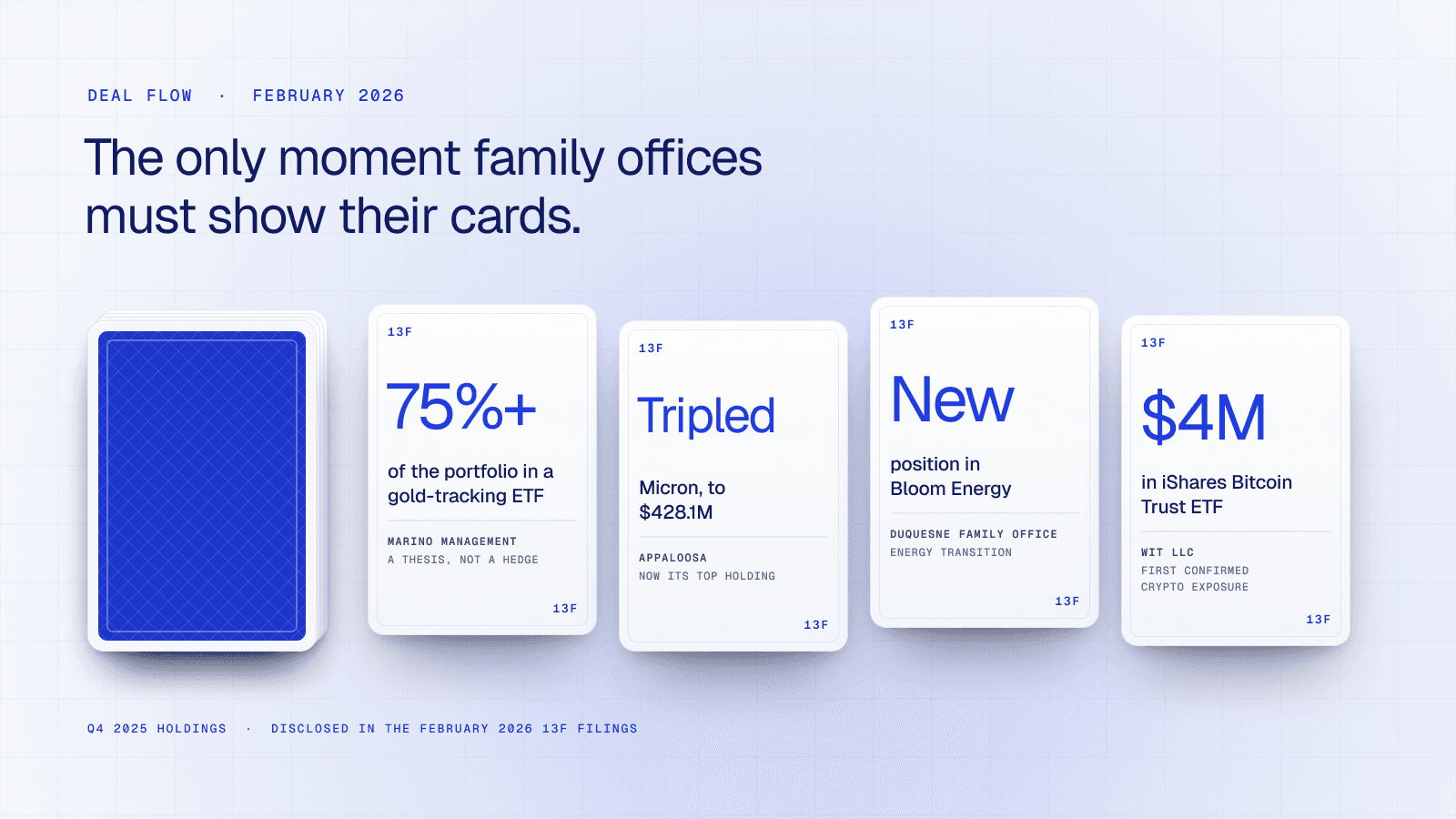
Family-office deal flow recap for February 2026 — frontier AI mega-rounds, autonomous mobility, energy infrastructure, public-market 13F disclosures, real estate capital-stack inversion, and the formation of new family offices from infrastructure wealth. What top families backed, why it matters, and signals for Q2.
TL;DR: February 2026 was the most consequential month in the history of venture finance — and family offices, sovereign-family vehicles, and billionaire-backed platforms were at the center of every defining transaction. Over $195 billion in tracked AI-related capital alone moved through the system, anchored by OpenAI's $110 billion round (the largest private financing ever), Anthropic's $30 billion Series G (with ICONIQ, Founders Fund, and MGX co-leading), and Waymo's $16 billion autonomous mobility raise (with Mubadala Capital participating). Three dynamics defined the month. First, sovereign-family capital — MGX, QIA, GIC, and Mubadala — became the structural underwriters of American AI infrastructure, collectively committing tens of billions across competing platforms. Second, 13F filings revealed how the biggest US family offices repositioned in Q4 2025: Ray Dalio loaded 75%+ into gold, David Tepper tripled his semiconductor bet, Stanley Druckenmiller went long on energy transition, and the Walton family quietly entered Bitcoin. Third, a new wave of family office formation emerged — four of six GIP founding partners launched or expanded SFOs after BlackRock's $12.5 billion acquisition, signaling that infrastructure wealth is now the fastest-growing source of new family capital. For fundraising teams, the signal is unmistakable: the capital that matters most is no longer sitting in traditional VC or PE structures. It's in sovereign-adjacent vehicles, billionaire-backed platforms, and newly formed family offices that don't appear in any legacy database.
The 8 most important family-office-backed moves of February 2026
1) Anthropic closes $30B Series G — ICONIQ, Founders Fund, and MGX co-lead the second-largest private round in history
On February 12, Anthropic closed a $30 billion Series G at a $380 billion post-money valuation — more than double its $183 billion valuation from the September 2025 Series F. GIC (Singapore's sovereign wealth fund) and Coatue Management led the round. The co-lead syndicate included D.E. Shaw Ventures, Dragoneer, Peter Thiel's Founders Fund, ICONIQ Capital, and MGX (Abu Dhabi). Additional investors included Accel, Alpha Wave Global, Appaloosa LP (David Tepper's family office), Baillie Gifford, Bessemer, BlackRock, Blackstone, D1 Capital, Fidelity, General Catalyst, Greenoaks, Goldman Sachs Growth Equity, Insight Partners, Jane Street, JPMorgan Chase, Lightspeed, Menlo Ventures, Morgan Stanley Investment Management, QIA (Qatar Investment Authority), Sands Capital, Sequoia, and Temasek. The round also included portions of previously announced commitments from Microsoft and Nvidia.
Why it matters
Three family-capital vehicles co-led a $30 billion round — and that's the story. ICONIQ Capital, the multi-family office platform managing wealth for Mark Zuckerberg, Sheryl Sandberg, Jack Dorsey, and others, co-led its second consecutive mega-round for Anthropic after helping lead the $13 billion Series F. Peter Thiel's Founders Fund co-led alongside its principal's personal investment in Etched just one month earlier — confirming that Thiel's capital is now split across competing AI infrastructure bets, with fund capital going to Anthropic and personal capital going to Nvidia alternatives. MGX's co-lead position in Anthropic, one month after co-investing in xAI's $20 billion round, makes Abu Dhabi's sovereign-adjacent vehicle the single most active non-US participant in frontier AI — it has now written checks into both leading foundation model companies within sixty days.
The inclusion of Appaloosa LP (Tepper's family office) as a named investor in a venture-stage round is notable. Tepper's office is best known for public-market macro bets — his Q4 2025 13F showed a tripled position in Micron. A pre-IPO allocation to Anthropic at $380 billion signals that the most sophisticated macro family offices are now treating frontier AI companies as infrastructure-grade assets, not venture bets. For GPs raising AI-adjacent vehicles, the Anthropic syndicate is no longer just a VC cap table — it's a map of which sovereign, institutional, and family-capital vehicles are willing to write nine- and ten-figure checks into pre-revenue AI platforms.
For fundraising teams: Anthropic's run-rate revenue reached $14 billion, growing over 10x annually. Eight of the Fortune 10 are now Claude customers. Over 500 businesses spend more than $1 million annually with the company. These are the metrics that converted family offices from participants to co-leads. If you're raising around enterprise AI, this is the bar your portfolio companies will be measured against.
2) OpenAI raises $110B — sovereign and strategic capital underwrites the largest private funding round ever recorded
On February 27, OpenAI closed the largest private financing in history: $110 billion at a $730 billion pre-money valuation. Amazon invested $50 billion (with $15 billion committed upfront and $35 billion contingent on milestones), Nvidia invested $30 billion, and SoftBank invested $30 billion. The round remains open, with additional financial investors — including sovereign wealth funds — expected to join. OpenAI disclosed that it has spent the past two weeks meeting with sovereign wealth funds about adding another $10 billion.
Why it matters
The family-office signal isn't in the headline participants — it's in the secondary market dynamics this round creates. OpenAI's $840 billion post-money valuation (including capital raised) makes it the most valuable private company in history. The active solicitation of sovereign wealth funds for the remaining allocation means QIA, PIF, Mubadala, ADIA, and GIC are all evaluating whether to participate alongside Amazon, Nvidia, and SoftBank. For family offices with sovereign adjacency, this round defines the competitive landscape: if your target sovereign allocator commits $5–10 billion to OpenAI, that capital is unavailable for your fund. For GPs raising AI-focused vehicles and pitching Gulf or Asian sovereigns, understand that OpenAI's fundraise is actively competing for the same allocable dollars.
The round also has implications for family offices managing secondary-market positions. OpenAI's nonprofit foundation, now valued at over $180 billion, may pursue secondary sales to fund philanthropic programs — creating a potential liquidity event that family offices with existing OpenAI positions should be monitoring. For placement agents working the sovereign circuit, the next 90 days are a window where AI allocation budgets will be substantially committed or exhausted.
3) Waymo raises $16B — Mubadala and BDT & MSD Partners back the physical AI scale-up
On February 2, Waymo closed a $16 billion funding round at a $126 billion post-money valuation. Dragoneer Investment Group, DST Global, and Sequoia Capital led the round. Alphabet maintained its position as majority investor. The syndicate included Andreessen Horowitz, Mubadala Capital (the asset management subsidiary of Abu Dhabi's sovereign wealth fund), Bessemer Venture Partners, Silver Lake, Tiger Global, T. Rowe Price, BDT & MSD Partners, CapitalG, Fidelity, GV, Kleiner Perkins, Perry Creek Capital, and Temasek.
Why it matters
BDT & MSD Partners — the merchant bank formed by the 2023 merger of Byron Trott's BDT Capital Partners (which historically advised and invested alongside many of the world's wealthiest families including the Pritzkers, Mars family, and Koch family) and Michael Dell's MSD Partners — participated in the round. BDT & MSD operates at the intersection of family capital advisory and principal investing, making its presence in a $16 billion autonomous mobility round a signal that the firm's family-office client base is being offered co-investment access to physical AI infrastructure at scale. For GPs targeting BDT & MSD's client network for autonomous mobility or transportation infrastructure vehicles, the Waymo position is now the benchmark they'll use to evaluate competing opportunities.
Mubadala Capital's participation — in addition to MGX's simultaneous AI investments — confirms that Abu Dhabi is deploying through multiple sovereign vehicles across different AI verticals. Mubadala in autonomous mobility, MGX in foundation models. For fundraising teams building Gulf relationships, mapping which vehicle covers which mandate is now critical to avoiding wasted meetings. Waymo disclosed more than 400,000 rides per week across six US metro areas and plans to expand to 20 additional cities in 2026, including Tokyo and London. At $350 million in annual recurring revenue, the $126 billion valuation implies the market is pricing autonomous mobility as infrastructure, not software.
4) Emerson Collective backs World Labs' $1B round — Laurene Powell Jobs bets on spatial intelligence
On February 18, World Labs — the spatial intelligence startup founded by AI pioneer Fei-Fei Li — raised $1 billion in new funding. Investors included AMD, Autodesk ($200 million), Andreessen Horowitz, Emerson Collective, Fidelity Management & Research Company, Nvidia, and Sea. Valuation was not disclosed, though Bloomberg previously reported discussions at approximately $5 billion.
Why it matters
Emerson Collective — Laurene Powell Jobs's family office and impact platform — was notably absent from January 2026 deal flow (its last confirmed investment was Chai Discovery in December 2025). Its return to active deployment via World Labs is significant for two reasons. First, Emerson Collective's participation in a spatial AI round signals that the family office's AI thesis has expanded beyond language models into physical-world understanding — the same migration pattern we tracked for Bezos Expeditions (robotics) and Thiel (custom silicon) in January. Second, World Labs' investor list places Emerson Collective alongside strategic investors (AMD, Nvidia, Autodesk) rather than traditional VC syndicate members, suggesting the family office is deliberately positioning in deals where strategic relationships — not just financial returns — create long-term value.
For GPs raising around 3D AI, spatial computing, robotics simulation, or world models: Emerson Collective's check into World Labs is the first confirmed family-office allocation to spatial intelligence specifically. It opens a new category for family-capital targeting that didn't exist as a distinct LP conversation six months ago.
5) 13F disclosures reveal how the biggest family offices repositioned in Q4 2025 — and what it signals for Q1
The February 2026 13F filing season — covering Q4 2025 positions — delivered the most comprehensive public window into family-office allocation thinking since Altss began tracking these disclosures.
Ray Dalio's family office disclosed its US stock investments for the first time since the pandemic. Marino Management (the Dalio family office operating entity) reported approximately $503 million in US equities as of year-end — a roughly one-third increase from early 2021. Over 75% of the portfolio was allocated to a gold-tracking ETF (SPDR Gold Trust, ~$438.5 million), with smaller positions in US Treasury ETFs and S&P 500 index funds. The portfolio also now includes ETFs covering developed and emerging markets — nearly a dozen total positions, up from just two gold-related ETFs previously. Dalio told CNBC in early February: "Perhaps central banks or governments or sovereign wealth funds should say, 'What percentage of my portfolio should I have in gold?'" Dalio has resumed direct management of his family office's investments after hiring Steven Kryger (former Bridgewater research team lead) as co-CIO and Alma DeMetropolis (former Morgan Stanley) as deputy CEO.
David Tepper's Appaloosa tripled its Micron position to $428.1 million, making it the firm's top holding. Micron shares surged roughly 50% from the start of 2026 — a bet on AI data center memory demand that has already paid off substantially.
Stanley Druckenmiller's Duquesne Family Office initiated a new position in Bloom Energy, a fuel-cell company that has risen more than 100% year-to-date. This follows Duquesne's January participation in Cellares' $257 million Series D — confirming a dual thesis across energy transition and healthcare manufacturing automation.
The Walton family's WIT LLC made a $4 million allocation to iShares Bitcoin Trust ETF — constituting less than 1% of the portfolio. The Walton family was notably absent from January deal flow. This small but symbolically significant Bitcoin position represents the first confirmed crypto exposure from America's wealthiest family.
Leon Cooperman's Omega Advisors increased its stake in Manchester United during Q4, continuing the pattern of family offices treating sports franchises as long-duration alternative assets.
The Longbow SA (Rausing family) downsized positions in Amazon, Nvidia, Microsoft, Apple, Alphabet, and Meta — a notable de-risking from the Magnificent Seven trade by one of Europe's most private industrial dynasties.
Why it matters
The 13F cycle is the only moment when family offices are legally required to show their cards. February's disclosures reveal three structural shifts. First, Dalio's 75%+ gold allocation isn't a hedge — it's a thesis. When the most prominent macro investor in history dedicates three-quarters of his disclosed portfolio to a single commodity, it tells you something about how the most sophisticated family capital views the next three to five years: inflation-hedged, sovereign-risk-aware, and deeply skeptical of AI valuations. Second, the Tepper/Druckenmiller/Duquesne moves collectively signal that macro family offices are not sitting out the AI trade — they're accessing it through the picks-and-shovels layer (Micron memory chips, Bloom Energy fuel cells, Cellares manufacturing automation) rather than writing checks directly into pre-revenue foundation model companies. Third, the Walton family's Bitcoin ETF position, however small, crosses a symbolic threshold: the family behind Walmart — the world's largest company by revenue — now has digital asset exposure. For crypto-native fund managers, that data point alone changes the LP conversation.
6) Breakthrough Energy Ventures co-leads Heron Power's $140M — then halts its Catalyst fund
On February 18, Breakthrough Energy Ventures co-led Heron Power's $140 million Series B alongside Andreessen Horowitz's American Dynamism Fund. Capricorn Investment Group, Energy Impact Partners, Valor Atreides AI Fund, and Gigascale Capital also participated. Heron Power, founded by former Tesla executive Drew Baglino (who spent 18 years at Tesla leading powertrain and energy groups), is building solid-state transformers for data centers and grid modernization, with 50 gigawatts of orders already lined up.
One day earlier, on February 17, Bloomberg reported that Breakthrough Energy's Catalyst fund — a separate $1 billion+ vehicle focused on scaling first-of-their-kind green technologies — had suspended new investments and laid off staff. The Catalyst fund had supported 10 startups and deployed hundreds of millions of dollars since its 2021 launch.
Why it matters
The juxtaposition is the insight. BEV co-leads a $140 million energy infrastructure round on the same day its Catalyst fund halts new deployments. This isn't contradiction — it's capital-structure triage. The Catalyst fund focused on commercial-scale demonstration projects for unproven technologies — exactly the category that faces headwinds under the current US policy environment. BEV's venture arm, by contrast, is doubling down on proven energy hardware (solid-state transformers) with immediate commercial demand driven by AI data center buildout.
For climate founders: the implication is that "climate tech" is no longer a single category in family-office allocation frameworks. It has split into two distinct buckets — AI-adjacent energy infrastructure (where capital is flowing aggressively) and standalone climate demonstration projects (where capital is contracting). Heron Power's 50 gigawatts of committed orders and its positioning at the AI-energy intersection attracted BEV's capital even as the organization's broader climate mandate was being constrained. If you're raising around energy infrastructure that directly serves the AI compute buildout, the capital environment is historically strong. If your thesis requires policy support or pre-commercial scale-up funding, the window has narrowed.
7) Gencom's NYC luxury hotel acquisitions show family offices now fund majority of real estate capital stacks
Bloomberg reported on February 24 that Gencom, a Miami-based real estate developer and operator, has acquired two New York City luxury hotels in the past four months funded primarily by family offices. According to Gencom CIO Alessandro Colantonio, family offices historically comprised approximately 20% of the firm's capital pool — that figure has now exceeded 50%, with the most recent deals almost entirely driven by wealthy families.
Why it matters
This is the data point that real estate GPs and placement agents should study carefully. A capital-stack inversion — from family offices as minority co-investors to family offices as majority funders — represents a structural shift in how luxury hospitality deals get financed. The traditional model of institutional LP capital anchoring a real estate fund, with family offices filling out the syndicate, is inverting in trophy-asset categories. Family offices are now the price-setters, the governance-setters, and the timeline-setters in deals where they provide the majority of equity.
For real estate fund managers: this changes your fundraising math. If family offices are willing to fund 50–100% of deal-level capital stacks directly, the value proposition of a blind-pool fund structure has to be compelling enough to justify the fee load versus direct co-investment access. The Gencom example suggests that in luxury hospitality specifically, family offices prefer deal-by-deal participation with manager selection rather than fund commitments. Your fundraising materials need to answer the question: "Why should I commit to your fund when I can access this deal directly and keep the economics?"
8) GIP founders launch family offices post-BlackRock acquisition — infrastructure wealth creates new SFO formation wave
Bloomberg reported on February 12 that at least four of Global Infrastructure Partners' six founding partners have started or expanded family offices since BlackRock acquired GIP for approximately $12.5 billion. This represents a significant wave of new single-family-office formation from a single liquidity event — and it's happening in a sector (infrastructure) that is currently attracting the largest capital flows in market history.
Why it matters
The GIP-to-family-office pipeline illustrates a pattern that Altss tracks systematically: major liquidity events create new family offices, and those new family offices deploy capital into the sectors they know best. GIP's founders built their careers and fortunes in infrastructure — ports, airports, energy, data centers. Their family offices will almost certainly allocate disproportionately to infrastructure-adjacent opportunities, creating a new buyer pool for GPs raising around energy transition, data center development, transportation, and related themes. These newly formed SFOs are invisible to legacy databases. They don't have websites, they don't attend conferences yet, and their investment mandates are still being formalized. For fundraising teams, the actionable intelligence is: when a major PE or infrastructure exit creates $1 billion+ in individual wealth, track the principals' next moves. The family office formation typically follows within 12–24 months, and the first few allocations often go to managers who establish the relationship early.
Physical AI became the dominant family-capital allocation theme
February's deal flow confirmed that physical AI — autonomous vehicles, robotics, spatial intelligence, and embodied AI systems — has replaced enterprise SaaS as the default growth-equity thesis for family offices deploying into technology.
Waymo ($16 billion, Mubadala and BDT & MSD Partners participating), Wayve ($1.2 billion Series D on February 25, backed by Baillie Gifford, Ontario Teachers' Pension Plan, and SoftBank Vision Fund 2, with Mercedes-Benz, Nissan, and Stellantis investing as strategic partners), and Waabi ($750 million Series C in late January/early February, with a subsidiary of the Abu Dhabi Investment Authority participating) collectively raised over $18 billion for autonomous systems in a single month.
But the physical AI story extends well beyond autonomous vehicles. Apptronik closed a $520 million Series A-X extension on February 11 — bringing its total Series A to over $935 million and total capital raised to nearly $1 billion — for humanoid robotics. QIA (Qatar Investment Authority) participated alongside Google, Mercedes-Benz, B Capital, PEAK6, AT&T Ventures, and John Deere, at roughly three times the original Series A valuation ($5.3 billion post-money). Apptronik's Apollo humanoid is already deployed in pilot programs with Mercedes-Benz, GXO Logistics, and Jabil, with a strategic partnership with Google DeepMind to integrate Gemini Robotics. Skyryse raised over $300 million in Series C funding on February 3, again with QIA participation alongside Fidelity, Autopilot Ventures, Atreides Management, Baron Capital, Durable Capital Partners, Positive Sum, and RCM Private Markets Fund (managed by Rokos Capital Management). The aviation automation startup — which replaces dozens of mechanical flight controls with a single AI-powered flight operating system — is now valued at $1.15 billion and has contracts with United Rotorcraft, Air Methods, and Mitsubishi Corporation. Bedrock Robotics raised $270 million in Series B on February 4, co-led by CapitalG (Alphabet's growth fund) and the Valor Atreides AI Fund, with Tishman Speyer, NVentures (Nvidia's venture arm), 8VC, Eclipse, and MIT investing. The autonomous construction company — founded by former Waymo engineers — is building retrofit kits that turn existing excavators and heavy machinery into autonomous systems, with a $1.75 billion valuation and contracts with Sundt Construction, Zachry Construction, and Champion Site Prep. Tishman Speyer's participation is particularly telling: one of the world's largest commercial real estate developers is investing directly in the technology that will automate its own construction sites. And Einride — the Swedish autonomous freight company — secured a $113 million oversubscribed PIPE ahead of its NYSE listing via SPAC merger, backed by EQT Ventures and a major US West Coast asset manager, adding European autonomous mobility to the physical AI capital cluster.
Add World Labs ($1 billion, with Emerson Collective) and the continuation of January patterns from Skild AI and Field AI, and the picture is unmistakable: family offices and sovereign vehicles that built generational wealth in physical-world businesses — shipping, automotive, manufacturing, energy, construction — are recognizing that AI's next phase will be defined by machines that move through three-dimensional space, not software that processes text. The total capital deployed into physical AI in February alone exceeds $22 billion across nine confirmed deals. The check sizes are massive, the holding horizons are multi-decade, and the due diligence questions center on physics, safety, and regulatory pathways — not user growth curves.
For GPs raising around robotics, autonomous systems, or physical AI infrastructure: the LP target list should now prominently feature industrial dynasty family offices (Agnelli/Exor, A.P. Moller, Pritzker), sovereign-adjacent vehicles (Mubadala, ADIA subsidiaries, QIA), and family-office advisory platforms (BDT & MSD) that can aggregate client capital into these deals. Note that QIA alone participated in Anthropic, Apptronik, and Skyryse in a single month — spanning foundation models, humanoid robotics, and aviation autonomy — making Qatar's sovereign vehicle the most diversified physical AI investor in the February cycle.
Sovereign-family capital deepened its grip on American technology
February made explicit what January hinted at: sovereign-adjacent vehicles from the Gulf are now the structural underwriters of American AI infrastructure. The numbers are staggering:
MGX (Abu Dhabi) co-led Anthropic's $30 billion round one month after participating in xAI's $20 billion round and acquiring 15% of TikTok US. QIA (Qatar) didn't just participate in Anthropic's round — it invested in three additional February deals: Apptronik's $520 million humanoid robotics extension, Skyryse's $300 million aviation autonomy round, and built on its January $25 billion MoU with Goldman Sachs and its xAI participation. That makes QIA the most diversified sovereign technology investor in February by deal count — covering foundation models, humanoid robotics, and aviation automation in a single month. GIC (Singapore) led Anthropic's round alongside Coatue, deploying sovereign capital at foundation-model-layer scale. Mubadala Capital participated in Waymo's $16 billion round, extending Abu Dhabi's AI infrastructure positioning into autonomous mobility. A subsidiary of ADIA participated in Waabi's funding. And OpenAI spent the final weeks of February actively soliciting sovereign wealth funds for an additional $10 billion.
The total disclosed sovereign-family capital committed to American AI companies in January–February 2026 exceeds $100 billion. For GPs raising AI-focused vehicles, the competitive landscape has fundamentally changed: sovereign-adjacent vehicles are no longer LP targets — they're co-investors and, increasingly, competitors for allocation in the highest-profile cap tables. Fundraising strategies must account for this reality.
Additional verified deals worth tracking
Apptronik closed a $520 million Series A-X extension on February 11, with QIA, Google, Mercedes-Benz, B Capital, PEAK6, AT&T Ventures, and John Deere participating. The Austin-based humanoid robotics company's total Series A now exceeds $935 million at a $5.3 billion valuation — roughly three times its 2025 Series A price. Apptronik's Apollo humanoid is deployed with Mercedes-Benz, GXO Logistics, and Jabil, and the company has a strategic partnership with Google DeepMind on Gemini Robotics integration. CEO Jeff Cardenas expects orders for $1 billion worth of robots starting in 2027 at approximately $80,000 per unit annually. QIA's participation alongside industrial strategics (Mercedes-Benz, John Deere) signals that Gulf sovereign capital is now evaluating humanoid robotics as an infrastructure-grade investment.
Skyryse raised over $300 million in Series C funding on February 3, led by Autopilot Ventures with QIA, Fidelity Management & Research, Atreides Management, BAM Elevate, Baron Capital, Durable Capital Partners, Positive Sum, RCM Private Markets Fund (managed by Rokos Capital Management), and Woodline Partners participating. The aviation automation company — which replaces mechanical flight controls with its SkyOS operating system — reached a $1.15 billion valuation. Skyryse has contracts with United Rotorcraft, Air Methods, and Mitsubishi Corporation, and its system is being integrated on US military Black Hawk helicopters. Rokos Capital Management's participation through its RCM fund is noteworthy — Sir Chris Rokos's macro-focused platform rarely appears in venture syndicates, suggesting the trade has a macro-risk or defense-infrastructure dimension that attracted attention beyond typical VC.
Bedrock Robotics raised $270 million in Series B on February 4, co-led by CapitalG and Valor Atreides AI Fund, with Tishman Speyer, NVentures, 8VC, Eclipse, Emergence Capital, Perry Creek Capital, MIT, Georgian, Incharge Capital, and C4 Ventures participating. The autonomous construction startup — founded by former Waymo engineers — reached a $1.75 billion valuation, going from stealth to unicorn in under 18 months. Tishman Speyer's participation as a strategic investor deserves attention: one of the world's largest commercial real estate developers is investing directly in the autonomous construction technology that will reshape its own project economics. Bedrock's systems are already deployed with Sundt Construction, Zachry Construction, and Champion Site Prep on 130+ acre sites.
Inertia Enterprises raised $450 million in Series A on February 11 — one of the largest Series A rounds in clean energy history — led by Bessemer Venture Partners with GV (Google Ventures), Modern Capital, and Threshold Ventures. The fusion energy company, co-founded by Twilio co-founder Jeff Lawson, is commercializing inertial confinement fusion technology from Lawrence Livermore's National Ignition Facility, targeting a pilot plant groundbreaking by 2030. The Lawson connection matters for family offices: tech-billionaire-to-deep-tech-founder pipelines create co-investment access points for family offices that already know the founder from prior venture relationships.
Form Energy landed a $1 billion deal with Google on February 24–26 for a 300-megawatt, 30-gigawatt-hour iron-air battery system capable of 100 hours of continuous discharge — the largest battery by energy capacity ever announced. Form Energy, backed by Breakthrough Energy Ventures, ArcelorMittal, and others, has raised $1.4 billion to date and plans a $500 million round ahead of a 2027 IPO. The Google deal is the clearest signal yet that AI-energy infrastructure — the intersection of data center power demand and long-duration storage — is attracting nine- and ten-figure commercial commitments, not just venture checks. For climate-focused family offices, Form Energy's trajectory from BEV portfolio company to $1 billion Google deal is the proof point that climate hardware with AI-adjacent demand can reach scale.
Einride secured a $113 million oversubscribed PIPE on February 26 ahead of its planned NYSE listing via SPAC merger with Legato Merger Corp. at a $1.35 billion pre-money valuation. EQT Ventures and a major US West Coast asset manager participated. Combined with a prior $100 million crossover round, total transaction financing reached approximately $213 million. The Swedish autonomous freight company — operating electric and autonomous trucks across North America, Europe, and the Middle East — represents the most significant European physical AI deal of the month and adds geographic diversity to an otherwise US-dominated deal flow cycle.
MatX raised $500 million in Series B funding during the week of February 21–27, led by Jane Street Capital and Situational Awareness — the investment fund formed by former OpenAI researcher Leopold Aschenbrenner. The Mountain View-based startup designs custom chips and hardware architectures optimized for large language models. Combined with Taalas, SambaNova, and Axelera rounds the same month, over $1.2 billion flowed into Nvidia alternatives in a single week — confirming that the AI chip arms race is creating a new infrastructure layer that family offices with semiconductor thesis exposure (see: Tepper's tripled Micron position) are positioned to evaluate.
ICONIQ Capital led Braintrust's $80 million Series B (AI observability for development teams) during the week of February 14–20. The same week, ICONIQ Growth participated in Pepper's $50 million Series C (AI-powered eCommerce for food distribution). ICONIQ also filed SEC documents for its 2026-vintage private equity, private credit, real estate, real assets, and GP stakes funds — confirming that the multi-family office platform is building out its full alternative-asset stack. For GPs seeking ICONIQ as an LP, understanding which vintage vehicle matches your strategy is now a prerequisite to an effective pitch.
Garner Health raised $118 million in Series D funding in February, with Founders Fund and Maverick Ventures (a family-office-affiliated vehicle) participating. The healthcare technology company connects employers with high-performing medical providers — extending Founders Fund's presence in health-tech alongside its Anthropic co-lead.
Vestwell closed a $385 million Series E at a $2 billion valuation on February 14–20, led by Blue Owl Capital and Sixth Street Growth. While family-office participation was not individually disclosed, the round's positioning — profitable at $200 million ARR, pre-IPO trajectory, workplace savings infrastructure — fits the profile of deals that attract family offices through co-investment platforms like ICONIQ and BDT & MSD.
Notable absences and transitions
Despite comprehensive OSINT scanning across regulatory filings, press releases, fund announcements, and media coverage, several major family offices showed limited confirmed February deal activity.
Bezos Expeditions had no confirmed February investments (last confirmed: Skild AI Series C, January 14). Given the cadence of January deployment across physical AI, a February pause may indicate portfolio company support rather than new deployment — or simply that deals haven't been publicly disclosed yet.
Cascade Investment (Bill Gates personal) had no confirmed February deals separate from Breakthrough Energy Ventures' activity. The BEV Catalyst fund suspension raises questions about whether Gates's climate allocation is migrating toward BEV's venture arm or toward new vehicles entirely.
Mousse Partners (Wertheimer family, Chanel owners) remained quiet through February, consistent with the January CIO transition signal. The departure of CIO Suzi Kwon Cohen (effective June 2026) continues to suggest a 6–18 month window where the incoming CIO will reassess manager relationships.
Eric Schmidt's Hillspire — named #1 on CNBC's inaugural Family Office 15 ranking for 2025 deal activity (15 disclosed investments, predominantly AI) — had no individually confirmed February deals, though Schmidt remains one of the most active family-office principals in the AI ecosystem.
February intelligence releases that reshape LP targeting
Two major research publications released in February 2026 provide structural context for how family offices are positioning.
CNBC's inaugural Inside Wealth Family Office 15 — published February 12, using exclusive data from FINTRX — ranked the most active US family offices by disclosed 2025 deal activity. The list confirms what Altss tracks in continuously refreshed: AI dominated family-office dealmaking in 2025, accounting for more than a third of all disclosed deals. The top five by deal count: Eric Schmidt's Hillspire (15 investments, mostly AI including a Paris-based voice AI startup and a fusion company), Jeff Bezos's Bezos Expeditions (Physical Intelligence, Unconventional AI, Arrived), Jim Pallotta's Raptor Group and Laurene Powell Jobs's Emerson Collective (tied at third), and Barry Sternlicht's Jaws Estates Capital. Lukas Walton's Builders Vision also made the list, notable for its sustainable food, agriculture, and clean energy focus — positioning the Walmart heir's $15 billion impact platform as the most active environmentally-focused family office in America. For fundraising teams, the list is a first-pass filter: these 15 offices made over 120 investments combined in 2025, and understanding their sector biases and co-investment patterns is prerequisite to effective outreach.
J.P. Morgan's 2026 Global Family Office Report — released in February, surveying 333 single-family offices with an average net worth of $1.6 billion — delivered a striking finding: while 65% of family offices cite AI as their top investment priority, over 70% currently have zero investment in AI infrastructure (data centers, chips, energy). That gap between ambition and execution is the opportunity. The report also found US family offices hold 40% in public equities and 34% in private investments, that 80% outsource at least some portfolio management, and that inflation (61%) and interest rates (64%) are the top portfolio risks. For GPs: the "65% interested in AI but 70% have no infrastructure exposure" data point is your pitch slide. Family offices know they need AI exposure but haven't yet found the right vehicle — and the J.P. Morgan data gives you the third-party validation to open that conversation.
What remains unconfirmed — corrections and caveats
OpenAI's additional sovereign allocation. Axios reported that OpenAI is meeting with sovereign wealth funds about adding $10 billion to the current round. Until specific SWF commitments are disclosed, the $110 billion headline should be treated as the floor, not the final number.
World Labs valuation. The company did not disclose its valuation with the $1 billion round. Bloomberg's previously reported $5 billion figure remains the best available estimate.
Waymo's BDT & MSD Partners participation. The firm was listed among investors in TechCrunch and Yahoo Finance reporting. Individual check size was not disclosed, and the participation could represent principal capital, client capital, or both.
Gencom family office percentage. CIO Alessandro Colantonio described family offices as providing the majority of capital in recent deals but did not disclose specific family names or percentages per transaction.
GIP family office formation. Bloomberg reported that at least four of six founding partners launched or expanded SFOs. Individual family office names, structures, and investment mandates were not disclosed.
The 13F gold position. Dalio's $438.5 million SPDR Gold Trust position was disclosed via Marino Management's 13F filing. Separate filings under the Dalio Family Office entity showed the $503 million total. The relationship between these entities and total Dalio family AUM is not publicly disclosed.
What February tells us about family-office capital going into Q2 2026
1. The family office 13F cycle is now a mandatory intelligence input for fundraising teams
February's 13F disclosures provided more actionable LP intelligence than most databases update in a quarter. When Dalio loads 75% into gold, that tells you his risk-off thesis and shapes how you pitch macro-aware family offices. When Tepper triples his Micron bet, that tells you semiconductor-adjacent opportunities have a receptive audience in macro family offices. When Druckenmiller initiates Bloom Energy, that tells you energy-transition hardware is on the radar of one of the most successful macro investors in history. And when the Walton family allocates to Bitcoin — even at $4 million — that tells you the institutional-family resistance to digital assets is cracking. Altss tracks these disclosures in continuously refreshed and maps them to mandate implications. Your fundraising calendar should now include a standing review of major family office 13F filings (due within 45 days of quarter-end) as a source of live allocation intelligence.
2. Sovereign-family capital has effectively pre-committed the AI infrastructure stack through 2027
MGX in Anthropic and xAI. QIA in Anthropic, Apptronik, and Skyryse. GIC leading Anthropic. Mubadala in Waymo. ADIA in Waabi. The sovereign-family vehicles that family offices are often compared against or co-invest alongside have now committed tens of billions to specific AI platforms. QIA's February activity alone — spanning foundation models (Anthropic), humanoid robotics (Apptronik), and aviation autonomy (Skyryse) — demonstrates a systematic physical-AI thesis that no Western family office has yet matched in breadth. The practical consequence for competing GPs: if you're raising an AI-focused fund and targeting these sovereigns as LPs, understand that their direct-investment activity has consumed a substantial portion of their AI allocation budget. Your fund pitch needs to offer something their direct investments don't — whether that's geographic diversification, sector-niche access, or exposure to earlier-stage opportunities that the mega-rounds don't cover.
3. BEV's Catalyst halt doesn't mean climate family capital dried up — it means the capital structure is shifting
Breakthrough Energy's venture arm co-led a $140 million deal on the same day its scale-up fund suspended operations. And Form Energy — a BEV portfolio company — landed a $1 billion deal with Google for a 100-hour iron-air battery to power a Minnesota data center. The message: family capital for climate tech is alive, but it's migrating toward commercially validated hardware with immediate AI-infrastructure demand (long-duration storage, grid modernization, data center power) and away from demonstration-scale projects with policy dependency. Form Energy's trajectory — from BEV venture bet to $1 billion Google contract — is the template. For climate founders, the fundraising implication is concrete: lead with your commercial pipeline, not your climate impact thesis. The family offices still writing checks in climate — BEV's venture arm, Capricorn Investment Group, Energy Impact Partners, Lukas Walton's Builders Vision — are evaluating you on unit economics and customer commitments, not emissions reduction potential alone.
4. Physical AI has replaced SaaS as the default family-office growth-equity thesis
Waymo ($16 billion), Wayve ($1.2 billion), Waabi ($1 billion), World Labs ($1 billion), and the January carry-forward from Skild AI and Lyte AI collectively absorbed over $20 billion in physical AI capital during January–February 2026. Zero of these deals involved enterprise SaaS, productivity tools, or AI application-layer companies. The family offices and sovereign vehicles writing the largest checks — Mubadala, BDT & MSD, Emerson Collective, Baillie Gifford — are selecting for capex-intensive businesses with defensible moats: autonomous fleets, proprietary silicon, spatial intelligence models, and hardware-dependent platforms. For GPs raising AI-focused vehicles with application-heavy portfolios, the diligence pushback from family offices will increasingly center on infrastructure exposure. "Where's your physical AI position?" is the new "Where's your AI strategy?"
5. Real estate capital stacks are flipping — family offices are now majority funders, not minority co-investors
Gencom's disclosure that family offices now provide over 50% of deal-level capital — up from a historical 20% — represents a structural change in how trophy real estate gets financed. This isn't just about luxury hotels in Manhattan. The same dynamic is playing out in logistics real estate, data center development, and single-family rental platforms. Family offices are increasingly willing to provide majority equity at the deal level because they get better economics, more governance control, and direct relationship with the operating manager. For real estate fund managers, the competitive threat isn't from other funds — it's from deal-by-deal family-office capital that eliminates the need for a fund structure entirely.
6. The GIP-to-SFO pipeline is a leading indicator of where the next wave of family offices will come from
Four of six GIP partners formed or expanded family offices after BlackRock's $12.5 billion acquisition. This pattern will repeat. Every major PE, infrastructure, or technology exit that creates $500 million+ in individual liquidity is a leading indicator of future SFO formation. The principals from these exits deploy capital based on their operating expertise — infrastructure founders invest in infrastructure, technology founders invest in technology, healthcare founders invest in healthcare. For fundraising teams, tracking major exit events and mapping the principals' subsequent family-office formation is a prospecting strategy that yields warm conversations before legacy databases even know the family office exists.
Altss lens: where the warm paths actually sit
The sovereign-family AI syndicate graph. MGX, QIA, GIC, and Mubadala collectively participated in Anthropic, xAI, Waymo, Waabi, Apptronik, Skyryse, TikTok US, and the Goldman Sachs MoU across January–February. QIA alone touched four February deals spanning three distinct AI verticals. Board seats, advisory roles, and co-investor relationships from these deals create a network that reaches into every major AI lab, cloud provider, autonomous systems company, and robotics platform. Altss maps which people in your existing network sit one or two degrees from these nodes — that's how you access sovereign-family capital through referrals rather than cold emails to Doha or Abu Dhabi.
The CNBC Family Office 15 as an outreach filter. The inaugural ranking — Schmidt's Hillspire, Bezos Expeditions, Pallotta's Raptor Group, Powell Jobs's Emerson Collective, Sternlicht's Jaws Estates, Walton's Builders Vision — is now a public, third-party-validated list of America's most active dealmaking family offices. Altss has full profiles on all 15, including contact paths, sector preferences, check size ranges, and co-investment relationships with institutional GPs. If these 15 offices made 120+ investments in 2025, understanding their 2026 thesis and remaining allocation capacity is the highest-leverage LP intelligence task available.
The J.P. Morgan AI-infrastructure gap. The 65%-interested-but-70%-no-infrastructure-exposure finding is the single most actionable data point for GPs raising AI-adjacent funds. Every family office meeting should reference this gap and position your fund as the bridge. Whether you're raising around data center REITs, AI chip supply chains, power infrastructure, or compute-as-a-service — the J.P. Morgan data gives you the external validation that family offices need AI infrastructure exposure and haven't yet found the vehicle.
The 13F-to-mandate bridge. Tepper's Micron tripling, Druckenmiller's Bloom Energy initiation, Cooperman's Manchester United stake, and Dalio's gold loading each imply specific mandate preferences that can be mapped to fund strategies. A semiconductor fund matches Tepper's positioning. An energy-transition vehicle aligns with Druckenmiller's thesis. A sports and media fund resonates with Cooperman's Manchester United play. A real-asset or commodity-linked strategy matches Dalio's portfolio. Altss surfaces these 13F-to-mandate connections so your outreach references the family office's own positioning — not generic LP targeting.
ICONIQ's expanding product stack. ICONIQ's 2026 vintage fund filings across PE, credit, real estate, real assets, secondaries, and GP stakes mean the platform is actively allocating across every alternative-asset class. If you're raising any alternative-asset vehicle and targeting ICONIQ as an LP, understanding which fund-of-funds vehicle within ICONIQ is the right entry point is the difference between a productive meeting and a dead end.
Newly formed infrastructure SFOs. The GIP founding partners' family offices represent fresh, uncommitted capital with infrastructure expertise. These offices are in formation — establishing governance, hiring investment staff, and evaluating first allocations. The first GPs who establish relationships with these principals will have a structural advantage as the offices begin deploying. Altss tracks SFO formation signals from major exit events in continuously refreshed.
Family office real estate capital pools. Gencom's disclosure identifies Miami as a hub where family-office capital is actively displacing institutional capital in luxury hospitality. For real estate managers with deal-level co-investment vehicles, the family-office LP pool in South Florida — where dozens of newly relocated family offices are actively seeking direct real estate exposure — is the most target-rich environment in the US.
Methodology
Altss included direct investments, acquisitions, fund-anchor commitments, and publicly disclosed portfolio repositioning where a family office (SFO or MFO), principal family-capital vehicle, or family-office-managed entity was named and February 2026 was the announcement, close, or disclosure month per public sources. OSINT methodology across regulatory filings (including 13F disclosures), press releases, and trusted financial media was used to detect where family offices are named in cap tables, recapitalizations, acquisitions, and portfolio positions. Dollar amounts reflect announced round sizes, purchase prices, or disclosed portfolio values; where only non-USD figures were disclosed, we list the original currency. We excluded traditional institutional LP activity but included sovereign vehicles where family adjacency is structural (QIA, MGX, Mubadala, GIC). 13F positions reflect Q4 2025 holdings disclosed in February 2026. All company names link to the company's own website where available.
FAQ
How many family office deals were there in February 2026?
Altss verified over 35 transactions with confirmed family-office, principal-family-capital, or sovereign-family participation during February 2026, with total disclosed capital exceeding $195 billion when AI mega-rounds are included. This makes February 2026 the most capital-intensive month for technology dealmaking in history, surpassing January 2026's already-record $50 billion.
Which family offices were most active in February 2026?
By deal count and presence: ICONIQ Capital (co-led Anthropic's $30B round plus multiple growth-stage deals including Braintrust and Pepper), Founders Fund (co-led Anthropic, participated in Garner Health), QIA (participated in Anthropic, Apptronik, and Skyryse — three distinct AI verticals in a single month), and MGX (co-led Anthropic one month after xAI and TikTok US). By capital committed: GIC (led Anthropic's $30B), MGX and QIA (Anthropic), and Mubadala (Waymo's $16B). By 13F signal intensity: Dalio Family Office ($503M disclosed), Appaloosa/Tepper ($428M Micron position), and Duquesne/Druckenmiller (new Bloom Energy position). By deal diversity: QIA stands out as the only investor to participate in foundation models (Anthropic), humanoid robotics (Apptronik), and aviation autonomy (Skyryse) in the same month.
What sectors attracted the most family office capital in February 2026?
Frontier AI dominated by total capital deployed ($140B+ across Anthropic, OpenAI, and others with confirmed family-office or sovereign-family participation). Physical AI and autonomous systems was second ($22B+ across Waymo, Wayve, Waabi, Apptronik, Skyryse, Bedrock Robotics, Einride, and World Labs with confirmed participation from QIA, Mubadala, BDT & MSD, ADIA, Google, Mercedes-Benz, John Deere, Tishman Speyer, Fidelity, EQT Ventures, and Emerson Collective). AI infrastructure — including chips (MatX $500M) and energy (Form Energy $1B Google deal, Inertia $450M fusion, Heron Power $140M) — attracted over $2 billion in venture and commercial commitments. Real estate saw significant family-office capital flow into NYC luxury hospitality. Public markets repositioning via 13F disclosures revealed billions in family-office capital movement across semiconductors, gold, energy transition, sports, and digital assets.
How does February 2026 compare to January 2026?
February dwarfed January by total capital deployed, primarily due to the Anthropic ($30B), OpenAI ($110B), and Waymo ($16B) mega-rounds. January had broader deal diversity across climate tech, European healthcare, sports, and Italian media, but February compensated with significantly deeper physical AI coverage — adding humanoid robotics (Apptronik, QIA), aviation autonomy (Skyryse, QIA), autonomous construction (Bedrock Robotics, Tishman Speyer), autonomous freight (Einride, EQT Ventures), and AI energy infrastructure (Form Energy, Inertia). February's family-office signal was concentrated in three areas: mega-round syndicate participation (where family offices and sovereign-family vehicles co-led at unprecedented scale), 13F public-market disclosures (the deepest public window into allocation thinking since before the pandemic), and physical AI infrastructure (where sovereign vehicles like QIA participated in three or more deals in a single month). Geographic breadth improved from pure US-focus with Einride (Sweden/Europe), Wayve (UK), and QIA (Qatar) adding international dimensions, though the deal flow remained majority US-centric.
Which family offices made their first moves in new asset classes?
The Walton family's WIT LLC made its first confirmed Bitcoin ETF allocation. Ray Dalio's family office disclosed its broadest US equity portfolio since the pandemic. Appaloosa LP (Tepper) made its first confirmed venture-stage investment via the Anthropic round. BDT & MSD Partners participated in its first confirmed autonomous mobility investment via Waymo.
How can I track family office deal flow in continuously refreshed?
Static databases refresh quarterly. Mandates shift, contacts decay, and timing windows close between updates. Altss provides OSINT-powered LP intelligence across 9,000+ verified family offices with continuously refreshed signal detection, relationship mapping, and verified decision-maker contacts. The platform surfaces which family offices are active now, what they actually invest in, and whether there's a credible path to a conversation — not just a name and an email address that may be six months stale.
What is the average check size family offices wrote in February 2026?
The range was more extreme than January. At the top: GIC, MGX, and ICONIQ co-led Anthropic's $30 billion round with individual commitments likely in the billions. Mubadala participated in Waymo's $16 billion raise. At the entry level: the Walton family allocated $4 million to a Bitcoin ETF. For disclosed family-office-specific checks in venture and growth equity, the median appeared to cluster in the $100–500 million range — reflecting February's concentration in mega-rounds rather than the mid-market deal diversity seen in January. The 13F disclosures add a public-market dimension: Tepper's $428 million Micron position and Dalio's $438 million gold ETF position show that family-office capital movement is significant in both private and public markets.
Which family offices are investing in autonomous vehicles and physical AI?
February 2026 confirmed: Mubadala Capital (Waymo), BDT & MSD Partners (Waymo), a subsidiary of ADIA (Waabi), SoftBank Vision Fund 2 (Wayve), Ontario Teachers' Pension Plan (Wayve), Baillie Gifford (Wayve), QIA (Apptronik humanoid robotics, Skyryse aviation autonomy), Google and Mercedes-Benz (Apptronik), John Deere and AT&T Ventures (Apptronik), Fidelity and Rokos Capital Management (Skyryse), CapitalG and Tishman Speyer (Bedrock Robotics autonomous construction), NVentures/Nvidia (Bedrock Robotics), EQT Ventures (Einride autonomous freight), and Emerson Collective (World Labs spatial AI). Total physical AI capital deployed in February exceeded $22 billion across nine confirmed deals. January's Bezos Expeditions (Skild AI, Field AI) and Exor Ventures (Lyte AI) continue to represent additional family-office physical AI activity. For a continuously updated view of which family offices have allocated to physical AI sub-themes — autonomous mobility, humanoid robotics, aviation, construction, spatial computing, embodied AI — Altss tracks mandate-level signals across 9,000+ family offices.
How did sovereign wealth funds participate in February 2026?
GIC (Singapore) led Anthropic's $30B round. MGX (Abu Dhabi) co-led Anthropic and continued its January positions in xAI and TikTok US. QIA (Qatar) participated in four February deals — Anthropic, Apptronik ($520M humanoid robotics), and Skyryse ($300M aviation autonomy) — making it the most diversified sovereign technology investor of the month by deal count. Mubadala Capital (Abu Dhabi) participated in Waymo's $16B round. A subsidiary of ADIA participated in Waabi's funding. OpenAI is actively soliciting additional sovereign commitments. Total sovereign-family capital committed to American AI in January–February 2026 exceeds $100 billion.
Want to turn these headlines into pipelines? Altss maps 9,000+ verified family offices with mandate-grade detail, continuously refreshed OSINT signals, and verified decision-maker contacts. See who's actually deploying — and reach them when they're open to the conversation.
Find the allocators who actually back funds like yours
GPs and IR teams use Altss to research allocators with ownership, commitment, transaction and relationship context, then prioritize outreach.
Firms mentioned in this article


See the allocators behind your next close.
Public records carry source-specific dates where available. No population-wide measured refresh cadence or universal verification deadline is established here. Page modified, source captured, fact observed, entity verified and aggregate measured describe different events. Check the date attached to the relevant claim; a missing verification date means unknown. Stored source history does not establish a customer-facing historical-analysis interface.