Standard · Version 1.2.0 · Last reviewed
Source check: Legal and regulatory statements checked against the cited primary sources on (how). General information, not advice.
Altss Family Office Classification Standard
How Altss classifies family offices: the SEC family office rule as a US regulatory exclusion rather than a general definition, accredited-investor family office categories, Altss-defined labels for single-, multi-, embedded and virtual family offices, adjacent types excluded, and the evidence each label requires.
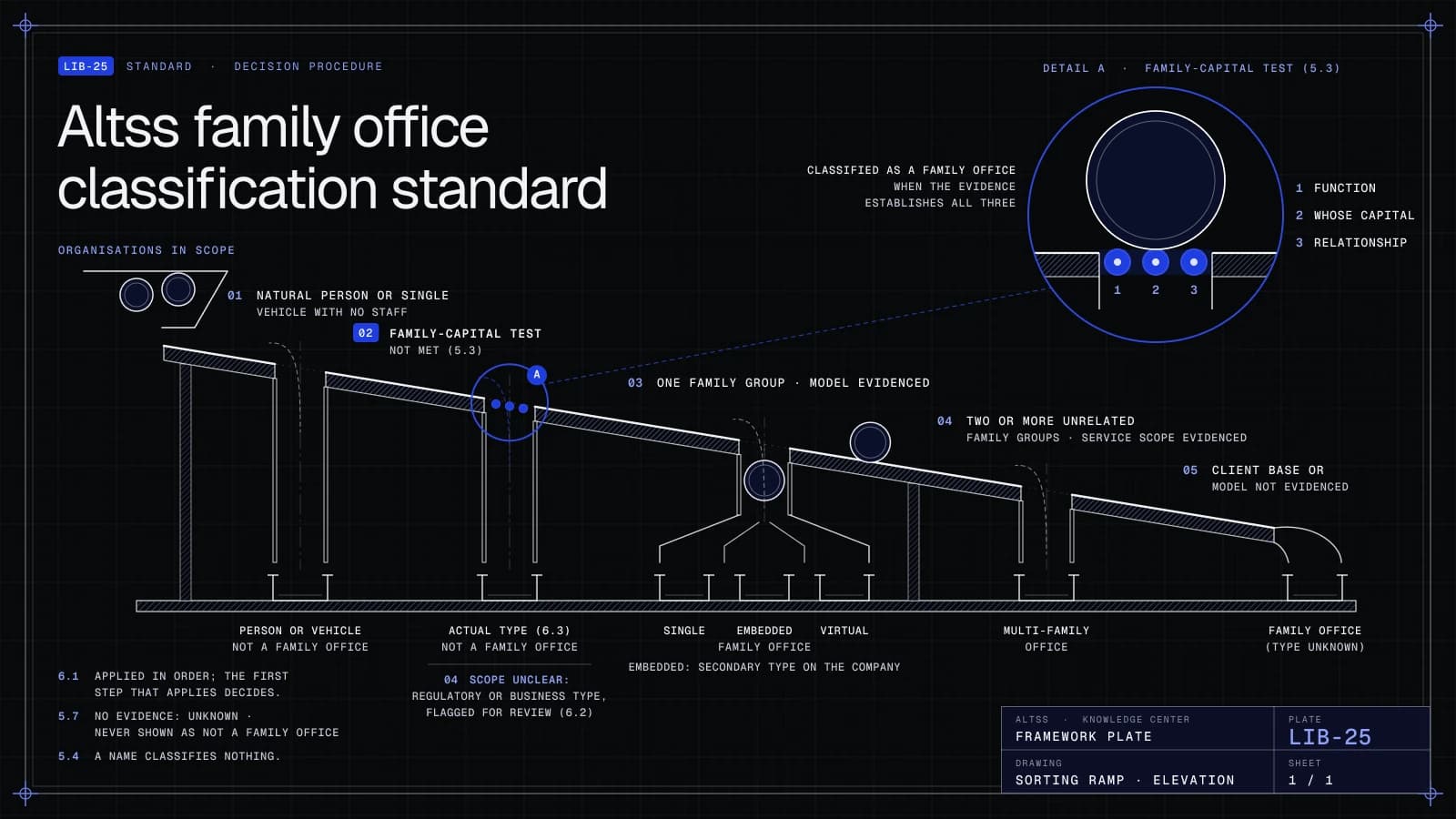
Reference plate: applied in order, the first step that applies decides.
1. Purpose
This standard sets the rules Altss applies when it records that an organisation is a family office, which kind of family office it is, and on what evidence. It exists for two reasons. "Family office" has a narrow legal meaning in one US rule and a broad, loosely used meaning in the market. And the label is unreliable in both directions: some organisations that call themselves family offices are wealth managers serving a broad client base, and some family offices say nothing about themselves at all.
The operating-model labels in this standard (single-family office, multi-family office, embedded family office, virtual family office) are Altss-defined classification labels. They follow market usage, but no statute or standard setter defines them in the form used here. Legal tests, such as the SEC family office rule and the accredited investor categories, are recorded as separate attributes with their jurisdiction. A legal test never decides the market label, and the market label never implies a legal status.
A reader who has the evidence for an organisation should be able to apply these rules and reach the same label.
2. Scope
In scope
- Organisations that manage the investments, and often the wider financial affairs, of one or more families.
- The assignment of one operating-model label to each such organisation, and the adjacent organisation types that are excluded.
- The legal attributes recorded alongside the label: US Advisers Act status as shown in regulatory records, and the evidence relevant to the US accredited investor family office categories.
- The evidence each label requires, expressed in the Altss evidence model.
Out of scope
- Whether an organisation in fact meets the SEC family office rule, or is an accredited investor or qualified purchaser. These are legal determinations for the organisation, the issuer and their counsel.
- Whether two records are the same organisation: Entity Resolution Methodology.
- What family offices invest in or look for in a manager: Family Office Investment Criteria Guide.
- Pensions, endowments, foundations, sovereign wealth funds and other institutional allocators: Institutional Allocator Classification Standard.
- Concept-level classification (which facet "family office" belongs to): Private Markets Taxonomy & Classification Standard.
- Information about individual family members beyond what is needed to establish an organisation's structure.
3. Definitions
- Family office (market sense). An organisation whose principal function is to manage the investments, and often the wider financial affairs, of one or more specific families, acting for those families. See family office.
- SEC-rule family office. A company that meets 17 CFR 275.202(a)(11)(G)-1(b): it has no clients other than family clients (a person who becomes a client through the death of a family member or key employee, or another involuntary transfer from one, is treated as a family client for one year following the completion of the transfer of legal title to the assets); it is wholly owned by family clients and exclusively controlled, directly or indirectly, by family members or family entities; and it does not hold itself out to the public as an investment adviser. Such a company is not an investment adviser for the purposes of the US Investment Advisers Act. See SEC Family Office Rule.
- Family member, family client (SEC rule). In the rule, family members are the lineal descendants of a common ancestor no more than 10 generations removed from the youngest generation, with their spouses or spousal equivalents. Family clients include family members, former family members, key employees, certain former key employees, and certain charitable organisations, estates, trusts and companies wholly owned by family clients. This summary is for orientation; the rule text governs.
- Family group (Altss-defined). The natural persons related by descent from a common ancestor, their spouses, spousal equivalents and former spouses, and the trusts, estates, companies and foundations established for them. It is modelled on the SEC rule's family member and family client definitions but is not identical: it has no generation limit and does not include key employees. A family group is a relation construct used to apply the tests in section 6. It is not an entity, and it never merges records.
- Office entity. The organisation that employs the staff and makes or advises on investment decisions.
- Family vehicle. A legal entity that holds family assets: a holding company, partnership, family trust, private foundation or similar. Vehicles are classified by their own entity type and related to the office.
- Principal. A family member who directs the office or its investments. A role held by a person, not an organisation type. See principal.
- Operating model. How family-office functions are organised and delivered. See family office operating models.
- Single-family office (SFO), multi-family office (MFO), embedded family office, virtual family office. Altss-defined operating-model labels, set out in rule 6.2. See single-family office and multi-family office.
- Classification. The label assigned to an organisation under this standard. In the Altss evidence model a classification is a DERIVED value: it is produced by applying a published rule, with a stated version, to observed claims.
4. Inputs and source types
Each source is described with its evidence origin, one of the five values of the Altss evidence model, assigned relative to the organisation being classified.
| Source | Evidence origin | Can establish | Cannot establish |
|---|---|---|---|
| SEC adviser records: Form ADV through the Investment Adviser Public Disclosure site | REGULATORY_PUBLIC_RECORD | That the organisation is registered as an investment adviser or reports as an exempt reporting adviser; where the filing reports them, the types and approximate number of its clients, including a high net worth individuals category (Part 1A Item 5.D), its regulatory assets under management (Item 5.F) and the private funds it advises (Schedule D Section 7.B.(1)) | That an organisation absent from these records relies on the family office rule; who its families are |
| Form 13F filings | REGULATORY_PUBLIC_RECORD | That the organisation is an institutional investment manager exercising investment discretion over accounts holding section 13(f) securities with an aggregate fair market value of at least $100 million on the last trading day of any month of a calendar year (17 CFR 240.13f-1(a)(1); a fixed amount, not indexed), and those holdings | Its ownership, its clients or its private holdings |
| Company registers, legal entity identifier records, beneficial ownership and PSC registers | REGULATORY_PUBLIC_RECORD | Legal form, officers, and registered owners or controllers where the register records them; parent relationships in LEI Level 2 data | The organisation's function |
| Form D filings by issuers | REGULATORY_PUBLIC_RECORD | An issuer's offering and its related persons (executive officers, directors, promoters) | Who invested: Form D reports only the number of investors |
| Records of public bodies naming the organisation as a counterparty (for example pension board minutes) | OFFICIAL_INSTITUTIONAL | The relationship with that body | The organisation's type |
| The organisation's own website, reports, press releases, and statements it gives on request | DISCLOSED | Self-description; stated service scope, client base and ownership | Independent confirmation of any of these |
| News, counterparty announcements, professional directories, event programmes, archived pages | OSINT_SOURCED | What the third party reports, with attribution | Facts only the organisation knows, unless the report traces to the organisation |
| Licensed datasets | LICENSED_THIRD_PARTY | Leads, and the licensor's own labels | An Altss classification, without the underlying evidence |
How an artefact was found or obtained is recorded separately, as collection method in the process metadata of the Evidence & Provenance Standard. It is not an origin value.
5. Method
5.1 Classify organisations, not families. Each legal entity has its own record and its own type. The office entity is classified under this standard. Family vehicles are classified by entity type (holding company, trust, foundation, partnership) and related to the office. A family's entities are never merged because they share a surname, an address, a principal, a director or a web domain. Only a registry identifier, or a filing naming both as one entity, establishes that two records are one organisation (Entity Resolution Methodology). No metric, such as assets under management, is summed across a family's entities into a family total; each figure stays with the entity it belongs to (Entity Resolution Methodology 5.11).
5.2 Ask three questions separately.
- Is the organisation a family office? (The family-capital test, rule 5.3.)
- If so, which operating model? (Rule 6.2.)
- What legal attributes does the evidence show? (Rule 5.5.)
An answer to one question never answers another.
5.3 The family-capital test (Altss-defined). An organisation is classified as a family office when the evidence establishes all three of the following:
- Function. Its principal activity is managing investments, and possibly wider financial affairs, rather than operating a business for customers.
- Whose capital. The capital it manages belongs to identifiable family groups and their vehicles, not to the public or to institutions.
- Relationship. It acts for those families as their office: it is owned by them, employed by them, or engaged as their dedicated provider of family-office services, rather than offering a standard product to a broad client base.
Where conditions 1 and 2 are evidenced but condition 3 is not, the organisation is classified by its regulatory or business type (rule 6.3), and its self-description is recorded as a separate claim.
5.4 Self-description is evidence of self-description. A statement such as "we are a family office" is an OBSERVED claim, with origin DISCLOSED, about how the organisation describes itself. It is an input to the test. It does not satisfy conditions 2 and 3 on its own. A name ("Family Office", "Family Holdings", "Family Capital") classifies nothing.
5.5 Legal attributes are recorded separately.
- US adviser status. Recorded as observed in the SEC's adviser records on a stated date: registered adviser, exempt reporting adviser, or no adviser record found under a stated search. An SEC-rule family office is not considered an investment adviser for the purposes of the Act (17 CFR 275.202(a)(11)(G)-1(a)), so it does not register or report as one and is not expected to appear in those records as an adviser. Absence from them is therefore consistent with the exclusion, with a different exemption, with a non-US organisation or with a search error, and supports none of these alone. Reliance on the family office rule is recorded only as a statement by the organisation ("states that it relies on the family office exclusion", origin DISCLOSED). It is never inferred.
- Accredited investor categories. Under Rule 501(a)(12), an SEC-rule family office is an accredited investor if it has assets under management in excess of $5,000,000, was not formed for the specific purpose of acquiring the securities offered, and its prospective investment is directed by a person whose knowledge and experience in financial and business matters make the family office capable of evaluating the merits and risks of the investment. Under Rule 501(a)(13), a family client of such an office is an accredited investor when its investment is directed by that office. Altss records evidence relevant to these tests, such as an assets figure with its definition and source. It does not record the status itself: the definition applies at the time of each sale, to a person who falls within a category or whom the issuer reasonably believes does, so status is established in each offering. The same applies to the family company test for a qualified purchaser (Investment Company Act section 2(a)(51)(A)(ii)): evidence relevant to it may be recorded, the status is not.
- Other jurisdictions. Where another jurisdiction has a family-office regime, status under it is recorded as an attribute with the jurisdiction, the provision and the source. It is not used as the definition of a family office.
5.6 A classification is a DERIVED value. It records its inputs (the observed claims and their evidence items, each with its origin), the rule applied (this standard, with its version and the rule number), the resulting label, and the as-of date. It carries a validation status under the Altss evidence model, an Altss-defined methodology set out in full in the Evidence & Provenance Standard (6.7):
| Validation status | When it applies to a classification |
|---|---|
| UNVERIFIED | The default: the inputs are held as captured, with no independent support and no completed review. |
| CORROBORATED | The decisive inputs are supported by at least two evidence items whose chains do not reach the same originating source (Evidence & Provenance Standard 6.8), and nothing unresolved contradicts them. |
| RESEARCH_VALIDATED | A named reviewer role completed a deliberate check of the inputs and the application of the rule on a recorded date. |
| CONFLICTING | Inputs assert incompatible values for the same attribute (for example the number of client families) under the same definition and period, and the conflict is unresolved. |
Validation checks the inputs and the correct application of the rule. A classification does not become OBSERVED because it was validated.
5.7 Minimum evidence. A label is published only with at least one evidence item for function (condition 1) and at least one for the client base (condition 2), which may come from the same artefact. If the only evidence is the organisation's description of itself, the record shows "self-described family office", not a classification. If there is no evidence, the classification is UNKNOWN.
5.8 One operating-model label at a time. An organisation holds one operating-model label for any period. A multi-family office also carries the intermediary facet, because it allocates on behalf of client families, as set out in the Taxonomy & Classification Standard.
5.9 Payment does not change a classification. A commercial relationship with an organisation, or a request from it, does not change its label, its evidence or its validation status. An organisation's submission is a DISCLOSED source like any other.
6. Classification rules
6.1 Decision procedure. Applied in order; the first step that applies decides.
- If the evidence shows a natural person investing personally, or a single vehicle with no staff of its own, the record is not a family office. It is recorded as a person or vehicle and related to the family's office if one exists.
- If the family-capital test (5.3) is not met, the organisation is classified by its actual type (6.3).
- If the test is met and the client base is one family group:
- with a dedicated office entity owned or controlled within that family group: single-family office;
- with the function performed by staff of a family-owned operating or holding company and no separate office entity: embedded family office;
- with the function coordinated by a principal or a small staff and delivered mainly by outside providers under contract, and no dedicated office entity: virtual family office.
- If the test is met, the client base is two or more unrelated family groups and the service scope required by 6.2 is evidenced: multi-family office. Where the service scope is unclear, the last paragraph of 6.2 applies.
- If the test is met but the client base or the model is not evidenced: family office (type unknown).
6.2 Operating-model labels (Altss-defined).
| Label | Rule | Minimum evidence | Not this |
|---|---|---|---|
| Single-family office | Serves one family group; a dedicated office entity owned or controlled within that family group; no clients outside the family group other than the office's own employees (section 10) | Function; single-family client base; ownership or control within the family | An adviser with a broad high net worth client base that describes itself as a family office |
| Multi-family office | Serves two or more unrelated family groups as their family office, providing family-office services beyond portfolio management (for example consolidated reporting, coordination of tax and estate advisers, governance, administration); ownership may be a founding family, its executives or an outside firm | Function; more than one client family; service scope | A wealth manager, private bank or adviser whose service is mainly investment management or banking for a broad client base |
| Embedded family office | One family group's investments and affairs managed by staff inside a family-owned operating or holding company, with no separate office entity | Staff or functions inside the company serving the family's own investments | A corporate treasury managing the company's own cash for the business |
| Virtual family office | One family group's office functions coordinated by a principal or small staff and delivered mainly through outside providers, with no dedicated office entity | Evidence of the coordinating person or staff and of the outsourced delivery | A family that simply uses a wealth manager, with no coordinating function of its own |
The embedded label is recorded on the operating or holding company as a secondary type; its primary type stays company or holding company. The virtual label is recorded on the coordinating entity where one exists, otherwise the arrangement is recorded as a relation between the family group and its providers.
Where the evidence leaves an organisation's service scope unclear (for example an adviser that describes itself as a multi-family office but whose records show mainly portfolio management), it is classified by its regulatory or business type and flagged for review. It is not labelled a multi-family office on self-description.
6.3 Excluded types. These organisations can serve families but are not family offices under this standard.
| Type | Why it is excluded | Classified as | Typical relation to a family office |
|---|---|---|---|
| Registered investment adviser or wealth manager with a broad client base | Offers a standard advisory service to many clients; condition 3 fails | Registered investment adviser or private bank and wealth manager | advises |
| Private bank, trust company offering services to the public | Provides banking or fiduciary services to the public | Private bank and wealth manager | advises, administers |
| Outsourced chief investment officer | Allocates capital that belongs to its clients under delegated discretion | OCIO | advises, manages for |
| Family-owned operating company or holding company | Runs a business, or holds assets, rather than acting as the family's office | Company or holding company (may carry the embedded label) | owned by the family group |
| Private foundation established by a family | A separate charitable entity with its own governance, even where the same staff serve it | Private foundation | established by; shares staff with |
| Family trust or other family vehicle | Holds assets; does not make or advise decisions as an organisation | Trust or vehicle | advised by |
| Fund manager founded by a family member, managing outside capital | Manages pooled vehicles for outside investors | Manager (GP) | sponsored by; invests for |
| Placement agent, consultant or other service provider to family offices | Sells or advises; does not manage family capital | Intermediary | advises |
6.4 The legal and market axes are independent. An organisation can be a single-family office in this standard's sense and also appear in the SEC's records as a registered adviser; the standard records both and does not infer the reason for the registration. Conversely, meeting the SEC rule does not determine which operating-model label applies. Each axis is recorded on its own evidence.
6.5 Recorded states. Each organisation in scope carries one of: a label from 6.2; "family office (type unknown)"; "self-described family office" (5.7); "not a family office", with the type from 6.3; or UNKNOWN, meaning no determination has been recorded. These follow the null-state vocabulary of the Evidence & Provenance Standard. UNKNOWN is never shown as "not a family office".
7. Conflict handling
7.1 First test whether the conflict is real. Two claims that use different definitions are different attributes, not a conflict. "Single-family office" in a self-description and "registered investment adviser" in a regulatory record answer different questions (rule 6.4). An assets figure described as regulatory assets under management on Form ADV and a self-reported "assets under advice" figure are two attributes.
7.2 Self-description against structural evidence. Where an organisation describes itself as a single-family office but its Form ADV reports many clients across categories, the regulatory record is evidence of the client base it reported, as of its filing date. The self-description is kept as a DISCLOSED claim. The classification follows the structural evidence, and if the two cannot be reconciled for the same attribute and period, the classification is CONFLICTING until reviewed.
7.3 Change over time is not a conflict. An office that served one family and later took on others has two classifications with consecutive validity periods (section 9).
7.4 Third-party labels. A licensed dataset or a directory that labels an organisation a family office states the licensor's label. Its origin is LICENSED_THIRD_PARTY or OSINT_SOURCED, and it is recorded as a claim about that label. It does not override evidence of structure.
7.5 Preference between conflicting evidence follows the order in the Source Reliability & Confidence Methodology: authority for the claim type, proximity to the originating source, independent corroboration, specificity, then reliability grade. Conflicting values are never averaged.
8. Confidence and limitations
- A family office may publish little: it can have no website and file nothing that names it. Where the evidence is missing, the record states "type unknown" or UNKNOWN, and the gap is never filled in from a name.
- Regulatory evidence is asymmetric. Registered and reporting advisers appear in the SEC's records; an SEC-rule family office, which is not an adviser under the Act, is not expected to.
- A filing is the filer's account. The SEC states that accepting a Form ADV is not a finding that it is correct.
- Self-reported asset figures follow the organisation's own definition. They are recorded with that definition and are not compared with regulatory figures as if they measured the same thing.
- These labels are Altss-defined. Other publishers use other definitions and thresholds, so counts of "family offices" from different sources are not comparable.
- This standard sets no minimum asset size for a family office. Size is recorded as a separate attribute with its source and definition.
- Distinguishing a multi-family office from a wealth manager requires judgement about service scope. Rule 6.2 requires the evidence for that judgement to be recorded and flags unclear cases for review.
- A classification is not legal advice and does not establish any organisation's status under any law.
9. Temporal rules
- Each classification carries a valid-from and, where it ends, a valid-to date, and the date of the assessment. A change of model (an SFO that opens to other families, an embedded office spun out as a separate entity) produces a new classification. The earlier one is kept.
- Legal attributes are dated by the filing or search they come from. A search with no result supports NOT FOUND for that search and date only.
- Under the SEC rule, a person who becomes a client through an involuntary transfer, such as a death, is treated as a family client for one year following the completion of the transfer of legal title to the assets, not from the event itself. Where such an event is evidenced, its date and, where known, the date the transfer of title completed are recorded; the legal effect is not assessed.
- Regulatory references, with their status as of 1 October 2026:
- The SEC family office rule was adopted in June 2011 (76 FR 37994) and last amended in September 2016 (81 FR 60457); the current eCFR text shows no later amendment.
- The family office and family client accredited investor categories were added by Release 33-10824, effective 8 December 2020. The definition's dollar thresholds are not inflation-indexed.
- On 30 September 2026 the SEC sought comment on possible additional accredited investor pathways for natural persons (a FINRA-developed exam, and certain licences, certifications or credentials), in a release that also proposed unrelated rule amendments. These are requests for comment, not proposed amendments to the definition, and they do not change the current text.
- A classification is reviewed when its evidence changes: a new or amended filing, a change of ownership in a register, or the disappearance or rewording of the organisation's own description of its clients.
10. Edge cases
- Key employees. Under the SEC rule, certain key employees are family clients. For this standard's single-family office test, an office that lets its own staff invest alongside the family is still serving one family group.
- Co-investors are not clients. An outside investor who co-invests in a deal the office leads is a counterparty. A person or entity whose money the office manages under an advisory or management relationship is a client. One outside client means the client base is no longer one family group; the organisation is then a multi-family office or an adviser under 6.2 and 6.3. Whether it remains within the SEC rule is a separate legal question.
- Divorce. Former spouses remain within the family group under this standard, and former family members are family clients under the SEC rule.
- Several offices for one family. Each office entity is classified separately and related through the family group. Branches of one family descended from a common ancestor are one family group, so offices serving different branches are not, for that reason alone, a multi-family office.
- An office that began as a single-family office and admits other families. Reclassified with a new validity period (9.1).
- A single-family office acquired by, or merged into, a multi-family platform. The surviving organisation is classified on its own evidence; the acquisition is recorded as a relation ("succeeded by").
- Family-office services inside a bank or wealth manager. A desk or department is not an organisation. The bank or wealth manager is classified under 6.3.
- Trust company structures. Some offices are organised as chartered trust companies. The charter is recorded as an attribute; the operating-model label follows 6.1.
- An office that also sponsors a fund for outside investors. The office and the fund manager are separate entities with separate types, related to each other.
- Dormant offices. An office with no evidence of current activity keeps its last classification with its last-observed date. Absence of recent evidence does not end the classification or reclassify it.
- Organisations outside the United States. The family-capital test and operating-model rules apply unchanged. Legal attributes are those of the relevant jurisdiction (5.5).
11. Worked examples
All names are fictitious.
Example 1: a single-family office.
| Input | Evidence origin | Derivation status or null state |
|---|---|---|
| Website: "Example Family Office LLC manages the investments of the Example family" | DISCLOSED | OBSERVED |
| Company register: sole member is the Example Family Trust | REGULATORY_PUBLIC_RECORD | OBSERVED |
| SEC adviser records searched by name and known identifiers on 2026-09-15: no record | none (a search result, not an evidence item) | NOT FOUND, for that search and date |
Rule 6.1 step 3: one family group, a dedicated office entity owned within it. Classification: single-family office, DERIVED under this standard version 1.0.0 rule 6.1(3), on the evidence as of 2026-09-15. Validation: UNVERIFIED. The website and the register filing are both statements by the office about itself, so for facts only the office can supply they reach the same originating source and do not corroborate each other, although their evidence-origin values differ. A reviewer's documented check would make the classification RESEARCH_VALIDATED; it would still not be CORROBORATED. US adviser status: "no adviser record found (2026-09-15)". Reliance on the family office rule: not recorded.
Example 2: a self-described multi-family office that is classified as an adviser. An adviser's website calls it "a multi-family office". Its Form ADV reports several hundred clients in the high net worth individuals category, and its brochure describes portfolio management and financial planning. There is no evidence of family-office services to particular families. Condition 3 of the family-capital test fails. Classification: registered investment adviser (intermediary), with the self-description recorded as a DISCLOSED claim. Had its materials evidenced a small number of client families receiving consolidated reporting, tax and estate coordination and governance support, the classification would be multi-family office, with "SEC-registered adviser" as a legal attribute.
Example 3: an embedded family office. A family-owned manufacturer's annual report describes a "family investment team" within the company that manages the family's private investments, and the company's site lists its members. There is no separate office entity. The company keeps its primary type and carries embedded family office as a secondary type. Validation: CORROBORATED only if, for example, a counterparty's own announcement independently names the team as the investor in a transaction.
Example 4: names are not evidence. Three records are found: "Smith Family Holdings LLC", "Smith Capital Partners" and "The Smith Family Foundation". They share a surname and an address. None is merged with another. The foundation is classified as a private foundation. The holding company is classified as a holding company. "Smith Capital Partners" is classified on its own evidence; without any, it is UNKNOWN. Relation candidates between them are reviewed, and a relation is recorded only with a source that states it.
Example 5: accredited investor evidence. An office states on request that it has "USD 60 million under management". This is recorded as an OBSERVED claim, origin DISCLOSED, with the office's own definition of the figure. Altss does not record that the office is an accredited investor. The record notes only that Rule 501(a)(12) sets a threshold of assets under management in excess of $5,000,000 together with two further conditions, and that status is established in each offering.
Example 6: a reclassification. A single-family office announces in 2025 that it will serve two further, unrelated families. A later Form ADV filing shows it registered as an adviser. Records: single-family office, valid until the announced date; multi-family office from that date, subject to the service-scope evidence in 6.2; legal attribute "SEC-registered adviser" from the filing date. Neither classification overwrites the other.
12. External references
- 17 CFR 275.202(a)(11)(G)-1 (SEC family office rule). The legal definition of a family office excluded from the US Advisers Act. This standard uses it as a legal attribute, not as the definition of a family office.
- 17 CFR 230.501(a)(12) and (a)(13), and SEC Release 33-10824. Family office and family client accredited investor categories, effective 8 December 2020.
- Investment Advisers Act section 203, Rule 204-4, Form ADV Part 1A and the Investment Adviser Public Disclosure site. Registration and exempt reporting status; client types (Item 5.D), regulatory assets under management (Item 5.F) and private funds advised (Schedule D Section 7.B.(1)).
- 17 CFR 240.13f-1. The Form 13F reporting threshold.
- Form D. Related persons and investor counts.
- Investment Company Act section 2(a)(51)(A)(ii) and Rule 2a51-1. The family company qualified purchaser test. As with the accredited investor categories, evidence relevant to the test may be recorded; the status is not (5.5).
- GLEIF LEI and the UK register of people with significant control. Ownership and parent evidence where available.
- Altss standards. Concept classification follows the Taxonomy & Classification Standard; evidence, origins and validation follow the Evidence & Provenance Standard and the Altss evidence model; identity follows the Entity Resolution Methodology.
- Where this standard differs from common usage. It does not treat the SEC rule as a general definition. It sets no asset threshold. It does not accept self-description or names as classification. It treats embedded and virtual arrangements as operating models of a single family group, not as separate organisation types.
13. Version and change log
- Version 1.0.0 (2026-10-01). First publication. Establishes the family-capital test, the four Altss-defined operating-model labels, the excluded types, legal attributes recorded separately from the market label, evidence minimums expressed in the Altss evidence model (origin, derivation, validation), and the recorded states.
- Version 1.1.0 (2026-10-01). Independent review. The one-year family-client treatment after an involuntary transfer now runs, as in the rule, from completion of the transfer of legal title, not from the event (3, 9.3). Rule 6.4 no longer describes an office with non-family clients as a single-family office, which contradicted 6.2 and section 10. The September 2026 SEC accredited investor item is described as a request for comment, not proposals. The evidence model is referred to the Evidence & Provenance Standard; independence is stated as not reaching the same originating source. The qualified purchaser test is treated like the accredited investor categories (evidence recorded, status not). No family totals (5.1). Multi-family office step 6.1(4) requires the 6.2 service scope.
- Version 1.2.0 (2026-10-02). Specialist review of the US legal and regulatory statements against their primary sources. Corrected: the family client summary (3) and the amendment history of the family office rule (9.4). Narrowed: the Form 13F threshold now states its measurement basis (4), and absence from adviser records is stated as an expectation that follows from the exclusion (5.5, 8).
Change control. Changes to the family-capital test, the label rules or the excluded types are major changes, and earlier classifications are reassessed. New examples and clarifications are minor changes.
Concepts used
- Family Office
- Single-Family Office (SFO)
- Multi-Family Office (MFO)
- Family Office Operating Models
- SEC Family Office Rule (Rule 202(a)(11)(G)-1)
- Accredited Investor
- Qualified Purchaser (QP)
- Registered Investment Adviser (RIA)
- Private Bank and Wealth Manager
- Outsourced Chief Investment Officer (OCIO)
- Principal (Family Office)
- Holding Company
- Private Foundation
- Family Trust
- Form ADV
- Observed, Derived and Estimated Data
Sources
- 17 CFR 275.202(a)(11)(G)-1 - Family offices. U.S. Securities and Exchange Commission (CFR text via eCFR; LII mirror), eCFR current as of 2026-09-29; adopted 2011 (76 FR 37994), amended 2016 (81 FR 60457). Status: in force (checked 2026-10-01). 275.202(a)(11)(G)-1(a), (b)(1)-(3), (d)(4)(i)-(xi) family client, (d)(6) family member, (d)(7) former family member; source note '[76 FR 37994, June 29, 2011, as amended at 81 FR 60457, Sept. 1, 2016]'
- 17 CFR 230.501 - Definitions and terms used in Regulation D (accredited investor). U.S. Securities and Exchange Commission (CFR text via eCFR; LII mirror), eCFR current as of 2026-09-29; last amended 2025-02-18 (technical, 90 FR 9684); last substantive amendment effective 2020-12-08 (85 FR 64234). Status: in force (checked 2026-10-01). 230.501(a) introductory text, (a)(12), (a)(13)
- Accredited Investor Definition (final rule), Release No. 33-10824. U.S. Securities and Exchange Commission, Adopted 2020-08-26; 85 FR 64234 (2020-10-09); effective 2020-12-08. Status: in force (checked 2026-10-01). Effective date; family office categories
- SEC Proposes Amendments to Expand Responsible Retailization of Private Markets (press release 2026-96). U.S. Securities and Exchange Commission, 2026-09-30. Status: proposed (checked 2026-10-01). Paragraphs on accredited investor pathways ('seeks comment on the potential designation ...')
- 15 U.S.C. 80b-3 - Registration of investment advisers (Advisers Act sec. 203, incl. 203(l) and 203(m)). U.S. Congress (United States Code; LII mirror), Current US Code text as published by LII (accessed 2026-10-01). Status: in force (checked 2026-10-01). Sec. 203(l), 203(m)
- 17 CFR 275.204-4 - Reporting by exempt reporting advisers. U.S. Securities and Exchange Commission (CFR text via eCFR; LII mirror), eCFR current as of 2026-09-29; no substantive amendment since eCFR baseline. Status: in force (checked 2026-10-01). 275.204-4(a)
- Form ADV (Uniform Application for Investment Adviser Registration and Report by Exempt Reporting Advisers) - SEC form cover and index. U.S. Securities and Exchange Commission, OMB No. 3235-0049; expires 2027-07-31. Status: in force (checked 2026-10-01). Index page, 'SEC's Collection of Information'
- Form ADV Part 1A (paper version) - Uniform Application for Investment Adviser Registration and Report by Exempt Reporting Advisers. U.S. Securities and Exchange Commission, SEC 1707 (07-24). Status: in force (checked 2026-10-01). Item 5.D (types and number of clients, incl. (b) high net worth individuals); Item 5.F (regulatory AUM); Schedule D Section 7.B.(1)
- Investment Adviser Public Disclosure (IAPD). U.S. Securities and Exchange Commission, Live database (accessed 2026-10-01). Status: current (checked 2026-10-01). Firm search pages (accessed 2026-10-01)
- 17 CFR 240.13f-1 - Reporting by institutional investment managers of information with respect to accounts over which they exercise investment discretion (Form 13F). U.S. Securities and Exchange Commission (CFR text via eCFR; LII mirror), eCFR current as of 2026-09-29; no substantive amendment since eCFR baseline. Status: in force (checked 2026-10-01). 240.13f-1(a)(1)
- Form D - Notice of Exempt Offering of Securities (form and instructions, paper version). U.S. Securities and Exchange Commission, SEC1972 (5/17); OMB No. 3235-0076, expires 2027-07-31. Status: in force (checked 2026-10-01). Item 3 (Related Persons); Item 14 (Investors)
- 15 U.S.C. 80a-2 - Definitions (Investment Company Act sec. 2, incl. 2(a)(48) BDC and 2(a)(51) qualified purchaser). U.S. Congress (United States Code; LII mirror), Current US Code text as published by LII (accessed 2026-10-01). Status: in force (checked 2026-10-01). Sec. 2(a)(51)(A)(ii)
- 17 CFR 270.2a51-1 - Definition of investments for purposes of section 2(a)(51) (qualified purchaser); certain calculations. U.S. Securities and Exchange Commission (CFR text via eCFR; LII mirror), eCFR current as of 2026-09-29; no substantive amendment since eCFR baseline (2016-12-31). Status: in force (checked 2026-10-01). 270.2a51-1(b)
- Introducing the Legal Entity Identifier (LEI). GLEIF, Global Legal Entity Identifier Foundation, ISO 17442 identifier; web page accessed 2026-10-01. Status: Current (checked 2026-10-01). Level 1 and Level 2 data
- Summary guidance for companies: register of people with significant control (PSCs). Department for Business and Trade / Companies House, GOV.UK, Web guidance (Companies Act 2006 Part 21A regime, in force since 2016); accessed 2026-10-01. Status: Current (checked 2026-10-01). Summary guidance: who is a person with significant control (conditions and ownership bands)
- 26 U.S.C. 509 - Private foundation defined. U.S. Congress (Internal Revenue Code; LII mirror), Current US Code text as published by LII (accessed 2026-10-01). Status: in force (checked 2026-10-01). Sec. 509(a)
Related frameworks
Standard · Version 1.1
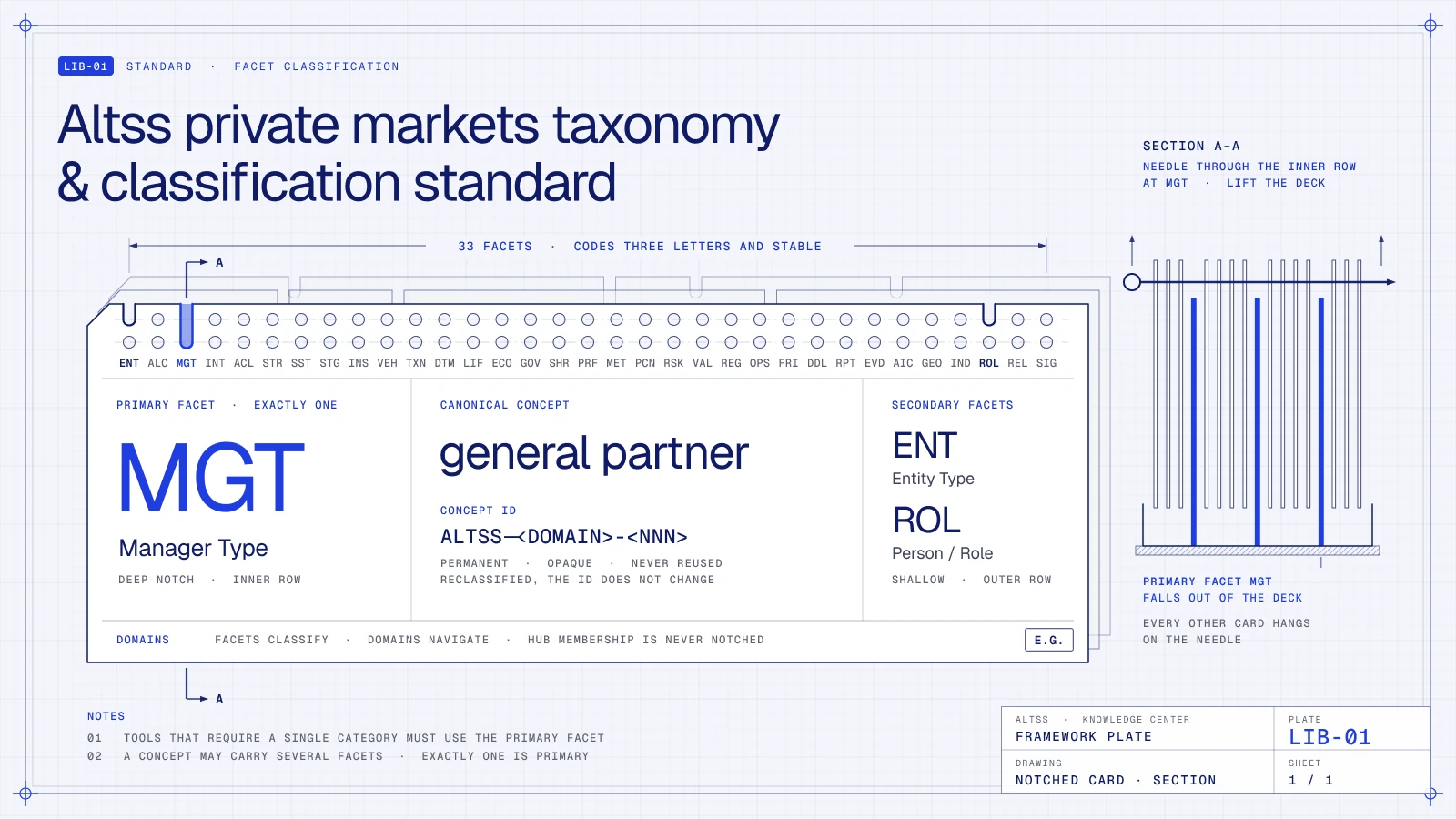
Altss Private Markets Taxonomy & Classification Standard
The Altss standard for classifying private-markets concepts: 33 facets with one primary facet per concept, permanent concept IDs, one canonical page per concept, rules against common category errors, and crosswalks to external classifications.

Standard · Version 1.2
Altss Evidence & Provenance Standard
The Altss standard for recording evidence behind private-markets facts: claim-level provenance, evidence chains, three separate evidence dimensions (evidence origin, derivation status, validation status), distinct date types, null states such as unknown vs not disclosed, negative evidence, conflicts and claim citation.
Methodology · Version 1.2
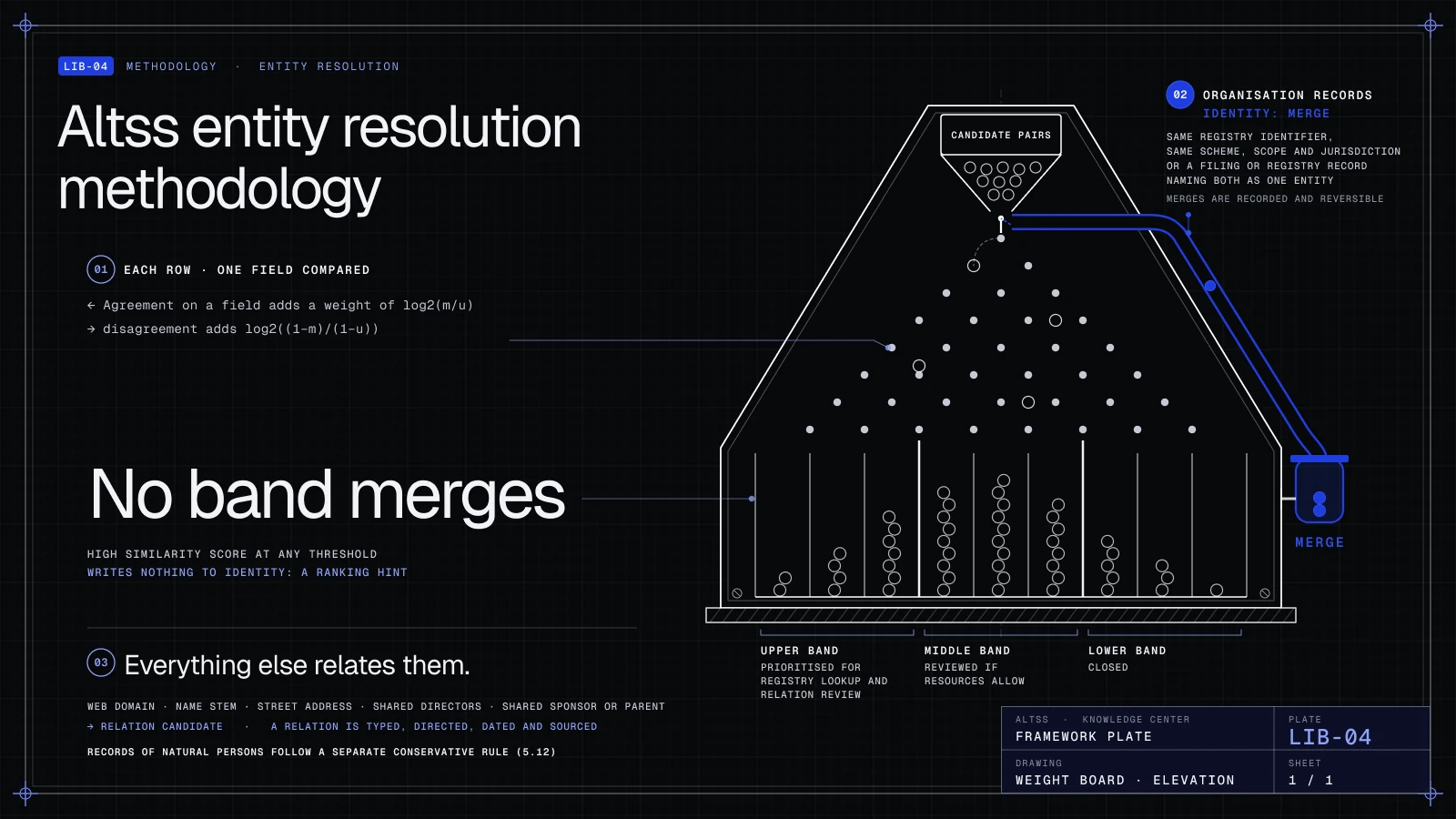
Altss Entity Resolution Methodology
The Altss methodology for deciding whether two records describe the same entity: identity, relation and role kept separate; organisations merged only on registry identifiers or a filing naming both as one; similarity creates relation candidates, never merges; no metrics summed across entity families.
Methodology · Version 1.2
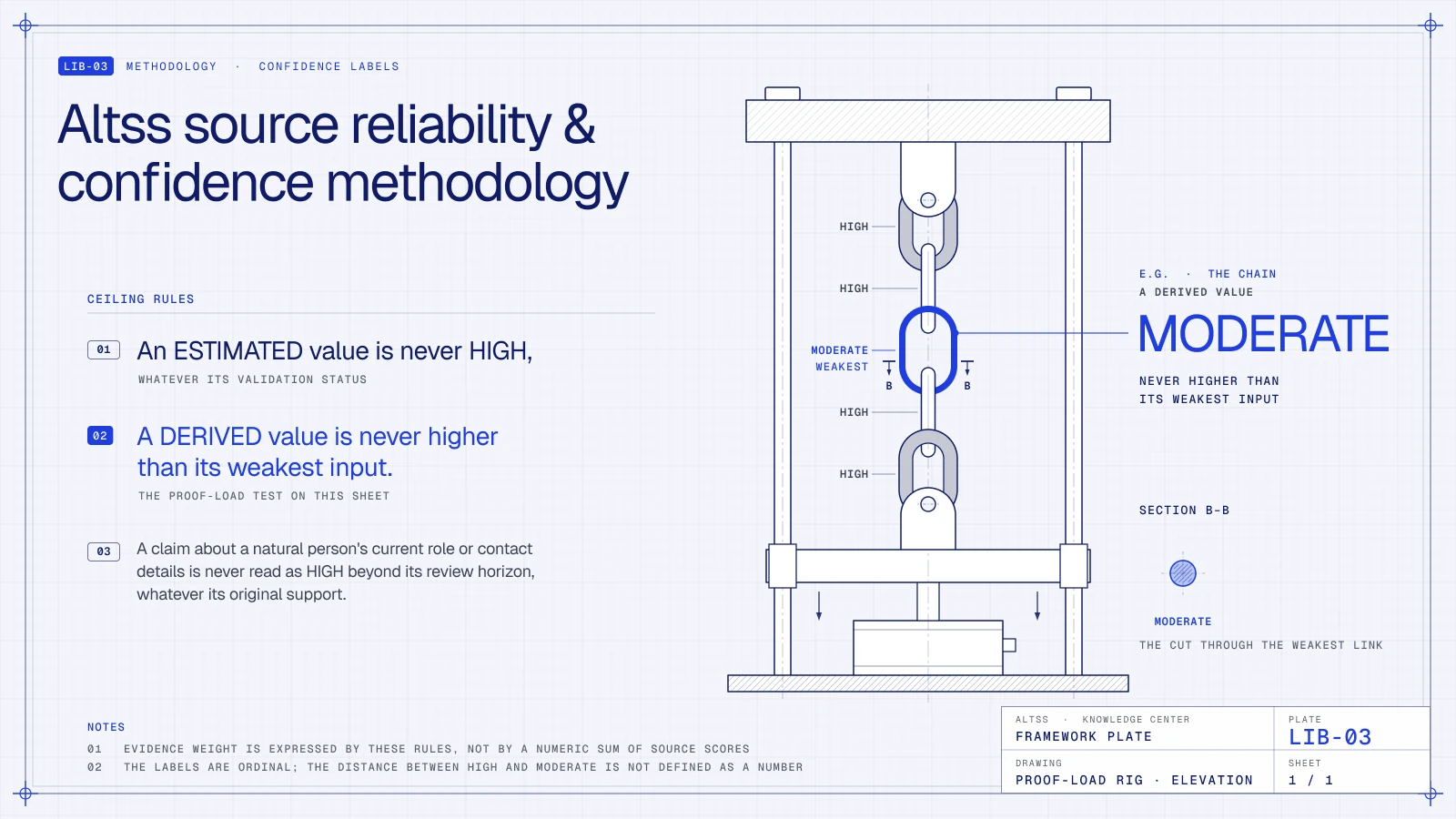
Altss Source Reliability & Confidence Methodology
The Altss methodology for grading sources and assigning confidence labels to private-markets claims: source authority classes, reliability and credibility grades adapted from the NATO Admiralty system, independence, use of validation status, conflict handling, label meaning and limits, calibration and decay.
Standard · Version 1.2.0
Altss Private Markets OSINT Verification Standard
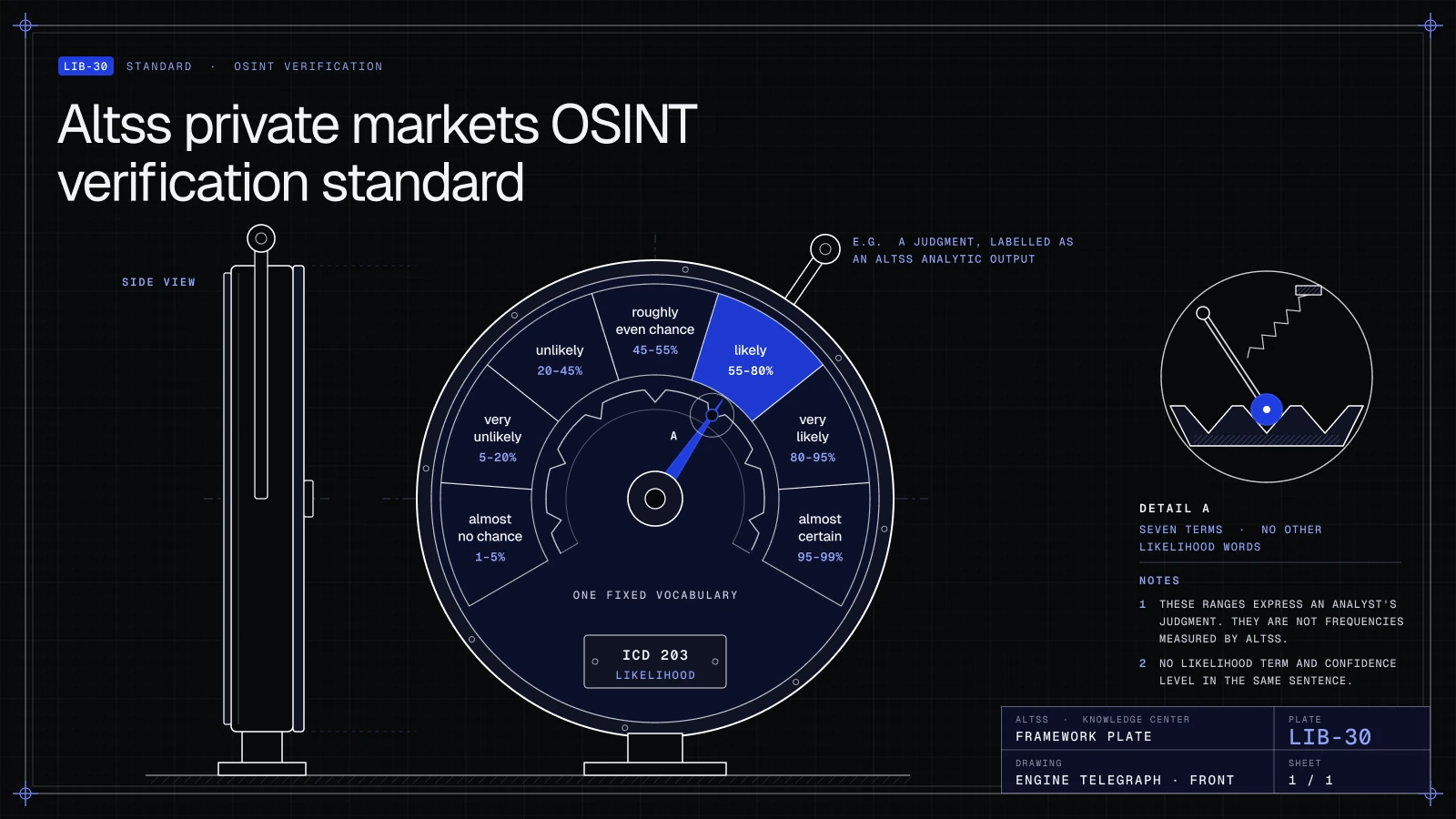
The Altss standard for verifying publicly accessible private-markets information: Berkeley Protocol-aligned source, item and content verification, the three evidence dimensions with origin kept separate from collection method, source grading, ICD 203 language for judgments, and source-rights recording.
Framework · Version 1.2.0
Institutional LP Manager Due Diligence Framework
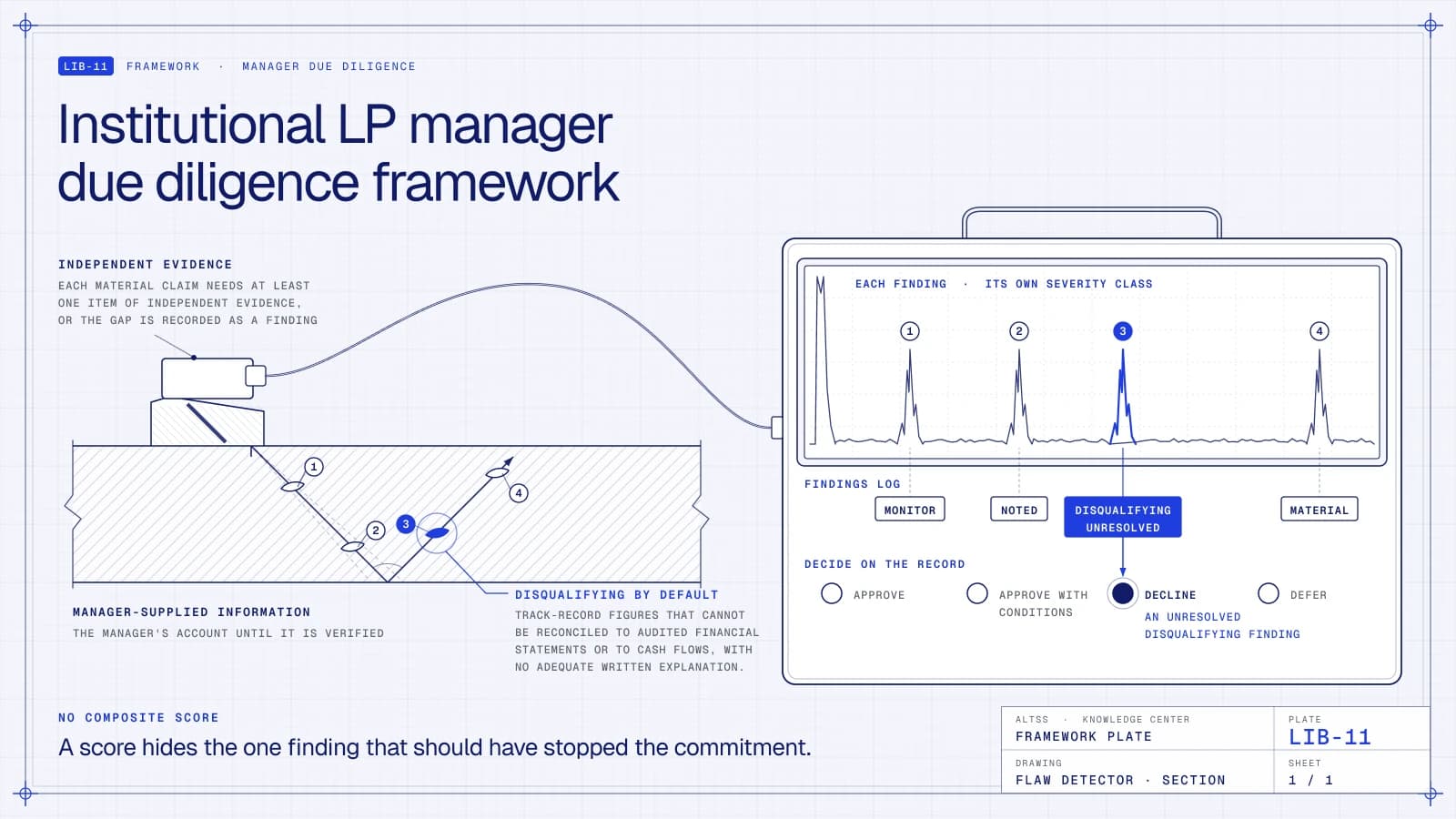
A method for LPs to evaluate a private-fund manager before committing: investment due diligence across ten domains, evidence and verification rules, finding severity and decision outcomes, mapping to ILPA DDQ 2.0 and the AIMA DDQ, an operational due diligence gate and a family-office variant.