Framework · Version 1.2.0 · Last reviewed
Source check: Legal, regulatory and accounting statements checked against the cited primary sources on (how). General information, not advice.
Private Capital Valuation & Mark Quality Framework
How unquoted private-capital investments and fund interests are marked to fair value under ASC 820, IFRS 13, the IPEV Guidelines (2025 edition) and Rule 2a-5, and the Altss-defined indicators used to read a mark: timeliness, staleness, divergence, dispersion and backtesting.
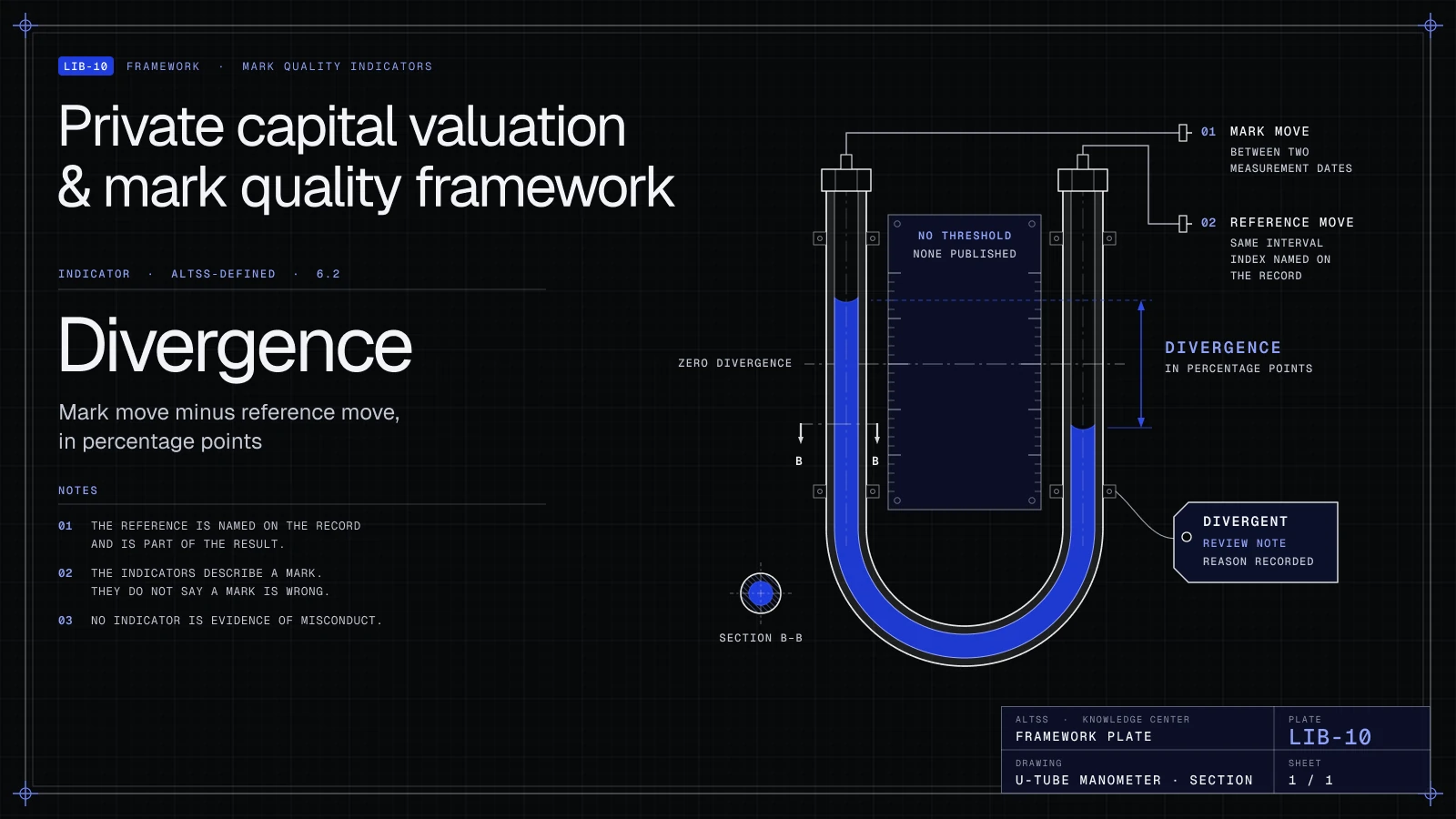
Reference plate: mark quality is read as a measurement, never a re-valuation.
1. Purpose
Most private-capital investments have no quoted price. Their reported values, called marks here, are estimates of fair value made by the holder at each reporting date. Interim fund returns, NAVs, secondary prices and LP allocation figures all depend on those estimates.
This framework does two things. First, it sets out how fair value is required to be measured for unquoted investments and fund interests: the accounting definitions in ASC 820 and IFRS 13, the industry guidance in the International Private Equity and Venture Capital Valuation (IPEV) Guidelines and the AICPA valuation guide, and the rule for US registered funds and BDCs. Second, it defines a set of Altss-defined mark-quality indicators: descriptive tests for how current a mark is, whether it has been re-estimated, whether it moved with its reference market and how it compared with the eventual exit.
The indicators describe a mark. They do not re-value an investment, and they do not say a mark is wrong. Altss does not produce fair value estimates under this framework.
2. Scope
In scope
- Fair value of unquoted equity, debt and hybrid instruments held by private funds and other investment entities, and of interests in private funds.
- Funds reporting under US GAAP (ASC 820, with ASC 946 for investment companies) or IFRS (IFRS 13), and funds that follow the IPEV Guidelines.
- US registered investment companies and business development companies, whose fair value determinations fall under Rule 2a-5.
- Reading and comparing reported marks, and the Altss-defined indicators applied to them.
Out of scope
- Valuations for tax purposes, such as 409A valuations.
- Fairness opinions and pricing of GP-led transactions: see the Secondaries & Continuation Vehicle Evaluation Framework.
- Use of NAV in performance figures: see the Private Markets Performance Measurement Standard.
- Valuation governance as an operational due diligence topic: see the Operational Due Diligence Framework.
- Auditing standards, and accounting for consolidation or impairment by operating companies.
3. Definitions
- Fair value. The price that would be received to sell an asset or paid to transfer a liability in an orderly transaction between market participants at the measurement date: an exit price. This is the definition in ASC 820-10-35-2 and in IFRS 13, and the IPEV Guidelines adopt it.
- Measurement date. The date at which fair value is estimated. Under the IPEV Guidelines, fair value is estimated at each measurement date, meaning each time a fair-value-based NAV is reported to investors.
- Unit of account. The level at which an asset is measured: for example one share class, one loan tranche, or a whole interest in a fund.
- Fair value hierarchy. Three levels of inputs. Level 1: unadjusted quoted prices in active markets for identical assets. Level 2: other inputs observable directly or indirectly. Level 3: unobservable inputs. A measurement is categorised at the lowest level of input that is significant to it as a whole.
- Valuation approaches. The market approach, the income approach and the cost approach (ASC 820-10-35-24A). The IPEV Guidelines list as techniques: under the market approach, multiples, industry valuation benchmarks and available market prices; under the income approach, discounted cash flows of the investee company or from the investment; under the replacement cost approach, net assets. See comparable company analysis and cost approach.
- Price of recent investment. The price of a recent transaction in the investee's instruments. Under the 2025 IPEV Guidelines it is used to calibrate inputs and is not a standalone valuation technique or a default.
- Calibration. Setting the inputs of the techniques that will be used at later dates so that, at the transaction date, they reproduce a transaction price deemed to be fair value; then carrying those calibrated inputs forward with updated market data.
- Backsolve. A practice term for one form of calibration: solving a model, often an option pricing allocation across share classes, for the equity value implied by the price paid for one class in a recent round.
- Valuation backtesting. Comparing the value implied by an actual liquidity event (sale, IPO, financing round) with the most recent fair value estimates, to understand the difference.
- NAV as a practical expedient. Under US GAAP, the use of an investee fund's reported NAV per share, or its equivalent, as the fair value of an interest in that fund, where ASC 820's conditions are met.
- Valuation designee. Under Rule 2a-5, the person (for example, the investment adviser) designated by a registered fund's board to perform fair value determinations, subject to board oversight.
- Valuation policy and valuation committee. The documented methods and the body that applies and reviews them.
- Mark. A value reported by a named holder for a stated unit of account at a stated measurement date.
- Stale mark. In general use, a mark that has not been re-estimated and may no longer reflect conditions at its measurement date. In this framework, STALE is an Altss-defined review note described in section 6.3.
- Mark quality. An Altss-defined description of a mark built from the indicators in section 6. It is not a fair value opinion.
4. Inputs and source types
4.1 Where marks come from.
| Source | Evidence origin | What it shows |
|---|---|---|
| A fund manager's quarterly report or capital account statement, obtained from the manager | DISCLOSED | Investment-level marks, sometimes with technique and key inputs; fund NAV |
| Audited fund financial statements | DISCLOSED | Fair values at fiscal year end, hierarchy levels, and disclosures about Level 3 measurements |
| Periodic reports of US registered funds and BDCs | REGULATORY_PUBLIC_RECORD | Fair value determinations made under Rule 2a-5 |
| Public pension board and investment committee materials | OFFICIAL_INSTITUTIONAL | The LP's carrying value of its fund interests, often based on a lagged NAV |
| Announcements of financing rounds, exits and secondary sales | DISCLOSED or OSINT_SOURCED | Transaction prices used for calibration and backtesting |
| Public market index levels, recorded with provider, index name and date | DISCLOSED when taken from the index provider's own publication; LICENSED_THIRD_PARTY when obtained under a data licence | Reference movements for divergence tests |
4.2 Derivation status. A mark is recorded as OBSERVED, exactly as its holder reports it, with the holder, unit of account, measurement date, currency and reporting basis. The indicators in section 6 are DERIVED from observed marks, dates and reference levels under this framework's stated rules. A rolled-forward fund NAV is ESTIMATED (section 9). Altss does not derive a fair value for an investment.
4.3 Minimum record for a mark. Holder; instrument and unit of account; measurement date; value and currency; whether per unit or for the whole position; reporting basis (US GAAP, IFRS, other); audited or unaudited; technique and hierarchy level where disclosed, otherwise NOT DISCLOSED; date and price of the most recent known transaction in the issuer's instruments.
5. Method
Part A: how fair value is required to be measured
A1. Exit price. Fair value is the price to sell in an orderly transaction between market participants at the measurement date (ASC 820-10-35-2; IFRS 13). It is a market-based measurement, not an entity-specific one, and the holder's intention to hold the asset is not relevant (ASC 820-10-05-1B and 05-1C). A mark set from the holder's own expectations, rather than from the assumptions market participants would use, does not meet that objective.
A2. Techniques and weighting. Fair value is measured with techniques consistent with the market, income or cost approach (ASC 820-10-35-24A). When several techniques are used, their indications are evaluated and weighted, and the measurement is the point within the range most representative of fair value (ASC 820-10-35-24B). The IPEV Guidelines ask the valuer to select one or more techniques at each measurement date using market-participant assumptions (IPEV 2025, Section I 3.3).
A3. Hierarchy. The measurement is categorised in its entirety in the level of the lowest-level input that is significant to the entire measurement (ASC 820-10-35-37A). Level 3 inputs are unobservable inputs. They reflect the assumptions that market participants would use when pricing the asset, including assumptions about risk (ASC 820-10-35-53), and are developed from the best information available in the circumstances, which might include the reporting entity's own data (ASC 820-10-35-54A). Unquoted private-company investments usually depend on significant unobservable inputs and fall in Level 3.
A4. Re-estimate at every measurement date. Fair value is assessed at each measurement date (IPEV 2025, Section I 2.1). The price of a recent investment is not automatically fair value, is not a default that removes the need to re-estimate, and is not a standalone technique (Section I 2.3 and 3.10).
A5. Calibrate. When the entry price is deemed fair value, the techniques expected to be used later are calibrated so that they reproduce the entry price at inception, and are then applied with current market inputs at later dates (IPEV 2025, Section I 2.6). The IPEV Guidelines state that accounting standards require calibration. Where a later orderly transaction exists, calibrating to it is usually more relevant than calibrating to the original investment. The AICPA guide to valuing portfolio company investments of venture capital and private equity funds also addresses calibration, unit of account, control and marketability, and backtesting.
A6. Respect share-class rights. The price of a round in one class is not applied automatically to other classes with different rights and preferences (IPEV 2025, Section I 3.10). The equity value implied by the round may differ from the round's headline post-money value, and a technique such as a backsolve may be needed to allocate value.
A7. Unit of account and restrictions. Under US GAAP, a contractual restriction on the sale of an equity security is not part of the unit of account and is not considered in measuring fair value (ASU 2022-03).
A8. Fund interests. An investor may base the fair value of a fund interest on its share of the last reported NAV if that NAV is derived from the fair value of the underlying investments, adjusted for significant known or knowable changes to the investor's measurement date (IPEV 2025, Section I 4.1). Exceptions are an actively traded interest (use the traded price) and an interest the holder has decided to sell for an amount other than NAV (use the expected sale price). Adjustments to the last NAV may be needed for time elapsed, later investments and realisations, market changes, carried interest allocation, waived fees, clawback provisions and materially different marks by different GPs for identical securities (Section I 4.2). An orderly secondary transaction in the same fund is one input to be considered (Section I 4.3).
A9. NAV practical expedient (US GAAP). ASC 820 permits NAV to be used as fair value for an investment in an entity within its scope (paragraphs 820-10-15-4 to 15-5 and 35-59). The IPEV Guidelines summarise the conditions as an investment in a fund as defined by ASC 946 whose underlying investments are reported at fair value as of the measurement date. An investment measured this way is not categorised within the fair value hierarchy; its amount is disclosed so that the hierarchy table reconciles to the balance sheet (ASU 2015-07; ASC 820-10-35-54B). IFRS 13 has no equivalent practical expedient: the ASU 2011-04 summary lists it among the differences between Topic 820 and IFRS 13, and the IPEV Guidelines state that IFRS is silent on the use of NAV (IPEV 2025, Section I 4.1 guidance).
A10. US registered funds and BDCs. Under Rule 2a-5 under the US Investment Company Act, determining fair value in good faith requires assessing and managing valuation risks, establishing and applying fair value methodologies, testing them, and evaluating pricing services (17 CFR 270.2a-5(a)). The fund's board carries out these functions or may designate a valuation designee to perform them, subject to its oversight and to reporting (270.2a-5(b)). The rule applies to registered investment companies and BDCs (270.2a-5(e)), not to private funds.
Part B: reading a mark (Altss method)
B1. Record the mark with the minimum record in 4.3.
B2. Record the technique, hierarchy level and key inputs if the holder discloses them. If not, record NOT DISCLOSED. Do not infer a technique.
B3. Identify the most recent known orderly transaction in the issuer's instruments, its date and the class it concerned. This is the calibration reference.
B4. Compute the indicators in section 6.2 from the holder's series of marks.
B5. Where other holders report the same instrument at the same measurement date, compute dispersion (6.2) and apply the conflict rules (section 7).
B6. After a realisation or liquidity event, compute the backtest gap against the last marks made before the event was announced.
B7. Apply the labels and flags in section 6.3, and record the inputs to each.
6. Classification and indicator rules
6.1 Hierarchy level as reported. A mark carries the hierarchy level its holder reports (1, 2 or 3), NAV PRACTICAL EXPEDIENT (not categorised), or NOT DISCLOSED. Altss does not assign a level.
6.2 Indicators (Altss-defined). Each is computed only from recorded marks, dates and reference levels.
| Indicator | Definition |
|---|---|
| Mark age | Days from the mark's measurement date to the date the mark is displayed or used |
| Unchanged-mark run | Number of consecutive quarterly measurement dates at which the holder reported the same value for the same unit of account |
| Cost-hold duration | Number of consecutive quarterly measurement dates since acquisition at which the mark has equalled cost, with no later orderly transaction in the issuer's instruments |
| Mark move | Percentage change in the mark between two measurement dates, in the instrument's own currency |
| Reference move | Percentage change over the same interval in a reference index named on the record (a sector or regional public index, or a stated comparable set) |
| Divergence | Mark move minus reference move, in percentage points |
| Holder dispersion | (Highest − lowest) / median of marks reported by different holders for the same unit of account at the same measurement date |
| NAV lag | For a fund interest: days between the underlying fund's NAV date and the holder's measurement date |
| Backtest gap | Value implied by a realisation or liquidity event divided by the last mark made before the event was announced, minus one |
6.3 Labels and review notes (Altss-defined). ASC 820, IFRS 13 and the IPEV Guidelines set no staleness, divergence or dispersion thresholds, and this framework publishes none. The indicator values in 6.2 are always shown with the mark, so a reader can see how pronounced a pattern is.
Timeliness label (exactly one per mark, at the display date):
- CURRENT. The measurement date is on or after the latest quarter end for which reports would be due under the ILPA delivery windows for the holder type: 60 days after a quarter end and 120 days after a fiscal year end for a direct fund; 120 and 180 days for a fund of funds.
- LAGGED. One quarter older than CURRENT.
- AGED. Two or more quarters older than CURRENT.
- NOT ASSESSABLE. Measurement date unknown.
Flags (zero or more per mark; each is a recorded test):
| Flag | Test |
|---|---|
| STALE (debt) | Mark unchanged since a recorded credit event at the borrower (payment default, covenant breach, restructuring or amendment) |
| LAGGED NAV | For a fund interest: the underlying fund's NAV date is earlier than the latest quarter end whose report would be due by the holder's measurement date under the ILPA delivery windows used in the timeliness label, and no roll-forward or adjustment is disclosed |
Review notes (zero or more per mark; attached by a reviewer, never by a numeric cut-off):
| Note | Pattern it describes | Shown with |
|---|---|---|
| STALE (equity and fund interests) | The holder has reported an unchanged value at consecutive quarterly measurement dates, with no orderly transaction in the issuer's instruments during that run | Unchanged-mark run |
| HELD AT COST | The mark has equalled cost since acquisition, with no later orderly transaction in the issuer's instruments | Cost-hold duration |
| DIVERGENT | The mark has moved differently from the named reference over the unchanged-mark run or another stated interval | Divergence and the interval |
| DISPERSED | Different holders report different values for the same unit of account at the same measurement date | Holder dispersion |
A reviewer who attaches a note records the reason with it. A note with no recorded reason is not shown.
Backtest gap is recorded as a value, not a flag. A single gap does not show bias: the IPEV Guidelines describe backtesting as a tool to assess, over time, whether biases are built into a valuation process, based on what was known or knowable at the measurement date.
6.4 What the labels do not mean. No label, flag or note states that a mark is wrong, that a holder breached a standard, or what the fair value is. A label or flag states that a recorded pattern meets a stated test; a note states that a reviewer judged a recorded pattern worth attention, and why.
7. Conflict handling
7.1 Check that the marks describe the same thing. Before two marks are compared:
- Unit of account. The same share class or tranche? A Series C preferred mark and a common share mark of the same company are different assets (rule A6).
- Measurement date. Different dates are two points in a series.
- Basis. Per unit against whole position; local currency against reporting currency; gross of carried interest against net (for fund interests).
- Kind of value. A fair value estimate and a transaction price are different attributes. A secondary price for a fund interest is a transaction datum that the holder must consider, not a competing mark of the same attribute (IPEV 2025, Section I 4.3).
- Holder. A fund's own NAV and an LP's carrying value of its interest in that fund can legitimately differ by the LP's adjustments (rule A8).
7.2 Two holders, same instrument, same date. Both marks are kept with their holders and evidence. The holder dispersion is recorded, and a reviewer may attach a DISPERSED note (6.3). The marks are never averaged, and Altss does not choose a correct one.
7.3 Restatement. A holder's restated mark for the same measurement date (for example in audited statements that differ from the unaudited quarterly report) is a new version that supersedes the earlier one for display. The earlier version is kept.
8. Confidence and limitations
- Level 3 fair values are estimates that depend on judgement. Recording them faithfully does not make them accurate.
- Holders often do not disclose technique or inputs. Many marks can therefore be described only by their pattern over time.
- An unchanged mark can be correct: the business and its market may not have moved. An unchanged mark can also signal that no re-estimate was made. The unchanged-mark run, and any STALE note, cannot distinguish the two; the holder's disclosures can.
- A large backtest gap can arise from events after the measurement date, such as a competitive sale process. Backtesting compares what was known or knowable at the measurement date with the outcome; it is not a test of hindsight.
- Values set by periodic appraisal or model adjust gradually and with a lag, which makes reported volatility and correlation with public markets lower than the underlying economics. See return smoothing. This framework does not quantify that effect.
- Divergence depends on the reference chosen. The reference is named on the record and is part of the result.
- No indicator is evidence of misconduct.
9. Temporal rules
- A mark is valid as of its measurement date. The report date, the publication date and the capture date are recorded separately and never replace it.
- A mark is judged against what was known or knowable at its measurement date. Later information is used only for backtesting (IPEV 2025, Section I 2.6 and 2.7).
- A mark is never carried forward as current. It is displayed with its measurement date and timeliness label.
- Roll-forward of fund NAV. Until the next NAV is reported, a holder's interest may be shown as the last NAV plus later contributions minus later distributions, labelled ESTIMATED, with the NAV date and the roll-forward date. Market adjustments are added only where the holder discloses them.
- Year-end marks. Under the US Custody Rule, an adviser registered or required to be registered with the SEC that relies on the audit provision for a pooled vehicle distributes the vehicle's audited financial statements, prepared under US GAAP, to its investors within 120 days of the end of the vehicle's fiscal year (17 CFR 275.206(4)-2(b)(4)(i)). Year-end marks may therefore appear first unaudited and later audited; rule 7.3 applies.
- Editions and effective dates.
- IPEV Guidelines, 2025 edition (published December 2025): in effect for quarterly reporting periods beginning on or after 1 April 2026, with early adoption encouraged. It supersedes the December 2022 edition, which applied to periods beginning on or after 1 January 2023. A mark for an earlier period is read against the edition in force for that period.
- Rule 2a-5: effective 8 March 2021; compliance date 8 September 2022.
- ASU 2022-03: effective for public business entities for fiscal years beginning after 15 December 2023, and for other entities for fiscal years beginning after 15 December 2024.
- ASU 2015-07 (May 2015) and ASU 2011-04 (May 2011) are codified in ASC 820. IFRS 13 was issued in May 2011.
10. Edge cases
- Round with different rights. A new preferred round priced at 10 per share does not make common shares worth 10 (rule A6).
- Insider-only rounds. Whether new investors participate is one of the factors the IPEV Guidelines list for weighting a recent transaction (Section I 3.10), so a round with no new investors is a weaker calibration reference. Insider funding rounds are addressed separately in Section II 5.2.
- Signs that a transaction price is not fair value. Different rights for new and existing investments, disproportionate dilution of existing investors, a strategic buyer, market conditions when the price was agreed, or a forced sale or rescue package (IPEV 2025, Section I 3.10).
- Distressed or dislocated markets. Fair value is still estimated from market-participant assumptions and market conditions at the measurement date (IPEV 2025, Section I 2.3), not from conditions considered normal. The IPEV Guidelines address dislocated markets and distressed transactions in Section II 5.3 and 5.4.
- Private loans. A performing loan can be marked near par for many quarters; that pattern alone does not trigger STALE for debt (6.3).
- SAFEs, convertible notes and venture debt. The 2025 IPEV edition includes guidance on hybrid instruments such as convertible notes and SAFEs.
- Holder decides to sell a fund interest. Fair value becomes the expected sale price, not NAV (rule A8).
- Continuation vehicles. The transfer price is a transaction datum for the transferred assets; whether it is an orderly transaction is assessed under the Secondaries & Continuation Vehicle Evaluation Framework.
- Written-off investments. A mark of zero is a held value and is shown as zero, not as missing.
- Currency. Mark move and divergence are computed in the instrument's own currency, so exchange-rate movements in a reporting currency do not register as revaluation.
- Real estate. Fund NAVs may be reported under a GAAP basis or adjusted under the INREV NAV guidelines; the basis is recorded with the mark.
11. Worked examples
All amounts are illustrative, in USD millions unless stated. Arithmetic is shown in full.
Example 1: calibration. A fund buys a company at 8.0x last-twelve-months EBITDA of 20: enterprise value 160. Debt is 70 and cash 10, so the equity price is 160 − 60 = 100. Comparable public companies trade at 10.0x, so the entry multiple sits 20% below them. At the next year end, comparables trade at 12.0x, EBITDA is 22, debt 68 and cash 8.
| Approach | Multiple | Enterprise value | Equity value |
|---|---|---|---|
| Calibrated: entry discount of 20% carried forward | 9.6x | 211.2 | 151.2 |
| Uncalibrated: comparables' multiple applied directly | 12.0x | 264.0 | 204.0 |
Carrying the 20% discount forward is a starting point, not a rule: the valuer judges whether the reasons for the discount (size, growth, liquidity, control) still apply. Applying the comparables' multiple directly ignores the evidence in the entry price, which is the error calibration is designed to prevent.
Example 2: STALE and DIVERGENT. A fund reports a company at 50 at five consecutive quarter ends, from 30 June 2025 to 30 June 2026. There has been no financing round, secondary trade or other transaction in the company's instruments since early 2025. The reference index named on the record fell 18% over the same period. The record shows an unchanged-mark run of 5 with no transaction during it, and a divergence of 0% − (−18%) = +18 percentage points over the run against the named index. A reviewer reading those values may attach STALE and DIVERGENT notes, each with its reason. The values and notes report a pattern. The next step is to read the holder's disclosures: the company's own results may justify an unchanged value.
Example 3: backtesting. A sale is announced that values the fund's stake at 165. The last two marks before the announcement were 120 and then 150. Backtest gap against the last mark: 165 / 150 − 1 = +10.0%; against the mark one quarter earlier: 165 / 120 − 1 = +37.5%. If a signed offer existed at the date of the 150 mark, that mark reflected information known at its measurement date. Both gaps are recorded.
Example 4: NAV lag and roll-forward. An LP's measurement date is 30 September 2026. The latest NAV from the fund manager is 100, as of 30 June 2026. Between the two dates the fund called 5 and distributed 8. The rolled-forward value is 100 + 5 − 8 = 97, labelled ESTIMATED, with NAV lag of 92 days. The 30 June NAV is the latest one due by 30 September under the ILPA delivery windows, so LAGGED NAV does not apply. Any market adjustment is added only if the LP discloses one (rule A8 lists the factors).
Example 5: two holders. Two funds hold the same Series C preferred shares. At 31 March 2026 one marks them at 12.00 per share and the other at 9.00. Median 10.50; dispersion = (12.00 − 9.00) / 10.50 = 28.6%, recorded with both marks; a reviewer may attach a DISPERSED note with its reason. Both marks remain on record with their holders. If one fund had instead held common shares, the marks would describe different assets and would not be compared (rule 7.1).
12. External references
| Reference | What this framework takes from it | Where this framework differs or adds |
|---|---|---|
| FASB ASC 820, as amended by ASU 2011-04 | Fair value definition (820-10-35-2); market-based measurement and irrelevance of the holder's intention (05-1B, 05-1C); valuation approaches and weighting (35-24A, 35-24B); hierarchy and categorisation (35-37, 35-37A); Level 3 inputs (35-53, 35-54A) | — |
| ASU 2011-04, summary of differences | Topic 820 and IFRS 13 were written to be the same, apart from differences including the US NAV practical expedient and additional IFRS disclosure for Level 3 financial instruments | — |
| IFRS 13 Fair Value Measurement (IASB, issued May 2011) | Fair value as an exit price, measured with market-participant assumptions | — |
| ASU 2015-07 | NAV practical expedient investments are not categorised within the hierarchy (820-10-35-54B) | — |
| ASU 2022-03 | Contractual sale restrictions are not part of the unit of account | — |
| IPEV Guidelines, 2025 edition | Fair value at each measurement date; price of recent investment not a default; calibration; backtesting; techniques; fund-interest NAV and adjustments; secondary transactions; signs a transaction is not at fair value | IPEV defines no stale-mark test. The indicators, labels, flags and notes in section 6 are Altss-defined, and this framework sets no numeric thresholds for them |
| IPEV Guidelines, December 2022 edition | Applies to periods before the 2025 edition takes effect | — |
| AICPA Accounting and Valuation Guide on portfolio company investments of VC and PE funds (2019) | Non-authoritative guidance on unit of account, calibration, control and marketability, and backtesting | Cited for its subject matter only; its chapter text was not examined for this version |
| SEC Rule 2a-5 and Release IC-34128 | Fair value obligations and valuation designee for registered funds and BDCs; effective and compliance dates | Not applicable to private funds |
| GIPS Standards for Firms 2020 | Recommends an external valuation of private market investments at least every 12 months (2.B.8) and a valuation hierarchy (2.B.6); requires disclosure of the share of composite assets valued with subjective unobservable inputs where material (5.A.3) | — |
| ILPA Principles 3.0 | The LPAC's mandate should include review of valuation methodologies and changes to them | — |
| ILPA Model LPA (July 2020 update) | The model agreement identifies a specific valuation methodology | — |
| Invest Europe Investor Reporting Guidelines (2024) | Refer valuation to the IPEV Guidelines | — |
| INREV Guidelines | INREV NAV adjustments to a GAAP or IFRS NAV for real estate vehicles | — |
| ILPA Performance Template guidance | Delivery windows used in the timeliness label | ILPA does not define timeliness labels |
13. Version and change log
- Version 1.0.0 (2026-10-01). First publication. Sets out the fair value framework for unquoted investments and fund interests under ASC 820, IFRS 13, the IPEV Guidelines (2025 edition, with the 2022 edition for earlier periods), the AICPA guide and Rule 2a-5, and defines the Altss mark-quality indicators, labels and flags.
- Version 1.1.0 (2026-10-01). Independent review. The evidence origin of public index levels in 4.1 now uses the values of the Evidence & Provenance Standard (DISCLOSED or LICENSED_THIRD_PARTY) instead of 'reference data'. No change to the indicators, thresholds or examples.
- Version 1.2.0 (2026-10-02). Specialist review of the accounting, valuation and US regulatory statements against their primary sources. The numeric screening thresholds in 6.3 were removed, because no accounting or valuation standard sets them: STALE (equity and fund interests), HELD AT COST, DIVERGENT and DISPERSED are now review notes attached with a reason, and LAGGED NAV is tied to the ILPA delivery windows. Corrected: the Level 3 input wording and the categorisation pinpoint (ASC 820-10-35-37A, 35-53, 35-54A); the market-based measurement wording in A1; the Rule 2a-5 elements in A10. Jurisdiction and scope added to the Custody Rule statement in 9.5. Examples 2, 4 and 5 updated.
Change control. Any change to an indicator definition, a flag test or the review-note rules in section 6.3 is a major change and is recorded here with its effective date, because it changes which marks carry a flag. New examples and clarifications are minor changes.
Concepts used
- Fair Value
- Fair Value Hierarchy
- Unit of Account
- IPEV Valuation Guidelines
- Calibration (Valuation)
- Price of Recent Investment
- Valuation Backtesting
- Stale Mark
- NAV as Practical Expedient
- Net Asset Value (NAV)
- Valuation Policy
- Valuation Committee
- Mark-to-Model
- Return Smoothing
- Discounted Cash Flow (DCF)
- Comparable Company Analysis (Trading Comps)
- Cost Approach
- Option Pricing Method
- Discount for Lack of Marketability
- Business Development Company (BDC)
Sources
- ASU 2011-04, Fair Value Measurement (Topic 820): Amendments to Achieve Common Fair Value Measurement and Disclosure Requirements in U.S. GAAP and IFRSs. Financial Accounting Standards Board, May 2011. Status: in force (codified in ASC 820) (checked 2026-10-01). Amended ASC 820-10-05-1B, 05-1C, 35-2, 35-24A, 35-24B, 35-37, 35-37A, 35-53, 35-54A; Summary, differences between Topic 820 and IFRS 13 (printed p. 7, item 1)
- IFRS 13 Fair Value Measurement. IFRS Foundation / International Accounting Standards Board (IASB), Issued May 2011 by the IASB; later consequential amendments (IAS 19 2011, Annual Improvements 2011-2013, IFRS 9 2014, IFRS 16 2016, IFRS 18 2024, IFRS 19 2024). Status: in force (checked 2026-10-01). Standard summary page
- ASU 2015-07, Fair Value Measurement (Topic 820): Disclosures for Investments in Certain Entities That Calculate Net Asset Value per Share (or Its Equivalent). Financial Accounting Standards Board, May 2015. Status: in force (codified in ASC 820) (checked 2026-10-01). Amended ASC 820-10-35-54B
- ASU 2022-03, Fair Value Measurement (Topic 820): Fair Value Measurement of Equity Securities Subject to Contractual Sale Restrictions. Financial Accounting Standards Board, June 2022. Status: in force (checked 2026-10-01). Summary; effective dates
- ASU 2013-08, Financial Services - Investment Companies (Topic 946): Amendments to the Scope, Measurement, and Disclosure Requirements. Financial Accounting Standards Board, June 2013; effective for fiscal years beginning after 2013-12-15. Status: in force (codified in ASC 946) (checked 2026-10-01). ASC 946-10-15-6
- International Private Equity and Venture Capital Valuation Guidelines (2025 edition). IPEV Board, IPEV, Published 11 December 2025; in effect for quarterly reporting periods beginning on or after 1 April 2026; early adoption encouraged. Status: Current; supersedes the December 2022 edition (checked 2026-10-01). Preface (effective date); Section I 1.1, 2.1-2.3, 2.6, 2.7, 3.3, 3.10, 4.1-4.3; Section II 5.2-5.4; Section I 3.10 application guidance ('Price of Recent Investment is not a default'; weighting factors incl. whether new investors participate; indicators that a price was not Fair Value); Section I 4.1 guidance ('IFRS is silent on the use of NAV')
- International Private Equity and Venture Capital Valuation Guidelines (December 2022 edition). IPEV Board, IPEV, Published 14 December 2022; effective for periods beginning on or after 1 January 2023. Status: Superseded by the 2025 edition for periods beginning on or after 1 April 2026 (checked 2026-10-01). Edition note
- Valuation of Portfolio Company Investments of Venture Capital and Private Equity Funds and Other Investment Companies - Accounting and Valuation Guide. AICPA (AICPA & CIMA), 2019 edition (product page does not print a date; release reported August 2019 by trade press). Status: current (nonauthoritative) (checked 2026-10-01). Product description
- 17 CFR 270.2a-5 - Fair value determination and readily available market quotations (Rule 2a-5). U.S. Securities and Exchange Commission (CFR text via eCFR; LII mirror), eCFR current as of 2026-09-29; last amended 2021-03-08 (effective date of adoption). Status: in force (checked 2026-10-01). 270.2a-5(a)(1)-(4), (b), (e)(2)
- Good Faith Determinations of Fair Value (final rule), Release No. IC-34128. U.S. Securities and Exchange Commission, Adopted 2020-12-03; 86 FR 748 (2021-01-06); effective 2021-03-08; compliance 2022-09-08. Status: in force (checked 2026-10-01). Release page (effective date 8 March 2021); final rule section II.G (compliance date eighteen months after the effective date)
- 17 CFR 275.206(4)-2 - Custody of funds or securities of clients by investment advisers (Custody Rule). U.S. Securities and Exchange Commission (CFR text via LII mirror), Current text as served by LII on 2026-10-01; source line 75 FR 1484, Jan. 11, 2010. Status: in force (checked 2026-10-01). 275.206(4)-2(a) introductory text; (b)(4)(i)
- Global Investment Performance Standards (GIPS) for Firms 2020. CFA Institute, 2020 edition; effective 1 January 2020; required for GIPS Reports with periods ending on or after 31 December 2020. Status: Current (checked 2026-10-01). Provisions 2.B.6, 2.B.8, 5.A.3
- ILPA Principles 3.0: Fostering Transparency, Governance and Alignment of Interests for General and Limited Partners. Institutional Limited Partners Association, ILPA, Third edition, released 27 June 2019. Status: Current edition (no 4.0 found as of 2026-10-01) (checked 2026-10-01). Fund Governance, LPAC mandate (p. 27)
- ILPA Model Limited Partnership Agreement (Whole of Fund and Deal-by-Deal versions). Institutional Limited Partners Association, ILPA, Whole of Fund first released October 2019, updated July 2020; Deal-by-Deal version and term sheet released 22 July 2020. Status: Current (checked 2026-10-01). WOF overview, July 2020 updates (Section 1.1, Valuation)
- ILPA Performance Template (Granular Methodology and Gross Up Methodology), v1.1. Institutional Limited Partners Association, ILPA, Released January 2025 (QRSI); v1.1 April 2025. Status: Current; for funds commencing operations on or after 1 January 2026 (checked 2026-10-01). Granular guidance, Overview (p. 12) and delivery timing
- Invest Europe Professional Standards (Code of Conduct and Commentary) and 2024 Investor Reporting Guidelines. Invest Europe, Investor Reporting Guidelines published 25 January 2024 (replace all earlier versions); Professional Standards Handbook last full edition April 2018. Status: Current (checked 2026-10-01). 2024 Investor Reporting Guidelines
- INREV Guidelines (modules incl. INREV NAV and Fee and Expense Metrics). INREV, European Association for Investors in Non-Listed Real Estate Vehicles (INREV), Modular; Fee and Expense Metrics module last updated March 2020, effective for periods ending on or after 31 December 2020. Status: Current (checked 2026-10-01). INREV NAV module
Related frameworks
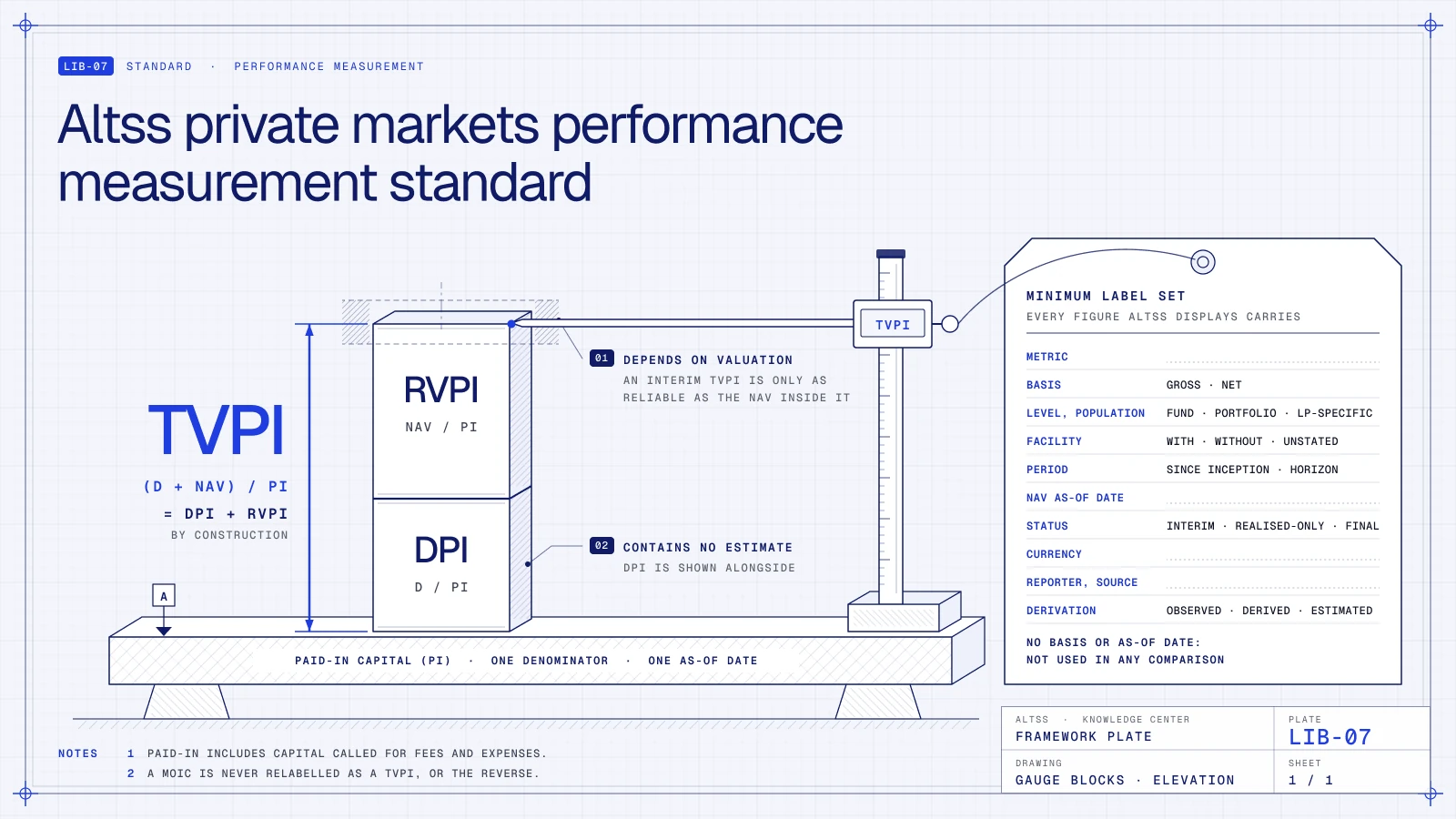
Standard · Version 1.2.0
Altss Private Markets Performance Measurement Standard
The Altss standard for calculating, labelling and comparing private-fund performance: money-weighted IRR on actual dates, NAV as terminal value, TVPI, DPI, RVPI and MOIC, gross versus net, subscription-line effects, pooled versus average figures, horizon returns, and GIPS 2020 and ILPA alignment.

Standard · Version 1.2
Altss Evidence & Provenance Standard
The Altss standard for recording evidence behind private-markets facts: claim-level provenance, evidence chains, three separate evidence dimensions (evidence origin, derivation status, validation status), distinct date types, null states such as unknown vs not disclosed, negative evidence, conflicts and claim citation.

Methodology · Version 1.2
Altss Temporal Data & Freshness Methodology
The Altss methodology for time in private-markets data: valid time vs transaction time, point-in-time reconstruction, as-of reporting, freshness as an attribute of each claim rather than a page, decay, and why a content edit never implies that a fact was verified.